
Natural Resources
Conservation Service
Ecological site F133BY004TX
Loamy Claypan Upland
Last updated: 9/21/2023
Accessed: 08/27/2026
-
Search


Major Land Resource Area or ecological site by name and/or ID.
PreviousSectionsNextGeneral information
Provisional. A provisional ecological site description has undergone quality control and quality assurance review. It contains a working state and transition model and enough information to identify the ecological site.
Click to explore map
Figure 1. Mapped extent
Areas shown in blue indicate the maximum mapped extent of this ecological site. Other ecological sites likely occur within the highlighted areas. It is also possible for this ecological site to occur outside of highlighted areas if detailed soil survey has not been completed or recently updated.
MLRA notes
Major Land Resource Area (MLRA): 133B–Western Coastal Plain
Major Land Resource Area (MLRA) 133B, Western Coastal Plain is in eastern Texas, western Louisiana, and the southwest corner of Arkansas. The area is dominated by coniferous forest covering 45,450 square miles (29,088,000 acres). The region is a hugely diverse transition zone between the eastern deciduous forests and the central grasslands to the west.
Classification relationships
NatureServe, 2002
- CEGL007800 – Shortleaf Pine-Post Oak Woodland
- CEGL007499 – Shortleaf Pine-Post Oak Forest
- CEGL002112 – Loblolly Pine-Post Oak Forest/Woodland
- CEGL008415 – Dry-Mesic Southern Red Oak Slope Forest
Soil Survey Staff, 2011
- Woodland Suitability Group – 2c2 Vertic
USDA-Natural Resources Conservation Service, 2006.
-Major Land Resource Area (MLRA) 133B
Van Kley et. al., 2007
- 232Fe (231Ef).13.2.10 Shortleaf Pine-Post Oak/Chasmanthium Clayey Dry-Mesic Uplands Landtype Phase
- 232Fe.14.2.10 Shortleaf Pine-Post Oak/Chasmanthium Clayey Dry-Mesic Uplands Landtype PhaseEcological site concept
The Loamy Claypan Uplands have loamy-surfaced soils with an abrupt texture change into clay. The textural difference creates the primary force in formation of the the plant community. The sites are known to be very droughty in short periods without precipitation and very wet with low amounts of rain.
Associated sites
F133BY001TX Depression
Sites are depressed and have poor drainage resulting in ponding.
F133BY002TX Seasonally Wet Upland
Sites have poor drainage resulting in plants more associated with prolonged wetness.
F133BY005TX Loamy Upland
Sites have loamy textures throughout the horizons.
F133BY006TX Northern Sandy Loam Upland
Sites have sandy and loamy textured soils.
F133BY007TX Southern Sandy Loam Upland
Sites have sandy and loamy textured soils.
F133BY012TX Wet Terrace
Sites are on a lower terrace position and drainage patterns are not as well developed.
F133BY013TX Terrace
Sites are on a lower terrace landform and do not have an abrupt textural change.
Similar sites
F133BY002TX Seasonally Wet Upland
Sites are wetter and have less developed drainage patterns. Do not have abrupt textural change.
F133BY003TX Loamy Over Clayey Upland
Sites are clayey throughout the horizons and do not have an abrupt textural change.
F133BY005TX Loamy Upland
Sites have loamy textures throughout and do not have an abrupt textural change.
Table 1. Dominant plant species
Tree (1) Pinus echinata
(2) Quercus stellataShrub (1) Callicarpa americana
Herbaceous (1) Chasmanthium sessiliflorum
Physiographic features
The sites are generally found on uplands, also known as interfluves, and are gently sloping to moderately steep. Slopes are dominantly 3 to 8 percent, but range from 1 to 15 percent. Due to the abrupt increase in clay subsoil, runoff is high. A seasonally high water table can exist during the late fall and early winter.
Table 2. Representative physiographic features
Landforms (1) Coastal plain > Interfluve
Runoff class High to very high Flooding frequency None Elevation 50 – 500 ft Slope 3 – 8 % Water table depth 12 – 80 in Aspect Aspect is not a significant factor Table 3. Representative physiographic features (actual ranges)
Runoff class Not specified Flooding frequency Not specified Elevation 0 ft Slope 1 – 15 % Water table depth 0 in Climatic features
The climate of the Western Coastal Plain (MLRA 133B) is humid subtropical with hot summers and mild winters. Canadian air masses that move southward across Texas and Louisiana over the Gulf of Mexico in winter produce cool, cloudy, rainy weather with only rare cold waves that moderate in one or two days. Precipitation is distributed fairly even throughout the year and is most often in the form of slow and gentle rains.
Spring weather can be variable. March is relatively dry while thunderstorm activities increase in April and May. Occasional slow-moving thunderstorms or other weather disturbances may dump excessive amounts of precipitation on the area. Fall has moderate temperatures. Fall experiences an increase of precipitation and frequently has periods of mild, dry, sunny weather. Heavy rain may occur early in the fall because of tropical disturbances, which move westward from the gulf. Tropical storms are a threat to the area in the summer and fall but severe storms are rare. Prolonged droughts and snowfall are rare.
The total annual precipitation ranges from 39 inches in the western part of the region to 60 inches in the eastern part of the region. Approximately 50 percent of the rainfall occurs between April and September, which includes the growing season for most crops. Thunderstorms occur on about 50 days each year and most occur during the summer.
The average relative humidity in mid-afternoon is about 60 percent. Humidity is higher at night and the average at dawn is about 90 percent. The sun shines 70 percent of the time in summer and 50 percent in winter. The prevailing wind is from the south-southeast. Average wind-speed is highest at 11 miles per hour in spring.Table 4 Representative climatic features
Frost-free period (average) 240 days Freeze-free period (average) 270 days Precipitation total (average) 60 in BarLineFigure 2. Monthly precipitation range
BarLineFigure 3. Monthly average minimum and maximum temperature
Figure 4. Annual precipitation pattern
Figure 5 Annual average temperature pattern
Climate stations used
-
(1) HUNTSVILLE [USC00414382], Huntsville, TX
-
(2) LUFKIN 11 NW [USC00415415], Pollok, TX
-
(3) GROVETON [USC00413778], Groveton, TX
-
(4) TOLEDO BEND DAM [USC00419068], Anacoco, TX
-
(5) BOYCE 3 WNW [USC00161232], Lena, LA
-
(6) SAM RAYBURN DAM [USC00417936], Brookeland, TX
-
(7) HODGES GARDENS [USC00164288], Florien, LA
-
(8) JENA 4 WSW [USC00164696], Trout, LA
-
(9) HEMPHILL 6 NE [USC00414077], Hemphill, TX
-
(10) LUFKIN ANGELINA CO AP [USW00093987], Lufkin, TX
">Influencing water features
Water affects the soils due to their slow permeability. The soils have high runoff, but can become saturated during the early fall to late winter, resulting in a water table. The water table can be as high as 12 inches on some sites.
Wetland description
The soils correlated to the site are not classified as hydric, but some sites do have a seasonally high water table.
Soil features
Moswell loam is the representative soil of the Loamy Claypan Uplands. The ecological site is associated with loamy soils over a fine-textured clay subsurface occurring on the Yegua, Manning and Caddell geologic formations. Even though the subsoil has high clay content and is very-slowly permeable, the site is well-drained and does not pond water for any great length. The clay in the subsoil does shift and swell during droughty periods and wet periods. This is evidenced when looking at the crooked tree trunks of the older trees. The abrupt change in clay content from the upper to lower horizons does cause some root restriction. Other soils correlated to this site include: Herty, Kellison, Keltys, Kisatchie, Kitterll, Oakhurst, Rayburn, Urland, and Woodville.
Table 5. Representative soil features
Parent material (1) Residuum – sandstone and shale
Surface texture (1) Loam
(2) Fine sandy loam
Family particle size (1) Clayey
Drainage class Well drained to somewhat poorly drained Permeability class Slow Soil depth 36 – 60 in Surface fragment cover <=3" Not specified Surface fragment cover >3" Not specified Available water capacity
(0-40in)5 – 8 in Calcium carbonate equivalent
(0-40in)Not specified Electrical conductivity
(0-40in)0 – 8 mmhos/cm Soil reaction (1:1 water)
(0-40in)4.5 – 6 Subsurface fragment volume <=3"
(Depth not specified)Not specified Subsurface fragment volume >3"
(Depth not specified)Not specified Ecological dynamics
The information in this ecological site description (ESD), including the state-and-transition model (STM), was developed using archeological and historical data, professional experience, and scientific studies. The information is representative of a complex set of plant communities. Not all scenarios or plants are included. Key indicator plants, animals, and ecological processes are described to inform land management decisions.
Introduction – Southern Arkansas, western Louisiana, and eastern Texas have been deemed the Pineywoods because of the vast expanse of pine trees. The region represents the western edge of the southern coniferous belt. Historically, the area was covered by pines with mixed hardwoods, sparse shrubs, and a diverse understory of grasses and forbs. Fire played a significant role in reducing the woody competition that generally out-competes the herbaceous understory layer. Fire suppression and land conversion have reduced the amount of historical communities in existence today.
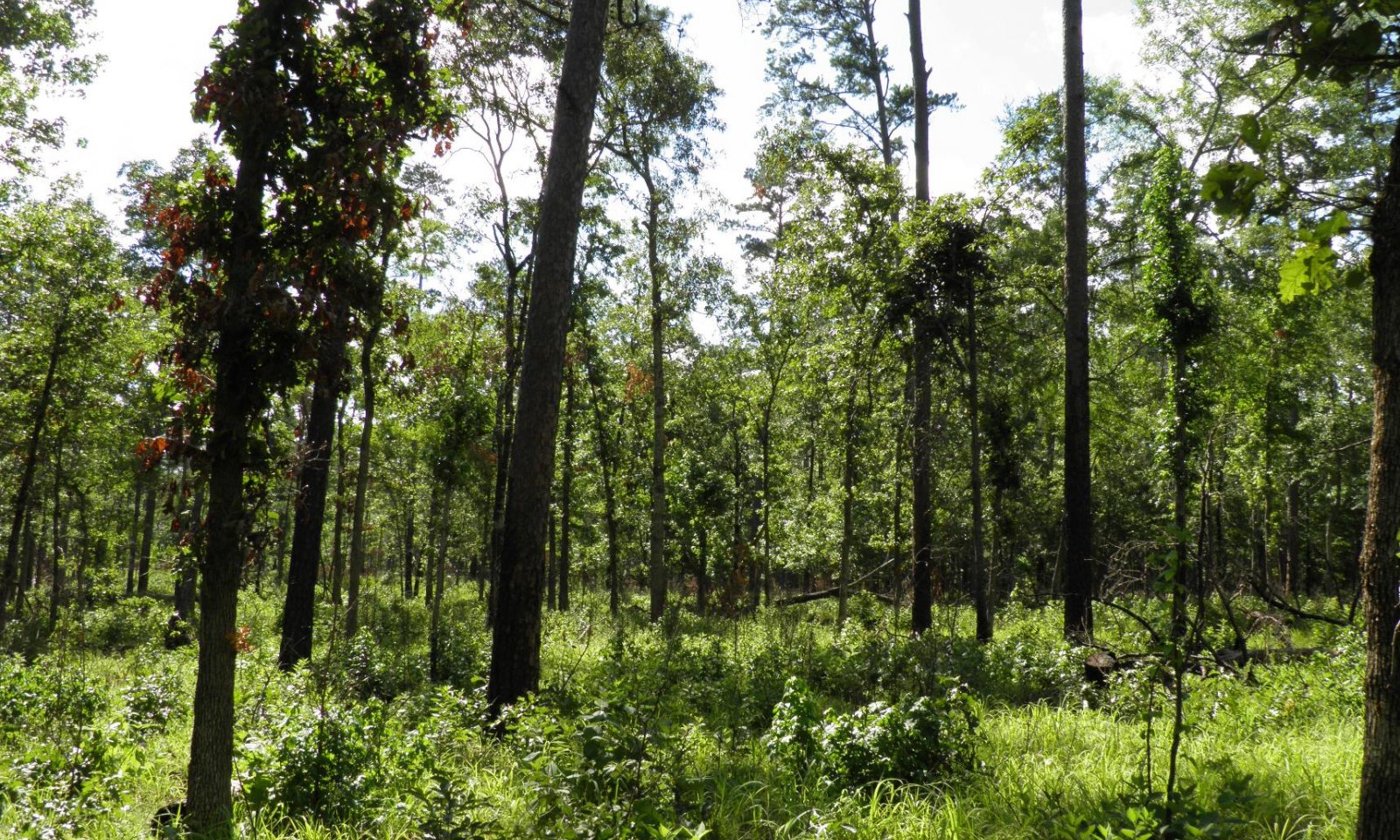
Background – Prior to settlement by the Europeans, the reference state for the Loamy Claypan Uplands was a Shortleaf Pine/Post Oak (Pinus echinata/Quercus stellata) Woodland. Remnants of this presumed historic plant community still exist where natural conditions are replicated through conservation management techniques. Evidence of the reference state is found in accounts of early historic explorers to the area, historic forest and biological survey teams, as well as recent ecological studies in the last 30 years. The community is an uneven-aged woodland with a well-developed understory of grasses/forbs, shrubs, and overstory saplings.
Settlement Management – As human settlement increased throughout the area, so did the increase in logging and grazing by domestic livestock. The logging became so extensive that by the 1930’s most of the region had been cut-over. Replanting trees to historic communities was not common and early foresters began planting loblolly pine (Pinus taeda) for its quick growth. As more people colonized they began suppressing fire, which allowed dense thickets of shrubs to replace the herbaceous understory.
Current Management and State – Today much of the remnant forest is gone, replaced by pine plantations, crops, and pastures. The areas that were not converted have been fire-suppressed so long that loblolly pine and fire intolerant hardwoods populate the overstory structure. Currently, U.S Forest Service properties are the best place to view the remnant sites. Some private individuals have begun restoring communities through selective tree planting and retention of communities that remain. Other restoration efforts include mimicking natural-disturbance regimes through gap-phase regeneration on plantation sites.
Fire Regimes – Fire was a natural and important disturbance throughout the Western Gulf Plain. Fire occurred naturally from lightning strikes and was started by Native Americans for game movement. The reference community developed with a frequency of fire every 5 to 10 years. Fires usually occurred in early spring, removing senescent vegetation, recycling nutrients and minerals, and spurring new plant growth. Late summer fires occurred as well, but with a different community effect. Summer fires burned hotter and with more intensity, greatly suppressing the shrub canopy layer. The summer fires also shifted the ecological site transitional state by decreasing grass densities and increasing forb densities. The topography, fuel loads, and other conditions caused patchy burns throughout the region resulting in mosaic patterns of plant communities and a heterogeneous landscape.
Disturbance Regimes – Extreme weather events occur occasionally throughout the region. Tornados uproot trees and open canopies in the spring months. In the late summer and early fall, hurricanes or tropical depressions often make landfall, dumping excessive amounts of rain and toppling trees with high winds. Another cause of large canopy openings is the effects of the southern pine beetle (Dendroctonus frontalis). Starting in the late 1950’s, beetle outbreaks have occurred every 6 to 9 years (although a major attack has not occurred in some time), usually when the trees are stressed due to multiple environmental factors.
Plant Community Interactions – The length of fire intervals and position on the landscape create a moderate overstory-canopy cover (40 to 70 percent). The canopy cover is higher than the associated upland sandy sites with frequent fire, and much lower than the lower loamy-to-clayey sites with infrequent fire. The understory consists of small shrubs and a diverse layer of grasses and forbs. The claypan in the soil restricts the growth of some plants due to the abrupt increase in clay (less than 20 percent increase). Plants like American beautyberry (Callicarpa Americana) and longleaf woodoats (Chasmanthium sessiliflorum) are well adapted to this site, while less-adapted plants are hindered from growing into the subsoil and extracting moisture.State and transition model
More interactive model formats are also available. View Interactive Models
Click on state and transition labels to scroll to the respective textEcosystem states
States 1, 5 and 2 (additional transitions)
T1A - Fire suppression, no disturbance T1B - Clearcut, site preparation, tree planting T1C - Clearcut, grass/crop planting R2A - Selective timber harvest, prescribed burns T2A - Fire suppression, no disturbance T2B - Clearcut, site preparation, tree planting T2C - Clearcut, grass/crop planting R3A - Selective timber harvest, mid-story shrub control, prescribed burns T3A - Clearcut, site preparation, tree planting T3B - Clearcut, grass/crop planting R4A - Gap-phase regeneration or clearcut with tree planting T4A - Fire suppression, no disturbance T4B - Clearcut, grass/crop planting R5A - Tree planting, mid-story shrub control, prescribed burns T5A - Clearcut, site preparation, tree planting State 1 submodel, plant communities
1.1A - Natural development between fire 1.2A - Fire (5-10 year interval) State 2 submodel, plant communities
State 3 submodel, plant communities
State 4 submodel, plant communities
State 5 submodel, plant communities
State 1
WoodlandThere are two communities in the Woodland State: the Shortleaf Pine/Post Oak Woodland Forest (1.1), the Fire-primed Understory (1.2). The reference state has a moderate overstory cover (40 to 70 percent) of Shortleaf Pine and Post Oak with a well-developed and diversified understory of grasses, forbs, and shrubs. The forest composition is uneven-aged with members of the pine community probably being over 200 years.
Natural disturbances of fires, lightning strikes, hurricanes (wind throw), ice events (rare), and beetle infestations create large canopy gaps from which the ecosystem is naturally regenerating. The natural canopy spacing is kept intact by periodic fires ranging from 5 to 10 years. Good representative basal areas are less than 70 square feet per acre. Growth competition can be seen in the outer rings on trees in locations where the basal area exceeds 80 square feet per acre.
Community 1.1
Shortleaf Pine/Post Oak Woodland
Shortleaf pine and post oak comprise the majority of the overstory. The occurrence of shortleaf pine in the overstory at any given site is usually 70 to 90 percent. Post oaks have established on the sites at 10 to 30 percent. Other hardwoods are sometimes found colonizing the areas in lesser amounts (less than 5 percent), including oak and hickory species. American beautyberry is extremely prevalent and makes up the majority of the understory shrub layer.
Table 6. Ground cover
Tree foliar cover 10-30% Shrub/vine/liana foliar cover 10-50% Grass/grasslike foliar cover 30-50% Forb foliar cover 0-20% Non-vascular plants 0% Biological crusts 0% Litter 30-100% Surface fragments >0.25" and <=3" 0% Surface fragments >3" 0% Bedrock 0% Water 0% Bare ground 10-40% Table 7. Canopy structure (% cover)
Height Above Ground (ft) Tree Shrub/Vine Grass/
GrasslikeForb <0.5 0-1% 0-10% 10-30% 0-15% >0.5 <= 1 5-25% 0-30% 10-40% 0-15% >1 <= 2 0-5% 5-30% 5-30% 0-5% >2 <= 4.5 0-5% 5-50% 0-5% 0-1% >4.5 <= 13 5-15% 0-5% – – >13 <= 40 15-25% 0-1% – – >40 <= 80 25-35% – – – >80 <= 120 10-35% – – – >120 5-10% – – – Community 1.2
Fire-primed UnderstoryBoth communities are characterized by a diverse ground layer. Longleaf woodoats and Texas ironweed (Veronia texana) are especially common. This layer is thick enough to provide ground-nesting birds and fawns with adequate cover. In phase 1.1, the fire interval has been so recent that shrubs and tree saplings have not grown higher than three feet. Phase 1.2 has an increased abundance and height of the shrub layer. Under natural conditions, only fire tolerant saplings will grow into the overstory.
Pathway 1.1A
Community 1.1 to 1.2The driver for the community shift is time since the last fire. As post-fire time increases, so does the foliar cover by shrub species. As the perennial grasses and forbs age, their senesced leaves increase fine fuel levels.
Pathway 1.2A
Community 1.2 to 1.1The driver for the community shift is fire. As fire burns through the understory, it encourages a diverse herbaceous layer while suppressing shrubs and tree seedlings.
State 2
Mid-story Dominant ForestThe Mid-story Dominant State has crossed a threshold in which normal environmental events cannot transition the community back to State 1. The brush canopy has become so thick, it has begun to limit the productivity of the ground-layer. The limited ground layer does not provide enough fuel to harbor a burn with the intensity found in State 1.
Community 2.1
Mixed Mid-story
Yaupon (Ilex vomitoria) may begin to overpower the shrub layer. Yaupon has limited fire toleranance and takes advantage of the clay soil found below the loamy surface. Because of fire suppression, the American beautyberry will have several years of growth still attached to the plant. Frequent fires keep the plant pruned and vibrant.
Tree seedlings have grown higher and are beginning to escape the effects of fire and will become part of the overstory given more time with lack of management. The species present in the reference community will still be found, only in lesser amounts because the canopy cover is creating a better environment for fire-intolerant and shade-loving species.Table 8. Ground cover
Tree foliar cover 10-30% Shrub/vine/liana foliar cover 40-80% Grass/grasslike foliar cover 10-30% Forb foliar cover 0-10% Non-vascular plants 0% Biological crusts 0% Litter 50-100% Surface fragments >0.25" and <=3" 0% Surface fragments >3" 0% Bedrock 0% Water 0% Bare ground 0-20% State 3
Mixed ForestA long-term lack of fire and management has now caused the plant community to cross two major thresholds resulting in a very-closed canopy community. Fire intolerant hardwoods have become part of the overstory. The overstocking reduces the overall value of the timber stand. The value is decreased because of reduction in shortleaf pine numbers and an increase in hardwoods.
Community 3.1
Dense Pine/Hardwood Forest
The understory plant layer only contains remnants of longleaf woodoats and only a few forb species. The shrub layer is dominated by large, dense patches of yaupon. Because the site lacks the diversity found in the reference state the wildlife diversity is reduced to only generalist species and those seeking refuge.
Similar to State 2, this ecological state requires management to restore the reference community. Selective timber harvest to remove unwanted hardwood species is the first step to allow the understory to return. Frequent prescribed burns (1 to 3 years) will help suppress the hardwood regeneration. Intense summer fires may also be required. The suppression of overstory seedlings will allow grasses, forbs, and shrubs to reestablish.Table 9. Ground cover
Tree foliar cover 80-100% Shrub/vine/liana foliar cover 40-80% Grass/grasslike foliar cover 0-10% Forb foliar cover 0-10% Non-vascular plants 0% Biological crusts 0% Litter 30-100% Surface fragments >0.25" and <=3" 0% Surface fragments >3" 0% Bedrock 0% Water 0% Bare ground 0-10% Community 3.2
No OverstoryThe No Overstory community is the result of a natural disaster or clearcutting in which the entire overstory has been removed. Immediately after the event, the understory may begin to resemble State 1. Although given enough time without fire or management, the area will return to a Dense Pine/Hardwood Community (3.1).
Pathway 3.1A
Community 3.1 to 3.2The driver for the shift is a natural disaster or clearcut situation. Examples of natural disasters include hurricane, wind throw, severe ice storms, or severe fires. Following timber harvest by clearcut, little of the State 1 vegetation remains. Primary vegetative succession occurs post clearcut.
Pathway 3.2A
Community 3.2 to 3.1The driver for the community shift is time and lack of fire. Shrubs and tree saplings will not be suppressed without return fire intervals.
State 4
PlantationThe Plantation State is a result of conversion activities. The landowner has maximized silviculture production by planting a monoculture of tree species.
Community 4.1
Pine/Hardwood PlantationIn the immediate years following the initial plantation tree planting, the understory community will resemble State 1. During this early growth period, the landowner will typically remove unwanted hardwoods and herbaceous plants to reduce competition with the planted trees. As the overstory canopy closes, less understory management is required due to sunlight restrictions to the ground layer.
State 5
Pasture and CroplandThe Pasture and Cropland State is a result of conversion activities. The landowner has maximized agriculture production by planting a monoculture of introduced grass species or agricultural row crops.
Community 5.1
Planted Pasture and Row CropTypical introduced pasture grass species include bahiagrass (Paspalum notatum) and different varieties of bermudagrass (Cynodon dactylon). The grasses are grown for livestock production through direct grazing or baling hay for later use. Agricultural row crops are grown for food and fiber production. Many farmers use herbicides to reduce unwanted plant competition which yields a plant community unrepresentative of State 1 or subsequent vegetative states.
Transition T1A
State 1 to 2The transition from a State 1 to State 2 is a result of time and long periods (greater than 10 years) of no fire. Without fire to suppress shrubs and tree seedlings, biomass and diversity will be lost from the grass and forb layers of the system. The transition is also characterized by tree sapling’s bud zones beginning to escape the height at which fire is effective at suppression.
Transition T1B
State 1 to 4The transition is due to the land manager maximizing silviculture potential. Merchantable timber is harvested by clearcut, then the site is prepared and planted to a monoculture of trees.
Transition T1C
State 1 to 5The transition is due to the land manager maximizing agricultural production. Merchantable timber is harvested by clearcut, then the site is prepared and planted to either an improved grass or row crops.
Restoration pathway R2A
State 2 to 1The driver for restoration is fire. Enough fuel is still left in this community to carry a fire through the site. More frequent burns (1 to 3 years) may be required, initially, to suppress the woody vegetation. Some tree species may have escaped the effective fire height and will have to be selectively cut down to return to State 1.
Transition T2A
State 2 to 3The transition from a State 2 to State 3 is a result of time and long periods (greater than 20 years) of no fire. Without fire to suppress fire intolerant trees, they become part of the overstory canopy. The overstory is so saturated that the understory herbaceous layer is almost non-existent. As the overstory canopy closes, the mid-story becomes well established with shade tolerant species.
Transition T2B
State 2 to 4The transition is due to the land manager maximizing silviculture potential. Merchantible timber is harvested by clearcut, then the site is prepared and planted to a monoculture of trees.
Transition T2C
State 2 to 5The transition is due to the land manager maximizing agricultural production. Merchantable timber is harvested by clearcut, then the site is prepared and planted to either an improved grass or row crops.
Restoration pathway R3A
State 3 to 1This restoration path is the most energy intensive. Restoration of this community to the reference state begins with a selective timber harvest. Removing unwanted trees (shade and fire intolerant) opens up the canopy allowing sunlight penetration to the ground. Years of overstory growth have limited the fuel necessary to have an effective fire. Time will be needed to encourage an understory and, if possible, mowing the understory may help. Once the herbaceous layer has established, frequent burns (1 to 3 years) may be required to suppress the woody vegetation.
Transition T3A
State 3 to 4The transition is due to the land manager maximizing silviculture potential. Merchantible timber is harvested by clearcut, prepared, and planted to a monoculture of trees.
Transition T3B
State 3 to 5The transition is due to the land manager maximizing agricultural production. Merchantable timber is harvested by clearcut, then the site is prepared and planted to either an improved grass or row crops.
Restoration pathway R4A
State 4 to 1This restoration pathway can be accomplished in different ways depending on goals. One option is to create canopy openings by reducing the number of overstory trees. Then, restore the resulting canopy gaps with species from the State 1 understory. Restoring the understory may include planting shortleaf pine and post oak. This method keeps the forest structure intact and slowly changes the species composition. Another restoration method is to selectively harvest and remove brush (via mechanical or chemical means), followed by re-planting shortleaf pine and oak species (using reduced planting rates.) The herbaceous understory will take time to develop, but this process can be expedited if adapted plant material is available. Fire is the best option to maintain desired canopy cover for enhancement of the understory, and reduce undesirable woody species. Fire frequencies of 1 to 3 years during both growing and cool seasons may be desired in order to maintain an open canopy and reduce undesirable plant competition. If fire is not a viable option, management of woody encroachment could be controlled by mowing or the use of herbicides.
Transition T4A
State 4 to 3This community transition is caused by neglecting the plantation understory. Without mowing or herbicides, the brush canopy becomes a dense thicket.
Transition T4B
State 4 to 5The transition is due to the land manager maximizing agricultural production. Merchantable timber is harvested by clearcut, then the site is prepared and planted to either an improved grass or row crops.
Restoration pathway R5A
State 5 to 1This restoration path can be accomplished by planting a mix of shortleaf pine and oak species to their natural frequencies (see State 1 Overstory Composition table), trying to attain a 40 to 70 percent mature overstory canopy. Management will be required to control unwanted species by burning, mowing, and/or herbicides. Controlling introduced pasture grasses is difficult, with complete control likely not attainable. The herbaceous understory will take time to develop, but this process can be expedited if adapted plant material is available.
Transition T5A
State 5 to 4The transition is due to the land manager maximizing silviculture potential. The site is prepared and planted to a monoculture of trees.
Additional community tables
Table 10. Community 1.1 plant community composition
Group Common name Symbol Scientific name Annual production () Foliar cover (%) Table 11. Community 1.1 forest overstory composition
Common name Symbol Scientific name Nativity Height ft Canopy cover (%) Diameter in Basal area (square ft/acre) Treeshortleaf pine PIEC2 Pinus echinata Native – 70-90 – 0 post oak QUST Quercus stellata Native – 10-30 – 0 southern red oak QUFA Quercus falcata Native – 0-5 – 0 black hickory CATE9 Carya texana Native – 0-5 – 0 blackjack oak QUMA3 Quercus marilandica Native – 0-5 – 0 Table 12. Community 1.1 forest understory composition
Common name Symbol Scientific name Nativity Height (ft) Canopy cover (%) Grass/grass-like (Graminoids)longleaf woodoats CHSE2 Chasmanthium sessiliflorum Native – 25–75 variable panicgrass DICO2 Dichanthelium commutatum Native – 5–20 sedge CAREX Carex Native – 5–20 Forb/HerbTexas ironweed VETE3 Vernonia texana Native – 0–5 devil's grandmother ELTO2 Elephantopus tomentosus Native – 0–3 Virginia tephrosia TEVI Tephrosia virginiana Native – 0–3 partridgeberry MIRE Mitchella repens Native – 0–3 Nuttall's wild indigo BANU2 Baptisia nuttalliana Native – 0–3 bedstraw CRUCI2 Cruciata Native – 0–3 Shrub/SubshrubAmerican beautyberry CAAM2 Callicarpa americana Native – 5–50 yaupon ILVO Ilex vomitoria Native – 0–10 parsley hawthorn CRMA5 Crataegus marshallii Native – 0–5 possumhaw ILDE Ilex decidua Native – 0–5 farkleberry VAAR Vaccinium arboreum Native – 0–5 southern arrowwood VIDE Viburnum dentatum Native – 0–5 Treeshortleaf pine PIEC2 Pinus echinata Native – 5–30 post oak QUST Quercus stellata Native – 5–15 southern red oak QUFA Quercus falcata Native – 0–5 blackjack oak QUMA3 Quercus marilandica Native – 0–5 black hickory CATE9 Carya texana Native – 0–5 hophornbeam OSTRY Ostrya Native – 0–5 winged elm ULAL Ulmus alata Native – 0–5 loblolly pine PITA Pinus taeda Native – 0–5 Vine/Lianamuscadine VIRO3 Vitis rotundifolia Native – 0–10 greenbrier SMILA2 Smilax Native – 0–10 blackberry RUBUS Rubus Native – 0–5 evening trumpetflower GESE Gelsemium sempervirens Native – 0–5 Alabama supplejack BESC Berchemia scandens Native – 0–5 Virginia creeper PAQU2 Parthenocissus quinquefolia Native – 0–5 Table 13. Community 1.2 plant community composition
Group Common name Symbol Scientific name Annual production () Foliar cover (%) Table 14. Community 2.1 plant community composition
Group Common name Symbol Scientific name Annual production () Foliar cover (%) Table 15. Community 3.1 plant community composition
Group Common name Symbol Scientific name Annual production () Foliar cover (%) Table 16. Community 3.2 plant community composition
Group Common name Symbol Scientific name Annual production () Foliar cover (%) Table 17. Community 4.1 plant community composition
Group Common name Symbol Scientific name Annual production () Foliar cover (%) Table 18. Community 5.1 plant community composition
Group Common name Symbol Scientific name Annual production () Foliar cover (%) Interpretations
Animal community
The historic animal community is relatively similar to the current community in the reference state. One major missing component is the black bear. Black bears were highly prevalent across the Western Coastal Plain. Their reduced numbers are directly correlated with the westward expansion of the European settlers. Like other mobile animals in the area, bears would have used multiple ecological sites. The Loamy Claypan Uplands would have provided the bears with nutrition/food in the form of soft and hard mast (American beautyberries and acorns). Other apex predators like the mountain lion and wolf have disappeared in a similar manner. No specific species utilize this ecological site exclusively. Most wildlife species utilize many ecological sites in combination to fill their niche in the environment.
Turkey will utilize the site to some degree, but in combination with other sites. The grass layer is not thick enough to provide nesting habitat, but the presence of mature oaks will provide roosting areas. After hatching, chicks may utilize the site more because of the natural lack of an overly-dense ground layer. As long as the canopy is open, favoring the reference site conditions, a more diverse forb layer will create an abundance of insects. The insects provide high-quality protein in their diet, especially for the newly hatched chicks.
Deer will utilize the Loamy Claypan Upland site for browse because of the well-developed shrub layer, especially American beautyberry. Sites with developed longleaf woodoats stands in conjunction with the shrub-layer also provide good bedding cover. In good years, there will be some mast fall from acorns, but not as much as lower positioned ecological sites dominated by oaks. As the site transitions from State 1, less forbs and browse will be available and as a thicket forms the sites will only be used for escape cover.
Migratory song birds and woodpeckers use the site as well. Locations with fire and snags will typically have a higher diversity of birds. The red-cockaded woodpecker may be found in some sites, but is typically associated with sandier sites supporting wider-tree spacing dominated by longleaf pines.
Recreational uses
The most popular recreational use is hunting for white-tail deer and other game animals.
Wood products
Pine trees are used for all types of wood products. Hardwoods are suitable for use as railroad ties, pulpwood, and pallet material. When harvested tracts are reforested, they are typically planted to loblolly pine.
Supporting information
Inventory data references
These site descriptions were developed as part a Provisional Ecological Site project using historic soil survey manuscripts, available site descriptions, and low intensity field traverse sampling. Future work to validate the information is needed. This will include field activities to collect low, medium, and high-intensity sampling, soil correlations, and analysis of that data. A final field review, peer review, quality control, and quality assurance review of the will be needed to produce the final document.
Type locality
Location 1: Houston County, TX UTM zone N UTM northing 31.4004222 UTM easting -95.187336 General legal description Davy Crockett National Forest Other references
Ajilvsgi, G. 2003. Wildflowers of Texas. Revised edition. Shearer Publishing, Fredericksburg, TX.
Ajilvsgi, G. 1979. Wildflowers of the Big Thicket. Texas A&M University Press, College Station, TX.
Allen, J. A., B. D. Keeland, J. A. Stanturf, and A. F. Kennedy Jr. 2001. A guide to bottomland hardwood restoration. Technical report, USGS/BRD/ITR-2000-0011.
Bray, W. L. 1904. Forest resources of Texas. Bureau of Forestry Bulletin 47, Government Printing Office, Washington D.C.
Diggs, G. M., B. L. Lipscomb, M. D. Reed, and R. J. O’Kennon. 2006. Illustrated flora of East Texas. Second edition. Botanical Research Institute of Texas & Austin College, Fort Worth, TX.
Jones, S. D., J. K. Wipff, and P. M. Montgomery. 1997. Vascular plants of Texas: a comprehensive checklist including synonymy, bibliography, and index. University of Texas Press, Austin.
NatureServe. 2002. International classification of ecological communities: Terrestrial vegetation of the United States. National forests in Texas final report. NatureServe, Arlington, VA.
Nixon, E. S. 2000. Trees, shrubs & woody vines of East Texas. Second edition. Bruce Lyndon Cunningham Productions, Nacogdoches, TX.
Picket, S. T. and P. S. White. 1985. The ecology of natural disturbance and patch dynamics. Academic Press, Orlando, FL.
Randall, J. M., and J. Marinelli. 1996. Invasive plants: weeds of the global garden. Volume 149. Brooklyn Botanic Garden, Brooklyn, NY.
Roberts, O. M. 1881. A description of Texas, its advantages and resources with some account of their development past, present and future. Gilbert Book Company, Saint Louis, MO.
Soil Survey Staff, Natural Resources Conservation Service, United States Department of Agriculture. Soil Survey Geographic (SSURGO) Database.
Stanturf, J. A., S. H. Schoenholtz, C. J. Schweitzer, and J. P. Shepard. 2001. Achieving restoration success: Myths in bottomland hardwood forests. Restoration Ecology, 9:189-200.
Stringham, T. K., W. C. Krueger, and P. L. Shaver. 2003. State and transition modeling: An ecological process approach. Journal of Range Management 56:106-113.
Truett, J. C. 1984. Land of bears and honey: A natural history of East Texas. The University of Texas Press, Austin, TX.
U.S. Army Corps of Engineers. 2010. Regional supplement to the Corps of Engineers Wetland Delineation Manual: Atlantic and Gulf Coastal Plain Region (Version 2.0). U.S. Army Corps of Engineers, Engineer Research and Development Center, Environmental Laboratory ERDC/EL TR-10-20.
USDA-NRCS Ag Handbook 296 (2006).
Van Kley, J. E., R. L. Turner, L. S. Smith, and R. E. Evans. 2007. Ecological classification system for the national forests and adjacent areas of the West Gulf Coastal Plain. Second approximation. Stephen F. Austin University and The Nature Conservancy, Nacogdoches, TX.
Vines, R. A. 1960. Trees, shrubs, and woody vines of the Southwest. University of Texas Press, Austin, TX.
Watson, G. E. 2006. Big Thicket Plant Ecology. Third Edition. University of North Texas Press, Denton, TX.Contributors
Tyson Hart
Approval
Bryan Christensen, 9/21/2023
Rangeland health reference sheet
Interpreting Indicators of Rangeland Health is a qualitative assessment protocol used to determine ecosystem condition based on benchmark characteristics described in the Reference Sheet. A suite of 17 (or more) indicators are typically considered in an assessment. The ecological site(s) representative of an assessment location must be known prior to applying the protocol and must be verified based on soils and climate. Current plant community cannot be used to identify the ecological site.
Author(s)/participant(s) Contact for lead author Date 09/03/2021 Approved by Approval date Composition (Indicators 10 and 12) based on Annual Production Indicators
-
Number and extent of rills:
-
Presence of water flow patterns:
-
Number and height of erosional pedestals or terracettes:
-
Bare ground from Ecological Site Description or other studies (rock, litter, lichen, moss, plant canopy are not bare ground):
-
Number of gullies and erosion associated with gullies:
-
Extent of wind scoured, blowouts and/or depositional areas:
-
Amount of litter movement (describe size and distance expected to travel):
-
Soil surface (top few mm) resistance to erosion (stability values are averages - most sites will show a range of values):
-
Soil surface structure and SOM content (include type of structure and A-horizon color and thickness):
-
Effect of community phase composition (relative proportion of different functional groups) and spatial distribution on infiltration and runoff:
-
Presence and thickness of compaction layer (usually none; describe soil profile features which may be mistaken for compaction on this site):
-
Functional/Structural Groups (list in order of descending dominance by above-ground annual-production or live foliar cover using symbols: >>, >, = to indicate much greater than, greater than, and equal to):
Dominant:
Sub-dominant:
Other:
Additional:
-
Amount of plant mortality and decadence (include which functional groups are expected to show mortality or decadence):
-
Average percent litter cover (%) and depth ( in):
-
Expected annual annual-production (this is TOTAL above-ground annual-production, not just forage annual-production):
-
Potential invasive (including noxious) species (native and non-native). List species which BOTH characterize degraded states and have the potential to become a dominant or co-dominant species on the ecological site if their future establishment and growth is not actively controlled by management interventions. Species that become dominant for only one to several years (e.g., short-term response to drought or wildfire) are not invasive plants. Note that unlike other indicators, we are describing what is NOT expected in the reference state for the ecological site:
-
Perennial plant reproductive capability:
Print Options
Sections
Font
AAAAOther
PrintThe Ecosystem Dynamics Interpretive Tool is an information system framework developed by the USDA-ARS Jornada Experimental Range, USDA Natural Resources Conservation Service, and New Mexico State University.
Accessibility statement


