
Natural Resources
Conservation Service
-
Search


Major Land Resource Area or ecological site by name and/or ID.
PreviousSectionsNextGeneral information
Provisional. A provisional ecological site description has undergone quality control and quality assurance review. It contains a working state and transition model and enough information to identify the ecological site.
Click to explore map
Figure 1. Mapped extent
Areas shown in blue indicate the maximum mapped extent of this ecological site. Other ecological sites likely occur within the highlighted areas. It is also possible for this ecological site to occur outside of highlighted areas if detailed soil survey has not been completed or recently updated.
MLRA notes
Major Land Resource Area (MLRA): 085A–Grand Prairie
The Grand Prairie MLRA is characterized by predominately loam and clay loam soils underlain by limestone and shale. Topography transitions from steeper ridges and summits of the Lampasas Cut Plain on the southern end to the more rolling hills of the Fort Worth Prairie to the north. The Arbuckle Mountain area in Oklahoma is also within this MLRA.
Classification relationships
This ecological site is correlated to soil components at the Major Land Resource Area (MLRA) level which is further described in USDA Ag Handbook 296.
Ecological site concept
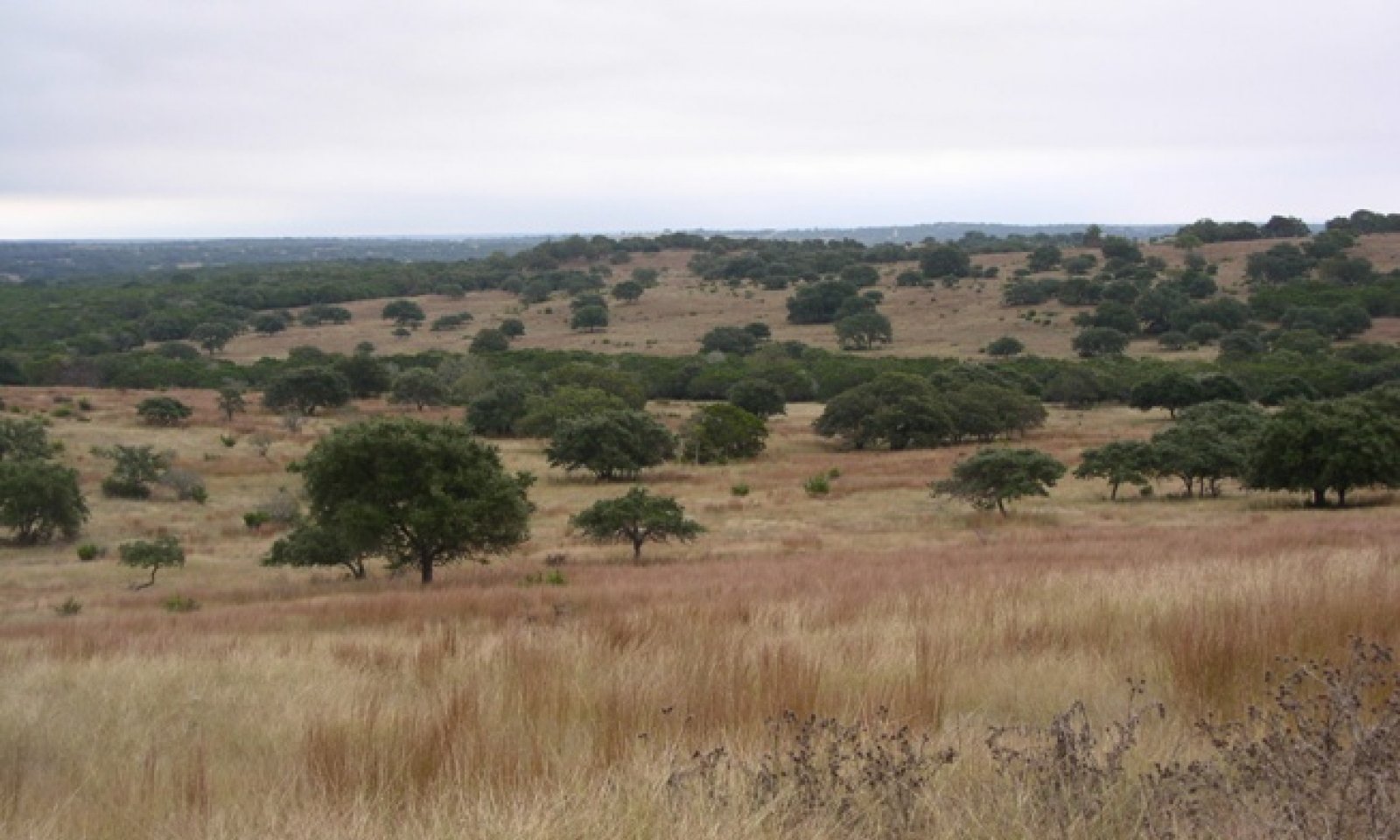
The Adobe ecological site occurs on shallow to moderately deep, calcareous soils over limestone. The reference vegetation includes native tallgrasses and midgrasses with numerous forbs and very few woody species. In the absence of fire or other brush management, the woody species may begin to dominate the ecological site. Due to the high lime soils, overall production is typically lower than adjacent ecological sites that are less calcareous.
Associated sites
R085AY179TX Clayey Slope 30-38
This site is at a lower elevation, has deeper soils and has much more total annual production.
R085AY185TX Shallow 30-38" PZ
This site is at a lower elevation, has deeper soils, and less woody species.
Similar sites
R085AY276TX Gravelly 30-38 PZ
Gravelly site higher on landscape
R085AY186TX Steep Adobe 30-38" PZ
These site occur on similar soils with slopes ranging from 15 - 30 percent.
R085AY565TX Pink Caliche 30-38" PZ
Shallow soils over pink caliche
Table 1. Dominant plant species
Tree (1) Quercus fusiformis
(2) Quercus buckleyiShrub Not specified
Herbaceous (1) Schizachyrium scoparium
(2) Sorghastrum nutansPhysiographic features
This site occurs on side slopes, nose slopes, and crests of hillslopes in the Grand Prairie. Characteristic of this site are benched outcrops of strongly cemented limestone typically 6 to 24 inches in thickness followed by thicker intervals of calcareous mudstone at vertical intervals of 4 to 50 feet.
Table 2. Representative physiographic features
Landforms (1) Hills > Hill
(2) Hills > Ridge
(3) Hills > Hillslope
Runoff class Medium to high Elevation 500 – 1900 ft Slope 1 – 12 % Aspect Aspect is not a significant factor Table 3. Representative physiographic features (actual ranges)
Runoff class Low to high Elevation 0 ft Slope 0 % Climatic features
The climate is subhumid subtropical and is characterized by hot summers and relatively mild winters. Tropical maritime air controls the climate during spring, summer and fall. In winter and early spring, frequent surges of Polar Canadian air cause sudden drops in temperatures and add considerable variety to the daily weather. The average first frost should occur around November 5 and the last freeze of the season should occur around March 19.
The average relative humidity in mid-afternoon is about 60 percent. Humidity is higher at night, and the average at dawn is about 80 percent. The sun shines 75 percent of the time possible during the summer and 50 percent in winter. The prevailing wind direction is from the south and highest windspeeds occur during the spring months.
Approximately two-thirds of annual rainfall occurs during the April to September period. Rainfall during this period generally falls during thunderstorms, and fairly large amounts of rain may fall in a short time. The driest months are usually July and August.Table 4 Representative climatic features
Frost-free period (characteristic range) 200-210 days Freeze-free period (characteristic range) 230-240 days Precipitation total (characteristic range) 40-40 in Frost-free period (actual range) 200-210 days Freeze-free period (actual range) 220-250 days Precipitation total (actual range) 30-40 in Frost-free period (average) 210 days Freeze-free period (average) 240 days Precipitation total (average) 40 in Characteristic rangeActual rangeBarLineFigure 2. Monthly precipitation range
Characteristic rangeActual rangeBarLineFigure 3. Monthly minimum temperature range
Characteristic rangeActual rangeBarLineFigure 4. Monthly maximum temperature range
BarLineFigure 5. Monthly average minimum and maximum temperature
Figure 6. Annual precipitation pattern
Figure 7 Annual average temperature pattern
Climate stations used
-
(1) CLEBURNE [USC00411800], Cleburne, TX
-
(2) BENBROOK DAM [USC00410691], Fort Worth, TX
-
(3) DENTON MUNI AP [USW00003991], Ponder, TX
-
(4) EVANT 1SSW [USC00413005], Evant, TX
-
(5) WHITNEY DAM [USC00419715], Clifton, TX
">Influencing water features
These sites are in upland positions that shed water to adjacent areas downslope. The presence of deep-rooted tallgrass and midgrass species help facilitate infiltration into the soil.
Wetland description
NA

Figure 8.
Soil features
Representative soil components for this ecological site include: Brackett, Dugout, and Real
The site is characterized by shallow to moderately deep soils with a high concentration of lime. The high lime content causes nutrient imbalance that can limit the quality of forage.Table 5. Representative soil features
Parent material (1) Residuum – limestone
(2) Residuum – mudstone
Surface texture (1) Gravelly clay loam
(2) Stony clay loam
(3) Gravelly loam
(4) Clay loam
(5) Loam
Drainage class Well drained Permeability class Moderately slow to moderate Soil depth 10 – 40 in Surface fragment cover <=3" 0 – 20 % Surface fragment cover >3" 0 – 5 % Available water capacity
(0-40in)1 – 4 in Calcium carbonate equivalent
(0-40in)40 – 85 % Electrical conductivity
(0-40in)0 – 2 mmhos/cm Sodium adsorption ratio
(0-40in)0 – 2 Soil reaction (1:1 water)
(0-40in)7.9 – 8.4 Subsurface fragment volume <=3"
(Depth not specified)5 – 60 % Subsurface fragment volume >3"
(Depth not specified)0 – 20 % Ecological dynamics
The reference plant community for the Adobe ecological site is a tallgrass prairie with scattered oaks. Soils are nearly level to 8 percent slopes. The grasses are primarily little bluestem (Schizachyrium scoparium), Indiangrass (Sorghastrum nutans), sideoats grama (Bouteloua curtipendula), tall grama (Bouteloua pectinata), and smaller amounts of Virginia wildrye (Elymus virginicus), seep muhly (Muhlenbergia reverchonii) and Lindheimer’s muhly (Muhlenbergia lindheimeri). The clay textured soils in a rainfall regime of 30 to 36 inches favors the tallgrass plant structure. Both buffalo impact and fires were dominant forces to manipulate the historic tallgrass community. Large herds of buffalo would intensely graze this ecological site, usually following a fire, and then not come back for many months or even years. The collective influence of animal impact, fire, and weather, were the key to maintaining the open tallgrass with the broadly spaced oaks.
Fires that originated with Native Americans or lightning not only maintained the original prairie vegetation, they also had a major impact on the plant community structure. These fires would burn in mosaic patterns and go out where fuel loads were sparse, such as on the steeper slopes. Fire does not produce high mortality in older, resprouting, woody plants but does reduce canopy cover in the short term. These early fires were extensive and probably occurred any time the grass was dry enough to burn. Grass species such as little bluestem, big bluestem, and Indiangrass are generally responsive to fire, while forbs are stimulated if the timing is right. Grazing following fire usually created more diversity for a year or two post-burn. Without fire and grazing the diversity decreased.
Moisture was a major factor in creating diversity in the plant community.
With abusive grazing practices, Indiangrass will become lower in vigor; little bluestem will increase; secondary successional species such as sideoats grama, silver bluestem (Bothriochloa laguroides), and Texas wintergrass (Nassella leucotricha) will increase along with an increase of woody plants. Little bluestem is tolerant of fairly heavy grazing for long periods, but at some point, a threshold will be crossed and the ground cover is reduced, resulting in bare places where weedy species can establish. Plants such as Texas wintergrass seep muhly, Wright’s (Aristida purpurea var. wrightii) and purple threeawn (Aristida purpurea), red grama (Bouteloua trifida), Western ragweed (Ambrosia psilostachya), prairie coneflower (Ratibida columnifera), sumpweed (Iva annua), and cool-season annuals will quickly invade if the principal species are in a weakened condition.
Birds consume the seed of many woody species and when passed through the digestive system and excreted in the droppings, re-establish various plant species. Grazing management with cattle alone probably has minimal effect on the proliferation of woody plants, but a good cover of perennial grasses minimizes the seed-to-soil contact woody plants such as mesquite need to establish. Prescribed fire helps to control the seedlings. Selective removal of mesquite or juniper is easy and economical when a few plants begin to show up on the Adobe ecological site. However, the increase of plants can be fairly rapid and the number of woody plants per acre will soon become too numerous for individual control to be feasible. Prescribed grazing can sustain the grass species composition and production at a near reference levels even during the initial stages of brush invasion. However, the Adobe ecological site can be abused to the point that the perennial warm-season grasses thin out and lower successional grasses and annual forbs begin to dominate. This process of degradation usually takes many years and is exacerbated by summer drought and above average winter moisture.
Long-term droughts that occur only three to four times in a century can effect some change in plant communities, when coupled with abusive grazing. Short-term droughts are common and usually do not have a lasting effect on changing stable plant communities, although production will be affected. When brush canopy becomes established enough to sufficiently shade the ground, the site tends to favor cool-season annual species. Once a state of brush and cool-season annuals is reached, recovery to a perennial warm-season grass cover is unlikely without major inputs of brush management and reseeding. In summary, the change in states of vegetation depends on the type of grazing management as well as vegetation manipulation practices applied over many years, and the rate of invasion and establishment of woody species. The effects of seasonal moisture and short-term dry spells become more pronounced after the Adobe ecological site crosses a threshold to a different plant community. Plant communities that consist of warm-season perennial grasses such as little bluestem and the associated species of the reference community (1.1) are resilient and can withstand climatic extremes with only minor shifts in the overall plant community.
Native Americans ruled the prairies for nearly three centuries prior to 1800 using horses imported from the Spanish explorers. These same explorers brought domesticated cattle to Texas as early as 1690 and by the late 1700’s the livestock became wild and free ranging in South Texas. Unmanaged, the cattle began competing with the native ruminants such as buffalo, elk, and pronghorn antelope and had an impact on white- tailed deer. By 1845, European settlers reduced wild fires. Cattle herds continued to expand especially after the slaughter and near extinction of the buffalo in the 1870’s. Then in 1867 a railhead was established in Abilene, Kansas which caused a thriving livestock industry to be born and the development of the trailing era. By early 1880’s the Texas prairies became more and more overstocked. By 1885 livestock were fenced, further concentrating livestock and causing a deteriorated plant community due to overgrazing and droughts. By the 1920’s large prairie land areas had been put to the plow. Early farmers had to protect their crops from burning, so it was even more important for them to control fire than it was for the livestock operators. With the cessation of fire, prairies soon gave way to woodland and shrubland in many areas. Overgrazing and drought reduced grass vigor and left little ground cover or litter to carry fire.
The Adobe ecological site, historically, was inhabited by grassland wildlife species such as bison, grassland birds, and small mammals. Over the years, as the ecological site has changed to a more mixed-grass and shrub community hence, more wildlife species utilize it for habitat.
Woody plants provide cover for white-tailed deer and bobwhite quail. These wildlife species have increased as the brushy plants increased. This created habitat for species that prefer a lower successional plant community than the historic climax community. It is often the objective of many land owners to manage for a plant community that is a compromise between these wildlife species and domestic livestock. This can be done with a carefully planned grazing and brush management program. Managing at a lower successional state may meet some wildlife species requirements very well, but may not be as productive for cattle grazing, nutrient cycling, hydrologic protection, plant community stability, or soil protection. A proper balance can be achieved with careful planning that considers all resources.
Hydrologically, the Adobe ecological site contributes runoff to various draws, creeks, and streams that are common in the MLRA. If a perennial tallgrass cover is maintained in good vigor, maximum water infiltration will occur and runoff will be reduced. More water captured in the soil will support a more productive plant community with less runoff. Runoff that does occur has less sediment. Much of the ecological site has a benched or stair-stepped appearance, with soils high in calcium carbonate content making the soils droughty and causing rapid run off; even with good plant cover. Except for footslopes, the soils may not have an A horizon.
A loss of soil organic matter has a negative impact on infiltration and soil compaction. More rainfall becomes overland flow, which increases soil erosion and flooding above normal levels. Soils with low organic matter are more prone to drought stress because they store less water. Overall watershed protection is enhanced by healthy grassland communities.
State and Transitional Pathways: Narrative
The following diagram suggests some pathways that vegetation on the Adobe ecological site might take in response to various treatments or natural stimuli over time. There may be other states that are not shown on this diagram. This information identifies the changes in plant communities that do occur due to management practices and natural factors. The plant communities described here are commonly observed on this ecological site. The local NRCS field office has information available to assist with planning and development of the plant community for specific purposes .
Changes in plant community makeup may be due to many factors. Change may occur slowly or in some cases, fairly rapidly. As vegetative changes occur, certain thresholds are crossed. A threshold means that once a certain point is reached during the transition of one community to another, a return to the previous state may not be possible without the input of some form of energy. This often means intervention with practices that are not part of natural processes. An example might be the application of herbicide to control some woody species to reduce their population and encourage more grass and forbs growth. Merely adjusting grazing practices would probably not accomplish any significant change in a plant community once certain thresholds are crossed. The amount of energy required to effect change in community would depend on the present vegetative state and the desired change.
State and transition model
Custom diagramStandard diagram
More interactive model formats are also available. View Interactive Models
More interactive model formats are also available. View Interactive Models
Click on state and transition labels to scroll to the respective textState 1 submodel, plant communities
State 2 submodel, plant communities
State 3 submodel, plant communities
State 1
Tallgrass Prairie State - ReferenceThe Tallgrass Prairie State (1) has two communities: The Tallgrass Prairie Community (1.1) and the Mid/Tallgrass Community (1.2).
Dominant plant species
-
Texas live oak (Quercus fusiformis), tree
-
little bluestem (Schizachyrium scoparium), grass
Community 1.1
Tallgrass Prairie Community
Figure 9. 1.1 Tallgrass Prairie Community
The Tallgrass Prairie Community (1.1) is dominated by warm-season perennial tallgrasses such as little bluestem and Indiangrass. Other major perennial grass species such as sideoats grama, tall grama, tall dropseed (Sporobolus compositus var. compositus), cane (Bothriochloa barbinodis var. barbinodis), pinhole (Bothriochloa barbinodis var. perforata), and silver bluestem are well dispersed throughout the ecological site. Perennial forbs such as sunflowers (Helianthus spp.), prairie clovers (Dalea spp.), bundleflowers (Desmanthus spp.), and daleas (Dalea spp.) are well represented throughout the community. The plant community evolved under short duration, heavy use by large herbivores. This short, heavy grazing was followed by long rest periods due to herd migration along with occasional fire.
With heavy grazing pressure and the removal of fire, the historic community will change into a Mid/Tallgrass Community (1.2) and Woodland Community (2.1). These three communities can become an open grassland state when brush is eliminated and range planting is applied. Thus the Open Grassland Community (3.1) becomes established. This may become a Woodland Community (3.2) with heavy continuous grazing and no fire.
The Tallgrass Community (1.1) can go directly to the Brushland State (2.1) in the absence of fire or some method of suppressing the brush species and still have the tallgrass component present. The changes within the grassland communities can change fairly rapidly while communities having an increase of woody plants change somewhat slower.
Annual production ranges from 2,000 to 4,500 pounds per acre.Figure 10. Annual production by plant type (representative values) or group (midpoint values)
Table 6. Annual production by plant type
Plant type Low
(lb/acre)Representative value
(lb/acre)High
(lb/acre)Grass/Grasslike 1600 2600 3600 Forb 200 325 450 Shrub/Vine 125 205 280 Tree 75 120 170 Total 2000 3250 4500 Figure 11. Plant community growth curve (percent production by month). TX6011 , Warm-season perennial tallgrass prairie. The community is dominated by warm-season perennial tallgrasses with few shrubs, trees and forbs..
Jan Feb Mar Apr May Jun Jul Aug Sep Oct Nov Dec J F M A M J J A S O N D 1 2 2 18 23 17 6 4 16 6 3 2 Community 1.2
Mid/Tallgrass Community
Figure 12. 1.2 Mid/Tallgrass Community
This transition state occurs without fire or brush management coupled with heavy yearlong grazing. The tallgrasses and forbs such as little bluestem, Indiangrass, bush sunflower (Simsia calva), and Engelmann’s daisy (Engelmannia peristenia) will start to disappear from the plant community replaced by midgrasses such as seep muhly, sideoats grama, Wright’s and purple threeawn, slim (Tridens muticus) and rough tridens (Tridens muticus var. muticus) which will increase. Invader brush species such as Ashe juniper (Juniperus ashei) appears and becomes established. Greenbriar (Smilax bona-nox), bumelia (Sideroxylon lanuginosum), sumac (Rhus spp.) and hackberry (Celtis spp.) also start to increase. Texas wintergrass (Nassella leucotricha) increases as brush canopy increases. Continuous heavy grazing by domestic livestock and fire suppression has accelerated the shift towards the Woodland Community (2.1).
The Mid/Tallgrass Community (1.2) can revert back to the Tallgrass Prairie Community (1.1) with prescribed burning and/or prescribed grazing. Without prescribed burning and/or prescribed grazing, this plant community would continue to shift toward the Woodland Community (2.1). The Tallgrass Prairie Community (1.1) or the Mid/Tallgrass Community (1.2) can be converted to an open grassland community by eliminating all brush and applying range planting. This state then is an Open Grassland Community (3.1) that could also become invaded with woody species in the absence fire or brush management and with heavy yearlong grazing. Then the Woodland Community (3.2) becomes established. The seeded state with prescribed burning and prescribed grazing could not revert back to the tallgrass prairie state within a reasonable time, because the oaks and other higher successional plants have been eliminated.
Figure 13. Annual production by plant type (representative values) or group (midpoint values)
Table 7. Annual production by plant type
Plant type Low
(lb/acre)Representative value
(lb/acre)High
(lb/acre)Grass/Grasslike 1260 1505 1750 Forb 270 320 375 Shrub/Vine 180 215 250 Tree 90 110 125 Total 1800 2150 2500 Figure 14. Plant community growth curve (percent production by month). TX6025 , Midgrass/Tallgrass Prairie Community. The tallgrasses and forbs are starting to be replaced by midgrasses and invader brush species (less than fifteen percent canopy)..
Jan Feb Mar Apr May Jun Jul Aug Sep Oct Nov Dec J F M A M J J A S O N D 1 2 2 18 23 17 6 4 16 6 3 2 Pathway 1.1A
Community 1.1 to 1.2
Tallgrass Prairie Community
Mid/Tallgrass CommunityThe Tallgrass Prairie Community will shift to the Mid/Tallgrass Prairie Community due to heavy continuous grazing, no fires, and brush invasion.
Pathway 1.2A
Community 1.2 to 1.1
Mid/Tallgrass Community
Tallgrass Prairie CommunityThe Mid/Tallgrass Community (1.2) can revert back to the Tallgrass Prairie Community (1.1) with prescribed burning and/or prescribed grazing.
Conservation practices
Prescribed Burning Prescribed Grazing State 2
Brushland StateThis State only has one community: the Woodland Community (2.1) which is recognized in having greater than 20% woody canopy dominated by Ashe juniper, redberry juniper, prickly pear, and honey mesquite. Other species present in small amounts are hackberry, Texas oak, and live oak. The herbaceous understory is almost nonexistent. Shade-tolerant species such as Texas wintergrass and cedar sedge tends to dominate the site where mesquite is dominant. When the canopy of juniper increases toward a cedar breaks community, most grasses have almost disappeared. Due to the presence of shade, the amount of total grass cover is greatly reduced which in turn reduces herbaceous production. Annual production ranges from 1000 to 2000 pounds per acre.
Dominant plant species
-
Ashe's juniper (Juniperus ashei), tree
-
Texas wintergrass (Nassella leucotricha), grass
Community 2.1
Woodland Community
Figure 15. 2.1 Woodland Community
This plant community is a Woodland Community (2.1) having greater than 20% woody canopy dominated by Ashe juniper, redberry juniper (Juniperus pinchotti), prickly pear (Opuntia spp.) and honey mesquite (Prosopis glandulosa). Other species present in small amounts are hackberry, Texas oak and live oak. The herbaceous understory is almost nonexistent. Shade tolerant species such as Texas wintergrass and cedar sedge (Carex planostachys) tends to dominate the site where mesquite is the major woody plant. When the canopy of juniper increases toward a cedar breaks community most grasses have almost disappeared. Due to the presence of shade, the amount of total grass cover is greatly reduced which in turn reduces herbaceous production. Continuous heavy grazing by domestic livestock has accelerated the shift.
The tallgrass prairie can be restored by prescribed burning but will require many years of burning and prudent grazing management due to low production of fine fuel and the absence of a seed source for the tall grasses. Chemical control alone is a choice for treatment on a large scale especially where a seed source is present. Mechanical treatment of this site along with range planting is a good option when seeding is needed.Figure 16. Annual production by plant type (representative values) or group (midpoint values)
Table 8. Annual production by plant type
Plant type Low
(lb/acre)Representative value
(lb/acre)High
(lb/acre)Grass/Grasslike 600 900 1200 Forb 200 300 400 Shrub/Vine 100 150 200 Tree 100 150 200 Total 1000 1500 2000 Figure 17. Plant community growth curve (percent production by month). TX6024 , Woodland Community. Woodland community having greater than twenty percent woody canopy dominated by Ashe and redberry juniper, prickly pear and honey mesquite. Shade tolerant grasses also begins to increase..
Jan Feb Mar Apr May Jun Jul Aug Sep Oct Nov Dec J F M A M J J A S O N D 1 3 8 20 25 19 5 3 10 4 1 1 State 3
Open Grassland StateOpen Grassland Community (3.1) by eliminating all woody species and applying range planting using native or introduced species such as Kleingrass or old world bluestems such as WW Spar and WW B Dahl. This community can also become invaded with woody species in the absence of fire, brush management and with heavy yearlong grazing. Annual production ranges from 2000 to 4000 pounds per acre.
Thus the Woodland Community (3.2) becomes established with Ashe juniper, redberry juniper, pricklypear, honey mesquite and other woody shrubs or trees since the oaks and other higher successional plants have been virtually eliminated. Annual production ranges from 800 to 1800 pounds per acre.Dominant plant species
-
yellow bluestem (Bothriochloa ischaemum), grass
Community 3.1
Open Grassland CommunityThe Tallgrass Prairie Community (1.1) or the Mid/Tallgrass Community (1.2) can be converted to an Open Grassland Community (3.1) by eliminating all woody species and applying range planting using native or introduced species such as Kleingrass (Panicum coloratum), or old world bluestems (Bothriochloa ischaemum var.) such as WW Spar and WW B Dahl. This state can also become invaded with woody species in the absence of fire, brush management and with heavy yearlong grazing. Then the Woodland Community (3.2) becomes established. The seeded state with prescribed burning and prescribed grazing could not revert back to the tallgrass prairie state because the oaks and other higher successional plants have been virtually eliminated.
Figure 18. Annual production by plant type (representative values) or group (midpoint values)
Table 9. Annual production by plant type
Plant type Low
(lb/acre)Representative value
(lb/acre)High
(lb/acre)Grass/Grasslike 1700 2550 3400 Forb 200 300 400 Shrub/Vine 60 90 120 Tree 40 60 80 Total 2000 3000 4000 Figure 19. Plant community growth curve (percent production by month). TX6015 , Open Seeded Grassland Community. This state is usually the result of mechanical brush control and reseeding using one or more native grass species..
Jan Feb Mar Apr May Jun Jul Aug Sep Oct Nov Dec J F M A M J J A S O N D 1 2 2 18 23 17 6 4 16 6 3 2 Community 3.2
Woodland Community
Figure 20. 3.2 Woodland Community
The Open Grassland Community (3.1) which is established to native and or introduced grasses can also become invaded with woody species without fire and/or brush management to suppress their spread. Thus the Woodland Community (3.2) becomes established with Ashe juniper, redberry juniper, pricklypear, honey mesquite and other woody shrubs or trees since the oaks and other higher successional plants have been virtually eliminated. The seeded state (3.1) with prescribed burning and prescribed grazing could not revert back to the tallgrass prairie state within any reasonable time because of the loss of original plants and the invasive nature of the introduced plants.
Figure 21. Annual production by plant type (representative values) or group (midpoint values)
Table 10. Annual production by plant type
Plant type Low
(lb/acre)Representative value
(lb/acre)High
(lb/acre)Grass/Grasslike 480 780 1080 Forb 160 260 360 Shrub/Vine 80 130 180 Tree 80 130 180 Total 800 1300 1800 Figure 22. Plant community growth curve (percent production by month). TX6024 , Woodland Community. Woodland community having greater than twenty percent woody canopy dominated by Ashe and redberry juniper, prickly pear and honey mesquite. Shade tolerant grasses also begins to increase..
Jan Feb Mar Apr May Jun Jul Aug Sep Oct Nov Dec J F M A M J J A S O N D 1 3 8 20 25 19 5 3 10 4 1 1 Pathway 3.1A
Community 3.1 to 3.2With heavy continuous grazing, no fires, no brush management, and brush invasion, the Open Grassland Community will shift to the Woodland Community.
Pathway 3.2A
Community 3.2 to 3.1The Woodland Community can be shifted back to the Open Grassland Community through the use of Prescribed Grazing, Prescribed Burning, and Brush Management.
Conservation practices
Brush Management Prescribed Burning Prescribed Grazing Transition T1A
State 1 to 2Without prescribed burning and/or prescribed grazing, the Tallgrass Prairie State would continue to shift toward the Brushland State.
Transition T1B
State 1 to 2The Tallgrass Prairie State can be converted to an Open Grassland State by eliminating all brush and applying range planting.
Restoration pathway R2A
State 2 to 1With the implementation of various conservation practices including Prescribed Grazing, Prescribed Burning, Brush Management, and Range Planting, the Brushland State can be restored to the Tallgrass Prairie State.
Conservation practices
Brush Management Prescribed Burning Prescribed Grazing Range Planting Transition T2A
State 2 to 3With Brush Management and Range Planting conservation practices, the Brushland State can be converted into the Open Grassland State.
Additional community tables
Table 11. Community 1.1 plant community composition
Group Common name Symbol Scientific name Annual production () Foliar cover (%) Grass/Grasslike1 Tallgrass 800–1800 little bluestem SCSC Schizachyrium scoparium 800–1800 – 2 Tallgrasses 100–225 big bluestem ANGE Andropogon gerardii 25–225 – switchgrass PAVI2 Panicum virgatum 25–225 – Indiangrass SONU2 Sorghastrum nutans 25–225 – eastern gamagrass TRDA3 Tripsacum dactyloides 25–225 – 3 Midgrasses 300–675 sideoats grama BOCU Bouteloua curtipendula 150–675 – tall grama BOHIP Bouteloua hirsuta var. pectinata 150–675 – 4 Midgrasses 200–400 cane bluestem BOBA3 Bothriochloa barbinodis 66–450 – silver beardgrass BOLAT Bothriochloa laguroides ssp. torreyana 66–450 – composite dropseed SPCOC2 Sporobolus compositus var. compositus 66–450 – 5 Midgrasses/Shortgrasses 175–400 purple threeawn ARPUP9 Aristida purpurea var. perplexa 0–400 – Wright's threeawn ARPUW Aristida purpurea var. wrightii 0–400 – fall witchgrass DICO6 Digitaria cognata 0–400 – green sprangletop LEDU Leptochloa dubia 0–400 – muhly MUIN Muhlenbergia ×involuta 0–400 – Lindheimer's muhly MULI Muhlenbergia lindheimeri 0–400 – seep muhly MURE2 Muhlenbergia reverchonii 0–400 – panicgrass PANIC Panicum 0–400 – vine mesquite PAOB Panicum obtusum 0–400 – Drummond's dropseed SPCOD3 Sporobolus compositus var. drummondii 0–400 – white tridens TRAL2 Tridens albescens 0–400 – slim tridens TRMU Tridens muticus 0–400 – slim tridens TRMUE Tridens muticus var. elongatus 0–400 – 6 Midgrass/Shortgrasses 25–50 buffalograss BODA2 Bouteloua dactyloides 0–50 – hairy grama BOHI2 Bouteloua hirsuta 0–50 – Texas wintergrass NALE3 Nassella leucotricha 0–50 – Forb7 Forbs 190–430 Cuman ragweed AMPS Ambrosia psilostachya 0–430 – white sagebrush ARLUM2 Artemisia ludoviciana ssp. mexicana 0–430 – yellow sundrops CASE12 Calylophus serrulatus 0–430 – whitemouth dayflower COER Commelina erecta 0–430 – prairie clover DALEA Dalea 0–430 – purple prairie clover DAPU5 Dalea purpurea 0–430 – Illinois bundleflower DEIL Desmanthus illinoensis 0–430 – blacksamson echinacea ECAN2 Echinacea angustifolia 0–430 – Engelmann's daisy ENPE4 Engelmannia peristenia 0–430 – beeblossom GAURA Gaura 0–430 – Maximilian sunflower HEMA2 Helianthus maximiliani 0–430 – bluet HOUST Houstonia 0–430 – coastal indigo INMI Indigofera miniata 0–430 – trailing krameria KRLA Krameria lanceolata 0–430 – dotted blazing star LIPU Liatris punctata 0–430 – Nuttall's sensitive-briar MINU6 Mimosa nuttallii 0–430 – yellow puff NELU2 Neptunia lutea 0–430 – beardtongue PENST Penstemon 0–430 – groundcherry PHYSA Physalis 0–430 – scurfpea PSORA2 Psoralidium 0–430 – snoutbean RHYNC2 Rhynchosia 0–430 – wild petunia RUELL Ruellia 0–430 – pitcher sage SAAZG Salvia azurea var. grandiflora 0–430 – fanpetals SIDA Sida 0–430 – false gaura STLI2 Stenosiphon linifolius 0–430 – white heath aster SYERE Symphyotrichum ericoides var. ericoides 0–430 – 8 Forbs 10–20 American star-thistle CEAM2 Centaurea americana 0–20 – croton CROTO Croton 0–20 – Leavenworth's eryngo ERLE11 Eryngium leavenworthii 0–20 – snow on the mountain EUMA8 Euphorbia marginata 0–20 – hoary false goldenaster HECA8 Heterotheca canescens 0–20 – upright prairie coneflower RACO3 Ratibida columnifera 0–20 – Texas star SACA3 Sabatia campestris 0–20 – white rosinweed SIAL Silphium albiflorum 0–20 – compassplant SILA3 Silphium laciniatum 0–20 – Shrub/Vine9 Shrubs/Vines 125–280 catclaw acacia ACGR Acacia greggii 0–280 – Texas redbud CECAT Cercis canadensis var. texensis 0–280 – black prairie clover DAFR2 Dalea frutescens 0–280 – Texas kidneywood EYTE Eysenhardtia texana 0–280 – stretchberry FOPU2 Forestiera pubescens 0–280 – algerita MATR3 Mahonia trifoliolata 0–280 – plum PRUNU Prunus 0–280 – fragrant sumac RHAR4 Rhus aromatica 0–280 – winged sumac RHCO Rhus copallinum 0–280 – saw greenbrier SMBO2 Smilax bona-nox 0–280 – Tree10 Trees 75–170 hackberry CELTI Celtis 0–170 – Texas red oak QUBU2 Quercus buckleyi 0–170 – Texas live oak QUFU Quercus fusiformis 0–170 – bastard oak QUSI Quercus sinuata 0–170 – bully SIDER2 Sideroxylon 0–170 – Table 12. Community 1.2 plant community composition
Group Common name Symbol Scientific name Annual production () Foliar cover (%) Table 13. Community 2.1 plant community composition
Group Common name Symbol Scientific name Annual production () Foliar cover (%) Table 14. Community 3.1 plant community composition
Group Common name Symbol Scientific name Annual production () Foliar cover (%) Table 15. Community 3.2 plant community composition
Group Common name Symbol Scientific name Annual production () Foliar cover (%) Interpretations
Animal community
The Tallgrass Prairie Community was habitat to migratory bison herds. Forage grown on this site is usually low in nutritive value and must be supplemented, especially with phosphorus. Deer and turkey were mostly found along wooded streams adjacent to this site occasionally feeding on the open prairie. Large predators such as wolves, coyotes, mountain lions and black bear roamed throughout the area. White-tailed deer, turkey, bobcats and coyotes along with resident and migratory birds and small mammals find suitable habitat today. Domestic livestock such as cattle, sheep and goats are the dominant grazers of the site. As the prairie passes through various vegetative states towards the Brushland, the quality of habitat may improve for some species and decline for others. Management must be applied to maintain a vegetative state in optimum habitat quality for the desired animal species.
Hydrological functions
Peak rainfall periods occur in April, May, June, September and October. Rainfall amounts may be high (3 to 10 inches per event) and events may be intense. The soils of this site are mainly shallow. Runoff is rapid, even under good plant cover. Periods of 60 plus days of little or no rainfall during the growing season are common. During periods of good rainfall with good grass cover water infiltrates to the limestone rock below and moves to lower elevations to emerge as seeps and springs. The hydrology of this site may be manipulated with management to yield higher runoff volumes or greater infiltration to groundwater. Management for less herbaceous cover will favor higher surface runoff while dense herbaceous cover favors infiltration. Potential movement of soil (erosion), pesticides and both organic and inorganic nutrients (fertilizer) should always be considered when managing for higher volumes of surface runoff.
Recreational uses
Hunting, hiking, camping, equestrian, bird watching and off road vehicle use.
Wood products
None.
Other products
None.
Other information
None.
Supporting information
Inventory data references
Information presented here has been derived from NRCS clipping data and field observations of range trained personnel: James Luton RMS, Montague; William Donham, DC, Weatherford; Kent Ferguson RMS, Weatherford; Dan Caudle, Fort Worth
References
-
. 2021 (Date accessed). USDA PLANTS Database. http://plants.usda.gov.
Other references
1 Ajilvsgi, Geyata, Wildflowers of Texas, Shearer Publishing, Fredericksburg, Texas, 1984
2 Anderson, C. A. et.al, The Western Range: Letter from Sec. of Agr. in Response to Senate Resolution No. 289, A Report on the Western Range, A great Neglected Natural Resource, Document No. 199, United States Government Printing Office, Washington , April 24, 1936
3 Bentley, H. L., Cattle Ranges of the Southwest: A History of the Exhaustion of the Pasturage and Suggestions for Its Restoration, USDA Farmer’s Bulletin No. 72, Abilene, Texas, 1898
4 Bogusch, E. R., Brush Invasion in the Rio Grande Plain of Texas, Texas Journal of Science, 1952
5 Bonnell, G. W., Topographical descriptions of Texas, Clark, Wing and Brown, Austin, 1840
6 Box, T. W., Brush, fire and West Texas Rangeland, Proceedings of the Tall Timbers Fire Ecology Conference, 1967
7 Bray, W. L., Forest Resources of Texas, 600 Acres Cedar Brake Burned at Marble Falls July, 1901, USDA, Bulletin No. 47 Bureau of Forestry,
8 Bray, W. L., The timber of the Edwards Plateau of Texas: It’s Relation to Climate, Water Supply and Soil, USDA, Forest Bulletin No 49, 1904
9 Clambey, Gary K, The Prairie: Past, Present, and Future, Proceedings of the Ninth North American Prairie Conference, Tri-College University Center for Environmental Studies, Fargo North Dakota, October, 1986
10 Clements, Dr. Frederic E., Dynamics of Vegetation, The H. W. Wilson Company, New York, 1949
11 Clements, Frederic E., Plant Succession and Indicators: A Definitive Edition of Plant Succession and Plant Indicators, The H. W. Wilson Company, New York City 1928
12 Collins, O. B., Smeins, Fred E & Johnson, M.C., Plant Communities of the Blackland Prairie of Texas, In Prairie: A Multiple View, University of North Dakota Press, Grand Forks, North Dakota, 1975
13 Coranado, Francisco V., Early Spanish Explorations of New Mexico and Texas, Journal of Pedro de Castenda, who was the historian for the Expedition of Francisco V. Coronado, April, 1541
14 Custis, Peter & Freeman, Jefferson and Southwestern Exploration: The Freeman and Curtis Accounts of the Red River Expedition of 1806, Norman, University of Oklahoma Press, 1984
15 Custis, Peter, The Ecology of the Red River in 1806: Peter Custis and Early Southwestern Natural History, Southern Historical Quarterly, 1806
16 Dary, David A., The Buffalo Book: The Saga of an American Symbol, A Spellbinding recreation of lore, legend and fact about the great American Bison,
17 Diamond, David & Smeins, Fred E., Remnant Grassland Vegetation and Ecological Affinities of the Upper Coastal Prairie of Texas, The American Midland Naturalist 110, The University of Notre Dame, Notre Dame, Indiana, August 28, 1984
18 Diamond, David D., Texas Prairies: Almost Gone, Almost Forgotten, Texas Parks and Wildlife, Vol. 48, No. 3, March, 1990
19 Diggs, George M., Liscomb, & O’Kennor, Skinners & Mahler’s Illustrated Flora of North Central Texas, Botanical Research Institute of Texas, Fort Worth, Texas, 1999
20 Dyksterhuis, E. J., The Vegetation of the Fort Worth Prairie, Contribution No 146 from the Department of Botany, University of Nebraska, January, 1946
21 Flores, Dan, Indian Use of Range Resources, Texas Tech Department of History, 20th Annual Range Management Conference, Lubbock, Texas, About 1990
22 Flores, Dan, The Red River Branch of the Alabama-Coushatta Indians: An Ethnohistory, Southern Studies Journal 16, Spring 1977
23 Foreman, Grant, Adventure on the Red River, Norman, University of Oklahoma Press, 1937
24 Foster, J.H., The Spread of Timbered Areas in Central Texas, Journal of Forestry No. 15, 1917
25 Gard, Wayne, The Chisholm Trail, Norman, University of Oklahoma Press, 1954
26 Geiser, S. W., Naturalists of the Frontier, Southern Methodist University Press, Dallas, Texas 1948
27 Gey, Kenneth, et.al, White-tailed Deer, Their Foods and Management in the Cross Timbers, A Samuel Roberts Nobel Foundation Publication, 1991
28 Gibson, A.M., From the Brazos to the North Fork: The Autobiography of Otto Koeltzow, The Chronicles of Oklahoma, University of Oklahoma, Part 1 & 2, Vol. XL, No. 1, 1962
29 Hignight, K.W., et. Al, Grasses of the Texas Cross Timbers and Prairies, MP-1657, Texas Agricultrual Experiment Station, College Station, Texas 1988
30 Jackson, A.S., Wildfires in the Great Plains Grassland, Proceedings of the Tall Timbers Fire Ecology Conference, 1965
31 Jenkins, John Holmes III, Recollections of Early Texas, The Memoirs of John Holland Jenkins, University of Texas Press, Austin Texas, 1958
32 Johnston, M.C, Past and Present Grasslands of Southern Texas and Northeastern Mexico, Ecology 44, 1963
33 Jordan, Gilbert J., Yesterday in the Texas Hill Country, Texas A&M University Press, College Station, Texas, 1979
34 Jordan, Terry G., German Seed in Texas Soil, Immigrants Farmers in Nineteenth-Century Texas, University of Texas Press, Austin, Texas, 1966
35 Kelton, Elmer, History of Rancher Use of Range Resources, 20th Annual Ranch Management Conference, Lubbock, Texas, September 30, 1983
36 Kelton, Elmer, West Texas: From Settlement to the Present, Talk presented to Texas Section, Society for Range Management, San Angelo, Texas October 8, 1993
37 Kendall, G. W., Narrative of the Texas Sante Fe Expedition, Vol. I, Wiley and Putman, London, 1844
38 King, I. M., John Q. Meusebach, German Colonizer in Texas, University of Texas Press, Austin, Texas, 1967
39 Kruger, M.A. P., Second Fatherland: The Life and Fortunes of a German Immigrant, Texas A&M University Press, College Station, Texas 1976
40 Kurlansky, Mark, Salt – A World History, Walter Publishing Company, New York, NY, USA 2002
41 Launchbaugh, J.L., Vegetational Changes in the San Antonio Prairie Associated with Grazing, retirement from grazing, and abandonment from cultivation, Ecol. Monogr., 25, 1955
42 Lehmann, V. W., Fire in the Range of the Attwater’s Prairie Chicken, Proceedings of the Tall Timbers Fire Ecology Conference, 1965
43 Marcy, R. B., His diary as captain of 5th Infantry U.S. Army, 31st Cong., 1st Sess., U. S. Senate Exec. Doc., Vol. 14, 1849 –1850
44 Marcy, R. B., Thirty Years of Army Life on the Border, Harper & Fros., Franklin Square, New York, 1866
45 Marks, Paula Mitchell, The American Gold Rush Era: 1848 – 1900, William Morrow and Company, Inc., New York, 1994
46 Martin, P.S., Vanshings, and Future of the Prairie, Geoscience and Man, 1965
47 Moorehead, M.L., Commerce of the Prairies by Josiah Gregg, University of Oklahoma Press, Norman, Oklahoma 1954
48 Murrah, David J., C. C. Slaughter, Rancher, Banker, Baptist, University of Texas Press, Austin, Texas 1981
49 Newcomb, S.P., Journal of a trip from the Clear Fork of the Brazos to the San Saba River, Addenda in Interwoven by Sallie R. Matthews, Reprint by Hertzog, El Paso, Texas 1958
50 Norton-Griffiths,M., The Influence of Grazing, Browsing, and Fire on the Vegetation of the Serengeti, In Serengeti Dynamics of an Ecosystem, Edited by A.R.E Barnes and Company, New York, 1976
51 Nuez, Cabeza de Vaca, The Journey of Alvar Nuez Cabeza de Vaca and His Companions for Florida to the Pacific 1528 – 1536, Edited with Introduction by A. F. Bandeleir, A.S. Barnes and Company, New York, 1905
52 Odum, E.P., Fundamentals of Ecology, 3rd Edition, W.B. Saunders Company, Philadelphia, 1971
53 Olmsted, Frederick Law, A Journey through Texas, Or, A Saddle-Trip on the Southwestern Frontier, University of Texas Press, Austin, Texas, 1857
54 Ormsby, Waterman L., The Butterfield Overland Mail, The Huntington Library San Marino, California, 1942
55 Parker, William B., Notes Taken during the Expedition through Unexplored Texas: With Capitan Randolph March and Major Robert S. Neighbors in 1854. Transcript given Archer County Soil Conservation Service by K.F. Neighbors
56 Parker, A.A., Trip to West and Texas, Comprising a Journey of 8,000 Miles, Through New York, Michigan, Illinois, Missouri, Louisiana and Texas in the Autumn and Winter of 1834 – 1835, 2nd Edition William White, Concord, New Hampshire 1836
57 Riskind, David H. & Diamond, David D., Edwards Plateau Vegetation, B Amos & F.R. Gehlbach, Baylor University Press, 1988
58 Roemer, F, Texas with Particular Reference to German Immigrants: The Physical Appearance of the Country, Standard Printing Company, San Antonio, Texas 1935
59 Sauer, C. O., Man’s Dominance by Use of Fire, Geoscience and Man, 1975
60 Smeins, Fred E. & Diamond, David D., Composition, Classification and Species Response Patterns of Remnant Tallgrass Prairies in Texas, The American Midland Naturalist 113, The University of Notre Dame, Notre Dame, Indiana, 1985
61 Smeins, Fred E. & Diamond, David D., Remnant Grasslands of the Fayette Prairie, The American Midland Naturalist 110, The University of Notre Dame, Notre Dame, Indiana, 1983
62 Smith, Jared.G., Grazing problems in the Southwest and How to Meet Them, USDA, Division Agronomy, Bulletin No. 16, 1899
63 Spaeth, Kenneth E, Grazingland Hydrology Issues: Perspectives for the 21st Century, Published by the Society for Range Management, Denver, Colorado, 1996
64 Stefferud, Alfred, Grass: The Yearbook of Agriculture 1948, USDA, U. S. Government Printing Office, Washington 1948
65 Stoddart, Laurence A., Range Management, McGraw-Hill Book Company, Inc., New York, 1955
66 Terry, J. Dale, Explorations of the Big Wichita, Etc., Terry Bros., Printers, Wichita Falls, Texas August, 1962.
67 Tharp, B. C., Structure of the Texas Vegetation East of the 98th Meridian, University of Texas Bulletin No 2606, 1926
68 Unknown, Author, Saga of the Buffalo: From Multitudes to Near Extinction, Ranch Magazine, San Angelo, Texas November, 1994
69 Unknown, Timber of the Edwards Plateau of Texas, Cedar Brake Fires, More Cedars by Fire than by the Axe 1880 – 1904, USDA, Bulletin No. 49, Bureau of Forestry
70 Vasey, Dr. George, Report of an Investigation of the Forage Plants of Western Texas, USDA Publication, January 17, 1888, Houston, Texas
71 Vine, Robert A., Trees, Shrubs and Wood Vines of the Southwest, University of Texas, Austin, Texas, 1960
72 Webb, W. P., The Great Plains, Gossett and Dunlap, New York, 1965
73 Williams, Jesse Wallace, Old Texas Trails, USA, Eakin Press, Burnet, Texas 1979
74 Wright, Henry A., Fire Ecology: United States and Southern Canada, Awiley-Interscience Publication, New York, 1982
Technical Review:
Mark Moseley, Acting State RMS, NRCS, Boerne, Texas
Kent Ferguson, Zone RMS, NRCS, Weatherford, Texas
Ricky Linex, Zone Biologist, NRCS, Weatherford, Texas
Jerry Rives, Zone Soil Scientist, NRCS, Weatherford, Texas
Justin Clary, RMS, NRCS, Temple, Texas
Dr. Jack Eckroat, RMS, NRCS, Stillwater, OklahomaContributors
Donald Pendleton
Earl Hogan & Dalton Merz
PES Edits by Colin Walden, Stillwater Soil Survey OfficeApproval
Bryan Christensen, 9/21/2023
Acknowledgments
Site Development and Testing Plan: Future work, as described in a Project Plan, to validate the information in this Provisional Ecological Site Description is needed. This will include field activities to collect low, medium and high intensity sampling, soil correlations, and analysis of that data. Annual field reviews should be done by soil scientists and vegetation specialists. A final field review, peer review, quality control, and quality assurance reviews of the ESD will be needed to produce the final document. Annual reviews of the Project Plan are to be conducted by the Ecological Site Technical Team.
Rangeland health reference sheet
Interpreting Indicators of Rangeland Health is a qualitative assessment protocol used to determine ecosystem condition based on benchmark characteristics described in the Reference Sheet. A suite of 17 (or more) indicators are typically considered in an assessment. The ecological site(s) representative of an assessment location must be known prior to applying the protocol and must be verified based on soils and climate. Current plant community cannot be used to identify the ecological site.
Author(s)/participant(s) Lem Creswell, Zone RMS, NRCS, Weatherford, Texas Contact for lead author 817-596-2685 Date 02/20/2006 Approved by Approval date Composition (Indicators 10 and 12) based on Annual Production Indicators
-
Number and extent of rills:
None. This site does not usually develop rills due to shallow depths and surface rocks. -
Presence of water flow patterns:
None. This site rarely has flow patterns, due to shallow soil depth and surface rocks. Some are expected to be around surface obstacles. -
Number and height of erosional pedestals or terracettes:
None. Some very minor pedestalling may occur in the shallow, lower production portions of the site. Rarely should they be over 1/4 inch height. -
Bare ground from Ecological Site Description or other studies (rock, litter, lichen, moss, plant canopy are not bare ground):
0 to 10 percent. Small and non-connected areas. -
Number of gullies and erosion associated with gullies:
This site does not develop gullies due to shallow soils and rock outcrops. -
Extent of wind scoured, blowouts and/or depositional areas:
None. -
Amount of litter movement (describe size and distance expected to travel):
Minimal and short. Less than 6 inches. Only associated with water flow patterns following extremely high intensity rainfall. -
Soil surface (top few mm) resistance to erosion (stability values are averages - most sites will show a range of values):
Soil surface is stabilized by organic matter, decomposition products and/or a biological crust. Stability class 6 for both canopy and ground cover. -
Soil surface structure and SOM content (include type of structure and A-horizon color and thickness):
Pale to dark brown loamy surface with sub surface rounded to angular pebbles, cobbles and stones. Soil Organic Matter is 1 to 4 percent. -
Effect of community phase composition (relative proportion of different functional groups) and spatial distribution on infiltration and runoff:
High canopy and basal cover and density with small interspaces make rainfall impact negligible. This site has well drained soils, slowly permeable with 1 to 12% (some short steep slopes up to 20%) slopes which allow negligible runoff and erosion. -
Presence and thickness of compaction layer (usually none; describe soil profile features which may be mistaken for compaction on this site):
None. -
Functional/Structural Groups (list in order of descending dominance by above-ground annual-production or live foliar cover using symbols: >>, >, = to indicate much greater than, greater than, and equal to):
Dominant:
Warm-season tallgrases >>Sub-dominant:
Warm-season midgrasses > Warm-season shortgrasses >Other:
Forbs = Shrubs > TreesAdditional:
-
Amount of plant mortality and decadence (include which functional groups are expected to show mortality or decadence):
Grasses due to their growth habit will exhibit some mortality and decadence, though very slight. -
Average percent litter cover (%) and depth ( in):
Litter is dominantly herbaceous and covers most plant and rock interspaces. -
Expected annual annual-production (this is TOTAL above-ground annual-production, not just forage annual-production):
2000 - 4500 #/acre. 2000# in below average moisture years, 3250# in "normal" years, and 4500# in above average moisture years. -
Potential invasive (including noxious) species (native and non-native). List species which BOTH characterize degraded states and have the potential to become a dominant or co-dominant species on the ecological site if their future establishment and growth is not actively controlled by management interventions. Species that become dominant for only one to several years (e.g., short-term response to drought or wildfire) are not invasive plants. Note that unlike other indicators, we are describing what is NOT expected in the reference state for the ecological site:
Ashe juniper, pricklypear, and mesquite are the primary invaders. Also baccharis, persimmon, old world bluestems, and agrito. -
Perennial plant reproductive capability:
All plants should be capable of reproduction except during periods of prolonged drought conditions, heavy natural herbivory or intense wildfires.
Print Options
Sections
Font
AAAAOther
PrintThe Ecosystem Dynamics Interpretive Tool is an information system framework developed by the USDA-ARS Jornada Experimental Range, USDA Natural Resources Conservation Service, and New Mexico State University.
Accessibility statement


