
Natural Resources
Conservation Service
Ecological site F152BY006TX
Well Drained Loamy Upland
Last updated: 9/22/2023
Accessed: 08/13/2026
-
Search


Major Land Resource Area or ecological site by name and/or ID.
PreviousSectionsNextGeneral information
Provisional. A provisional ecological site description has undergone quality control and quality assurance review. It contains a working state and transition model and enough information to identify the ecological site.
Click to explore map
Figure 1. Mapped extent
Areas shown in blue indicate the maximum mapped extent of this ecological site. Other ecological sites likely occur within the highlighted areas. It is also possible for this ecological site to occur outside of highlighted areas if detailed soil survey has not been completed or recently updated.
MLRA notes
Major Land Resource Area (MLRA): 152B–Western Gulf Coast Flatwoods
Major Land Resource Area (MLRA) 152B, Western Gulf Coast Flatwoods, is in eastern Texas and western Louisiana. Locally termed the Flatwoods, the area is dominated by coniferous forest covering 5,681 square miles (14,714 square kilometers). The region is a hugely diverse transition zone between the northern and eastern mixed forests and southern and western coastal prairies and grasslands.
Classification relationships
Major Land Resource Area (MLRA) (USDA-Natural Resources Conservation Service, 2006)
Ecological site concept
The Well Drained Loamy Upland ecological site has very deep loamy, well to moderately well drained soils. These sites have the highest potential for producing biomass across the area. They support high quality stands of timber and dense stands of herbaceous vegetation.
Associated sites
F152BY001TX Depressional
Soils are on a lower landform and are ponded during portions of the year.
F152BY002TX Sodic Flats
Soils have high salt concentrations and bioturbation.
F152BY004TX Clayey Flat
Soils are comprised of shrink-swell clays.
F152BY005TX Seasonally Wet Loamy Upland
Soils have seasonally high water table.
F152BY007TX Poorly Drained Loamy Upland
Soils are poorly drained.
F152BY010TX Terrace
Soils on terraces.
F152BY014TX Poorly Drained Clayey Bottomland
Soils are clayey and on floodplains.
Similar sites
F152BY009TX Sandy Terrace
Soils have deep sands.
F152BY005TX Seasonally Wet Loamy Upland
Soils have seasonally high water table.
F152BY010TX Terrace
Soils are on terraces.
Table 1. Dominant plant species
Tree (1) Pinus palustris
Shrub (1) Ilex vomitoria
Herbaceous (1) Andropogon gerardii
(2) Schizachyrium scopariumPhysiographic features
The ecological site includes areas on uplands. Slope ranges from 0 to 12 percent, but are typically between 1 and 5 percent. Elevation ranges from 10 to 200 feet. The surfaces are typically convex, which allows for better overall drainage. The water table fluctuates throughout the year. From December to April the depth to the water table can be 15 to 60 inches from the surface. The water table deepens or disappears during the warmer seasons.
Table 2. Representative physiographic features
Landforms (1) Coastal plain > Flat
(2) Coastal plain > Interfluve
Runoff class High to low Flooding frequency None Ponding frequency None Elevation 10 – 200 ft Slope 0 – 2 % Water table depth 15 – 60 in Aspect Aspect is not a significant factor Climatic features
The Western Gulf Coast Flatwoods (MLRA 152B) is within the humid subtropical climate zone. The region boasts one of the highest rainfall averages in the southern United States, over 60 inches (152 centimeters) annually. This is due to the gulf currents that carry humid air to the region, where it condenses and precipitates. Rainfall averages are fairly consistent month by month, ranging from the lowest of 3.5 inches (8.9 centimeters) in March and the highest of 5.6 inches (14.3 centimeters) in June.
The area is prone to severe thunderstorms and tornadoes when the proper conditions exist, generally in the springtime. Sometimes excessive rainfall occurs, leading to flooding. Hurricanes also strike the region, generally in late summer or early fall. These extreme weather events can be quite destructive, toppling trees, and serves to naturally reset the vegetation to primary succession. The higher humidity of the region amplifies the feeling of heat during the summer. Prolonged droughts and snowfall events are rare.Table 3 Representative climatic features
Frost-free period (average) 250 days Freeze-free period (average) 290 days Precipitation total (average) 60 in BarLineFigure 2. Monthly precipitation range
BarLineFigure 3. Monthly average minimum and maximum temperature
Figure 4. Annual precipitation pattern
Figure 5 Annual average temperature pattern
Climate stations used
-
(1) CLEVELAND [USC00411810], Cleveland, TX
-
(2) LIBERTY [USC00415196], Liberty, TX
-
(3) LUMBERTON [USC00415435], Silsbee, TX
-
(4) TOWN BLUFF DAM [USC00419101], Jasper, TX
-
(5) DE RIDDER [USC00162367], Deridder, LA
-
(6) DE QUINCY [USC00162361], Dequincy, LA
-
(7) ELIZABETH [USC00162800], Oakdale, LA
-
(8) OBERLIN FIRE TWR [USC00166938], Oberlin, LA
-
(9) ORANGE 9 N [USC00416680], Orange, TX
-
(10) WILDWOOD [USC00419754], Kountze, TX
">Influencing water features
Due to the well-drained nature of the soils, water is typically not a factor to the sites.
Wetland description
The soils associated with this site are considered non-hydric. Some sites have small areas of hydric soils. These small areas are typically small depressions that pond or low flats that remain wet for long periods. Onsite investigation is required to verify local conditions.
Soil features
The soils consist of very deep, well to moderately well drained soils formed in loamy fluviomarine deposits. The representative soils series are Atasco, Boy, Buna, Craigen, Dallardsville, Gist, Kountze, Messer, Niwana, Otanya, Segno, Silsbee, Tarkington, and Westcott. The soils range in taxonomic classification, but belong to the soil orders of alfisols and ultisols. The soils are expansive across the region and provide the best medium for growing plants with little to any restrictions.
Table 4. Representative soil features
Parent material (1) Fluviomarine deposits – igneous, metamorphic and sedimentary rock
Surface texture (1) Very fine sandy loam
(2) Fine sandy loam
(3) Silt loam
Family particle size (1) Fine-loamy
(2) Coarse-loamy
Drainage class Moderately well drained to well drained Permeability class Moderately slow to very slow Soil depth 80 in Surface fragment cover <=3" Not specified Surface fragment cover >3" Not specified Available water capacity
(0-60in)7 – 14 in Calcium carbonate equivalent
(0-60in)Not specified Electrical conductivity
(0-60in)0 – 2 mmhos/cm Sodium adsorption ratio
(0-60in)0 – 4 Soil reaction (1:1 water)
(0-60in)3.5 – 7.3 Subsurface fragment volume <=3"
(36-60in)0 – 3 % Subsurface fragment volume >3"
(Depth not specified)Not specified Ecological dynamics
The information in this ecological site description (ESD), including the state-and-transition model (STM), was developed using archeological and historical data, professional experience, and scientific studies. The information is representative of a complex set of plant communities. Not all scenarios or plants are included. Key indicator plants, animals, and ecological processes are described to inform land management decisions.
Introduction – In southeastern Texas and southwestern Louisiana the transition from coastal grasslands to the large expanse of coniferous forest has been deemed the “Flatwoods”. As the name suggests, the region is relatively flat and, with many transitional areas, highly diverse in flora and fauna. Historically, the area was covered by pines with mixed hardwoods, sparse shrubs, and a diverse understory of grasses and forbs. Fire and drainage patterns play a significant role in shaping the plant communities and their development. Fire suppression, drainage alterations, and land conversion have reduced the amount of historical communities in existence today.
Background – Prior to settlement by the Europeans, the reference state for the Well Drained Loamy Uplands were Longleaf Pine/Big Bluestem Woodlands. Remnants of this presumed historic plant community still exist where natural conditions are intact. Evidence of the reference state is found in accounts of early historic explorers to the area, historic forest and biological survey teams, as well as recent ecological studies in the last 30 years. The age of this woodland community varies, and has a diverse flora.
Settlement Management – As human settlement increased throughout the area, so did the increase in logging and grazing by domestic livestock. The logging became so extensive that by the 1930’s most of the region had been cut-over. Replanting trees to historic communities was not common and early foresters began planting loblolly pine (Pinus taeda) for its quick growth. As more people colonized they began suppressing fire, which allowed dense thickets of shrubs to replace the herbaceous understory.
Current Management and State – Today much of the historic forest is gone, replaced by pine plantations, crops, and pastures. The areas that were not converted have been fire-suppressed so long that loblolly pine and fire intolerant hardwoods populate the overstory structure. Currently, federally-managed properties are the best place to view the remnant sites (National Park Service, U.S. Fish and Wildlife Service, etc.). Some private individuals have begun restoring communities through selective tree planting and retention of communities that remain. Other restoration efforts include mimicking natural-disturbance regimes through gap-phase regeneration on plantation sites.
Fire Regimes – Fire was a natural and important disturbance throughout the region. Fire occurred naturally from lightning strikes, by Native Americans for game movement, and eventually early European settlers. Fires throughout the Flatwoods occurred at two different times. Early in the year, they would occur during late winter and early spring, removing senescent vegetation, recycling nutrients and minerals, and spurring new plant growth. Late summer and early fall fires occurred as well, but with a different community effect. Summer fires burned hotter and with more intensity, greatly suppressing the shrub canopy layer. The summer fires also shifted the ecological site transitional state by decreasing grass densities and increasing forb densities. The topography, fuel loads, and other conditions caused patchy burns throughout the region resulting in mosaic patterns of plant communities and a heterogeneous landscape.
Disturbance Regimes – Extreme weather events occur occasionally throughout the region. Tornados uproot trees and open canopies in the spring months. In the late summer and early fall, hurricanes or tropical depressions can make landfall, dumping excessive amounts of rain and toppling trees with high winds. Another cause of large canopy openings is the effects of the southern pine beetle (Dendroctonus frontalis). Starting in the late 1950’s, beetle outbreaks have occurred every 6 to 9 years (although a major attack has not occurred in some time); usually when the trees are stressed due to multiple environmental factors.State and transition model
More interactive model formats are also available. View Interactive Models
Click on state and transition labels to scroll to the respective textEcosystem states
T1A - Absence of disturbance, coupled with natural regeneration over time T1B - Merchantable timber is harvested by clearcut and site is planted to a monoculture of pine trees T1C - Removal of native vegetation and introduction of improved forage species or annual crops R2A - Reduction of overstory canopy using fire and selective thinning T2A - Merchantable timber is harvested by clearcut and site is planted to a monoculture of pine trees T2B - Merchantable timber harvested by clearcut, followed by planting of improved forage species or annual crops R3A - Selective harvest combined with reintroduction of natural disturbances and native species T3A - Lack of natural/anthropogenic disturbance and natural regeneration over time T3B - Timber harvest by clearcut, followed by planting improved forage species or annual crops T4A - Lack of natural/anthropogenic disturbance and natural regeneration over time T4B - Site is planted to a monoculture of pine trees State 1 submodel, plant communities
State 2 submodel, plant communities
State 3 submodel, plant communities
State 4 submodel, plant communities
State 1
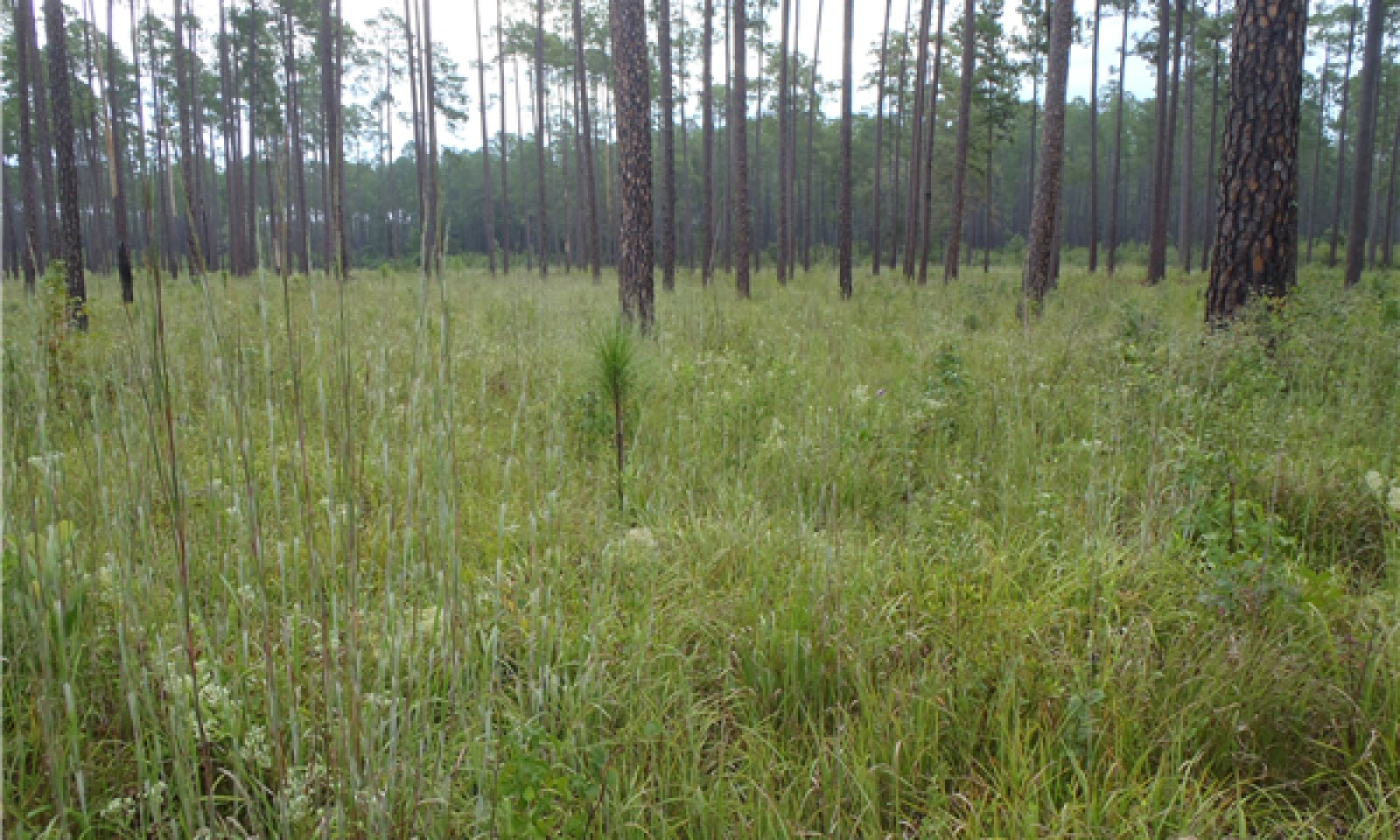
ReferenceThe Well Drained Loamy Upland ecological site is a Longleaf Pine/Big Bluestem Woodland. The deep loamy soils provide an excellent growing medium for plants. The water holding capacity is greater than sandy sites and more available to plants than sites with heavy clays. Nutrients accumulate better in soils with higher clay content in their profile, so the sites have better nutrient availability than the sites with deep sands. The sites are characterized by the high amounts of plant growth. The amounts of fine-fuel litter accumulation allow fires to burn frequently (3 to 5 years). All of these factors contribute to the openness of the site, generally 60 to 80 percent canopy cover. In parallel, sites typically have basal areas of 85 to 105 square feet per acre.
Community 1.1
Longleaf Pine/Big Bluestem Woodland
The overstory canopy is dominated by longleaf pine. An occasional southern red oak (Quercus falcata) or post oak (Quercus stellata) may be seen, but not enough to be considered co-dominants. The midstory is dependent on time since last fire. Areas with recent burns will have less midstory shrubs present. Indicator shrubs are flameleaf sumac (Rhus copallinum) and farkleberry (Vaccinium arboreum). Other shrubs present will be American beautyberry (Callicarpa americana) and yaupon (Ilex vomitoria). Tall grass species are dominant on the site. Little bluestem (Schizachyrium scoparium) will be the most common, but indicator species are big bluestem (Andropogon gerardii) and switchgrass (Panicum virgatum). The understory is diverse in forbs as well. Purple coneflower (Echinacea sp.), flowering spurge (Euphorbia corollata), gayfeathers (Liatris sp.), and Texas ironweed (Veronia texana) are common.
State 2
EncroachedA long-term lack of fire and management has caused the community to cross a threshold. The crossing of this threshold represents a closure in the overstory canopy, which limits the productivity of the ground layer. The limited ground layer does not provide enough fuel to harbor a burn with the intensity found in State 1. Fire-intolerant hardwoods have become part of the overstory. The overstory trees are overstocked and limit the growth of neighboring species. The overstocking reduces tree growth and causes stress, making them vulnerable to attacks from insects and/or diseases. Longleaf recruitment may be nonexistent due to lack of light and bare ground. Loblolly pine will especially take advantage of the current conditions. The plant communities will stay in this constant state and continue to age without disturbance or intervention.
Community 2.1
Pine/Hardwood Forest
The understory plant layer only contains remnants of the reference community and possibly no reference community indicator species. Shade-tolerant grasses, such as longleaf woodoats (Chasmanthium sessiliflorum), forbs, and greenbriers (Smilax sp.) may be the only ground-layer species. Added litter accumulation lessens the impact of the droughty soil at the surface. Because the site lacks the diversity of the reference state, the wildlife diversity will be limited to generalist species, species requiring a closed canopy, and those seeking refuge.
State 3
PlantationThe Plantation State is a result of conversion activities. The landowner has maximized silviculture production by planting a monoculture of pine species, usually loblolly pine, but sometimes slash pine (Pinus ellioti) is planted.
Community 3.1
PlantationIn the immediate years following the initial plantation tree planting, the understory community will resemble the reference state (State 1). During this early growth period, the landowner will typically remove unwanted hardwoods and herbaceous plants to reduce competition with the planted pine trees. As the overstory canopy closes, less understory management is required due to sunlight restrictions to the ground layer.
State 4
ConvertedThe Converted state is a result of pasture and/or cropping activities. The landowner has maximized agriculture production by planting a monoculture of introduced grass species or agricultural row crops.
Community 4.1
Planted Pasture and Row CropTypical introduced pasture grass species include bahiagrass (Paspalum notatum) and different varieties of bermudagrass (Cynodon dactylon). The grasses are grown for livestock production through direct grazing or baling hay for later use. Agricultural row crops are grown for food and fiber production. Many farmers use herbicides to reduce unwanted plant competition which yields a plant community unrepresentative of the reference (State 1) or subsequent vegetative states.
Transition T1A
State 1 to 2The transition from State 1 to State 2 is a result of time and long periods (greater than 10 years) of no fire and/or forest management practices. Without fire to suppress tree seedlings, biomass and diversity is lost from the grass and forb layers of the system.
Transition T1B
State 1 to 3The transition is due to the land manager maximizing silviculture potential. Merchantable timber is harvested by clearcut. Then, the site is prepared and planted to a monoculture of pine trees.
Transition T1C
State 1 to 4The transition is due to the land manager maximizing agricultural production. Merchantable timber is harvested by clearcut. Then, the site is prepared and planted to either an improved grass or row crops.
Restoration pathway R2A
State 2 to 1Restoration of this community to the reference state begins with a selective timber harvest. Removing unwanted trees opens up the canopy, allowing sunlight penetration to the ground. Years of overstory growth have limited the fuel necessary to have an effective fire. Time will be needed to encourage understory growth. Once the herbaceous layer has established, more frequent than natural burns (1 to 2 years) may be required to suppress the woody vegetation.
Transition T2A
State 2 to 3The transition is due to the land manager maximizing silviculture potential. Merchantable timber is harvested by clearcut. Then, the site is prepared and planted to a monoculture of pine trees.
Transition T2B
State 2 to 4The transition is due to the land manager maximizing agricultural potential. Merchantable timber is harvested by clearcut. Then, the site is prepared and planted to either an improved grass or row crops.
Restoration pathway R3A
State 3 to 1When restoring a plantation, the land manager can either clearcut the timber, prepare the site, and plant trees. Otherwise, gap-phase regeneration is possible through selective timber harvests. This involves replanting the desired overstory species in small openings within the current structure of the forest. The benefit is a slow progression of restoration instead of starting from primary succession.
Transition T3A
State 3 to 2This community transition is caused by neglecting the plantation understory. Without fire, mowing, or herbicides, unwanted understory saplings can begin to grow into the overstory.
Transition T3B
State 3 to 4The transition is due to the land manager maximizing agricultural production. Merchantable timber is harvested by clearcut. Then, the site is prepared and planted to either an improved grass or row crops.
Transition T4A
State 4 to 2This community transition is caused by neglecting crop or pasture. Without continuation of agricultural management, first-successional herbaceous plants will occupy the ground layer, followed by shrubs, and eventually shade-loving, fire-intolerant overstory species.
Transition T4B
State 4 to 3The transition is due to the land manager maximizing silviculture production. The site prepared and planted to a monoculture of pine trees.
Additional community tables
Table 5. Community 1.1 plant community composition
Group Common name Symbol Scientific name Annual production () Foliar cover (%) Table 6. Community 1.1 forest overstory composition
Common name Symbol Scientific name Nativity Height ft Canopy cover (%) Diameter in Basal area (square ft/acre) Treelongleaf pine PIPA2 Pinus palustris Native – – – 0 southern red oak QUFA Quercus falcata Native – – – 0 post oak QUST Quercus stellata Native – – – 0 shortleaf pine PIEC2 Pinus echinata Native – – – 0 Table 7. Community 1.1 forest understory composition
Common name Symbol Scientific name Nativity Height (ft) Canopy cover (%) Grass/grass-like (Graminoids)big bluestem ANGE Andropogon gerardii Native – – needleleaf rosette grass DIAC Dichanthelium aciculare Native – – switchgrass PAVI2 Panicum virgatum Native – – little bluestem SCSC Schizachyrium scoparium Native – – Forb/Herbpurple coneflower ECHIN Echinacea Native – – flowering spurge EUCO10 Euphorbia corollata Native – – blazing star LIATR Liatris Native – – anisescented goldenrod SOOD Solidago odora Native – – sidebeak pencilflower STBI2 Stylosanthes biflora Native – – Texas ironweed VETE3 Vernonia texana Native – – Fern/fern allywestern brackenfern PTAQ Pteridium aquilinum Native – – Shrub/SubshrubAmerican beautyberry CAAM2 Callicarpa americana Native – – yaupon ILVO Ilex vomitoria Native – – winged sumac RHCO Rhus copallinum Native – – farkleberry VAAR Vaccinium arboreum Native – – Treesouthern red oak QUFA Quercus falcata Native – – post oak QUST Quercus stellata Native – – shortleaf pine PIEC2 Pinus echinata Native – – longleaf pine PIPA2 Pinus palustris Native – – Vine/Lianagreenbrier SMILA2 Smilax Native – – Table 8. Community 2.1 plant community composition
Group Common name Symbol Scientific name Annual production () Foliar cover (%) Table 9. Community 3.1 plant community composition
Group Common name Symbol Scientific name Annual production () Foliar cover (%) Table 10. Community 4.1 plant community composition
Group Common name Symbol Scientific name Annual production () Foliar cover (%) Interpretations
Wood products
These soils occur in the Woodland Suitability Group 2o7 and have a high potential for woodland management, both pine and hardwood. The 50-year site index for loblolly pine averages 90 feet (60 feet on a 25-year curve), but ranges from 85 to 100 feet. The yield from an unmanaged, natural stand of loblolly pine, over a 50-year period, is approximately 330 board feet (Doyle Rule), 2.64 tons, or 90 cubic feet per acre per year. Management can substantially increase this yield. The only problem associated with these soils is the somewhat limited access and equipment operability during wet periods when rutting can be a moderate concern. Short term restrictions may be necessary at these times.
Supporting information
Type locality
Location 1: Newton County, TX UTM zone N UTM northing 30.639205 UTM easting -93.832603 General legal description E.O. Siecke State Forest Other references
Ajilvsgi, G. 2003. Wildflowers of Texas. Revised edition. Shearer Publishing, Fredericksburg, TX.
Ajilvsgi, G. 1979. Wildflowers of the Big Thicket. Texas A&M University Press, College Station, TX.
Allen, J. A., B. D. Keeland, J. A. Stanturf, and A. F. Kennedy Jr. 2001. A guide to bottomland hardwood restoration. Technical report, USGS/BRD/ITR-2000-0011.
Bray, W. L. 1904. Forest resources of Texas. Bureau of Forestry Bulletin 47, Government Printing Office, Washington D.C.
Diggs, G. M., B. L. Lipscomb, M. D. Reed, and R. J. O’Kennon. 2006. Illustrated flora of East Texas. Second edition. Botanical Research Institute of Texas & Austin College, Fort Worth, TX.
Jones, S. D., J. K. Wipff, and P. M. Montgomery. 1997. Vascular plants of Texas: a comprehensive checklist including synonymy, bibliography, and index. University of Texas Press, Austin.
Liu, C., P. A. Harcombe, and I. S. Elsik. 1990. Fire study report, including Roy E. Larsen Preserve species list. Summer 1990. Department of Ecology and Evolutionary Biology, Rice University, Houston, TX.
Marks, P. L., and P. A. Harcombe. 1981. Forest Vegetation of the Big Thicket, southeast Texas. Ecological Monographs 51:287-305.
Matos, J. A. 1985. Roy E. Larsen Sandylands Sanctuary vascular plant species list. Master thesis, Stephen F. Austin University, Nacogdoches, TX.
NatureServe. 2002. International classification of ecological communities: Terrestrial vegetation of the United States. National forests in Texas final report. NatureServe, Arlington, VA.
Nixon, E. S. 2000. Trees, shrubs & woody vines of East Texas. Second edition. Bruce Lyndon Cunningham Productions, Nacogdoches, TX.
Randall, J. M., and J. Marinelli. 1996. Invasive plants: weeds of the global garden. Volume 149. Brooklyn Botanic Garden, Brooklyn, NY.
Stanturf, J. A., S. H. Schoenholtz, C. J. Schweitzer, and J. P. Shepard. 2001. Achieving restoration success: Myths in bottomland hardwood forests. Restoration Ecology, 9:189-200.
Stringham, T. K., W. C. Krueger, and P. L. Shaver. 2003. State and transition modeling: An ecological process approach. Journal of Range Management 56:106-113.
Soil Survey Staff, Natural Resources Conservation Service, United States Department of Agriculture. Soil Survey Geographic (SSURGO) Database.
Truett, J. C. 1984. Land of bears and honey: A natural history of East Texas. The University of Texas Press, Austin, TX.
Van Kley, J. E., R. L. Turner, L. S. Smith, and R. E. Evans. 2007. Ecological classification system for the national forests and adjacent areas of the West Gulf Coastal Plain. Second approximation. Stephen F. Austin University and The Nature Conservancy, Nacogdoches, TX.
USDA-NRCS Ag Handbook 296 (2006).
Vines, R. A. 1960. Trees, shrubs, and woody vines of the Southwest. University of Texas Press, Austin, TX.
Watson, G. E. 2006. Big Thicket Plant Ecology. Third Edition. University of North Texas Press, Denton, TX.Contributors
Tyson Hart
Approval
Bryan Christensen, 9/22/2023
Acknowledgments
Thanks to all involved during the preparation, sampling, and reviewing of the Flatwoods project. Thanks to Josh Berry, Dennis Brezina, Kenny Hall, Jason Hohlt, Stacey Kloesel, Ricky Lambert, Cody Langston, Mark Moseley, Ramiro Molina, Mike Oliver, Alan Peer, Sara Russell, Don Sabo, Mary Webb-Marek, and Jon Wiedenfeld for all their help.
Rangeland health reference sheet
Interpreting Indicators of Rangeland Health is a qualitative assessment protocol used to determine ecosystem condition based on benchmark characteristics described in the Reference Sheet. A suite of 17 (or more) indicators are typically considered in an assessment. The ecological site(s) representative of an assessment location must be known prior to applying the protocol and must be verified based on soils and climate. Current plant community cannot be used to identify the ecological site.
Author(s)/participant(s) Contact for lead author Date 09/21/2021 Approved by Approval date Composition (Indicators 10 and 12) based on Annual Production Indicators
-
Number and extent of rills:
-
Presence of water flow patterns:
-
Number and height of erosional pedestals or terracettes:
-
Bare ground from Ecological Site Description or other studies (rock, litter, lichen, moss, plant canopy are not bare ground):
-
Number of gullies and erosion associated with gullies:
-
Extent of wind scoured, blowouts and/or depositional areas:
-
Amount of litter movement (describe size and distance expected to travel):
-
Soil surface (top few mm) resistance to erosion (stability values are averages - most sites will show a range of values):
-
Soil surface structure and SOM content (include type of structure and A-horizon color and thickness):
-
Effect of community phase composition (relative proportion of different functional groups) and spatial distribution on infiltration and runoff:
-
Presence and thickness of compaction layer (usually none; describe soil profile features which may be mistaken for compaction on this site):
-
Functional/Structural Groups (list in order of descending dominance by above-ground annual-production or live foliar cover using symbols: >>, >, = to indicate much greater than, greater than, and equal to):
Dominant:
Sub-dominant:
Other:
Additional:
-
Amount of plant mortality and decadence (include which functional groups are expected to show mortality or decadence):
-
Average percent litter cover (%) and depth ( in):
-
Expected annual annual-production (this is TOTAL above-ground annual-production, not just forage annual-production):
-
Potential invasive (including noxious) species (native and non-native). List species which BOTH characterize degraded states and have the potential to become a dominant or co-dominant species on the ecological site if their future establishment and growth is not actively controlled by management interventions. Species that become dominant for only one to several years (e.g., short-term response to drought or wildfire) are not invasive plants. Note that unlike other indicators, we are describing what is NOT expected in the reference state for the ecological site:
-
Perennial plant reproductive capability:
Print Options
Sections
Font
AAAAOther
PrintThe Ecosystem Dynamics Interpretive Tool is an information system framework developed by the USDA-ARS Jornada Experimental Range, USDA Natural Resources Conservation Service, and New Mexico State University.
Accessibility statement


