
Natural Resources
Conservation Service
Ecological site F121XY002KY
Moderately Deep Interbedded Limestone-Shale Backslopes
Accessed: 09/17/2026
-
Search


Major Land Resource Area or ecological site by name and/or ID.
PreviousSectionsNextGeneral information
Approved. An approved ecological site description has undergone quality control and quality assurance review. It contains a working state and transition model, enough information to identify the ecological site, and full documentation for all ecosystem states contained in the state and transition model.
Click to explore map
Figure 1. Mapped extent
Areas shown in blue indicate the maximum mapped extent of this ecological site. Other ecological sites likely occur within the highlighted areas. It is also possible for this ecological site to occur outside of highlighted areas if detailed soil survey has not been completed or recently updated.
MLRA notes
Major Land Resource Area (MLRA): 121X–Kentucky Bluegrass
The project area lies within the major land resource area (MLRA)121 as designated by the Natural Resources Conservation Service. Central Kentucky makes up 83% of the MLRA with the remaining acreage in Ohio (11%) and Indiana (6%). Total MLRA size is 10,680 square miles or 27,670 square kilometers. The majority of the MLRA is in the Lexington Plain Section of the Interior Low Plateaus Province of the Interior Plains. Elevations in MLRA 121 range from about 430 feet (on the Ohio River) to approximately 1100 feet.
This ecological site description covers sites within the Inner and Outer Bluegrass physiographic regions of Kentucky. The rolling hills of this area are caused by the weathering of limestone that has been pushed up along the crest of the Cincinnati Arch. Younger geologic units occur along the eastern and western edges of the bluegrass region and are typified by thin-bedded shale, siltstone, and limestone.
Classification relationships
Plant Communities of the Midwest, Association Descriptions: CEGL002070 White Oak-Mixed Oak Dry-Mesic Alkaline Forest.
Kentucky State Nature Preserves Commission, Calcareous Sub-xeric Forest (Evans, Hines, Yahn, 2009).
USNVV Hierachy: Quercus alba (Quercus rubra, Carya spp.) Forest Alliance.
Ecological site concept
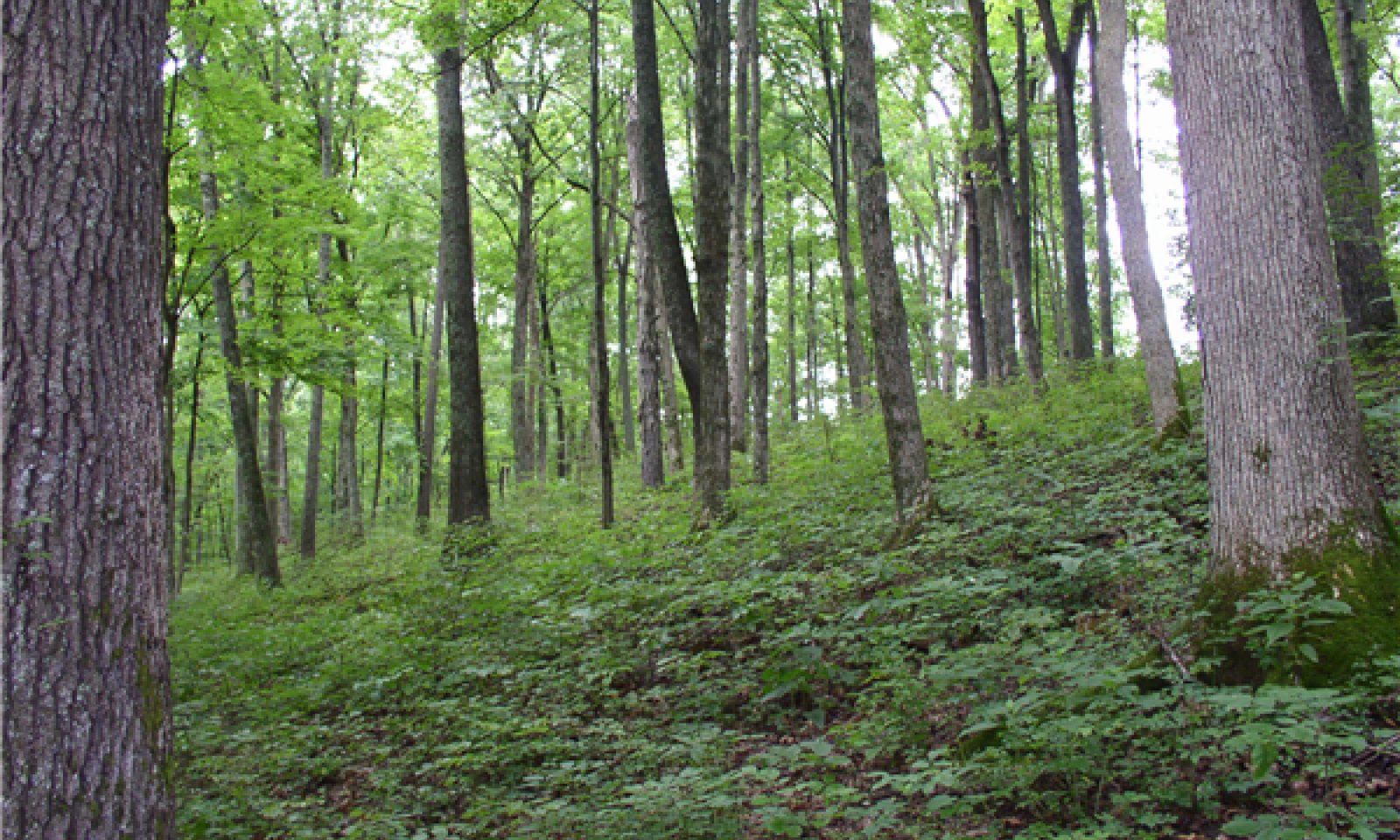
These ecological sites are characterized by moderately-deep soils predominately influenced by parent materials of limestone and shale. Soil depths of 21 to 40 inches provide an adequate moisture and growing environment for a wide range of quality hardwood trees, including various species of oaks and hickories. Understory communities, while influenced by differences in soil depths and soil parent materials, exhibited similarities in species composition. Located on hillsides and ridges, these sites were a hardwood forest of oak-hickory or oak-hickory-sugar maple with a robust and diverse herbaceous layer. The most common summer understory species were: various species of agrimony (AGPU & AGR03), black snakeroots (SACA15 & SAOD), white snakeroot (AGALA), Virginia creeper (PAQU2), smooth Solomon's seal (POBI2), false Solomon's seal (SMRA), etc. The shrub layer usually consisted of coralberry (SYOR) and groupings of northern spicebush (LIBE3). Species such as spicebush and paw-paw often found on these sites are indicative of higher levels of available moisture compared to the shallow limestone-based ecological sites (121XY0001) that are geographically related within MLRA 121.
The state and transition model for this ecological site description highlights the various community states and phases including three reference phases and multiple successional stages including managed pastureland, minimally managed pastureland, managed native grasses, eastern red cedar communities, and honeysuckle (non-native invasive) woodlands. These stages transition predictably with external influences and through natural succession.Table 1. Dominant plant species
Tree (1) Quercus alba
(2) Carya ovataShrub (1) Symphoricarpos orbiculatus
(2) Lindera benzoinHerbaceous (1) Sanicula canadensis
(2) AgrimoniaPhysiographic features
These ecological sites (ES) are found on hillsides and/or ridgetops. The best examples of these sites were found on slopes ranging from 15-45% range. Soils depth ranges from 21- 40" over interbedded limestone and shale or interbedded limestone, shale, and siltstone. The mixed geology can be seen best on road cuts where the limestone & shale or limestone, shale & siltstone layers are layered along the hillsides. Elevations of these sites generally range from 500 feet to 1000 feet. There is no influencing water table, flooding or ponding on these sites as the runoff class is medium to rapid.
Table 2. Representative physiographic features
Landforms (1) Hill
(2) Ridge
(3) Knob
Flooding frequency None Ponding frequency None Elevation 450 – 1429 ft Slope 2 – 50 % Water table depth 60 in Aspect Aspect is not a significant factor Climatic features
These ecological sites are located in central Kentucky and are at the northern periphery of the humid subtropical climate zone. Generally characterized by hot, humid summers and cold winter, the area has four distinct seasons. The expected annual precipitation for sites included in this ecological site description is 40 to 50 inches. The majority of precipitations falls during the freeze-free months, and thunderstorms with heavy rainfall are common during the spring and summer months. The freeze-free period averages 210 days, but varies somewhat based on localized topography and longtitude.
Table 3 Representative climatic features
Frost-free period (average) 160 days Freeze-free period (average) 190 days Precipitation total (average) 110 in BarLineFigure 2. Monthly precipitation range
BarLineFigure 3. Monthly average minimum and maximum temperature
Figure 4. Annual precipitation pattern
Figure 5 Annual average temperature pattern
Climate stations used
-
(1) CYNTHIANA [USC00151998], Cynthiana, KY
">Influencing water features
There are no influencing water features for this ESD.
Soil features
These ecological sites are found on specific landscapes dominated by Eden and Faywood soils and are influenced by interbedded geology of limestone and shale parent materials. The Eden series consists of moderately-deep, well-drained, and slowly-permeable soils formed in residuum from interbedded calcareous shale, siltstone, and limestone. These soils are found on steep hillsides and narrow ridgetops. The Faywood series consists of moderately-deep and well-drained soils formed in limestone residuum interbedded with thin layers of shale. The office site description for Eden includes slopes from 2 to 70 percent; however, for this ecological site description, sites evaluated ranged in slope from 12 to 40 percent. The official site description for Faywood includes slopes from 2 to 60 percent; however, sites evaluated for this ecological site description ranged in slope from 12 to 40 percent.
Table 4. Representative soil features
Parent material (1) Residuum – limestone
Surface texture (1) Flaggy silty clay loam
(2) Very flaggy silt loam
(3) Channery silty clay
Family particle size (1) Loamy
Drainage class Well drained Permeability class Very slow to moderate Soil depth 12 – 48 in Surface fragment cover <=3" 0 – 25 % Surface fragment cover >3" 0 – 25 % Available water capacity
(0-40in)1.9 – 3.4 in Calcium carbonate equivalent
(0-40in)0 – 1 % Electrical conductivity
(0-40in)Not specified Sodium adsorption ratio
(0-40in)Not specified Soil reaction (1:1 water)
(0-40in)6.2 – 7.5 Subsurface fragment volume <=3"
(Depth not specified)5 – 20 % Subsurface fragment volume >3"
(Depth not specified)5 – 30 % Ecological dynamics
As diagramed in the state and transition model, these ecological sites have four distinct states and eight easily identifiable community phases. The reference state consists of three woodland phases. The first is the mature oak-hickory forest (phase 1.1) which is dominated by oak and hickory species, such as white oak, northern red oak, shagbark hickory, Shumard oak, black oak, chinkapin oak, and mockernut hickory. Sugar maple is also common, especially on more mesic sites. Other tree species found on these sites include white ash, American elm, slippery elm, eastern red cedar, bitternut hickory, and eastern redbud. The understory frequently had a shrub layer of coralberry or spicebush. On monitored plots, coralberry was denser in areas of higher shale content (Eden soils) and on drier sites. Spicebush was denser in more protected micro-climates, northern slopes, and sites mapped as Faywood soils. The herbaceous understory is robust and diverse. Most undisturbed locations had a beautiful array of native wildflowers in early spring.
Phase 1.2 is best described as an eastern red cedar woodland. This successional state is seen throughout the Inner and Outer Bluegrass physiographic regions of Kentucky, as well as southern Indiana and Ohio. Eastern red cedar is well adapted to the limestone and limestone-shale soils, highly drought tolerant, and serves as an ecological bridge between the transitional field (phase 3.1) and the oak-hickory forest (phase 1.1)and the sugar maple-white oak forest (phase 1.3).
Monitored plots within these dense stands of eastern red cedar were typified by high basal areas and slow-growing young oaks and hickory trees in the understory and midstory. These young hardwood trees will eventually overtop the cedars, and within a few decades, start to dominate the overstory. In the spring these hillsides were a mass of dark green cedars and highlighted with bright pink blooms from eastern redbud trees.
On more mesic sites, phase 1.2 plots exhibited a predominance of sugar maple, ash, and elm seedlings with a reduced oak and hickory regeneration. These sites were transitioning toward phase 1.3 and would likely required forest stand management activities, such as maple thinning or prescribed fire, to reach phase 1.1.
Phase 1.3 sites were observable on numerous locations in the study area, but the long- range composition of these sites and the long-term potential to transition to other phases is somewhat of an unknown. Ecologists, researchers, and natural resource professional interviewed for this project believed that the reduction of historic wildfire regimes have contributed to the reduction of oak-hickory forests and increased the predominance of sugar maple-oak woodlands on this (and many other) ecological sites. The density of shade-tolerant maple on these sites modifies the ground-level environment by increasing shade levels and moisture content, altering leaf litter composition, and influencing the tree regeneration. The dense shading from maples and the thick leaf litter reduces oak and hickory regeneration and increases the reproductive success of shade-tolerant tree such as sugar maple and white ash.
The pasture state (state 2.0) contains three commonly found phases: managed cool-season grasses (usually tall fescue or other non-native planted grasses), minimally-managed pastures, and a native warm-season grass habitat. Production levels vary on these sites by grass species and the management of the sites.
The transitional field (state 3.0) is a successional state between an abandoned pasture and an eastern red cedar grove. Characterized by a variety of grasses, forbs, herbs, and young trees, these sites are often wildlife friendly, pollinator beneficial, and are often maintained by landowners to maximize wildlife habitat.
Trees found on these sites are a mix depending on adjacent seed sources and how long the land was in pasture. Eastern red cedar is the early successional dominant tree; however, hardwood seedling and saplings were found scattered throughout monitored plots and included honey locust, black locust, osage orange, black walnut, hackberry, boxelder, and eastern red cedar. Multiflora rose, briars, berries and brambles were a component on all sites visited. The most common non-native herbaceous species included Queen Anne’s lace, thistles, lespedeza, lambs quarters, horse nettle, mullein, and pigweed. The most common native herbaceous species were ironweed, common milkweed, goldenrods, yellow crownbeard, and sunflowers. This state will transition naturally to phase 1.3 the eastern red cedar grove. Landowners wishing to retain the wildlife benefits of the “old field” state would control cedar growth.
State 4 is woodland with dense bush honeysuckle (usually Lonicera maackii) in the understory and midstory. This non-native, invasive plant is aggressive, adaptable, persistent, and currently negatively impacting oak-hickory forests throughout Kentucky. Found on many different ecological sites, this plant fundamentally alters the natural ecological pathways and transition mechanisms due to its dense growth form and aggressive growth and reproduction capabilities. Ecological sites in state 4 require substantial and long-term management inputs, including multi-year restoration activities, to transition to another ecological state or phase.State and transition model
Custom diagramStandard diagram
Figure 6. F121XY002KY_STM
More interactive model formats are also available. View Interactive Models
More interactive model formats are also available. View Interactive Models
Click on state and transition labels to scroll to the respective textEcosystem states
State 2 submodel, plant communities
State 3 submodel, plant communities
State 4 submodel, plant communities
State 1
Moderately Deep Interbedded Limestone-Shale Oak-Hickory ForestThese ecological sites generally occupied the middle to upper sideslopes and lower ridges of hills within the Inner and Outer Bluegrass physiographic regions of Kentucky. The aspect on these sites is variable as soil depth and rock content appeared to have more influence on plant growth and species density than aspect. Slopes on sites visited ranged from 15% to over 45%. Soil depth varied from 21 to 40 inches and parent material of the soils were residuum from interbedded calcareous shale, siltstone, and limestone (Eden soils) or limestone residuum interbedded with thin layers of shale (Faywood soils). Sites frequently had exposed surface rock and rock content in the soil profile.
Tree canopies were generally medium in height and somewhat closed (70 to 90% shade levels) with dominant trees consisting of oak and hickory species in phase 1.1, oak and sugar maple in phase 1.3, and eastern red cedar in phase 1.2. Understory herbaceous layers were generally dense and diverse with minor variations dependent upon soil depth, rock content, soil type, and micro-topography.
Community 1.1
Moderately Deep Limestone-Shale Oak-Hickory Backslope
Figure 7. Eden_Faywood_backslope_Outerbluegrass_KY

Figure 8. Eden_Faywood_pawpaw_grove_Outerbluegrass_KY

Figure 9. Eden_FaywoodUnderstory_GrantCo_KY

Figure 10. Eden_Faywood_PendletonCo_KY
This community phase is characterized by a a mix of oak and hickory species including white oak, northern red oak, chinkapin oak, Shumard oak, black oak, shagbark hickory, mockernut hickory, and pignut hickory. Sugar maple was common on all sites. Other tree species found on these ecological sites may included bitternut hickory, eastern redbud, hackberry, white ash, blue ash, and sassafras.
Shrub and herbaceous layers varied somewhat with soil depth, topography, drainage patterns and aspect. For example, spicebush was more prevalent on the north and east aspects and on concave hillsides where soil moisture levels were higher. In more mesic microclimate areas, pawpaw trees were common. Coralberry was prevalent on Eden soils versus Faywood soils and on shallow, drier sites. Spicebush was denser on Faywood soils and on mesic sites.Forest overstory.Sites showed variations in overstory composition based on soil depth ranging from 21-40 inches, micro-topography, and available seed sources.<br /> <br /> Shallower sites (monitored 6 sites 21-28" depth) had more chinkapin oak and Shumard oak than deeper sites, but still exhibited the variety of overstory trees that typify this community phase. Species present included white oak, black oak, pignut hickory, shagbark hickory. Also present, but not dominate, where American elm, white ash, and sugar maple. Eastern redbud, hophornbeam, sassafras, hackberry, black walnut, black locust, and bitternut hickory were also present in monitored plots. Protected sites had the addition of northern red oaks and often a grove of pawpaw trees.
Forest understory. Understory composition of these sites ranged from shrub and herbaceous to just herbaceaous. Common shrub species included coralberry, spicebush, blackhaw, and rarely, arrow-wood. Herbaceous plants were plentiful and varied with a wide variety of spring wildflowers and summer natives.
Table 5. Soil surface cover
Tree basal cover 0-0% Shrub/vine/liana basal cover 0% Grass/grasslike basal cover 0% Forb basal cover 30-70% Non-vascular plants 0-0% Biological crusts 0% Litter 10-20% Surface fragments >0.25" and <=3" 0-10% Surface fragments >3" 0-10% Bedrock 0-10% Water 0% Bare ground 0-10% Table 6. Woody ground cover
Downed wood, fine-small (<0.40" diameter; 1-hour fuels) 1-3% Downed wood, fine-medium (0.40-0.99" diameter; 10-hour fuels) 1-2% Downed wood, fine-large (1.00-2.99" diameter; 100-hour fuels) 1-1% Downed wood, coarse-small (3.00-8.99" diameter; 1,000-hour fuels) 0-1% Downed wood, coarse-large (>9.00" diameter; 10,000-hour fuels) 0-1% Tree snags** (hard***) – Tree snags** (soft***) – Tree snag count** (hard***) 0-0 per acre Tree snag count** (hard***) 0-0 per acre * Decomposition Classes: N - no or little integration with the soil surface; I - partial to nearly full integration with the soil surface.
** >10.16cm diameter at 1.3716m above ground and >1.8288m height--if less diameter OR height use applicable down wood type; for pinyon and juniper, use 0.3048m above ground.
*** Hard - tree is dead with most or all of bark intact; Soft - most of bark has sloughed off.
Table 7. Canopy structure (% cover)
Height Above Ground (ft) Tree Shrub/Vine Grass/
GrasslikeForb <0.5 1-5% 1-3% 3-5% 5-15% >0.5 <= 1 1-15% 1-10% 5-15% 15-30% >1 <= 2 5-10% 1-10% – 20-55% >2 <= 4.5 5-10% 10-30% – 1-10% >4.5 <= 13 15-25% 1-15% – – >13 <= 40 10-35% – – – >40 <= 80 30-70% – – – >80 <= 120 10-40% – – – >120 – – – – Community 1.2
Moderately-Deep Interbedded Limestone-Shale Cedar Woodland
Figure 11. ERC_successional_grove_FaywoodSoils
This successional community phase is dominated by eastern red cedar trees. Hardwood species such as white oak, chinkapin oak, Shumard oak, northern red oak, shagbark hickory, white ash, blue ash, sugar maple, and elms are in the understory and growing slowly due to the shaded environment. Within two to three decades, natural succession will result in the hardwoods starting to overtop the cedars. This process can be accelerated through forest stand management activities. This community will transition to phase 1.1 or phase 1.2 depending upon the management, available seed sources, and the fire regime of the site.
Forest overstory.Dense eastern red cedar composes the canopy of this community. A small percentage of the midstory or overstory canopy may be hardwood species. If nearby seed sources are available, oak and hickory species are likely to include white oak, chinkapin oak, Shumard oak, black oak, and northern red oak. Hickory species found on some sites included shagbark, bitternut, mockernut and black walnut. Trees with wind-blow seed distribution were common on all sites and included white ash, sugar maple, and elm species. Some sites contained blue ash and hackberry.
Forest understory. Eastern redbud is the most common midstory hardwood tree in these communities. Limited hardwood seedling and sapplings were found in the understory on monitored sites and included sugar maple, white ash, American elm, slippery elm, red oak (Shumard or northern red), chinkapin oak, hackberry, eastern redbud, Ohio buckeye, hackberry, and black locust. Two sites in the Inner Bluegrass also included blue ash (Fraxinus quadrangulata Michx.).
Table 8. Canopy structure (% cover)
Height Above Ground (ft) Tree Shrub/Vine Grass/
GrasslikeForb <0.5 0-1% 0-1% 1-1% 1-2% >0.5 <= 1 1-2% 1-5% 1-40% 1-15% >1 <= 2 1-5% 1-40% 1-25% 1-25% >2 <= 4.5 2-10% 1-15% 0-1% 0-1% >4.5 <= 13 30-45% – – – >13 <= 40 75-90% – – – >40 <= 80 1-10% – – – >80 <= 120 – – – – >120 – – – – Community 1.3
Moderately Deep Interbedded Limestone/Shale Maple Oak Forest
Figure 12. maple_midstory_EdenSoils_KincaidLakeSP

Figure 13. understory_maple_regeneration_EdenSoil_PendletonCo
This community phase still has a predominant oak-hickory overstory component; however, this phase is characterized by the dominance of sugar maple in the understory and midstory levels. These sites are typically found on protected areas or on hillsides with deeper soils (30-40 inches). Additional soils depth, north or eastern aspects, and convex micro-topography offer plants additional available water. The dense shading of the understory reduces the reproduction of oaks and hickories on these sites. High basal areas were typical due to large numbers of small DBH maples found in plots.
Forest overstory.Phase 1.2 sites had forest overstories of oak, hickory and sugar maple. Oak and hickory still made up a major component of the upper overstory; however, the understory, midstory and lower portion of the overstory all had a noticeably high percentage of sugar maple compared to phase 1.1.
Forest understory. This phase is noticeably different from 1.1 due to the lack of oak/hickory regeneration, the higher percentage of canopy cover shading, and the higher density of the leaf litter layer. Rather than the drier, fluffier oak/hickory leaf litter, the sugar maple sites had a thick, matted layer of maple leaves. These sites also had less of an understory: fewer forbs/herb, a lighter shrub layer, and a much higher percentage of young maple trees.
Table 9. Ground cover
Tree foliar cover 0-0% Shrub/vine/liana foliar cover 0% Grass/grasslike foliar cover 0% Forb foliar cover 0-0% Non-vascular plants 0% Biological crusts 0% Litter 40-60% Surface fragments >0.25" and <=3" 0-10% Surface fragments >3" 0-10% Bedrock 0-0% Water 0% Bare ground 0-0% Table 10. Canopy structure (% cover)
Height Above Ground (ft) Tree Shrub/Vine Grass/
GrasslikeForb <0.5 1-1% 1-1% 1-1% 1-15% >0.5 <= 1 1-1% 1-2% 1-1% 5-15% >1 <= 2 1-1% 1-5% 1-1% 5-10% >2 <= 4.5 5-15% 5-10% – 0-1% >4.5 <= 13 5-30% – – – >13 <= 40 20-40% – – – >40 <= 80 30-80% – – – >80 <= 120 20-40% – – – >120 – – – – Pathway 1.1A
Community 1.1 to 1.2
Moderately Deep Limestone-Shale Oak-Hickory Backslope
Moderately-Deep Interbedded Limestone-Shale Cedar WoodlandLarge-scale disturbance, specifically mature hardwood tree removal or destruction, will cause phase 1.1 to transition back to phase 1.2. Natural or man-made events such as clear cutting, wind, ice, or catastrophic fires will cause a community shift in this direction. Removal of the oak-hickory forest overstory will allow eastern red cedar trees to thrive and dominate the site. Phase 1.2 will then transition to either 1.1 or 1.3 depending on seed sources, fire regime, and timber stand management activities.
Conservation practices
Brush Management Fence Access Control Forest Trails and Landings Forest Stand Improvement Forest Management Plan - Applied Pathway 1.1B
Community 1.1 to 1.3
Moderately Deep Limestone-Shale Oak-Hickory Backslope
Moderately Deep Interbedded Limestone/Shale Maple Oak ForestWith removal of overstory oak and hickory species (for example, a selective harvest), phase 1.1 will transition to phase 1.3. Forest stand maangement is often warranted under these conditions to control sugar maple density and encourage regeneration of oak and hickory species. This pathway also reflects a growing ecological concern nationwide that oak-hickory forests are transitioning to maple-dominated woodlands due to a change in the natural fire regime (i.e. lack of wildfires). Ecological communities that were previously oak-hickory forests are converting to maple woodlands. Ten sites visited for this ecological site description had understory and midstory canopies consisting of 60 to 85 percent sugar maple. The dense shading from a maple dominant overstory retards oak and hickory reproduction and reduces the diversity of the herbaceous layer. As a shade-tolerant species, sugar maple will continue to thrive on these sites. Without management inputs or wildfires, this community will likely not transition naturally to an oak-hickory forest.
Conservation practices
Brush Management Prescribed Burning Fence Access Control Tree/Shrub Site Preparation Tree/Shrub Establishment Forest Stand Improvement Forest Management Plan - Applied Herbaceous Weed Control Pathway 1.2A
Community 1.2 to 1.1
Moderately-Deep Interbedded Limestone-Shale Cedar Woodland
Moderately Deep Limestone-Shale Oak-Hickory BackslopePhase 1.2, the eastern red cedar grove, will transition to the reference community given adequate seed sources and a natural fire regime. In the absense of oak and hickory seed sources or a natural fire regime, timber stand improvement activites may be needed. Activities may include planting oak and hickory trees, reducing maple populations, and controling bush honeysuckle. Maple control would allow hardwoods the additional light needed to speed growth and increase forest production rates. These ecological sites contain a variety of hardwood species in the understory and midstory level. White oak, northern red oak, black oak, chinkapin oak, Shumard oak, shagbark hickory, mockernut hickory, pignut hickory, bitternut hickory, white ash, blue ash, eastern redbud, American elm, slippery elm, and black walnut are some of the more frequent tree species.
Conservation practices
Brush Management Fence Access Control Tree/Shrub Site Preparation Tree/Shrub Establishment Upland Wildlife Habitat Management Forest Stand Improvement Forest Management Plan - Applied Herbaceous Weed Control Pathway 1.2B
Community 1.2 to 1.3
Moderately-Deep Interbedded Limestone-Shale Cedar Woodland
Moderately Deep Interbedded Limestone/Shale Maple Oak ForestThis pathway was seen on multiple mesic sites where sugar maple was the dominant midstory and understory tree species. On multiple sites visited, sugar maple regeneration was dense but oak-hickory seedlings were scarce. Long-term pastures that have transitioned to eastern red cedar groves often do not have an adequate seed source to successfully reach the oak-hickory reference phase without management inputs (i.e. plantings). A highly shade-tolerant species, sugar maple will likely become the dominate hardwood species on such sites in the absense of managment intervention.
Conservation practices
Brush Management Prescribed Burning Fence Access Control Tree/Shrub Site Preparation Tree/Shrub Establishment Upland Wildlife Habitat Management Forest Stand Improvement Prescribed Grazing Forest Management Plan - Applied Herbaceous Weed Control Pathway 1.3A
Community 1.3 to 1.1
Moderately Deep Interbedded Limestone/Shale Maple Oak Forest
Moderately Deep Limestone-Shale Oak-Hickory BackslopeThis community pathway involves forest stand improvement activities to reduce maple growth in the midstory and understory. The reduction in maples will allow more light to young oak and hickory seedlings and saplings. Planting of oaks and hickories my be required depending on available seed sources, management goals, and site quality. Landowners should also be on the lookout for the invasive bush honeysuckle and take active control measures if required. Potential conservation practices include forest stand improvement, forest management plan applied, brush management, prescribed burning, and/or upland wildlife habitat management.
Conservation practices
Brush Management Prescribed Burning Upland Wildlife Habitat Management Forest Stand Improvement Forest Management Plan - Applied Pathway 1.3B
Community 1.3 to 1.2
Moderately Deep Interbedded Limestone/Shale Maple Oak Forest
Moderately-Deep Interbedded Limestone-Shale Cedar Woodlandemoval of hardwood trees (harvesting, ice damage, wind storms, catastrophic fires) can shift a maple-oak community toward an eastern red cedar woodland. These moderately deep sites over limestone/shale parent material are excellent habitat for eastern red cedar succesional communities. Potential conservation practices include access control, fence, brush management, forest stand improvement, tree/shrub establishment, and/or upland wildlife habitat management.
Conservation practices
Brush Management Fence Access Control Tree/Shrub Establishment Upland Wildlife Habitat Management Forest Stand Improvement Forest Management Plan - Applied State 2
GrasslandsThe pasture state for these ecological sites is commonly one of three phases: managed pasture, minimally managed pasture, or a warm-season grass habitat. The managed and minimally managed pasture sites were predominately cool-season, introduced grass species such as tall fescue, orchard grass, brome grass, and Kentucky bluegrass.
Community 2.1
Managed Pastureland
Figure 14. Managed_Pasture_F121XY002KY
This community phase consists of managed pastureland and was found mostly on lower slope sites. The majority of these sites were planted with tall fescue and actively managed for grazing or hay production. Forb and herb species, noxious weeds, vines, and trees were kept to a minimum through herbicide treatments and mowing.
This phase was found on limited sites. Since most of the sites included in this project are in excess of 15 percent slope, this phase occurred on lower slope sites.Forest overstory.There was no forest overstory composition for this community phase.
Forest understory. There is no forest understory composition for this community phase.
Table 11. Ground cover
Tree foliar cover 0-0% Shrub/vine/liana foliar cover 0-0% Grass/grasslike foliar cover 80-100% Forb foliar cover 0-10% Non-vascular plants 0% Biological crusts 0% Litter 0% Surface fragments >0.25" and <=3" 0% Surface fragments >3" 0% Bedrock 0% Water 0% Bare ground 0% Table 12. Canopy structure (% cover)
Height Above Ground (ft) Tree Shrub/Vine Grass/
GrasslikeForb <0.5 0-1% 0-1% 5-30% 1-5% >0.5 <= 1 0-1% 0-1% 25-35% 1-5% >1 <= 2 0-1% 0-1% 40-60% 1-5% >2 <= 4.5 0-1% 0-1% 15-40% 1-5% >4.5 <= 13 – – – – >13 <= 40 – – – – >40 <= 80 – – – – >80 <= 120 – – – – >120 – – – – Community 2.2
Minimally Managed Pastureland
Figure 15. unmanaged_pasture_F121XY002KY
This phase is typified by an array of introduced grasses such as tall fescue, orchard grass, timothy, Johnson grass, orchard grass, Kentucky bluegrass, etc. Due to the reduction in management inputs (less weed treatment, less mowing, unmanaged grazing, etc.) the quality and quanity of forage was reduced compared to phase 2.1. The amount and diversity of native and introduced forbs, herbs, and vines were greater than phase 2.1. On sites with unmanaged grazing, especially those with steeper slopes, moderate to severe soil erosion was often visible.
Forest overstory.There is no Forest Overstory composition in this community phase.
Forest understory. There is no Forest Overstory composition in this community phase.
Table 13. Ground cover
Tree foliar cover 0-0% Shrub/vine/liana foliar cover 0-10% Grass/grasslike foliar cover 50-70% Forb foliar cover 20-40% Non-vascular plants 0% Biological crusts 0% Litter 0% Surface fragments >0.25" and <=3" 0% Surface fragments >3" 0% Bedrock 0% Water 0% Bare ground 0% Table 14. Canopy structure (% cover)
Height Above Ground (ft) Tree Shrub/Vine Grass/
GrasslikeForb <0.5 0-1% 1-2% 1-5% 1-5% >0.5 <= 1 0-1% 1-2% 5-10% 5-10% >1 <= 2 0-1% 1-2% 10-25% 5-10% >2 <= 4.5 0-1% 1-2% 20-65% 5-20% >4.5 <= 13 – – 10-25% 0-10% >13 <= 40 – – – – >40 <= 80 – – – – >80 <= 120 – – – – >120 – – – – Community 2.3
Native Grass-Pollinator pasture
Figure 16. native_grass_pollinator_herbs_forbs_F121XY002KY
This community contains a majority of native plants but is not truly "natural" in that management inputs are required to create and maintain this phase. The community consists mainly of warm-season grasses, forbs, and herbs - the percentages of each and species are dependent upon seeding and management. Maintenance of this community may include prescribed burning to control the growth of eastern red cedar and other pioneer species of trees and shrubs.
Six plots in the Bluegrass physiographic region of Kentucky were monitored and plants found are listed below. Not all species were found on all plots as species distribution was determined mainly by what seed mix was used.
Landowners interested in developing a native grass prairie often have the objective of benefiting wildlife and pollinators. Seed companies have developed specific mixes targeting this market, and NRCS conservation planners can assist in developing a plan specific to a landowners location and objectives.Forest overstory.There is no forest overstory composition for this phase.
Forest understory. There is no forest understory composition for this phase.
Table 15. Ground cover
Tree foliar cover 0-0% Shrub/vine/liana foliar cover 0-0% Grass/grasslike foliar cover 50-90% Forb foliar cover 30-50% Non-vascular plants 0% Biological crusts 0% Litter 0% Surface fragments >0.25" and <=3" 0% Surface fragments >3" 0% Bedrock 0% Water 0% Bare ground 0% Table 16. Canopy structure (% cover)
Height Above Ground (ft) Tree Shrub/Vine Grass/
GrasslikeForb <0.5 1-1% 0-1% 5-15% 1-2% >0.5 <= 1 0-1% 0-1% 10-20% 1-3% >1 <= 2 0-1% 0-1% 35-65% 5-15% >2 <= 4.5 0-1% 0-1% 25-75% 10-15% >4.5 <= 13 0-1% 0-1% – 0-1% >13 <= 40 – – – – >40 <= 80 – – – – >80 <= 120 – – – – >120 – – – – Pathway 2.1A
Community 2.1 to 2.2
Managed Pastureland
Minimally Managed PasturelandThis pathway will occur naturally with the reduction or lack of management inputs and is generally observed on hilly locations where pasture maintenance is more difficult. With a lack of grazing, these sites had a dense cover of cool-season grasses along with a variety of introduced and native forbs, herbs, and vines. Unmanaged grazing on these sites generally resulted in an increase in undesirable species including thistles, greenbrier, ironweed, and multiflora rose. Signs of soil erosion were often present on these sites.
Conservation practices
Brush Management Fence Access Control Prescribed Grazing Grazing Management Plan - Applied Herbaceous Weed Control Pathway 2.1B
Community 2.1 to 2.3
Managed Pastureland
Native Grass-Pollinator pastureTransitioning a predominately fescue field to a native grass pasture requires management inputs including herbicides, seeding, and weed control management. These areas of natural grasses are utilized as wildlife habitat, hay production, summer pastures, pollinator habitat, and/or conservation areas for native plants. Monitored sites contained a diversity of grasses, herbs, and forbs, usually dependent upon inital plantings selected by landowners and the levels of ongoing management.
Conservation practices
Brush Management Prescribed Burning Fence Access Control Water Well Stream Crossing Grazing Management Plan - Applied Fish and Wildlife Habitat Plan - Applied Pollinator Habitat Plan - Applied Herbaceous Weed Control Pathway 2.2A
Community 2.2 to 2.1
Minimally Managed Pastureland
Managed PasturelandWith additional management inputs, this phase can be transitioned to a high-quality pasture or hayland. Steep slopes and/or high rock content preclude mechanized management, so the better pasture sites were always found on the lower slopes.
Conservation practices
Brush Management Forage Harvest Management Forage and Biomass Planting Grazing Management Plan - Written Grazing Management Plan - Applied Herbaceous Weed Control Pathway 2.2B
Community 2.2 to 2.3
Minimally Managed Pastureland
Native Grass-Pollinator pastureOn sites with lower slopes and less rock content, it would be feasible to plant and maintain a native grass pasture. Two native grass prairies were visited as part of this project. The owners had installed them with NRCS assistance for wildlife benefits and pollinator conservation. Species planted would vary depending on the owners management goals. The species listed below are not all-inclusive but represent the species found in the field during site visits.
Conservation practices
Field Border Upland Wildlife Habitat Management Fish and Wildlife Habitat Plan - Written Fish and Wildlife Habitat Plan - Applied Pollinator Habitat Plan - Written Pollinator Habitat Plan - Applied Pathway 2.3A
Community 2.3 to 2.1
Native Grass-Pollinator pasture
Managed PasturelandThis community pathway was not observed in the field. However, it is feasible to convert a warm-season grass pasture to a managed tall fescue pasture if so desired. Inputs would include herbicide, seed, and labor. The taller native grass species, such as big blue stem and indian grass, would likely require multiple herbicide treatment for a complete die down. Tall fescue is a bunch grass with deep roots, short rhizomes, and is highly adaptable to different soils types and site conditions, so development of this phase would not be difficult on most sites. Production levels will be determined by available moisture and management.
Conservation practices
Fence Access Control Forage and Biomass Planting Prescribed Grazing Grazing Management Plan - Applied Herbaceous Weed Control State 3
Transitional FieldThis state is characterized by encroaching eastern red cedar trees into a pastureland environment. This natural transition occurs once pasture management inputs are reduced. Monitored sites were predominately tall fescue pastures that were in the process of naturally reverting to a eastern red cedar grove. The moderately-deep soils on these sites had minimal surface rock and with 5 to 20 percent rock fragments in the subsurface layers. Hardwood seedlings present could include white oak, chinkapin oak, red oak, black oak, shagbark hickory, mockernut hickory, and/or black walnut if an adequate seed sources were available. Seedlings of white ash, red maple, sugar maple, hackberry, black locust, honey locust, American elm, osage orange and slippery elm could also be found on these sites.
Community 3.1
Transitional Field
Figure 17. Transitional_field_F121XY002KY_2

Figure 18. Transitional_field_F121XY002KY
This phase is best described as an old field habitat with a mixture of native and introduced grasses, a variety of native herbs and forbs, a selection of non-native weedy plants such as thistles, a robust community of young eastern red cedar trees, and a few hardwood seedlings. The moderately-deep limestone soil provides adequate available moisture for a wide variety of plant species.
These sites were often found on private property of landowners interested in wildlife habitat or on Kentucky wildlife management areas. The variety of plants found on these sites provides desired habitat for non-game and game species. To reduce the density of the eastern red cedar trees, many landowners chose to actively managing these properties by thinning or removal of cedar trees. This management activity halts or slows the natural transition of this community to phase 1.3.
On sites that were still being grazing, the eastern red cedars were encroaching but there were very few native forbs and herbs. These sites generally had few hardwood seedlings, more weedy species, and lower pasture production levels. Common species on these sites included honey or black locust, multiflora rose, Canadian thistle, bull thistle, ironweed, greenbriers, and blackberries.Forest overstory.The overstory composition on these sites consisted mainly of eastern red cedar. Most sites also had assorted young hardwoods (especially those species with wind-blown seeds)including sugar maple, hackberry, white ash, American elm, and eastern redbud. Other species on monitored sites included black walnut, sassafras, white oak, chinkapin oak, Shumard oak, osage orange, and winged elm.
Forest understory. The understory composition of this phase was a mix of introduced grasses and many different species of native and introduced forbs, herbs, and vines. Grass composition was dependent upon previous seeding and adjacent fields
Table 17. Ground cover
Tree foliar cover 0% Shrub/vine/liana foliar cover 0% Grass/grasslike foliar cover 30-70% Forb foliar cover 10-30% Non-vascular plants 0-0% Biological crusts 0% Litter 20-40% Surface fragments >0.25" and <=3" 0-10% Surface fragments >3" 0-10% Bedrock 0-0% Water 0% Bare ground 0% Table 18. Canopy structure (% cover)
Height Above Ground (ft) Tree Shrub/Vine Grass/
GrasslikeForb <0.5 1-2% 0-1% 5-20% 1-5% >0.5 <= 1 1-3% 0-1% 10-35% 1-5% >1 <= 2 1-5% 0-2% 25-50% 5-15% >2 <= 4.5 1-5% 0-2% 5-15% 5-20% >4.5 <= 13 1-10% – – – >13 <= 40 5-20% – – – >40 <= 80 0-5% – – – >80 <= 120 – – – – >120 – – – – State 4
Honeysuckle Invaded StateThis State is characterized by the dominance of bush honeysuckle, an aggressive non-native shurb. Bush honeysuckle is a common name used for many differenct species including Lonicera maackii, L. tatarica, L. morrowii, L. fragrantissima, etc. Plot monitoring for this project found Amur honeysuckle, Lonicera maackii, was the most common species on these sites. This plan was introduced from Asia in the 1700 and 1800s for ornamental purposes and is now an ecological epidemic in central Kentucky and surrounding states. L. maackii is shade tolerate plant that forms dense thickets in forests, roadsides, and pastures. Colonizing by abundant seed production and root sprouting, this plant will dominate the midstory of forest communities. The dense shade and competition from these plants destroys the native herbaceous layer and halts normal oak-hickory reproduction.
Community 4.1
Honeysuckle-Hardwood Woodland
Figure 19. HoneysuckleWoodland
This community phase is typified by dense Lonicera maackii in the understory and midstory, limited to no hardwood reproduction, a sparse and undiverse herbaceous layer. Often the overstory is still oak-hickory trees which pre-date the invasion of the honeysuckle. Plots on these sites show that the understory consists of 70-100% honeysuckle. Forest floor shading is 80-100% due to the dense grown pattern of this plant. Six out of ten monitored plots had no hardwood tree seedlings. The other four plots had one white oak and 6 sugar maple seedlings total. Restoration of this community to an oak-hickory woodland requires extensive and long-term inputs to remove the honeysuckle, plant desirable tree species, and maintain a multi-year control program.
Forest overstory.Forest overstory composition of these sites varied depending on age of the community when invaded by the bush honeysuckle. Overstory trees on monitored sites included sugar maple, white oak, chinkapin oak, hackberry, white ash, red oak, black oak, shagbark hickory, black locust, honey locust, and in on plot- blue ash. Older oak-hickory forests that had been invaded by honeysuckle still had an intact overstory; however, normal oak-hickory reproduction was not present due to the dense shading of the honeysuckle. Younger communities had almost no oak-hickory overstory component and were generally composed of sugar maple, hackberry, white ash, and other more shade tolerant tree species.
Forest understory. The understory composition of these sites were hugely different from reference sites. Juvenile bush honeysuckle plants were 70-95% of the recorded plants in monitored plots. Ground cover shade from the shrub layer was sometimes as high as 100%. Overall, these areas were unique in that the herbaceous layer was sparse and lacked species diversity. Most noticeable in monitored plots was the absence of oak-hickory seedling and/or saplings and the usual native forbs found on reference sites. Limited sugar maple, hackberry, and white ash seedlings were recorded on these sites; however the majority of plant reproduction was that of bush honeysuckle.
Table 19. Ground cover
Tree foliar cover 0-10% Shrub/vine/liana foliar cover 10-30% Grass/grasslike foliar cover 0-0% Forb foliar cover 0-0% Non-vascular plants 0-0% Biological crusts 0% Litter 20-40% Surface fragments >0.25" and <=3" 0-0% Surface fragments >3" 0-0% Bedrock 0% Water 0% Bare ground 0-10% Table 20. Canopy structure (% cover)
Height Above Ground (ft) Tree Shrub/Vine Grass/
GrasslikeForb <0.5 0-1% 0-5% 0-1% 1-2% >0.5 <= 1 0-1% 5-10% 0-1% 1-2% >1 <= 2 0-1% 5-10% 0-1% 1-2% >2 <= 4.5 0-1% 10-20% – 0-1% >4.5 <= 13 0-1% 60-90% – – >13 <= 40 5-15% 0-50% – – >40 <= 80 50-70% – – – >80 <= 120 20-50% – – – >120 – – – – Transition T1B, T1C
State 1 to 4These transitions represent the ecological impacts of a woodland phase being invaded by bush honeysuckle.
Transition T3A
State 3 to 1Transition 3A will occur via natural succession for these ecological sites. The transitional field community will progressively develop into an eastern red cedar woodland (phase 1.2 in the state and transition model).
Restoration pathway R3A
State 3 to 2The transitional field community, with appropriate management inputs, can be moved back to any of the pasture phases. This transition is labeled as a restoration pathway only because the transitional field phase (State 3) originally transitioned from pastureland (State 2).
Conservation practices
Brush Management Forage and Biomass Planting Integrated Pest Management (IPM) Native Plant Community Restoration and Management Invasive Plant Species Control Integrated Pest Management Plan - Written Integrated Pest Management Plan - Applied Fish and Wildlife Habitat Plan - Written Fish and Wildlife Habitat Plan - Applied Restoration pathway R4A
State 4 to 1Restoration of this State is a multi-year undertaking that requires extensive inputs and continual brush/invasive plant removal and treatment. Several sources indicate bush honeysuckle seeds are dispersed primarily by frugivorous birds and numerous studies have shown that a wide variety of bird species consume and spread Amur honeysuckle fruit. Seeds are viable for many years and seed production is robust. Research has shown that bush honeysuckle plants can produce thousands of seeds annually. Herbicides are necessary to reduce sprouting after brush cutting and such treatment requires a multi-year effort. Most of the sites monitored for this project did not have adequate seed sources to naturally return to a productive oak-hickory forest, so forest planting/seeding would likely be necessary for most sites.
Conservation practices
Brush Management Tree/Shrub Site Preparation Tree/Shrub Establishment Upland Wildlife Habitat Management Forest Stand Improvement Invasive Plant Species Control Forest Management Plan - Written Forest Management Plan - Applied Fish and Wildlife Habitat Plan - Written Fish and Wildlife Habitat Plan - Applied Herbaceous Weed Control Additional community tables
Table 21. Community 1.1 plant community composition
Group Common name Symbol Scientific name Annual production () Foliar cover (%) Table 22. Community 1.1 forest overstory composition
Common name Symbol Scientific name Nativity Height ft Canopy cover (%) Diameter in Basal area (square ft/acre) TreeShumard's oak QUSH Quercus shumardii Native 31-87 0-35 18-20.5 0 mockernut hickory CATO6 Carya tomentosa Native 30-75 0-30 17.5-19 0 northern red oak QURU Quercus rubra Native 27-94 0-30 18-21.5 0 white oak QUAL Quercus alba Native 16-90 10-30 18-22.5 0 chinquapin oak QUMU Quercus muehlenbergii Native 30-89 10-30 17-20 0 sugar maple ACSA3 Acer saccharum Native 19-88 0-25 18.5-20 0 shagbark hickory CAOV2 Carya ovata Native 27-84 5-20 16-19 0 Table 23. Community 1.1 forest understory composition
Common name Symbol Scientific name Nativity Height (ft) Canopy cover (%) Grass/grass-like (Graminoids)sedge CAREX Carex Native 0–0.6 1–5 Forb/Herbwhite snakeroot AGALA Ageratina altissima var. altissima Native 0.5–2 10–50 cutleaf toothwort CACO26 Cardamine concatenata Native 0.2–0.8 5–40 dwarf larkspur DETR Delphinium tricorne Native 0.2–0.8 5–40 Virginia springbeauty CLVI3 Claytonia virginica Native 0.1–0.5 5–35 spring blue eyed Mary COVE2 Collinsia verna Native 0.1–0.5 10–20 Canadian blacksnakeroot SACA15 Sanicula canadensis Native 0.3–1.2 1–20 clustered blacksnakeroot SAOD Sanicula odorata Native 0.4–1.5 1–10 celandine poppy STDI3 Stylophorum diphyllum Native 0.3–1.2 0–10 American hogpeanut AMBR2 Amphicarpaea bracteata Native 0.1–0.6 1–10 wild blue phlox PHDI5 Phlox divaricata Native 0.2–1 1–10 harbinger of spring ERBU Erigenia bulbosa Native 0.2–0.6 3–10 white avens GECA7 Geum canadense Native 0.1–1 0–5 spring avens GEVE Geum vernum Native 0.3–2 0–5 beaked agrimony AGRO3 Agrimonia rostellata Native 0.3–1.2 1–5 soft agrimony AGPU Agrimonia pubescens Native 0.3–1 1–5 Virginia snakeroot ARSE3 Aristolochia serpentaria Native 0.3–1.3 0–5 toadshade TRSE2 Trillium sessile Native 0.4–0.6 1–5 bellwort UVULA Uvularia Native 0.3–1 1–5 mayapple POPE Podophyllum peltatum Native 0.5–1.2 1–5 goldenseal HYCA Hydrastis canadensis Native 0.3–0.7 0–5 yellow fumewort COFL3 Corydalis flavula Native 0.3–1.2 0–3 crinkleroot CADI10 Cardamine diphylla Native 0.3–0.7 0–3 cream avens GEVI4 Geum virginianum Native 0.2–2 0–2 wild comfrey CYVI Cynoglossum virginianum Native 0.3–2 0–2 rue anemone THTH2 Thalictrum thalictroides Native 0.3–0.8 0–2 common selfheal PRVU Prunella vulgaris Native 0.1–0.6 0–2 Carolina elephantsfoot ELCA3 Elephantopus carolinianus Native 0.2–2.3 0–1 Canadian white violet VICA4 Viola canadensis Native 0.3–0.7 0–1 yellow giant hyssop AGNE2 Agastache nepetoides Native 0.3–2.8 0–1 perfoliate bellwort UVPE Uvularia perfoliata Native 0.2–0.8 0–1 common blue wood aster SYCO4 Symphyotrichum cordifolium Native 0.3–1.2 0–1 eastern poison ivy TORA2 Toxicodendron radicans Native 0.3–0.8 0–1 smooth Solomon's seal POBI2 Polygonatum biflorum Native 0.4–1.5 0–1 early meadow-rue THDI Thalictrum dioicum Native 0.2–0.8 0–1 twinleaf JEDI Jeffersonia diphylla Native 0.2–1 0–1 spring forget-me-not MYVE Myosotis verna Native 0.2–0.5 0–1 longstyle sweetroot OSLO Osmorhiza longistylis Native 0.4–1.4 0–1 Clayton's sweetroot OSCL Osmorhiza claytonii Native 0.3–1.8 0–1 licorice bedstraw GACI2 Galium circaezans Native 0.3–1.4 0–1 shining bedstraw GACO3 Galium concinnum Native 0.4–1.7 0–1 jumpseed POVI2 Polygonum virginianum Native 0.4–1.6 0–1 bloodroot SACA13 Sanguinaria canadensis Native 0.2–0.5 0–1 hairy alumroot HEVI2 Heuchera villosa Native 0.3–0.8 0–1 Jack in the pulpit ARTR Arisaema triphyllum Native 0.5–1 0–1 violet woodsorrel OXVI Oxalis violacea Native 0.2–0.8 0–1 blisterwort RARE2 Ranunculus recurvatus Native 0.3–1.1 0–1 limestone wild petunia RUST2 Ruellia strepens Native 0.4–0.8 0–1 rattlesnakeroot PRENA Prenanthes Native 0.5–3.3 0–1 roundleaf ragwort PAOB6 Packera obovata Native 0.2–1.3 0–1 eastern false rue anemone ENBI Enemion biternatum Native 0.4–0.8 0–1 American stoneseed LILA2 Lithospermum latifolium Native 0.4–1.2 0–1 green dragon ARDR3 Arisaema dracontium Native 1–1.3 0–1 common yellow oxalis OXST Oxalis stricta Native 0.3–0.5 0–1 panicledleaf ticktrefoil DEPA6 Desmodium paniculatum Native 0.4–1.8 0–1 nakedflower ticktrefoil DENU4 Desmodium nudiflorum Native 0.3–1.5 0–1 sharplobe hepatica HENOA Hepatica nobilis var. acuta Native 0.3–0.5 0–1 fourleaf yam DIQU Dioscorea quaternata Native 0.4–1.5 0–1 richweed COCA4 Collinsonia canadensis Native 0.5–2.5 0–1 Maryland senna SEMA11 Senna marilandica Native 0.6–3.2 0–1 Virginia strawberry FRVI Fragaria virginiana Native 0.1–0.6 0–1 stickywilly GAAP2 Galium aparine Native 0.2–1.2 0–1 dutchman's breeches DICU Dicentra cucullaria Native 0.4–1.2 0–1 smallspike false nettle BOCY Boehmeria cylindrica Native 0.5–1.5 0–1 downy rattlesnake plantain GOPU Goodyera pubescens Native 0–0.3 0 Fern/fern allyebony spleenwort ASPL Asplenium platyneuron Native 0–1.1 0–2 Christmas fern POAC4 Polystichum acrostichoides Native 0.3–1.4 0–2 northern maidenhair ADPE Adiantum pedatum Native 0.4–0.8 0–1 rattlesnake fern BOVI Botrychium virginianum Native 0.2–0.8 0–1 Shrub/Subshrubcoralberry SYOR Symphoricarpos orbiculatus Native 0.4–2.5 1–30 northern spicebush LIBE3 Lindera benzoin Native 0.8–3.7 0–25 rusty blackhaw VIRU Viburnum rufidulum Native 0.3–3.4 0–1 blackhaw VIPR Viburnum prunifolium Native 0.8–15 0–1 Indianhemp APCA Apocynum cannabinum Native 0.3–1.4 0–1 Treeeastern redbud CECA4 Cercis canadensis Native 3.3–9.7 0–10 white oak QUAL Quercus alba Native 3.2–5.7 0–5 chinquapin oak QUMU Quercus muehlenbergii Native 1.8–3.5 0–5 bitternut hickory CACO15 Carya cordiformis Native 6– 0–5 bitternut hickory CACO15 Carya cordiformis Native 2.9–5.1 0–5 white oak QUAL Quercus alba Native 6.8–12 0–3 shagbark hickory CAOV2 Carya ovata Native 1.3–2.1 0–2 white oak QUAL Quercus alba Native 0.5–1.5 1–2 hophornbeam OSVI Ostrya virginiana Native 0.4–0.9 0–1 shagbark hickory CAOV2 Carya ovata Native 0.4–0.8 0–1 chinquapin oak QUMU Quercus muehlenbergii Native 0.6–1.1 0–1 black oak QUVE Quercus velutina Native 1–1.3 0–1 Shumard's oak QUSH Quercus shumardii Native 0.7–1 0–1 eastern redcedar JUVI Juniperus virginiana Native 0.3–0.7 0–1 flowering dogwood COFL2 Cornus florida Native 2.1–6.8 0–1 sassafras SAAL5 Sassafras albidum Native 0.2–0.5 0–1 sassafras SAAL5 Sassafras albidum Native 4.1–7.9 0–1 white ash FRAM2 Fraxinus americana Native 0.3–0.5 0–1 white ash FRAM2 Fraxinus americana Native 0.9–1.7 0–1 white ash FRAM2 Fraxinus americana Native 6.9–10.7 0–1 sugar maple ACSA3 Acer saccharum Native 2.2–6 0–1 sugar maple ACSA3 Acer saccharum Native 0.5–0.9 0–1 boxelder ACNE2 Acer negundo Native 2.9–5.4 0–1 common hackberry CEOC Celtis occidentalis Native 1.4–7 0–1 eastern redbud CECA4 Cercis canadensis Native 0.4–0.9 0–1 Vine/LianaVirginia creeper PAQU2 Parthenocissus quinquefolia Native 0.5–18 2–15 frost grape VIVU Vitis vulpina Native 0.5–16 0–1 roundleaf greenbrier SMRO Smilax rotundifolia Native 0.1–5 0–1 summer grape VIAE Vitis aestivalis Native 0.3–0.7 0–1 crossvine BICA Bignonia capreolata Native 0.1–2.5 0–1 summer grape VIAE Vitis aestivalis Native 4.2–21 0–1 common moonseed MECA3 Menispermum canadense Native 0.1–1.4 0–1 Table 24. Community 1.2 plant community composition
Group Common name Symbol Scientific name Annual production () Foliar cover (%) Table 25. Community 1.2 forest overstory composition
Common name Symbol Scientific name Nativity Height ft Canopy cover (%) Diameter in Basal area (square ft/acre) Treeeastern redcedar JUVI Juniperus virginiana Native 5.4-35 60-90 6.5-8.5 0 white oak QUAL Quercus alba Native 14-30 15-35 6-9 0 chinquapin oak QUMU Quercus muehlenbergii Native 11-27 5-25 3-5 0 Table 26. Community 1.2 forest understory composition
Common name Symbol Scientific name Nativity Height (ft) Canopy cover (%) Grass/grass-like (Graminoids)tall fescue SCAR7 Schedonorus arundinaceus Native 0.1–1.3 5–65 tall fescue SCAR7 Schedonorus arundinaceus Introduced 0.1–1.4 1–15 Forb/Herbwhite snakeroot AGALA Ageratina altissima var. altissima Native 0.5–1.3 1–2 sedge CAREX Carex Native 0.1–0.8 1–2 Canadian blacksnakeroot SACA15 Sanicula canadensis Native 0.3–1 0–1 stickywilly GAAP2 Galium aparine Native 0.3–0.8 0–1 Fern/fern allyebony spleenwort ASPL Asplenium platyneuron Native 0.2–0.9 1 Treeeastern redcedar JUVI Juniperus virginiana Native 0.2–1.3 0–5 eastern redbud CECA4 Cercis canadensis Native 4.3–10 1–5 chinquapin oak QUMU Quercus muehlenbergii Native 3.7–10 0–3 white oak QUAL Quercus alba Native 4.7–13 1–2 blue ash FRQU Fraxinus quadrangulata Native 4.9–13 0–2 common hackberry CEOC Celtis occidentalis Native 0.7–1.3 0–1 American elm ULAM Ulmus americana Native 0.4–0.9 0–1 slippery elm ULRU Ulmus rubra Native 4.8–10.2 0–1 Shumard's oak QUSH Quercus shumardii Native 0.3–0.8 0–1 eastern redbud CECA4 Cercis canadensis Native 0.6–1 1 sugar maple ACSA3 Acer saccharum Native 0.4–1 1 sugar maple ACSA3 Acer saccharum Native 3.6–8.9 1 white ash FRAM2 Fraxinus americana Native 0.4–0.8 0–1 Table 27. Community 1.3 plant community composition
Group Common name Symbol Scientific name Annual production () Foliar cover (%) Table 28. Community 1.3 forest overstory composition
Common name Symbol Scientific name Nativity Height ft Canopy cover (%) Diameter in Basal area (square ft/acre) Treesugar maple ACSA3 Acer saccharum Native 27-92 25-50 18-22 0 white oak QUAL Quercus alba Native 38-100 10-30 18-23 0 northern red oak QURU Quercus rubra Native 28-90 0-20 21 0 shagbark hickory CAOV2 Carya ovata Native 31-94 0-20 17-20 0 Shumard's oak QUSH Quercus shumardii Native 36-98 0-15 18-20 0 chinquapin oak QUMU Quercus muehlenbergii Native 31-92 1-15 17-19 0 Table 29. Community 1.3 forest understory composition
Common name Symbol Scientific name Nativity Height (ft) Canopy cover (%) Grass/grass-like (Graminoids)sedge CAREX Carex Native 0.1–0.7 1–2 Forb/Herbspring blue eyed Mary COVE2 Collinsia verna Native 0.1–0.4 5–20 dwarf larkspur DETR Delphinium tricorne Native 0.3–0.6 5–20 Virginia springbeauty CLVI3 Claytonia virginica Native 0.1–0.5 5–15 cutleaf toothwort CACO26 Cardamine concatenata Native 0.2–0.8 1–10 clustered blacksnakeroot SAOD Sanicula odorata Native 0.3–1.2 3–10 harbinger of spring ERBU Erigenia bulbosa Native 0.1–0.5 2–10 Canadian blacksnakeroot SACA15 Sanicula canadensis Native 0.4–1 1–5 spring avens GEVE Geum vernum Native 0.3–1.5 0–3 rue anemone THTH2 Thalictrum thalictroides Native 0.2–0.6 0–2 celandine poppy STDI3 Stylophorum diphyllum Native 0.3–1.1 1–2 American hogpeanut AMBR2 Amphicarpaea bracteata Native 0.4–0.8 1–2 zigzag spiderwort TRSU2 Tradescantia subaspera Native 0.1–1.8 0–1 eastern false rue anemone ENBI Enemion biternatum Native 0.3–0.7 0–1 smooth Solomon's seal POBI2 Polygonatum biflorum Native 0.3–1 0–1 narrowleaf knotweed POBE Polygonum bellardii Native 0.6–0.8 0–1 early meadow-rue THDI Thalictrum dioicum Native 0.5–1.4 0–1 twinleaf JEDI Jeffersonia diphylla Native 0.5–0.8 0–1 Canadian woodnettle LACA3 Laportea canadensis Native 0.4–2.1 0–1 spring forget-me-not MYVE Myosotis verna Native 0.1–0.5 0–1 dutchman's breeches DICU Dicentra cucullaria Native 0.4–1.1 0–1 stickywilly GAAP2 Galium aparine Native 0.1–0.8 0–1 licorice bedstraw GACI2 Galium circaezans Native 0.1–0.7 0–1 toadshade TRSE2 Trillium sessile Native 0.4–0.6 0–1 Canadian wildginger ASCA Asarum canadense Native 0.3–0.6 0–1 cream avens GEVI4 Geum virginianum Native 0.3–1.7 0–1 goldenseal HYCA Hydrastis canadensis Native 0.3–0.7 0–1 white avens GECA7 Geum canadense Native 0.1–0.8 0–1 shining bedstraw GACO3 Galium concinnum Native 0.1–0.9 0–1 Fern/fern allyebony spleenwort ASPL Asplenium platyneuron Native 0.1–1 0–1 rattlesnake fern BOVI Botrychium virginianum Native 0.3–0.7 0–1 Christmas fern POAC4 Polystichum acrostichoides Native 0.2–1.1 0–1 Shrub/Subshrubnorthern spicebush LIBE3 Lindera benzoin Native 0.6–2.8 0–10 coralberry SYOR Symphoricarpos orbiculatus Native 0.6–2.1 1–5 Treesugar maple ACSA3 Acer saccharum Native 5.7–13 10–60 sugar maple ACSA3 Acer saccharum Native 3.8–9.5 15–35 sugar maple ACSA3 Acer saccharum Native 0.3–1.7 5–25 white ash FRAM2 Fraxinus americana Native 0.4–1.2 0–2 white ash FRAM2 Fraxinus americana Native 6.2–13 0–1 white oak QUAL Quercus alba Native 0.3–0.8 0–1 white ash FRAM2 Fraxinus americana Native 3.9–5.5 0–1 Vine/LianaVirginia creeper PAQU2 Parthenocissus quinquefolia Native 0.5–1.2 0–10 eastern poison ivy TORA2 Toxicodendron radicans Native 0.2–1 0–1 Table 30. Community 2.1 plant community composition
Group Common name Symbol Scientific name Annual production () Foliar cover (%) Table 31. Community 2.1 forest understory composition
Common name Symbol Scientific name Nativity Height (ft) Canopy cover (%) Grass/grass-like (Graminoids)tall fescue SCAR7 Schedonorus arundinaceus Introduced 0.1–2 80–95 orchardgrass DAGL Dactylis glomerata Introduced 0.2–2.3 0–10 Johnsongrass SOHA Sorghum halepense Introduced 0.5–2.6 0–5 Kentucky bluegrass POPR Poa pratensis Introduced 0.2–2 1–5 Forb/Herbred clover TRPR2 Trifolium pratense Introduced 0.6–2 0–5 white clover TRRE3 Trifolium repens Introduced 0.2–0.6 1–5 Vine/Lianafield bindweed COAR4 Convolvulus arvensis Introduced 0.6–1.8 0–1 Table 32. Community 2.2 plant community composition
Group Common name Symbol Scientific name Annual production () Foliar cover (%) Table 33. Community 2.2 forest understory composition
Common name Symbol Scientific name Nativity Height (ft) Canopy cover (%) Grass/grass-like (Graminoids)tall fescue SCAR7 Schedonorus arundinaceus Introduced 0.1–2.4 35–80 orchardgrass DAGL Dactylis glomerata Introduced 0.2–2.8 1–10 timothy PHPR3 Phleum pratense Introduced 0.2–2.8 1–10 Kentucky bluegrass POPR Poa pratensis Introduced 0.1–2.5 2–10 Johnsongrass SOHA Sorghum halepense Introduced 0.5–4.5 0–5 Forb/Herbgiant ironweed VEGI Vernonia gigantea Native 0.5–3.2 1–5 aster SYMPH4 Symphyotrichum Native 0.5–2.7 1–3 goldenrod SOLID Solidago Native 0.6–2.7 1–3 common milkweed ASSY Asclepias syriaca Native 0.5–2 1–2 yarrow ACHIL Achillea Native 0.3–1.8 0–2 buttercup RANUN Ranunculus Native 0.3–1.8 1–2 Joseph's-coat AMTR2 Amaranthus tricolor Native 0.6–3 0–2 yellow crownbeard VEOC Verbesina occidentalis Native 0.5–3.4 0–2 wild garlic ALVI Allium vineale Introduced 0.2–0.9 0–1 Queen Anne's lace DACA6 Daucus carota Introduced 0.2–2.8 0–1 lambsquarters CHAL7 Chenopodium album Introduced 0.6–2.1 0–1 field thistle CIDI Cirsium discolor Introduced 0.2–1.9 0–1 devil's beggartick BIFR Bidens frondosa Native 0.3–2.1 0–1 eastern daisy fleabane ERAN Erigeron annuus Introduced 0.3–2.4 0–1 curly dock RUCR Rumex crispus Introduced 0.1–3 0–1 stickywilly GAAP2 Galium aparine Introduced 0.1–1.4 0–1 burdock ARCTI Arctium Introduced 0.2–3 0–1 annual ragweed AMAR2 Ambrosia artemisiifolia Introduced 0.6–3 0–1 yellowrocket BARBA Barbarea Native 0.4–1.9 0–1 chicory CIIN Cichorium intybus Introduced 0.6–2.2 0–1 bull thistle CIVU Cirsium vulgare Introduced 0.2–3.1 0–1 sericea lespedeza LECU Lespedeza cuneata Introduced 0.3–2 0–1 wild parsnip PASA2 Pastinaca sativa Introduced 0.4–3.5 0–1 American pokeweed PHAM4 Phytolacca americana Native 1.8–3.6 0–1 common sneezeweed HEAU Helenium autumnale Introduced 0.2–2.1 0–1 common chickweed STME2 Stellaria media Introduced 0.3–1.2 0–1 Table 34. Community 2.3 plant community composition
Group Common name Symbol Scientific name Annual production () Foliar cover (%) Table 35. Community 2.3 forest understory composition
Common name Symbol Scientific name Nativity Height (ft) Canopy cover (%) Grass/grass-like (Graminoids)big bluestem ANGE Andropogon gerardii Native 0.3–5.2 35–55 Indiangrass SONU2 Sorghastrum nutans Native 0.3–5.6 20–40 switchgrass PAVI2 Panicum virgatum Native 0.3–5.5 20–40 little bluestem SCSC Schizachyrium scoparium Native 0.4–3.7 10–40 Virginia wildrye ELVI3 Elymus virginicus Native 0.3–2.2 0–20 sideoats grama BOCU Bouteloua curtipendula Native 0.2–1.4 0–15 tall fescue SCAR7 Schedonorus arundinaceus Introduced 0.2–2.1 2–10 Kentucky bluegrass POPRP2 Poa pratensis ssp. pratensis Introduced 0.5–1.6 0–5 sedge CAREX Carex Native 0.1–1 0–1 Forb/Herbblackeyed Susan RUHI2 Rudbeckia hirta Native 0.4–2.9 1–10 eastern purple coneflower ECPU Echinacea purpurea Native 0.3–3.4 1–3 purpletop tridens TRFL2 Tridens flavus Native 0.1–4.2 0–3 wild bergamot MOFI Monarda fistulosa Native 0.8–3.1 1–2 pinnate prairie coneflower RAPI Ratibida pinnata Native 0.5–2.6 0–2 foxglove beardtongue PEDI Penstemon digitalis Native 0.3–2.8 0–1 common milkweed ASSY Asclepias syriaca Native 0.3–2.9 0–1 dense blazing star LISP Liatris spicata Native 0.2–2.7 0–1 wild bergamot MOFI Monarda fistulosa Native 0.3–3.1 0–1 Canada goldenrod SOCA6 Solidago canadensis Native 0.4–4.7 0–1 sweetscented joe pye weed EUPU21 Eutrochium purpureum Native 2.7–4.5 0–1 Illinois bundleflower DEIL Desmanthus illinoensis Native 0.6–1.5 0–1 partridge pea CHFAF Chamaecrista fasciculata var. fasciculata Native 0.3–2.2 0–1 common yarrow ACMI2 Achillea millefolium Native 0.4–2 0–1 butterfly milkweed ASTU Asclepias tuberosa Native 0.4–2.7 0–1 partridge pea CHFAF Chamaecrista fasciculata var. fasciculata Native 0.3–2.8 0–1 eastern purple coneflower ECPU Echinacea purpurea Native 0.2–4.1 0–1 smooth oxeye HEHE5 Heliopsis helianthoides Native 0.4–5.7 0–1 lanceleaf tickseed COLA5 Coreopsis lanceolata Native 0.1–3.2 0–1 wingstem VEAL Verbesina alternifolia Native 1–4.5 0–1 giant ironweed VEGI Vernonia gigantea Native 2.8–5 0–1 bluejacket TROH Tradescantia ohiensis Native 0.6–1.9 0–1 New England aster SYNO2 Symphyotrichum novae-angliae Native 0.4–2.9 0–1 blackeyed Susan RUHI2 Rudbeckia hirta Native 0.4–3 0–1 Shrub/SubshrubCarolina rose ROCA4 Rosa carolina Native 0.4–2.8 0–1 Vine/Lianagreenbrier SMILA2 Smilax Native 0.3–2.9 0–1 blackberry RUBUS Rubus Native 0.8–3.6 0–1 Table 36. Community 3.1 plant community composition
Group Common name Symbol Scientific name Annual production () Foliar cover (%) Table 37. Community 3.1 forest overstory composition
Common name Symbol Scientific name Nativity Height ft Canopy cover (%) Diameter in Basal area (square ft/acre) Treeeastern redcedar JUVI Juniperus virginiana Native 1.8-40 10-50 5.5-9 0 Table 38. Community 3.1 forest understory composition
Common name Symbol Scientific name Nativity Height (ft) Canopy cover (%) Grass/grass-like (Graminoids)tall fescue SCAR7 Schedonorus arundinaceus Introduced 0.2–1.4 40–75 timothy PHPR3 Phleum pratense Introduced 0.1–1.5 0–15 Johnsongrass SOHA Sorghum halepense Introduced 0.1–4.1 1–15 orchardgrass DAGL Dactylis glomerata Introduced 0.1–1.8 1–5 perennial ryegrass LOPE Lolium perenne Native 0.1–2.3 0–3 Kentucky bluegrass POPRP2 Poa pratensis ssp. pratensis Introduced 0.2–1 0–3 Virginia wildrye ELVI3 Elymus virginicus Native 0.2–2.3 0–2 Forb/Herbcommon mallow MANE Malva neglecta Introduced 0.3–0.7 0–1 red clover TRPR2 Trifolium pratense Introduced 0.4–1.1 0–1 curly dock RUCR Rumex crispus Introduced 0.1–3 0–1 eastern daisy fleabane ERAN Erigeron annuus Native 0.4–3.1 0–1 Indian-tobacco LOIN Lobelia inflata Native 0.5–1.7 0–1 American pokeweed PHAM4 Phytolacca americana Native 1.1–5.3 0–1 common yarrow ACMI2 Achillea millefolium Native 0.3–1.9 0–1 common milkweed ASSY Asclepias syriaca Native 0.3–2.1 0–1 butterfly milkweed ASTU Asclepias tuberosa Native 0.4–2 0–1 crownvetch CORON Coronilla Introduced 0.2–0.8 0–1 Canadian horseweed COCA5 Conyza canadensis Native 0.4–2.5 0–1 blackeyed Susan RUHI2 Rudbeckia hirta Native 0.6–2.4 0–1 Canada goldenrod SOAL6 Solidago altissima Native 0.6–2.5 0–1 Jerusalem artichoke HETU Helianthus tuberosus Native 0.5–4.2 0–1 trumpetweed EUFI14 Eutrochium fistulosum Native 0.5–4.7 0–1 common chickweed STME2 Stellaria media Introduced 0.1–0.6 0–1 buttercup RANUN Ranunculus Introduced 0.3–1.4 0–1 lambsquarters CHAL7 Chenopodium album Introduced 0.4–3.1 0–1 Carolina horsenettle SOCA3 Solanum carolinense Introduced 0.1–0.5 0–1 pigweed AMARA Amaranthus Introduced 0.4–2.9 0–1 burdock ARCTI Arctium Native 0.2–3.4 0–1 Canada thistle CIAR4 Cirsium arvense Introduced 0.1–3.6 0–1 Queen Anne's lace DACA6 Daucus carota Introduced 0.4–3.5 0–1 sweetscented joe pye weed EUPU21 Eutrochium purpureum Native 0.4–4.2 0–1 Jerusalem artichoke HETU Helianthus tuberosus Native 0.2–2.9 0–1 blackeyed Susan RUHI2 Rudbeckia hirta Native 0.3–2.8 0–1 giant ironweed VEGI Vernonia gigantea Native 0.4–4.3 0–1 winter vetch VIVI Vicia villosa Introduced 0.1–1.7 0–1 wild bergamot MOFI Monarda fistulosa Native 0.5–3 0–1 nodding plumeless thistle CANU4 Carduus nutans Introduced 0.4–2.7 0–1 chicory CIIN Cichorium intybus Introduced 0.6–3.2 0–1 Shrub/Subshrubsmooth sumac RHGL Rhus glabra Native 2–8.9 0–5 winged sumac RHCO Rhus copallinum Native 2–10.3 0–3 fragrant sumac RHAR4 Rhus aromatica Native 0.3–2.5 0–1 Carolina rose ROCA4 Rosa carolina Introduced 0.4–2.8 0–1 Treeeastern redcedar JUVI Juniperus virginiana Native 0.5–4.7 5–30 eastern redcedar JUVI Juniperus virginiana Native 1.6–10.2 0–25 eastern redcedar JUVI Juniperus virginiana Native 0.1–1.5 1–5 American elm ULAM Ulmus americana Native 3.1–7.7 0–5 black locust ROPS Robinia pseudoacacia Native 3.5–7.8 0–5 Osage-orange MAPO Maclura pomifera Native 0.4–8.4 0–3 honeylocust GLTR Gleditsia triacanthos Native 4.8–8.2 0–2 white oak QUAL Quercus alba Native 0.5–1.9 0–2 white oak QUAL Quercus alba Native 4.6–10.2 0–2 chinquapin oak QUMU Quercus muehlenbergii Native 3.9–11.4 0–2 Shumard's oak QUSH Quercus shumardii Native 0.8–3.1 0–2 Shumard's oak QUSH Quercus shumardii Native 0.3–1.8 0–1 chinquapin oak QUMU Quercus muehlenbergii Native 0.3–1.4 0–1 chinquapin oak QUMU Quercus muehlenbergii Native 2.2–5.7 0–1 common hackberry CEOC Celtis occidentalis Native 0.7–1.3 0–1 black walnut JUNI Juglans nigra Native 0.8–3.8 0–1 black locust ROPS Robinia pseudoacacia Native 0.5–1.6 0–1 honeylocust GLTR Gleditsia triacanthos Native 0.7–2.2 0–1 sassafras SAAL5 Sassafras albidum Native 0.6–2.3 0–1 winged elm ULAL Ulmus alata Native 3.3–7.9 0–1 black cherry PRSE2 Prunus serotina Native 0.1–0.8 0–1 boxelder ACNE2 Acer negundo Native 0.6–1.3 0–1 sugar maple ACSA3 Acer saccharum Native 0.4–1.3 0–1 Vine/Lianablackberry RUBUS Rubus Native 0.3–4.5 0–1 greenbrier SMILA2 Smilax Native 0.3–4 0–1 field bindweed COAR4 Convolvulus arvensis Introduced 0.5–2.1 0–1 Table 39. Community 4.1 plant community composition
Group Common name Symbol Scientific name Annual production () Foliar cover (%) Table 40. Community 4.1 forest overstory composition
Common name Symbol Scientific name Nativity Height ft Canopy cover (%) Diameter in Basal area (square ft/acre) Treewhite oak QUAL Quercus alba Native 43-87 20-40 14-21 0 chinquapin oak QUMU Quercus muehlenbergii Native 26-82 0-25 13-18 0 common hackberry CEOC Celtis occidentalis Native 28-79 5-20 13-15 0 white ash FRAM2 Fraxinus americana Native 18-77 5-15 15-18 0 northern red oak QURU Quercus rubra Native 25-83 0-15 8-19.5 0 sugar maple ACSA3 Acer saccharum Native 16-48 1-15 11-18 0 black walnut JUNI Juglans nigra Native 15-71 0-10 7-12 0 Table 41. Community 4.1 forest understory composition
Common name Symbol Scientific name Nativity Height (ft) Canopy cover (%) Grass/grass-like (Graminoids)tall fescue SCAR7 Schedonorus arundinaceus Introduced 0.2–1.5 1–8 Kentucky bluegrass POPR Poa pratensis Introduced 0.2–1.3 0–5 sedge CAREX Carex Native 0.1–1 0–1 Nepalese browntop MIVI Microstegium vimineum Introduced 0.2–1.3 0–1 Forb/Herbwinter creeper EUFO5 Euonymus fortunei Introduced 0.1–0.5 0–1 Canadian blacksnakeroot SACA15 Sanicula canadensis Native 0.6–2 0–1 stickywilly GAAP2 Galium aparine Native 0.2–0.8 0–1 clustered blacksnakeroot SAOD Sanicula odorata Native 0.4–1.2 0–1 avens GEUM Geum Native 0.2–0.7 0–1 eastern poison ivy TORA2 Toxicodendron radicans Native 0.3–0.9 0–1 Virginia creeper PAQU2 Parthenocissus quinquefolia Native 0.4–0.8 0–1 dwarf larkspur DETR Delphinium tricorne Native 0.2–0.6 0–1 Virginia springbeauty CLVI3 Claytonia virginica Native 0.2–0.5 0–1 harbinger of spring ERBU Erigenia bulbosa Native 0.3–0.5 0–1 Fern/fern allyebony spleenwort ASPL Asplenium platyneuron Native 0.3–1.2 0–1 Shrub/SubshrubAmur honeysuckle LOMA6 Lonicera maackii Introduced 4–13 35–90 Amur honeysuckle LOMA6 Lonicera maackii Introduced 2.4–6.8 20–65 Amur honeysuckle LOMA6 Lonicera maackii Introduced 0.8–2 10–15 Amur honeysuckle LOMA6 Lonicera maackii Introduced 0.2–0.6 5–10 multiflora rose ROMU Rosa multiflora Introduced 0.3–6.7 0–5 lespedeza LESPE Lespedeza Introduced 0.3–4.8 0–1 Treeeastern redbud CECA4 Cercis canadensis Native 0.7–1.3 0–1 American elm ULAM Ulmus americana Native 0.4–0.9 0–1 white oak QUAL Quercus alba Native 0.3–0.9 0–1 sugar maple ACSA3 Acer saccharum Native 0.5–1.5 0–1 white ash FRAM2 Fraxinus americana Native 0.5–1 0–1 common hackberry CEOC Celtis occidentalis Native 0.4–1.2 0–1 chinquapin oak QUMU Quercus muehlenbergii Native 0.5–0.8 0–1 Vine/LianaJapanese honeysuckle LOJA Lonicera japonica Introduced 0.8–2.9 0–2 bristly greenbrier SMTA2 Smilax tamnoides Native 0.3–3.4 0–1 Virginia creeper PAQU2 Parthenocissus quinquefolia Native 4–18 0–1 Interpretations
Animal community
The ecological sites included in this project have three main forested phases; mixed oak-hickory forest, oak-sugar maple forest, and eastern red cedar woodland. Oak species on these ecological sites are predominately white, chinkapin, Shumard, black, and northern red. Shagbark, pignut, and mockernut were the common hickory species. Other hardwoods on these sites include white ash, blue ash, American elm, slippery elm, sugar maple, eastern redbud, and Ohio buckeye.
The mixed oak-hickory forested phase provides critical habitat and ecosystem functions for a multitude of wildlife species. Research has documented that ninety-six species of birds and mammals consume acorns, especially during the fall and winter months (Martin et al. 1961). In many ecosystems, oaks are a community foundation and their production of acorns influences wildlife population and community dynamics. (Ellison et al. 2005). Valuable as an energy-rich food available to wildlife, acorn production is a key element of quality wildlife habitat.
The noted ecologist E.L. Braun believed that at the time of European settlement, the most widespread and common mast-producing trees were oaks, beech, hickory and chestnut. With the loss of the American chestnut and the reduction in many areas of American beech (due to introduced pathogens), the importance of oaks to wildlife populations has increased. Although hickories are present on these ecological sites as well, the hard, thick shell of many Carya species relegates them to being utilized more as a food source for rodents (Martin et. al. 1961) while acorns are an abundant and accessible wildlife food source.
Wildlife researchers have documented that acorn production in mature oak forests impacts wildlife behavior, habitat uses, population numbers, and reproductive successes in a variety of species ranging from deer to mice (McShea and Schwede 1993, Ostfeld et al. 1996). In eastern forests, no other genus of trees provides the same wildlife habitat functional role as mature oak-dominated forests. (McShea and Healy 2002).
The age of a forest stand is an important consideration for wildlife. Plantings of young trees, along with a shrub layer and herbaceous cover, are of greatest value to early-successional wildlife. These include cottontail rabbits, songbirds, deer, and Although oak trees typically do not produce a significant amount of mast until 20 years of age or more, young tree plantings can serve as important resting and foraging areas for migrating songbirds.
Old field or transitional field habitat is the stage of plant successional between the pasture phases and the forested phases. This ecological state is characteried primarily by grasses, forbs, brambles and shurbs pioneering into a previous pasture or field. Common wildlife psecies that use early successional habitat include wild turkey, northern bobwhite, deer, boblink, eastern meadowlark, Henslow's sparrow, sedge wren, and northern harriers. A key component of early successional habitat for many widlife species is the dominance of native warm-season grasses such as little bluestem, big bluestem, switchgrass, indiangrass, eastern gamagrass, etc. Unlike cool-season, non-native grasses like fescue, the warm-season grasses grow best during the warm months of the year, typically June, July, and August in Kentucky. There structural growth is that of a bunch grass, so that ground-feeding birds can move easily through the habitat. These grasses are also taller than fescue and provide cover for white-tail deer.
The transitional field habitat has two distinct successional stages: the early stage which consists mainly of grass, forbs, herbs, vines, small shrubs, and a few young trees. As succession progresses, the pasture will increasingly become dominated by shrubs and trees.
Many groups of animals dependent on invertebrates (especially butterflies and moths) are often dependent on specific hosts or forage plants that are found only in early successional plant communities. Monarch butterflies are an example of a species whose populations has decreased greatly and depends on specific plant species found in transitional field habitats. Although terrestrial vertebrates tend to be generalists with regards to habitat needs, over 50 species of native wildlife use early successional habitat. Within these early successional communities, annual plants produce an abundance of seeds that are eaten by granivorous birds and many small mammals. Herbivores and browsers, like the white-tailed deer, depend on nutritious forbs, legumes, and shrubs found on these sites. Additionally, this lower height herbaceous vegetation provides key cover for small mammals and birds that prefer open habitats. Without the shade of a tree canopy, light and heat are allowed to penetrate the ground, an essential habitat feature for reptiles that depend on heat sources outside their body for temperature regulation. Maintaining and creating early successional habitat has become a priority for many landowners and natural resource agencies.
Using the Natural Resources Conservation Service (NRCS) planning and programs to establish or maintain an early successional habitat project will ensure that landowners can protect, conserve, and enhance their natural resources including the many species of wildlife that depend on these sites.
Recreational uses
Multiple state-owned wildlife management areas in central Kentucky contain large areas of Eden and Faywood soils with these ecological sites present. Recreational benefits include hiking, bird-watching, native plant identification, photography, and hunting.
Wood products
Many of these ecological sites would be suitable for timber production and would benefit from active forest management such as brush control and timber stand improvement activities. The large majority of privately-owned forested sites visited were second or third growth unmanaged forests of lower quality. Many were in the invaded honeysuckle state with undesirable tree species present.
Field work conducted as part of this project and a review of USDA-NRCS Soil Surveys show that these ecological sites are well-suited for timber production with upland oak site indices ranging from 55 to 70 depending on site-specific characteristics such as soil depth, rock content, micro-topography, and of course, long-term forest management. Oak species well-suited to these sites include white, chinkapin, Shumard, and on more mesic locations, northern red oak and black oak. Shagbark hickory was frequently found on monitored sites.
Eastern red cedar production site indices on these sites generally range from 35 to 50, and as a pioneer species, cedar is very well-adapted to these shale and limestone sites.
Other products
Most sites included in this ecological site description are above 15 percent slope and generally not ideal for cropland or hay production. However, there were sites visited that had slopes of less than 15 percent were being utilized for hay production and pastureland. Generally these fields had been seeded to tall fescue and were being maintained with moderate to high levels of management. Although predominately tall fescue, most fields also contained one or more of the following: alfalfa, timothy, Kentucky bluegrass, orchardgrass, Johnson grass, ryegrass, and bromegrass.
Alternative forest products that may offer private landowners an alternative revenue opportunity on these ecological sites, as most are suitable for alternative forest products. For example, Shiitake mushroom may provide landowners with an economic return on small diameter woodlands that would otherwise be damaged by unmanaged grazing, utilized as firewood, or simply ignored. Hardwood oak, hickory, and maple logs 3 to 8 inches in diameter are ideal for growing Shiitake mushrooms. Private landowners in this region are growing this crop successfully and production details should be investigated based on site-specific characteristics.
Another non-timber woodland product that could be considered is ginseng. Kentucky is a leading exporter of wild ginseng (5 to 8 million dollars annually) and private landowner production is increasing in this region. This medicinal herb requires the cooler north or east-facing slopes of shaded woodlands. The forest understory should be open to allow for good air circulation and slopes of 20 to 40 percent are often recommended in literature. The woodland should be protected and the soil productive enough to include native understory plants such as Solomon’s seal, mayapples, and trilliums.
Landowners interested in investigating alternative agro-forestry products should contact their state extension service or local university for assistance.
Other information
Many landowners of these ecological sites protect and appreciate the woodlands for the variety of spring and summer native woodland flower that bloom annually. The limestone slopes of these sites are ideal for a diverse population of native forbs, herbs, and vines including an array of native wildflowers that are outstanding in their beauty. A list of wildflowers typically found on these sites, if protected, is included in the understory plants list, community phase 1.1, of this document.
Supporting information
Inventory data references
Ecological states and phases and the plant species lists were developed utilizing low-intensity reconnaissance followed by selective medium or high-intensity monitoring. Medium and high intensity monitoring was conducted on 20 x 20 meter plots. Low intensity data collection included: verification of soil mapping, ocular estimates of cover, development of plant lists for species on site, landscape and individual plant photos, and the development of draft ecological site concepts based on these field observations. Additional data collection on higher-quality sites included: verification of soils (soil profile description), spatial coordinates, expanded plant identification lists, additional field notes, and evaluations of plant communities on similarly mapped soils. Photos of individual plants, transect lines within the plots, and landscape views were recorded. Species lists were developed with assistance of Kentucky State Nature Preserves Commission botanists. Successional community phases were documented on private lands and on Kentucky Department of Fish and Wildlife Resources wildlife management areas. These sites included a known history. and in some cases, photo documentation of landscape changes over multiple years. Nature Conservancy sites and Kentucky State Nature Preserves Commission lands provided high-quality older-growth sites with protected understories. Management history was also usually available for these sites. Kentucky state parks, private wildlife sanctuaries, and other public recreation areas provided examples of communities impacted by invasive vegetation, recreational uses, soil erosion and compaction, timber harvesting, and road and trail development. Private lands visited provided a range of community states and phases depending on the landowner’s purpose for owning the land. One reference site was located on private land and was of the high quality. Most private lands visited for this project were in a successional state, versus a reference state, as the property had been repeatedly logged or grazed. Tree identification and production data on plots were developed with the assistance of a private-lands forester with the Kentucky Division of Forestry.
Type locality
Location 1: Owen County, KY Latitude 84° 46′ 16″ Longitude 38° 21′ 47″ General legal description This site is located in a State wildlife management area. The property is predominately second and third growth oak-hickory forest. Access to the site is only by foot. Soils are mapped Eden silty clay loam, 12 to 20 percent slope. Location 2: Nicholas County, KY Latitude 83° 53′ 14″ Longitude 38° 20′ 44″ General legal description This site is within a Kentucky wildlife mangement area and is mapped as Eden flaggy silty clay, 20 to 30 percent slope. The majority of the wildlife management area, including this site, is oak-hickory forest. Access to the site is by foot only. Location 3: Spencer County, KY Latitude 85° 16′ 5″ Longitude 38° 1′ 52″ General legal description This oak-hickory forest site is located in a Kentucky state park. Soils are Eden flaggy silty clay, 20 to 30 percent slope. Soil mapunits adjacent to the site are Eden silty clay loam, 6- to 20 percent slope, eroded. Access is by foot only. Location 4: Pendleton County, KY Latitude 84° 24′ 40″ Longitude 38° 37′ 57″ General legal description This privately owned and protected property is a high-quality oak-hickory forest and an excellent representative for this ecological site. The monitored plot was on Eden flaggy silty clay, 20 to 30 percent slope Other references
Abrams, M.D. 1992. Fire and the development of oak forests. BioScience, 42: 346–353.
Alexander, H.D. and M.A. Arthur, D.L. Loftis, and S.R. Green. 2008. Survival and growth of upland oak and co-occurring competitor seedlings following single and repeated prescribed fires. Forest Ecology and Management 256: 1021–1030.
Anderson, Michelle D. 2003. Juniperus virginiana. In: Fire Effects Information System, U.S. Department of Agriculture, Forest Service, Rocky Mountain Research Station, Fire Sciences Laboratory.
Anderson, R.C. 1991. Presettlement Forest of Illinois, pp. 9-19, in: Proc. of the Oak Woods Management Workshop. Eastern Illinois University, Charleston.
Anderson, R.C. & Brown, L.E. 1983. Comparative effects of fire on trees in a midwestern savannah and an adjacent forest. Bulletin of the Torrey Botanical Club, 110: 87–90.
Auten, J,T. 1941. Notes on old-growth forests in Ohio, Indiana and Illinois. USDA Forest Service Tech. Note 49. Columbus, OH. pp. 1-8.
Barnhisel, R.T., H.H. Bailey and S. Matondang. 1971. Loess distribution in central and eastern Kentucky. Soil Science Society of America Proceedings 35:483-487.
Baskin, J.M., C.C. Baskin, and E.W. Chester. 1994. The Big Barrens of Kentucky and Tennessee: Further observations and considerations. Castanea 59:226-254.
Baskin, J.M., and C.C. Baskin. 1985. A Floristic Study of a Cedar Glade in Blue Licks Battlefield State Park, KY. Castanea 50:19-25.
Braun, E.L. 1950. Eastern Deciduous Forests of North America. Philadelphia, PA: Blakiston Press.
Bryant, W.S. 1983. Savanna-woodland in the Outer Bluegrass of Kentucky. Transactions of the Kentucky Academy of Science 44:46-49.
Bryant. W.S., M.E. Wharton, W.H. Martin and J.B. Varner. 1980. The Blue Ash-Oak Savannah Woodland, a remnant of pre-settlement vegetation in the Inner Bluegrass of Kentucky. Castanea 45:149-165.
Campbell, J.J.N. 1989. Historical Evidence of Forest Composition in the Bluegrass Region of Kentucky, Proceedings of the 7th Central Hardwood Forest Conference, (ed. by G. Rink and C.A. Budelsky), USDA Forest Service Gen. Tech. Rep. NC-132: 231–246.
Campbell, J.J.N.1987. Gradients of tree species composition in the Central Hardwood Region. R.L. Hay, F.W. Woods and H. DeSelm (eds.). Proceedings of the Central Hardwood Forest Conference VI, p. 325-346.
Campbell, J.J.N. 1985. The Land of Cane and Clover – Presettlement Vegetation in the So-Called Bluegrass Region of Kentucky. A draft report from the Herbarium - University of Kentucky.
Campbell, J.J.N. 1980. Present and pre-settlement forest conditions in the Inner Bluegrass
Ph.D. dissertation, University of Kentucky, Lexington.
Carmean. W.H. 1970. Site quality for eastern hardwoods. The silviculture of oaks and associated species. USDA Forest Service Research paper, Northeast. Forest Exp. Sta., Upper Darby, PA, NE-144: 36-56.
Carmean, W.H. 1971. Soil-site relationships of the upland oaks. Oak Symp. Proc. USDA Forest Service Research Paper. Northeast. Forest Exp. Sta., Upper Darby, PA. p. 23-29.
Carmean, Willard H.; Hahn, Jerold T.; Jacobs, Rodney D. 1989. Site index curves for forest species in the eastern United States. Gen. Tech. Rep. NC-128. St. Paul, MN: U.S. Department of Agriculture, Forest Service, North Central Forest Experiment Station.
Chenault, W. 1884. The early history of Madison County. J.T. Dorriss (ed.). 1932. Register of the Kentucky State Historical Society 30:119-161.
Cho.D.S. and R.Boerner. 1991. Canopy disturbance patterns and regeneration of Quercus species in two Ohio Old-growth forests. Vegetation 93:9-13.
Curtis, J. T., 1959. Ecological Systems of the United States: A Working Classification of U.S. Terrestrial Systems. NatureServe, Virginia. .
Davidson U.M. 1950. The Original Vegetation of Lexington, Kentucky and vicinity. M.A. thesis, University of Kentucky, Lexington, KY.
Davis, D.H. 1927. The Geography of the Blue Grass Region of Kentucky. Kentucky Geological Survey. Ser.6, Vol.23
Denevan, W.M. 1992. The pristine myth: the landscape of the Americas in 1492. Annals of the Association of American Geographers, 82 (3), 369–385.
Ellison, A.M., M.S. Banks, B.D. Clinton et.al. 2005. Loss of foundation species: consequences for the structure and dynamics of forested ecosystems. Frontiers in Ecology and Environment 3:479-486.
Environmental Protection Agnecy (EPA), Environmental Mapping and Assessment Program (EMAP). 2004. Washington DC., USA. http://www.epa.gov/docs/emap/
Gingrich, S.F. 1967. Measuring and evaluating stocking and stand density in upland hardwood forests in the Central States. Forest Science. 13(1): 38-53.
Gleason, H.A. and A. Cronquist. Manual of Vascular Plants of Northeastern United States and Adjacent Canada. 2nd edition. The New York Botanical Garden, Bronx.
Guyette, R.P., Muzika, R.M. & Dey, D.C. 2002. Dynamics of an anthropogenic fire regime. Ecosystems, 5:472–486.
Healy, W.M. 2002. Managing eastern oak forests for wildlife. Pages 317-332. W.J.McShea and W.M. Healy editors. Oak forest ecosystems; ecology and management for wildlife. Johns Hopkins University Press, Baltimore, Maryland, USA.
Illinois Wildflower. Accessed January to October, 2013. http://www.illinoiswildflowers.info
Johnson, E.A. & Gutsell, S.L. 1994. Fire frequency models, methods and interpretations. Advances in Ecological Research, 25:239–287.
Johnson, P.S.; Shifley, S.R.; Rogers, R. 2002. The Ecology and Silviculture of Oaks. New York, CABI Publishing.
Kipfmueller, K.F. & Swetnam, T.W. 2001. Using dendrochronology to reconstruct the history of forest and woodland ecosystems. The historical ecology handbook. Island Press, Washington, DC. 199–228.
Kingsley, N.P. & D.S. Powell. 1978. The Forest Resources of Kentucky. Forest Service Resource Bulletin, NE-54. USDA Northeast Forest Experiment Station.
Kuchler, A.W. 1964. Potential natural vegetation of the conterminous United States. Spec. Publ. 36 New York, NY: American Geographical society.
Land Resource Regions and Major Land Resource Areas of the United States. United States Department of Agriculture Soil Conservation Service Handbook 296. Dec. 1981. 87-88.
Lindsey, A.A., W.B. Crankshaw, and S.A. Qadir. 1965. Soil relations and distribution map of the vegetation of presettlement Indiana. Botan. Gaz. 126(3): 155-163..
Lunt, I.D. & Spooner, P.G. 2005. Using historical ecology to understand patterns of biodiversity in fragmented agricultural landscapes. Journal of Biogeography, 32:1859–1873.
Martin, A.C., H.C.Zim, and A.L. Nelson. 1961. American wildlife and plants: a guide to wildlife food habits. Dover, New York, New York, USA.
McEwan, R.W., Hutchinson, T.F., Ford, R.D. & McCarthy, B.C. 2007. An experimental evaluation of fire history reconstruction using dendrochronology in white oak. Canadian Journal of Forest Research, 37: 806–816.
McInteer, B.B. 1952. Original vegetation of the Blue Grass Region of Kentucky. Castanea, 17:153-157.
McGee, C.E. 1986. Loss of Quercus spp. dominance in an undisturbed old-growth forest. The L of the Elisha Mitchell Sci. Soc. 102(1): 10-15.
McGee, L.E. 1984. Heavy mortality & succession in a virgin mixed mesophytic forest. USDA Forest Service Res. Pap. SO-209: 1-9.
McQuilkin, Robert A. 1974. Site index prediction tables for black, scarlet and white oaks in southeastern Missouri. USDA Forest Service Research paper, NC-108.
McQuilkin, Robert A., and Robert Rogers. 1978. A method for determining the precision of site index estimates made from site index predictions functions. Forestry Science 24:289-296.
McShea, W.J. 2000. The influence of acron crops on annual variations in roden and bird populations. Ecologyc 81:228-238.
Miller, J.H., Chambliss, E.B. and Loewenstein, N.J. 2010. A field guide for the Identification of Invasive Plants in Southern Forests. US Forest Service Southern Research Station, General Technical Report SRS-119.
Muller, R.N. 1982. Vegetation patterns in the mixed mesophtyic forest of eastern Kentucky. Ecology, 63, 1901–1917.
NatureServe Explorer (The Nature Conservancy). Accessed July 2013. http://www.natureserve.org/explorer.
Ober, H., 2008. The Value of Oaks to Wildlife.
WEC248, Wildlife Ecology and Conservation-University of Florida.
Parker, G.R. 1989. Old-growth forests of the Central Hardwood Region. Nat. Areas J. 9(1): 5-11.
Rathfon, R. and Lowe, Z., Bush Honeysuckle Control Options and Strategies, Purdue University, Southern Indiana CWMA. 2012.
Schlesinger, R.C. 1976. Hard maples increasing in an upland hardwood stand. Proceedings Of The Central Hardwood Forest Conference. 1: 177-185.
Shotola, S.J., G.T. Weaver, EA. Robertson, and W.C. Ashby. 1992. Sugar maple invasion of an old-growth oak hickory forest in southwestern Illinois. Am. Midl. Nat. 127: 125-138.
Thompson, R.L. 2008.The Vascular Plants of the Berea College Forest in Madison, Jackson, and Rockcastle Counties, Kentucky. Castanea, 73(3):188-209. Southern Appalachian Botanical Society.
U.S. Department of Agriculture, Forest Service. 1994. Ecosystem classification of the United States; Ecological Subregions of the United States. Compiled by W. Henry McNab, Peter E. Avers, et al., Washington, DC. http://www.fs.fed.us/land/pubs/ecoregions.
U.S. Department of the Interior. 2004. Vegetation Mapping Program, National Vegetation Classification Standard. http://biology.usgs.gov/npsveg.
U.S. Geological Survey (USGS), Center for Biological Informatics (CBI) 2004. U.S. Department of the Interior. http://biology.usgs.gov/cbi
Vegetation Classification Standard, Vegetation Subcommittee, Federal Geographic Data Conservation Assessment for Cliff Communities. Accessed July 2013. U.S. Department of the Interior, U.S. Geological Survey. Reston, Virginia. http://www.fgdc.gov/standards/projects/FGDC-standards-projects/vegetation.
Wharton, M.E. & Barbour, R.W. 1991. Bluegrass land and life. Land character, plants, and animals of the Inner Bluegrass Region of Kentucky – past, present, and future. The University
of Kentucky Press, Lexington, KY.
Wharton, M.E. and R.W. Barbour. 1973. Trees and Shrubs of Kentucky. The University of Kentucky Press, Lexington, KY.
Contributors
A. Arends
Anita ArendsRangeland health reference sheet
Interpreting Indicators of Rangeland Health is a qualitative assessment protocol used to determine ecosystem condition based on benchmark characteristics described in the Reference Sheet. A suite of 17 (or more) indicators are typically considered in an assessment. The ecological site(s) representative of an assessment location must be known prior to applying the protocol and must be verified based on soils and climate. Current plant community cannot be used to identify the ecological site.
Author(s)/participant(s) Contact for lead author Date Approved by Approval date Composition (Indicators 10 and 12) based on Annual Production Indicators
-
Number and extent of rills:
-
Presence of water flow patterns:
-
Number and height of erosional pedestals or terracettes:
-
Bare ground from Ecological Site Description or other studies (rock, litter, lichen, moss, plant canopy are not bare ground):
-
Number of gullies and erosion associated with gullies:
-
Extent of wind scoured, blowouts and/or depositional areas:
-
Amount of litter movement (describe size and distance expected to travel):
-
Soil surface (top few mm) resistance to erosion (stability values are averages - most sites will show a range of values):
-
Soil surface structure and SOM content (include type of structure and A-horizon color and thickness):
-
Effect of community phase composition (relative proportion of different functional groups) and spatial distribution on infiltration and runoff:
-
Presence and thickness of compaction layer (usually none; describe soil profile features which may be mistaken for compaction on this site):
-
Functional/Structural Groups (list in order of descending dominance by above-ground annual-production or live foliar cover using symbols: >>, >, = to indicate much greater than, greater than, and equal to):
Dominant:
Sub-dominant:
Other:
Additional:
-
Amount of plant mortality and decadence (include which functional groups are expected to show mortality or decadence):
-
Average percent litter cover (%) and depth ( in):
-
Expected annual annual-production (this is TOTAL above-ground annual-production, not just forage annual-production):
-
Potential invasive (including noxious) species (native and non-native). List species which BOTH characterize degraded states and have the potential to become a dominant or co-dominant species on the ecological site if their future establishment and growth is not actively controlled by management interventions. Species that become dominant for only one to several years (e.g., short-term response to drought or wildfire) are not invasive plants. Note that unlike other indicators, we are describing what is NOT expected in the reference state for the ecological site:
-
Perennial plant reproductive capability:
Print Options
Sections
Font
AAAAOther
PrintThe Ecosystem Dynamics Interpretive Tool is an information system framework developed by the USDA-ARS Jornada Experimental Range, USDA Natural Resources Conservation Service, and New Mexico State University.
Accessibility statement


