
Natural Resources
Conservation Service
-
Search


Major Land Resource Area or ecological site by name and/or ID.
PreviousSectionsNextGeneral information
Approved. An approved ecological site description has undergone quality control and quality assurance review. It contains a working state and transition model, enough information to identify the ecological site, and full documentation for all ecosystem states contained in the state and transition model.
Click to explore map
Figure 1. Mapped extent
Areas shown in blue indicate the maximum mapped extent of this ecological site. Other ecological sites likely occur within the highlighted areas. It is also possible for this ecological site to occur outside of highlighted areas if detailed soil survey has not been completed or recently updated.
MLRA notes
Major Land Resource Area (MLRA): 121X–Kentucky Bluegrass
The project area lies within the Major Land Resource Area (MLRA) 121 as designated by USDA-NRCS. Central Kentucky makes up 83 percent of the MLRA with the remaining acreage in Ohio (11 percent) and Indiana (6 percent). Total MLRA size is 10,680 square miles or 27,670 square kilometers. The majority of the MLRA is in the Lexington Plain section of the Interior Low Plateaus province of the Interior Plains. Elevations in MLRA 121 range from about 430 feet (on the Ohio River) to approximately 1,100 feet.
The Bluegrass physiographic region, which includes much of MLRA 121, is restricted to the central portion of Kentucky where Ordovician (and some Silurian, and Devonian) age rocks are exposed at the surface. The rolling hills of this area are caused by the weathering of limestone that has been pushed up along the crest of the Cincinnati Arch. Younger geologic units occur along the eastern and western edges of the Bluegrass Region and are typified by thin-bedded shale, siltstone, and limestone.Classification relationships
National Vegetation Classification. The community described in this ecological description also relates to the Interior Plateau Chinkapin Oak-Shumard Oak Forest, Identifier CEGL007808 in the NatureServe Explorer Database.
Kentucky State Nature Preserves Commission has identified 15 Forest Communities in Kentucky. This ecological site closely relates to KSNPCs "Calcareous sub-xeric forest".
The U.S. Forest Service has developed ecological regions and the soils covered under this ESD are found the following USFS Ecological Units of the Eastern United States:
Domain: # 200- Humid Temperate; Division: Hot Continental; Province: #222 -Eastern Broadleaf Forest (Continental) Province; Sections: #222F - Interior Low Plateau, Bluegrass, #222Fa - Outer Bluegrass Subsection, #222Fb - Inner Bluegrass Subsection, #222Fc - Western Bluegrass Subsection, #222Fd - Northern Bluegrass Subsection.
The Environmental Protection Agency (EPA) also has delineated ecological regions. This ESD lies within the following EPA designated areas: Level 1-Ecological Region #8.0 - Eastern Temperate Forests; Level 2 - #8.3 – Southeastern US Plains; Level 3 - #71 -Interior Plateau; Level 4 - #71l - Inner Bluegrass; #71d – Outer Bluegrass, #71k – Hills of the Bluegrass.
This community also related to the "Shumard oak-chinkapin oak-ash-elm" Upland Forest Type as identified by Ecologist Julian Campbell based on nutrient states cross referenced to xeric & seral sites.Ecological site concept
This ecological site is defined by the shallow limestone soils found on hillsides and ridges in the Bluegrass physiographic region of Kentucky. The plant communities found on these sites are influenced by parent material and the well-drained to somewhat excessively-drained soils. The ecological site reference community is typified by chinkapin oak, Shumard’s oak, hickories, sugar maple, blue ash, white ash, and elm. The minor composition differences in this community will depend on many factors including soil depth, which ranged from 10 to 20 inches for sites evaluated under this ecological site description. Other influencing factors are the amount of rock content in the soil profile, surface rock, aspect, soil texture and structure, and presence of seeps, and rock outcrops. Some sites below 20 percent are unmanaged or minimally managed pasturelands. Most of the remaining woodlands are second or third growth with little management.
Table 1. Dominant plant species
Tree (1) Quercus muehlenbergii
(2) Quercus shumardiiShrub Not specified
Herbaceous (1) Ageratina altissima
(2) Bignonia capreolataPhysiographic features
These ecological sites are found on hillsides and narrow ridges in the Inner and Outer Bluegrass regions on hillsides and ridges generally ranging from 12 to 60 percent slopes. The major influencing geologic formation is Lexington limestone. Soil depth ranges from 10 to 20 inches over limestone bedrock or interbedded limestone and calcareous shale. Approximate site elevations range from 450 feet to 1,100 feet.
There is no water table, flooding or ponding on these sites as the runoff class is high and very high. Due to slope and slow permeability, these sites generate rapid runoff.Table 2. Representative physiographic features
Landforms (1) Hill
(2) Ridge
Flooding frequency None Ponding frequency None Elevation 450 – 1429 ft Slope 6 – 60 % Water table depth 60 in Aspect Aspect is not a significant factor Climatic features
The average annual precipitation in this area is 45 to 55 inches. Approximately 60 percent of the precipitation falls during the freeze-free period, and thunderstorms are common in the spring and summer months, producing lightning and high winds. The freeze-free period averages 210 days and ranges from 190 to 230 days, increasing in length to the south. The longest freeze-free periods are along the Ohio River. Most of Kentucky is in the USDA hardiness zone 6b. The warmest month of the year is July with an average maximum temperature of 85.90 degrees Fahrenheit, while the coldest month of the year is January with an average minimum temperature of 24.10 degrees Fahrenheit. Temperature variations between night and day tend to be moderate during summer with a difference that can reach 20 degrees Fahrenheit, and fairly limited during winter with an average difference of 17 degrees Fahrenheit. The annual average precipitation is 45.91 inches. The wettest month of the year is July with an average rainfall of 4.81 inches.
Table 3 Representative climatic features
Frost-free period (average) 210 days Freeze-free period (average) 190 days Precipitation total (average) 50 in BarLineFigure 2. Monthly precipitation range
BarLineFigure 3. Monthly average minimum and maximum temperature
Figure 4. Annual precipitation pattern
Figure 5 Annual average temperature pattern
">Influencing water features
This ecological site does not have any influencing water features.
Soil features
This ecological site is defined by the shallow limestone soils found on hillsides and ridges in the Bluegrass physiographic region of Kentucky. The plant communities found on these sites are influenced by parent material and the well drained to somewhat excessively drained soils.
The reference community is characterized by chinkapin oak, Shumard’s oak, shagbark hickory, sugar maple and elm. Blue ash is abundant on some sites. The minor composition differences in this community will depend on many factors including soil depth, which ranged from 10 to 20 inches for sites evaluated under this ecological site description. Other influencing factors are rock content in the soil profile, surface rock, aspect, soil texture and structure, and presence of seeps and/or rock outcrops. Some sites below 20% are unmanaged or minimally managed pasturelands. Most of the remaining woodlands are second or third growth woodlands with little to no management.
This ecological site is associated with Fairmount (clayey, mixed, active, mesic Lithic Hapludolls) and Cynthiana (clayey, mixed, active, mesic Lithic Hapludalf) soils in the Bluegrass physiographic region of Kentucky. These soils are shallow (less than 20”) to limestone and calcareous shale bedrock parent materials. They tend to be fertile due to these parent materials and adequate cation exchange capacity is associated with their clay contents. Available water holding capacity is variable depending on position on the landscape. Locations on steeper slopes or at the lower end of the range of soil depths can be relatively limited in their ability to supply water to plants during the growing season.
Sites mapped as rock land and/or rock outcrop-Fairmount complex, 50 to 120 percent slopes do not fit the concept of this ecological site description as differences in vegetation type and quantity were observed. Fairmount and Cynthiana soil components found in these excluded map units eventually will be revised and included in a different ecological site description.Table 4. Representative soil features
Parent material (1) Residuum – limestone
Surface texture (1) Flaggy silty clay loam
(2) Channery silty clay
(3) Very flaggy sandy loam
Family particle size (1) Clayey
Drainage class Well drained Permeability class Very slow to moderately slow Soil depth 12 – 21 in Surface fragment cover <=3" 0 – 25 % Surface fragment cover >3" 0 – 25 % Available water capacity
(0-40in)1.7 – 3 in Calcium carbonate equivalent
(0-40in)Not specified Electrical conductivity
(0-40in)Not specified Sodium adsorption ratio
(0-40in)Not specified Soil reaction (1:1 water)
(0-40in)6.5 – 7.5 Subsurface fragment volume <=3"
(Depth not specified)0 – 10 % Subsurface fragment volume >3"
(Depth not specified)0 – 26 % Ecological dynamics
Site Characteristics:
This ecological site is characterized by rocky, well drained to excessively drained shallow soils, and steep slopes. Most sites are best suited for timber production, wildlife habitat, or recreational uses, although lower sloping lands can be utilized as pasture. Most sites visited were unmanaged, lower-quality woodlands that had been cut over multiple times; however, some high-quality mature sites still exist in public and privately-owned protected areas.
Typical tree species include chinkapin oak, Shumard’s oak, white oak, hickories (mockernut, shagbark, pignut), sugar maple, ashes (white, blue) and elms (American, slippery). The exact composition of the community will depend on many factors including soil depth, slope, rock content, soil texture and structure, and presence of seeps and rock. The native plant understory was diverse but not dense, and there was no substantial shrub layer.
States and Phases:
There are three phases in state 1, the reference community. Phase 1.1 is a mature, stable oak-hickory community. Phase 1.2 is a less mature mixed hardwood community that includes a greater component of sugar maple. Phase 1.3 is an eastern red cedar dominated successional stage with hardwood seedlings and samplings present. Disturbances such as selective timber harvest, wind and ice damage, or clear cutting will transition this phases with the reference state. The invasion of the aggressive non-native plant, Amur or bush honeysuckle can quickly transition phases 1.1 or 1.2 to an altered state. Complete tree removal and conversion to pastureland is feasible for few sites under this ecological site description due to steep slopes, shallow and droughty soils and high rock content. However, on sites conducive to pasture, a transition from state 1 to state 2 can be accomplished. State 4 includes a transitional phase, a pasture encroached upon by eastern red cedar and hardwood tree species. Oak and hickory regeneration may occur assuming there is still a viable seed source for these species on site or adjacent to the site. For pastureland (state 2) to successfully transition to the reference community (state 1), it is essential that a viable seed source exists for native tree and herbaceous species. Long-term pasture locations may need extensive restoration including seeding, planting, weed control, and timber stand improvement to achieve a full transition to state 1. Movement from a honeysuckle dominated woodland (state 3) back to state 1 can be accomplished but requires extensive inputs over a multi-year period.
Communities at Risk:
One of the greatest threats to this ecological site is the invasive plant commonly referred to as bush honeysuckle. Although this term is used to describe many different honeysuckle species, the most common bush honeysuckle found on these ecological sites was Amur honeysuckle (Lonicera maackii). These plants reproduce through seed and a single plant can produce approximately one million berries in one season. Adapted to a wide range of habitats and light conditions, honeysuckle out competes native woodland plants including oak-hickory seedling and can quickly dominate woodlands. Most plants grow to a height of approximately 15 feet effectively shading the entire forest floor. This invasive plant is changing the fundamental composition and associated ecological functions of Kentucky's native woodland communities. Decades of honeysuckle growth have resulted in substantial losses in forest regeneration, wildlife habitat, and native plant species. Prevention and immediate early control of honeysuckle is strongly recommended as once the invasive plant is well established, landowners are faced with an expensive and long-term management challenge.
Forestry Management Considerations:
Since most of the sites under this ecological site description are woodlands, forestry management considerations are important. Careful pre-planning is recommended prior to any timber harvesting on these ecological sites, as the implementation of best management practices is essential to minimize soil erosion and impacts to water quality. A timber harvest plan should also include practices that provide protective measures to prevent the introduction and spread of invasive species such as bush honeysuckle. Landowners must be aware that the shallow bedrock on these sites makes construction of haul roads and log landings more costly and difficult, and that steep slopes will create operating challenges for mechanized equipment. Surface rock can also greatly restrict the use of machinery on many of these sites.
The utilization of fire in the management of Kentucky's oak woodlands is also relevant. In historically oak-dominated forests of the eastern U.S., prescribed fire is now commonly utilized as a management technique to increase understory light, suppress non-native plant species, and encourage successful oak regeneration. Decades of extensive research on this subject exists; however, the use of fire as a management tool in Kentucky woodland ecosystems is not without controversy. Fire may indeed be a valuable tool to foster oak regeneration on some sites, but it is by no means a simple or universal management technique appropriate for all oak woodlands.
In a 2008 University of Kentucky-Department of Forestry dissertation, Ms. Heather Alexander’s research conducted in Kentucky suggested that upland oak seedlings do not necessarily respond well to low-intensity prescribed burns, especially during the early growing season. Her conclusions were, “prescribed fire is often used to … encourage oak establishment and growth, but the efficacy of this strategy remains questionable.” Ms. Alexander’s work provided evidence that low intensity prescribed fire alone may not play a large role in encouraging oak regeneration, and that repeated burning had significant negative effects on survival and growth of both red and white oaks. Landowners and land managers should be aware of site-specific research such as this prior to utilizing fire as a management tool on these ecological sites.
Historical Perspective:
The Bluegrass was the first of Kentucky’s regions to be intensively settled and woody vegetation of various compositions covered the majority of the region before settlement. A grass species, Kentucky bluegrass (Poa pratensis), provided the region with its common name, and although the exact introduction of Poa pratensis to the region is obscure, the grass was likely was introduced by European settlers. (Campbell 1985). Many attempts at describing the original vegetation in the Inner and/or Outer Bluegrass have been made by Davis (1927), McInteer (1941), Braun (1950), Davidson (1950), Wharton and Barbour (1973), and Campbell (1985).
Based in the Lexington, KY area, ecologist Julian J.N. Campbell has compiled extensive records and historical accounts of early Bluegrass vegetation. These accounts, many from the 1700-1800’s, provide evidence that the region was mostly covered by forests. An early explorer of Kentucky, Filson (1784) wrote, “The country in general may be considered as well timbered, producing large trees of many kinds, and to be exceeded by no country in variety.” Drake (1840s re.1794) described land in Mason County as “covered with an unbroken forest” consisting “chiefly of blue ash – tall, straight." Parry (1794) wrote that land in Bourbon County was “first quality” and contained “walnut, cherry, blue-ash, buckeye, locust and hackberry." Today’s Inner and Outer Bluegrass regions are predominately managed pasture for horses and cattle, urban development, and row crops interspersed by relatively small blocks of private and publically owned woodlands. For example, Woodford, Fayette, Mercer and Bourbon counties have 3 to 18 percent of their acreage remaining in woodlands. (Kentucky Division of Forestry, 2009).
A unique historical vegetative characteristic of the Bluegrass was the existence of extensive canebrakes areas (Arundinaria gigantea (Walter) Muhl.), a bamboo species native to North America. Bluegrass canebrakes were recorded extensively in upland areas at the time of settlement; however, soils within this ecological site description are too shallow to support this specific vegetative community.
For example, in the Versailles, Kentucky vicinity, historical records from Graddy (1840s re.1788) stated that one “couldn’t find 10 acres of uncleared land that was not cane.” The locally known Cane Ridge in eastern Bourbon County was described by Finley (1840’s re.1790) as part of an “unbroken canebrake extending for twenty miles”. Traveling through what is now Madison county, Walker (1824 re.1775) wrote that he “traveled about thirty miles through thick cane and reed.”
Based on early records, pre-settlement forests in the Bluegrass region contained an abundance of woodland species now less common even in the remaining protected remnant forests. Blue ash (Fraxinus quadrangulata Michx.), Kentucky coffeetree (Gymnocladus dioicus (L.)K. Koch), pawpaw (Asimina triloba (L.) Dunal) and Ohio buckeye (Aesculus glabra Willd.) are now reduced in number and location throughout the region. (Campbell. 1985).State and transition model
Custom diagramStandard diagram
Figure 6. ES-MLRA 121-Shallow Limestone Residuum Backslope S
More interactive model formats are also available. View Interactive Models
More interactive model formats are also available. View Interactive Models
Click on state and transition labels to scroll to the respective textEcosystem states
State 1 submodel, plant communities
State 2 submodel, plant communities
State 3 submodel, plant communities
State 4 submodel, plant communities
State 1
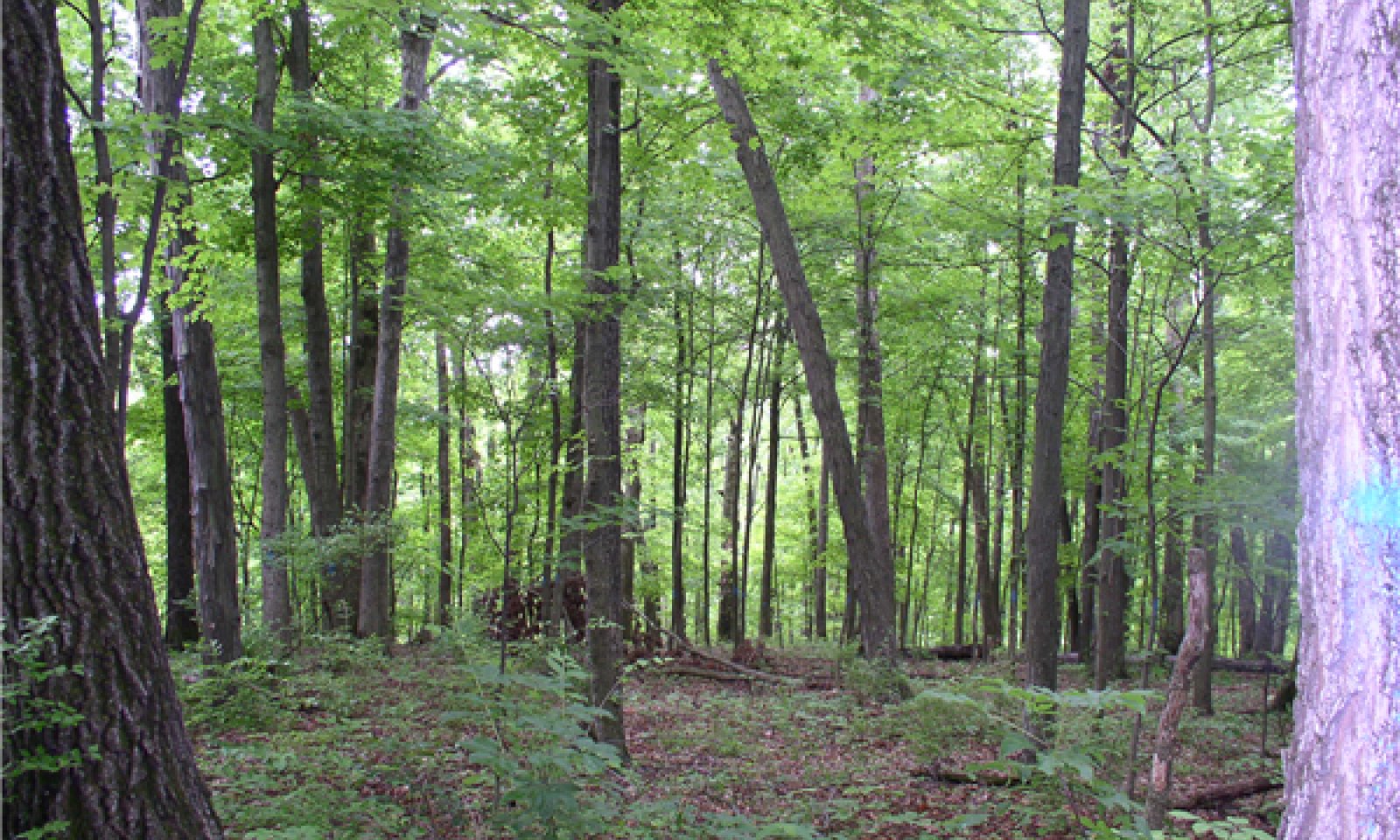
Shallow LImestone Oak-Hickory ForestThis state consists of three phases: mixed oak-hickory forest, oak-maple-hickory forest, and early successional eastern red cedar woodland. Common species for more mature forested sites are chinkapin oak (Quercus muehlenbergii Engelm.), white oak (Quercus alba L.), and Shumard’s oak (Quercus shumardii Buckley), and northern red oak (Quercus rubra L.). Black oak (Quercus velutina Lam.) may be present.
Common hickory species are pignut (Carya glabra (Mill.) Sweet), mockernut (Carya alba (L.)Nutt.) and shagbark (Carya ovata (Mill.)K.Koch). Sugar maple (Acer saccharum Marsh.), white ash (Fraxinus americana L.), blue ash (Fraxinus quadrangulata Michx.), American elm (Ulmus americana) and slippery elm (Ulmus rubra) were also found on these sites.
The understory community, in the absence of invasive non-native vegetation, consists of a moderately diverse but not dense understory of native woodland plants, leaf litter, and usually surface rock. A defined shrub layer was not present, and tree seedling and samplings were common.Community 1.1
Shallow Limestone Oak-Hickory Forest
Figure 7. KYplotRivercliffs

Figure 8. KYdorman_rockoutcrop

Figure 9. KYplotH

Figure 10. KYplotKleber
Indicator species for this site included chinkapin oak (Quercus muehlenbergii Engelm.) and Shumard’s oak (Quercus shumardii Buckley). Shumard's oak is common throughout the Bluegrass region but virtually absent from the Appalachian section of Kentucky and infrequent in other parts of the state. White oak (Quercus alba L.) can also be found frequently on these sites. Other oaks present on this ecological site, but to a much lesser degree, are Northern red oak (Quercus rubra L.), and black oak (Quercus velutina Lam.).
Monitoring plots in both the Inner and Outer Bluegrass physiographic regions displayed subtle differences in species preferences. Scarlet oak was not found and black oak was rarely found in monitoring plots within the Inner Bluegrass region. Northern red oak was found in both regions but only on the more protected sites.
Hickories found on sites included pignut (Carya glabra), mockernut (Carya alba) and shagbark (Carya ovata). Pignut was common in monitoring plots in the Outer Bluegrass region and was less common in the Inner Bluegrass plots. Mockernut hickory grows throughout Kentucky and is commonly found on dry slopes/uplands. This species was found in multiple plots.
With light, mobile, wind-blown seeds and a high tolerance to shade, maples and ashes were also predominate species. Sugar maple (Acer saccharum Marsh.), white ash (Fraxinus americana L.), and blue ash (Fraxinus quadrangulata Michx.) were recorded on all sites visited. Frequent in the Bluegrass region of Kentucky, the blue ash is usually found on limestone rock outcrops or shallow, rocky limestone soils. It is easily identified by distinctive, winged branches. Although greatly reduced in number from the turn of the century, this species can be found on the limestone cliffs along the Kentucky River and other limestone hillsides throughout the Bluegrass. American elm (Ulmus americana) and slippery elm (Ulmus rubra) were also found on these sites.
The understory community for this phase included a light to moderate layer of native woodland plants and substantial leaf litter. Surface rock may be present. A well-defined shrub layer is not usually present. Successful regeneration of multiple tree species, including oak and hickories, was occurring in the understory.Forest overstory.The overstory composition for this phase consists of chinkapin oak, Shumards oak, white oak, sugar maple, white ash, blue ash, shagbark hickory, mockernut hickory, American elm and/or slippery elm. Black oak, northern red oak, scarlet, and bitternut hickory were infrequent on these sites.
Forest understory. The typical understory composition for these sites are leaf litter, surface rock, and a light herbaceous layer of native Kentucky woodland plants such as snakeroot, bignonia (crossvine) agrimony, sedges, violets, ferns, spleenworts, grape,and Virginia creeper. Sites were protected from grazing, logging, and heavy recreational uses, so the understory was especially beautiful in the early spring when native wildflowers covered the forest floor. A well-defined shrub layer was not present. Understory seedling and/or sapling trees included sugar maple, elms, ashes, oaks, and hickories. Cedar seedlings scattered on site. Ohio buckeye, eastern red cedar, and slippery elm were not uncommon.
Table 5. Soil surface cover
Tree basal cover 0-0% Shrub/vine/liana basal cover 0% Grass/grasslike basal cover 0% Forb basal cover 0% Non-vascular plants 0-0% Biological crusts 0% Litter 30-60% Surface fragments >0.25" and <=3" 0-10% Surface fragments >3" 10-10% Bedrock 0-20% Water 0% Bare ground 10-20% Table 6. Woody ground cover
Downed wood, fine-small (<0.40" diameter; 1-hour fuels) 1-1% Downed wood, fine-medium (0.40-0.99" diameter; 10-hour fuels) 1-2% Downed wood, fine-large (1.00-2.99" diameter; 100-hour fuels) 1-1% Downed wood, coarse-small (3.00-8.99" diameter; 1,000-hour fuels) 1-2% Downed wood, coarse-large (>9.00" diameter; 10,000-hour fuels) 1-5% Tree snags** (hard***) – Tree snags** (soft***) – Tree snag count** (hard***) 0-0 per acre Tree snag count** (hard***) 0-0 per acre * Decomposition Classes: N - no or little integration with the soil surface; I - partial to nearly full integration with the soil surface.
** >10.16cm diameter at 1.3716m above ground and >1.8288m height--if less diameter OR height use applicable down wood type; for pinyon and juniper, use 0.3048m above ground.
*** Hard - tree is dead with most or all of bark intact; Soft - most of bark has sloughed off.
Table 7. Canopy structure (% cover)
Height Above Ground (ft) Tree Shrub/Vine Grass/
GrasslikeForb <0.5 1-5% 1-5% 1-5% 2-25% >0.5 <= 1 1-10% 5-10% 1-10% 5-15% >1 <= 2 5-15% 5-15% 1-15% 2-15% >2 <= 4.5 5-15% 1-5% – – >4.5 <= 13 5-15% 0-5% – – >13 <= 40 5-20% – – – >40 <= 80 50-70% – – – >80 <= 120 30-50% – – – >120 – – – – Community 1.2
Shallow Limestone Oak-Maple Forest
Figure 11. chinkapin-maple-elm community on Fairmount mapunit
This phase is characterized by hardwoods overtopping the eastern red cedar of phase 1.3. Tree species include chinkapin oak, Shumard oak, white oak, sugar maple, white ash, blue ash, American elm, slippery elm, and hickories. Quick growing and shade-tolerant, sugar maple and ash are usually an important component of this phase.
Removal of the hardwood trees will result in a transition back to phase 1.3 and a re-dominance of eastern red cedar. Once the hardwoods begin to completely overtop the cedars, shade mortality reduces cedar numbers allowing hardwood dominance and phase 1.3 will transition to phase 1.2. Phase 1.2 will transition with time phase 1.1 as the shallow, droughty, rocky limestone soils found on these specific sites favor oak-hickory dominance. Drought years will reduce the number of maples allowing mast species to favorably compete in the long-term.Forest overstory.Overstory composition for this community consisted mainly of chinkapin oak, sugar maple, and Shumard oak. Some sites had white oak, mockernut hickory, shagbark hickory, and American elm. Sugar maple is a major component in this phase. Shade tolerant, adaptable, and quick growing, this species is very competitive on these ecological sites in non-drought years or in more protected sites. This phase had a higher sugar maple canopy cover, basal area, and regeneration rate than the other State 1 phases.
Forest understory. The understory composition for these sites includes leaf litter, usually some surface rock, and a diverse but not dense herbaceous layer of native Kentucky woodland plants such as snakeroot, bignonia (crossvine) agrimony, ticktrefoils, sedges, violets, ferns, spleenworts, frost or summer grape, and Virginia creeper. A well-defined shrub layer was not present on these sites. Understory seedling and sapling trees included sugar maple, elms, ashes, oaks, and hickories. Cedar seedlings were usually on site. Ohio buckeye, eastern red cedar, and slippery elm were not uncommon.
Table 8. Canopy structure (% cover)
Height Above Ground (ft) Tree Shrub/Vine Grass/
GrasslikeForb <0.5 1-1% 1-3% 1-3% 5-15% >0.5 <= 1 1-5% 1-2% 1-10% 5-15% >1 <= 2 1-5% 1-5% 1-10% 2-10% >2 <= 4.5 5-25% 0-1% – – >4.5 <= 13 10-40% 0-1% – – >13 <= 40 10-45% – – – >40 <= 80 50-70% – – – >80 <= 120 10-50% – – – >120 – – – – Community 1.3
Shallow Limestone Cedar Woodland
Figure 12. Eastern red cedar grove -old fescue pasture-Fairmount soils

Figure 13. Fairmount hillside with previously cleared sites overtaken by eastern red cedar

Figure 14. Hardwoods overtopping cedars on Cynthiana soil
Rocky limestone soils are typified by successional communities of dense eastern red cedar. This community is the natural next step from the transitional field state (state 4). This phase also occurs where timber harvests have removed the overstory hardwoods or other disturbances (fire, wind damage, etc.) have occurred. Eastern red cedar prefers dry rocky hillsides and thrives in open fields, limestone glades, and limestone outcrops. Waiting for sunlight and release, multiple species of hardwood seedling and sapling are usually in the understory including sugar maple, white ash, white oak, chinkapin oak, red oaks, American elm, slippery elm, and hickories. Understory composition of oaks and hickories were dependent on available seed sources. This is an important consideration for landowners wishing to transition from either pasture or transitional field states. Long-term pasture may not have the desired oak and hickory seed sources on site and oak-hickory plantings may be necessary. Light, wind-blown seeds from sugar maple, elm, hackberry, and ash will naturally be present on most sites. Timber stand improvement activities may be recommended to favor regeneration of oak-hickory.
Forest overstory.This successional community is typified by an overstory composition of dense eastern red cedar. Cedars can thrive in the shallow, often droughty, soils included in this ESD and are the primary pioneer tree on abandoned farmland.
Forest understory. Due to shading, the forest understory composition of the shallow limestone cedar woodlands less diverse than phases 1.1 or 1.2. Phase 1.3 were often abandoned cool-season grass pastures, so fescue or other planted pasture grasses were still a major component of the understory for these communities.
Table 9. Ground cover
Tree foliar cover 0-0% Shrub/vine/liana foliar cover 0% Grass/grasslike foliar cover 20-40% Forb foliar cover 0-10% Non-vascular plants 0% Biological crusts 0% Litter 20-40% Surface fragments >0.25" and <=3" 0-10% Surface fragments >3" 0-0% Bedrock 0-0% Water 0% Bare ground 0-20% Table 10. Canopy structure (% cover)
Height Above Ground (ft) Tree Shrub/Vine Grass/
GrasslikeForb <0.5 0-1% 0-1% 1-5% 1-1% >0.5 <= 1 1-2% 0-1% 5-10% 1-3% >1 <= 2 1-5% 0-1% 5-25% 1-3% >2 <= 4.5 1-10% – – – >4.5 <= 13 10-15% – – – >13 <= 40 50-85% – – – >40 <= 80 20-75% – – – >80 <= 120 – – – – >120 – – – – Pathway 1.1A
Community 1.1 to 1.2
Shallow Limestone Oak-Hickory Forest
Shallow Limestone Oak-Maple ForestSelective harvest of the larger oak and hickory trees will shift this phase to 1.2. With the removal of mast species and the additional sunlight, sugar maple often increases. In some locations, sugar maple seedling and sapling can be dense.
Conservation practices
Brush Management Fence Access Control Tree/Shrub Site Preparation Tree/Shrub Establishment Forest Stand Improvement Forest Management Plan - Applied Herbaceous Weed Control Pathway 1.1B
Community 1.1 to 1.3
Shallow Limestone Oak-Hickory Forest
Shallow Limestone Cedar WoodlandDisturbances such as logging will result in phase 1.1 moving to phase 1.3. Removal of hardwoods will open the canopy allowing the eastern red cedar to regenerate. Post disturbance management options include allowing regeneration throughout natural succession, direct planting of oak and hickory species and control of eastern red cedar, bush honeysuckle and invasive vegetation control, and forest and wildlife management planning based on landowner objectives.
Conservation practices
Brush Management Upland Wildlife Habitat Management Early Successional Habitat Development/Management Forest Stand Improvement Forest Management Plan - Applied Pathway 1.2A
Community 1.2 to 1.1
Shallow Limestone Oak-Maple Forest
Shallow Limestone Oak-Hickory ForestThis natural transition occurs during prolonged dry periods. Oak and hickory species typical for these sites are better adapted to surviving periods of drought compared to sugar maple. Unlike the moderately deep or deep soil sites which were visibly transitioning to sugar maple, the shallow, rocky soil sites described within this ecological site were still dominated by drought-resistant oaks and hickories on the majority of sites. These sites are at risk due to the invasion of bush honeysuckle (see transition T1.B).
Conservation practices
Brush Management Forest Management Plan - Applied Pathway 1.3A
Community 1.3 to 1.2
Shallow Limestone Cedar Woodland
Shallow Limestone Oak-Maple ForestThis phase consists of oaks, hickories, maples, elms, and ashes that have reached a height to overtop the eastern red cedars. The young trees have escaped the shaded environment of the red cedar canopy. Oak and hickory species numbers will depend on local seed sources while the light, windblown seeds of maples, ashes, and elms were often dense on monitored sites as these species are better adapted to growing under the dense shade of cedar. Eastern redbud (<a class="species-link" href="https://plants.usda.gov/core/profile?symbol=CECA4" target="_blank" title="Open in plants.usda.gov"><i>Cercis canadensis</i></a> L.) was frequently found in these mid-successional communities.
Conservation practices
Brush Management Fence Access Control Forest Stand Improvement Forest Management Plan - Applied Herbaceous Weed Control State 2
Planted pastureThis state varies greatly in species composition depending on management and specific site characteristics such as slope, rock content, and soil depth which can range between 10 to 20 inches. The pasture sites on Fairmount and Cynthiana mapunits were on lower slope sites. Pastures were predominately fescue (Festuca arundinacea). These shallow soil sites lie over limestone or limestone and calcareous shale parent material. They are droughty with moderately slow to slow permeability on slopes. Therefore, a good plant cover is needed at all times to reduce runoff and protect against soil erosion. Grazing should be regulated on sites to maintain a minimum plant height with periods of rest to allow adequate regrowth and avoid erosion.
Community 2.1
Managed pasture
Figure 15. Fairmount, min slope, mowed annually, mged graze
This community phase is characterized by a high level of management that includes some combination of seeding, mowing, fertilizing, controlled grazing, and weed control. Species and production levels varied greatly on the sites visited and were dependent on landowner objectives and management. Sites visited were mowed annually or bi-annually, fertilized periodically, usually had slopes of less than 15 percent, had little or no visible rock outcrops, and were predominately seeded in tall fescue. Managed sites were only found on a few lower slope areas where mechanical management was feasible. Production on these sites varied depending on specific site conditions, type of grass seeded, the level of use, and the type of management. Estimated pasture production levels for specific soil map units is available in the USDA-NRCS county soil surveys.
Table 11. Ground cover
Tree foliar cover 0% Shrub/vine/liana foliar cover 0-0% Grass/grasslike foliar cover 90-100% Forb foliar cover 0-10% Non-vascular plants 0% Biological crusts 0% Litter 0% Surface fragments >0.25" and <=3" 0-0% Surface fragments >3" 0-0% Bedrock 0% Water 0% Bare ground 0% Table 12. Canopy structure (% cover)
Height Above Ground (ft) Tree Shrub/Vine Grass/
GrasslikeForb <0.5 – – 10-30% 1-5% >0.5 <= 1 – – 20-30% 1-5% >1 <= 2 – – 20-60% 1-5% >2 <= 4.5 – – 10-15% 1-10% >4.5 <= 13 – – – – >13 <= 40 – – – – >40 <= 80 – – – – >80 <= 120 – – – – >120 – – – – Community 2.2
Minimally managed pasture
Figure 16. min managed pasture grazed

Figure 17. Minimally managed pasture-ungrazed but mowed
Sites in this phase were under low-levels of management usually due in part to the steep slopes, high rock content, and shallow soils. Many of the minimally managed pasture sites had encroaching eastern red cedar, locust, multiflora rose, greenbriers, ironweed, and other non-grass species.
Sites were typically characterized by slopes of 15 percent or greater, visible surface rock, and soils 12 to 20 inches in depth. These characteristics made the pastures difficult to manage mechanically. Most sites showed signs of overgrazing.
Undesirable pasture species, including noxious weeds, were often present and soil erosion was commonly visible. As expected, the overgrazed sites had a lower percent grass cover, and increased percentage in bare ground, and a wider variety and greater number of invasive weed species.
Many pasture sites mapped as Fairmount and Cynthiana were investigated for this project and found to actually be complexes of shallow and moderately deep soils. Twenty pasture sites mapped as Cynthiana were visited, but after site-specific testing (depth probing), twelve of these sites were discovered to actually be a mixture of shallow and moderately deep soils, such as a Cynthiana-Faywood complex. Twenty Fairmount pasture sites were also visited. Sixteen of these twenty sites were actually a complex of shallow and moderately deep soils. In-depth species monitoring was conducted on sites testing as shallow (20" soil depth or less).
Graminoids included tall fescue (Schedonorus arundinaceus (Schreb.) Dumort., nom. cons.), Kentucky bluegrass (Poa pratensis L.), orchardgrass (Dactylis glomerata L.) timothy (Phleum pratense L.), smooth brome (Bromus inermis Leyss.), quackgrass (Elymus repens (L.) Gould), perennial ryegrass (Lolium perenne L.), reed Canarygrass (Phalaris arundinacea L.), foxtail barley (Hordeum jubatum L.), barnyardgrass (Echinochloa crus-galli (L.) P. Beauv) and yellow foxtail (Setaria pumila). Common velvet grass (Holcus lanatus L.) was present on two sites. Seeded forb/herb species on sites often included red clover (Trifolium pratense L.), white clover (Trifolium repens L.), and alfalfa (Medicago sativa L.).
The most common tree species on these sites was eastern red cedar (Juniperus virginiana L.). Other species found in monitored areas included greenbriers (Smilax L.), blackberries (Rubus L.), giant ironweed (Vernonia gigantea (Walter) Trel.), bull thistle (Cirsium vulgare (Savi) Ten.), Canada thistle (Cirsium arvense (L.) Scop.), spiny sowthistle (Sonchus asper (L.) Hill.), spiny amaranth (Amaranthus spinosus L.), buttercup spp. (Ranunculus L.), spiny cocklebur (Xanthium spinosum L.), rough cocklebur (Santhium strumarium L.), multiflora rose (Rosa multiflora), poison hemlock (Conium maculatum L.), common or lanceleaf ragweed (Ambrosia bidentata Michx.), common yarrow (Achillea millefolium L.), American pokeweed (Phytolacca americana L.), goldenrod spp. (Solidago L.), common dandelion (Taraxacum officinale F.H. Wigg.), Canadian horseweed (Conyza canadensis (L.) Cronquist), curly dock (Rumex crispus L.), Queen Anne’s lace (Daucus carota L.), jimsonweed (Datura stramonium L.), black medick (Medicago lupulina L.), Canadian horsenettle (Solanum carolinense L.), Amur (bush) honeysuckle (Lonicera maackii (Rupr.) Herder), black locust (Robinia pseudoacacia L.), mulberry (Morus L.), osage orange (Maclura pomifera (Raf.) C.K.), winged sumac (Rhus copallinum L.), common hackberry (Celtis occidentalis L.), black cherry (Prunus serotina Ehrh.), and honey locust (Gleditsia triacanthos L.).Table 13. Ground cover
Tree foliar cover 10-20% Shrub/vine/liana foliar cover 0-0% Grass/grasslike foliar cover 70-90% Forb foliar cover 10-20% Non-vascular plants 0% Biological crusts 0% Litter 0% Surface fragments >0.25" and <=3" 0-0% Surface fragments >3" 0-10% Bedrock 0-10% Water 0% Bare ground 0% Table 14. Canopy structure (% cover)
Height Above Ground (ft) Tree Shrub/Vine Grass/
GrasslikeForb <0.5 1-1% 1-1% 1-30% 1-1% >0.5 <= 1 1-1% 1-1% 20-50% 1-1% >1 <= 2 1-2% 1-1% 40-70% 1-15% >2 <= 4.5 1-50% 1-2% 0-5% 1-5% >4.5 <= 13 1-5% 1-3% – – >13 <= 40 – – – – >40 <= 80 – – – – >80 <= 120 – – – – >120 – – – – Pathway 2.1A
Community 2.1 to 2.2
Managed pasture
Minimally managed pastureWith a reduction or absence of management, these site will transition naturally to a minimally managed pasture. The vegetative component of the community will shift from a high percentage of grass to a community more native and invasive forbs and herbs. Tree seedlings/ and saplings, along with vines, will also increase in number and diversity. Future management and recommended conservation practices will depend on landowner goals.
Conservation practices
Fence Access Control Prescribed Grazing Pathway 2.2A
Community 2.2 to 2.1
Minimally managed pasture
Managed pastureSites under this project are typically not highly productive pastures due to the shallow, rocky soils; however, some of the lower sloping sites investigated were being utilized as pastureland. On these sites, landowners can make improvements to increase production and protect soil resources. Potential management inputs may include controlled grazing, brush removal, development of a grazing management plan, weed control, and installation of fencing and/or water facilities.
Conservation practices
Brush Management Pond Fence Access Control Forage Harvest Management Forage and Biomass Planting Livestock Pipeline Heavy Use Area Protection Spring Development Watering Facility Water Well Prescribed Grazing Stream Crossing Grazing Management Plan - Applied Herbaceous Weed Control State 3
Honeysuckle Invaded StateThis community is characterized by a midstory and understory dominated by Amur honeysuckle (Lonicera maackii (Rupr.) Herder). Japanese honeysuckle (Lonicera japonica Thunb.), another invasive plant, is often on this sites as well. Honeysuckle varieties were introduced to this country in the 1700s and 1800s as ornamentals; however, their growth form, adaptively, hardiness, and aggressiveness has resulted in dense thickets in forested areas and abandoned fields throughout the Bluegrass region.
Often this community has a mixed hardwood overstory that includes oaks, which predate the honeysuckle. A dense midstory of shade- tolerant species such as sugar maple, hackberry, elm, and white ash, is usually present. Juvenile oak and hickory trees were scarce on monitored sites due to the shading effect of the honeysuckle. In areas opened up by felled trees due to wind damage, timber harvest, or disturbance, honeysuckle was especially thick completely shading the forest floor. Honeysuckle is by far the dominant species in the midstory and understory of these communities. A limited number of sugar maple, hackberry, and white ash seedling were found within monitored plots, but oak-hickory regeneration was often completely absent.Community 3.1
Honeysuckle Invaded Woodland
Figure 18. Honeysuckle woodland 1

Figure 19. honeysuckle woodland 2

Figure 20. honeysuckle woodland 3
Chinkapin oak, sugar maple, and elms were the common overstory tree species on these sites. Sugar maple, white ash, and hackberry were dominant tree species in the midstory and understory. Some hillsides included white oak and hickories but these species were usually a minor component. Honeysuckle was the single dominant species in the lower midstory and understory effectively outcompeting and shading-out native understory plants.
The density and dominance of bush honeysuckle on these sites is sufficient to greatly reduce, or in severe cases, prohibit oak-hickory reproduction. The native herbaceous layer in woodlands is also negatively impacted. The low percentage of tree and forb cover is the direct result of the high percentage of shrub (honeysuckle) cover. On many monitored sites, oaks and hickories were absent. Forbs and grasses present were generally non-natives such as tall fescue (Schedonorus arundinaceus (Schreb. Dumort.), garlic mustard (Alliaria petiolata (M. Bieb.) Cavara & Grande), Japanese stiltgrass (Microstegium vimineum (Trin.) A. Camus.), and wintercreeper (Euonymus fortunei (Turcz.)Hand.-Maz). Shade-tolerant tree species such as sugar maple, white ash and hackberry were regenerating in monitored plots but limited in number.Forest overstory.Overstory composition for these sites consists of oaks and elms that pre-date the honeysuckle invasion along with sugar maple, hackberry, white ash and in few cases, hickory species.
Forest understory. Understory composition consists of honeysuckle species (Amur and Japanese honeysuckle). Oak and hickory regeneration is minimal to non-existent on these sites. Sugar maple regeneration is occuring but minimal. There is no typical forest community herbaceous layer due to the dense mid-story shading from the honeysuckle.
Table 15. Ground cover
Tree foliar cover 0-0% Shrub/vine/liana foliar cover 0-0% Grass/grasslike foliar cover 0-0% Forb foliar cover 0-0% Non-vascular plants 0-0% Biological crusts 0% Litter 30-50% Surface fragments >0.25" and <=3" 0-0% Surface fragments >3" 0-0% Bedrock 0-0% Water 0% Bare ground 20-30% Table 16. Canopy structure (% cover)
Height Above Ground (ft) Tree Shrub/Vine Grass/
GrasslikeForb <0.5 0-1% 1-3% 0-1% 0-1% >0.5 <= 1 0-1% 1-5% 0-1% 0-1% >1 <= 2 0-1% 2-4% – 0-1% >2 <= 4.5 0-1% 10-15% – – >4.5 <= 13 1-2% 35-65% – – >13 <= 40 1-5% 1-20% – – >40 <= 80 55-75% – – – >80 <= 120 0-10% – – – >120 – – – – State 4
Transitional FieldThis state is the result of pastureland being abandoned and eastern red cedar encroaching into the field. Black locust, honey locust, elms, oaks, and hackberry seedling and saplings were common depending on nearby seed sources. A variety of pasture grasses, weeds, and native forbs were found on these sites. Typically, this state is the natural transition between a managed pasture and an eastern red cedar woodland. Not yet woodland, but no longer a pasture, this successional state is characterized by diversity in plant height, density, and vegetation type (trees, shrubs, grasses, forbs, vines, etc.) thereby providing good wildlife habitat for many native species. These sites were often found on wildlife management areas in Kentucky that were previously a working farm but are now being allowed to naturally transition to a cedar woodland.
Community 4.1
Transitional Shallow Limestone Field
Figure 21. transitional field
This phase is the natural transition of a pastureland moving toward phase 1.3. Planted grasses, typically tall fescue (or a mix of planted grasses), still occupies a significant component of the plant community. Other grass species such as timothy, ryegrass, orchardgrass, Kentucky bluegrass, Johnsongrass, and bromegrass were often present. Eastern red cedar, black locust, honey locust, hackberry, elm, and oak seedling are usually present. Oak, hickory and walnut trees were on site if a nearby seed sources were available. Briars, berries, thistles, ironweed, and an array of herbs were typical for these sites.
This community phase is beneficial to many game species and was often found on wildlife management areas and on private property of landowners interested in hunting or wildlife viewing.
This phase is characterized by planted pasture grasses, an array of forbs and vines (both native and introduced), seedling hardwood trees, and young eastern red cedars. Eastern red cedar will eventually dominate moving this community to phase 1.3.Table 17. Ground cover
Tree foliar cover 10-10% Shrub/vine/liana foliar cover 0% Grass/grasslike foliar cover 60-80% Forb foliar cover 10-30% Non-vascular plants 0% Biological crusts 0% Litter 0% Surface fragments >0.25" and <=3" 0-0% Surface fragments >3" 0-0% Bedrock 0-0% Water 0% Bare ground 0% Table 18. Canopy structure (% cover)
Height Above Ground (ft) Tree Shrub/Vine Grass/
GrasslikeForb <0.5 0-1% 1-1% 1-5% 1-1% >0.5 <= 1 1-1% 1-1% 5-15% 1-2% >1 <= 2 1-1% 1-1% 20-65% 1-10% >2 <= 4.5 1-1% 1-1% 25-60% 1-15% >4.5 <= 13 1-50% – – 1-10% >13 <= 40 0-80% – – – >40 <= 80 – – – – >80 <= 120 – – – – >120 – – – – Transition T1A
State 1 to 2Substantial management inputs including tree removal and seeding of pasture grasses would move state 1 to state 2. This would be feasible on few sites included under this ESD, due to the steep slopes, surface rock, droughty shallow soils, potential for soil erosion and limited production rates.
Transition T1B
State 1 to 3The introduction of Amur or bush honeysuckle into oak-hickory woodlands has the potential to completely alter the future community of these sites. Once established, the density and dominance of honeysuckle is sufficient to prohibit oak and hickory regeneration and can entirely replace the native understory community. Introduced from Asia, these species are shade tolerant and form dense thickets in open woods and along forest edges. Honeysuckle plants are fast growing with seeds that germinate quickly in high percentages and are easily transmitted by wildlife and human activity such as road building, recreational uses, livestock grazing, and ground disturbance. Honeysuckle can aggressively spread via root sprouting and compared to many native plants, has longer flowering and seed production periods (Rathfon and Lowe, 2012). Once established, control of honeysuckle requires repeated treatments over multiple years. The seed bank under mature shrubs will remain viable for 2 to 6 years, requiring long-term control efforts. This species is severely impacting the natural composition of woodlands throughout central Kentucky.
Transition T1B
State 1 to 3The introduction of Amur or bush honeysuckle into oak-hickory woodlands has the potential to completely alter the future community of these sites. Once established the density and dominance of honeysuckle is sufficient to prohibit oak and hickory regeneration and can entirely replace the native understory community. Introduced from Asia, these species are shade tolerant and form dense thickets in open woods and along forest edges. Honeysuckle plants are fast growing with seeds that germinate quickly in high percentages and are easily transmitted by wildlife and human activity such as road building, recreational uses, livestock grazing, and ground disturbance. Honeysuckle can aggressively spread via root sprouting and compared to many native plants, has longer flowering and seed production periods (Rathfon and Lowe, 2012). Once established, control of honeysuckle requires repeated treatments over multiple years. The seed bank under mature shrubs will remain viable for 2 to 6 years, requiring long-term control efforts. This species is fundamentally changing the composition of woodlands throughout central Kentucky.
Transition T2A
State 2 to 4This is a natural transition from a pasture site to a transitional field. The planted pasture is being encroached upon by eastern red cedar, locusts, briars, other grasses, native forbs, and weeds.
Restoration pathway R3A
State 3 to 1The management inputs necessary to control bush honeysuckle are long-term and intensive. Control measures may include a variety of herbicide treatments (basal bark spray, foliar spray, stump injections, etc.), manual cutting or pulling of plants, mechanical brush removal, fire management, and biological controls. Hand pulling of seedlings is time consuming and tedious, but should be conducted when soils are moist as all of the root must be removed or re-sprouting will occur. Digging or grubbing out larger plants must be done with care, as bare, open soil will result in rapid re-invasion or re-sprouting. Extensive research has been conducted on the use of herbicides to control bush honeysuckle. Applying herbicide to cut stumps is one common treatment method for larger plants. Cutting should be avoided during the winter as it “prunes” the plants and encourages more vigorous resprouting. Research at Purdue University has shown that the herbicides Picloram and 2,4-D or 20 percent triclopyr ester in an oil carrier are highly effective for this method but follow-up treatments will be required. (Rathfon and Lowe, 2012). Landowners can obtain free technical information and assistance from their local NRCS office or university extension service in the selection and use of herbicides. Spring prescribed burning has been shown to kill bush honeysuckle seedlings and damage the tops of mature plants; however, these plants will easily re-sprout so it may be necessary to burn annually or biennially for five years or more for effective control. (Missouri Department of Conservation, 2011)
Conservation practices
Brush Management Fence Access Control Tree/Shrub Site Preparation Tree/Shrub Establishment Upland Wildlife Habitat Management Forest Stand Improvement Forest Management Plan - Applied Herbaceous Weed Control Restoration pathway R3B
State 3 to 2Low quality woodlands with dense honeysuckle could be transitioned to a pasture state on lower-slope sites. The cost and level of inputs for this restoration would depend on access, age of trees, density of honeysuckle and goals of the landowner. This restoration would be a long-term effort requiring planting of desired species and multiple years of brush and weed control.
Conservation practices
Brush Management Pond Fence Access Control Forage and Biomass Planting Livestock Pipeline Spring Development Watering Facility Water Well Forest Stand Improvement Prescribed Grazing Stream Crossing Grazing Management Plan - Applied Herbaceous Weed Control Restoration pathway R4A
State 4 to 1A transitional field will move naturally with time to an eastern red cedar woodland. However, depending on the length of time in pasture and the available seed sources naturally available, restoration activities may be required. Most long-term pasture sites will not have the oak-hickory seed source necessary to transition successfully to a mature oak-hickory forest. Tree planting, timber stand improvement activities (removal of less desirable tree species), weed and grass control, and planting of native understory species may be required to fully restore this community.
Conservation practices
Fence Access Control Prescribed Grazing Forest Management Plan - Applied Restoration pathway R4B
State 4 to 2With management inputs, the transitional field state could be restored back to a pasture state. Tree removal, mowing, weed control, seeding, and fertilizing may be required. Because this ecological site description includes rocky sites with soil depths of 10 to 20 inches, landowners should be advised to consider their site characteristics carefully. Many of these transitional field sites were previously pasture and were abandoned becuase of low productivity and difficulty in management due to slope and rock content. Control of cedar, if so desired, can be accomplished by burning, chemical control, or manual removal. Eastern red cedar seedlings and saplings are very susceptible to fire with winter or spring burning usually recommended as the leaf water content is lower. However, research has shown burning is most effective on cedars up to 1m tall (3.3 feet) although larger trees can be occasionally killed (Anderson, 2003). Burning is not without complications including incomplete control, narrow window of conditions, need for grazing management (pre and post burn), and risk of fire escape.
Conservation practices
Conservation Cover Critical Area Planting Fence Access Control Forage and Biomass Planting Livestock Pipeline Watering Facility Water Well Grazing Management Plan - Applied Herbaceous Weed Control Additional community tables
Table 19. Community 1.1 plant community composition
Group Common name Symbol Scientific name Annual production () Foliar cover (%) Table 20. Community 1.1 forest overstory composition
Common name Symbol Scientific name Nativity Height ft Canopy cover (%) Diameter in Basal area (square ft/acre) Treesugar maple ACSA3 Acer saccharum Native 25-85 15-50 16-18.5 0 chinquapin oak QUMU Quercus muehlenbergii Native 30-85 20-40 18-22 0 Shumard's oak QUSH Quercus shumardii Native 27-90 15-40 18-21 0 white oak QUAL Quercus alba Native 30-90 15-30 17-19 0 shagbark hickory CAOV2 Carya ovata Native 25-75 0-25 16-18 0 Table 21. Community 1.1 forest understory composition
Common name Symbol Scientific name Nativity Height (ft) Canopy cover (%) Grass/grass-like (Graminoids)hairy woodland brome BRPU6 Bromus pubescens Native 0.2–1.5 1–3 Bosc's panicgrass DIBO2 Dichanthelium boscii Native 0.2–1 0–2 eastern bottlebrush grass ELHY Elymus hystrix Native 0.2–1 0–1 Forb/Herbcelandine poppy STDI3 Stylophorum diphyllum Native 0.2–1.1 5–30 dwarf larkspur DETR Delphinium tricorne Native 0.1–0.6 5–25 cutleaf toothwort CACO26 Cardamine concatenata Native 0.2–0.8 1–20 mayapple POPE Podophyllum peltatum Native 0.5–1 1–20 white snakeroot AGALA Ageratina altissima var. altissima Native 0.5–2 10–20 sedge CAREX Carex Native 0–1 5–15 blisterwort RARE2 Ranunculus recurvatus Native 0.3–0.5 1–15 harbinger of spring ERBU Erigenia bulbosa Native 0.2–0.4 5–15 yellow fumewort COFL3 Corydalis flavula Native 0.2–1 1–10 wild comfrey CYVI Cynoglossum virginianum Native 0.1–1.5 2–10 Virginia springbeauty CLVI3 Claytonia virginica Native 0.1–0.6 1–10 Canadian blacksnakeroot SACA15 Sanicula canadensis Native 0.2–0.8 1–10 bellwort UVULA Uvularia Native 0.3–0.8 0–10 early meadow-rue THDI Thalictrum dioicum Native 0.2–0.7 0–10 rue anemone THTH2 Thalictrum thalictroides Native 0.2–0.7 0–10 toadshade TRSE2 Trillium sessile Native 0.4–0.6 0–5 goldenseal HYCA Hydrastis canadensis Native 0.4–0.5 0–5 clustered blacksnakeroot SAOD Sanicula odorata Native 0.2–0.8 0–5 soft agrimony AGPU Agrimonia pubescens Native 0.2–0.5 1–5 pointedleaf ticktrefoil DEGL5 Desmodium glutinosum Native 0.1–1 1–5 eastern false rue anemone ENBI Enemion biternatum Native 0.1–0.5 1–5 spring blue eyed Mary COVE2 Collinsia verna Native 0.1–0.5 1–5 wild blue phlox PHDI5 Phlox divaricata Native 0.2–1.5 0–5 Virginia snakeroot ARSE3 Aristolochia serpentaria Native 0.1–0.6 1–3 crossvine BICA Bignonia capreolata Native 0–0.5 1–3 dutchman's breeches DICU Dicentra cucullaria Native 0.3–0.9 0–2 beaked agrimony AGRO3 Agrimonia rostellata Native 0.3–0.8 1–2 hairy alumroot HEVI2 Heuchera villosa Native 0.3–0.6 0–2 feathery false lily of the valley MARA7 Maianthemum racemosum Native 0.2–0.7 0–2 downy pagoda-plant BLCI Blephilia ciliata Native 0.4–1.5 1–2 smallspike false nettle BOCY Boehmeria cylindrica Native 0.5–1.5 1–2 spring avens GEVE Geum vernum Native 0.1–2 0–1 white avens GECA7 Geum canadense Native 0.1–1.6 0–1 woodland sunflower HEDI2 Helianthus divaricatus Native 0.2–1 0–1 sharplobe hepatica HENOA Hepatica nobilis var. acuta Native 0.3–0.9 0–1 roundlobe hepatica HENOO Hepatica nobilis var. obtusa Native 0.2–0.9 0–1 hairy alumroot HEVI2 Heuchera villosa Native 0.3–1 0–1 panicledleaf ticktrefoil DEPA6 Desmodium paniculatum Native 0.3–2 1 fourleaf yam DIQU Dioscorea quaternata Native 0.2–1.5 0–1 Virginia strawberry FRVI Fragaria virginiana Native 0.1–0.3 1 cream avens GEVI4 Geum virginianum Native 0.1–2 0–1 crinkleroot CADI10 Cardamine diphylla Native 0.2–0.5 1 Clayton's sweetroot OSCL Osmorhiza claytonii Native 0.3–2 0–1 spring forget-me-not MYVE Myosotis verna Native 0.2–0.5 0–1 roundleaf ragwort PAOB6 Packera obovata Native 0.1–1.5 0–1 limestone wild petunia RUST2 Ruellia strepens Native 0.3–0.7 0–1 smooth rockcress ARLA Arabis laevigata Native 0.1–0.4 0–1 early saxifrage SAVI5 Saxifraga virginiensis Native 0.1–1 0–1 woodland stonecrop SETE3 Sedum ternatum Native 0.1–0.3 0–1 Greek valerian PORE2 Polemonium reptans Native 0.2–0.6 0–1 smooth Solomon's seal POBI2 Polygonatum biflorum Native 0.3–1.5 0–1 Canadian woodnettle LACA3 Laportea canadensis Native 0.2–2 0–1 jumpseed POVI2 Polygonum virginianum Native 0.3–1.5 0–1 Christmas fern POAC4 Polystichum acrostichoides Native 0.1–1.2 0–1 rock buttercup RAMI2 Ranunculus micranthus Native 0.1–1 0–1 licorice bedstraw GACI2 Galium circaezans Native 0.2–0.5 0–1 shining bedstraw GACO3 Galium concinnum Native 0.1–0.5 0–1 wavyleaf aster SYUN Symphyotrichum undulatum Native 0.2–1 0–1 Jack in the pulpit ARTR Arisaema triphyllum Native 0.5–0.8 0–1 wreath goldenrod SOCA4 Solidago caesia Native 0.2–1.2 0–1 zigzag goldenrod SOFL2 Solidago flexicaulis Native 0.2–1.2 0–1 common blue wood aster SYCO4 Symphyotrichum cordifolium Native 0.2–1 0–1 late purple aster SYPA11 Symphyotrichum patens Native 0.2–1 0–1 twinleaf JEDI Jeffersonia diphylla Native 0.2–1 0–1 fire pink SIVI4 Silene virginica Native 0.1–0.5 0–1 stickywilly GAAP2 Galium aparine Native 0.1–0.4 0–1 bloodroot SACA13 Sanguinaria canadensis Native 0.1–0.2 0–1 white fawnlily ERAL9 Erythronium albidum Native 0.1–0.2 0–1 limestone bittercress CADO Cardamine douglassii Native 0.1–0.2 0–1 Fern/fern allyebony spleenwort ASPL Asplenium platyneuron Native 0.2–1 1–2 walking fern ASRH2 Asplenium rhizophyllum Native 0.2–0.8 0–1 rattlesnake fern BOVI Botrychium virginianum Native 0.2–1 1 Treesugar maple ACSA3 Acer saccharum Native 0.5–2 10–15 chinquapin oak QUMU Quercus muehlenbergii Native 8–15 0–10 sugar maple ACSA3 Acer saccharum Native 8–15 1–10 white ash FRAM2 Fraxinus americana Native 8–15 0–5 Shumard's oak QUSH Quercus shumardii Native 0.5–2 0–5 shagbark hickory CAOV2 Carya ovata Native 0.5–1.5 1–5 white ash FRAM2 Fraxinus americana Native 0.5–2 1–5 blue ash FRQU Fraxinus quadrangulata Native 0.5–1 0–3 chinquapin oak QUMU Quercus muehlenbergii Native 0.5–1.5 1–2 shagbark hickory CAOV2 Carya ovata Native 5–10 0–1 blue ash FRQU Fraxinus quadrangulata Native 8–15 0–1 mockernut hickory CATO6 Carya tomentosa Native 0.5–2 0–1 Ohio buckeye AEGL Aesculus glabra Native 5–8 0–1 eastern redbud CECA4 Cercis canadensis Native 8–15 0–1 eastern redcedar JUVI Juniperus virginiana Native 0.5–1 0–1 American elm ULAM Ulmus americana Native 0.5–1.5 0–1 slippery elm ULRU Ulmus rubra Native 0.5–1.5 0–1 Vine/LianaVirginia creeper PAQU2 Parthenocissus quinquefolia Native 0.5–20 1–5 eastern poison ivy TORA2 Toxicodendron radicans Native 0.1–0.5 0–2 roundleaf greenbrier SMRO Smilax rotundifolia Native 0.1–5 0–1 bristly greenbrier SMTA2 Smilax tamnoides Native 0.1–5 0–1 summer grape VIAE Vitis aestivalis Native 1–12 0–1 frost grape VIVU Vitis vulpina Native 0.5–10 0–1 Table 22. Community 1.2 plant community composition
Group Common name Symbol Scientific name Annual production () Foliar cover (%) Table 23. Community 1.2 forest overstory composition
Common name Symbol Scientific name Nativity Height ft Canopy cover (%) Diameter in Basal area (square ft/acre) Treesugar maple ACSA3 Acer saccharum Native 15-72 50-80 15-19 0 chinquapin oak QUMU Quercus muehlenbergii Native 40-73 20-35 16-17 0 white oak QUAL Quercus alba Native 40-75 10-30 15-18 0 Shumard's oak QUSH Quercus shumardii Native 40-70 20-25 16-18 0 Table 24. Community 1.2 forest understory composition
Common name Symbol Scientific name Nativity Height (ft) Canopy cover (%) Grass/grass-like (Graminoids)sedge CAREX Carex Native 0.1–0.5 1–5 Forb/HerbVirginia springbeauty CLVI3 Claytonia virginica Native 0.1–0.5 1–15 white snakeroot AGALA Ageratina altissima var. altissima Native 0.5–2 10–15 Canadian blacksnakeroot SACA15 Sanicula canadensis Native 0.2–0.6 1–15 dwarf larkspur DETR Delphinium tricorne Native 0.1–0.5 5–10 harbinger of spring ERBU Erigenia bulbosa Native 0.2–0.4 5–10 mayapple POPE Podophyllum peltatum Native 0.5–0.7 1–10 cutleaf toothwort CACO26 Cardamine concatenata Native 0.2–0.6 1–7 clustered blacksnakeroot SAOD Sanicula odorata Native 0.2–0.8 1–5 bellwort UVULA Uvularia Native 0.3–0.8 0–5 toadshade TRSE2 Trillium sessile Native 0.4–0.5 1–5 early meadow-rue THDI Thalictrum dioicum Native 0.3–0.5 0–5 yellow fumewort COFL3 Corydalis flavula Native 0.2–1 1–5 soft agrimony AGPU Agrimonia pubescens Native 0.2–0.5 1–5 goldenseal HYCA Hydrastis canadensis Native 0.4–1 0–5 blisterwort RARE2 Ranunculus recurvatus Native 0.4–0.6 0–5 spring blue eyed Mary COVE2 Collinsia verna Native 0.1–0.5 1–5 wild blue phlox PHDI5 Phlox divaricata Native 0.2–1.5 0–5 celandine poppy STDI3 Stylophorum diphyllum Native 0.2–1 1–3 Virginia snakeroot ARSE3 Aristolochia serpentaria Native 0.1–0.5 1–3 crossvine BICA Bignonia capreolata Native 0.1–0.4 1–3 pointedleaf ticktrefoil DEGL5 Desmodium glutinosum Native 0.2–1 0–3 feathery false lily of the valley MARA7 Maianthemum racemosum Native 0.3–1.5 0–2 spring avens GEVE Geum vernum Native 0.1–2 1–2 cream avens GEVI4 Geum virginianum Native 0.1–2 0–2 Canadian woodnettle LACA3 Laportea canadensis Native 0.3–2 0–2 smallspike false nettle BOCY Boehmeria cylindrica Native 0.5–1.5 1–2 fourleaf yam DIQU Dioscorea quaternata Native – 0–1 fourleaf yam DIQU Dioscorea quaternata Native 0.2–1.5 0–1 roundleaf ragwort PAOB6 Packera obovata Native 0.1–1.5 0–1 Clayton's sweetroot OSCL Osmorhiza claytonii Native 0.3–2 0–1 white avens GECA7 Geum canadense Native 0.1–1.2 0–1 panicledleaf ticktrefoil DEPA6 Desmodium paniculatum Native 0.4–2 0–1 stickywilly GAAP2 Galium aparine – 0.6–1.3 0–1 stickywilly GAAP2 Galium aparine Native 0.1–0.4 0–1 white fawnlily ERAL9 Erythronium albidum Native 0.1–0.2 0–1 bloodroot SACA13 Sanguinaria canadensis Native 0.1–0.6 0–1 hairy alumroot HEVI2 Heuchera villosa Native 0.3–0.8 0–1 Jack in the pulpit ARTR Arisaema triphyllum Native 0.4–0.6 0–1 downy pagoda-plant BLCI Blephilia ciliata Native 0.3–2 0–1 wild comfrey CYVI Cynoglossum virginianum Native 0.1–2 0–1 sharplobe hepatica HENOA Hepatica nobilis var. acuta Native 0.3–0.9 0–1 roundlobe hepatica HENOO Hepatica nobilis var. obtusa Native 0.2–0.8 0–1 beaked agrimony AGRO3 Agrimonia rostellata Native 0.2–0.6 0–1 smooth Solomon's seal POBI2 Polygonatum biflorum Native 0.2–1 0–1 jumpseed POVI2 Polygonum virginianum Native 0.2–1 0–1 crinkleroot CADI10 Cardamine diphylla Native 0.2–0.5 0–1 spring forget-me-not MYVE Myosotis verna Native 0.2–0.5 0–1 licorice bedstraw GACI2 Galium circaezans Native 0.2–0.5 0–1 shining bedstraw GACO3 Galium concinnum Native 0.1–0.5 0–1 hairy alumroot HEVI2 Heuchera villosa Native 0.2–0.5 0–1 Greek valerian PORE2 Polemonium reptans Native 0.2–0.5 0–1 squirrel corn DICA Dicentra canadensis Native 0.3–1 0–1 eastern false rue anemone ENBI Enemion biternatum Native 0.1–0.5 0–1 rue anemone THTH2 Thalictrum thalictroides Native 0.2–0.5 0–1 Fern/fern allyebony spleenwort ASPL Asplenium platyneuron Native 0.2–1 1 walking fern ASRH2 Asplenium rhizophyllum Native 0.1–0.5 0–1 bladderfern CYSTO Cystopteris Native 0.2–0.8 0–1 Christmas fern POAC4 Polystichum acrostichoides Native 0.2–1 0–1 Treesugar maple ACSA3 Acer saccharum Native 0.5–2 2–10 sugar maple ACSA3 Acer saccharum Native 3–10 1–5 Shumard's oak QUSH Quercus shumardii Native 0.5–2 0–1 white oak QUAL Quercus alba Native 0.5–2 0–1 white oak QUAL Quercus alba Native 3–6 0–1 elm ULMUS Ulmus Native 0.5–1.5 0–1 elm ULMUS Ulmus Native 3–5 0–1 white ash FRAM2 Fraxinus americana Native 1–3 0–1 white ash FRAM2 Fraxinus americana Native 7–12 0–1 blue ash FRQU Fraxinus quadrangulata Native 2–4 0–1 shagbark hickory CAOV2 Carya ovata Native 1–2.5 0–1 shagbark hickory CAOV2 Carya ovata Native 4–7 0–1 mockernut hickory CATO6 Carya tomentosa Native 5–9 0–1 eastern redcedar JUVI Juniperus virginiana Native 0.5–1 0–1 eastern redbud CECA4 Cercis canadensis Native 0.5–2 0–1 eastern redbud CECA4 Cercis canadensis Native 5–12 0–1 Shumard's oak QUSH Quercus shumardii Native 7–12 0–1 Vine/LianaVirginia creeper PAQU2 Parthenocissus quinquefolia Native 0.5–10 1 frost grape VIVU Vitis vulpina Native 0.5–5 0–1 roundleaf greenbrier SMRO Smilax rotundifolia Native 0.5–2 0–1 bristly greenbrier SMTA2 Smilax tamnoides Native 0.3–2 0–1 eastern poison ivy TORA2 Toxicodendron radicans Native 0.3–0.5 0–1 summer grape VIAE Vitis aestivalis Native 0.5–10 0–1 Table 25. Community 1.3 plant community composition
Group Common name Symbol Scientific name Annual production () Foliar cover (%) Table 26. Community 1.3 forest overstory composition
Common name Symbol Scientific name Nativity Height ft Canopy cover (%) Diameter in Basal area (square ft/acre) Treeeastern redcedar JUVI Juniperus virginiana Native 5-35 80-90 2-12 0 Table 27. Community 1.3 forest understory composition
Common name Symbol Scientific name Nativity Height (ft) Canopy cover (%) Grass/grass-like (Graminoids)tall fescue SCAR7 Schedonorus arundinaceus Introduced 0.1–1 20–40 sedge CAREX Carex Native 0.1–0.5 1–5 Forb/Herblespedeza LESPE Lespedeza Introduced 0.2–1.2 0–5 Canadian blacksnakeroot SACA15 Sanicula canadensis Native 0.1–0.7 1–2 eastern poison ivy TORA2 Toxicodendron radicans Native 0.1–0.5 1–2 Virginia creeper PAQU2 Parthenocissus quinquefolia Native 0.1–0.5 1–2 white snakeroot AGALA Ageratina altissima var. altissima Native 0.2–1 1–2 ebony spleenwort ASPL Asplenium platyneuron Native 0.1–0.7 0–1 Fern/fern allyebony spleenwort ASPL Asplenium platyneuron Native 0.1–0.7 0–1 Shrub/Subshrubmultiflora rose ROMU Rosa multiflora Introduced 0.3–1 0–1 Treesugar maple ACSA3 Acer saccharum Native 1–2 1–10 eastern redbud CECA4 Cercis canadensis Native 5–10 1–5 chinquapin oak QUMU Quercus muehlenbergii Native 1–3 1–2 white ash FRAM2 Fraxinus americana Native 0.5–1 1–2 black locust ROPS Robinia pseudoacacia Native 0.3–1 0–1 honeylocust GLTR Gleditsia triacanthos Native 0.3–1 0–1 eastern redbud CECA4 Cercis canadensis Native 0.5–1 1 blue ash FRQU Fraxinus quadrangulata Native 1–2 0–1 Vine/Lianafrost grape VIVU Vitis vulpina Introduced 0.5–2 0–1 bristly greenbrier SMTA2 Smilax tamnoides Native 0.2–1 0–1 Table 28. Community 2.1 plant community composition
Group Common name Symbol Scientific name Annual production () Foliar cover (%) Table 29. Community 2.2 plant community composition
Group Common name Symbol Scientific name Annual production () Foliar cover (%) Table 30. Community 3.1 plant community composition
Group Common name Symbol Scientific name Annual production () Foliar cover (%) Table 31. Community 3.1 forest overstory composition
Common name Symbol Scientific name Nativity Height ft Canopy cover (%) Diameter in Basal area (square ft/acre) Treecommon hackberry CEOC Celtis occidentalis Native 22-68 0-50 9-17 0 sugar maple ACSA3 Acer saccharum Native 30-80 20-50 17-20 0 chinquapin oak QUMU Quercus muehlenbergii Native 35-85 20-45 18-21 0 American elm ULAM Ulmus americana Native 27-78 0-20 15-18 0 Table 32. Community 3.1 forest understory composition
Common name Symbol Scientific name Nativity Height (ft) Canopy cover (%) Grass/grass-like (Graminoids)Nepalese browntop MIVI Microstegium vimineum Introduced 0.5–2 0–20 tall fescue SCAR7 Schedonorus arundinaceus Introduced 0.2–1.7 0–1 sedge CAREX Carex Native 0.1–0.8 0–1 Forb/Herbgarlic mustard ALPE4 Alliaria petiolata Introduced 0.3–2.2 10–80 white snakeroot AGALA Ageratina altissima var. altissima Native 0.3–1.2 0–3 bignonia BIGNO Bignonia Native 0.5–2 0–1 agrimony AGRIM Agrimonia Native 0.3–0.7 0–1 whiteflower leafcup POCA11 Polymnia canadensis Native 0.5–1.6 0–1 violet VIOLA Viola Native 0.1–0.6 0–1 annual ragweed AMAR2 Ambrosia artemisiifolia Introduced 0.5–1.3 0–1 Shrub/SubshrubAmur honeysuckle LOMA6 Lonicera maackii Introduced 2–14 30–80 Japanese honeysuckle LOJA Lonicera japonica Introduced 4–8 25–70 autumn olive ELUM Elaeagnus umbellata Introduced 0.5–13 0–10 Amur honeysuckle LOMA6 Lonicera maackii Introduced 0.5–1.5 1–10 winter creeper EUFO5 Euonymus fortunei Introduced 0.3–1.8 0–10 Amur honeysuckle LOMA6 Lonicera maackii Introduced 2.5–4 1–5 Treecommon hackberry CEOC Celtis occidentalis Native 4.2–12.5 0–10 sugar maple ACSA3 Acer saccharum Native 0.5–1 0–1 white ash FRAM2 Fraxinus americana Native 0.3–1 0–1 elm ULMUS Ulmus Native 0.5–1 0–1 Vine/LianaJapanese honeysuckle LOJA Lonicera japonica Introduced 2–7 5–25 Japanese honeysuckle LOJA Lonicera japonica Introduced 0.2–2 1–2 Table 33. Community 4.1 plant community composition
Group Common name Symbol Scientific name Annual production () Foliar cover (%) Table 34. Community 4.1 forest understory composition
Common name Symbol Scientific name Nativity Height (ft) Canopy cover (%) Grass/grass-like (Graminoids)tall fescue SCAR7 Schedonorus arundinaceus Introduced 0.1–3 30–70 timothy PHPR3 Phleum pratense Introduced 0.2–2.5 1–30 orchardgrass DAGL Dactylis glomerata Introduced 0.2–3.5 1–20 Johnsongrass SOHA Sorghum halepense Introduced 1–6 1–15 Kentucky bluegrass POPR Poa pratensis Native 0.2–2 0–5 perennial ryegrass LOPE Lolium perenne Introduced 0.1–1 0–1 Forb/Herbsericea lespedeza LECU Lespedeza cuneata Introduced 0.3–2.8 0–10 giant ironweed VEGI Vernonia gigantea Native 1–8.2 1–10 crownvetch SEVA4 Securigera varia Introduced 0.1–2.3 0–5 white crownbeard VEVI3 Verbesina virginica Native 0.6–5.2 1–2 wingstem VEAL Verbesina alternifolia Native 1–7 0–2 white snakeroot AGALA Ageratina altissima var. altissima Native 0.3–1.5 1–2 hairy white oldfield aster SYPIP3 Symphyotrichum pilosum var. pilosum Native 0.5–4.2 0–2 Canada goldenrod SOAL6 Solidago altissima Native 0.5–5 1–2 blackeyed Susan RUHI2 Rudbeckia hirta Native 0.4–1.2 0–1 browneyed Susan RUTR2 Rudbeckia triloba Native 0.4–4 0–1 lespedeza LESPE Lespedeza Introduced 0.3–1.2 0–1 hoary ticktrefoil DECA8 Desmodium canescens Native 0.3–1.1 0–1 late purple aster SYPAP2 Symphyotrichum patens var. patens Native 0.5–2 0–1 common milkweed ASSY Asclepias syriaca Native 0.4–4 0–1 devil's beggartick BIFR Bidens frondosa Native 0.3–2.5 0–1 eastern daisy fleabane ERAN Erigeron annuus Native 0.4–3 0–1 hedge false bindweed CASE13 Calystegia sepium Introduced 0.4–1.2 0–1 Queen Anne's lace DACA6 Daucus carota Introduced 0.5–1.5 0–1 American pokeweed PHAM4 Phytolacca americana Native 0.5–5.2 0–1 chicory CIIN Cichorium intybus Introduced 1–3 0–1 annual ragweed AMAR2 Ambrosia artemisiifolia Introduced 0.5–4 0–1 white clover TRRE3 Trifolium repens – 0.1–0.5 0–1 butterfly milkweed ASTU Asclepias tuberosa Native 0.8–2.4 0–1 trailing lespedeza LEPR Lespedeza procumbens Native 0.5–1.3 0–1 chokecherry PRVI Prunus virginiana Native 0.2–1 0–1 Carolina horsenettle SOCA3 Solanum carolinense Native 0.4–1.5 0–1 red clover TRPR2 Trifolium pratense Introduced 0.5–2 0–1 field thistle CIDI Cirsium discolor Introduced 0.1–4.1 0–1 Canadian horseweed COCA5 Conyza canadensis Introduced 1.2–4 0–1 bull thistle CIVU Cirsium vulgare Introduced 0.6–3.2 0–1 common sneezeweed HEAU Helenium autumnale Native 0.6–1.8 0–1 crownvetch SEVA4 Securigera varia Introduced 0.1–0.5 0–1 thoroughwort EUPAT Eupatorium Native 0.5–1.5 0–1 Canada thistle CIAR4 Cirsium arvense Introduced 0.3–1.7 0–1 wild parsnip PASA2 Pastinaca sativa Introduced 0.4–2.6 0–1 Fern/fern allymustard BRASS2 Brassica Introduced 0.2–1.8 0–1 Shrub/Subshrubblack raspberry RUOC Rubus occidentalis Native 1–4.4 0–1 multiflora rose ROMU Rosa multiflora Introduced 0.5–4.8 0–1 fragrant sumac RHARA Rhus aromatica var. arenaria Native 0.4–4 0–1 Treeeastern redcedar JUVI Juniperus virginiana Native 1–10 5–20 sugar maple ACSA3 Acer saccharum Native 0.4–1.5 1–3 common hackberry CEOC Celtis occidentalis Native 1–3 1–3 red maple ACRU Acer rubrum Native 0.2–0.8 0–1 eastern redcedar JUVI Juniperus virginiana Native 0.1–0.7 1 mulberry MORUS Morus Native 0.3–1 0–1 white ash FRAM2 Fraxinus americana Native 0.5–1.5 0–1 Osage-orange MAPO Maclura pomifera Native 0.5–2 0–1 black locust ROPS Robinia pseudoacacia Native 0.5–2.5 1 honeylocust GLTR Gleditsia triacanthos Native 0.5–1.5 0–1 chinquapin oak QUMU Quercus muehlenbergii Native 0.3–1 0–1 white oak QUAL Quercus alba Native 0.3–1 0–1 American elm ULAM Ulmus americana Native 0.5–1.2 0–1 Vine/Lianaroundleaf greenbrier SMRO Smilax rotundifolia Native 0.6–2.5 0–1 tall morning-glory IPPU2 Ipomoea purpurea Introduced 0.5–2.3 0–1 saw greenbrier SMBO2 Smilax bona-nox Native 0.6–3.3 0–1 American hogpeanut AMBR2 Amphicarpaea bracteata Native 0.2–1.3 0–1 Interpretations
Animal community
The forested and transitional field states provide excellent habitat for wildlife including food and cover. Common species documented during monitoring of sites included white-tailed deer, turkey, red-tailed hawks, sparrow hawks, squirrels, chipmunks, eastern box turtles, black rat snakes, and multiple species of salamanders, toads, frogs, and lizards. Various songbirds were frequent throughout the spring and fall seasons.
The oak forest phases of this ecological site provide high-quality wildlife habitat. Oak trees are long-lived, slow-growing trees that provide many benefits to wildlife including food, shelter and browse for both vertebrate and invertebrate species. Oak forests, such as the reference community for this ecological site, has the major benefit of mast production, which serves as a major food source for many wildlife species. More than 100 species of U.S. wildlife are known to consume acorns including white-tailed deer, black-bear, multiple species of squirrels, mice, voles, raccoons, rabbits, opossums, gray and red foxes, wild turkey, bobwhite quail, blue jays, crows, wood ducks, mallards, and various woodpeckers.
Many species depend on mast production as the major component of their diet, and research has shown that wildlife will modify their movements in response to acorn abundance and availability (Ober, 2008). Acorns mature in the fall and early winter which is exactly the time of year that other food resources (berries, leaves, grasses, herbs) are waning. Winter is also the time that wildlife are most in need of energy-dense, highly palatable food to prepare them for survival over the winter. Oak woodlands provide this critical food source.
General wildlife benefits of these oak woodlands include protection of riparian habitats, temperature modification of streams, functional wildlife corridors, soil erosion control, and water quality protection. Because oak trees tend to drop their leaves later than many other deciduous tree species, oak woodlands provide important late fall and early winter shelter to small mammals, birds, amphibians, and insects. The shallow soils, steep slopes, and rocky surface found on many of areas included in this ecological site description are well-suited for conservation, wildlife management, and recreational pursuits including hunting, bird watching, and wildlife viewing.
Both red (northern red, Shumard’s) and white oaks (Chinkapin, White) are consumed by wildlife; but white oak acorns are generally considered more palatable as they contain a lower level of tannins. However, high quality wildlife habitat for these sites will have both red and white oaks. In years of lower white oak production, red oaks become a more important food source. Also, white oak acorns generally germinate earlier than red oak so in late winter, red oak acorns are still available as food.
Should a landowner implement planting of oaks to benefit wildlife, proper species selection, planting, spacing, and post-planting protection should be considered. Browsing animals, including deer, voles, and rabbits, can do damage to young trees after planting so tree shelters for seedling and sapling protection are highly recommended. For landowners wanting to restore pastures or cleared areas back to oak hardwood habitats, it should be noted that research shows that mast production is usually minimal in oak stands less than 20 to 25 years old. Therefore, the value of both protecting and creating oak forestlands over 25 years old is of substantial value for wildlife by providing shelter, and a long-term, critical food source for both game and non-game species.
Recreational uses
Many sites visited or monitored as part of the ecological site description development were sites that are open to public recreation (state parks, county parks, private wildlife preserves, and state wildlife management areas). Most areas were rocky with steep slopes and shallow soils and not desirable for agricultural production or urban development. Soil map units included in this project are highly suitable for recreational uses with proper management. On sites with slopes over 15 percent, trail maintenance was challenging due to the steep slopes and propensity for soil erosion. All of the state parks visited within central Kentucky had moderate to severe soil erosion on their public trails. Major recreational uses for these lands included hunting, hiking, bird watching, wildlife viewing, and wildflower identification.
Other products
The majority of pastures visited for this ecological site description (18 out of 25) were being grazed with minimal to no management. Pasture quality and quantity was poor on these sites, and soil erosion was often visible.
Three sites with slopes of less than 15 percent were being utilized for hay production (tall fescue with limited timothy, bluegrass, and orchardgrass). These sites were generally in good condition with no soil erosion evident. Two sites were native grass "prairies" developed by private or public landowners to benefit pollinators, birds, and other wildlife. Big bluestem, little bluestem, switchgrass, Indiangrass and various native herbs were present. Although mapped as shallow soils, testing showed that these sites were actually complexes of shallow and moderately deep soils and were on lower slope sites where the use of machinery was feasible.
Most sites included in this ecological site description are above 15 percent slope and generally not suitable for cropland or hay production. However, many sites would be suitable for long-term and carefully managed timber production, or alternative forest products that may offer private landowners alternative revenue opportunities. Many sites visited were privately-owned lands with second or third growth forests of poor quality trees. Timber sales would not be profitable on these sites and forest stand management was needed. However, many of these properties could be suitable for alternative forest products. For example, Shiitake mushroom may provide landowners with an economic return on small diameter woodlands that would otherwise be damaged by unmanaged grazing, utilized as firewood, or simply ignored. Hardwood oak, hickory, and maple logs 3 to 8 inches in diameter are ideal for growing Shiitake mushrooms. Private landowners in this region are growing this crop successfully and production details should be investigated based on site-specific characteristics.
Another non-timber woodland product that could be considered is ginseng. Kentucky is a leading exporter of wild ginseng (5 to 8 million dollars annually) and private landowner production is increasing in this region. This medicinal herb requires the cooler north or east-facing slopes of shaded woodlands. The forest understory should be open to allow for good air circulation and slopes of 20 to 40 percent are often recommended in literature. The woodland should be protected and the soil productive enough to include native understory plants such as Solomon’s seal, mayapples, and trilliums. Landowners interested in investigating alternative agro-forestry products should contact their state extension service or local university for assistance.
Other information
Many landowners of these ecological sites protect and appreciate the woodlands for the variety of spring and summer native woodland flower that bloom annually. The rocky limestone slopes of these sites are ideal native wildflowers that are outstanding in their diversity and beauty. A list of wildflowers typically found on these sites, if protected from grazing, is included in the understory plants list, community phase 1.1, of this document.
Supporting information
Inventory data references
Plant community lists and community states and phases were developed utilizing low-intensity reconnaissance followed by selective medium or high-intensity monitoring. Medium and high intensity monitoring was conducted utilizing 20m x 20m plot monitoring. Low intensity data collection included: verification of soil mapping, ocular estimates of cover, development of plant ID lists for species on site, landscape and species photos, and the development of draft ecological site concepts based on these field observations. Additional data collection on higher-quality sites included: verification of soils, expanded plant identification lists, additional field notes, transect photos, and the evaluation of plant community variability on similarly mapped soils. On the four high-quality "Reference" plots intensive data collection was conducted. The additional quantitative data was forestry measurement data. Other data collected was plant ID lists, soil profile descriptions, landscape/ species/ transect photos, and GPS coordinates. Species lists developed by Kentucky State Nature Preserves Commission botanists were a valuable resource on this project as they were site specific, recent, comprehensive, and on soil map units included in this ecological site description. Successional community phases were documented on private lands and on Kentucky Department of Fish and Wildlife management areas. Staff were able to provide management histories and in some cases, photo documentation over decades of transition. Kentucky State Nature Preserve properties provided high-quality older growth sites with protected understories. Management history was also usually available for these sites. Kentucky state parks, wildlife sanctuaries, and other heavily utilized recreation areas provided examples of forest communities impacted by invasive vegetation, recreational uses, soil erosion and compaction, timber harvest, and road and trail development. Private lands visited provided a range of community states and phases depending on the landowners purpose for owning the land. One reference site was located on private land and was of highest quality. Most private lands visited were in a successional state, versus a reference state, having been repeatedly logged and/or grazed. Production data on forested sites were developed with the assistance of a private-lands forester with the Kentucky Division of Forestry.
Type locality
Location 1: Franklin County, KY UTM zone N UTM northing 4234640.68 UTM easting 690321.86 Latitude 38° 14′ 22″ Longitude 84° 49′ 31″ General legal description This plot is an example of a site with minimal rock and 18 to 20 inch soils. The overstory canopy included Shumard oak, white oak, shagbark hickory, blue ash, and chinkapin oak. The midstory included eastern redbud and sugar maple. Location 2: Owen County, KY UTM zone N UTM northing 4248126.91 UTM easting 633499.07 Latitude 38° 22′ 16″ Longitude 85° 28′ 18″ General legal description Overstory: chinkapin and Shumard oak, mockernut and shagbark hickories, sugar maple, white ash, and elm. Ohio buckeye saplings on site due to an adjacent seed source tree. Surface rock present, heavy leaf litter, and light herbaceous layer. Other references
Abrams, M.D. 1992. Fire and the development of oak forests. BioScience, 42: 346–353.
Alexander, H.D. and M.A. Arthur, D.L. Loftis, and S.R. Green. 2008. Survival and growth of upland oak and co-occurring competitor seedlings following single and repeated prescribed fires. Forest Ecology and Management 256: 1021–1030.
Anderson, Michelle D. 2003. Juniperus virginiana. In: Fire Effects Information System, U.S. Department of Agriculture, Forest Service, Rocky Mountain Research Station, Fire Sciences Laboratory.
Anderson, R.C. 1991. Presettlement Forest of Illinois, pp. 9-19, in: Proc. of the Oak Woods Management Workshop. Eastern Illinois University, Charleston.
Anderson, R.C. & Brown, L.E. 1983. Comparative effects of fire on trees in a midwestern savannah and an adjacent forest. Bulletin of the Torrey Botanical Club, 110: 87–90.
Auten, J,T. 1941. Notes on old-growth forests in Ohio, Indiana and Illinois. USDA Forest Service Tech. Note 49. Columbus, OH. pp. 1-8.
Barnhisel, R.T., H.H. Bailey and S. Matondang. 1971. Loess distribution in central and eastern Kentucky. Soil Science Society of America Proceedings 35:483-487.
Baskin, J.M., C.C. Baskin, and E.W. Chester. 1994. The Big Barrens of Kentucky and Tennessee: Further observations and considerations. Castanea 59:226-254.
Baskin, J.M., and C.C. Baskin. 1985. A Floristic Study of a Cedar Glade in Blue Licks Battlefield State Park, KY. Castanea 50:19-25.
Braun, E.L. 1950. Eastern Deciduous Forests of North America. Philadelphia, PA: Blakiston Press.
Bryant, W.S. 1983. Savanna-woodland in the Outer Bluegrass of Kentucky. Transactions of the Kentucky Academy of Science 44:46-49.
Bryant. W.S., M.E. Wharton, W.H. Martin and J.B. Varner. 1980. The Blue Ash-Oak Savannah Woodland, a remnant of pre-settlement vegetation in the Inner Bluegrass of Kentucky. Castanea 45:149-165.
Campbell, J.J.N. 1989. Historical Evidence of Forest Composition in the Bluegrass Region of Kentucky, Proceedings of the 7th Central Hardwood Forest Conference, (ed. by G. Rink and C.A. Budelsky), USDA Forest Service Gen. Tech. Rep. NC-132: 231–246.
Campbell, J.J.N.1987. Gradients of tree species composition in the Central Hardwood Region. R.L. Hay, F.W. Woods and H. DeSelm (eds.). Proceedings of the Central Hardwood Forest Conference VI, p. 325-346.
Campbell, J.J.N. 1985. The Land of Cane and Clover – Presettlement Vegetation in the So-Called Bluegrass Region of Kentucky. A draft report from the Herbarium - University of Kentucky.
Campbell, J.J.N. 1980. Present and pre-settlement forest conditions in the Inner Bluegrass
Ph.D. dissertation, University of Kentucky, Lexington.
Carmean. W.H. 1970. Site quality for eastern hardwoods. The silviculture of oaks and associated species. USDA Forest Service Research paper, Northeast. Forest Exp. Sta., Upper Darby, PA, NE-144: 36-56.
Carmean, W.H. 1971. Soil-site relationships of the upland oaks. Oak Symp. Proc. USDA Forest Service Research Paper. Northeast. Forest Exp. Sta., Upper Darby, PA. p. 23-29.
Carmean, Willard H.; Hahn, Jerold T.; Jacobs, Rodney D. 1989. Site index curves for forest species in the eastern United States. Gen. Tech. Rep. NC-128. St. Paul, MN: U.S. Department of Agriculture, Forest Service, North Central Forest Experiment Station.
Chenault, W. 1884. The early history of Madison County. J.T. Dorriss (ed.). 1932. Register of the Kentucky State Historical Society 30:119-161.
Cho.D.S. and R.Boerner. 1991. Canopy disturbance patterns and regeneration of Quercus species in two Ohio Old-growth forests. Vegetation 93:9-13.
Curtis, J. T., 1959. Ecological Systems of the United States: A Working Classification of U.S. Terrestrial Systems. NatureServe, Virginia. .
Davidson U.M. 1950. The Original Vegetation of Lexington, Kentucky and vicinity. M.A. thesis, University of Kentucky, Lexington, KY.
Davis, D.H. 1927. The Geography of the Blue Grass Region of Kentucky. Kentucky Geological Survey. Ser.6, Vol.23
Denevan, W.M. 1992. The pristine myth: the landscape of the Americas in 1492. Annals of the Association of American Geographers, 82 (3), 369–385.
Environmental Protection Agnecy (EPA), Environmental Mapping and Assessment Program (EMAP). 2004. Washington DC., USA. http://www.epa.gov/docs/emap/
Gingrich, S.F. 1967. Measuring and evaluating stocking and stand density in upland hardwood forests in the Central States. Forest Science. 13(1): 38-53.
Gleason, H.A. and A. Cronquist. Manual of Vascular Plants of Northeastern United States and Adjacent Canada. 2nd edition. The New York Botanical Garden, Bronx.
Guyette, R.P., Muzika, R.M. & Dey, D.C. 2002. Dynamics of an anthropogenic fire regime. Ecosystems, 5:472–486.
Illinois Wildflower. Accessed January to October, 2013. http://www.illinoiswildflowers.info
Johnson, E.A. & Gutsell, S.L. 1994. Fire frequency models, methods and interpretations. Advances in Ecological Research, 25:239–287.
Johnson, P.S.; Shifley, S.R.; Rogers, R. 2002. The Ecology and Silviculture of Oaks. New York, CABI Publishing.
Kipfmueller, K.F. & Swetnam, T.W. 2001. Using dendrochronology to reconstruct the history of forest and woodland ecosystems. The historical ecology handbook. Island Press, Washington, DC. 199–228.
Kingsley, N.P. & D.S. Powell. 1978. The Forest Resources of Kentucky. Forest Service Resource Bulletin, NE-54. USDA Northeast Forest Experiment Station.
Kuchler, A.W. 1964. Potential natural vegetation of the conterminous United States. Spec. Publ. 36 New York, NY: American Geographical society.
Land Resource Regions and Major Land Resource Areas of the United States. United States Department of Agriculture Soil Conservation Service Handbook 296. Dec. 1981. 87-88.
Lindsey, A.A., W.B. Crankshaw, and S.A. Qadir. 1965. Soil relations and distribution map of the vegetation of presettlement Indiana. Botan. Gaz. 126(3): 155-163..
Lunt, I.D. & Spooner, P.G. 2005. Using historical ecology to understand patterns of biodiversity in fragmented agricultural landscapes. Journal of Biogeography, 32:1859–1873.
McEwan, R.W., Hutchinson, T.F., Ford, R.D. & McCarthy, B.C. 2007. An experimental evaluation of fire history reconstruction using dendrochronology in white oak. Canadian Journal of Forest Research, 37: 806–816.
McInteer, B.B. 1952. Original vegetation of the Blue Grass Region of Kentucky. Castanea, 17:153-157.
McGee, C.E. 1986. Loss of Quercus spp. dominance in an undisturbed old-growth forest. The L of the Elisha Mitchell Sci. Soc. 102(1): 10-15.
McGee, L.E. 1984. Heavy mortality & succession in a virgin mixed mesophytic forest. USDA Forest Service Res. Pap. SO-209: 1-9.
McQuilkin, Robert A. 1974. Site index prediction tables for black, scarlet and white oaks in southeastern Missouri. USDA Forest Service Research paper, NC-108.
McQuilkin, Robert A., and Robert Rogers. 1978. A method for determining the precision of site index estimates made from site index predictions functions. Forestry Science 24:289-296.
Miller, J.H., Chambliss, E.B. and Loewenstein, N.J. 2010. A field guide for the Identification of Invasive Plants in Southern Forests. US Forest Service Southern Research Station, General Technical Report SRS-119.
Muller, R.N. 1982. Vegetation patterns in the mixed mesophtyic forest of eastern Kentucky. Ecology, 63, 1901–1917.
NatureServe Explorer (The Nature Conservancy). Accessed July 2013. http://www.natureserve.org/explorer.
Ober, H., 2008. The Value of Oaks to Wildlife.
WEC248, Wildlife Ecology and Conservation-University of Florida.
Parker, G.R. 1989. Old-growth forests of the Central Hardwood Region. Nat. Areas J. 9(1): 5-11.
Rathfon, R. and Lowe, Z., Bush Honeysuckle Control Options and Strategies, Purdue University, Southern Indiana CWMA. 2012.
Schlesinger, R.C. 1976. Hard maples increasing in an upland hardwood stand. Proceedings Of The Central Hardwood Forest Conference. 1: 177-185.
Shotola, S.J., G.T. Weaver, EA. Robertson, and W.C. Ashby. 1992. Sugar maple invasion of an old-growth oak hickory forest in southwestern Illinois. Am. Midl. Nat. 127: 125-138.
Thompson, R.L. 2008.The Vascular Plants of the Berea College Forest in Madison, Jackson, and Rockcastle Counties, Kentucky. Castanea, 73(3):188-209. Southern Appalachian Botanical Society.
U.S. Department of Agriculture, Forest Service. 1994. Ecosystem classification of the United States; Ecological Subregions of the United States. Compiled by W. Henry McNab, Peter E. Avers, et al., Washington, DC. http://www.fs.fed.us/land/pubs/ecoregions.
U.S. Department of the Interior. 2004. Vegetation Mapping Program, National Vegetation Classification Standard. http://biology.usgs.gov/npsveg.
U.S. Geological Survey (USGS), Center for Biological Informatics (CBI) 2004. U.S. Department of the Interior. http://biology.usgs.gov/cbi
Vegetation Classification Standard, Vegetation Subcommittee, Federal Geographic Data Conservation Assessment for Cliff Communities. Accessed July 2013. U.S. Department of the Interior, U.S. Geological Survey. Reston, Virginia. http://www.fgdc.gov/standards/projects/FGDC-standards-projects/vegetation.
Wharton, M.E. & Barbour, R.W. 1991. Bluegrass land and life. Land character, plants, and animals of the Inner Bluegrass Region of Kentucky – past, present, and future. The University
of Kentucky Press, Lexington, KY.
Wharton, M.E. and R.W. Barbour. 1973. Trees and Shrubs of Kentucky. The University of Kentucky Press, Lexington, KY.
Contributors
A Arends
A. ArendsRangeland health reference sheet
Interpreting Indicators of Rangeland Health is a qualitative assessment protocol used to determine ecosystem condition based on benchmark characteristics described in the Reference Sheet. A suite of 17 (or more) indicators are typically considered in an assessment. The ecological site(s) representative of an assessment location must be known prior to applying the protocol and must be verified based on soils and climate. Current plant community cannot be used to identify the ecological site.
Author(s)/participant(s) Contact for lead author Date Approved by Approval date Composition (Indicators 10 and 12) based on Annual Production Indicators
-
Number and extent of rills:
-
Presence of water flow patterns:
-
Number and height of erosional pedestals or terracettes:
-
Bare ground from Ecological Site Description or other studies (rock, litter, lichen, moss, plant canopy are not bare ground):
-
Number of gullies and erosion associated with gullies:
-
Extent of wind scoured, blowouts and/or depositional areas:
-
Amount of litter movement (describe size and distance expected to travel):
-
Soil surface (top few mm) resistance to erosion (stability values are averages - most sites will show a range of values):
-
Soil surface structure and SOM content (include type of structure and A-horizon color and thickness):
-
Effect of community phase composition (relative proportion of different functional groups) and spatial distribution on infiltration and runoff:
-
Presence and thickness of compaction layer (usually none; describe soil profile features which may be mistaken for compaction on this site):
-
Functional/Structural Groups (list in order of descending dominance by above-ground annual-production or live foliar cover using symbols: >>, >, = to indicate much greater than, greater than, and equal to):
Dominant:
Sub-dominant:
Other:
Additional:
-
Amount of plant mortality and decadence (include which functional groups are expected to show mortality or decadence):
-
Average percent litter cover (%) and depth ( in):
-
Expected annual annual-production (this is TOTAL above-ground annual-production, not just forage annual-production):
-
Potential invasive (including noxious) species (native and non-native). List species which BOTH characterize degraded states and have the potential to become a dominant or co-dominant species on the ecological site if their future establishment and growth is not actively controlled by management interventions. Species that become dominant for only one to several years (e.g., short-term response to drought or wildfire) are not invasive plants. Note that unlike other indicators, we are describing what is NOT expected in the reference state for the ecological site:
-
Perennial plant reproductive capability:
Print Options
Sections
Font
AAAAOther
PrintThe Ecosystem Dynamics Interpretive Tool is an information system framework developed by the USDA-ARS Jornada Experimental Range, USDA Natural Resources Conservation Service, and New Mexico State University.
Accessibility statement


