
Natural Resources
Conservation Service
Ecological site F116AY035MO
Wet Terrace Forest
Last updated: 9/24/2020
Accessed: 08/30/2026
-
Search


Major Land Resource Area or ecological site by name and/or ID.
PreviousSectionsNextGeneral information
Provisional. A provisional ecological site description has undergone quality control and quality assurance review. It contains a working state and transition model and enough information to identify the ecological site.
Click to explore map
Figure 1. Mapped extent
Areas shown in blue indicate the maximum mapped extent of this ecological site. Other ecological sites likely occur within the highlighted areas. It is also possible for this ecological site to occur outside of highlighted areas if detailed soil survey has not been completed or recently updated.
MLRA notes
Major Land Resource Area (MLRA): 116A–Ozark Highland
The Ozark Highland constitutes the Salem Plateau of the Ozark Uplift. Elevation ranges from about 300 feet on the southeast edge of the Ozark escarpment, to about 1,600 feet in the west, adjacent to the Burlington Escarpment of the Springfield Plateau. The underlying bedrock is mainly horizontally bedded Ordovician-aged dolomites and sandstones that dip gently away from the uplift apex in southeast Missouri. Cambrian dolomites are exposed on deeply dissected hillslopes. In some places, Pennsylvanian and Mississipian sediments overlie the plateau. Relief varies, from the gently rolling central plateau areas to deeply dissected hillslopes associated with drainageways such as the Buffalo, Current, Eleven Point and White Rivers.
Classification relationships
Terrestrial Natural Community Type in Missouri (Nelson, 2010):
The reference state for this ecological site is most similar to a Wet-Mesic Bottomland Forest.
Missouri Department of Conservation Forest and Woodland Communities (MDC, 2006):
The reference state for this ecological site is most similar to a Wet Bottomland Forest.
National Vegetation Classification System Vegetation Association (NatureServe, 2010):
The reference state for this ecological site is most similar to a Quercus macrocarpa – Quercus shumardii – Carya cordiformis / Chasmanthium latifolium Forest (CEGL004544).
Geographic relationship to the Missouri Ecological Classification System (Nigh & Schroeder, 2002):
This ecological site is widespread across the Ozark Highlands Section.Ecological site concept
NOTE: This is a “provisional” Ecological Site Description (ESD) that is under development. It contains basic ecological information that can be used for conservation planning, application and land management. After additional information is collected, analyzed and reviewed, this ESD will be refined and published as “Approved”.
Wet Terrace Forests are widely distributed throughout the Ozark Highland. Soils are very deep with loamy to clayey subsoils, have a high water table in the Spring months, and are subject to flooding. The reference plant community is forest with an overstory dominated by a variety of trees including bur oak, Shumard oak, swamp white oak, American elm, and black cherry, an understory dominated by American hornbeam, northern spicebush, and Ohio buckeye and a rich herbaceous ground flora.Associated sites
F116AY011MO Chert Upland Woodland
Chert Upland Woodlands, and other upland and backslope ecological sites, are upslope.
F116AY031MO Dry Footslope Forest
Dry Footslope Forests are upslope.
F116AY032MO Loamy Footslope Forest
Loamy Footslope Forests are upslope.
F116AY039MO Loamy Floodplain Step Forest
Loamy Floodplain Step Forests are adjacent and downslope.
F116AY042MO Sandy/Gravelly Floodplain Forest
Sandy/Gravelly Floodplain Forests and other floodplain ecological sites are downslope.
Similar sites
F116AY040MO Wet Floodplain Step Forest
Wet Floodplain Step Forests are usually lower on the landscape but have similar species composition and more flooding.
Table 1. Dominant plant species
Tree (1) Quercus macrocarpa
(2) Carya laciniosaShrub (1) Carpinus caroliniana
Herbaceous (1) Chasmanthium latifolium
Physiographic features
This site is on low stream terraces and high floodplains (floodplain steps), with slopes of 0 to 5 percent. The site generates some runoff to adjacent lower floodplain sites, and receives some runoff from higher stream terraces and uplands. This site is subject to rare to occasional flooding. Scour is uncommon in these flood events, and deposition is minimal, so ecological processes more closely resemble those of stream terrace systems.
The following figure (adapted from Holbrook and Childress, 2006) shows the typical landscape position of this ecological site, and landscape relationships with other ecological sites. It is within the area labeled “2” on the figure. Wet Terrace Forest sites are often associated with Loamy Terrace Forest sites, labeled “3”. Both sites are above the floodplain step and floodplain ecological sites.
Figure 2. Landscape relationships for this ecological site.
Table 2. Representative physiographic features
Landforms (1) Stream terrace
(2) Flood-plain step
Flooding duration Very brief (4 to 48 hours) to brief (2 to 7 days) Flooding frequency Rare to occasional Ponding frequency None Slope 0 – 5 % Water table depth 0 – 24 in Aspect Aspect is not a significant factor Climatic features
The Ozark Highland has a continental type of climate marked by strong seasonality. In winter, dry-cold air masses, unchallenged by any topographic barriers, periodically swing south from the northern plains and Canada. If they invade reasonably humid air, snowfall and rainfall result. In summer, moist, warm air masses, equally unchallenged by topographic barriers, swing north from the Gulf of Mexico and can produce abundant amounts of rain, either by fronts or by convectional processes. In some summers, high pressure stagnates over the region, creating extended droughty periods. Spring and fall are transitional seasons when abrupt changes in temperature and precipitation may occur due to successive, fast-moving fronts separating contrasting air masses.
The Ozark Highland experiences regional differences in climates, but these differences do not have obvious geographic boundaries. Regional climates grade inconspicuously into each other. The basic gradient for most climatic characteristics is along a line crossing the MLRA from northwest to southeast.
The average annual precipitation in almost all of this area is 38 to 45 inches. Snow falls nearly every winter, but the snow cover lasts for only a few days. The average annual temperature is about 53 to 60 degrees F. The lower temperatures occur at the higher elevations in the western part of the MLRA. Mean January minimum temperature follows a stronger north-to-south gradient. However, mean July maximum temperature shows hardly any geographic variation in the MLRA. Mean July maximum temperatures have a range of only two or three degrees across the area.
Mean annual precipitation varies along a northwest to southeast gradient. Seasonal climatic variations are more complex. Seasonality in precipitation is very pronounced due to strong continental influences. June precipitation, for example, averages three to four times greater than January precipitation. Most of the rainfall occurs as high-intensity, convective thunderstorms in summer.
During years when precipitation comes in a fairly normal manner, moisture is stored in the top layers of the soil during the winter and early spring, when evaporation and transpiration are low. During the summer months the loss of water by evaporation and transpiration is high, and if rainfall fails to occur at frequent intervals, drought will result. Drought directly affects plant and animal life by limiting water supplies, especially at times of high temperatures and high evaporation rates.
Superimposed upon the basic MLRA climatic patterns are local topographic influences that create topoclimatic, or microclimatic variations. In regions of appreciable relief, for example, air drainage at nighttime may produce temperatures several degrees lower in valley bottoms than on side slopes. At critical times during the year, this phenomenon may produce later spring or earlier fall freezes in valley bottoms. Deep sinkholes often have a microclimate significantly cooler, moister, and shadier than surrounding surfaces, a phenomenon that may result in a strikingly different ecology. Higher daytime temperatures of bare rock surfaces and higher reflectivity of these unvegetated surfaces may create distinctive environmental niches such as glades and cliffs.
Slope orientation is an important topographic influence on climate. Summits and south-and-west-facing slopes are regularly warmer and drier than adjacent north- and-east-facing slopes. Finally, the climate within a canopied forest is measurably different from the climate of a more open grassland or savanna areas.
Source: University of Missouri Climate Center - http://climate.missouri.edu/climate.php; Land Resource Regions and Major Land Resource Areas of the United States, the Caribbean, and the Pacific Basin, United States Department of Agriculture Handbook 296 - http://soils.usda.gov/survey/geography/mlra/Table 3 Representative climatic features
Frost-free period (characteristic range) 160-160 days Freeze-free period (characteristic range) 190-190 days Precipitation total (characteristic range) 40-50 in Frost-free period (actual range) 150-170 days Freeze-free period (actual range) 170-190 days Precipitation total (actual range) 40-50 in Frost-free period (average) 160 days Freeze-free period (average) 190 days Precipitation total (average) 50 in Characteristic rangeActual rangeBarLineFigure 3. Monthly precipitation range
Characteristic rangeActual rangeBarLineFigure 4. Monthly minimum temperature range
Characteristic rangeActual rangeBarLineFigure 5. Monthly maximum temperature range
BarLineFigure 6. Monthly average minimum and maximum temperature
Figure 7. Annual precipitation pattern
Figure 8 Annual average temperature pattern
Climate stations used
-
(1) CLEARWATER DAM [USC00231674], Ellington, MO
-
(2) FREEDOM [USC00233043], Linn, MO
-
(3) MARSHFIELD [USC00235307], Marshfield, MO
-
(4) OSCEOLA [USC00236402], Osceola, MO
-
(5) WEST PLAINS [USC00238880], West Plains, MO
">Influencing water features
This ecological site is influenced by a seasonal high water table from high groundwater levels. The water table is typically near the surface in late fall through spring, receding in the summer. This ecological site is on stream terraces and floodplain steps of perennial streams. They are not adjacent to the current stream channel. Areas on floodplain steps are subject to flooding, typically of short duration and low intensity. Constructed levees, often accompanied by stream channelization, have altered the flooding dynamics in many places.<br />
<br />
These sites are in the RIVERINE wetlands class of the Hydrogeomorphic (HGM) classification system (Brinson, 1993), and are Forested Palustrine wetlands (Cowardin et al., 1979).Soil features
These soils have no rooting restriction. They were formed under a mixture of herbaceous wetland and woodland vegetation. Organic matter content is variable. Parent material is alluvium. They have silt loam surface horizons, and loamy or clayey subsoils with argillic horizons. They are affected by a seasonal high water table during the spring months. Soil series associated with this site include Baylock, Deible, Freeburg, Gabriel, Hacreek, Hartville, Higdon, Lostpond, Moniteau, Racoon, and Tanglenook.
The accompanying picture of the Deible series shows a clayey subsoil with dull gray colors, indicating seasonal wetness. Scale is in centimeters. Picture courtesy of John Preston, NRCS.
Figure 9. Deible series
Table 4. Representative soil features
Parent material (1) Alluvium
Surface texture (1) Silt loam
Family particle size (1) Loamy
Drainage class Poorly drained to somewhat poorly drained Permeability class Very slow to moderately slow Soil depth 72 in Surface fragment cover <=3" 0 – 2 % Surface fragment cover >3" Not specified Available water capacity
(0-40in)7 – 9 in Calcium carbonate equivalent
(0-40in)Not specified Electrical conductivity
(0-40in)0 – 2 mmhos/cm Sodium adsorption ratio
(0-40in)Not specified Soil reaction (1:1 water)
(0-40in)4.5 – 7.3 Subsurface fragment volume <=3"
(Depth not specified)0 – 20 % Subsurface fragment volume >3"
(Depth not specified)Not specified Ecological dynamics
Information contained in this section was developed using historical data, professional experience, field reviews, and scientific studies. The information presented is representative of very complex vegetation communities. Key indicator plants, animals and ecological processes are described to help inform land management decisions. Plant communities will differ across the MLRA because of the naturally occurring variability in weather, soils, and aspect. The Reference Plant Community is not necessarily the management goal. The species lists are representative and are not botanical descriptions of all species occurring, or potentially occurring, on this site. They are not intended to cover every situation or the full range of conditions, species, and responses for the site.
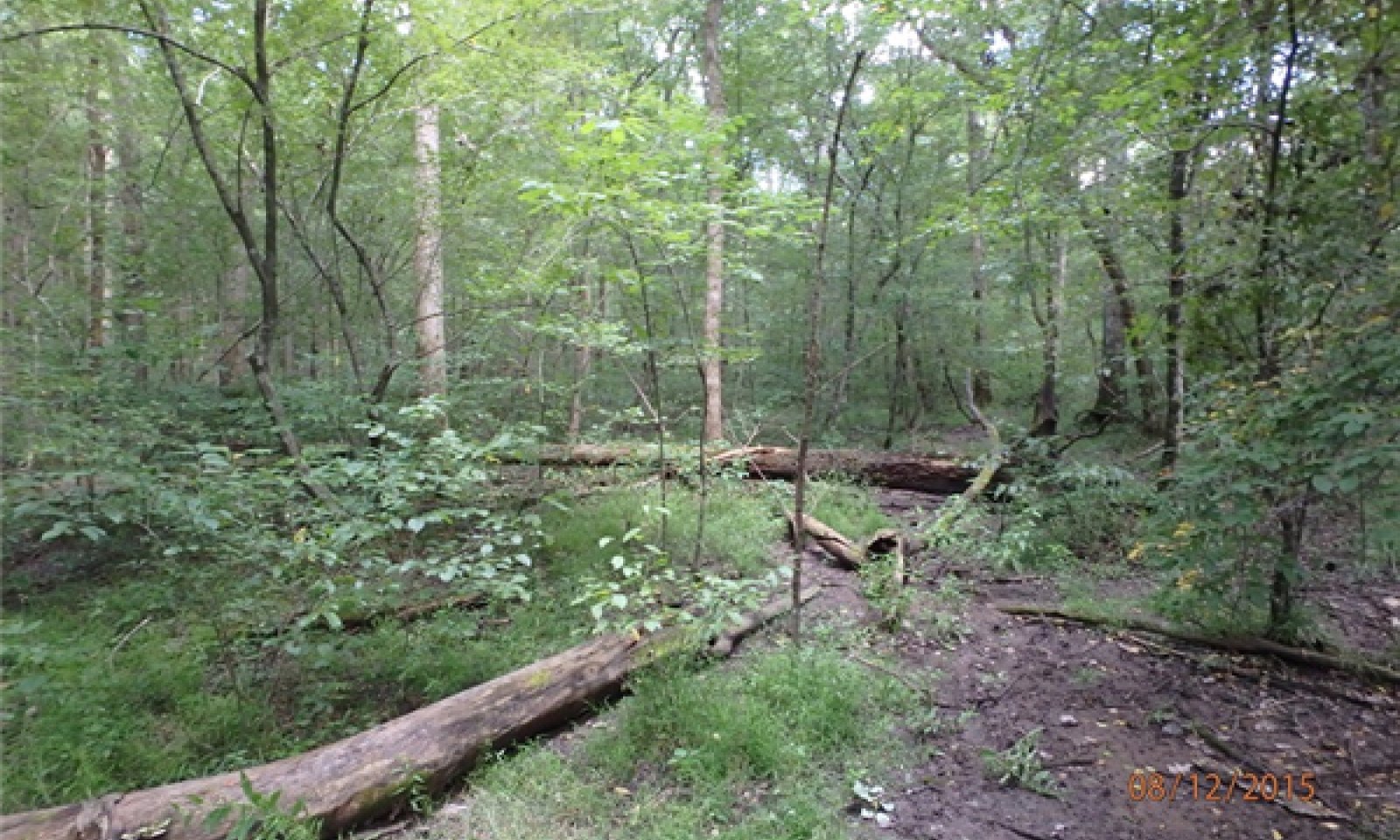
The historic reference plant community is dominated by a wide variety of deciduous hardwood tree species, tolerant of seasonally wet conditions including bur oak, Shumard oak, shellbark hickory, American elm, green ash. Trees are generally large and tall forming a dense, closed canopy. Both historically and today, these forests are structurally and compositionally diverse, with occasional tree-fall gaps and natural mortality providing opportunities for regeneration of overstory species. The understory is also complex, with multiple layers of shade tolerant species such as American hornbeam, northern spicebush, and Ohio buckeye. Grape vine, greenbriar, and trumpet creeper are also present along with a diverse array of ground flora species that carpets the forest floor.
In this region of historic fire-prone savannas and woodlands, Wet Terrace Forests occur in protected landscape positions on stream terraces and high floodplains distant from the fire prone uplands. While the upland woodlands had an estimated fire frequency of 3 to 5 years, these sites burned much less frequently (estimated 10 to 25 years) and with lower intensity. Wet Footslope Forests are also subject to occasional disturbances from wind and ice, which periodically open the canopy up by knocking over trees or breaking substantial branches of canopy trees. Such canopy disturbances allow more light to reach the ground and favor reproduction of the dominant oak species.
Today, these communities have been cleared and converted to pasture, or have undergone repeated timber harvest and domestic grazing. Most existing occurrences have a younger (50 to 80 years) canopy layer whose composition may have been altered by timber harvesting practices. An increase in hickory over historic conditions is common. The absence of periodic fire may have allowed more shade-tolerant tree species, such as sugar maple, white ash, or hickory to increase in abundance.
Uncontrolled domestic grazing has also diminished the diversity and cover of woodland ground flora species, and has often introduced weedy species such as gooseberry, coralberry, poison ivy and Virginia creeper. Grazed sites also have a more open understory. In addition, soil compaction and erosion related to grazing can lower site productivity. Uncontrolled grazing by domestic livestock in these remaining areas of forest damages and kills smaller trees and removes the ground cover. Carefully planned timber harvests can be tolerated on these sites, but high grading of the timber will ultimately degrade the sites. Re-establishment of these terrace forests is important for stream quality and stream health, and as critical habitat for migratory birds.
Prescribed fire can play a beneficial but limited role in the management of this ecological site. Terrace forests did evolve with some fire, but their composition often reflects more closed, forested conditions, with fewer woodland ground flora species that can respond to fire. Consequently, while having these sites in a burn unit is acceptable, targeting them solely for woodland restoration is not advisable.
A State and Transition Diagram follows. Detailed descriptions of each state, transition, plant community, and pathway follow the model. This model is based on available experimental research, field observations, professional consensus, and interpretations. It is likely to change as knowledge increases.State and transition model
Custom diagramStandard diagram
Figure 10. State and transition diagram for this ecological site
More interactive model formats are also available. View Interactive Models
More interactive model formats are also available. View Interactive Models
Click on state and transition labels to scroll to the respective textEcosystem states
SWAPAEHState 1 submodel, plant communities
State 2 submodel, plant communities
State 3 submodel, plant communities
State 4 submodel, plant communities
State 1
ReferenceThe historical reference state for this ecological site was old growth oak forest. The forest was dominated by a wide variety of deciduous hardwood tree species, tolerant of seasonally wet conditions. Periodic disturbances from flooding, fire, wind or ice as well as grazing by native large herbivores maintained the woodland structure and diverse ground flora species. Long disturbance-free periods allowed an increase in both the density of trees and the abundance of shade tolerant species.
Two community phases are recognized in the reference state, with shifts between phases based on disturbance frequency. Reference states are very rare today. Fire suppression and altered drainage have resulted in increased canopy density, which has affected the abundance and diversity of ground flora. Most reference states are currently altered because of timber harvesting, clearing and conversion to grassland or cropland.Dominant plant species
-
bur oak (Quercus macrocarpa), tree
-
shellbark hickory (Carya laciniosa), tree
-
American hornbeam (Carpinus caroliniana), shrub
-
Indian woodoats (Chasmanthium latifolium), grass
Community 1.1
Bur Oak – Shellbark Hickory/American Hornbeam/Indian Woodoats
Figure 11. Reference state on the Current River Area, Ozark National Scenic Riverway; photo credit MDC
Periodic disturbances from flooding, wind or ice as well as grazing by native large herbivores influenced the forest structure and diverse ground flora species. Two community phases are recognized in the reference state, with shifts between phases based on disturbance frequency.
Forest overstory.The Overstory Species list is based on field reconnaissance as well as commonly occurring species listed in Nelson 2010; names and symbols are from USDA PLANTS database.
Forest understory. The Understory Species list is based on field reconnaissance as well as commonly occurring species listed in Nelson 2010; names and symbols are from USDA PLANTS database.
Community 1.2
Bur Oak –Shellbark Hickory – Shumard Oak/Blue Beech/River OatsPathway P1.1A
Community 1.1 to 1.2Lack of disturbance events 10 plus years
Pathway P1.2A
Community 1.2 to 1.1Disturbance events 2-5 years.
State 2
Low Disturbance/ Logged ForestComposition and structure are altered from the reference state due to subjective tree selection during harvest. This state will slowly increase in more shade tolerant species and swamp white oak and bur oak will become less dominant. Without periodic canopy disturbance, stem density and fire intolerant species, like hackberry, will increase in abundance. Some periodic grazing may be occurring.
Dominant plant species
-
bur oak (Quercus macrocarpa), tree
-
elm (Ulmus), tree
-
hackberry (Celtis), tree
-
possumhaw (Ilex decidua), shrub
-
sedge (Carex), grass
Community 2.1
Bur Oak – Elm – Hackberry/Possumhaw/SedgeState 3
Cool Season GrasslandConversion of other states to non-native cool season species such as tall fescue, orchard grass, and white clover has been common. Occasionally, these pastures will have scattered isolated oak. Long term uncontrolled grazing can cause significant soil erosion and compaction. A return to the reference state may be impossible, requiring a very long term series of management options and transitions.
Dominant plant species
-
tall fescue (Schedonorus arundinaceus), grass
-
white clover (Trifolium repens), other herbaceous
Community 3.1
Tall Fescue – White CloverState 4
CroplandThis is a state that exists currently with intensive cropping of primarily soybeans and wheat. Some conversion to non-native cool season hay land occurs, but when commodity prices are high, these states transition back to cropland.
Dominant plant species
-
wheat (Triticum), grass
-
soybean (Glycine max), other herbaceous
Community 4.1
Soybean, WheatTransition T1A
State 1 to 2Lack of disturbance events greater than 20 years ; repeated timber harvests.
Transition T1B
State 1 to 3Woody removal; tillage; vegetative seeding; grassland management.
Transition T1C
State 1 to 4Woody removal; tillage; conservation cropping system.
Restoration pathway R2A
State 2 to 1Forest stand improvement; prescribed fire
Transition T2A
State 2 to 3Woody removal; tillage; vegetative seeding; grassland management.
Transition T2B
State 2 to 4Woody removal; tillage; conservation cropping system.
Transition T3A
State 3 to 4Tillage; conservation cropping system.
Transition T4A
State 4 to 3Vegetative seeding; grassland management.
Additional community tables
Table 5. Community 1.1 plant community composition
Group Common name Symbol Scientific name Annual production () Foliar cover (%) Table 6. Community 1.1 forest overstory composition
Common name Symbol Scientific name Nativity Height ft Canopy cover (%) Diameter in Basal area (square ft/acre) Treepin oak QUPA2 Quercus palustris Native – – – 0 swamp white oak QUBI Quercus bicolor Native – – – 0 bur oak QUMA2 Quercus macrocarpa Native – – – 0 shellbark hickory CALA21 Carya laciniosa Native – – – 0 white oak QUAL Quercus alba Native – – – 0 American elm ULAM Ulmus americana Native – – – 0 bitternut hickory CACO15 Carya cordiformis Native – – – 0 Shumard's oak QUSH Quercus shumardii Native – – – 0 boxelder ACNE2 Acer negundo Native – – – 0 northern red oak QURU Quercus rubra Native – – – 0 green ash FRPE Fraxinus pennsylvanica Native – – – 0 sugarberry CELA Celtis laevigata Native – – – 0 honeylocust GLTR Gleditsia triacanthos Native – – – 0 American sycamore PLOC Platanus occidentalis Native – – – 0 American basswood TIAM Tilia americana Native – – – 0 bitternut hickory CACO15 Carya cordiformis Native – – – 0 pecan CAIL2 Carya illinoinensis Native – – – 0 slippery elm ULRU Ulmus rubra Native – – – 0 common hackberry CEOC Celtis occidentalis Native – – – 0 Table 7. Community 1.1 forest understory composition
Common name Symbol Scientific name Nativity Height (ft) Canopy cover (%) Grass/grass-like (Graminoids)whitegrass LEVI2 Leersia virginica Native – – Virginia wildrye ELVI3 Elymus virginicus Native – – limestone meadow sedge CAGR3 Carex granularis Native – – fuzzy wuzzy sedge CAHI6 Carex hirsutella Native – – Indian woodoats CHLA5 Chasmanthium latifolium Native – – rosy sedge CARO22 Carex rosea Native – – eastern woodland sedge CABL Carex blanda Native – – blue sedge CAGL6 Carex glaucodea Native – – Gray's sedge CAGR5 Carex grayi Native – – sweet woodreed CIAR2 Cinna arundinacea Native – – fowl mannagrass GLST Glyceria striata Native – – Forb/Herbjumpseed POVI2 Polygonum virginianum Native – – sharpwing monkeyflower MIAL2 Mimulus alatus Native – – American ginseng PAQU Panax quinquefolius Native – – wingstem VEAL Verbesina alternifolia Native – – spring avens GEVE Geum vernum Native – – twoflower dwarfdandelion KRBI Krigia biflora Native – – Canadian woodnettle LACA3 Laportea canadensis Native – – tall thoroughwort EUAL3 Eupatorium altissimum Native – – licorice bedstraw GACI2 Galium circaezans Native – – white snakeroot AGAL5 Ageratina altissima Native – – fewflower ticktrefoil DEPA7 Desmodium pauciflorum Native – – mayapple POPE Podophyllum peltatum Native – – dotted smartweed POPU5 Polygonum punctatum Native – – stalked wild petunia RUPE4 Ruellia pedunculata Native – – Canadian blacksnakeroot SACA15 Sanicula canadensis Native – – smallspike false nettle BOCY Boehmeria cylindrica Native – – jewelweed IMCA Impatiens capensis Native – – Canadian clearweed PIPU2 Pilea pumila Native – – eastern waterleaf HYVI Hydrophyllum virginianum Native – – bottomland aster SYON2 Symphyotrichum ontarionis Native – – pale touch-me-not IMPA Impatiens pallida Native – – foxglove beardtongue PEDI Penstemon digitalis Native – – bristly buttercup RAHI Ranunculus hispidus Native – – limestone wild petunia RUST2 Ruellia strepens Native – – cutleaf coneflower RULA3 Rudbeckia laciniata Native – – blue skullcap SCLA2 Scutellaria lateriflora Native – – giant goldenrod SOGI Solidago gigantea Native – – calico aster SYLAA Symphyotrichum lateriflorum var. angustifolium Native – – Fern/fern allyChristmas fern POAC4 Polystichum acrostichoides Native – – sparselobe grapefern BOBI Botrychium biternatum Native – – sensitive fern ONSE Onoclea sensibilis Native – – Shrub/Subshrubnorthern spicebush LIBE3 Lindera benzoin Native – – pawpaw ASTR Asimina triloba Native – – possumhaw ILDE Ilex decidua Native – – eastern leatherwood DIPA9 Dirca palustris Native – – TreeAmerican hornbeam CACA18 Carpinus caroliniana Native – – Ohio buckeye AEGL Aesculus glabra Native – – Vine/Lianaeastern poison ivy TORA2 Toxicodendron radicans Native – – saw greenbrier SMBO2 Smilax bona-nox Native – – bristly greenbrier SMTA2 Smilax tamnoides Native – – summer grape VIAE Vitis aestivalis Native – – riverbank grape VIRI Vitis riparia Native – – heartleaf peppervine AMCO2 Ampelopsis cordata Native – – trumpet creeper CARA2 Campsis radicans Native – – catbird grape VIPA7 Vitis palmata Native – – Table 8. Community 1.2 plant community composition
Group Common name Symbol Scientific name Annual production () Foliar cover (%) Table 9. Community 2.1 plant community composition
Group Common name Symbol Scientific name Annual production () Foliar cover (%) Table 10. Community 3.1 plant community composition
Group Common name Symbol Scientific name Annual production () Foliar cover (%) Table 11. Community 4.1 plant community composition
Group Common name Symbol Scientific name Annual production () Foliar cover (%) Interpretations
Animal community
Wildlife (MDC 2006):
Moist conditions with abundant coarse woody debris make this type of ecological site important for many herptiles.
Ephemeral pools provide important amphibian breeding habitat. Periodic inundation and acorns provide important habitat and food for migrating ducks (especially mallards) and breeding ducks including wood ducks and hooded mergansers.
Tall emergent trees along with an uneven canopy structure and canopy gaps are important for heron colonies, eagle nesting, Mississippi kites, cerulean warblers and other bird species.
Birds associated with late-successional to mature forests are Wood Duck, Hooded Merganser, Barred Owl, Cerulean Warbler, Yellow-throated Warbler, Prothonotary Warbler, Pileated Woodpecker, Yellow-throated Vireo, Brown Creeper, and Yellow-crowned Night Heron.
Reptiles and amphibians associated with ecological site include: small-mouthed salamander, central newt, midland brown snake, gray treefrog, northern spring peeper, Blanchard’s cricket frog, southern leopard frog, western painted turtle, and red-eared slider.Other information
Forestry (NRCS 2002, 2014)
Management: Field measured site index values range from 58 to 75. On the wettest sites, timber management opportunities may be limited. Management of these groups may be difficult because of the great variation in species, age, stocking levels and seasonal wetness. Use seed-tree, group selection, or clear cutting regeneration methods. Harvest favoring reproduction of the less-shade tolerant species such as bur oak, Shumard oak, swamp white oak, sycamore, and cottonwood. Maintain adequate riparian buffer areas.
Limitations: Wetness from flooding; high water table. Use of equipment may be restricted in spring and other excessively wet periods. Restrict activities to dry periods or surfaced areas. Equipment use when wet may compact soil and damage tree roots. Unsurfaced roads and traffic areas tend to be slippery and form ruts easily. Access to forests is easiest during periods in late summer or winter when soils are frozen or dry. Planting is extremely difficult during spring periods. Seedling mortality may be high due to excess wetness. Unsurfaced roads and skid trails may be impassable during rainy periods.Supporting information
Inventory data references
Potential Reference Sites: Wet Terrace Forest Plot LOLICA02 - Racoon soil Located in Loutre Lick Access, Montgomery County, MO Latitude: 38.881251 Longitude: -91.585828 Plot WOWOCA05 – Freeburg soil Located in Woodson K. Woods CA, Phelps & Crawford Counties, MO Latitude: 37.96897 Longitude: -91.530006 Plot BISMCA02 – Deible soil Located in Bismarck CA, St. Francois County, MO Latitude: 37.71636 Longitude: -90.650584 Plot CURINP04 – Racoon soil Located in Current River Area, Ozark National Scenic Riverways, NPS, Carter County, MO Latitude: 37.085043 Longitude: -91.058551
Other references
Anderson, R.C. 1990. The historic role of fire in North American grasslands. Pp. 8-18 in S.L. Collins and L.L. Wallace (eds.). Fire in North American tallgrass prairies. University of Oklahoma Press, Norman.
Batek, M.J., A.J. Rebertus, W.A. Schroeder, T.L. Haithcoat, E. Compas, and R.P. Guyette. 1999. Reconstruction of early nineteenth-century vegetation and fire regimes in the Missouri Ozarks. Journal of Biogeography 26:397-412.
Brinson, M.M. 1993. A hydrogeomorphic classification for wetlands. Technical Report WRP-DE-4, U.S. Army Corps of Engineers, Engineer Waterways Experiment Station, Vicksburg, MS.
Cowardin, L.M., V. Carter, F.C. Golet, & E.T. LaRoe. 1979. Classification of wetlands and deepwater habitats of the United States. U.S. Dept. of Interior, Fish & Wildlife Service, Office of Biological Services, Washington DC.
Harlan, J.D., T.A. Nigh and W.A. Schroeder. 2001. The Missouri original General Land Office survey notes project. University of Missouri, Columbia.
Holbrook, Donald, and J. Daniel Childress. 2006. Soil Survey of Bollinger County, Missouri. U.S. Dept. of Agric. Natural Resources Conservation Service.
Ladd, D. 1991. Reexamination of the role of fire in Missouri oak woodlands. Pp. 67-80 in G.V. Brown, James K.; Smith, Jane Kapler, eds. 2000. Wildland fire in ecosystems: effects of fire on flora. Gen. Tech. Rep. RMRS-GTR-42-vol. 2. Ogden, UT: U.S. Department of Agriculture, Forest Service, Rocky Mountain Research Station. 257 p.
Missouri Department of Conservation. 2010. Missouri Forest and Woodland Community Profiles. Missouri Department of Conservation, Jefferson City, Missouri.
Natural Resources Conservation Service. 2002. Woodland Suitability Groups. Missouri FOTG, Section II, Soil Interpretations and Reports. 30 pgs.
Natural Resources Conservation Service. Site Index Reports. Downloaded 2015. https://esi.sc.egov.usda.gov/ESI_Forestland/pgFSWelcome.aspx
NatureServe, 2010. Vegetation Associations of Missouri (revised). NatureServe, St. Paul, Minnesota.
Nelson, Paul W. 2010. The Terrestrial Natural Communities of Missouri. Missouri Department of Conservation, Jefferson City, Missouri. 550p.
Nigh, Timothy A. and Walter A. Schroeder. 2002. Atlas of Missouri Ecoregions. Missouri Department of Conservation, Jefferson City, Missouri. 212p.
Schoolcraft, H.R. 1821. Journal of a tour into the interior of Missouri and Arkansas from Potosi, or Mine a Burton, in Missouri territory, in a southwest direction, toward the Rocky Mountains: performed in the years 1818 and 1819. Richard Phillips and Company, London.
United States Department of Agriculture – Natural Resource Conservation Service (USDA-NRCS). 2006. Land Resource Regions and Major Land Resource Areas of the United States, the Caribbean, and the Pacific Basin. U.S. Department of Agriculture Handbook 296. 682 pgs.Contributors
Fred Young
Doug WallaceApproval
Nels Barrett, 9/24/2020
Acknowledgments
Missouri Department of Conservation and Missouri Department of Natural Resources personnel provided significant and helpful field and technical support during this project.
Rangeland health reference sheet
Interpreting Indicators of Rangeland Health is a qualitative assessment protocol used to determine ecosystem condition based on benchmark characteristics described in the Reference Sheet. A suite of 17 (or more) indicators are typically considered in an assessment. The ecological site(s) representative of an assessment location must be known prior to applying the protocol and must be verified based on soils and climate. Current plant community cannot be used to identify the ecological site.
Author(s)/participant(s) Contact for lead author Date 08/30/2026 Approved by Approval date Composition (Indicators 10 and 12) based on Annual Production Indicators
-
Number and extent of rills:
-
Presence of water flow patterns:
-
Number and height of erosional pedestals or terracettes:
-
Bare ground from Ecological Site Description or other studies (rock, litter, lichen, moss, plant canopy are not bare ground):
-
Number of gullies and erosion associated with gullies:
-
Extent of wind scoured, blowouts and/or depositional areas:
-
Amount of litter movement (describe size and distance expected to travel):
-
Soil surface (top few mm) resistance to erosion (stability values are averages - most sites will show a range of values):
-
Soil surface structure and SOM content (include type of structure and A-horizon color and thickness):
-
Effect of community phase composition (relative proportion of different functional groups) and spatial distribution on infiltration and runoff:
-
Presence and thickness of compaction layer (usually none; describe soil profile features which may be mistaken for compaction on this site):
-
Functional/Structural Groups (list in order of descending dominance by above-ground annual-production or live foliar cover using symbols: >>, >, = to indicate much greater than, greater than, and equal to):
Dominant:
Sub-dominant:
Other:
Additional:
-
Amount of plant mortality and decadence (include which functional groups are expected to show mortality or decadence):
-
Average percent litter cover (%) and depth ( in):
-
Expected annual annual-production (this is TOTAL above-ground annual-production, not just forage annual-production):
-
Potential invasive (including noxious) species (native and non-native). List species which BOTH characterize degraded states and have the potential to become a dominant or co-dominant species on the ecological site if their future establishment and growth is not actively controlled by management interventions. Species that become dominant for only one to several years (e.g., short-term response to drought or wildfire) are not invasive plants. Note that unlike other indicators, we are describing what is NOT expected in the reference state for the ecological site:
-
Perennial plant reproductive capability:
Print Options
Sections
Font
AAAAOther
PrintThe Ecosystem Dynamics Interpretive Tool is an information system framework developed by the USDA-ARS Jornada Experimental Range, USDA Natural Resources Conservation Service, and New Mexico State University.
Accessibility statement


