
Natural Resources
Conservation Service
Ecological site R085BY076OK
Savannah 38-42 PZ
Last updated: 9/21/2023
Accessed: 08/31/2026
-
Search


Major Land Resource Area or ecological site by name and/or ID.
PreviousSectionsNextGeneral information
Provisional. A provisional ecological site description has undergone quality control and quality assurance review. It contains a working state and transition model and enough information to identify the ecological site.
Click to explore map
Figure 1. Mapped extent
Areas shown in blue indicate the maximum mapped extent of this ecological site. Other ecological sites likely occur within the highlighted areas. It is also possible for this ecological site to occur outside of highlighted areas if detailed soil survey has not been completed or recently updated.
MLRA notes
Major Land Resource Area (MLRA): 085B–Arbuckle Uplift
The Grand Prairie MLRA is characterized by predominately loam and clay loam soils underlain by limestone and shale. Topography transitions from steeper ridges and summits of the Lampasas Cut Plain on the southern end to the more rolling hills of the Fort Worth Prairie to the north. The Arbuckle Mountain area in Oklahoma is also within this MLRA. In the structurally complex Arbuckle Mountains of southern Oklahoma, outcropping rocks are primarily limestone, sandstone, dolomite, quartzite, and chert. These units are exposed as alternating beds of Paleozoic rocks that have been faulted, tilted, and deformed to form a tombstone-like topography. This area has significant exposures of granite, rhyolite, and gabbro of Precambrian age.
Classification relationships
This ecological site is correlated to soil components at the Major Land Resource Area (MLRA) level which is further described in USDA AgHandbook 296.
Ecological site concept
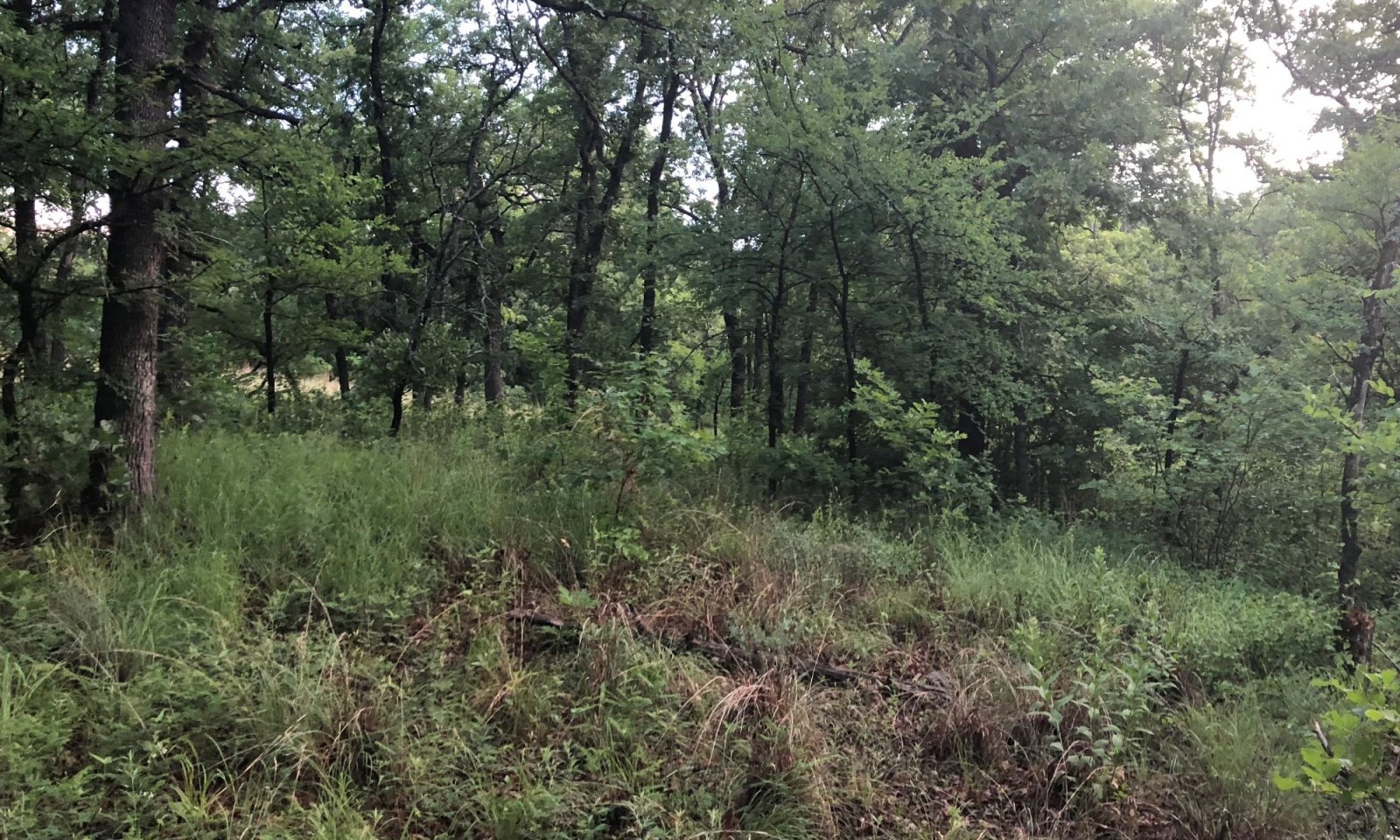
These sites occur on moderately deep sandy loam soils on hills. Parent material is predominately fractured sandstone or conglomerate. The reference vegetation includes a mosaic of mixed oak savannah with tallgrasses and a variety of forbs and legumes. Woody canopy is variable and generally less than 60 percent canopy cover. However, in the absence of fire or other brush management woody species will increase across the site. Many of these sites were cleared and farmed during early settlement and some are still in crop production.
Associated sites
R085BY056OK Loamy Upland 38-42 PZ
Loamy soils on uplands.
R085BY088OK Shallow Savannah 38-42 PZ
Oak savannahs on shallow soils.
R085BY002OK Clay Upland 38-42 PZ
Clay soils on uplands
Similar sites
R085BY088OK Shallow Savannah 38-42 PZ
Shallow soils supporting Oak Savannah vegetation
Table 1. Dominant plant species
Tree (1) Quercus stellata
(2) Quercus marilandicaShrub Not specified
Herbaceous (1) Schizachyrium scoparium
Physiographic features
This site occurs on treads of stream terraces and paleoterraces and on homoclinal ridges and hillslopes in the Arbuckle Uplift.
Table 2. Representative physiographic features
Landforms (1) Alluvial plain remnant > Stream terrace
(2) Alluvial plain remnant > Paleoterrace
(3) Hills > Homoclinal ridge
(4) Hills > Hillslope
Runoff class Medium to high Elevation 650 – 1300 ft Slope 5 – 15 % Water table depth 20 – 0 in Aspect Aspect is not a significant factor Table 3. Representative physiographic features (actual ranges)
Runoff class Negligible to very high Elevation 0 ft Slope 0 – 30 % Water table depth 0 in Climatic features
The climate is moist subhumid with average annual rainfall from 37 to 42 inches per year. The highest percentages in rainfall occur during April, May and June. More years of below average rainfall can be expected than those above average. Winters are characterized by mild temperatures with occasional “Northers” which can produce severe cold for short periods of time. Average wind velocities can be high in the Southern Great Plains during February, March and April causing erosion on unprotected surfaces.
Table 4 Representative climatic features
Frost-free period (characteristic range) 190-200 days Freeze-free period (characteristic range) 200-220 days Precipitation total (characteristic range) 40-40 in Frost-free period (actual range) 180-210 days Freeze-free period (actual range) 200-230 days Precipitation total (actual range) 40-40 in Frost-free period (average) 190 days Freeze-free period (average) 210 days Precipitation total (average) 40 in Characteristic rangeActual rangeBarLineFigure 2. Monthly precipitation range
Characteristic rangeActual rangeBarLineFigure 3. Monthly minimum temperature range
Characteristic rangeActual rangeBarLineFigure 4. Monthly maximum temperature range
BarLineFigure 5. Monthly average minimum and maximum temperature
Figure 6. Annual precipitation pattern
Figure 7 Annual average temperature pattern
Climate stations used
-
(1) CHICKASAW NRA [USC00341745], Sulphur, OK
-
(2) ARDMORE [USC00340292], Ardmore, OK
-
(3) ADA [USC00340017], Ada, OK
-
(4) PAULS VALLEY 4 WSW [USC00346926], Pauls Valley, OK
-
(5) MADILL [USC00345468], Madill, OK
">Influencing water features
These sites occur on upland and shed water to adjacent sites lower on the landscape.
Wetland description
NA

Figure 8.
Soil features
Representative soil components for this ecological site include: Bastrop, Bromide, Chigley, Counts, Gasil, Konawa, Konsil, Naru, Stephenville, Windthorst
The site is characterized by noncalcareous soils in the surface and upper subsoil. Soils are sandy to loamy but most commonly gravelly sandy loam surface texture. They are weathered from sandstone, shale and conglomerate materials. The gravelly or cobbly texture allows for good water infiltration but may result in lower water holding capacity.Table 5. Representative soil features
Parent material (1) Alluvium – conglomerate
(2) Alluvium – sandstone and shale
(3) Residuum – conglomerate
(4) Residuum – sandstone and shale
Surface texture (1) Gravelly, channery, very cobbly sandy loam
(2) Gravelly, channery, very cobbly fine sandy loam
(3) Gravelly, channery, very cobbly loamy fine sand
(4) Gravelly, channery, very cobbly loam
(5) Gravelly, channery, very cobbly silt loam
(6) Sandy loam
(7) Fine sandy loam
(8) Loamy fine sand
(9) Loam
(10) Silt loam
Drainage class Moderately well drained to well drained Permeability class Very slow to moderate Soil depth 20 – 0 in Surface fragment cover <=3" 0 – 30 % Surface fragment cover >3" 0 – 20 % Available water capacity
(0-40in)4 – 10 in Calcium carbonate equivalent
(0-40in)0 – 5 % Electrical conductivity
(0-40in)0 – 2 mmhos/cm Sodium adsorption ratio
(0-40in)Not specified Soil reaction (1:1 water)
(0-40in)5.5 – 7.5 Subsurface fragment volume <=3"
(Depth not specified)0 – 60 % Subsurface fragment volume >3"
(Depth not specified)0 – 60 % Table 6. Representative soil features (actual values)
Drainage class Not specified Permeability class Not specified Soil depth 0 in Surface fragment cover <=3" 0 % Surface fragment cover >3" 0 % Available water capacity
(0-40in)0 in Calcium carbonate equivalent
(0-40in)0 % Electrical conductivity
(0-40in)0 mmhos/cm Sodium adsorption ratio
(0-40in)0 Soil reaction (1:1 water)
(0-40in)4.5 – 8.4 Subsurface fragment volume <=3"
(Depth not specified)0 % Subsurface fragment volume >3"
(Depth not specified)0 % Ecological dynamics
Like many sites across the Great Plains, changes in disturbance initiated by permanent settlements has had a profound impact on the ecological dynamics of these sites. Historically, the site was influenced by periodic fires during all seasons of growth. These fires were often the result of dry lightning strikes and/or anthropogenic fires set by Native Americans. The fire frequency during the period prior to settlement is estimated between 2-5 years for the southern Great Plains. These frequent fires were often followed by grazing of migratory bison herds attracted to the new growth of grass. This led to a shifting mosaic between burned/grazed and unburned and ungrazed landscapes.
With the removal of fire and the introduction of conventional livestock fencing, the landscape began to change to more homogenous vegetation patterns and altered plant communities. Gently sloping sites like the Savannah site were often cleared and broken out for crop production also. This led to a highly fragmented, highly disturbed landscape we see today across much of the area.
Less fire tolerant woody species are more prevalent in many areas due to fire suppression and/or the use of strictly dormant season fires. Abusive grazing can shift the plant community to less palatable grass species and lead to an increase in opportunistic forbs. Heavy grazing can also reduce fine fuel load and limit the ability to conduct a prescribed fire.
State and Transitional Pathways:
The following diagram suggests some pathways that vegetation on the site might take in response to various treatments or natural stimuli over time. There may be other states that are not shown on this diagram. This information identifies the changes in plant communities that do occur due to management practices and natural factors. The plant communities described here are commonly observed on this ecological site. The local NRCS field office has information available to assist with planning and development of the plant community for specific purposes.
Changes in plant community makeup may be due to many factors. Change may occur slowly or in some cases, fairly rapidly. As vegetative changes occur, certain thresholds are crossed. A threshold means that once a certain point is reached during the transition of one community to another, a return to the previous state may not be possible without the input of some form of energy. This often means intervention with practices that are not part of natural processes. An example might be the application of herbicide to control some woody species to reduce their population and encourage more grass and forbs growth. Merely adjusting grazing practices would probably not accomplish any significant change in a plant community once certain thresholds are crossed. The amount of energy required to effect change in community would depend on the present vegetative state and the desired change.State and transition model
Custom diagramStandard diagramMore interactive model formats are also available. View Interactive Models
Click on state and transition labels to scroll to the respective textEcosystem states
State 1 submodel, plant communities
State 1
Oak Savannah - ReferenceThis is the reference state for the Savannah ecological site. It represents the historic range of variability in the plant communities with the periodic disturbance of fire and grazing. It is dominated by a mosaic of oak savannah species and herbaceous plants.
Dominant plant species
-
post oak (Quercus stellata), tree
-
little bluestem (Schizachyrium scoparium), grass
Community 1.1
Tallgrass SavannahThe dominant grasses are big bluestem, Indiangrass, switchgrass and little bluestem. Other grasses include Texas cupgrass, sideoats grama, dropseeds, silver bluestem and Scribner’s panicum. Dominant forbs include sunflowers, western ragweed, heath aster, poppymallows and prairie petunia. Legumes include Illinois bundleflower, scurfpea, tick-clovers, trailing wildbeans, and native lespedezas. Woody species include blackjack oak, post oak, Shumard oak, chittamwood, redbud, poison ivy, greenbriar, coralberry, hackberry and American elm.
The Savannah site is estimated to produce between 2,500– 4,500 pounds of vegetative production per year in reference condition. Woody canopy in this community is complex with some areas having dense oak canopy mixed with multiple prairie openings. For planning and management purposes, the average woody canopy in reference condition can be described as 20% - 40%.
Tallgrasses Midgrasses Trees Forbs = Shrubs
Minor component : Cool season grass/grasslikeFigure 9. Annual production by plant type (representative values) or group (midpoint values)
Table 7. Annual production by plant type
Plant type Low
(lb/acre)Representative value
(lb/acre)High
(lb/acre)Grass/Grasslike 1500 2100 2700 Tree 500 700 900 Forb 250 350 450 Shrub/Vine 250 350 450 Total 2500 3500 4500 Community 1.2
Midgrass Savannah
Figure 10. Chigley soils. Murray County, OK
This community has shifted to predominately midgrass species such as sideoats grama, dropseeds, purpletop and Carolina joint-tail with some remnant tallgrasses such as little bluestem remaining. Woody species canopy cover may increase due to lack of fire. Cool season grasses and sedges increase as shade increases. Heavy grazing has reduced palatable tallgrasses and forbs and the community is at risk of transitioning to a closed canopy state. Woody canopy averages between 40% - 60%.
Pathway 1.1A
Community 1.1 to 1.2Abusive grazing practices can lead to a reduction in palatable tallgrasses and forbs. Coupled with the absence of fire or brush management, the site may shift to the Midgrass Savannah community.
Pathway 1.2A
Community 1.2 to 1.1With adequate rest from grazing and implementation of prescribed fire and/or selective brush management, the site may shift back to the Tallgrass Savannah community.
State 2
Closed Canopy Woodland
Figure 11. Naru soils. Murray County, OK
This state is often the result of fire suppression for multiple years. Non fire-tolerant woody species such as elms, hackberry and juniper have increased and created a shaded environment with a heavy accumulation of leaf litter. Ecosystem processes are significantly altered and the herbaceous community is dominated by shade tolerant understory species. Greenbriar, grape and other shrubs and vines may create a dense understory layer.
Dominant plant species
-
post oak (Quercus stellata), tree
-
elm (Ulmus), tree
-
wildrye (Elymus), other herbaceous
State 3
Converted Land Use
Figure 12. Chigley soils in fescue. Johnston County, OK
This state represents a change in land use from rangeland to pastureland. The soil structure and biology has been altered and the site is dominated by introduced species. Management of introduced forages requires more inputs than native grasses. Careful consideration should be taken prior to planting to ensure the result meets the desired use. Ratings for forage yields can be found under the non-irrigated crop yield section in web soil survey. As with any fertility management program, current soil tests should be taken before planting and subsequent fertilization of introduced pastures.
The most common forage species on these sites include Bermudagrass and Old World Bluestems(eg. KR Bluestem).
Without brush management, woody species such as mesquites, junipers, elms, or honey locust may invade these sites.
There may be opportunities to plant native grass species on these sites to restore the reference plant communities. The success of this type of restoration is highly variable and depends on the remaining soil resources and past management. This type of endeavor often requires site specific planning and evaluation. However, the species described in the reference state are a good resource for initial planning of any restoration project.Dominant plant species
-
tall fescue (Schedonorus arundinaceus), grass
State 4
Abandoned/Invaded
Figure 13. Chigley soils. Johnston County, OK
This state describes the invaded, woody dominated plant community of the Savannah site. The ecological processes are dominated by woody species including mesquite, honey locust, elm, hackberry and juniper species. Some herbaceous plants persist under the woody canopy or in interspaces. Usually, shade tolerant species like Texas wintergrass and sedges are prominent herbaceous components in this community.
Dominant plant species
-
elm (Ulmus), tree
-
sugarberry (Celtis laevigata), tree
Transition T1A
State 1 to 2In the absence of fire or other forms of brush management, woody species will continually increase on these sites. As woody plants begin to dominate ecological processes, the site will transition to the Closed Canopy Woodland state.
Transition T1B
State 1 to 3Many of these sites were cultivated for crop production during the settlement of the area. Many of them have been planted to monocultures of introduced forage grasses in recent years. When these sites are cultivated, the soil properties are significantly altered from the reference state. Soil structure, hydrology and biology have been impacted and the site is transitioned to the Converted Land Use state.
Restoration pathway R2A
State 2 to 1At this point it will take significant inputs to remove woody species and restore the grass dominated pasture. However, it may be achieved through prescribed fire or brush management and a prescribed grazing plan which allows ample rest for the re-establishment of grasses. Effectiveness of prescribed fire depends upon fine fuel load and continuity and burning conditions. Selective thinning may be required in order to maintain the reference savannah dynamics without detrimental impacts to the hardwood community.
Transition T3A
State 3 to 4
Converted Land Use
Abandoned/InvadedThese sites are prone to invasion by juniper, mesquite and honey locust. Without brush management, brush invasion may increase to the point where the site transitions to the Abandoned/Invaded state. At this point it will take significant inputs to remove woody species and restore the herbaceous plant community.
Transition T4A
State 4 to 3
Abandoned/Invaded
Converted Land UseAt this point it will take significant inputs to remove woody species and restore the grass dominated pasture. However, it may be achieved through brush management and a prescribed grazing plan which allows ample rest for the re-establishment of grasses.
Additional community tables
Table 8. Community 1.1 plant community composition
Group Common name Symbol Scientific name Annual production () Foliar cover (%) Table 9. Community 1.2 plant community composition
Group Common name Symbol Scientific name Annual production () Foliar cover (%) Interpretations
Animal community
Domestic livestock and white-tail deer are the dominant grazers and browsers of the site. Various songbirds and small mammals may also find use of these areas. As the site changes towards the woody dominated community, the quality of the habitat may improve for some species and decline for others. Management must be applied to maintain a vegetative state in optimum habitat quality for the desired animal species.
Hydrological functions
These sites occur on upland and shed water to adjacent sites lower on the landscape. The presence of deep rooted tallgrasses can help facilitate percolation of water into the soil profile.
Recreational uses
NA
Wood products
NA
Other products
NA
Other information
NA
Supporting information
Inventory data references
Soil Survey Manuscripts Murray, Carter, Johnston counties in Oklahoma. Range Site Descriptions, Oklahoma NRCS Draft ESDs Oklahoma NRCS
Type locality
Location 1: Murray County, OK Township/Range/Section T1S R3E S7 General legal description 7-T1S-R3E CNRA References
-
. 2021 (Date accessed). USDA PLANTS Database. http://plants.usda.gov.
-
Frost, C.C. 1998. Presettlement Fire Frequency Regimes of the United States: A First Approximation. Plant Conservation Program. North Carolina Department of Agriculture and Consumer Services, Raleigh, NC.
Other references
These site descriptions were developed as part a Provisional ESD project using historic soil survey manuscripts, available range site descriptions, and low intensity field traverse sampling.
Contributors
Colin Walden, Soil Survey Region 9
Approval
Bryan Christensen, 9/21/2023
Acknowledgments
Site Development and Testing Plan: Future work, as described in a Project Plan, to validate the information in this Provisional Ecological Site Description is needed. This will include field activities to collect low, medium, and high-intensity sampling, soil correlations, and analysis of that data. Annual field reviews should be done by soil scientists and vegetation specialists. A final field review, peer review, and quality control and quality assurance reviews of the ESD will be needed to produce the final document. Annual reviews of the Project Plan are to be conducted by the Ecological Site Technical Team.
Rangeland health reference sheet
Interpreting Indicators of Rangeland Health is a qualitative assessment protocol used to determine ecosystem condition based on benchmark characteristics described in the Reference Sheet. A suite of 17 (or more) indicators are typically considered in an assessment. The ecological site(s) representative of an assessment location must be known prior to applying the protocol and must be verified based on soils and climate. Current plant community cannot be used to identify the ecological site.
Author(s)/participant(s) Contact for lead author Date 08/31/2026 Approved by Approval date Composition (Indicators 10 and 12) based on Annual Production Indicators
-
Number and extent of rills:
-
Presence of water flow patterns:
-
Number and height of erosional pedestals or terracettes:
-
Bare ground from Ecological Site Description or other studies (rock, litter, lichen, moss, plant canopy are not bare ground):
-
Number of gullies and erosion associated with gullies:
-
Extent of wind scoured, blowouts and/or depositional areas:
-
Amount of litter movement (describe size and distance expected to travel):
-
Soil surface (top few mm) resistance to erosion (stability values are averages - most sites will show a range of values):
-
Soil surface structure and SOM content (include type of structure and A-horizon color and thickness):
-
Effect of community phase composition (relative proportion of different functional groups) and spatial distribution on infiltration and runoff:
-
Presence and thickness of compaction layer (usually none; describe soil profile features which may be mistaken for compaction on this site):
-
Functional/Structural Groups (list in order of descending dominance by above-ground annual-production or live foliar cover using symbols: >>, >, = to indicate much greater than, greater than, and equal to):
Dominant:
Sub-dominant:
Other:
Additional:
-
Amount of plant mortality and decadence (include which functional groups are expected to show mortality or decadence):
-
Average percent litter cover (%) and depth ( in):
-
Expected annual annual-production (this is TOTAL above-ground annual-production, not just forage annual-production):
-
Potential invasive (including noxious) species (native and non-native). List species which BOTH characterize degraded states and have the potential to become a dominant or co-dominant species on the ecological site if their future establishment and growth is not actively controlled by management interventions. Species that become dominant for only one to several years (e.g., short-term response to drought or wildfire) are not invasive plants. Note that unlike other indicators, we are describing what is NOT expected in the reference state for the ecological site:
-
Perennial plant reproductive capability:
Print Options
Sections
Font
AAAAOther
PrintThe Ecosystem Dynamics Interpretive Tool is an information system framework developed by the USDA-ARS Jornada Experimental Range, USDA Natural Resources Conservation Service, and New Mexico State University.
Accessibility statement


