
Natural Resources
Conservation Service
-
Search


Major Land Resource Area or ecological site by name and/or ID.
General information
Provisional. A provisional ecological site description has undergone quality control and quality assurance review. It contains a working state and transition model and enough information to identify the ecological site.
MLRA notes
Major Land Resource Area (MLRA): 070A–High Plateaus of the Southwestern Great Plains
This site is confined to the Canadian Plateaus LRU of MLRA 70A.
LRU notes
This site is confined to the Canadian Plateaus LRU of MLRA 70A.
Please use the following Key:
1a. The site exists on a landform of volcanic origin, such as a basalt plateau, or is part of an escarpment system that rises directly to a volcanic structure. These escarpments are included if they have volcanic alluvium or colluvium (i.e., basalt, rhyolite, tuff, cinders) overlying non-volcanic residuum or bedrock (i.e., sandstone, shale). → VOLCANIC PLATEAUS LRU (VP)
User tip: Other alluvial or colluvial landform features extending below the escarpments are not included unless they have a predominance of volcanic fragments at the surface. Also, note that playas atop volcanic plateaus are included within the VP-LRU.
1b. All other sites. → 2
2a. The site exists in the annulus or floor of a playa1. → CANADIAN PLATEAUS LRU (CP)
User tip: Small islands of playas occur within large areas of HP-LRU. These sites may be far from the nearest CP landform but will still key-out to the CP-LRU. The playa rim components, however, may key out to either LRU, so it is important to properly identify their soil properties.
2b All other sites. → 3
3a. The site is part of an escarpment landscape complex (defined below) or is within a canyon, valley, or small basin confined by such escarpments. At the upper boundary of the LRU, the soil surface meets at least 4 of the following 5 criteria:
I. Shallow or very shallow soils are present in at least 50% of the landform area;
II. Soils are underlain by sandstone bedrock of the Cretaceous Dakota Formation or older;
III. Presence or historical evidence of a conifer stand (≥ 2% canopy cover);
IV. The ground surface has a slope of at least 10%;
V. The landforms drain towards steep-walled escarpments or canyons below the Dakota sandstone (older Jurassic and Triassic Formations underlie this sandstone mesa cap).
→ MESOZOIC CANYONS AND BREAKS LRU (MCB)
User tip: The MCB sites also occur on any colluvial or alluvial bottomlands confined within escarpments or canyons. Some valleys transition from CP to MCB, or back to CP, and the turning point can be difficult to determine. Generally, the landforms are part of the MCB when confined between Dakota sandstone breaks or escarpments on both sides. Much of the acreage in the MCB is aproned by colluvial debris fans—composed of sandy materials with large sandstone fragments visible on the soil surface, including large stones or boulders. The soils in the bottoms of these confined valleys will also be in the MCB. When the valley opens, or there is only a single escarpment opening to the plains, the landforms below the steeper, rockier escarpments will be members of the CP-LRU.
3b. Fewer than 4 of the above criteria are met. → 4
4a. The soil is on a plateau summit position (tread) and is within 50 cm to contact with either plateau bedrock (non-soil bedrock of cemented sandstone, limestone, or shale) or strath terrace cobbles2, but not a petrocalcic contact (caprock or caliche of cemented calcium carbonate). → CANADIAN PLATEAUS LRU (CP)
4b. No plateau bedrock or strath terrace cobbles within 50 cm. → 5
5a. Fragments (>2 mm) are visible within the soil profile and/or on the surface. If fragments cannot be found in the profile, it is acceptable to look nearby on ant mounds or around burrows. If site is in a drainageway, one can look for fragments on landforms immediately upslope.→ 6
5b. Fragments are entirely absent. → 7
6a. Fragments are mostly petronodes3 or High Plains gravels4. → HIGH PLAINS LRU (HP)
6b. Fragments are mostly plateau bedrock fragments5. → CANADIAN PLATEAUS LRU
7a. All horizons in the upper 100 cm of soil have textures of sandy clay loam or sandier.
→ CANADIAN PLATEAUS LRU (CP)
7b. At least one horizon in the upper 100 cm of soil has a texture that is less sandy than sandy clay loam. → HIGH PLAINS LRU (HP)Classification relationships
NRCS and BLM: Limy Canadian Plateaus LRU Major Land Resource Area 70A, High Plateaus of the Southwestern Great Plains Land Resource Region G, Western Great Plains Range and Irrigated Region (United States Department of Agriculture, Natural Resources Conservation Service, 2006).
USFS: Limy Sandy Smooth High Plains Subsection Southern High Plains Section Great Plains-Palouse Dry Steppe Province (Cleland, et al., 2007).
EPA: Limy <26l Upper Canadian Plateau<26 Southwestern Tablelands (Griffith, et al., 2006).Ecological site concept
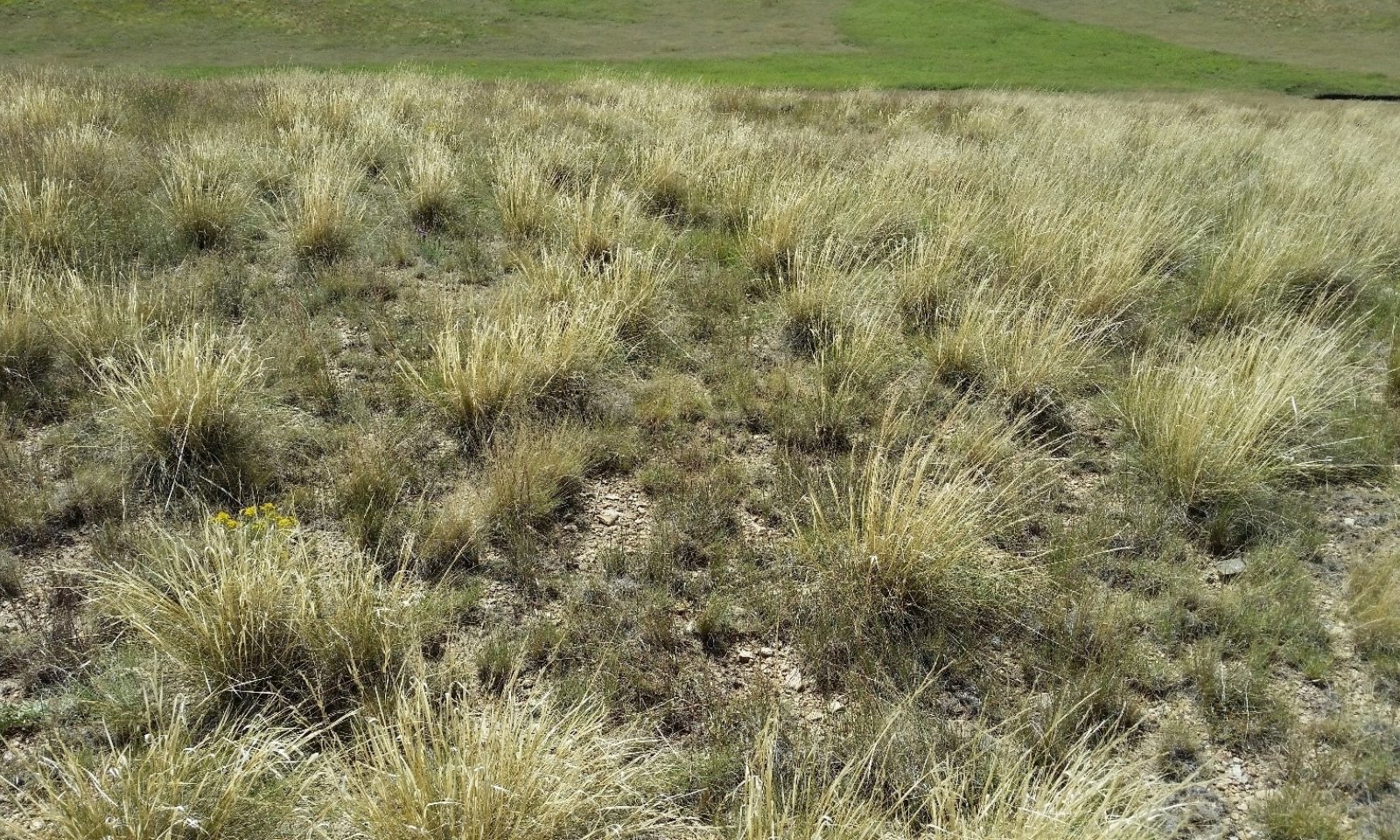
The Limy ecological site occurs on plateau landscapes in the Canadian Plateaus LRU which occupies the western portion of MLRA 70A. This LRU extends from Las Vegas, NM at the southern end to beyond Raton, NM at its northern end. Elevation for the Canadian Plateau LRU ranges from 5,000 to 7,500 feet.
The central concept for this site is a soil that ranges from 20 inches (50 centimeters[cm]) to over 80 inches (200 cm) to Cretaceous aged bedrock and has free carbonates throughout the profile. Surface textures range from loam to clay with at least 5 percent rock fragments on the surface. This differentiates this site from its most common associated site, the Clayey Uplands.Associated sites
GX070A01X004 Shallow Loamy
This site occurs where soils have paralithic contact within 20 inches (50 cm), and their surfaces lack one or both of the following: strong or violent effervescence and ≥ 5 percent calcareous rock fragments.
GX070A01X002 Clayey Uplands
This site occurs in soils that lack a combination of free carbonates and ≥ 5 percent calcareous fragments at the surface, and contain horizons with ≥ 35 percent clay in the upper 50 cm.
GX070A01X014 Lithic Limestone
This site occurs where soils are ≤ 20 inches (50 centimeters) to lithic contact with limestone bedrock, whereas Limy sites may be shallow or have a lithic contact at some depth, but not both.
GX070A01X003 Loamy Uplands
This site occurs in soils that lack a combination of free carbonates and ≥ 5 percent calcareous fragments at the surface, and lack horizons with ≥ 35 percent clay in the upper 20 inches (50 cm).
GX070A01X007 Limy Escarpments
This site differs from Limy sites in that it occurs on escarpments with slopes of 10 percent or more, and contains some amount of rock outcrop. These escarpments often contribute water to Limy sites via run-on and through-flow.
GX070A01X012 Low Terraces
This site occurs on terraces above perennial streams where the flooding frequency interval is ≥ 10 years. This site is often used for hay and small grain production. Adjacent Limy sites contribute water to this site via run-on and through-flow.
GX070A01X013 Lithic Sandstone
This site occurs where soils are ≤ 20 inches (50 cm) to lithic contact with sandstone bedrock, and often supports oneseed juniper savannahs.
GX070A01X017 Playas
This site occurs in playas. Limy sites often provide water to adjacent Playa sites via through-flow and run-on.
GX070A01X008 Ephemeral Drainageways
This site occurs on the channels and floodplains of ephemeral streams. Adjacent Limy sites contribute water to this site via run-on and through-flow.
Similar sites
R070AY001NM Loamy Upland
The Limy ecological site is currently correlated to the legacy ecological site Loamy Upland (R070AY001NM) in several locations. However, the former concept is quite broad, and does not distinguish potential New Mexico feathergrass habitat from other, less limy sites. This new Limy ecological site is a subset of the former.
Table 1. Dominant plant species
Tree Not specified
Shrub Not specified
Herbaceous Not specified
Legacy ID
R070AA005NM


