
Natural Resources
Conservation Service
-
Search


Major Land Resource Area or ecological site by name and/or ID.
PreviousSectionsNextGeneral information
Provisional. A provisional ecological site description has undergone quality control and quality assurance review. It contains a working state and transition model and enough information to identify the ecological site.
MLRA notes
Major Land Resource Area (MLRA): 063A–Northern Rolling Pierre Shale Plains
MLRA 63A is approximately 10,160 square miles in size, the majority of which is in South Dakota and a very small portion in North Dakota. The MLRA extends west of the northern half of the South Dakota reach of the Missouri River. All five of the major rivers draining western South Dakota cross this area. From north to south, these are the Grand, Moreau, Cheyenne, Bad, and White Rivers.
Elevation range from 1,300 to 1,640 feet on the bottom land along the Missouri River to 1,640 to 2,950 feet on the shale plain uplands. Cretaceous Pierre Shale underlies almost all of this area. This is a marine sediment having layers of volcanic ash that has been altered to smectitic clays. These clays shrink as they dry and swell as they get wet. Tertiary and Quaternary river deposits, remnants of erosion from the Black Hills uplift, cap isolated highlands in this area. Deposits of alluvial sand and gravel occur on the valley floors adjacent to the major streams in the area.
The average annual precipitation in this area is 15 to 20 inches.
The vegetation in this area is a transition from eastern tall grass prairie to a western mixed grass prairie, (USDA-NRCS, Ag Handbook 296).Classification relationships
Land Resource Region (LRR): G - Western Great Plains Range and Irrigated Region, Major Land Resource Area (MLRA): 63A Northern Rolling Pierre Shale Plains, (USDA-NRCS, Ag Handbook 296).
Level IV Ecoregions of the Conterminous United States: 43c – River Breaks and 43f – Subhumid Pierre Shale Plains.Ecological site concept
The Clayey Terrace Ecological Site occurs throughout the MLRA. This site occurs on nearly level areas that receive additional water from rare stream flooding events. Runoff from adjacent upland sites do provide addition moisture. Soil surface layer is 5 to 8 inches thick with texture ranges from silty clay to clay.
Associated sites
R063AY011SD Clayey
R063AY017SD Shallow Clay
R063AY021SD Clayey Overflow
R063AY022SD Loamy Terrace
Similar sites
R063AY011SD Clayey
Clayey [more green needlegrass; lower production]
R063AY022SD Loamy Terrace
Loamy Terrace [less western wheatgrass, more green needlegrass and big bluestem; higher production]
Table 1. Dominant plant species
Tree Not specified
Shrub (1) Symphoricarpos occidentalis
Herbaceous (1) Pascopyrum smithii
(2) Nassella viridulaPhysiographic features
This site occurs on nearly level areas that receive additional water from rare stream flooding events.
Table 2. Representative physiographic features
Landforms (1) Plain
(2) Stream terrace
(3) Flood plain
Flooding duration Very brief (4 to 48 hours) Flooding frequency None to rare Ponding frequency None Elevation 1600 – 2700 ft Slope 0 – 2 % Water table depth 42 – 80 in Aspect Aspect is not a significant factor Climatic features
MLRA 63A is considered to have a continental climate – cold winters and hot summers, low humidity, light rainfall, and much sunshine. Extremes in temperature may also abound. The climate is the result of this MLRA’s location near the geographic center of North America. There are few natural barriers on the Northern Great Plains and air masses move freely across the plains and account for rapid changes in temperature.
Annual precipitation ranges from 16 to 20 inches per year. The average annual temperature is about 47°F. January is the coldest month with average temperatures ranging from about 11°F (Pollock, South Dakota (SD)), to about 22°F (Cedar Butte, SD). July is the warmest month with temperatures averaging from about 72°F (Pollock, SD), to about 76°F (Cedar Butte, SD). The range of normal average monthly temperatures between the coldest and warmest months is about 58°F. This large annual range attests to the continental nature of this area's climate. Hourly winds are estimated to average about 11 miles per hour annually, ranging from about 13 miles per hour during the spring to about 10 miles per hour during the summer. Daytime winds are generally stronger than nighttime and occasional strong storms may bring brief periods of high winds with gusts to more than 50 miles per hour.
Growth of cool-season plants begins in early to mid-March, slowing or ceasing in late June. Warm-season plants begin growth about mid-May and continue to early or mid-September. Green up of cool-season plants may occur in September and October when adequate soil moisture is present.Table 3 Representative climatic features
Frost-free period (characteristic range) 110-120 days Freeze-free period (characteristic range) 130-130 days Precipitation total (characteristic range) 20-20 in Frost-free period (actual range) 100-120 days Freeze-free period (actual range) 130-130 days Precipitation total (actual range) 20-20 in Frost-free period (average) 110 days Freeze-free period (average) 130 days Precipitation total (average) 20 in Characteristic rangeActual rangeBarLineFigure 1. Monthly precipitation range
Characteristic rangeActual rangeBarLineFigure 2. Monthly minimum temperature range
Characteristic rangeActual rangeBarLineFigure 3. Monthly maximum temperature range
BarLineFigure 4. Monthly average minimum and maximum temperature
Figure 5. Annual precipitation pattern
Figure 6 Annual average temperature pattern
Climate stations used
-
(1) COTTONWOOD 2 E [USC00391972], Kadoka, SD
-
(2) CEDAR BUTTE 1NE [USC00391539], White River, SD
-
(3) KENNEBEC [USC00394516], Kennebec, SD
-
(4) POLLOCK [USC00396712], Pollock, SD
">Influencing water features
No riparian areas or wetland features are directly associated with this site.<br />
<br />
Soil features
The soils in this site are moderately well drained and formed in clayey alluvium. The silty clay or clay surface layer is five to eight inches thick. The soils have a slow infiltration rate. Subsoil textures range from silty clay loam to clay and are stratified. This site should show no evidence of rills, wind scoured areas, or pedestalled plants. If present, water flow paths are broken, irregular in appearance, or discontinuous. The soil surface is stable and intact.
These soils are mainly susceptible to water erosion if vegetative cover is inadequate or highly disturbed. A drastic loss of the soil surface layer on this site can result in a shift in species composition and/or production.
Access Web Soil Survey (http://websoilsurvey.nrcs.usda.gov/app/) for specific local soils information.
Table 4. Representative soil features
Parent material (1) Alluvium – calcareous shale
Surface texture (1) Silty clay
(2) Clay
Family particle size (1) Clayey
Drainage class Moderately well drained Permeability class Slow Soil depth 80 in Surface fragment cover <=3" Not specified Surface fragment cover >3" Not specified Available water capacity
(0-40in)5 – 6 in Calcium carbonate equivalent
(0-40in)0 – 15 % Electrical conductivity
(0-40in)0 – 2 mmhos/cm Sodium adsorption ratio
(0-40in)0 – 1 Soil reaction (1:1 water)
(0-40in)7.4 – 8.4 Subsurface fragment volume <=3"
(Depth not specified)Not specified Subsurface fragment volume >3"
(Depth not specified)Not specified Ecological dynamics
This site developed under Northern Great Plains climatic conditions, natural influences of large herbivores, occasional fire, and other biotic and abiotic factors that typically influence soil/site development. Changes will occur in the plant communities due to short-term weather variations, impacts of native and/or exotic plant and animal species, and management actions. While the following plant community descriptions describe more typical transitions between communities that will occur, severe disturbances, such as periods of well below average precipitation, can cause significant shifts in plant communities and/or species composition.
A high percentage of these areas have been tilled in the past, and have been planted to alfalfa for haying or are in a winter wheat/fallow rotation. Also, many of these areas are located in good winter livestock areas and are used as calving/feeding areas. Very few areas exist that have not had severe soil disturbance. Many areas that have not been tilled have been continuously hayed resulting in a mono-culture of western wheatgrass. Continuous seasonal grazing without adequate recovery periods following each grazing occurrence over several years causes this site to depart from the climax species. Species such as blue grama will initially increase. Western wheatgrass, green needlegrass, and sideoats grama will decrease in frequency and production. Extended periods of non-use and/or lack of fire or heavy, continuous season-long grazing will result in a plant community having high litter levels, which favors an increase in Kentucky bluegrass, smooth bromegrass, and/or annual bromegrass and in time, shrubs and trees such as western snowberry and green ash.
Interpretations are primarily based on the Western Wheatgrass/Shrubs Plant Community. It has been determined by study of rangeland relic areas, areas protected from excessive disturbance, and areas under long-term rotational grazing regimes. Trends in plant community dynamics ranging from heavily grazed to lightly grazed areas, seasonal use pastures, and historical accounts also have been used. Plant communities, states, transitional pathways, and thresholds have been determined through similar studies and experience.
The following is a diagram that illustrates the common plant communities that can occur on the site and the transition pathways between communities. The ecological processes will be discussed in more detail in the plant community descriptions following the diagram.State and transition model
Custom diagramStandard diagram
More interactive model formats are also available. View Interactive Models
More interactive model formats are also available. View Interactive Models
Click on state and transition labels to scroll to the respective textEcosystem states
State 1 submodel, plant communities
State 2 submodel, plant communities
State 3 submodel, plant communities
State 4 submodel, plant communities
State 1
Western Wheatgrass/Shrubs Plant CommunityCommunity 1.1
Western Wheatgrass/Shrubs Plant Community
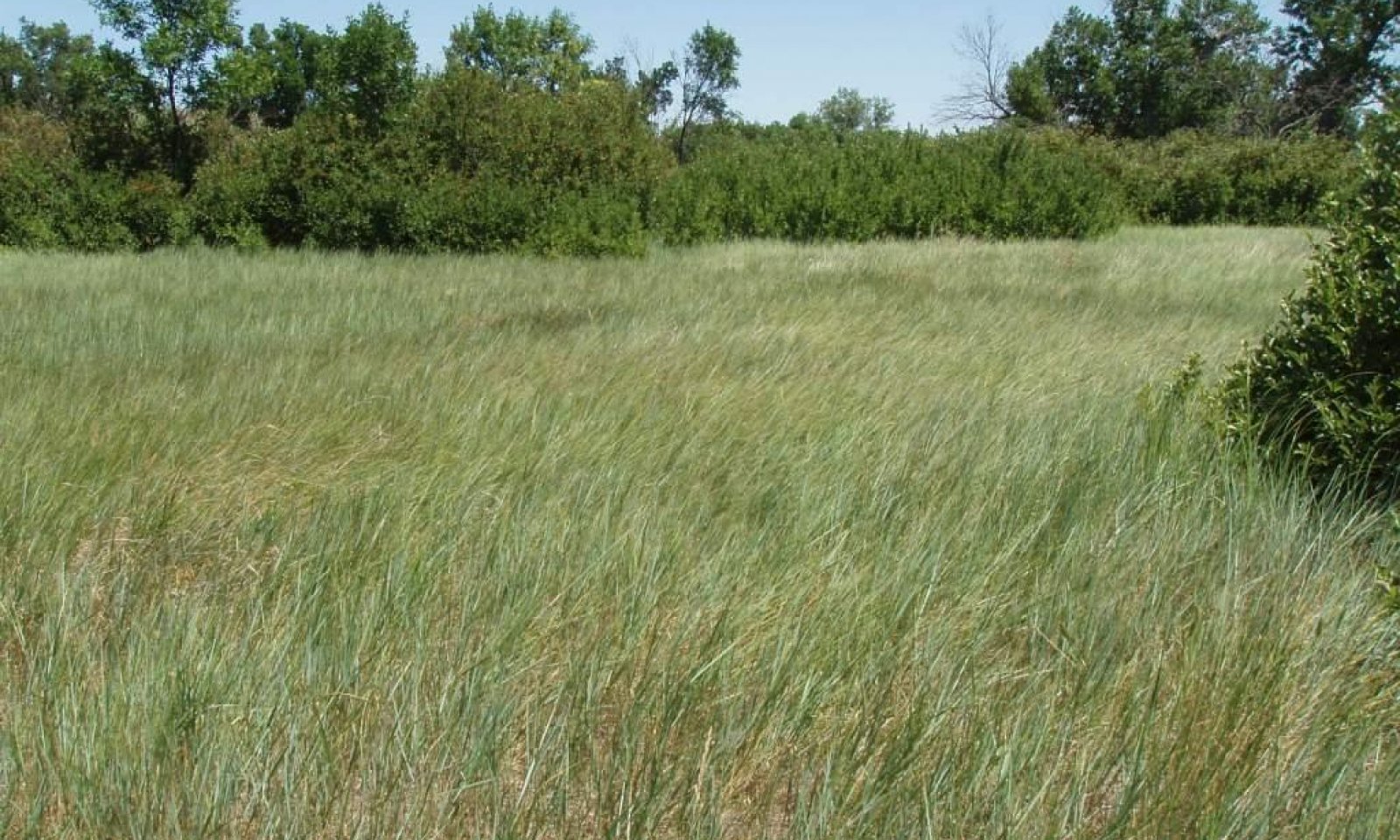
Interpretations are based primarily on the Western Wheatgrass/Green Needlegrass/Shrub Plant Community, which is considered to be climax. The potential vegetation is between 70-90 percent grasses or grass-like plants, 2-8 percent forbs, 10-20 percent shrubs, and 0-2 percent trees. The community is dominated by cool-season grasses. The major grasses include western wheatgrass and green needlegrass. Other prominent grasses and grass-likes include Canada wildrye, blue grama, and buffalograss. Forbs consist of cudweed sagewort, goldenrod, purple prairie clover, silverleaf scurfpea, and white prairie aster. Shrub species found on this site are leadplant, rose, snowberry, and wild plum. Common trees include American elm, boxelder, green ash, and plains cottonwood. Regeneration of trees is not common due to the lack of flooding, lower water table, and high grass cover.
This plant community is productive and diverse. The diversity in plant species allows for high drought tolerance. This is a sustainable plant community in regards to site/soil stability, watershed function, and biologic integrity.
Transitions or pathways leading to other plant communities are as follows:
• Continuous seasonal grazing and/or haying will convert the plant community to the Blue Grama/Buffalograss/Western Wheatgrass Plant Community.
• Nonuse and/or no fire or heavy, continuous season-long grazing will shift plant community to a Kentucky Bluegrass/Shrubs Plant Community.Figure 7. Annual production by plant type (representative values) or group (midpoint values)
Table 5. Annual production by plant type
Plant type Low
(lb/acre)Representative value
(lb/acre)High
(lb/acre)Grass/Grasslike 1725 2054 2285 Shrub/Vine 225 390 625 Forb 50 130 235 Tree 0 26 55 Total 2000 2600 3200 Figure 8. Plant community growth curve (percent production by month). SD6301 , Pierre Shale Plains, cool-season dominant.. Cool-season dominant on uplands..
Jan Feb Mar Apr May Jun Jul Aug Sep Oct Nov Dec J F M A M J J A S O N D 0 0 4 12 25 36 10 5 4 4 0 0 State 2
Blue Grama/Buffalograss/Western Wheatgrass Plant CommunityCommunity 2.1
Blue Grama/Buffalograss/Western Wheatgrass Plant CommunityThis plant community can slowly develop from the adverse effects of continuous seasonal grazing without adequate recovery periods between each grazing event during the growing season. Recognition of this plant community will enable the land user to implement key management decisions before a significant ecological threshold is crossed. Blue grama, buffalograss, and western wheatgrass are the dominant species. Green needlegrass has been reduced, while sedges have increased slightly, along with nonnative grasses.
Forb species include cudweed sagewort, goldenrod, silverleaf scurfpea, and western yarrow. Leadplant has been reduced while western snowberry has increased. Common trees include American elm, boxelder, bur oak, green ash, hackberry, and plains cottonwood. Regeneration of trees is still lacking.
This plant community is relatively stable and less productive than the climax community. Reduction of litter and short plant heights result in higher soil temperatures, poor water infiltration rates, increased runoff and high evapotranspiration rates. This plant community can occur throughout the site, on spot grazed areas, and around water sources where season-long grazing patterns occur. Soil erosion will be minimal due to the sod forming habit of blue grama.
Figure 9. Annual production by plant type (representative values) or group (midpoint values)
Table 6. Annual production by plant type
Plant type Low
(lb/acre)Representative value
(lb/acre)High
(lb/acre)Grass/Grasslike 1030 1413 1725 Shrub/Vine 85 180 310 Forb 85 180 310 Tree 0 27 55 Total 1200 1800 2400 Figure 10. Plant community growth curve (percent production by month). SD6303 , Pierre Shale Plains, cool/warm-season codominant.. Cool-season, warm-season codominant..
Jan Feb Mar Apr May Jun Jul Aug Sep Oct Nov Dec J F M A M J J A S O N D 0 0 3 10 20 28 21 10 5 3 0 0 State 3
Kentucky Bluegrass/Shrubs Plant CommunityCommunity 3.1
Kentucky Bluegrass/Shrubs Plant CommunityThis plant community develops after an extended period of non-use and exclusion of fire or from heavy continuous season-long grazing. Eventually litter levels become high enough to reduce native grass vigor, diversity and density. Kentucky bluegrass dominates this plant community. Other grass and grass-like species include blue grama, buffalograss, foxtail barley, cheatgrass, smooth bromegrass, and needleleaf sedge. Common forbs include cudweed sagewort, goldenrod, western ragweed, and western yarrow. Shrubs such as western snowberry and/or silver sagebrush will increase in density and cover and eventually tree species such as green ash, boxelder, bur oak, green ash, hackberry, plains cottonwood, and American elm will do the same. Tree regeneration is still lacking.
This plant community is resistant to change without prescribed grazing and/or fire. The combination of both grazing and fire is most effective in moving this plant community toward the Western Wheatgrass/Shrubs Plant Community. Soil erosion is low. Runoff is similar to the climax community. Once the advanced stage of this plant community is reached, time and external resources will be needed to see a recovery in the diversity of the site.
The following growth curve is an estimate of the monthly percentages of total annual growth of the dominant species expected during an average year:
Figure 11. Annual production by plant type (representative values) or group (midpoint values)
Table 7. Annual production by plant type
Plant type Low
(lb/acre)Representative value
(lb/acre)High
(lb/acre)Grass/Grasslike 710 1064 1280 Shrub/Vine 125 210 320 Forb 65 105 155 Tree 0 21 45 Total 900 1400 1800 Figure 12. Plant community growth curve (percent production by month). SD6301 , Pierre Shale Plains, cool-season dominant.. Cool-season dominant on uplands..
Jan Feb Mar Apr May Jun Jul Aug Sep Oct Nov Dec J F M A M J J A S O N D 0 0 4 12 25 36 10 5 4 4 0 0 State 4
Annuals, Pioneer Perennial Plant CommunityCommunity 4.1
Annuals, Pioneer Perennial Plant CommunityThis plant community develops under severe disturbance, heavy continuous season-long grazing, and/or defoliation. This can result from heavy livestock or wildlife concentration, and cropping abandonment (Go-back land). The dominant vegetation includes pioneer annual grasses, forbs, invaders, and early successional biennial and perennial species. Grasses may include sixweeks fescue, smooth bromegrass, annual brome, crested wheatgrass, needleandthread, prairie Junegrass, and western wheatgrass. The dominant forbs may include curlycup gumweed, lambsquarter, salsify, kochia, field bindweed, thistles, western ragweed, and other early successional species. Shrubs that may be present include rose and fringed sagewort. Plant species from adjacent ecological sites may become minor components of this plant community. The community also is susceptible to invasion of other nonnative species due to severe soil disturbances and relatively high percent of bare ground.
This plant community is resistant to change, as long as soil disturbance or severe vegetation defoliation persists, thus holding back secondary plant succession. Soil erosion is potentially high in this vegetation state. Reduced surface cover, low plant density, low plant vigor, loss of root biomass, and soil compaction, all contribute to decreased water infiltration, increased runoff, and accelerated erosion rates.
Significant economic inputs, management, and time would be required to move this plant community toward a higher successional stage and a more productive plant community. Secondary succession is highly variable, depending upon availability and diversity of a viable seed bank of higher successional species within the existing plant community and neighboring plant communities. This plant community can be renovated to improve the production capability, but management changes would be needed to maintain the new plant community.
Transitions or pathways leading to other plant communities are as follows:
• Under long-term prescribed grazing, including adequate rest periods, this plant community will move through the successional stages eventually leading to the Western Wheatgrass/Shrubs Plant Community. Depending on the slope, aspect, and size, and if adequate perennial plants exist, this change can occur more rapidly.
Go-back, Introduced, or Invaded
This group includes three separate vegetation states that are highly variable in nature. They are derived through three distinct management scenarios and are not related successionally. Infiltration, runoff, and soil erosion varies depending on the vegetation present on the site.
The Go-back Land state can be reached whenever severe mechanical disturbance occurs (e.g., tilled and abandoned land, either past or present). During the early successional stages, the species that mainly dominate are annual grasses and forbs, later being replaced by both native and introduced perennials. The vegetation on this site varies greatly, sometimes being dominated by threeawn, bluegrass, smooth bromegrass, annual brome, crested wheatgrass, buffalograss, broom snakeweed, sweetclover, and nonnative thistles. Other plants that commonly occur on the site include western wheatgrass, deathcamas, prickly lettuce, marestail, kochia, foxtail, and sunflowers. Bare ground is prevalent due to the loss of organic matter and lower overall soil health.
The Introduced state is normally those areas seeded to crested wheatgrass, pubescent wheatgrass, intermediate wheatgrass, alfalfa, or other introduced species. Refer to the associated Forage Suitability Group description for adapted species.
The Invaded state includes areas that have been invaded by species such as smooth bromegrass, bluegrass, nonnative thistles, field bindweed, knapweeds, leafy spurge, hoary cress, and other introduced species.
Figure 13. Plant community growth curve (percent production by month). SD6301 , Pierre Shale Plains, cool-season dominant.. Cool-season dominant on uplands..
Jan Feb Mar Apr May Jun Jul Aug Sep Oct Nov Dec J F M A M J J A S O N D 0 0 4 12 25 36 10 5 4 4 0 0 Additional community tables
Table 8. Community 1.1 plant community composition
Group Common name Symbol Scientific name Annual production () Foliar cover (%) Grass/Grasslike1 WHEATGRASSES 560–980 western wheatgrass PASM Pascopyrum smithii 560–980 – slender wheatgrass ELTR7 Elymus trachycaulus 0–140 – 2 COOL-SEASON BUNCHGRASSES 420–700 green needlegrass NAVI4 Nassella viridula 280–560 – needle and thread HECOC8 Hesperostipa comata ssp. comata 56–280 – porcupinegrass HESP11 Hesperostipa spartea 0–140 – Canada wildrye ELCA4 Elymus canadensis 0–140 – 3 MID WARM-SEASON GRASSES 140–560 big bluestem ANGE Andropogon gerardii 56–280 – sideoats grama BOCU Bouteloua curtipendula 28–140 – prairie sandreed CALO Calamovilfa longifolia 28–140 – little bluestem SCSC Schizachyrium scoparium 0–140 – composite dropseed SPCOC2 Sporobolus compositus var. compositus 0–84 – 4 SHORT WARM-SEASON GRASSES 28–140 blue grama BOGR2 Bouteloua gracilis 28–140 – buffalograss BODA2 Bouteloua dactyloides 0–84 – sand dropseed SPCR Sporobolus cryptandrus 0–56 – 5 OTHER NATIVE GRASSES 28–140 Graminoid (grass or grass-like) 2GRAM Graminoid (grass or grass-like) 0–140 – prairie Junegrass KOMA Koeleria macrantha 28–84 – saltgrass DISP Distichlis spicata 0–56 – 6 GRASS-LIKES 28–196 sedge CAREX Carex 28–196 – Grass-like (not a true grass) 2GL Grass-like (not a true grass) 0–84 – Forb8 FORBS 140–280 Forb, native 2FN Forb, native 28–140 – white sagebrush ARLU Artemisia ludoviciana 28–84 – American licorice GLLE3 Glycyrrhiza lepidota 28–84 – Maximilian sunflower HEMA2 Helianthus maximiliani 28–84 – goldenrod SOLID Solidago 28–84 – white heath aster SYER Symphyotrichum ericoides 28–56 – mint MENTH Mentha 0–56 – scurfpea PSORA2 Psoralidium 28–56 – upright prairie coneflower RACO3 Ratibida columnifera 28–56 – wavyleaf thistle CIUN Cirsium undulatum 28–56 – prairie clover DALEA Dalea 28–56 – western yarrow ACMIO Achillea millefolium var. occidentalis 28–56 – tarragon ARDR4 Artemisia dracunculus 0–56 – hoary verbena VEST Verbena stricta 28–56 – American vetch VIAM Vicia americana 28–56 – Cuman ragweed AMPS Ambrosia psilostachya 0–28 – rockcress ARABI2 Arabis 0–28 – scarlet beeblossom GACO5 Gaura coccinea 0–28 – false boneset BREU Brickellia eupatorioides 0–28 – nettle URTIC Urtica 0–28 – stiff sunflower HEPA19 Helianthus pauciflorus 0–28 – wood lily LIPH Lilium philadelphicum 0–28 – dotted blazing star LIPU Liatris punctata 0–28 – Shrub/Vine9 SHRUBS 280–560 western snowberry SYOC Symphoricarpos occidentalis 28–280 – Shrub (>.5m) 2SHRUB Shrub (>.5m) 0–224 – American plum PRAM Prunus americana 0–224 – silver buffaloberry SHAR Shepherdia argentea 0–224 – chokecherry PRVI Prunus virginiana 0–140 – leadplant AMCA6 Amorpha canescens 28–140 – silver sagebrush ARCA13 Artemisia cana 0–140 – rose ROSA5 Rosa 28–84 – skunkbush sumac RHTR Rhus trilobata 0–56 – Tree10 TREES 0–84 Tree 2TREE Tree 0–84 – boxelder ACNE2 Acer negundo 0–84 – green ash FRPE Fraxinus pennsylvanica 0–84 – plains cottonwood PODEM Populus deltoides ssp. monilifera 0–84 – American elm ULAM Ulmus americana 0–84 – Table 9. Community 2.1 plant community composition
Group Common name Symbol Scientific name Annual production () Foliar cover (%) Grass/Grasslike1 WHEATGRASSES 180–450 western wheatgrass PASM Pascopyrum smithii 180–450 – slender wheatgrass ELTR7 Elymus trachycaulus 0–36 – 2 COOL SEASON BUNCHGRASSES 90–180 green needlegrass NAVI4 Nassella viridula 36–144 – needle and thread HECOC8 Hesperostipa comata ssp. comata 18–90 – 3 MID&TALL warm-SEASON GRASSES 36–144 composite dropseed SPCOC2 Sporobolus compositus var. compositus 0–90 – little bluestem SCSC Schizachyrium scoparium 0–54 – sideoats grama BOCU Bouteloua curtipendula 0–54 – prairie sandreed CALO Calamovilfa longifolia 0–36 – big bluestem ANGE Andropogon gerardii 0–36 – 4 SHORT WARM-SEASON GRASSES 270–540 blue grama BOGR2 Bouteloua gracilis 180–450 – buffalograss BODA2 Bouteloua dactyloides 18–180 – sand dropseed SPCR Sporobolus cryptandrus 18–90 – 5 OTHER NATIVE GRASSES 18–90 Graminoid (grass or grass-like) 2GRAM Graminoid (grass or grass-like) 0–90 – saltgrass DISP Distichlis spicata 0–90 – prairie Junegrass KOMA Koeleria macrantha 18–36 – 6 GRASS-LIKES 36–180 sedge CAREX Carex 36–180 – Grass-like (not a true grass) 2GL Grass-like (not a true grass) 0–90 – 7 NON-NATIVE GRASSES 0–80 bluegrass POA Poa 0–144 – smooth brome BRIN2 Bromus inermis 0–90 – cheatgrass BRTE Bromus tectorum 0–90 – Forb8 forbs 90–270 Forb, introduced 2FI Forb, introduced 0–90 – Forb, native 2FN Forb, native 18–90 – white sagebrush ARLU Artemisia ludoviciana 18–90 – goldenrod SOLID Solidago 18–72 – tarragon ARDR4 Artemisia dracunculus 0–54 – scurfpea PSORA2 Psoralidium 18–54 – western yarrow ACMIO Achillea millefolium var. occidentalis 18–54 – hoary verbena VEST Verbena stricta 18–54 – curlycup gumweed GRSQ Grindelia squarrosa 0–38 – nettle URTIC Urtica 0–36 – white heath aster SYER Symphyotrichum ericoides 18–36 – Cuman ragweed AMPS Ambrosia psilostachya 18–36 – wavyleaf thistle CIUN Cirsium undulatum 0–36 – Canadian horseweed COCA5 Conyza canadensis 0–36 – common mullein VETH Verbascum thapsus 0–36 – prairie clover DALEA Dalea 0–18 – American licorice GLLE3 Glycyrrhiza lepidota 0–18 – yellow salsify TRDU Tragopogon dubius 0–18 – Maximilian sunflower HEMA2 Helianthus maximiliani 0–18 – dotted blazing star LIPU Liatris punctata 0–18 – upright prairie coneflower RACO3 Ratibida columnifera 0–18 – Shrub/Vine9 SHRUBS 90–270 western snowberry SYOC Symphoricarpos occidentalis 36–180 – Shrub (>.5m) 2SHRUB Shrub (>.5m) 0–90 – silver sagebrush ARCA13 Artemisia cana 0–90 – rose ROSA5 Rosa 18–54 – silver buffaloberry SHAR Shepherdia argentea 0–36 – American plum PRAM Prunus americana 0–36 – leadplant AMCA6 Amorpha canescens 0–36 – chokecherry PRVI Prunus virginiana 0–18 – skunkbush sumac RHTR Rhus trilobata 0–18 – Tree10 TREES 0–54 Tree 2TREE Tree 0–54 – boxelder ACNE2 Acer negundo 0–54 – green ash FRPE Fraxinus pennsylvanica 0–54 – plains cottonwood PODEM Populus deltoides ssp. monilifera 0–54 – American elm ULAM Ulmus americana 0–54 – Table 10. Community 3.1 plant community composition
Group Common name Symbol Scientific name Annual production () Foliar cover (%) Grass/Grasslike1 WHEATGRASSES 28–140 western wheatgrass PASM Pascopyrum smithii 28–140 – slender wheatgrass ELTR7 Elymus trachycaulus 0–14 – 2 COOL SEASON BUNCHGRASSES 0–70 green needlegrass NAVI4 Nassella viridula 0–70 – needle and thread HECOC8 Hesperostipa comata ssp. comata 0–28 – 3 MID&TALL WARM-SEASON GRASSES 0–42 composite dropseed SPCOC2 Sporobolus compositus var. compositus 0–42 – 4 SHORT WARM-SEASON GRASSES 210–420 buffalograss BODA2 Bouteloua dactyloides 210–420 – blue grama BOGR2 Bouteloua gracilis 210–420 – sand dropseed SPCR Sporobolus cryptandrus 0–112 – 5 OTHER NATIVE GRASSES 0–70 Graminoid (grass or grass-like) 2GRAM Graminoid (grass or grass-like) 0–70 – saltgrass DISP Distichlis spicata 0–56 – prairie Junegrass KOMA Koeleria macrantha 0–14 – 6 GRASS-LIKES 14–70 Grass-like (not a true grass) 2GL Grass-like (not a true grass) 0–70 – sedge CAREX Carex 17–70 – 7 NON-NATIVE GRASSES 280–560 bluegrass POA Poa 210–490 – smooth brome BRIN2 Bromus inermis 0–210 – cheatgrass BRTE Bromus tectorum 14–140 – Forb8 forbs 70–140 Forb, introduced 2FI Forb, introduced 0–112 – white sagebrush ARLU Artemisia ludoviciana 14–70 – Canadian horseweed COCA5 Conyza canadensis 0–56 – Forb, native 2FN Forb, native 14–56 – western yarrow ACMIO Achillea millefolium var. occidentalis 14–56 – common mullein VETH Verbascum thapsus 0–56 – tarragon ARDR4 Artemisia dracunculus 0–56 – hoary verbena VEST Verbena stricta 14–42 – goldenrod SOLID Solidago 14–42 – white heath aster SYER Symphyotrichum ericoides 14–42 – yellow salsify TRDU Tragopogon dubius 14–42 – curlycup gumweed GRSQ Grindelia squarrosa 0–42 – scurfpea PSORA2 Psoralidium 14–28 – Cuman ragweed AMPS Ambrosia psilostachya 14–28 – nettle URTIC Urtica 0–28 – Shrub/Vine9 SHRUBS 140–280 western snowberry SYOC Symphoricarpos occidentalis 70–210 – silver sagebrush ARCA13 Artemisia cana 0–140 – Shrub (>.5m) 2SHRUB Shrub (>.5m) 0–70 – American plum PRAM Prunus americana 0–42 – rose ROSA5 Rosa 14–28 – silver buffaloberry SHAR Shepherdia argentea 0–14 – skunkbush sumac RHTR Rhus trilobata 0–14 – Tree10 TREES 0–42 Tree 2TREE Tree 0–42 – boxelder ACNE2 Acer negundo 0–42 – green ash FRPE Fraxinus pennsylvanica 0–42 – plains cottonwood PODEM Populus deltoides ssp. monilifera 0–42 – American elm ULAM Ulmus americana 0–42 – Table 11. Community 4.1 plant community composition
Group Common name Symbol Scientific name Annual production () Foliar cover (%) Interpretations
Animal community
The following table lists annual, suggested initial stocking rates with average growing conditions. These are conservative estimates that should be used only as guidelines in the initial stages of conservation planning. Often, the current plant composition does not entirely match any particular plant community (as described in this ecological site description). Because of this, a resource inventory is necessary to document plant composition and production. More accurate carrying capacity estimates should eventually be calculated using the following stocking rate information along with animal preference data and actual stocking records, particularly when grazers other than cattle are involved. With consultation of the land manager, more intensive grazing management may result in improved harvest efficiencies and increased carrying capacity.
Western Wheatgrass/Shrubs
Average Annual Production(lbs./acre,air-dry)2600
Stocking Rate(AUM.acre) .71
Blue Grama/Buffalograss/Western Wheatgrass
Ave Annual Production(lbs.acre,air-dry) 1800
Stocking Rate(AUM.acre) .49
Kentucky Bluegrass/Shrubs
Ave Annual Production(lbs./acre,air-dry)1400
Stocking Rate(AUM/acre) .38
Blue Grama/Buffalograss/Western Wheatgrass 1800 0.49
Kentucky Bluegrass/Shrubs 1400 0.38
*Based on 912 lbs./acre (air-dry weight) per Animal Unit Month (AUM), and on 30 percent harvest efficiency (refer to USDA NRCS, National Range and Pasture Handbook).
Grazing by domestic livestock is one of the major income producing industries in the area. Rangeland in this area may provide yearlong forage. During the dormant period, the forage for livestock will likely be lacking protein to meet livestock requirements, and added protein will allow ruminants to better utilize the energy stored in grazed plant materials. A forage quality test (either directly or through fecal sampling) should be used to determine the level of supplementation needed.Hydrological functions
Water is the principal factor limiting forage production on this site. This site is dominated by soils in hydrologic group D. Infiltration varies from moderately slow to moderate and runoff potential varies from low to moderate depending on soil hydrologic group and ground cover. In many cases, areas with greater than 75 percent ground cover have the greatest potential for high infiltration and lower runoff. An exception would be where shortgrasses form a dense sod and dominate the site. Areas where ground cover is less than 50 percent have the greatest potential to have reduced infiltration and higher runoff (refer to Section 4, NRCS National Engineering Handbook for runoff quantities and hydrologic curves).
Recreational uses
This site provides hunting, hiking, photography, bird watching, and other opportunities. The wide varieties of plants that bloom from spring until fall have an aesthetic value that appeals to visitors.
Wood products
Wood products are limited mainly to harvest of aged trees for firewood.
Other products
Seed harvest of native plant species can provide additional income on this site.
Supporting information
Inventory data references
Information presented here has been derived from NRCS clipping data and other inventory data. Field observations from range-trained personnel were also used. Those involved in developing this site include: April Boltjes, Range Management Specialist, NRCS; Stan Boltz, Range Management Specialist, NRCS; Kent Cooley, Soil Scientist, NRCS; Rick Peterson, Range Management Specialist, NRCS; L. Michael Stirling, Range Management Specialist, NRCS. Ocular estimates of plant composition and production have been collected to develop this site description.
Other references
High Plains Regional Climate Center, University of Nebraska, 830728 Chase Hall, Lincoln, NE 68583-0728. (http://hpccsun.unl.edu)
USDA, NRCS. National Water and Climate Center, 101 SW Main, Suite 1600, Portland, OR 97204-3224. (http://wcc.nrcs.usda.gov)
USDA, NRCS. National Range and Pasture Handbook, September 1997
USDA, NRCS. National Soil Information System, Information Technology Center, 2150 Centre Avenue, Building A, Fort Collins, CO 80526. (http://nasis.nrcs.usda.gov)
USDA, NRCS. 2001. The PLANTS Database, Version 3.1 (http://plants.usda.gov). National Plant Data Center, Baton Rouge, LA 70874-4490 USA.
USDA, NRCS, Various Published Soil Surveys.Contributors
Betty Bisch
Stan BoltzApproval
Suzanne Mayne-Kinney, 6/26/2024
Rangeland health reference sheet
Interpreting Indicators of Rangeland Health is a qualitative assessment protocol used to determine ecosystem condition based on benchmark characteristics described in the Reference Sheet. A suite of 17 (or more) indicators are typically considered in an assessment. The ecological site(s) representative of an assessment location must be known prior to applying the protocol and must be verified based on soils and climate. Current plant community cannot be used to identify the ecological site.
Author(s)/participant(s) Stan Boltz Contact for lead author stanley.boltz@sd.usda.gov, 605-352-1236 Date 05/08/2010 Approved by Approval date Composition (Indicators 10 and 12) based on Annual Production Indicators
-
Number and extent of rills:
None. -
Presence of water flow patterns:
None, or barely visible and discontinuous. -
Number and height of erosional pedestals or terracettes:
None. -
Bare ground from Ecological Site Description or other studies (rock, litter, lichen, moss, plant canopy are not bare ground):
0 to 5 percent is typical. -
Number of gullies and erosion associated with gullies:
None should be present. -
Extent of wind scoured, blowouts and/or depositional areas:
None. -
Amount of litter movement (describe size and distance expected to travel):
Litter should fall in place. Slight amount of movement of smallest size class litter is possible, but not normal. -
Soil surface (top few mm) resistance to erosion (stability values are averages - most sites will show a range of values):
Soil aggregate stability ratings should typically be 5 to 6, normally 6. Surface organic matter adheres to the soil surface. Soil surface fragments will typically retain structure indefinitely when dipped in distilled water. -
Soil surface structure and SOM content (include type of structure and A-horizon color and thickness):
A-horizon should be 5 to 8 inches thick with mollic (dark) colors when moist. Structure typically is medium to fine granular in the upper A-horizon. -
Effect of community phase composition (relative proportion of different functional groups) and spatial distribution on infiltration and runoff:
Combination of shallow and deep rooted species (mid & tall rhizomatous and tufted perennial cool- and warm-season grasses) with fine and coarse roots positively influences infiltration. -
Presence and thickness of compaction layer (usually none; describe soil profile features which may be mistaken for compaction on this site):
None – when dry, B horizons can be hard and appear to be compacted, but no platy structure will be present. -
Functional/Structural Groups (list in order of descending dominance by above-ground annual-production or live foliar cover using symbols: >>, >, = to indicate much greater than, greater than, and equal to):
Dominant:
Mid cool-season rhizomatous grasses >>Sub-dominant:
Shrubs > Mid/tall cool-season bunchgrasses >Other:
Short warm-season grass > Forbs > Mid/tall warm-season grass = Grass-likes = Mid/short cool-season grass > TreesAdditional:
-
Amount of plant mortality and decadence (include which functional groups are expected to show mortality or decadence):
Very little evidence of decadence or mortality. Bunch grasses have strong, healthy centers and shrubs are vigorous. -
Average percent litter cover (%) and depth ( in):
-
Expected annual annual-production (this is TOTAL above-ground annual-production, not just forage annual-production):
Production ranges from 2,000-3,200 lbs./acre (air-dry weight). Reference value production is 2,600 lbs./acre (air-dry weight). -
Potential invasive (including noxious) species (native and non-native). List species which BOTH characterize degraded states and have the potential to become a dominant or co-dominant species on the ecological site if their future establishment and growth is not actively controlled by management interventions. Species that become dominant for only one to several years (e.g., short-term response to drought or wildfire) are not invasive plants. Note that unlike other indicators, we are describing what is NOT expected in the reference state for the ecological site:
State and local noxious weeds, Kentucky bluegrass, smooth bromegrass -
Perennial plant reproductive capability:
All species exhibit high vigor relative to climatic conditions. Do not rate based solely on seed production. Perennial grasses should have vigorous rhizomes or tillers.
Print Options
Sections
Font
AAAAOther
PrintThe Ecosystem Dynamics Interpretive Tool is an information system framework developed by the USDA-ARS Jornada Experimental Range, USDA Natural Resources Conservation Service, and New Mexico State University.
Accessibility statement


