
Natural Resources
Conservation Service
Ecological site R062XA024SD
Shallow Loamy - North
Last updated: 8/19/2024
Accessed: 08/17/2026
-
Search


Major Land Resource Area or ecological site by name and/or ID.
PreviousSectionsNextGeneral information
Provisional. A provisional ecological site description has undergone quality control and quality assurance review. It contains a working state and transition model and enough information to identify the ecological site.
Click to explore map
Figure 1. Mapped extent
Areas shown in blue indicate the maximum mapped extent of this ecological site. Other ecological sites likely occur within the highlighted areas. It is also possible for this ecological site to occur outside of highlighted areas if detailed soil survey has not been completed or recently updated.
MLRA notes
Major Land Resource Area (MLRA): 062X–Black Hills
The Black Hills (MLRA 62) is a unique, low lying mountain range situated in the midst of a mixed short and mid-grass prairie. It is a true Island in the Plains, as it has geophysical and biological attributes that are unlike the surrounding area. The Black Hills have strong floristic ties to four of the North American biomes: Cordilleran (Rocky Mountain) Forest, Northern Coniferous Forest, Eastern Deciduous Forest, and Grasslands.
MLRA 62 is approximately 3,040 square miles in size; 74 percent is located in South Dakota, and 26 percent is in Wyoming. The towns of Lead, Deadwood, Hill City, and Custer, South Dakota, are in this area. U.S. Highways 16 and 385 cross the MLRA. The Black Hills National Forest, Custer State Park, Mt. Rushmore National Monument, Jewel Cave National Monument, and Wind Cave National Park are located in this MLRA.
This area forms the core of the Black Hills and the Bear Lodge Mountains where the elevation ranges between 3,600 to 6,565 feet, however, Black Elk Peak (Harney Peak) rises to 7,242 feet. Slopes range from moderately sloping on some of the high plateaus to very steeply sloping along drainageways and on peaks and ridges. Narrow valleys generally are gently sloping to strongly sloping.
The Black Hills uplift is the product of the Laramide mountain-building episodes that produced most of the ranges in the Rocky Mountains. Uplift began near the end of the Cretaceous period, 65 million years ago and ended by 35 million years ago (Froiland 1999). The core of the Black Hills is a plutonic mass of granite with steeply dipping metamorphic rocks, primarily slate and schist, which directly surrounds the granite core. A plateau of Mississippian limestone surrounds the igneous and metamorphic rock core. The Madison limestone is broken around the outer edges of the uplifted area. The Permian Minnekahta limestone forms the outermost boundary of the area. Many other tilted sandstone, shale, and limestone units are exposed like a bathtub ring inside the steeply dipping Madison limestone.
The dominant soil orders in this MLRA are Alfisols (forest soils) and Mollisols (grassland soils). The soils in the area have a frigid or cryic soil temperature regime, a udic or ustic soil moisture regime, and mixed, micaceous, or smectitic mineralogy. They are shallow to very deep, generally well drained, and loamy in texture.
The Black Hills MLRA supports open to dense forest vegetation. Ponderosa pine is the dominant species across the Black Hills. White spruce grows at the higher elevations and along the major drainageways. Bur oak is found intermixed with pine in the northern and eastern fringes of the Black Hills, and Rocky Mountain Juniper is most common in the southern portion of the Black Hills. Aspen is of minor extent throughout the Black Hills area. Roughleaf ricegrass, slender wheatgrass, bearded wheatgrass, poverty oatgrass, Richardson’s needlegrass, and mountain ricegrass are the most common native grasses under open forest stands. The most common native shrubs are common snowberry, bearberry, common juniper, Oregon grape, and Saskatoon serviceberry.
MLRA 62 land ownership is approximately 47 percent private and 53 percent federal. Rangeland and forestland are split almost equally between private and federal ownership (47 percent each). Minor areas of land are privately owned cropland and urban development. The forestland in this area is used mainly for timber production, recreation, and grazing.
The major resource concerns are soil erosion and surface compaction caused by logging, mining, wildfires, grazing, and urban expansion. The quality of ground and surface water is another concern, especially in the northern part of the Black Hills. The primary cause is contamination from mine waste and septic systems in areas of rural development and urban expansion (USDA-NRCS, 2006: Ag Handbook 296).LRU notes
For development of ecological sites, MLRA 62 is divided into three Land Resource Units (LRU’s) or physiographic zones (A, B, C, and Y). Each LRU has a set of ecological sites that represents these zones.
The LRU is identified in the Ecological Site ID: R062XY000SD; “062X” identifies the MLRA, the next letter “Y” identifies the LRU. Note: The organization of Ecological Site ID’s will likely change in the future.
LRU-A includes the northern Black Hills and Bear Lodge Mountains (22-30” PZ); LRU-B includes the high elevation central core of the Black Hills (25-35” PZ); and LRU-C includes the southern portion of the Black Hills (17-21” PZ).
The Forest ecological sites are representative of sites in the Black Hills, Bear Lodge Mountains (MLRA-62), and the surrounding Dakota Hogback (MLRA-61). These sites are separated by elevation, soil temperature regimes, and slope.
The Low Mountain area includes all of the Black Hills, Bear Lodge Mountains, and Dakota Hogback below 6,200 feet in elevation (LRU’s A and C). The soils in this area have a frigid soil temperature regime.
The High Mountain area includes all of the Black Hills above 6,200 feet elevation (LRU-B). The soils in this area have a cryic soil temperature regime.Classification relationships
USDA
Land Resource Region G—Western Great Plains Range and Irrigated Region:
Major Land Resource Area (MLRA) 62—Black Hills
US Environmental Protection Agency (EPA)
Level IV Ecoregions of the Conterminous United States:
Black Hills Plateau—17b
Black Hills Core Highlands—17c
USDA Forest Service
Ecological Subregions: Sections and Subsections of Conterminous United States:
Black Hills Coniferous Forest Province—M334:
Black Hills Section—334A
Black Hills Limestone Plateau-Core Highlands Subsection—M334AbEcological site concept
This site is located on upland landscapes in the northern portion of the Black Hills Land Resource Unit (LRU)-A. Soils on this site are shallow, between 10 and 20 inches in depth, with a loamy surface layer ranging from 2 to 6 inches in depth. Most soils on this site are calcareous to the surface. The soils are well to excessively drained, with a restrictive bedrock layer of sandstone or limestone, which impedes water movement and rooting depth. The slopes can range from 2 to 60 percent. The site does not receive additional water from runoff or overflow. Vegetation in the Reference State is dominated by tall- and mid-height warm-season grasses, with cool-season grasses subdominant. The dominant grasses include little bluestem, big bluestem, and sideoats grama. Western wheatgrass and needlegrasses also comprise a significant amount of the plant community. Forbs are common and diverse, but never dominant. Shrubs such as western snowberry, skunkbush sumac, and prairie rose are often present in the plant community. Ponderosa pine can be scattered throughout the site, but will not exceed 2 percent canopy cover. This site is very susceptible to pine encroachment.
Associated sites
R062XA010SD Loamy - North
The Loamy ecological site can be adjacent to shallow loamy, and often is at lower positions on the landscape.
R062XY012SD Thin Upland
The Thin Upland site typically is located on steeper slopes adjacent to the Shallow Loamy site. The soils are moderate to deep, with a high percentage of carbonates to the surface.
R062XY029SD Stony Hills
Stony Hills ecological site can be adjacent to Shallow Loamy and often higher is on the landscape.
Similar sites
R062XY012SD Thin Upland
The Thin Upland site has more little bluestem and sideoats grama, and less big bluestem.
R062XY029SD Stony Hills
The Stony Hills site has more big bluestem and more lead plant, and a higher potential for ponderosa pine and higher production.
Table 1. Dominant plant species
Tree Not specified
Shrub Not specified
Herbaceous (1) Schizachyrium scoparium
(2) Andropogon gerardiiPhysiographic features
The Shallow Loamy-North ecological site occurs on gently sloping to very steep summits, shoulders, and backslopes in the Black Hills.
This site occurs on all aspects, but may be more common on east- and south-facing slopes (approximately 50 to 225 degrees of aspect).Table 2. Representative physiographic features
Landforms (1) Mountains > Ridge
(2) Mountains > Mountain slope
(3) Mountains > Structural bench
Runoff class Low to high Flooding frequency None Ponding frequency None Elevation 3600 – 6200 ft Slope 2 – 60 % Water table depth 80 in Aspect E, SE, S Climatic features
MLRA 62 is in a microclimate caused by the influence of increased elevation, which leads to increased precipitation, moderate air temperature, and lower wind velocities as compared to the surrounding Great Plains. In general, the Black Hills climate is a continental type, cold in the winter and hot in the summer.
Annual precipitation in MLRA 62 typically increases with elevation, and decreases from west to east and north to south. The average annual precipitation range for LRU-A (North) is 22 to 30 inches. Most of the rainfall occurs as frontal storms early in the growing season, in May and June. Some high-intensity, convective thunderstorms occur in July and August. Precipitation in the winter occurs mostly as snow.
The annual average snowfall ranges from 23 inches at the lower elevations in the south to 54 inches at the higher elevations in the central part of MLRA 62. Average annual temperature ranges from 36 to 48 degrees F. January is the coldest month, with an average temperature of 22°F in the central part and 25°F in the southern part of MLRA 62. July is the warmest month, with an average daily temperature of 67°F in the central part and 73°F in the southern part of this MLRA. The frost free-period ranges from 129 to 168 days: it is shortest at higher elevations and in the northwestern part of the MLRA. Hourly winds are estimated to average about 11 miles per hour (mph) annually.
Growth of cool-season plants begins in April, slowing or ceasing growth by mid-August. Warm-season plants begin growth in May, and continue to mid-September. Regrowth of cool-season plants may occur in September and October, depending upon soil moisture availability.Table 3 Representative climatic features
Frost-free period (characteristic range) 80-100 days Freeze-free period (characteristic range) 110-120 days Precipitation total (characteristic range) 20-30 in Frost-free period (actual range) 70-100 days Freeze-free period (actual range) 110-130 days Precipitation total (actual range) 20-30 in Frost-free period (average) 90 days Freeze-free period (average) 120 days Precipitation total (average) 20 in Characteristic rangeActual rangeBarLineFigure 2. Monthly precipitation range
Characteristic rangeActual rangeBarLineFigure 3. Monthly minimum temperature range
Characteristic rangeActual rangeBarLineFigure 4. Monthly maximum temperature range
BarLineFigure 5. Monthly average minimum and maximum temperature
Figure 6. Annual precipitation pattern
Figure 7 Annual average temperature pattern
Climate stations used
-
(1) MT RUSHMORE NATL MEM [USC00395870], Keystone, SD
-
(2) PACTOLA DAM [USC00396427], Rapid City, SD
-
(3) LEAD [USC00394834], Lead, SD
">Influencing water features
The Shallow Loamy (North) site is not influenced by additional moisture from streams or wetlands.
Soil features
The soils on this site are shallow and well to somewhat excessively drained. The surface layer ranges from 2 to 6 inches thick. Encroachment of ponderosa pine is common in many areas, thereby causing the mineral soil surface to be covered with 1 to 2 inches of pine needles and duff. Surface textures are variable and are listed below. Most soils on this site are calcareous to the surface. There are a few places where the soil parent material is derived from noncalcareous sources (primarily sandstone or schist), and the soils are noncalcareous. The slopes range from 2 to 60 percent.
This site typically shows slight to no evidence of rills, wind-scoured areas, or pedestalled plants. If present, water flow paths could include long, continuous, shallow gullies, or they could be broken, irregular in appearance, or discontinuous. The soil surface is stable and intact. There is a restrictive layer of bedrock (typically sandstone or limestone) at about 10 to 20 inches in depth, which impedes water movement and root penetration. These soils are mainly susceptible to water erosion. The hazard of water erosion increases on slopes greater than about 10 percent, and is more common on soils with few rock fragments. Loss of 50 percent or more of the surface layer of the soils on this site can result in a shift in species composition and/or production.
The commonly-occurring soils for this site include Corpening, Pactola, shallow, and Rockerville. Pactola, shallow is a taxadjunct to the Pactola series. Corpening and Pactola, shallow occur in the North and South LRUs. Rockerville occurs throughout the MLRA.
Access Web Soil Survey (http://websoilsurvey.nrcs.usda.gov/app/) for specific local soils information.Table 4. Representative soil features
Parent material (1) Residuum – limestone and sandstone
Surface texture (1) Channery loam
(2) Channery silt loam
(3) Loam
Family particle size (1) Loamy
Drainage class Well drained to somewhat excessively drained Permeability class Moderate to moderately rapid Soil depth 10 – 20 in Surface fragment cover <=3" 0 – 15 % Surface fragment cover >3" 0 – 7 % Available water capacity
(0-40in)1 – 3 in Calcium carbonate equivalent
(0-40in)0 – 30 % Electrical conductivity
(0-40in)0 – 4 mmhos/cm Sodium adsorption ratio
(0-40in)0 – 3 Soil reaction (1:1 water)
(0-40in)5.6 – 8.4 Subsurface fragment volume <=3"
(Depth not specified)0 – 75 % Subsurface fragment volume >3"
(Depth not specified)0 – 30 % Ecological dynamics
The vegetation of the shallow loamy ecological site is part of the Black Hills ecosystem consisting of a mixture of forests and grasslands resulting from the interaction of a varied topography, geology, climate and natural disturbance. Frequent fires, periodic droughts, and episodic mountain pine beetle infestations are also thought to have contributed to maintain this park-like forest structure of large prairie areas scattered throughout the Black Hills. Ponderosa pine is a fire adapted species as it has evolved to coexist and flourish with fire; particularly frequent, low-intensity fires that consume mostly small seedlings, prune lower branches from large trees, and reduce woody fuels debris on the forest floor. The result is a mosaic of conditions ranging from open grassland areas to groups of young seedlings to clumps and groups of large older trees. When large crown fires did occur, they probably did not completely consume all trees within the landscape, but left large healthy trees as sources of seeds to eventually recolonize the burnt areas (Shepperd and Battaglia, 2002). Between 1388 and 1900, fire intervals in the Black Hills ranged from 16 to 20 years (Brown and Hull-Sieg, 1996).
With the advent of fire suppression over the past 120 years, forests density has increased and grassland areas decreased across the whole landscape. Historical records indicated the presence of large areas covered by tall grasses on the outer edges and slopes of the limestone plateau but did not mention ponderosa pine encroachment. McIntosh (1949) conducted botanical field work in the Black hills during the summers of 1924 to 1930 and noted that pines were invading the grassland. Gardner and Thompson (1972) also mentioned that pine encroachment was most evident on areas dominated by warm season grasses. Today, ponderosa pine encroachment is still quite evident on the shallow loamy ecological site where trees seem to germinate and survive well on the rocky and gravelly soils in the absence of fire.
This site developed under Black Hills climatic conditions with short-term weather variations, light to severe grazing by bison, elk and small mammals, sporadic natural or man-caused wildfire (often of light intensities), and other biotic and abiotic factors that typically influence soil/site development.
The historic native vegetation on this site consisted of mixed prairie grasses occurring on ridges and uplands. The vegetation was predominately warm season grasses mixed with some cool-season grasses portraying a mixed grass prairie characteristic. Little bluestem is the dominant species. Big bluestem and sideoats grama are in association with little bluestem. Subdominant cool season grasses include needlegrasses and rhizomatous wheatgrasses. In the understory, are blue grama, hairy grama, and threadleaf sedge. Kentucky bluegrass is present but typically does not dominate the plant community. Forbs make up a significant proportion in the mixture. Common forbs include cudweed sagewort, scurfpeas, coneflowers, gayfeather, asters along with hood phlox and pussytoes in the understory. Shrubs include fringed sagewort, broom snakeweed, green sagewort, prairie rose, and a few yucca plants scattered on the landscape. A few ponderosa pine and juniper are often scattered across the site. Rocks, and rock fragments are very noticeable and bare ground can be present but not common.
The following diagram illustrates the common plant community phases that can occur on the site and the transition pathways between communities. These are the most common plant community phases based on current knowledge and experience, and changes will be made as more data is collected. Narratives following the diagram contain more detail pertaining to the ecological processes.State and transition model
Custom diagramStandard diagramMore interactive model formats are also available. View Interactive Models
Click on state and transition labels to scroll to the respective textEcosystem states
State 1 submodel, plant communities
State 2 submodel, plant communities
State 3 submodel, plant communities
State 1
Reference StateThis state represents the natural range of variability that dominates the dynamics in this ecological site. This site is dominated by warm-season grasses, with cool-season grasses being subdominant. In pre-European times the primary disturbances included fire and grazing by large ungulates and small mammals. Favorable growing conditions during the spring as well as the warm months of June and July along with routine or occasional fires, reduces tree cover and contributes to the ecological processes that maintain the reference plant community.
Today a similar state can be found in areas where proper livestock use has occurred and where the encroachment of trees, especially ponderosa pine, has been limited.Community 1.1
Bluestem-Wheatgrass/Ponderosa Pine (< 2% Cover)
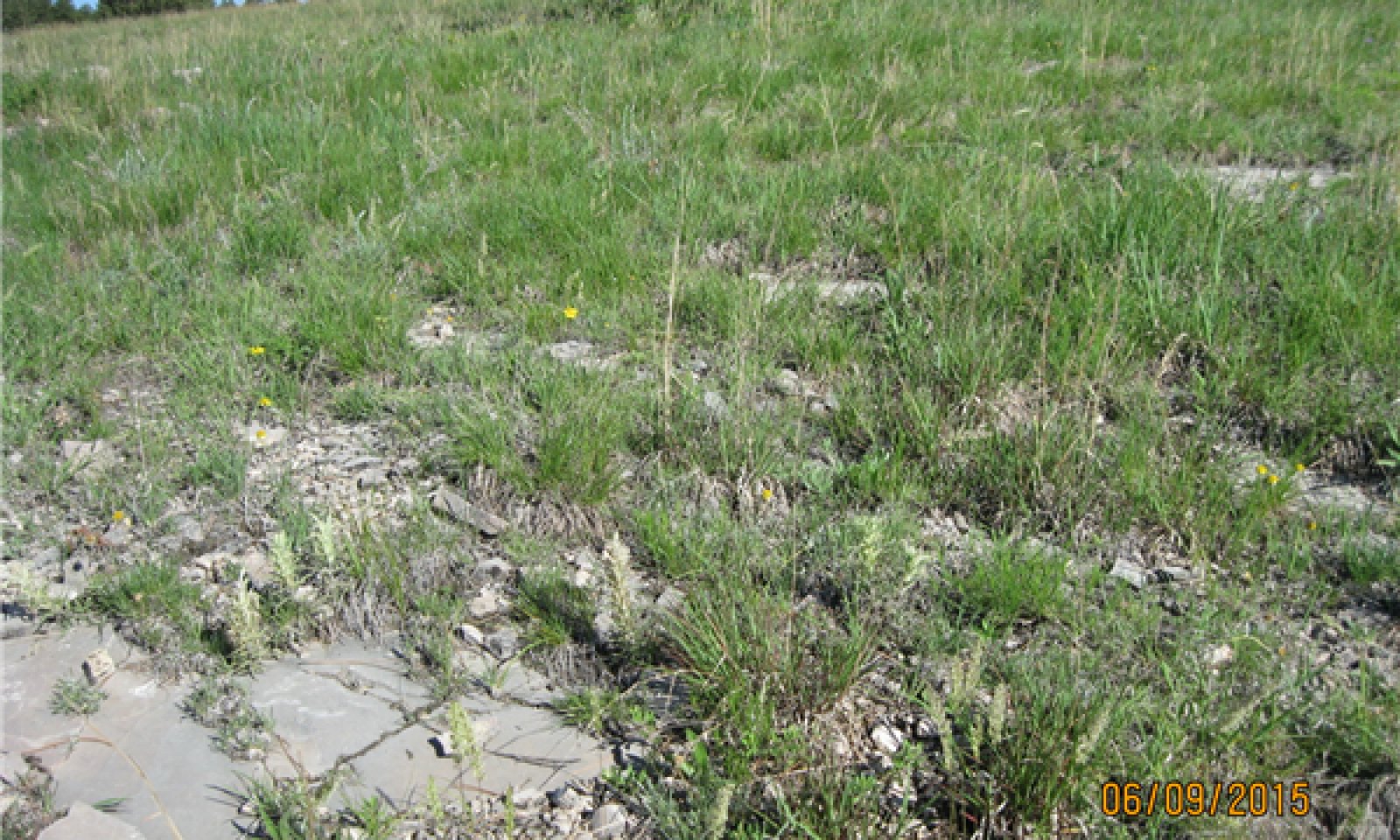
Figure 8. SwLy North - PCP 1.1 (Spring)

Figure 9. SwLy North - PCP 1.1 (Summer)
Interpretations are based primarily on the Bluestem-Sideoats grama-Rhizomatous wheatgrass plant community phase. This is also considered to be the reference or historic community. The potential vegetation is about 80 percent grass, 10 percent forbs, and 10 percent trees and shrubs. Average annual production for this plant community phase on a median year is 2,200 lbs/Ac. The community is dominated by tall and mid-height warm-season grasses with cool-season grasses being subdominant. The dominant grasses include little bluestem, big bluestem, and sideoats grama. Western wheatgrass and needlegrasses also comprise a significant amount of the plant community.
Ponderosa pine can be scattered throughout the site but will not exceed 2 percent canopy cover. Other grasses include prairie dropseed, tall dropseed, blue grama, sedge and slender wheatgrass. This plant community is productive and resilient to disturbances such as drought and fire. This is a sustainable plant community in regards to soil/site stability, watershed function, and biological integrity.Figure 10. Annual production by plant type (representative values) or group (midpoint values)
Table 5. Annual production by plant type
Plant type Low
(lb/acre)Representative value
(lb/acre)High
(lb/acre)Grass/Grasslike 1575 1837 2180 Forb 105 220 350 Shrub/Vine 20 121 225 Tree 0 22 45 Total 1700 2200 2800 Figure 11. Plant community growth curve (percent production by month). SD6204 , Black Hills, warm-season dominant, cool-season sub-dominant. Warm-season dominant, cool-season sub-dominant.
Jan Feb Mar Apr May Jun Jul Aug Sep Oct Nov Dec J F M A M J J A S O N D 0 0 3 7 17 25 25 15 7 1 0 0 Community 1.2
Wheatgrass-Needlegrass-Little Bluestem-Blue Grama/Ponderosa Pine (< 2% Cover)This plant community is a result of heavy continuous grazing, seasonal grazing with no change in season of use between grazing years, or continuous season-long grazing by livestock. The potential plant community is made up of approximately 70 percent grasses, 15 percent forbs, and 15 percent shrubs and trees. Dominant grasses include western wheatgrass, beardless wheatgrass, needleandthread, green or Columbia needlegrass and little bluestem. Short warm-season grasses such as blue grama and hairy grama present in the understory.
Sideoats grama, tall dropseed, and prairie dropseed may also be present. Invasive, non-native grasses such as Kentucky bluegrass, may contribute to biomass production but do not dominate this ecological site. Forbs contribute substantially to the biomass production in this plant community. Big bluestem has decreased dramatically and may be nearly absent from the site. Ponderosa pine can be scattered throughout the site but will not exceed 2 percent canopy cover. The herbaceous species within this plant community are well-adapted to grazing.Pathway 1.1A
Community 1.1 to 1.2Continuous season-long grazing or heavy continuous grazing with stocking rates above the carrying capacity for the entire growing season or seasonal grazing during the middle of the growing season every year will cause a decrease in big bluestem, little bluestem and sideoats grama. Rhizomatous wheatgrass and needlegrass will increase initially but will decrease in the plant community if grazing management is not changed.
Pathway 1.2A
Community 1.2 to 1.1Long-term prescribed grazing that provides adequate recovery and change in season of use, along with normal precipitation regime and periodic fire can restore the tall warm-season component of this plant community.
State 2
Shortgrass StateThis state is dominated by short-grass species and sedges and is the result of continuous season-long grazing or heavy continuous grazing. Desirable species have been over utilized and removed or greatly reduced in the plant community. The site is has increased runoff and depending on percent bare ground the site can be susceptible to erosion. This state can be very resistant to change.
Community 2.1
Blue Grama/Sedge/Fringed Sagewort/Ponderosa Pine (< 8% Cover)This plant community develops under continuous, season-long grazing or heavy continuous grazing. The transition may be accelerated by over-utilization during extended drought periods. This plant community is composed of approximately 65 percent grasses, 15 percent forbs, and 20 percent shrubs and conifers. Dominant grasses and grass-like plants include, blue grama, hairy grama, thread-leaf sedge, plains muhly, sideoats grama, and prairie junegrass. Other grasses include rhizomatous wheatgrass, needlegrass’s, little bluestem and sand dropseed. Cheatgrass, field brome, smooth brome, and Kentucky bluegrass may also invade the site. Forbs commonly found in this plant community include prairie coneflower, dotted gay feather, and common mares-tail. Shrubs commonly found on this site include fringed sagewort, broom snakeweed, soapweed yucca, and prairie rose. When compared to the Reference State, short statured grasses have increased significantly and become more dominant on the site. Shrubs become more common on the site as herbaceous species become reduced in vigor and cover. It is also common for Ponderosa pine to increase in this plant community.
State 3
Conifer/Herbaceous StateThis state is dominated by conifer and is a result of heavy continuous grazing and lack of frequent fire or no use and no fire resulting in encroachment of conifers. Areas of intermediate and dense ponderosa pine canopy was found to reduce precipitation reaching the forest floor by an average of 30 percent (Wrage, 1994). Native warm-season grasses such as bluestems, sideoats grama, blue grama and cool-season grasses such as wheatgrasses and needlegrasses declined as overstory canopy cover increases. Shade tolerant grasses, such as poverty oatgrass, bluegrasses, and rough-leaved ricegrass increase. Forbs such as cudweed, sagewort and shrubs such as wood rose increased under intermediate canopy closure (< 25 percent). In the absence of fire, this plant community phase will be resistant to change. Ponderosa pine canopy can continue to increase over time, reducing herbaceous production and increasing bare ground. This state will have lower water infiltration rates, increased runoff, and potential for soil erosion. The resulting plant community is less productive for grazing animals than the other states.
Community 3.1
Ponderosa Pine (> 25% Cover)/Wheatgrass-Kentucky Bluegrass/Fringed Sagewort
Figure 12. SwLy North - PCP 3.1 Ponderosa Pine
This plant community is characterized by the dominance of conifers as a result of heavy continuous season-long grazing, and no fire, or no use and no fire. Ponderosa pine make up approximately 30 percent of the plant community, and shrubs approximately 15 percent. Grasses and forbs make up approximately 55 percent of the plant community. Dominant grass and grass-like plants include Kentucky bluegrass, slender wheatgrass, needleandthread, rough-leaved rice grass, and upland sedge. Dominant forbs include cudweed sagewort, coneflower, and dotted gayfeather. Prevalent shrubs include fringed sagewort, wild rose, poison ivy, and skunkbush sumac. Most of these shrubs rarely exceed one foot in height. Ponderosa pine is the dominant tree species; and Rocky Mountain juniper is sometimes present as a subordinate tree, but does not dominate.
Transition 1A
State 1 to 2Continuous season-long grazing or heavy continuous grazing will cause a transition from the Reference State to a plant community dominated by shortgrass species in the Shortgrass State. Ponderosa pine may increase on this site but typically not greater than 8 percent canopy cover.
Transition 1B
State 1 to 3Heavy continuous season-long grazing with stocking rates well above the carrying capacity for the entire growing season combined with the absence of fire to control conifer seedling establishment, or no use, no fire and conifer encroachment will lead toward a conifer dominated state, State 3. More shade tolerant grasses will become dominant in this state.
Restoration pathway 2A
State 2 to 1Long-term prescribed grazing which provides growing season grazing deferment along with stocking rates not exceeding carrying capacities and periodic fire or prescribed burning will restore this plant community to the Reference State. The Shortgrass State can be resistant to change and grazing deferments and favorable growing conditions will in time help reestablish the plant community however management goals may not be achieved.
Transition 2A
State 2 to 3Continuous season-long grazing or heavy continuous grazing with stocking rates above the carrying capacity for the entire growing season combined with the absence of fire to control shrub and conifer seedlings’ establishment, or no use, no fire and encroachment will lead toward a conifer dominated state, State 3.
Restoration pathway 3A
State 3 to 1Fire or prescribed burning or mechanical brush management, plus long-term prescribed grazing may move the Conifer State back to the Reference State depending upon the plant community and climatic conditions. This could be a long-term process and the results may not be achieved or meet management goals. Seeding may be successful following wildfire; however, it is recommended to use native species that replicate the structural functional groups in PCP 1.2.
Transition 3A
State 3 to 2Depending upon the existing herbaceous plant species in the understory, prescribed fire and/or mechanical brush management to remove conifers and long-term prescribed grazing may transition the Conifer State to the Shortgrass State. Grazing deferments and favorable growing conditions will in time help to reestablish the plant community; however, management goals may not be achieved.
Additional community tables
Table 6. Community 1.1 plant community composition
Group Common name Symbol Scientific name Annual production () Foliar cover (%) Grass/Grasslike1 Tall and Mid- Warm-Season Grasses 440–1320 little bluestem SCSC Schizachyrium scoparium 220–660 – prairie dropseed SPHE Sporobolus heterolepis 110–220 – sideoats grama BOCU Bouteloua curtipendula 110–220 – big bluestem ANGE Andropogon gerardii 110–220 – plains muhly MUCU3 Muhlenbergia cuspidata 0–110 – composite dropseed SPCOC2 Sporobolus compositus var. compositus 22–110 – marsh muhly MURA Muhlenbergia racemosa 0–44 – 2 Cool-Season Bunchgrass 110–330 needle and thread HECOC8 Hesperostipa comata ssp. comata 22–220 – prairie Junegrass KOMA Koeleria macrantha 22–110 – Richardson's needlegrass ACRI8 Achnatherum richardsonii 0–110 – Rocky Mountain fescue FESA Festuca saximontana 0–110 – slender wheatgrass ELTR7 Elymus trachycaulus 22–110 – timber oatgrass DAIN Danthonia intermedia 0–110 – slender wheatgrass ELTRS Elymus trachycaulus ssp. subsecundus 22–110 – Columbia needlegrass ACNE9 Achnatherum nelsonii 0–110 – green needlegrass NAVI4 Nassella viridula 22–110 – mountain brome BRMA4 Bromus marginatus 0–110 – 3 Cool-Season Rhizomatous Grass 44–220 western wheatgrass PASM Pascopyrum smithii 44–220 – thickspike wheatgrass ELLAL Elymus lanceolatus ssp. lanceolatus 0–110 – 4 Short Warm-Season Grasses 22–330 blue grama BOGR2 Bouteloua gracilis 22–220 – hairy grama BOHI2 Bouteloua hirsuta 0–110 – threeawn ARIST Aristida 0–110 – 5 Other Native Grasses 0–110 Grass, perennial 2GP Grass, perennial 0–110 – 6 Grass-Likes 22–220 needleleaf sedge CADU6 Carex duriuscula 22–110 – threadleaf sedge CAFI Carex filifolia 22–110 – Grass-like (not a true grass) 2GL Grass-like (not a true grass) 0–110 – Richardson's sedge CARI Carex richardsonii 0–44 – sedge CAREX Carex 22–44 – 7 Non-Native Cool-Season Grasses 0 Forb8 Forbs 110–330 goldenrod SOLID Solidago 22–110 – blacksamson echinacea ECAN2 Echinacea angustifolia 22–110 – scurfpea PSORA2 Psoralidium 22–110 – western yarrow ACMIO Achillea millefolium var. occidentalis 22–44 – white prairie aster SYFA Symphyotrichum falcatum 22–44 – wild bergamot MOFI Monarda fistulosa 0–44 – Forb, perennial 2FP Forb, perennial 0–44 – fleabane ERIGE2 Erigeron 0–44 – hairy false goldenaster HEVI4 Heterotheca villosa 0–44 – mariposa lily CALOC Calochortus 22–44 – beardtongue PENST Penstemon 0–44 – prairie clover DALEA Dalea 0–44 – upright prairie coneflower RACO3 Ratibida columnifera 0–44 – old man's whiskers GETR Geum triflorum 0–44 – dotted blazing star LIPU Liatris punctata 22–44 – American vetch VIAM Vicia americana 0–44 – blanketflower GAAR Gaillardia aristata 0–44 – Lewis flax LILE3 Linum lewisii 0–44 – bluebell bellflower CARO2 Campanula rotundifolia 0–44 – cinquefoil POTEN Potentilla 0–44 – white sagebrush ARLU Artemisia ludoviciana 22–44 – deathcamas ZIGAD Zigadenus 0–22 – downy paintedcup CASE5 Castilleja sessiliflora 0–22 – spiny phlox PHHO Phlox hoodii 0–22 – common starlily LEMO4 Leucocrinum montanum 0–22 – Shrub/Vine9 Shrubs 22–220 Shrub (>.5m) 2SHRUB Shrub (>.5m) 0–110 – common juniper JUCO6 Juniperus communis 22–110 – creeping juniper JUHO2 Juniperus horizontalis 22–110 – prairie sagewort ARFR4 Artemisia frigida 22–110 – field sagewort ARCA12 Artemisia campestris 0–44 – skunkbush sumac RHTR Rhus trilobata 0–22 – smooth sumac RHGL Rhus glabra 0–22 – western snowberry SYOC Symphoricarpos occidentalis 0–22 – Tree10 Trees 0–44 ponderosa pine PIPO Pinus ponderosa 0–44 – bur oak QUMA2 Quercus macrocarpa 0–22 – Table 7. Community 1.2 plant community composition
Group Common name Symbol Scientific name Annual production () Foliar cover (%) Table 8. Community 2.1 plant community composition
Group Common name Symbol Scientific name Annual production () Foliar cover (%) Table 9. Community 3.1 plant community composition
Group Common name Symbol Scientific name Annual production () Foliar cover (%) Interpretations
Other information
Revision Notes:
“This PROVISIONAL ecological site concept has been QCd and QAd to ensure that the site meets the NESH standards for a provisional ecological site that provides basic compiled information in one location. This site should not be considered an Approved ESD, as it is only the foundational site concepts and requires further data collection—specifically high-intensity data characterizations and full 232 soil descriptions—and further site investigations and final STM reviews before it can be used as an Approved ESD meeting NESH standards”
Site Development and Testing Plan:
Future work, as described in a Project Plan, to validate the information in this Provisional Ecological Site Description is needed. This will include field activities to collect low-, medium-, and high-intensity sampling, soil correlations, and analysis of that data. Annual field reviews should be done by soil scientists and vegetation specialists. A final field review, peer review, quality control, and quality assurance reviews of the ESD will be needed to produce the final document.
Supporting information
Inventory data references
Information presented here has been derived from NRCS clipping data and other inventory data. Field observations from range-trained personnel also were used. Those involved in developing this site include Lakhdar Benkobi, ESI/SRIC, NRCS; Stan Boltz, Range Management Specialist, NRCS; Dan Brady, Soil Scientist, NRCS; Mitch Faulkner, Range Management Specialist, NRCS; Roger Gates, Associate Professor/Rangeland Management Specialist, West River Ag Center; Rick Peterson, Ecological Site Specialist, NRCS; Matthew, Scott, Botanist - USFS Hell Canyon District Ranger; L. Michael Stirling, Range Management Specialist, NRCS; and Jim Westerman, Soil Scientist, NRCS. All inventory information and data records are compiled within the Rapid City, SD USDA-NRCS Shared “S” network drive.
Other references
Brown, P. M. and C. Hull-Sieg. 1996. Fire history in interior ponderosa pine communities of the Black Hills, South Dakota. Int. J. Wildland Fire 6(3): 97-105.
Gartner F. R. and W. W. Thompson. 1972. Fire in the Black Hills forest-grass ecotone. South Dakota Agricultural Experiment Station, Journal Series No 1115.
High Plains Regional Climate Center, University of Nebraska. (http://www.hprcc.unl.edu/) McIntosh, A. C. 1949.
A botanical survey of the Black Hills of South Dakota. Black Hills Engineer. 28 (4): 3-75.
Shepperd, W. D. and M. A. Battaglia. 2002. Ecology, silviculture, and management of Black Hills ponderosa pine. Gen. Tech. Rep. RMRS- GTR-97. Fort Collins, CO: US Department of Agriculture, Forest Service, Rocky Mountain Research Station. 112 p.
Toledo, D., Sanderson, M., Spaeth, K., Hendrickson, J., Printz, J. 2014. Extent of Kentucky bluegrass and its effect on native plant species diversity and ecosystem services in the Northern Great Plains of the United States. Invasive Plant Science and Management. 7(4):543-522. Weed Science Society of America.
USDS, NRCS. 2006. Land Resource Regions and Major Land Resource Areas of the United States, the Caribbean, and the Pacific Basin. U.S. Department of Agriculture Handbook 296.
USDA, NRCS. National Water and Climate Center. (http://wcc.nrcs.usda.gov) USDA, NRCS. National Range and Pasture Handbook, September 1997
USDA, NRCS. National Soil Information System, Information Technology Center. (http://nasis.nrcs.usda.gov)
USDA, NRCS. 2001. The PLANTS Database, Version 3.1 (http://plants.usda.gov). National Plant Data Center.
USDA, NRCS. National Ecological Site Handbook, 1st Ed. January, 2014.
Wrage, K. J. 1994. The effects of ponderosa pine on soil moisture, precipitation, and understory vegetation in the Black Hills of South Dakota. 158 p. Thesis.Contributors
Peterson Rick L
Westerman JamesApproval
Suzanne Mayne-Kinney, 8/19/2024
Acknowledgments
MLRA 62 sites were written to the Provisional Level by Rick L. Peterson, ESS, Rapid City, SSO in FY20. The ESDs were reviewed for quality control by Emily Helms, John Hartung, Mitch Faulkner, and Ryan Murray. All ecological sites were then reviewed and approved at the Provisional Level by David Kraft, Regional ESS, Salina, KS in September 2020.
Rangeland health reference sheet
Interpreting Indicators of Rangeland Health is a qualitative assessment protocol used to determine ecosystem condition based on benchmark characteristics described in the Reference Sheet. A suite of 17 (or more) indicators are typically considered in an assessment. The ecological site(s) representative of an assessment location must be known prior to applying the protocol and must be verified based on soils and climate. Current plant community cannot be used to identify the ecological site.
Author(s)/participant(s) Contact for lead author Date 08/17/2026 Approved by Approval date Composition (Indicators 10 and 12) based on Annual Production Indicators
-
Number and extent of rills:
-
Presence of water flow patterns:
-
Number and height of erosional pedestals or terracettes:
-
Bare ground from Ecological Site Description or other studies (rock, litter, lichen, moss, plant canopy are not bare ground):
-
Number of gullies and erosion associated with gullies:
-
Extent of wind scoured, blowouts and/or depositional areas:
-
Amount of litter movement (describe size and distance expected to travel):
-
Soil surface (top few mm) resistance to erosion (stability values are averages - most sites will show a range of values):
-
Soil surface structure and SOM content (include type of structure and A-horizon color and thickness):
-
Effect of community phase composition (relative proportion of different functional groups) and spatial distribution on infiltration and runoff:
-
Presence and thickness of compaction layer (usually none; describe soil profile features which may be mistaken for compaction on this site):
-
Functional/Structural Groups (list in order of descending dominance by above-ground annual-production or live foliar cover using symbols: >>, >, = to indicate much greater than, greater than, and equal to):
Dominant:
Sub-dominant:
Other:
Additional:
-
Amount of plant mortality and decadence (include which functional groups are expected to show mortality or decadence):
-
Average percent litter cover (%) and depth ( in):
-
Expected annual annual-production (this is TOTAL above-ground annual-production, not just forage annual-production):
-
Potential invasive (including noxious) species (native and non-native). List species which BOTH characterize degraded states and have the potential to become a dominant or co-dominant species on the ecological site if their future establishment and growth is not actively controlled by management interventions. Species that become dominant for only one to several years (e.g., short-term response to drought or wildfire) are not invasive plants. Note that unlike other indicators, we are describing what is NOT expected in the reference state for the ecological site:
-
Perennial plant reproductive capability:
Print Options
Sections
Font
AAAAOther
PrintThe Ecosystem Dynamics Interpretive Tool is an information system framework developed by the USDA-ARS Jornada Experimental Range, USDA Natural Resources Conservation Service, and New Mexico State University.
Accessibility statement


