
Natural Resources
Conservation Service
Ecological site R047XA320UT
Upland Shallow Loam
(Wyoming big sagebrush)
Last updated: 2/05/2025
Accessed: 10/16/2026
-
Search


Major Land Resource Area or ecological site by name and/or ID.
PreviousSectionsNextGeneral information
Provisional. A provisional ecological site description has undergone quality control and quality assurance review. It contains a working state and transition model and enough information to identify the ecological site.
Click to explore map
Figure 1. Mapped extent
Areas shown in blue indicate the maximum mapped extent of this ecological site. Other ecological sites likely occur within the highlighted areas. It is also possible for this ecological site to occur outside of highlighted areas if detailed soil survey has not been completed or recently updated.
MLRA notes
Major Land Resource Area (MLRA): 047X–Wasatch and Uinta Mountains
MLRA 47 occurs in Utah (86 percent), Wyoming (8 percent), Colorado (4 percent), and Idaho (2 percent). It encompasses approximately 23,825 square miles (61,740 square kilometers). The northern half of this area is in the Middle Rocky Mountains Province of the Rocky Mountain System. Parts of the western edge of this MLRA are in the Great Basin Section of the Basin and Range Province of the Intermontane Plateaus. The MLRA includes the Wasatch Mountains, which trend north and south. The steeply sloping, precipitous Wasatch Mountains have narrow crests and deep valleys. Active faulting and erosion are a dominant force in controlling the geomorphology of the area.
The mountains in this area are primarily fault blocks that have been tilted up. Alluvial fans at the base of the mountains are recharge zones for the basin fill aquifers. An ancient shoreline of historic Bonneville Lake is evident on the footslopes along the western edge of the area. Rocks exposed in the mountains are mostly Mesozoic and Paleozoic sediments.
The average precipitation is from 12 to 16 inches in the valleys and can range up to 73 inches in the mountains. Peak precipitation occurs in the winter months. The average annual temperature is 30 to 50 degrees Fahrenheit (-1 to 15 C). The freeze-free period averages 140 days and ranges from 60 to 220 days, generally decreasing in length with elevation.
The dominant soil orders in this MLRA are Entisols, Inceptisols, and Mollisols. The lower elevations are dominated by a frigid temperature regime, while the higher elevations experience cryic temperature regimes. The soil moisture regime is typically xeric. The minerology is generally mixed and the soils are very shallow to very deep, generally well drained, and loamy or loamy-skeletal.LRU notes
This LRU includes the Wasatch Mountains which tend to run north and south. These steeply sloping, precipitous mountains have narrow crests and deep valleys. They are primarily fault blocks that have been tilted up. The alluvial fans located at the base of these mountains are important recharge zones for valley aquifers.
Classification relationships
Modal Soil: loamy, mixed (calcareous), frigid Lithic Xerorthents
Ecological site concept
The soils that support this site are shallow and very gravelly. They formed in colluvium and residuum derived from sandtone, conglomerate and shale parent materials. The surface layers are typically dark brown gravelly or stony loams and are subtended by sandstone gravels or conglomerate rock. Water holding capacity is low, ranging from 1.1 to 2.4 inches. The soil moisture regime is xeric and the soil temperature regime is frigid and sometimes mesic.
Associated sites
R047XA308UT Upland Loam (basin big sagebrush)
Similar sites
R047XA338UT Upland Stony Loam (Wyoming big sagebrush)
Table 1. Dominant plant species
Tree Not specified
Shrub (1) Artemisia tridentata ssp. wyomingensis
Herbaceous (1) Pseudoroegneria spicata
Physiographic features
This site occurs on mountain slopes, ridges, foothills and valley sides at elevations between 5,400 and 8,000 feet. It is common on southern exposures but can occur on all aspects. This site occurs on virtually all slopes, as long as the soil is shallow. Runoff ranges from medium to very high.
Table 2. Representative physiographic features
Landforms (1) Ridge
(2) Mountain slope
(3) Foothills
Runoff class Medium to very high Flooding frequency None Ponding frequency None Elevation 5400 – 8000 ft Slope 5 – 50 % Aspect Aspect is not a significant factor Table 3. Representative physiographic features (actual ranges)
Runoff class Not specified Flooding frequency Not specified Ponding frequency Not specified Elevation 4710 – 8730 ft Slope 1 – 70 % Climatic features
The climate for this site is characterized by cold, snowy winters and warm, dry summers. The average annual precipitation is 14 to 16 inches with most of the moisture coming in the spring and fall. Winter snowpack provides additional moisture to the soil as it melts in the spring. However, much of the spring moisture is unavailable to plants by mid-June, and reduced precipitation causes many herbaceous species to go dormant by July 1. July and August are typically the driest months of the year for this site.
Table 4 Representative climatic features
Frost-free period (characteristic range) 60-80 days Freeze-free period (characteristic range) 110-120 days Precipitation total (characteristic range) 10-20 in Frost-free period (actual range) 50-80 days Freeze-free period (actual range) 110-120 days Precipitation total (actual range) 10-20 in Frost-free period (average) 70 days Freeze-free period (average) 110 days Precipitation total (average) 20 in Characteristic rangeActual rangeBarLineFigure 2. Monthly precipitation range
Characteristic rangeActual rangeBarLineFigure 3. Monthly minimum temperature range
Characteristic rangeActual rangeBarLineFigure 4. Monthly maximum temperature range
BarLineFigure 5. Monthly average minimum and maximum temperature
Figure 6. Annual precipitation pattern
Figure 7 Annual average temperature pattern
Climate stations used
-
(1) COALVILLE [USW00024120], Coalville, UT
-
(2) ECHO DAM [USC00422385], Coalville, UT
-
(3) LAKETOWN [USC00424856], Laketown, UT
">Influencing water features
Due to its landscape position, this site is not typically influenced by streams or wetlands.
Wetland description
N/A
Soil features
The soils that support this site are shallow and very gravelly. They formed in colluvium and slope alluvium derived from sandstone, conglomerate and shale parent materials. The surface layers are typically dark brown gravelly or stony loams and are subtended by sandstone gravels or conglomerate rock. Water holding capacity is low, ranging from 1.1 to 2.4 inches. The soil moisture regime is aridic xeric and the soil temperature regime is frigid.
Table 5. Representative soil features
Parent material (1) Colluvium – sedimentary rock
(2) Slope alluvium – sedimentary rock
Surface texture (1) Gravelly loam
(2) Very gravelly loam
(3) Stony loam
Family particle size (1) Loamy-skeletal
Drainage class Well drained to somewhat excessively drained Permeability class Moderate to moderately rapid Depth to restrictive layer 10 – 20 in Soil depth 10 – 20 in Surface fragment cover <=3" 10 – 30 % Surface fragment cover >3" 0 – 15 % Available water capacity
(0-40in)1.1 – 2.4 in Calcium carbonate equivalent
(0-40in)5 – 20 % Electrical conductivity
(0-40in)0 – 2 mmhos/cm Sodium adsorption ratio
(0-40in)0 – 5 Soil reaction (1:1 water)
(0-40in)6.6 – 8.4 Subsurface fragment volume <=3"
(0-40in)25 – 40 % Subsurface fragment volume >3"
(0-40in)0 – 20 % Table 6. Representative soil features (actual values)
Drainage class Not specified Permeability class Not specified Depth to restrictive layer 0 in Soil depth 0 in Surface fragment cover <=3" 5 – 45 % Surface fragment cover >3" 0 – 30 % Available water capacity
(0-40in)0.4 – 2.8 in Calcium carbonate equivalent
(0-40in)0 – 30 % Electrical conductivity
(0-40in)0 mmhos/cm Sodium adsorption ratio
(0-40in)0 Soil reaction (1:1 water)
(0-40in)6.6 – 9 Subsurface fragment volume <=3"
(0-40in)8 – 69 % Subsurface fragment volume >3"
(0-40in)0 – 30 % Ecological dynamics
The plant community dynamics of this site are presumed to have been driven by fire historically. The Reference Plant Community consists of very diverse shrubs, forbs and grasses. Wyoming big sagebrush would have co-dominated with bluebuch wheatgrass and other perennial bunchgrasses in the Reference State, with grasses increasing in dominance immediately following fire (or possibly other shrub-removing disturbance i.e. aroga moth, snow mold, etc.) and big sagebrush increasing in dominance over time without fire. When sprouting shrubs are abundant in the community, they tend to co-dominate with grasses on this site following fire.
The introduction of non-native plants and domestic livestock since the time of European settlement has altered the plant community dynamics of this site, as diagrammed in the State-and-Transition Model. Although this site is resilient to properly managed livestock grazing, it is susceptible to grass loss and sagebrush dominance under excessive grazing pressures. When grazing pressures repeatedly remove the growing points (apical meristems) of perennial grasses, they will tend to lose vigor and decrease on the site.
This site has been documented to support introduced perennial grass species when these species are seeded under the proper conditions for germination and establishment.
Although cheatgrass and other non-native species can occur on this site, there is currently no documentation of non-native annual species dominance. However, the conditions of this site are similar to many sagebrush sites where cheatgrass has become dominant, so care should be taken to decrease the likelihood of cheatgrass invasion. Soil surface disturbance, removal of existing perennial plants, and introduction of cheatgrass seeds via hay, livestock, or vehicles will increase the likelihood of cheatgrass dominance on this site.State and transition model
Custom diagramStandard diagram
Figure 8. State-and-Transition Model
More interactive model formats are also available. View Interactive Models
More interactive model formats are also available. View Interactive Models
Click on state and transition labels to scroll to the respective textEcosystem states
T1a - non-native plants and domestic livestock are introduced to the site T2a - Extended drought in combination with excessive grazing T2b - non-native perennial grass seed is established on the site following tillage, wildfire, or other removal of the existing vegetation T3a - non-native perennial grass seed is established on the site following tillage, wildfire, or other removal of the existing vegetation T4a - Extended drought in combination with excessive grazing State 1 submodel, plant communities
1.1a - fire or other shrub-removal disturbance 1.1b - fire or other shrub-removal disturbance 1.2a - Time following disturbance 1.2b - an increase in sprouting shrubs, possibly due to repeated fires over a short time period 1.3a - Time following disturbance State 2 submodel, plant communities
2.1a - fire or other shrub-removal disturbance 2.1b - fire or other shrub-removal disturbance 2.2a - Time following disturbance 2.2b - an increase in sprouting shrubs, possibly due to repeated fires over a short time period 2.3a - Time following disturbance State 3 submodel, plant communities
State 4 submodel, plant communities
State 1
Reference StateThe plant community dynamics of this site are presumed to have been driven by fire historically. The Reference Plant Community consists of very diverse shrubs, forbs and grasses. Wyoming big sagebrush would have co-dominated with bluebunch wheatgrass and other perennial bunchgrasses in the Reference State, with grasses increasing in dominance immediately following fire (or possibly other shrub-removing disturbance i.e. aroga moth, snow mold, etc.) and big sagebrush increasing in dominance over time without fire. When sprouting shrubs are abundant in the community, they tend to co-dominate with grasses on this site following fire.
Community 1.1
Wyoming Big Sagebrush / Perennial Grass
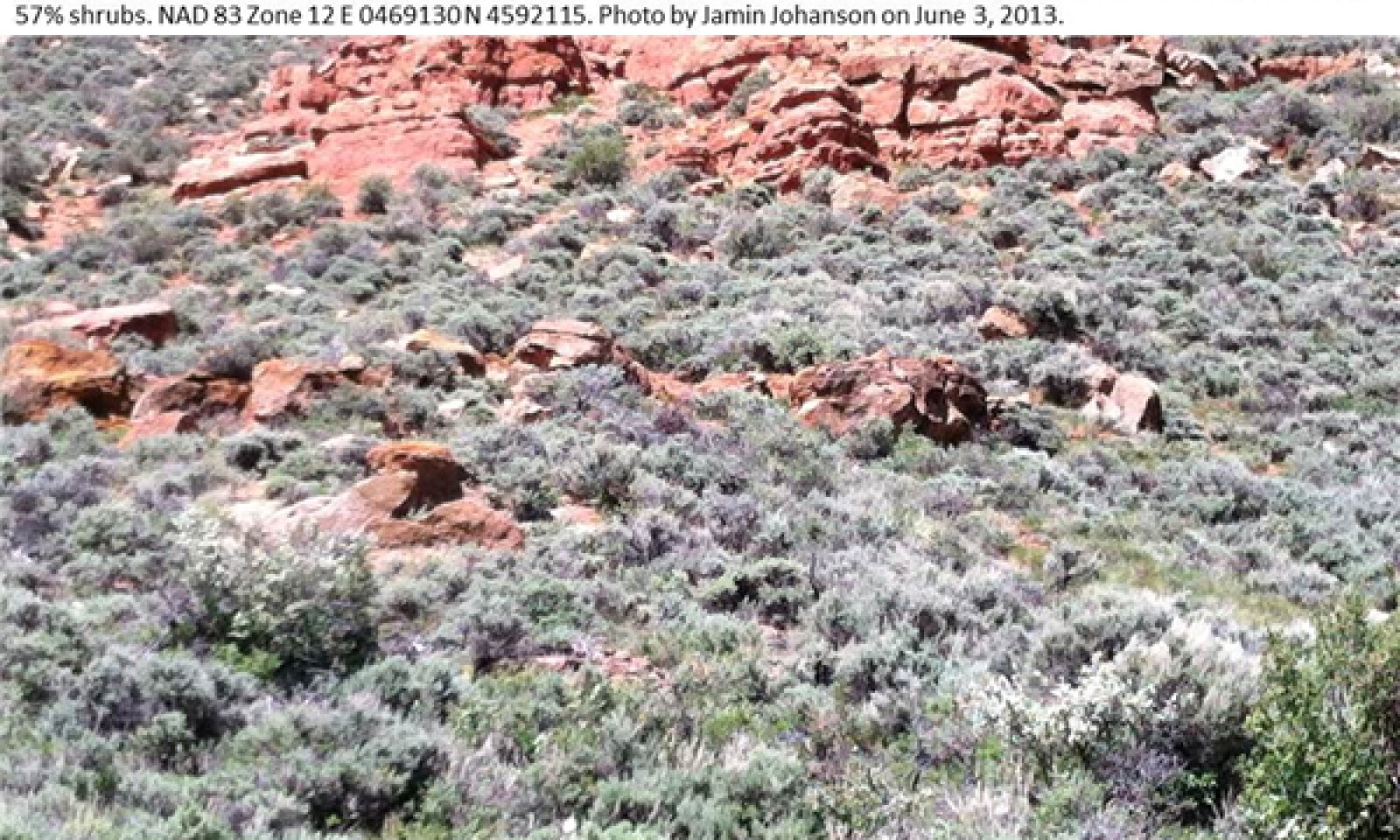
Figure 9. Phase 1.1
The Reference Plant community is dominated by Wyoming big sagebrush and diverse shrubs in the overstory, and by perennial bunchgrasses in the understory. Dominant perennial grasses are bluebunch wheatgrass, muttongrass, and Idaho fescue. Diverse perennial grasses and forbs are also abundant in the understory. Composition by air-dry weight is 25 to 50 percent grasses, 10 to 20 percent forbs, and 35 to 60 percent shrubs.
Figure 10. Annual production by plant type (representative values) or group (midpoint values)
Table 7. Annual production by plant type
Plant type Low
(lb/acre)Representative value
(lb/acre)High
(lb/acre)Shrub/Vine 300 425 550 Grass/Grasslike 225 350 450 Forb 75 125 200 Total 600 900 1200 Table 8. Ground cover
Tree foliar cover 0% Shrub/vine/liana foliar cover 10-20% Grass/grasslike foliar cover 10-20% Forb foliar cover 0-10% Non-vascular plants 0-0% Biological crusts 0% Litter 10-20% Surface fragments >0.25" and <=3" 20-30% Surface fragments >3" 0-10% Bedrock 0-20% Water 0% Bare ground 10-20% Table 9. Canopy structure (% cover)
Height Above Ground (ft) Tree Shrub/Vine Grass/
GrasslikeForb <0.5 0% 0% 0-10% 0-5% >0.5 <= 1 0% 0-5% 5-10% 2-10% >1 <= 2 0% 5-10% 5-10% 0-5% >2 <= 4.5 0% 10-20% 0-5% 0-5% >4.5 <= 13 0% 0-5% 0-1% 0% >13 <= 40 – – – – >40 <= 80 – – – – >80 <= 120 – – – – >120 – – – – Community 1.2
Perennial GrasslandThe Perennial Grassland Community is dominated by bluebunch wheatgrass and Idaho fescue. Diverse perennial grasses and forbs are also abundant in the plant community. Sprouting shrubs may be present in small numbers, but are not abundant in this community phase. Wyoming big sagebrush has been removed from the plant community, but may also be present (not dominant) due to natural succession as it slowly increases in the community following removal. Composition by air-dry weight is 50 to 90 percent grasses, 10 to 20 percent forbs, and 0 to 35 percent shrubs.
Figure 11. Annual production by plant type (representative values) or group (midpoint values)
Table 10. Annual production by plant type
Plant type Low
(lb/acre)Representative value
(lb/acre)High
(lb/acre)Grass/Grasslike 450 625 800 Shrub/Vine 0 150 300 Forb 75 125 200 Total 525 900 1300 Table 11. Ground cover
Tree foliar cover 0% Shrub/vine/liana foliar cover 0-10% Grass/grasslike foliar cover 20-40% Forb foliar cover 0-10% Non-vascular plants 0-0% Biological crusts 0% Litter 10-20% Surface fragments >0.25" and <=3" 20-30% Surface fragments >3" 0-10% Bedrock 0-20% Water 0% Bare ground 10-20% Table 12. Canopy structure (% cover)
Height Above Ground (ft) Tree Shrub/Vine Grass/
GrasslikeForb <0.5 0% 0% 0-10% 0-5% >0.5 <= 1 0% 0-5% 10-20% 2-10% >1 <= 2 0% 0-5% 15-25% 0-5% >2 <= 4.5 0% 0-10% 0-10% 0-5% >4.5 <= 13 – – – – >13 <= 40 – – – – >40 <= 80 – – – – >80 <= 120 – – – – >120 – – – – Community 1.3
Rabbitbrush / Perennial GrassThis plant community is dominated by sprouting shrubs in the overstory (usually yellow rabbitbrush) and by perennial bunchgrasses in the understory. In moist areas, such as northern exposures or higher elevations, other sprouting shrubs, such as bitterbrush, may co-dominate with grasses. Dominant perennial grasses are typically bluebunch wheatgrass and Idaho fescue. Diverse perennial grasses and forbs are also abundant. Wyoming big sagebrush does not co-dominate the site, but it may be present due to natural succession as it slowly increases in the community. Composition by air-dry weight is 25 to 50 percent grasses, 10 to 20 percent forbs, and 35 to 60 percent shrubs.
Figure 12. Annual production by plant type (representative values) or group (midpoint values)
Table 13. Annual production by plant type
Plant type Low
(lb/acre)Representative value
(lb/acre)High
(lb/acre)Shrub/Vine 300 425 550 Grass/Grasslike 225 350 450 Forb 75 125 200 Total 600 900 1200 Table 14. Ground cover
Tree foliar cover 0% Shrub/vine/liana foliar cover 10-20% Grass/grasslike foliar cover 10-20% Forb foliar cover 0-10% Non-vascular plants 0-0% Biological crusts 0% Litter 10-20% Surface fragments >0.25" and <=3" 20-30% Surface fragments >3" 0-10% Bedrock 0-20% Water 0% Bare ground 10-20% Table 15. Canopy structure (% cover)
Height Above Ground (ft) Tree Shrub/Vine Grass/
GrasslikeForb <0.5 0% 0% 0-10% 0-5% >0.5 <= 1 0% 0-5% 5-10% 2-10% >1 <= 2 0% 5-10% 5-10% 0-5% >2 <= 4.5 0% 10-20% 0-5% 0-5% >4.5 <= 13 0% 0-5% 0-1% 0% >13 <= 40 – – – – >40 <= 80 – – – – >80 <= 120 – – – – >120 – – – – Pathway 1.1a
Community 1.1 to 1.2This pathway occurs as fire or other shrub-removal disturbance (drought, herbivory, etc.) removes Wyoming big sagebrush from the plant community. Historic fire regime is expected to be mostly patchy, mixed-severity fires that occurred ever 10 to 70 years (Howard 1999). This pathway occurs when phase 1.1 does not have a significant amount of sprouting shrubs in the community, and results in a community dominated by perennial bunchgrasses.
Pathway 1.1b
Community 1.1 to 1.3This pathway occurs as fire or other shrub-removal disturbance (drought, herbivory, etc.) removes Wyoming big sagebrush from the plant community. Historic fire regime is expected to have been patchy, mixed-severity fires that occurred ever 10 to 70 years (Howard 1999). This pathway occurs when phase 1.1 has a significant amount of sprouting shrubs in the community, and results in a community co-dominated by perennial bunchgrasses and sprouting shrubs, most commonly yellow rabbitbrush.
Pathway 1.2a
Community 1.2 to 1.1This pathway occurs as Wyoming big sagebrush slowly increases in the plant community following fire or other shrub-removal events. It may take 10 to 40 years for sagebrush to regain dominance in the community, depending on subsequent weather events and distance to sagebrush seed source. The resulting community is co-dominated by sagebrush and perennial bunchgrasses.
Pathway 1.2b
Community 1.2 to 1.3This pathway is expected to occur when perennial grasslands experience an increase in sprouting shrubs, possibly due to repeated fires over a short time period.
Pathway 1.3a
Community 1.3 to 1.1This pathway occurs as Wyoming big sagebrush slowly increases in the plant community, while sprouting shrubs decrease. It may take 10 to 40 years for sagebrush to regain dominance in the community following fire or other sagebrush-removal event, depending on subsequent weather and distance to sagebrush seed source. The resulting community is co-dominated by sagebrush and perennial bunchgrasses, with abundant sprouting shrubs remaining in the community.
State 2
Invaded StateCommunity 2.1
Wyoming Big Sagebrush / Perennial Grass
Figure 13. Phase 2.1
This plant community is dominated by Wyoming big sagebrush and diverse shrubs in the overstory, and by perennial bunchgrasses in the understory. Dominant perennial grasses are bluebunch wheatgrass, muttongrass, and/or Idaho fescue. Diverse perennial grasses and forbs are also abundant in the understory. Non-native species are present but not dominant. Composition by air-dry weight is 25 to 50 percent grasses, 10 to 20 percent forbs, and 35 to 60 percent shrubs.
Figure 14. Annual production by plant type (representative values) or group (midpoint values)
Table 16. Annual production by plant type
Plant type Low
(lb/acre)Representative value
(lb/acre)High
(lb/acre)Shrub/Vine 300 425 550 Grass/Grasslike 175 350 450 Forb 25 100 200 Total 500 875 1200 Table 17. Ground cover
Tree foliar cover 0% Shrub/vine/liana foliar cover 10-20% Grass/grasslike foliar cover 10-20% Forb foliar cover 0-10% Non-vascular plants 0-0% Biological crusts 0% Litter 10-20% Surface fragments >0.25" and <=3" 20-30% Surface fragments >3" 0-10% Bedrock 0-20% Water 0% Bare ground 10-20% Table 18. Canopy structure (% cover)
Height Above Ground (ft) Tree Shrub/Vine Grass/
GrasslikeForb <0.5 0% 0% 0-10% 0-5% >0.5 <= 1 0% 0-5% 5-10% 2-10% >1 <= 2 0% 5-10% 5-10% 0-5% >2 <= 4.5 0% 10-20% 0-5% 0-5% >4.5 <= 13 0% 0-5% 0-1% 0% >13 <= 40 – – – – >40 <= 80 – – – – >80 <= 120 – – – – >120 – – – – Community 2.2
Perennial Grassland
Figure 15. Phase 2.2
The perennial grassland community is dominated by bluebunch wheatgrass and Idaho fescue. Diverse perennial grasses and forbs are also abundant in the plant community. Sprouting shrubs may be present in small numbers, but are not abundant in this community phase. Wyoming big sagebrush has been removed from the plant community, but may also be present (not dominant) due to natural succession as it slowly increases in the community following removal. Non-native species are present but not dominant. Composition by air-dry weight is 50 to 90 percent grasses, 10 to 20 percent forbs, and 0 to 35 percent shrubs.
Figure 16. Annual production by plant type (representative values) or group (midpoint values)
Table 19. Annual production by plant type
Plant type Low
(lb/acre)Representative value
(lb/acre)High
(lb/acre)Grass/Grasslike 450 625 800 Shrub/Vine 0 150 300 Forb 25 100 200 Total 475 875 1300 Table 20. Ground cover
Tree foliar cover 0% Shrub/vine/liana foliar cover 0-10% Grass/grasslike foliar cover 20-40% Forb foliar cover 0-10% Non-vascular plants 0-0% Biological crusts 0% Litter 10-20% Surface fragments >0.25" and <=3" 20-30% Surface fragments >3" 0-10% Bedrock 0-20% Water 0% Bare ground 10-20% Table 21. Canopy structure (% cover)
Height Above Ground (ft) Tree Shrub/Vine Grass/
GrasslikeForb <0.5 0% 0% 0-10% 0-5% >0.5 <= 1 0% 0-5% 10-20% 2-10% >1 <= 2 0% 0-5% 15-25% 0-5% >2 <= 4.5 0% 0-10% 0-10% 0-5% >4.5 <= 13 – – – – >13 <= 40 – – – – >40 <= 80 – – – – >80 <= 120 – – – – >120 – – – – Community 2.3
Rabbitbrush / Perennial Grass
Figure 17. Phase 2.3
This plant community is dominated by sprouting shrubs in the overstory (usually yellow rabbitbrush) and by perennial bunchgrasses in the understory. In moist areas, such as northern exposures or higher elevations, other sprouting shrubs, such as bitterbrush, may co-dominate with grasses. Dominant perennial grasses are typically bluebunch wheatgrass and/or Idaho fescue. Diverse perennial grasses and forbs are also abundant. Wyoming big sagebrush does not co-dominate the site, but it may be present due to natural succession as it slowly increases in the community. Non-native species are present but not dominant. Composition by air-dry weight is 25 to 50 percent grasses, 10 to 20 percent forbs, and 35 to 60 percent shrubs.
Figure 18. Annual production by plant type (representative values) or group (midpoint values)
Table 22. Annual production by plant type
Plant type Low
(lb/acre)Representative value
(lb/acre)High
(lb/acre)Shrub/Vine 300 425 550 Grass/Grasslike 175 350 450 Forb 25 100 200 Total 500 875 1200 Table 23. Ground cover
Tree foliar cover 0% Shrub/vine/liana foliar cover 10-20% Grass/grasslike foliar cover 10-20% Forb foliar cover 0-10% Non-vascular plants 0-0% Biological crusts 0% Litter 10-20% Surface fragments >0.25" and <=3" 20-30% Surface fragments >3" 0-10% Bedrock 0-20% Water 0% Bare ground 10-20% Table 24. Canopy structure (% cover)
Height Above Ground (ft) Tree Shrub/Vine Grass/
GrasslikeForb <0.5 0% 0% 0-10% 0-5% >0.5 <= 1 0% 0-5% 5-10% 2-10% >1 <= 2 0% 5-10% 5-10% 0-5% >2 <= 4.5 0% 10-20% 0-5% 0-5% >4.5 <= 13 0% 0-5% 0-1% 0% >13 <= 40 – – – – >40 <= 80 – – – – >80 <= 120 – – – – >120 – – – – Pathway 2.1a
Community 2.1 to 2.2
Wyoming Big Sagebrush / Perennial Grass
Perennial GrasslandThis pathway occurs as fire or other shrub-removal disturbance (drought, herbivory, etc.) removes Wyoming big sagebrush from the plant community. Historic fire regime is expected to have been patchy, mixed-severity fires that occurred ever 10 to 70 years (Howard 1999). This pathway occurs when phase 2.1 does not have a significant amount of sprouting shrubs in the community, and results in a community dominated by perennial bunchgrasses. This pathway may result in an increase in annual non-native species.
Pathway 2.1b
Community 2.1 to 2.3
Wyoming Big Sagebrush / Perennial Grass
Rabbitbrush / Perennial GrassThis pathway occurs as fire or other shrub-removal disturbance (drought, herbivory, etc.) removes Wyoming big sagebrush from the plant community. Historic fire regime is expected to have been patchy, mixed-severity fires that occurred ever 10 to 70 years (Howard 1999). This pathway occurs when phase 2.1 has a significant amount of sprouting shrubs in the community, and results in a community co-dominated by perennial bunchgrasses and sprouting shrubs, most commonly yellow rabbitbrush. This pathway may result in an increase in annual non-native species.
Pathway 2.2a
Community 2.2 to 2.1
Perennial Grassland
Wyoming Big Sagebrush / Perennial GrassThis pathway occurs as Wyoming big sagebrush slowly increases in the plant community following fire or other shrub-removal events. It may take 10 to 40 years for sagebrush to regain dominance in the community, depending on subsequent weather events and distance to sagebrush seed source. The resulting community is co-dominated by sagebrush and perennial bunchgrasses.
Pathway 2.2b
Community 2.2 to 2.3
Perennial Grassland
Rabbitbrush / Perennial GrassThis pathway is expected to occur when perennial grasslands experience an increase in sprouting shrubs, possibly due to repeated fires over a short time period. This pathway may also result in an increase in non-native annual plants.
Pathway 2.3a
Community 2.3 to 2.1
Rabbitbrush / Perennial Grass
Wyoming Big Sagebrush / Perennial GrassThis pathway occurs as Wyoming big sagebrush slowly increases in the plant community, while sprouting shrubs decrease. It may take 10 to 40 years for sagebrush to regain dominance in the community following fire or other sagebrush-removal event, depending on subsequent weather and distance to sagebrush seed source. The resulting community is co-dominated by sagebrush and perennial bunchgrasses, with abundant sprouting shrubs remaining in the community.
State 3
Sagebrush / Sparse Understory StateCommunity 3.1
Wyoming Big Sagebrush / Sparse Understory
Figure 19. Phase 3.1
This plant community is dominated by Wyoming big sagebrush and diverse shrubs, with few perennial forbs and bunchgrasses in the understory. Herbaceous species are unable to increase in the community due to shrub dominance. Non-native species are present but not dominant. Composition by air-dry weight is 0 to 10 percent grasses, 2 to 15 percent forbs, and 70 to 95 percent shrubs.
Figure 20. Annual production by plant type (representative values) or group (midpoint values)
Table 25. Annual production by plant type
Plant type Low
(lb/acre)Representative value
(lb/acre)High
(lb/acre)Shrub/Vine 500 650 800 Grass/Grasslike 25 100 175 Forb 25 50 100 Total 550 800 1075 Table 26. Ground cover
Tree foliar cover 0% Shrub/vine/liana foliar cover 30-50% Grass/grasslike foliar cover 0-0% Forb foliar cover 0-0% Non-vascular plants 0-0% Biological crusts 0% Litter 0-10% Surface fragments >0.25" and <=3" 20-30% Surface fragments >3" 0-10% Bedrock 0-20% Water 0% Bare ground 10-20% Table 27. Canopy structure (% cover)
Height Above Ground (ft) Tree Shrub/Vine Grass/
GrasslikeForb <0.5 0% 0% 0-2% 0-3% >0.5 <= 1 0% 0-5% 0-2% 0-3% >1 <= 2 0% 5-10% 0-2% 0-3% >2 <= 4.5 0% 25-35% 0-1% 0-1% >4.5 <= 13 0% 0-5% – – >13 <= 40 – – – – >40 <= 80 – – – – >80 <= 120 – – – – >120 – – – – State 4
Seeded Range StateThe Seeded Range State occurs following a successful rangeland seeding, in which sufficient soil moisture was available for seed germination and growth at critical times in the spring. This site is suitable for rangeland seedings, but even when properly applied, these seedings run the risk of failure due to incertain soil moisture conditions. Transitions out of this state are likely possible, but have not yet been documented.
Community 4.1
Introduced Perennial Grass
Figure 21. Phase 4.1
This plant community is dominated by introduced perennial bunchgrasses. It is possible to have some sprouting shrubs assuming they were present in the community before seeding.
Figure 22. Annual production by plant type (representative values) or group (midpoint values)
Table 28. Annual production by plant type
Plant type Low
(lb/acre)Representative value
(lb/acre)High
(lb/acre)Grass/Grasslike 450 625 800 Shrub/Vine 0 150 300 Forb 25 75 150 Total 475 850 1250 Table 29. Ground cover
Tree foliar cover 0% Shrub/vine/liana foliar cover 0-10% Grass/grasslike foliar cover 20-40% Forb foliar cover 0-10% Non-vascular plants 0-0% Biological crusts 0% Litter 10-20% Surface fragments >0.25" and <=3" 20-30% Surface fragments >3" 0-10% Bedrock 0-20% Water 0% Bare ground 10-20% Table 30. Canopy structure (% cover)
Height Above Ground (ft) Tree Shrub/Vine Grass/
GrasslikeForb <0.5 0% 0% 0-10% 0-5% >0.5 <= 1 0% 0-5% 10-20% 2-10% >1 <= 2 0% 0-5% 15-25% 0-5% >2 <= 4.5 0% 0-10% 0-10% 0-5% >4.5 <= 13 – – – – >13 <= 40 – – – – >40 <= 80 – – – – >80 <= 120 – – – – >120 – – – – Transition T1a
State 1 to 2This transition occurs as non-native plants and domestic livestock are introduced to the site. This state is similar to the Reference State in plant community structure and ecological process, but the presence of domestic livestock and exotic plants decreases the resilience of the site.
Transition T2a
State 2 to 3This transition occurs when perennial grasses are reduced on the site to the point that they can no longer perpetuate themselves. Wyoming big sagebrush increases on the site, as perennial grasses lose vigor and reproductive capability due to excessive livestock grazing. Extended drought in combination with excessive grazing may accelerate this transition.
Transition T2b
State 2 to 4This transition occurs when non-native perennial grass seed is established on the site following tillage, wildfire, or other removal of the existing vegetation. Crested wheatgrass is a common seeded species on this site.
Transition T3a
State 3 to 4This transition occurs when non-native perennial grass seed is established on the site following tillage, wildfire, or other removal of the existing vegetation. Crested wheatgrass is a common seeded species on this site.
Transition T4a
State 4 to 3This transition occurs when perennial grasses are reduced on the site to the point that they can no longer perpetuate themselves. Wyoming big sagebrush increases on the site, as perennial grasses lose vigor and reproductive capability due to excessive livestock grazing. Extended drought in combination with excessive grazing may accelerate this transition.
Additional community tables
Table 31. Community 1.1 plant community composition
Group Common name Symbol Scientific name Annual production () Foliar cover (%) Shrub/Vine0 Dominant Shrubs 250–500 Wyoming big sagebrush ARTRW8 Artemisia tridentata ssp. wyomingensis 100–300 8–20 antelope bitterbrush PUTR2 Purshia tridentata 0–200 0–12 yellow rabbitbrush CHVI8 Chrysothamnus viscidiflorus 0–150 0–10 Saskatoon serviceberry AMAL2 Amelanchier alnifolia 0–100 0–8 3 Sub-Dominant Shrubs 50–150 spineless horsebrush TECA2 Tetradymia canescens 0–65 0–4 Shrub (>.5m) 2SHRUB Shrub (>.5m) 0–50 0–4 mountain snowberry SYOR2 Symphoricarpos oreophilus 0–50 0–3 Woods' rose ROWO Rosa woodsii 0–30 0–2 little sagebrush ARARA Artemisia arbuscula ssp. arbuscula 0–30 0–2 black sagebrush ARNO4 Artemisia nova 0–30 0–2 rubber rabbitbrush ERNA10 Ericameria nauseosa 0–30 0–2 Utah juniper JUOS Juniperus osteosperma 0–30 0–2 creeping barberry MARE11 Mahonia repens 0–30 0–2 broom snakeweed GUSA2 Gutierrezia sarothrae 0–25 0–2 plains pricklypear OPPO Opuntia polyacantha 0–20 0–2 spiny phlox PHHO Phlox hoodii 0–20 0–1 slender buckwheat ERMI4 Eriogonum microthecum 0–20 0–1 Grass/Grasslike0 Dominant Grasses 175–400 bluebunch wheatgrass PSSP6 Pseudoroegneria spicata 50–300 4–22 Idaho fescue FEID Festuca idahoensis 0–125 0–10 muttongrass POFE Poa fendleriana 25–125 1–10 1 Sub-Dominant Grasses 50–150 Indian ricegrass ACHY Achnatherum hymenoides 0–75 0–5 oniongrass MEBU Melica bulbosa 0–65 0–4 western wheatgrass PASM Pascopyrum smithii 0–50 0–3 Sandberg bluegrass POSE Poa secunda 0–50 0–3 Letterman's needlegrass ACLE9 Achnatherum lettermanii 0–50 0–3 Geyer's sedge CAGE2 Carex geyeri 0–50 0–3 Grass, perennial 2GP Grass, perennial 0–50 0–3 needle and thread HECO26 Hesperostipa comata 0–50 0–3 squirreltail ELEL5 Elymus elymoides 0–40 0–3 basin wildrye LECI4 Leymus cinereus 0–40 0–3 Grass, annual 2GA Grass, annual 0–35 0–2 prairie Junegrass KOMA Koeleria macrantha 0–25 0–2 Forb2 Forbs 75–200 Forb, perennial 2FP Forb, perennial 25–75 2–5 Forb, annual 2FA Forb, annual 10–50 1–4 low beardtongue PEHU Penstemon humilis 10–50 1–4 rock goldenrod PEPU7 Petradoria pumila 10–50 1–4 arrowleaf balsamroot BASA3 Balsamorhiza sagittata 10–50 1–3 povertyweed IVAX Iva axillaris 0–40 0–3 western stoneseed LIRU4 Lithospermum ruderale 0–40 0–3 desertparsley LOMAT Lomatium 0–25 0–2 tapertip hawksbeard CRAC2 Crepis acuminata 5–25 1–2 shortstem buckwheat ERBR5 Eriogonum brevicaule 0–25 0–2 fleabane ERIGE2 Erigeron 0–25 0–2 sulphur-flower buckwheat ERUM Eriogonum umbellatum 0–25 0–2 scarlet gilia IPAG Ipomopsis aggregata 0–25 0–2 borage BORAG Borago 0–25 0–2 Indian paintbrush CASTI2 Castilleja 0–25 0–2 common yarrow ACMI2 Achillea millefolium 0–25 0–2 onion ALLIU Allium 0–25 0–2 pussytoes ANTEN Antennaria 0–25 0–2 longleaf phlox PHLO2 Phlox longifolia 5–25 1–2 vetch VICIA Vicia 0–25 0–2 primrose PRIMU Primula 0–15 0–1 Douglas' dustymaiden CHDO Chaenactis douglasii 0–15 0–1 Table 32. Community 1.2 plant community composition
Group Common name Symbol Scientific name Annual production () Foliar cover (%) Grass/Grasslike0 Dominant Grasses 400–700 1 Sub-Dominant Grasses 50–250 Indian ricegrass ACHY Achnatherum hymenoides 0–75 0–5 oniongrass MEBU Melica bulbosa 0–65 0–4 western wheatgrass PASM Pascopyrum smithii 0–50 0–3 muttongrass POFE Poa fendleriana 10–50 1–3 Sandberg bluegrass POSE Poa secunda 0–50 0–3 Letterman's needlegrass ACLE9 Achnatherum lettermanii 0–50 0–3 Geyer's sedge CAGE2 Carex geyeri 0–50 0–3 needle and thread HECO26 Hesperostipa comata 0–50 0–3 Grass, perennial 2GP Grass, perennial 0–50 0–3 basin wildrye LECI4 Leymus cinereus 0–40 0–3 squirreltail ELEL5 Elymus elymoides 0–40 0–3 Grass, annual 2GA Grass, annual 0–35 0–2 prairie Junegrass KOMA Koeleria macrantha 0–25 0–2 Forb2 Forbs 75–200 Forb, perennial 2FP Forb, perennial 25–75 2–5 Forb, annual 2FA Forb, annual 10–50 1–4 low beardtongue PEHU Penstemon humilis 10–50 1–4 rock goldenrod PEPU7 Petradoria pumila 10–50 1–4 arrowleaf balsamroot BASA3 Balsamorhiza sagittata 10–50 1–3 povertyweed IVAX Iva axillaris 0–40 0–3 western stoneseed LIRU4 Lithospermum ruderale 0–40 0–3 desertparsley LOMAT Lomatium 0–25 0–2 tapertip hawksbeard CRAC2 Crepis acuminata 5–25 1–2 shortstem buckwheat ERBR5 Eriogonum brevicaule 0–25 0–2 fleabane ERIGE2 Erigeron 0–25 0–2 sulphur-flower buckwheat ERUM Eriogonum umbellatum 0–25 0–2 scarlet gilia IPAG Ipomopsis aggregata 0–25 0–2 borage BORAG Borago 0–25 0–2 Indian paintbrush CASTI2 Castilleja 0–25 0–2 common yarrow ACMI2 Achillea millefolium 0–25 0–2 onion ALLIU Allium 0–25 0–2 pussytoes ANTEN Antennaria 0–25 0–2 longleaf phlox PHLO2 Phlox longifolia 5–25 1–2 vetch VICIA Vicia 0–25 0–2 primrose PRIMU Primula 0–15 0–1 Douglas' dustymaiden CHDO Chaenactis douglasii 0–15 0–1 Shrub/Vine3 Shrubs 0–300 spineless horsebrush TECA2 Tetradymia canescens 0–65 0–4 antelope bitterbrush PUTR2 Purshia tridentata 0–50 0–4 yellow rabbitbrush CHVI8 Chrysothamnus viscidiflorus 0–50 0–4 Saskatoon serviceberry AMAL2 Amelanchier alnifolia 0–50 0–4 mountain snowberry SYOR2 Symphoricarpos oreophilus 0–50 0–3 Shrub (>.5m) 2SHRUB Shrub (>.5m) 0–40 0–3 little sagebrush ARARA Artemisia arbuscula ssp. arbuscula 0–30 0–2 black sagebrush ARNO4 Artemisia nova 0–30 0–2 Woods' rose ROWO Rosa woodsii 0–30 0–2 rubber rabbitbrush ERNA10 Ericameria nauseosa 0–30 0–2 creeping barberry MARE11 Mahonia repens 0–30 0–2 broom snakeweed GUSA2 Gutierrezia sarothrae 0–25 0–2 plains pricklypear OPPO Opuntia polyacantha 0–20 0–2 spiny phlox PHHO Phlox hoodii 0–20 0–1 slender buckwheat ERMI4 Eriogonum microthecum 0–20 0–1 Table 33. Community 1.3 plant community composition
Group Common name Symbol Scientific name Annual production () Foliar cover (%) Shrub/Vine0 Dominant Shrubs 250–400 yellow rabbitbrush CHVI8 Chrysothamnus viscidiflorus 150–350 10–20 antelope bitterbrush PUTR2 Purshia tridentata 0–300 0–15 mountain snowberry SYOR2 Symphoricarpos oreophilus 0–150 0–10 Saskatoon serviceberry AMAL2 Amelanchier alnifolia 0–150 0–10 3 Sub-dominant Shrubs 50–150 spineless horsebrush TECA2 Tetradymia canescens 0–65 0–4 Shrub (>.5m) 2SHRUB Shrub (>.5m) 0–50 0–4 little sagebrush ARARA Artemisia arbuscula ssp. arbuscula 0–30 0–2 black sagebrush ARNO4 Artemisia nova 0–30 0–2 rubber rabbitbrush ERNA10 Ericameria nauseosa 0–30 0–2 Utah juniper JUOS Juniperus osteosperma 0–30 0–2 creeping barberry MARE11 Mahonia repens 0–30 0–2 Woods' rose ROWO Rosa woodsii 0–30 0–2 broom snakeweed GUSA2 Gutierrezia sarothrae 0–25 0–2 plains pricklypear OPPO Opuntia polyacantha 0–20 0–2 spiny phlox PHHO Phlox hoodii 0–20 0–1 slender buckwheat ERMI4 Eriogonum microthecum 0–20 0–1 Grass/Grasslike0 Dominant Grasses 200–400 bluebunch wheatgrass PSSP6 Pseudoroegneria spicata 100–400 4–22 Idaho fescue FEID Festuca idahoensis 0–200 0–15 1 Sub-Dominant Grasses 50–200 Indian ricegrass ACHY Achnatherum hymenoides 0–75 0–5 oniongrass MEBU Melica bulbosa 0–65 0–4 muttongrass POFE Poa fendleriana 10–50 1–4 Sandberg bluegrass POSE Poa secunda 0–50 0–3 western wheatgrass PASM Pascopyrum smithii 0–50 0–3 Letterman's needlegrass ACLE9 Achnatherum lettermanii 0–50 0–3 Geyer's sedge CAGE2 Carex geyeri 0–50 0–3 needle and thread HECO26 Hesperostipa comata 0–50 0–3 Grass, perennial 2GP Grass, perennial 0–50 0–3 basin wildrye LECI4 Leymus cinereus 0–40 0–3 squirreltail ELEL5 Elymus elymoides 0–40 0–3 Grass, annual 2GA Grass, annual 0–35 0–2 prairie Junegrass KOMA Koeleria macrantha 0–25 0–2 Forb2 Forbs 75–200 Forb, perennial 2FP Forb, perennial 25–75 2–5 Forb, annual 2FA Forb, annual 10–50 1–4 low beardtongue PEHU Penstemon humilis 10–50 1–4 rock goldenrod PEPU7 Petradoria pumila 10–50 1–4 arrowleaf balsamroot BASA3 Balsamorhiza sagittata 10–50 1–3 povertyweed IVAX Iva axillaris 0–40 0–3 western stoneseed LIRU4 Lithospermum ruderale 0–40 0–3 desertparsley LOMAT Lomatium 0–25 0–2 tapertip hawksbeard CRAC2 Crepis acuminata 5–25 1–2 shortstem buckwheat ERBR5 Eriogonum brevicaule 0–25 0–2 fleabane ERIGE2 Erigeron 0–25 0–2 sulphur-flower buckwheat ERUM Eriogonum umbellatum 0–25 0–2 scarlet gilia IPAG Ipomopsis aggregata 0–25 0–2 borage BORAG Borago 0–25 0–2 Indian paintbrush CASTI2 Castilleja 0–25 0–2 common yarrow ACMI2 Achillea millefolium 0–25 0–2 onion ALLIU Allium 0–25 0–2 pussytoes ANTEN Antennaria 0–25 0–2 longleaf phlox PHLO2 Phlox longifolia 5–25 1–2 vetch VICIA Vicia 0–25 0–2 primrose PRIMU Primula 0–15 0–1 Douglas' dustymaiden CHDO Chaenactis douglasii 0–15 0–1 Table 34. Community 2.1 plant community composition
Group Common name Symbol Scientific name Annual production () Foliar cover (%) Shrub/Vine0 Dominant Shrubs 250–500 Wyoming big sagebrush ARTRW8 Artemisia tridentata ssp. wyomingensis 100–300 8–20 antelope bitterbrush PUTR2 Purshia tridentata 0–200 0–12 yellow rabbitbrush CHVI8 Chrysothamnus viscidiflorus 0–150 0–10 Saskatoon serviceberry AMAL2 Amelanchier alnifolia 0–100 0–8 3 Sub-Dominant Shrubs 50–150 spineless horsebrush TECA2 Tetradymia canescens 0–65 0–4 Shrub (>.5m) 2SHRUB Shrub (>.5m) 0–50 0–4 mountain snowberry SYOR2 Symphoricarpos oreophilus 0–50 0–3 Woods' rose ROWO Rosa woodsii 0–30 0–2 rubber rabbitbrush ERNA10 Ericameria nauseosa 0–30 0–2 little sagebrush ARARA Artemisia arbuscula ssp. arbuscula 0–30 0–2 black sagebrush ARNO4 Artemisia nova 0–30 0–2 Utah juniper JUOS Juniperus osteosperma 0–30 0–2 creeping barberry MARE11 Mahonia repens 0–30 0–2 broom snakeweed GUSA2 Gutierrezia sarothrae 0–25 0–2 plains pricklypear OPPO Opuntia polyacantha 0–20 0–2 spiny phlox PHHO Phlox hoodii 0–20 0–1 slender buckwheat ERMI4 Eriogonum microthecum 0–20 0–1 Grass/Grasslike0 Dominant Grasses 175–400 bluebunch wheatgrass PSSP6 Pseudoroegneria spicata 50–300 4–22 Idaho fescue FEID Festuca idahoensis 0–125 0–10 muttongrass POFE Poa fendleriana 25–125 1–10 1 Sub-Dominant Grasses 50–150 cheatgrass BRTE Bromus tectorum 1–100 1–7 Indian ricegrass ACHY Achnatherum hymenoides 0–75 0–5 oniongrass MEBU Melica bulbosa 0–65 0–4 crested wheatgrass AGCR Agropyron cristatum 0–50 0–4 Grass, perennial 2GP Grass, perennial 0–50 0–3 Geyer's sedge CAGE2 Carex geyeri 0–50 0–3 Letterman's needlegrass ACLE9 Achnatherum lettermanii 0–50 0–3 western wheatgrass PASM Pascopyrum smithii 0–50 0–3 Sandberg bluegrass POSE Poa secunda 0–50 0–3 needle and thread HECO26 Hesperostipa comata 0–50 0–3 basin wildrye LECI4 Leymus cinereus 0–40 0–3 squirreltail ELEL5 Elymus elymoides 0–40 0–3 Grass, annual 2GA Grass, annual 0–35 0–2 prairie Junegrass KOMA Koeleria macrantha 0–25 0–2 Forb2 Forbs 25–200 Forb, annual 2FA Forb, annual 10–100 1–7 Forb, perennial 2FP Forb, perennial 25–75 2–5 thistle CIRSI Cirsium 0–50 0–4 low beardtongue PEHU Penstemon humilis 10–50 1–4 rock goldenrod PEPU7 Petradoria pumila 10–50 1–4 arrowleaf balsamroot BASA3 Balsamorhiza sagittata 10–50 1–3 povertyweed IVAX Iva axillaris 0–40 0–3 prickly lettuce LASE Lactuca serriola 0–40 0–3 western stoneseed LIRU4 Lithospermum ruderale 0–40 0–3 vetch VICIA Vicia 0–25 0–2 longleaf phlox PHLO2 Phlox longifolia 5–25 1–2 desertparsley LOMAT Lomatium 0–25 0–2 tapertip hawksbeard CRAC2 Crepis acuminata 5–25 1–2 shortstem buckwheat ERBR5 Eriogonum brevicaule 0–25 0–2 fleabane ERIGE2 Erigeron 0–25 0–2 sulphur-flower buckwheat ERUM Eriogonum umbellatum 0–25 0–2 scarlet gilia IPAG Ipomopsis aggregata 0–25 0–2 borage BORAG Borago 0–25 0–2 Indian paintbrush CASTI2 Castilleja 0–25 0–2 common yarrow ACMI2 Achillea millefolium 0–25 0–2 onion ALLIU Allium 0–25 0–2 pussytoes ANTEN Antennaria 0–25 0–2 Douglas' dustymaiden CHDO Chaenactis douglasii 0–15 0–1 primrose PRIMU Primula 0–15 0–1 Table 35. Community 2.2 plant community composition
Group Common name Symbol Scientific name Annual production () Foliar cover (%) Grass/Grasslike0 Dominant Grasses 400–700 1 Sub-Dominant Grasses 50–250 crested wheatgrass AGCR Agropyron cristatum 0–150 0–10 cheatgrass BRTE Bromus tectorum 1–100 1–7 Indian ricegrass ACHY Achnatherum hymenoides 0–75 0–5 oniongrass MEBU Melica bulbosa 0–65 0–4 western wheatgrass PASM Pascopyrum smithii 0–50 0–3 muttongrass POFE Poa fendleriana 10–50 1–3 Sandberg bluegrass POSE Poa secunda 0–50 0–3 needle and thread HECO26 Hesperostipa comata 0–50 0–3 Letterman's needlegrass ACLE9 Achnatherum lettermanii 0–50 0–3 Grass, perennial 2GP Grass, perennial 0–50 0–3 Geyer's sedge CAGE2 Carex geyeri 0–50 0–3 squirreltail ELEL5 Elymus elymoides 0–40 0–3 basin wildrye LECI4 Leymus cinereus 0–40 0–3 Grass, annual 2GA Grass, annual 0–35 0–2 prairie Junegrass KOMA Koeleria macrantha 0–25 0–2 Forb2 Forbs 25–200 Forb, annual 2FA Forb, annual 10–100 1–7 Forb, perennial 2FP Forb, perennial 25–75 2–5 thistle CIRSI Cirsium 0–50 0–4 low beardtongue PEHU Penstemon humilis 10–50 1–4 rock goldenrod PEPU7 Petradoria pumila 10–50 1–4 arrowleaf balsamroot BASA3 Balsamorhiza sagittata 10–50 1–3 povertyweed IVAX Iva axillaris 0–40 0–3 prickly lettuce LASE Lactuca serriola 0–40 0–3 western stoneseed LIRU4 Lithospermum ruderale 0–40 0–3 vetch VICIA Vicia 0–25 0–2 longleaf phlox PHLO2 Phlox longifolia 5–25 1–2 desertparsley LOMAT Lomatium 0–25 0–2 tapertip hawksbeard CRAC2 Crepis acuminata 5–25 1–2 shortstem buckwheat ERBR5 Eriogonum brevicaule 0–25 0–2 fleabane ERIGE2 Erigeron 0–25 0–2 sulphur-flower buckwheat ERUM Eriogonum umbellatum 0–25 0–2 scarlet gilia IPAG Ipomopsis aggregata 0–25 0–2 borage BORAG Borago 0–25 0–2 Indian paintbrush CASTI2 Castilleja 0–25 0–2 common yarrow ACMI2 Achillea millefolium 0–25 0–2 onion ALLIU Allium 0–25 0–2 pussytoes ANTEN Antennaria 0–25 0–2 Douglas' dustymaiden CHDO Chaenactis douglasii 0–15 0–1 primrose PRIMU Primula 0–15 0–1 Shrub/Vine3 Shrubs 0–300 spineless horsebrush TECA2 Tetradymia canescens 0–65 0–4 yellow rabbitbrush CHVI8 Chrysothamnus viscidiflorus 0–50 0–4 antelope bitterbrush PUTR2 Purshia tridentata 0–50 0–4 Saskatoon serviceberry AMAL2 Amelanchier alnifolia 0–50 0–4 mountain snowberry SYOR2 Symphoricarpos oreophilus 0–50 0–3 Shrub (>.5m) 2SHRUB Shrub (>.5m) 0–40 0–3 little sagebrush ARARA Artemisia arbuscula ssp. arbuscula 0–30 0–2 black sagebrush ARNO4 Artemisia nova 0–30 0–2 Woods' rose ROWO Rosa woodsii 0–30 0–2 creeping barberry MARE11 Mahonia repens 0–30 0–2 rubber rabbitbrush ERNA10 Ericameria nauseosa 0–30 0–2 broom snakeweed GUSA2 Gutierrezia sarothrae 0–25 0–2 plains pricklypear OPPO Opuntia polyacantha 0–20 0–2 spiny phlox PHHO Phlox hoodii 0–20 0–1 slender buckwheat ERMI4 Eriogonum microthecum 0–20 0–1 Table 36. Community 2.3 plant community composition
Group Common name Symbol Scientific name Annual production () Foliar cover (%) Shrub/Vine0 Dominant Shrubs 250–400 yellow rabbitbrush CHVI8 Chrysothamnus viscidiflorus 150–350 10–20 antelope bitterbrush PUTR2 Purshia tridentata 0–300 0–15 mountain snowberry SYOR2 Symphoricarpos oreophilus 0–150 0–10 Saskatoon serviceberry AMAL2 Amelanchier alnifolia 0–150 0–10 3 Sub-dominant Shrubs 50–150 spineless horsebrush TECA2 Tetradymia canescens 0–65 0–4 Shrub (>.5m) 2SHRUB Shrub (>.5m) 0–50 0–4 little sagebrush ARARA Artemisia arbuscula ssp. arbuscula 0–30 0–2 black sagebrush ARNO4 Artemisia nova 0–30 0–2 rubber rabbitbrush ERNA10 Ericameria nauseosa 0–30 0–2 Woods' rose ROWO Rosa woodsii 0–30 0–2 Utah juniper JUOS Juniperus osteosperma 0–30 0–2 creeping barberry MARE11 Mahonia repens 0–30 0–2 broom snakeweed GUSA2 Gutierrezia sarothrae 0–25 0–2 plains pricklypear OPPO Opuntia polyacantha 0–20 0–2 spiny phlox PHHO Phlox hoodii 0–20 0–1 slender buckwheat ERMI4 Eriogonum microthecum 0–20 0–1 Grass/Grasslike0 Dominant Grasses 150–400 bluebunch wheatgrass PSSP6 Pseudoroegneria spicata 100–400 4–22 Idaho fescue FEID Festuca idahoensis 0–200 0–15 1 Sub-Dominant Grasses 50–200 cheatgrass BRTE Bromus tectorum 1–100 1–7 Indian ricegrass ACHY Achnatherum hymenoides 0–75 0–5 oniongrass MEBU Melica bulbosa 0–65 0–4 muttongrass POFE Poa fendleriana 10–50 1–4 Sandberg bluegrass POSE Poa secunda 0–50 0–3 western wheatgrass PASM Pascopyrum smithii 0–50 0–3 needle and thread HECO26 Hesperostipa comata 0–50 0–3 Letterman's needlegrass ACLE9 Achnatherum lettermanii 0–50 0–3 Geyer's sedge CAGE2 Carex geyeri 0–50 0–3 Grass, perennial 2GP Grass, perennial 0–50 0–3 squirreltail ELEL5 Elymus elymoides 0–40 0–3 crested wheatgrass AGCR Agropyron cristatum 0–40 0–3 smooth brome BRIN2 Bromus inermis 0–40 0–3 basin wildrye LECI4 Leymus cinereus 0–40 0–3 Grass, annual 2GA Grass, annual 0–35 0–2 prairie Junegrass KOMA Koeleria macrantha 0–25 0–2 Forb2 Forbs 25–200 Forb, perennial 2FP Forb, perennial 25–75 2–5 thistle CIRSI Cirsium 0–50 0–4 Forb, annual 2FA Forb, annual 10–50 1–4 prickly lettuce LASE Lactuca serriola 0–50 0–4 low beardtongue PEHU Penstemon humilis 10–50 1–4 rock goldenrod PEPU7 Petradoria pumila 10–50 1–4 arrowleaf balsamroot BASA3 Balsamorhiza sagittata 10–50 1–3 western stoneseed LIRU4 Lithospermum ruderale 0–40 0–3 povertyweed IVAX Iva axillaris 0–40 0–3 vetch VICIA Vicia 0–25 0–2 longleaf phlox PHLO2 Phlox longifolia 5–25 1–2 desertparsley LOMAT Lomatium 0–25 0–2 tapertip hawksbeard CRAC2 Crepis acuminata 5–25 1–2 shortstem buckwheat ERBR5 Eriogonum brevicaule 0–25 0–2 fleabane ERIGE2 Erigeron 0–25 0–2 sulphur-flower buckwheat ERUM Eriogonum umbellatum 0–25 0–2 scarlet gilia IPAG Ipomopsis aggregata 0–25 0–2 borage BORAG Borago 0–25 0–2 Indian paintbrush CASTI2 Castilleja 0–25 0–2 common yarrow ACMI2 Achillea millefolium 0–25 0–2 onion ALLIU Allium 0–25 0–2 pussytoes ANTEN Antennaria 0–25 0–2 Douglas' dustymaiden CHDO Chaenactis douglasii 0–15 0–1 primrose PRIMU Primula 0–15 0–1 Table 37. Community 3.1 plant community composition
Group Common name Symbol Scientific name Annual production () Foliar cover (%) Shrub/Vine0 Dominant Shrubs 400–700 3 Sub-Dominant Shrubs 100–200 mountain snowberry SYOR2 Symphoricarpos oreophilus 0–100 0–7 spineless horsebrush TECA2 Tetradymia canescens 0–100 0–7 Shrub (>.5m) 2SHRUB Shrub (>.5m) 0–50 0–4 rubber rabbitbrush ERNA10 Ericameria nauseosa 0–50 0–3 Utah juniper JUOS Juniperus osteosperma 0–50 0–3 creeping barberry MARE11 Mahonia repens 0–30 0–2 little sagebrush ARARA Artemisia arbuscula ssp. arbuscula 0–30 0–2 black sagebrush ARNO4 Artemisia nova 0–30 0–2 Woods' rose ROWO Rosa woodsii 0–30 0–2 broom snakeweed GUSA2 Gutierrezia sarothrae 0–25 0–2 plains pricklypear OPPO Opuntia polyacantha 0–20 0–2 spiny phlox PHHO Phlox hoodii 0–20 0–1 slender buckwheat ERMI4 Eriogonum microthecum 0–20 0–1 Grass/Grasslike1 Grasses 25–175 cheatgrass BRTE Bromus tectorum 15–100 1–7 Idaho fescue FEID Festuca idahoensis 0–50 0–4 bluebunch wheatgrass PSSP6 Pseudoroegneria spicata 0–50 0–4 muttongrass POFE Poa fendleriana 0–50 0–4 Sandberg bluegrass POSE Poa secunda 0–50 0–3 Grass, perennial 2GP Grass, perennial 0–50 0–3 Grass, annual 2GA Grass, annual 0–35 0–2 western wheatgrass PASM Pascopyrum smithii 0–30 0–2 squirreltail ELEL5 Elymus elymoides 0–30 0–1 prairie Junegrass KOMA Koeleria macrantha 0–25 0–2 basin wildrye LECI4 Leymus cinereus 0–20 0–1 oniongrass MEBU Melica bulbosa 0–20 0–1 needle and thread HECO26 Hesperostipa comata 0–20 0–1 Geyer's sedge CAGE2 Carex geyeri 0–20 0–1 Indian ricegrass ACHY Achnatherum hymenoides 0–20 0–1 Letterman's needlegrass ACLE9 Achnatherum lettermanii 0–20 0–1 crested wheatgrass AGCR Agropyron cristatum 0–20 0–1 Forb2 Forbs 25–100 Forb, annual 2FA Forb, annual 10–50 1–4 povertyweed IVAX Iva axillaris 0–40 0–3 desertparsley LOMAT Lomatium 0–25 0–2 tapertip hawksbeard CRAC2 Crepis acuminata 5–25 1–2 shortstem buckwheat ERBR5 Eriogonum brevicaule 0–25 0–2 fleabane ERIGE2 Erigeron 0–25 0–2 sulphur-flower buckwheat ERUM Eriogonum umbellatum 0–25 0–2 scarlet gilia IPAG Ipomopsis aggregata 0–25 0–2 Forb, perennial 2FP Forb, perennial 0–25 0–2 common yarrow ACMI2 Achillea millefolium 0–25 0–2 onion ALLIU Allium 0–25 0–2 pussytoes ANTEN Antennaria 0–25 0–2 arrowleaf balsamroot BASA3 Balsamorhiza sagittata 0–25 0–2 borage BORAG Borago 0–25 0–2 Indian paintbrush CASTI2 Castilleja 0–25 0–2 vetch VICIA Vicia 0–25 0–2 longleaf phlox PHLO2 Phlox longifolia 5–25 1–2 low beardtongue PEHU Penstemon humilis 0–20 0–1 rock goldenrod PEPU7 Petradoria pumila 0–20 0–1 western stoneseed LIRU4 Lithospermum ruderale 0–20 0–1 Douglas' dustymaiden CHDO Chaenactis douglasii 0–15 0–1 primrose PRIMU Primula 0–15 0–1 Table 38. Community 4.1 plant community composition
Group Common name Symbol Scientific name Annual production () Foliar cover (%) Grass/Grasslike0 Dominant Grasses 400–700 1 Sub-dominant Grasses 50–250 cheatgrass BRTE Bromus tectorum 0–100 0–7 Idaho fescue FEID Festuca idahoensis 0–75 0–5 bluebunch wheatgrass PSSP6 Pseudoroegneria spicata 0–75 0–5 oniongrass MEBU Melica bulbosa 0–65 0–4 western wheatgrass PASM Pascopyrum smithii 0–50 0–3 muttongrass POFE Poa fendleriana 10–50 1–3 Sandberg bluegrass POSE Poa secunda 0–50 0–3 needle and thread HECO26 Hesperostipa comata 0–50 0–3 Geyer's sedge CAGE2 Carex geyeri 0–50 0–3 Grass, perennial 2GP Grass, perennial 0–50 0–3 Letterman's needlegrass ACLE9 Achnatherum lettermanii 0–50 0–3 basin wildrye LECI4 Leymus cinereus 0–40 0–3 squirreltail ELEL5 Elymus elymoides 0–40 0–3 Grass, annual 2GA Grass, annual 0–35 0–2 Indian ricegrass ACHY Achnatherum hymenoides 0–25 0–2 prairie Junegrass KOMA Koeleria macrantha 0–25 0–2 Forb2 Forbs 25–150 Forb, perennial 2FP Forb, perennial 0–50 0–3 povertyweed IVAX Iva axillaris 0–40 0–3 Forb, annual 2FA Forb, annual 0–30 0–2 vetch VICIA Vicia 0–25 0–2 longleaf phlox PHLO2 Phlox longifolia 5–25 1–2 desertparsley LOMAT Lomatium 0–25 0–2 tapertip hawksbeard CRAC2 Crepis acuminata 5–25 1–2 shortstem buckwheat ERBR5 Eriogonum brevicaule 0–25 0–2 fleabane ERIGE2 Erigeron 0–25 0–2 sulphur-flower buckwheat ERUM Eriogonum umbellatum 0–25 0–2 scarlet gilia IPAG Ipomopsis aggregata 0–25 0–2 common yarrow ACMI2 Achillea millefolium 0–25 0–2 onion ALLIU Allium 0–25 0–2 pussytoes ANTEN Antennaria 0–25 0–2 arrowleaf balsamroot BASA3 Balsamorhiza sagittata 0–25 0–2 borage BORAG Borago 0–25 0–2 Indian paintbrush CASTI2 Castilleja 0–25 0–2 western stoneseed LIRU4 Lithospermum ruderale 0–20 0–2 low beardtongue PEHU Penstemon humilis 0–20 0–1 rock goldenrod PEPU7 Petradoria pumila 0–20 0–1 Douglas' dustymaiden CHDO Chaenactis douglasii 0–15 0–1 primrose PRIMU Primula 0–15 0–1 Shrub/Vine3 Shrubs 0–300 yellow rabbitbrush CHVI8 Chrysothamnus viscidiflorus 0–200 0–15 rubber rabbitbrush ERNA10 Ericameria nauseosa 0–75 0–5 spineless horsebrush TECA2 Tetradymia canescens 0–65 0–4 antelope bitterbrush PUTR2 Purshia tridentata 0–50 0–4 Saskatoon serviceberry AMAL2 Amelanchier alnifolia 0–50 0–4 mountain snowberry SYOR2 Symphoricarpos oreophilus 0–50 0–3 Shrub (>.5m) 2SHRUB Shrub (>.5m) 0–40 0–3 little sagebrush ARARA Artemisia arbuscula ssp. arbuscula 0–30 0–2 black sagebrush ARNO4 Artemisia nova 0–30 0–2 Woods' rose ROWO Rosa woodsii 0–30 0–2 creeping barberry MARE11 Mahonia repens 0–30 0–2 broom snakeweed GUSA2 Gutierrezia sarothrae 0–25 0–2 plains pricklypear OPPO Opuntia polyacantha 0–20 0–2 spiny phlox PHHO Phlox hoodii 0–20 0–1 slender buckwheat ERMI4 Eriogonum microthecum 0–20 0–1 Interpretations
Animal community
Livestock use:
This site provides good grazing for cattle, sheep and horses for spring, summer, and fall use.
Wildlife use:
This site is fair habitat for hawks, upland game birds and other small birds as well as jack rabbits, cottontails, coyotes and other small mammals. It frequently provides food for mule deer and pronghorn antelope during the winter.
Hydrological functions
This site has high runoff potential. Soils are in hydrologic group d.
Recreational uses
This site has fair to good aesthetic appeal and is valued for open space. In good condition it has a relatively large number of forbs and a few shrubs which bloom in the spring and early summer. It has very little value for screening because of the low growing nature of the plants and is therefore not good for camping and picnicking. Hunting is good for upland game birds, particularly sage grouse, chukars, and for jack rabbits and cottontails. This site has value for snowmobiling as a recreational use in winter, but this type of use may conflict with large populations of wintering mule deer or pronghorn antelope.
Wood products
none
Supporting information
Inventory data references
Information presented here has been derived from NRCS clipping data and other inventory data. Field observations from range trained personnel were also used.
Other references
Galatowitsch, S. M. 1990. Using the original land survey notes to reconstruct pre-settlement landscapes in the American West. Great Basin Naturalist 50:181-191. Keywords: [Western U.S., conservation, history, human impact]
Howard, Janet L. 1999. Artemisia tridentata subsp. wyomingensis. In: Fire Effects Information System, [Online]. U.S. Department of Agriculture, Forest Service, Rocky Mountain Research Station, Fire Sciences Laboratory (Producer). Available: http://www.fs.fed.us/database/feis/ [2013, December 13].
Parson, R. E. 1996. A History of Rich County. Utah State Historical Society, County Commission, Rich County, Utah. Keywords: [Rich County, Utah, Historic land use, European settlements]
USDA-NRCS. 2003. National Range and Pasture Handbook. in USDA, editor, USDA-Natural Resources Conservation Service-Grazing Lands Technology Institute. Keywords: [Western US, Federal guidelines, Range pasture management]
Staggs, T. 2005. Early vegetational responses to supplemented and unsupplemented fall sheep grazing treatments in a sagebrush steppe. M.S. Thesis. Utah State University, Logan, UT.
Woodland, R.D., 2007. Influence of fall grazing by sheep on plant productivity, shrub age class structure, and herbaceous species diversity in sagebrush steppe. Master’s Thesis, Utah State University, Utah, USA.
Western Regional Climate Center, Western U.S. Climate Historical Summaries. Available at: http://www.wrcc.dri.edu/summary/Climsmut.html. Accessed 5 February 2009.
Web Soil Survey, Official Soil Series Descriptions. Available at: http://soils.usda.gov/technical/classification/osd/index.html. Accessed 20 February 2009.Contributors
Darryl Trickler
Jamin JohansonApproval
Kendra Moseley, 2/05/2025
Rangeland health reference sheet
Interpreting Indicators of Rangeland Health is a qualitative assessment protocol used to determine ecosystem condition based on benchmark characteristics described in the Reference Sheet. A suite of 17 (or more) indicators are typically considered in an assessment. The ecological site(s) representative of an assessment location must be known prior to applying the protocol and must be verified based on soils and climate. Current plant community cannot be used to identify the ecological site.
Author(s)/participant(s) V. Keith Wadman Contact for lead author shane.green@ut.usda.gov Date 06/24/2004 Approved by Approval date Composition (Indicators 10 and 12) based on Annual Production Indicators
-
Number and extent of rills:
Minor rill development in exposed areas. Rills present should be short on flatter slopes but may become longer (4 to 12 feet) as slope steepens. They should be somewhat widely spaced (4 to 6 feet), and follow the surface micro-features. Old rills should be weathered and muted in appearance. The presence of surface coarse fragments may reduce rill formation. -
Presence of water flow patterns:
Flow patterns wind around surface rock & perennial plant bases and show minor evidence of erosion. They are somewhat short and stable and there is only minor evidence of deposition. Evidence of flow will increase somewhat with slope. -
Number and height of erosional pedestals or terracettes:
Plants may show very minor pedestialing on their down slope side. There should be no exposed roots. Terracettes should be few and stable. -
Bare ground from Ecological Site Description or other studies (rock, litter, lichen, moss, plant canopy are not bare ground):
20 – 30%. (Soil surface is typically covered with 30% rock). -
Number of gullies and erosion associated with gullies:
Very few. Gullies should show only minor signs of active erosion and should be mostly stabilized with vegetation. Gullies may show slightly more indication of erosion as slope steepens. The presence of surface rock may mask erosion indicators. -
Extent of wind scoured, blowouts and/or depositional areas:
Little evidence of wind generated soil movement. Wind caused blowouts and deposition are not present. -
Amount of litter movement (describe size and distance expected to travel):
Some down slope redistribution caused by water. Some litter removal may occur in flow channels with deposition occurring at points of obstruction. Litter movement will increase with slope. -
Soil surface (top few mm) resistance to erosion (stability values are averages - most sites will show a range of values):
70 to 80% of this site should have an erosion rating of 4 or 5. 20 to 30% may have a rating of 3 to 4. The average should be a 4. Litter accumulation and cryptogamic crusts reduce erosion. The presence of surface rock also reduces site erosion. -
Soil surface structure and SOM content (include type of structure and A-horizon color and thickness):
Soil surface varies from 0 to 6 inches. Structure is subangular blocky. Color is red (2.5YR4/6). An orhric epipedon goes to a depth of 6 inches. -
Effect of community phase composition (relative proportion of different functional groups) and spatial distribution on infiltration and runoff:
When perennial grasses decrease, reducing ground cover and increasing bare ground, runoff will increase and infiltration will be reduced. -
Presence and thickness of compaction layer (usually none; describe soil profile features which may be mistaken for compaction on this site):
None. Bedrock occurs at approximately 17 inches. -
Functional/Structural Groups (list in order of descending dominance by above-ground annual-production or live foliar cover using symbols: >>, >, = to indicate much greater than, greater than, and equal to):
Dominant:
Cool Season Perennial bunchgrasses > Non-sprouting shrubsSub-dominant:
Sprouting shrubs = forbsOther:
Additional:
Assumed fire cycle of 40-60 years. Perennial bunchgrasses, non-sprouting shrubs > sprouting shrubs, perennial & annual forbs > invaders such as Cheatgrass, Peppergrass & Annual mustards. The perennial bunchgrass/non-sprouting shrub functioning groups are expected on this site. -
Amount of plant mortality and decadence (include which functional groups are expected to show mortality or decadence):
All age classes of perennial bunchgrasses should be present. Slight decadence in the principle shrubs could occur near the end of the fire cycle. -
Average percent litter cover (%) and depth ( in):
-
Expected annual annual-production (this is TOTAL above-ground annual-production, not just forage annual-production):
850 - 950 #/acre on an average year. -
Potential invasive (including noxious) species (native and non-native). List species which BOTH characterize degraded states and have the potential to become a dominant or co-dominant species on the ecological site if their future establishment and growth is not actively controlled by management interventions. Species that become dominant for only one to several years (e.g., short-term response to drought or wildfire) are not invasive plants. Note that unlike other indicators, we are describing what is NOT expected in the reference state for the ecological site:
Cheatgrass, Green rabbitbrush, Snakeweed, Sandberg bluegrass & Annual forbs. -
Perennial plant reproductive capability:
All perennial plants should have the ability to reproduce in all years, except in extreme drought years.
Print Options
Sections
Font
AAAAOther
PrintThe Ecosystem Dynamics Interpretive Tool is an information system framework developed by the USDA-ARS Jornada Experimental Range, USDA Natural Resources Conservation Service, and New Mexico State University.
Accessibility statement


