


Natural Resources
Conservation Service
High Mountain Loam (Douglas-fir)

Scenario model
Current ecosystem state
Select a state

Management practices/drivers
Select a transition or restoration pathway
-
Transition T1A
This transition occurs when various disturbances such as road building, pipeline construction or fence-line clearing provides and opportunity for non-native species to become established.
More details -
Transition T2A
This transition occurs when timber logging and its associated activities, including road building and skid trail development, removes mature and over-mature Douglas fir trees from the site and provides an opportunity for non-native species to increase.
More details -
Restoration pathway R3A
This restoration pathway occurs following logging activities when the site is allowed to recover naturally.
More details -
No transition or restoration pathway between the selected states has been described
Target ecosystem state
Select a state
State 1
Reference State
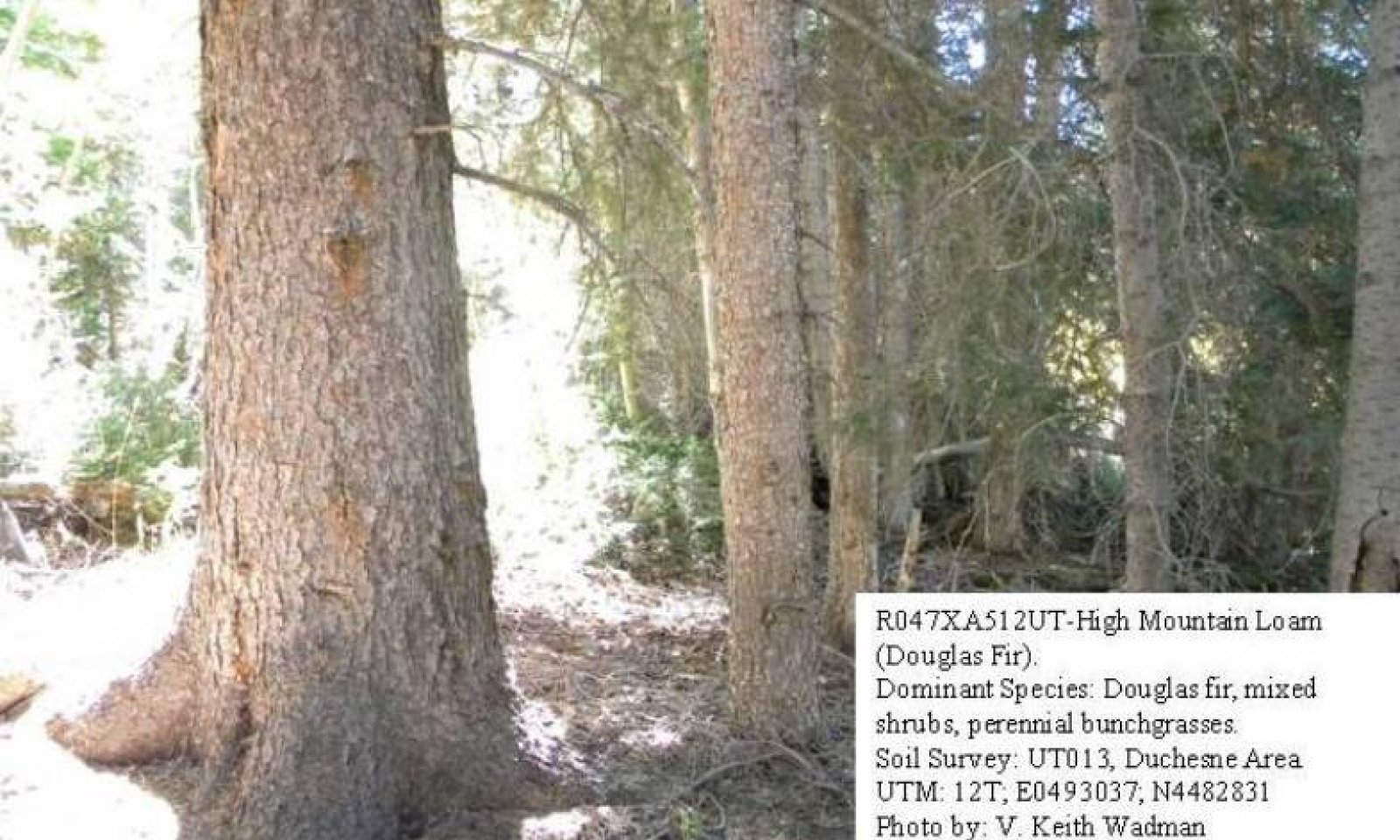
Reference State


Description
This Reference State (State 1) describes the biotic communities that may become established on the High Mountain Loam (Douglas Fir) ecological site if all successional sequences are completed under natural disturbance conditions. Species composition is generally dominated by an overstory canopy of Douglas fir. A wide mixture of shrubs occur in the understory with common juniper and Saskatoon serviceberry most dominant. Mountain snowberry, grouse whortleberry and alderleaf mountain mahogany are other common shrub species. Ross sedge, blue wildrye and fringed brome are dominant herbaceous species. A wide diversity of perennial forbs are also present.
The seral communities described in the Reference State are open canopy, seedling, sapling, pole, immature forest, mature forest, and old or over-mature forest type if fire is excluded for very long periods of time.
The primary disturbance mechanisms in the Reference State (1) are overstory canopy density, weather fluctuations, and fire, or lack of fire. The Reference State is self-sustaining and resistant to change beyond it's normal seral community types due to adaptation to natural disturbances and a high resilience following those disturbances. When natural disturbances such as fire do occur, the rate of recovery can be quite variable.
Reference State: Plant communities influenced by Douglas fir canopy density, long-term weather fluctuations, and periodic fire.
Indicators: A community dominated by Douglas fir with understory Douglas fir reproduction, and sprouting shrubs including alderleaf mountain mahogany, grouse whortleberry and Saskatoon serviceberry. The density of the overstory canopy determines the amount and composition of the other native perennial grasses, grass-likes and forbs that may be present.
Feedbacks: Natural fluctuations in weather patterns that allow for a self-sustaining mix of a Douglas fir, shrub and native grass and grass-like species in the community. Insect herbivory, more frequent fires, or other disturbances may allow for the establishment of invasive species.
At-risk Community Phase: All communities are at risk when native plants are stressed and nutrients become available for invasive plants to establish.
Trigger: The establishment of invasive plant species
Submodel
State 2
Current Potential State

Current Potential State


Description
The Current Potential State is similar to the Reference State; however, minor amounts of invasive species are present in the community phases. This condition has not been well documented and so community phases in this State are based on possible community dynamics and not documented facts. This State describes the biotic communities that may become established on the High Mountain Loam (Douglas Fir) ecological site if all successional sequences are completed under natural disturbance conditions with the presence of a non-native species. Species composition is generally dominated by an overstory canopy of Douglas fir. A wide mixture of shrubs occur in the understory with common juniper and Saskatoon serviceberry most dominant. Mountain snowberry, grouse whortleberry and alderleaf mountain mahogany are other common shrub species. Ross sedge, blue wildrye and fringed brome are dominant herbaceous species. A wide diversity of perennial forbs are also present.
Seral communities are described in the Current Potential State, including sapling, pole, immature forest, mature forest, and old or over-mature forest type if fire is excluded for very long periods of time.
The primary disturbance mechanisms are overstory canopy density, weather fluctuations and fire or lack of fire. The Current Potential State is still self-sustaining but has a lower resistance to change due to a reduced resilience to disturbances. When disturbances do occur, the rate of recovery can be highly variable.
Current Potential State: Plant communities influenced by wildlife browsing, insect herbivory, weather fluctuations, fire periods and surface disturbances.
Indicators: A community dominated by Douglas fir with understory Douglas fir reproduction, and sprouting shrubs including alderleaf mountain mahogany, grouse whortleberry and Saskatoon serviceberry. The density of the overstory canopy determines the amount and composition of the other native perennial grasses, grass-likes and forbs that may be present.
Feedbacks: Natural fluctuations in weather patterns that allow for a self-sustaining mix of a Douglas fir, shrub, native grass, and grass-like community. Insect herbivory, more frequent fires, or other disturbances may allow for the establishment of invasive species.
At-risk Community Phase: All communities are at risk when native plants are stressed and nutrients become available for invasive plants to establish.
Trigger: The establishment of invasive plant species
Submodel
Description
The Logged/Disturbed State is similar to the Current Potential State; however, merchantable timber composed mostly of mature and old Douglas fir have been removed. Various amounts of invasive species are present in all community phases. This condition has not been well documented and so community phases in this State are based on possible community dynamics and not documented facts. Species composition is generally dominated by an immature canopy of Douglas fir. A wide mixture of shrubs occur in the understory with common juniper and Saskatoon serviceberry most dominant. Mountain snowberry, grouse whortleberry and alderleaf mountain mahogany are other common shrub species. Ross sedge, blue wildrye, and fringed brome are dominant grass and grass-like species. A wide diversity of perennial forbs are also present. Non-native species including orchardgrass, Kentucky bluegrass and smooth brome may also be present. These species could have been seeded as part of the site rehabilitation following the logging process.
Logging will release younger Douglas fir trees and will give the site the look of an immature forest. Site will return to a mature and finally an old or over-mature forest type if fire is excluded for very long periods of time.
The primary disturbance mechanisms are logging, road building or other man caused activities, weather fluctuations and fire or lack of fire. The Logged/Disturbed State is still self-sustaining but has a lower resistance to change due to a reduced resilience to disturbances. When disturbances do occur, the rate of recovery can be highly variable.
Logged/Disturbed State: Plant communities influenced by man caused activities, wildlife browsing, insect herbivory, weather fluctuations, fire periods and surface disturbances.
Indicators: A community dominated by immature Douglas fir with understory of Douglas fir reproduction, and shrubs including common juniper, alderleaf mountain mahogany, grouse whortleberry and Saskatoon serviceberry. The density of the overstory canopy determines the amount and composition of the other native perennial grasses, grass-likes and forbs that may be present.
Feedbacks: Natural fluctuations in weather patterns that allow for a self-sustaining mix of a Douglas fir, shrub, native grass, and grass-like species in the community. Insect herbivory, more frequent fires, or other disturbances may allow for the establishment of invasive species.
At-risk Community Phase: All communities are at risk when native plants are stressed and nutrients become available for invasive plants to establish.
Trigger: The increase of invasive plant species
Submodel
Transition T1A
This transition occurs when various disturbances such as road building, pipeline construction or fence-line clearing provides and opportunity for non-native species to become established.


Mechanism
This transition occurs when various disturbances such as road building, pipeline construction or fence-line clearing provides and opportunity for non-native species to become established. Seeding of these species could be a normal part of these activities. Once non-native species are established, a threshold has been crossed.
Transition T2A
This transition occurs when timber logging and its associated activities, including road building and skid trail development, removes mature and over-mature Douglas fir trees from the site and provides an opportunity for non-native species to increase.

Mechanism
This transition occurs when timber logging and its associated activities, including road building and skid trail development, removes mature and over-mature Douglas fir trees from the site and provides an opportunity for non-native species to increase. Seeding species such as orchardgrass and smooth brome would often be a normal part of these activities. Once the site is logged, a threshold has been crossed.
Restoration pathway R3A
This restoration pathway occurs following logging activities when the site is allowed to recover naturally.
Mechanism
This restoration pathway occurs following logging activities when the site is allowed to recover naturally. Pole sized and immature Douglas fir trees are increasing in dominance. Seeded, non-native herbaceous species where present, are will established.
Model keys
Briefcase
Add { ecological sites } and { Major Land Resource Areas } to your briefcase by clicking on the briefcase
( ) icon wherever it occurs. Drag and drop items to reorder. Cookies are used to store briefcase items between browsing sessions. Because of this, the number of items that can be added to your briefcase is limited, and briefcase items added on one device and browser cannot be accessed from another device or browser. Users who do not wish to place cookies on their devices should not use the briefcase tool. Briefcase cookies serve no other purpose than described here and are deleted whenever browsing history is cleared.
Ecological sites
Major Land Resource Areas


The Ecosystem Dynamics Interpretive Tool is an information system framework developed by the USDA-ARS Jornada Experimental Range, USDA Natural Resources Conservation Service, and New Mexico State University.
Accessibility statement