
Natural Resources
Conservation Service
Ecological site F043BP708WY
Upland Aspen Woodland Group
Last updated: 3/31/2025
Accessed: 10/17/2026
-
Search


Major Land Resource Area or ecological site by name and/or ID.
PreviousSectionsNextGeneral information
Provisional. A provisional ecological site description has undergone quality control and quality assurance review. It contains a working state and transition model and enough information to identify the ecological site.
MLRA notes
Major Land Resource Area (MLRA): 043B–Central Rocky Mountains
043B – Central Rocky Mountains – This MLRA is extensive including Montana, Idaho, Wyoming and a small portion in Utah. This MLRA consists of the major chains of Mountain Ranges with the corresponding valleys. Cartographic standards limited the ability to capture the foothills as a separate MLRA, so revisions of the MLRA boundaries in 2006 led to the inclusion of the foothills with the mountains for much of Wyoming.
Further information regarding MLRAs, refer to: United States Department of Agriculture, Natural Resources Conservation Service. 2006. Land Resource Regions and Major Land Resource Areas of the United States, the Caribbean, and the Pacific Basin. U.S. Department of Agriculture Handbook 296. Available electronically at: http://www.nrcs.usda.gov/wps/portal/nrcs/detail/soils/ref/?cid=nrcs142p2_053624#handbook.LRU notes
LRU P: PES (Provisional Ecological Site or Group - PEG) A PROVISIONAL ECOLOGICAL SITE is a conceptual grouping of soil map unit components within a Major Land Resource Area
(MLRA) based on the similarities in response to management. Although there may be wide variability in the productivity of the soils grouped into a Provisional Site, the soil vegetation
interactions as expressed in the State and Transition Model are similar and the management actions required to achieve objectives, whether maintaining the existing ecological state or managing for an alternative state, are similar. Provisional Sites are
likely to be refined into more precise concept during the process of meeting the APPROVED ECOLOGICAL SITE DESCRIPTION criteria.
This PROVISIONAL ECOLOGICAL SITE has been developed to meet the standards established in the National Ecological Site Handbook. The information associated with this ecological site does not meet the Approved Ecological Site Description Standard, but it has been through a Quality Control and Quality Assurance processes to assure consistency and completeness. Further investigations, reviews and correlations are necessary before it becomes an Approved Ecological Site Description.Classification relationships
Other Classifications:
POTR5/MARE11 c.t. (Youngblood and Mueggler 1981)
POTR5/SHCA c.t. (Youngblood and Mueggler 1981)
POTR5/ARCO9 c.t. (Youngblood and Mueggler 1981)
POTR5/HEMA80 c.t. (Youngblood and Mueggler 1981)
POTR5/RUOC2 c.t. (Youngblood and Mueggler 1981)Ecological site concept
• Site does not receive any additional water
• Soils are
o Generally not saline or saline-sodic (limited extent)
o Moderately deep, deep, or very deep
o Typically less than 5% stone and boulder cover (<15%)
o Soil surface texture ranges from sandy loam to clay loam in surface mineral 4”Associated sites
F043BP702WY Shallow Cool Woodland Group
Shallow Cool Woodland can be found adjacent to where rock outcrop protrudes above the wet soils.
F043BP709WY Upland Cold Woodland Group
Upland Cold Woodlands are similar in concept in the upper extent of the Upland Aspen Woodland ecological site, with a shift in timber species (conifer rather than Aspen).
F043BP710WY Upland Cool Woodland Group
Upland Cool Woodland are similar in concept in the central extent of the Upland Aspen Woodland ecological site, with a shift in timber species (conifer rather than Aspen).
F043BP711WY Upland Warm Woodland Group
Upland Warm Woodland are similar in concept in the lower extent of the Upland Aspen Woodland ecological site, with a shift in timber species (conifer rather than Aspen).
F043BP707WY Subirrigated Cool Woodland Group
Subirrigated Cool Woodlands can be found in areas with snow melt catch, or seeps on the lower fringes of or in depressions within the Upland Cool Woodlands. The plant communities are similar but the upland has no additional moisture and upland under story, where the Subirrigated Cool site has additional moisture, generally a water table, and wetland-type plants.
F043BP704WY Shallow Warm Woodland Group
Shallow Warm Woodlands will occur on the transition from rock outrcrop to the deeper soils of the Upland Warm Woodlands, Upland Aspen Woodlands will occur intermixed in concave positions within these communitites.
Similar sites
F043BP707WY Subirrigated Cool Woodland Group
Subirrigated Cool Woodlands can be found in areas with snow melt catch, or seeps on the lower fringes of or in depressions within the Upland Cool Woodlands. The plant communities are similar but the upland has no additional moisture and upland under story, where the Subirrigated Cool site has additional moisture, generally a water table, and wetland-type plants.
R043BY308WY Coarse Upland (CU) 15-19” Foothills and Mountains East Precipitation Zone
Course Upland 15-19
R043BY322WY Loamy (Ly) 15-19” Foothills and Mountains East Precipitation Zone
Loamy 15-19
R043BY108WY Coarse Upland High Mountains
Course Upland High Mountains has similar soils, but is the rangeland composition of this site. No timber is seen within this community.
R043BY122WY Loamy High Mountains
Loamy High Mountains has similar soils, but is the rangeland composition of this site. No timber is seen within this community.
R043BY208WY Coarse Upland Foothills and Mountains West
Course Upland 15-19
R043BY222WY Loamy Foothills and Mountains West
Loamy 15-19
Table 1. Dominant plant species
Tree (1) Populus tremuloides
Shrub (1) Artemisia tridentata ssp. vaseyana
(2) Shepherdia canadensisHerbaceous (1) Calamagrostis rubescens
(2) Bromus marginatusPhysiographic features
This site occurs on most slopes, especially in pockets or concave areas within landslides and other deposits. Average slope is less than 20 percent.
Table 2. Representative physiographic features
Landforms (1) Mountains > Mountain slope
(2) Mountains > Moraine
(3) Mountains > Landslide
Runoff class Negligible to high Elevation 5600 – 10000 ft Slope 0 – 40 % Climatic features
Annual precipitation ranges from 15-60 inches per year. June is generally the wettest month. July, August, and September are somewhat less with daily amounts rarely exceeding one inch. Wide fluctuations may occur in yearly precipitation and result in more dry years than those with more than normal precipitation.
Temperatures show a wide range between summer and winter and between daily maximums and minimums. This is predominantly due to the high elevation and dry air, which permits rapid incoming and outgoing radiation. Cold air outbreaks in winter move rapidly from northwest to southeast and account for extreme minimum temperatures.
Snowfall is quite heavy in the area. Annual snowfall averages about 150 inches. Extreme storms may occur during the winter, but most severely affect ranch operations during late winter and spring. Prevailing winds are from the southwest, because of the varied topography, the wind will vary considerably for different parts of the area. The wind is usually much lighter at the lower elevations and in the valleys as compared with the higher terrain. Occasional storms, however, can bring brief periods of high winds with gusts
exceeding 50 mph. Growth of native cool season plants begins about May 15 and continues to about September 15.
The following information is from the “Jackson”, “Cooke City 2W”, "Darwin Ranch", "Snake River", and "Burgess Junction" climate stations, at the lower end of this precipitation zone. Climate Data is limited and is being extrapolated from the nearest stations.Table 3 Representative climatic features
Frost-free period (characteristic range) 0-10 days Freeze-free period (characteristic range) 10-50 days Precipitation total (characteristic range) 20-30 in Frost-free period (actual range) 0-10 days Freeze-free period (actual range) 10-50 days Precipitation total (actual range) 20-30 in Frost-free period (average) 0 days Freeze-free period (average) 30 days Precipitation total (average) 20 in Characteristic rangeActual rangeBarLineFigure 1. Monthly precipitation range
Characteristic rangeActual rangeBarLineFigure 2. Monthly minimum temperature range
Characteristic rangeActual rangeBarLineFigure 3. Monthly maximum temperature range
BarLineFigure 4. Monthly average minimum and maximum temperature
Figure 5. Annual precipitation pattern
Figure 6 Annual average temperature pattern
Climate stations used
-
(1) BURGESS JUNCTION [USC00481220], Dayton, WY
-
(2) JACKSON [USC00484910], Jackson, WY
-
(3) DARWIN RCH [USC00482375], Jackson, WY
-
(4) SNAKE RIVER [USC00488315], Moose, WY
-
(5) COOKE CITY 2 W [USC00241995], Gardiner, MT
">Influencing water features
This site is not associated with any type of surface water feature. Snow drift impact is moderate.
Soil features
The soils associated with this site were derived from sandstone, shale, and a mix of glacial till. These soils are greater than 20” in depth. The bedrock will include igneous, metamorphic and sedimentary material. The soil characteristic having the most influence on the plant community is not known at this time. Soil temperature regime ranges from the upper extent of frigid throughout cryic; while, soil moisture regime is typic ustic to typic udic.

Figure 7. Soils profile found under and Aspen stand.
Table 4. Representative soil features
Parent material (1) Alluvium – sandstone
(2) Colluvium – shale
(3) Till – igneous, metamorphic and sedimentary rock
Surface texture (1) Bouldery, stony, cobbly sandy loam
(2) Clay loam
(3) Silty clay loam
(4) Loam
Drainage class Well drained Permeability class Slow to rapid Depth to restrictive layer 20 – 0 in Soil depth 20 – 0 in Surface fragment cover <=3" 0 – 20 % Surface fragment cover >3" 0 – 15 % Calcium carbonate equivalent
(Depth not specified)0 – 5 % Electrical conductivity
(Depth not specified)0 – 4 mmhos/cm Soil reaction (1:1 water)
(Depth not specified)3.6 – 7.8 Subsurface fragment volume <=3"
(Depth not specified)0 – 20 % Subsurface fragment volume >3"
(Depth not specified)0 – 15 % Ecological dynamics
The Upland Aspen Woodland ecological group is being developed to cover a very broad range of climate, topographic and geographic differences. The ecological dynamic for this site is very similar across each of these ranges, and the major differences are shifts in the companion species found in each of the communities. There has been a significant level of information gathered and research completed on these Aspen community dynamics, these references are noted. The role of fire, utilization by large ungulates (including livestock), and the nature of Aspens themselves creates a unique community dynamic.
State and transition model
More interactive model formats are also available. View Interactive Models
Click on state and transition labels to scroll to the respective textEcosystem states
SWAPAEHSWAPAEHSWAPAEHSWAPAEHT1A - Fire suppression and frequent season long or severe grazing reduces aspen and encourages conifer encroachment. T1B - Fire suppression and sever (frequent season long) grazing reduces the cloning and regeneration of aspen, reducing the community to a herbaceous community. T1C - Improper (repeated severe) grazing and catastrophic fire with seed sources present transitions the site from Reference to the Invaded State. R2A - Grazing management (rest rotation preferred) with removal of conifer growth is required to restore the state to Reference. R3A - Grazing management with time provided for aspen regeneration allows this site to recover to the reference state. State 1 submodel, plant communities
1.1A - Insects, disease, and/or drought reduce Aspen canopy, herbaceous under story increases, and Aspen cloning may occur. 1.1B - Stand reducing fire and /or timber harvesting removes canopy, and encourages Aspen sprouting. 1.2A - Time for aspen recovery with grazing management allows aspen and the herbaceous under story to shift in dominance. 1.3A - Time for aspen to mature and grazing management to allow the under story to recover transitions this community. 1.4A - Time and proper grazing allow for aspen to gain in size and maturity while maintaining a healthy under story with aspen sprouting. State 2 submodel, plant communities
State 3 submodel, plant communities
State 4 submodel, plant communities
State 1
ReferenceAspens serve as key habitat within the conifer forest ecosystem. Their ability to colonize on the landscape with a strong herbaceous under story serves as a forage source, shelter and aesthetic view point. This state is the reference state, with an Aspen dominated over story and a native, herbaceous under story.
Characteristics and indicators. The dominance of aspen trees in this community with a strong native under story and minimal composition of conifer species (less than 5 percent) are the signature characteristics of this State. This state does not provide for non-native species in the reference 1.1 community, but it is generally understood that it is difficult to find communities that have a zero composition of non-native invaders (Kentucky bluegrass, smooth brome, timothy).
Resilience management. Aspens are a delicate species, but overall are resilient and able to recover given time and management. Their ability to clone themselves, and rhizomatous nature assist in their perseverance on the landscape. however, they are susceptible to disease and insects which does inhibit them to some degree. Fire and grazing are both tools for management but also are an impact to this plant community
Dominant plant species
-
quaking aspen (Populus tremuloides), tree
-
common juniper (Juniperus communis var. depressa), shrub
-
Woods' rose (Rosa woodsii), shrub
-
mountain snowberry (Symphoricarpos oreophilus), shrub
-
mountain big sagebrush (Artemisia tridentata ssp. vaseyana), shrub
-
russet buffaloberry (Shepherdia canadensis), shrub
-
pinegrass (Calamagrostis rubescens), grass
-
Geyer's sedge (Carex geyeri), grass
-
Letterman's needlegrass (Achnatherum lettermanii), grass
-
California brome (Bromus carinatus), grass
-
western coneflower (Rudbeckia occidentalis), other herbaceous
-
heartleaf arnica (Arnica cordifolia), other herbaceous
-
timber milkvetch (Astragalus miser), other herbaceous
-
plantainleaf buttercup (Ranunculus alismifolius), other herbaceous
Dominant resource concerns
-
Compaction
-
Plant productivity and health
-
Wildfire hazard from biomass accumulation
Community 1.1
Reference: Aspen/Herbaceous - Single Story
Figure 8. Aspen/Herbaceous Community Phase with a few sapling aspen present in the under story.

Figure 9. Aspen/Herbaceous Community Phase following an intense fire.
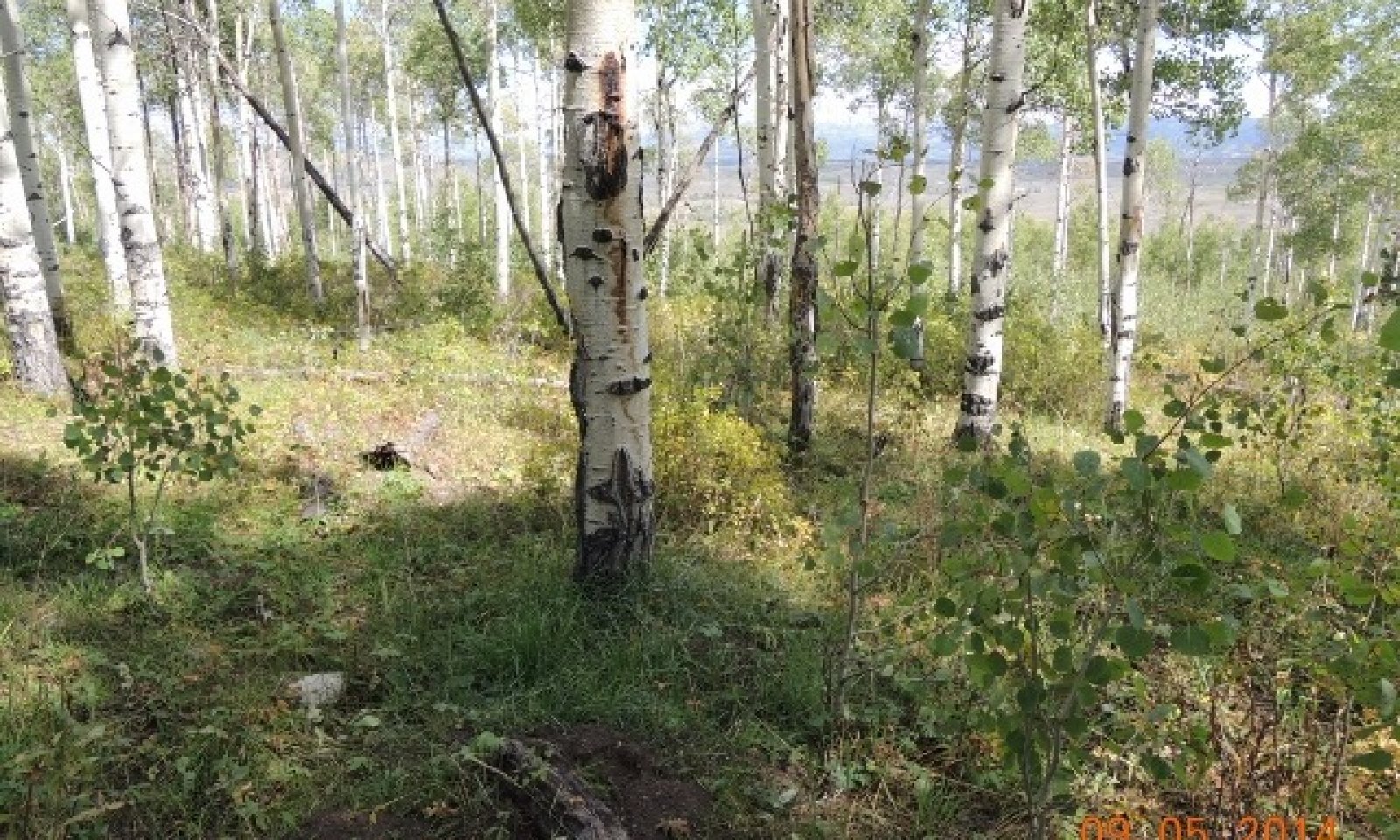
The reference community is Aspen over story with a herbaceous under story. In the Aspen over story, the trees are single story canopy with an even-aged stand. The trees are decadent to some degree, and range in age from 80 to 125 years old or older. Some aspen sprouts are present, but are minor in the canopy. The over story canopy is between 80 to 90 percent.
Resilience management. The decadence of this stand reduces the resiliency of the canopy, but with the presence of samplings, the stand is able to recover if impacts. The old growth trees are more susceptible to disease and insect damage.
Dominant plant species
-
quaking aspen (Populus tremuloides), tree
-
common juniper (Juniperus communis var. depressa), shrub
-
mountain big sagebrush (Artemisia tridentata ssp. vaseyana), shrub
-
western snowberry (Symphoricarpos occidentalis), shrub
-
pinegrass (Calamagrostis rubescens), grass
-
Geyer's sedge (Carex geyeri), grass
-
California brome (Bromus carinatus), grass
-
western coneflower (Rudbeckia occidentalis), other herbaceous
-
heartleaf arnica (Arnica cordifolia), other herbaceous
-
common cowparsnip (Heracleum maximum), other herbaceous
-
mule-ears (Wyethia amplexicaulis), other herbaceous
Community 1.2
Herbaceous/Aspen
Figure 10. A herbaceous under story with aspen sprouts increasing in the community phase.

Figure 11. Herbaceous/Aspen Community Phase with sapling aspen present but not densely populated.
The Herbaceous/Aspen Community Phase is predominantly a herbaceous under story with an over story of aspen sprouts (saplings). The tree canopy is generally less than 20 percent but is variable. The range in age of the tree stand is one to 25 years old. This stand is susceptible to herbivory impacts by wildlife and livestock. The under story is comprised of forbs and grasses with a few shrubs.
Resilience management. This community is young and resilient to most minor disturbances. Fire and insect/disease threats are low. However, grazing can be detrimental to the maturation potential of this stand.
Dominant plant species
-
quaking aspen (Populus tremuloides), tree
-
mountain big sagebrush (Artemisia tridentata ssp. vaseyana), shrub
-
common juniper (Juniperus communis var. depressa), shrub
-
russet buffaloberry (Shepherdia canadensis), shrub
-
pinegrass (Calamagrostis rubescens), grass
-
Letterman's needlegrass (Achnatherum lettermanii), grass
-
California brome (Bromus carinatus), grass
-
silvery lupine (Lupinus argenteus), other herbaceous
-
timber milkvetch (Astragalus miser), other herbaceous
-
western coneflower (Rudbeckia occidentalis), other herbaceous
Community 1.3
Aspen Sprouts
Figure 12. Over story of standing dead aspen with a young, dense stand of aspen sprouts below.
The Aspen Sprouts community phase is characterized by the dense canopy of young aspen samplings with a slightly decreased herbaceous under story. the tree canopy is generally all young aspen trees in age from one to ten years old. The canopy cover can range from 70 to 100 percent, reducing the diversity of under story species as well.
Resilience management. This canopy is generally short lived as the trees become stressed and are susceptible to disease and insect damage. Density of the tree stand reduces the threat of herbivory, although there is still impact by browsing/grazing on the canopy. In comparison to other communities, this is till higher in resiliency than old growth stands, but is less resistant to change.
Dominant plant species
-
quaking aspen (Populus tremuloides), tree
-
western snowberry (Symphoricarpos occidentalis), shrub
-
russet buffaloberry (Shepherdia canadensis), shrub
-
creeping barberry (Mahonia repens), shrub
-
pinegrass (Calamagrostis rubescens), grass
-
Geyer's sedge (Carex geyeri), grass
-
California brome (Bromus carinatus), grass
-
western coneflower (Rudbeckia occidentalis), other herbaceous
-
plantainleaf buttercup (Ranunculus alismifolius), other herbaceous
-
Fendler's meadow-rue (Thalictrum fendleri var. fendleri), other herbaceous
Community 1.4
Aspen/Herbaceous - Multi-story
Figure 13. Aspen/Herbaceous Community Phase with an Old stand aspen canopy and a dominance of aspen sprouts present in the under story.

Figure 14. Aspen/Herbaceous Community Phase with less prominent old stand aspen canopy with a dominant strata of aspen sprouts.

Figure 15. Aspen/Herbaceous Community Phase with a two story canopy of aspen, with a strong strata of aspen sprouts present in the under story.
Similar to reference, Community Phase 1.4 is a mature aspen stand, but with a dominant second over story layer of younger aspen samplings. Both strata of the over story are relatively healthy. The younger aspen are variable in age. The age of the main stand of aspen ranges from 30 to 70 years old. The tree canopy is between 70 to 90 percent. The variability in height and age alters the transparency of this canopy allowing for a dynamic under story canopy.
Resilience management. The relative health of both strata of the canopy and because of the dynamic of the aging of this tree stand, the community is relatively resilient to most disturbances and is resistant to major change.
Dominant plant species
-
quaking aspen (Populus tremuloides), tree
-
common juniper (Juniperus communis var. depressa), shrub
-
russet buffaloberry (Shepherdia canadensis), shrub
-
western snowberry (Symphoricarpos occidentalis), shrub
-
pinegrass (Calamagrostis rubescens), grass
-
Geyer's sedge (Carex geyeri), grass
-
California brome (Bromus carinatus), grass
-
heartleaf arnica (Arnica cordifolia), other herbaceous
-
Fendler's meadow-rue (Thalictrum fendleri var. fendleri), other herbaceous
-
timber milkvetch (Astragalus miser), other herbaceous
-
plantainleaf buttercup (Ranunculus alismifolius), other herbaceous
Pathway 1.1A
Community 1.1 to 1.2
Reference: Aspen/Herbaceous - Single Story
Herbaceous/AspenReduction in the Aspen canopy is a factor of insect and/or disease, drought, or other disturbance. The loss of over story canopy (shading) allows the herbaceous under story to increase. The increased light accessing the under story encourages aspen cloning.
Key drivers
-
Fire
-
Livestock grazing or browsing
-
Nonnative disease presence and/or establishment
-
Fire frequency
Key ecosystem services affected
-
Aesthetic values
-
Nutrient cycling
-
Primary production
-
Food and fiber: livestock forage
-
Wildlife forage
-
Wildlife habitat
-
Plant biodiversity
Pathway 1.1B
Community 1.1 to 1.3
Reference: Aspen/Herbaceous - Single Story
Aspen SproutsWildland fire for stand replacement or forest stand management with fire and/or timber harvesting removes most of woody canopy in the community. Aspen sprouting occurs in response to the open canopy and increased sunlight. In the herbaceous under story, forbs typically respond first to the open canopy, with grasses following in the natural succession of the community.
Conservation practices
Upland Wildlife Habitat Management Forest Stand Improvement Prescribed Grazing Forest Land Management Grazing management to improve wildlife habitat Patch-burning to enhance wildlife habitat Forest stand improvement for habitat and soil quality Forest stand improvement pre-treating vegetation and fuels Forest Stand Improvement, Prescribed burning Key drivers
-
Precipitation (decadal scale)
-
Temperature (decadal scale)
-
Livestock grazing or browsing
-
Climate
-
Precipitation (annual scale)
-
Mechanical soil disturbance
-
Temperature (annual scale)
-
Nonnative pest presence and/or establishment
-
Nonnative disease presence and/or establishment
-
Timber management
Key ecosystem services affected
-
Nutrient cycling
-
Primary production
-
Food and fiber: livestock forage
-
Wildlife forage
-
Wildlife habitat
-
Plant biodiversity
Pathway 1.2A
Community 1.2 to 1.4
Herbaceous/Aspen
Aspen/Herbaceous - Multi-storyTime for aspen to grow and mature with proper grazing to allow for under story growth provides a mechanism for the Herbaceous/Aspen community to transition to the Aspen/Herbaceous community.
Conservation practices
Upland Wildlife Habitat Management Planned Grazing System Prescribed Grazing Forest Land Management Key drivers
-
Precipitation (decadal scale)
-
Fire
-
Temperature (decadal scale)
-
Climate
-
Timber management
-
Fire frequency
Key ecosystem services affected
-
Aesthetic values
-
Nutrient cycling
-
Primary production
-
Food and fiber: livestock forage
-
Wildlife forage
-
Wildlife habitat
-
Plant biodiversity
Pathway 1.3A
Community 1.3 to 1.4
Aspen Sprouts
Aspen/Herbaceous - Multi-storyTime for aspen to grow and mature with proper grazing to allow for under story growth provides a mechanism for the Aspen Sprout community to transition to the Aspen/Herbaceous community.
Conservation practices
Prescribed Grazing Upland Wildlife Habitat Management Forest Stand Improvement Key drivers
-
Wildlife grazing or browsing
-
Livestock grazing or browsing
-
Climate
-
Timber management
-
Fire frequency
Key ecosystem services affected
-
Aesthetic values
-
Nutrient cycling
-
Primary production
-
Food and fiber: livestock forage
-
Wildlife forage
-
Wildlife habitat
-
Plant biodiversity
Pathway 1.4A
Community 1.4 to 1.1
Aspen/Herbaceous - Multi-story
Reference: Aspen/Herbaceous - Single StoryTime and proper grazing allows the aspen to mature while encouraging aspen sprouting. Using timber harvest or forest stand improvement techniques to manage stand health and providing longevity of the stand allows for the old growth trees to gain in size and stature. Proper grazing allows for a healthy under story.
Conservation practices
Prescribed Grazing Upland Wildlife Habitat Management Prescribed Grazing Forest Land Management Prescribed Forestry Patch-burning to enhance wildlife habitat Forest stand improvement for habitat and soil quality Wildlife corridors Forest stand improvement pre-treating vegetation and fuels Forest Stand Improvement to Reduce Wildfire Risk Key drivers
-
Wildlife grazing or browsing
-
Livestock grazing or browsing
-
Climate
-
Timber management
-
Fire frequency
Key ecosystem services affected
-
Aesthetic values
-
Nutrient cycling
-
Primary production
-
Food and fiber: livestock forage
-
Wildlife forage
-
Wildlife habitat
-
Plant biodiversity
State 2
Conifer EncroachedThe Aspen canopy provides opportunity for conifer species to remain, especially those species that are somewhat shade tolerant. Subalpine fir is one of those species that can tolerate the shade within the aspen community and then thrive once the canopy deteriorates.
Characteristics and indicators. This state is identified by the loss of Aspen, with less than 10 percent remaining in the stand, and an increase in conifer species. The conifers can be a mix, but subalpine fir in upper elevations, engelman spruce in central elevations and Douglas-fir in lower elevations tend to be the dominant species encroaching in on this community/State.
Resilience management. This state is relatively resistant to change, but in the face of fire or following timber management to remove the unwanted conifer cover, the state will revert to a reference state with time and proper grazing management.
Dominant plant species
-
subalpine fir (Abies lasiocarpa), tree
-
Douglas-fir (Pseudotsuga menziesii), tree
-
Engelmann spruce (Picea engelmannii), tree
-
quaking aspen (Populus tremuloides), tree
-
russet buffaloberry (Shepherdia canadensis), shrub
-
common juniper (Juniperus communis var. depressa), shrub
-
creeping barberry (Mahonia repens), shrub
-
mountain snowberry (Symphoricarpos oreophilus), shrub
-
pinegrass (Calamagrostis rubescens), grass
-
Geyer's sedge (Carex geyeri), grass
-
California brome (Bromus carinatus), grass
-
common cowparsnip (Heracleum maximum), other herbaceous
-
western coneflower (Rudbeckia occidentalis), other herbaceous
-
mule-ears (Wyethia amplexicaulis), other herbaceous
-
timber milkvetch (Astragalus miser), other herbaceous
-
Fendler's meadow-rue (Thalictrum fendleri var. fendleri), other herbaceous
Dominant resource concerns
-
Plant productivity and health
-
Plant structure and composition
-
Wildfire hazard from biomass accumulation
-
Terrestrial habitat for wildlife and invertebrates
-
Feed and forage imbalance
Community 2.1
Conifer/<10% Aspen Cover
Figure 16. Dense strata of conifers in the over story of old growth aspen.

Figure 17. Conifer encroachment in the over story of aspen.

Figure 18. Forest stand improvement project to remove conifers from an aspen stand.
Woody vegetation is the dominant cover for the Conifer Enroachment State. For this community phase, Aspens maintain less than 10 percent of the canopy cover; while conifers, largely subalpine fir, have taken over the rest of the community. Under story vegetation is still present but in varying composition.
Resilience management. This site will continue to degrade until fire or other means of timber management occur to reduce the conifer composition within the woody strata. Aspen regeneration is hindered within this community phase. The community is still resilient, in that as the conifers are removed, the aspen are able to respond and recover as is the herbaceous under story.
Dominant plant species
-
subalpine fir (Abies lasiocarpa), tree
-
Douglas-fir (Pseudotsuga menziesii), tree
-
Rocky Mountain juniper (Juniperus scopulorum), tree
-
quaking aspen (Populus tremuloides), tree
-
russet buffaloberry (Shepherdia canadensis), shrub
-
western snowberry (Symphoricarpos occidentalis), shrub
-
creeping barberry (Mahonia repens), shrub
-
pinegrass (Calamagrostis rubescens), grass
-
Geyer's sedge (Carex geyeri), grass
-
Sandberg bluegrass (Poa secunda), grass
-
arnica (Arnica), other herbaceous
-
Fendler's meadow-rue (Thalictrum fendleri var. fendleri), other herbaceous
-
timber milkvetch (Astragalus miser), other herbaceous
State 3
HerbaceousDeterioration of the Aspen community with age, disease, or over grazing by wildlife or livestock leads to the loss of the aspen under story as well as the herbaceous under story may be reduced to a select few species.
Characteristics and indicators. The Herbaceous State is characterized by the lack of Aspens in a community with a herbaceous under story. Remnant populations of old Aspens may still be present, but no young or producing Aspen are present in the community. The herbaceous is variable, but is generally limited to a few native grass/grass-like species and forbs.
Resilience management. Density of remaining herbaceous cover has proven to resist encroachment of other species, and serves to restrict the regeneration of Aspens, however with time and continued disturbance by grazing, logging or drought, this State becomes more susceptible to encroachment by conifer species or non-native species. Proper management and rest can help with transitioning this site back to reference.
Dominant plant species
-
mountain big sagebrush (Artemisia tridentata ssp. vaseyana), shrub
-
western snowberry (Symphoricarpos occidentalis), shrub
-
common juniper (Juniperus communis var. depressa), shrub
-
russet buffaloberry (Shepherdia canadensis), shrub
-
pinegrass (Calamagrostis rubescens), grass
-
Letterman's needlegrass (Achnatherum lettermanii), grass
-
Geyer's sedge (Carex geyeri), grass
-
California brome (Bromus carinatus), grass
-
silvery lupine (Lupinus argenteus), other herbaceous
-
mule-ears (Wyethia amplexicaulis), other herbaceous
-
western coneflower (Rudbeckia occidentalis), other herbaceous
-
heartleaf arnica (Arnica cordifolia), other herbaceous
-
timber milkvetch (Astragalus miser), other herbaceous
Dominant resource concerns
-
Sheet and rill erosion
-
Compaction
-
Plant productivity and health
-
Plant structure and composition
-
Wildfire hazard from biomass accumulation
-
Terrestrial habitat for wildlife and invertebrates
-
Inadequate livestock shelter
Community 3.1
Herbaceous/No Aspen
Figure 19. The herbaceous cover and shrub cover of a degraded aspen community (Herbaceous/No Aspen community phase) is easily mistaken for upland shrubland communities. (Photo: K. Clause)
Loss of the aspen over story with an increase in the herbaceous under story is the key dynamic of this community phase. With the lack of any substantial growth of aspen, this community will function similar to its shrub/grassland counterpart. However, the potential for aspen recovery is high.
Resilience management. This community is resilient, and able to recover given the time to recover with protection from grazing/browsing of young aspen sprouts. The herbaceous cover inhibits aspen growth and so this community can be relatively resistant to change without some disturbance to the herbaceous cover.
Dominant plant species
-
western snowberry (Symphoricarpos occidentalis), shrub
-
mountain big sagebrush (Artemisia tridentata ssp. vaseyana), shrub
-
Woods' rose (Rosa woodsii), shrub
-
Letterman's needlegrass (Achnatherum lettermanii), grass
-
California brome (Bromus carinatus), grass
-
pinegrass (Calamagrostis rubescens), grass
-
plantainleaf buttercup (Ranunculus alismifolius), other herbaceous
-
western coneflower (Rudbeckia occidentalis), other herbaceous
-
mule-ears (Wyethia amplexicaulis), other herbaceous
-
timber milkvetch (Astragalus miser), other herbaceous
State 4
InvadedThe Invaded State for the Upland Aspen Woodland ecological site typically productive and maintain function for livestock forage and for habitat. The shift in herbaceous species can lower the quality of forage, but in some instances will make the system more resistant to change during drought, intensive grazing use, or other unforeseen impact. But there is a cost to the system as well in the loss of resiliency to these impacts.
Characteristics and indicators. Kentucky bluegrass and smooth brome are the two most dominant invaders across the scope of the ecolgoical site. Other invaders including thistle, houndstongue, and knapweed have been identified in these wooded sites. As the invaders increase, Aspen will decline in the community. There is debate on where the threshold for invasion occurs, whether it is at the first sign of any non-native species or if it occurs after a determined composition. This threshold should be taken on a by species basis, but to simplify for the case of this ecological site, if there is 10 percent or greater composition by cover, the ecological site is invaded.
Resilience management. Resiliency of this site is dependent on maintaining the health and quality of the native species, especially the aspens themselves, while striving to reduce or remove the invasive species. The aggressive nature and ability to compete for limited resources allows an invaded community to recovery after intense use, major disturbances including drought and fire (species dependent), or following logging.
Dominant plant species
-
quaking aspen (Populus tremuloides), tree
-
mountain big sagebrush (Artemisia tridentata ssp. vaseyana), shrub
-
russet buffaloberry (Shepherdia canadensis), shrub
-
mountain snowberry (Symphoricarpos oreophilus), shrub
-
common juniper (Juniperus communis var. depressa), shrub
-
pinegrass (Calamagrostis rubescens), grass
-
Kentucky bluegrass (Poa pratensis), grass
-
smooth brome (Bromus inermis), grass
-
timothy (Phleum pratense), grass
-
tufted hairgrass (Deschampsia cespitosa), grass
-
Fendler's meadow-rue (Thalictrum fendleri var. fendleri), other herbaceous
-
mule-ears (Wyethia amplexicaulis), other herbaceous
-
common cowparsnip (Heracleum maximum), other herbaceous
-
timber milkvetch (Astragalus miser), other herbaceous
-
thistle (Cirsium), other herbaceous
-
gypsyflower (Cynoglossum officinale), other herbaceous
Dominant resource concerns
-
Compaction
-
Aggregate instability
-
Plant productivity and health
-
Plant structure and composition
-
Wildfire hazard from biomass accumulation
-
Terrestrial habitat for wildlife and invertebrates
Community 4.1
Invaded Understory
Figure 20. Kentucky bluegrass is the dominant grass cover of this Aspen community.
This community phase can resemble many of the other states and communities with variations in aspen cover and degrees of conifer encroachment. The major factor of this community phase is simply the significant presence (greater than 10% composition by cover) of a non-native, invasive species such as Kentucky bluegrass.
Resilience management. The challenge of eradicating or reducing non-native/invader species from these communities creates a resilient community that is resistant to change. Shifts and improvements in herbaceous cover can be achieved by there are risks to the native species.
Dominant plant species
-
quaking aspen (Populus tremuloides), tree
-
common juniper (Juniperus communis var. depressa), shrub
-
mountain big sagebrush (Artemisia tridentata ssp. vaseyana), shrub
-
western snowberry (Symphoricarpos occidentalis), shrub
-
Kentucky bluegrass (Poa pratensis), grass
-
smooth brome (Bromus inermis), grass
-
Sandberg bluegrass (Poa secunda), grass
-
heartleaf arnica (Arnica cordifolia), other herbaceous
-
mule-ears (Wyethia amplexicaulis), other herbaceous
-
timber milkvetch (Astragalus miser), other herbaceous
Transition T1A
State 1 to 2Fire suppression, especially with severe grazing by livestock and/or wildlife encourage the encroachment of conifer species. The pressure of the conifer species inhibits the cloning ability of aspen, and disease and insect impacts successfully decline or remove aspen from the community. Subalpine fir, Rocky mountain juniper, Douglas-fir, and white bark pine can be found in the over story.
Constraints to recovery.Removal of the conifer under story can be labor intensive or risky if fire is used depending on the location specifics. Once conifers are removed, reducing the risk of grazing impacts and browsing on young aspen saplings until the site is established and able to tolerate the use is key to allowing the site to recover.
Key drivers
-
Wildlife grazing or browsing
-
Fire
-
Livestock grazing or browsing
-
Mechanical soil disturbance
-
Timber management
-
Fire frequency
Key ecosystem services affected
-
Nutrient cycling
-
Primary production
-
Food and fiber: livestock forage
-
Wildlife forage
-
Wildlife habitat
-
Plant biodiversity
Transition T1B
State 1 to 3Lack of fire and frequent, season long grazing (severe defoliation) by livestock and wildlife, the ability for aspen to clone or regenerate is reduced. Aspens are impacted by disease and insects more readily as they are stressed, and begin to decline in the over story. The herbaceous species in the under story will decline in diversity and become limited in number of species, but will maintain cover.
Constraints to recovery.The ability to reduce grazing impacts, especially by wildlife, can be difficult depending on the specific characteristics of a location. Once aspen has declined or been removed from the community, it can be challenging to invigorate regrowth of aspen. Providing time for recovery post fire, or limiting use of the the community until it has recovered is critical.
Key drivers
-
Wildlife grazing or browsing
-
Fire
-
Livestock grazing or browsing
-
Mechanical soil disturbance
-
Nonnative pest presence and/or establishment
-
Nonnative disease presence and/or establishment
-
Timber management
-
Fire frequency
Key ecosystem services affected
-
Erosion control
-
Aesthetic values
-
Nutrient cycling
-
Primary production
-
Food and fiber: livestock forage
-
Wildlife forage
-
Wildlife habitat
-
Plant biodiversity
Transition T1C
State 1 to 4Repeated severe grazing without a period of recovery or during time when the community is fragile, especially with a seed source present, opens this community to invasive plant species. Catastrophic fire, especially in combination with drought, improper grazing, or other disturbance leads to an invaded community when the seed sources are present.
Constraints to recovery.The inability to reduce or remove most of the invasive species, specifically Kentucky bluegrass and smooth brome, without adversely impacting most native species limits the ability to recover this site. Without reducing the overall canopy of the herbaceous under story, Aspen have minimal chance of a full recovery, and the under story is currently thought to be irreversible.
Key drivers
-
Wildlife grazing or browsing
-
Fire
-
Livestock grazing or browsing
-
Seed dispersal by livestock
-
Mechanical soil disturbance
-
Timber management
-
Nonnative plant species presence and/or establishment
-
Fire frequency
Key ecosystem services affected
-
Erosion control
-
Aesthetic values
-
Nutrient cycling
-
Primary production
-
Food and fiber: livestock forage
-
Wildlife forage
-
Wildlife habitat
-
Plant biodiversity
Restoration pathway R2A
State 2 to 1Grazing management, with a rest rotation preferred, and removal of the conifer over story will allow aspen to recover on this site. Time for aspen recovery and targeted grazing to enhance the under story cover is needed to restore this community to the Reference State. Temporary exclusion from the community to allow aspen to regenerate may be necessary. The use of down fall or the conifer cuttings is one technique to limit access to allow aspen regrowth.
Conservation practices
Prescribed Grazing Grazing Land Mechanical Treatment Upland Wildlife Habitat Management Livestock Use Area Protection Forest Land Management Patch-burning to enhance wildlife habitat Forest stand improvement for habitat and soil quality Wildlife corridors Forest stand improvement pre-treating vegetation and fuels Forest Stand Improvement to Reduce Wildfire Risk Restoration pathway R3A
State 3 to 1Grazing management with time allowed for aspen regeneration is key for the restoration of this site back to reference. Temporary exclusion from aspen community or the use of downfall to limit access by both livestock and wildlife is pertinent to allowing aspen to regenerate.
Conservation practices
Prescribed Grazing Grazing Land Mechanical Treatment Heavy Use Area Protection Forest Stand Improvement Prescribed Grazing Grazing management to improve wildlife habitat Patch-burning to enhance wildlife habitat Forest stand improvement for habitat and soil quality Wildlife corridors Additional community tables
Table 5. Community 1.1 plant community composition
Group Common name Symbol Scientific name Annual production () Foliar cover (%) Table 6. Community 1.2 plant community composition
Group Common name Symbol Scientific name Annual production () Foliar cover (%) Table 7. Community 1.3 plant community composition
Group Common name Symbol Scientific name Annual production () Foliar cover (%) Table 8. Community 1.4 plant community composition
Group Common name Symbol Scientific name Annual production () Foliar cover (%) Table 9. Community 2.1 plant community composition
Group Common name Symbol Scientific name Annual production () Foliar cover (%) Table 10. Community 3.1 plant community composition
Group Common name Symbol Scientific name Annual production () Foliar cover (%) Table 11. Community 4.1 plant community composition
Group Common name Symbol Scientific name Annual production () Foliar cover (%) Interpretations
Animal community
This site and plant community complex has potential for livestock forage. This site is excellent habitat and has forage value for elk, mule deer, and moose. The site also provides habitat for bear, wolf, mountain lion, and a variety of other wildlife species including large raptors and a variety of smaller birds.
Hydrological functions
Water is the principal factor limiting forage production on this site. This site is dominated by soils in hydrologic group C, with localized areas in hydrologic group B and D. Infiltration ranges from moderately slow to moderate. Runoff potential for this site varies from low to moderate depending on soil hydrologic group and ground cover. In many cases, areas with greater than 75% ground cover have the greatest potential for high infiltration and lower
runoff. An example of an exception would be where short-grasses form a strong sod and dominate the site. Areas where ground cover is less than 50% have the greatest potential to have reduced infiltration and higher runoff (refer to Part 630, NRCS National Engineering Handbook for detailed hydrology information).
Rills and gullies should not typically be present. Water flow patterns should be barely distinguishable if at all present. Pedestals are only slightly present in association with
bunchgrasses. Litter typically falls in place, and signs of movement are not common. Chemical and physical crusts are rare to nonexistent. Cryptogamic crusts are present, but only cover 1-2% of the soil surface.Recreational uses
This site provides hunting opportunities for large ungulates and fur bearing species. Limited for upland game bird species. Hiking is limited by density of mature tree stands, otherwise provides an excellent area to camp, hike, and recreate.
Wood products
Timber harvest of standing dead or deadfall for firewood are common on this forest type.
Supporting information
Inventory data references
Information presented here has been derived from NRCS data and other inventory data. Field observations from range trained personnel were also used. Those involved in developing this site include: Bill Christensen, Range Management Specialist, NRCS; Karen Clause, Range Management Specialist, NRCS; and Everet Bainter, Range Management Specialist, NRCS. Other sources used as references include: USDA NRCS Water and Climate Center, USDA NRCS National Range and Pasture Handbook, and USDA NRCS Soil Surveys from various counties.
Other references
Bartos, Dale L.; Muggler, W.F. 1981. Early Succession in Aspen Communities Following Fire in Western Wyoming. Journal of Range Management. 34(4): 315-318.
Beetle, A.A.; 1974. Range Survey in Teton County, Wyoming: Part IV – Quaking Aspen. SM 27. Laramie, WY: University of Wyoming, Agricultural Experiment Station. 28 p.
DeByle, Norbert V. 1985. Aspen: Ecology and Management in the Western United States. General Technical Report RM-119. Fort Collins, CO: U.S. Department of Agriculture, Forest Service, Rocky Mountain Forest and Range Experiment Station.
Gruell, G.E.; Loope, L.L. 1974. Relationships Among Aspen, Fire, and Ungulate Browsing in Jackson Hole, Wyoming. Lakewood, CO: U.S. Department of the Interior, National Park Service, Rocky Mountain Region. 33p.
Kuchler, A.W. 1964. Potential Natural Vegetation of the Conterminous United States. Special Publication No. 36. New York: American Geographical Society. 1:3, 168,000; colored.
Mueggler, Walter F. 1988. Aspen Community Types of the Intermountain Region. General Technical Report INT-250. Ogeden, UT: U.S. Department of Agriculture, Forest Service, Intermountain Research Station.135 p.
Steele, Robert; Cooper, Stephen V.; Ondov, David M.; Roberts, David W.; Pfister, Robert D. 1983. Forest Habitat Types of Eastern Idaho-Western Wyoming. General Technical Report INT-144. Ogden, UT: U.S. Department of Agriculture, Forest Service, Intermountain Forest and Range Experiment Station. 122 p.
Youngblood, A.P. and W.F. Mueggler. 1981. Aspen Community Types on the Bridger-Teton National Forest in Western Wyoming. USDA Forest Service Research Paper INT-272, 34p. Intermountain Forest and Range Experiment Station, Ogden, UT 84401.Contributors
Bryan Christensen, Ecological Site Specialist, USDA-NRCS
Marji Patz, Ecological Site Specialist, USDA-NRCS
Karen Clause, Multi-County Rangeland Management Specialist, USDA-NRCSApproval
Kirt Walstad, 3/31/2025
Rangeland health reference sheet
Interpreting Indicators of Rangeland Health is a qualitative assessment protocol used to determine ecosystem condition based on benchmark characteristics described in the Reference Sheet. A suite of 17 (or more) indicators are typically considered in an assessment. The ecological site(s) representative of an assessment location must be known prior to applying the protocol and must be verified based on soils and climate. Current plant community cannot be used to identify the ecological site.
Author(s)/participant(s) Contact for lead author Date 03/05/2025 Approved by Approval date Composition (Indicators 10 and 12) based on Annual Production Indicators
-
Number and extent of rills:
-
Presence of water flow patterns:
-
Number and height of erosional pedestals or terracettes:
-
Bare ground from Ecological Site Description or other studies (rock, litter, lichen, moss, plant canopy are not bare ground):
-
Number of gullies and erosion associated with gullies:
-
Extent of wind scoured, blowouts and/or depositional areas:
-
Amount of litter movement (describe size and distance expected to travel):
-
Soil surface (top few mm) resistance to erosion (stability values are averages - most sites will show a range of values):
-
Soil surface structure and SOM content (include type of structure and A-horizon color and thickness):
-
Effect of community phase composition (relative proportion of different functional groups) and spatial distribution on infiltration and runoff:
-
Presence and thickness of compaction layer (usually none; describe soil profile features which may be mistaken for compaction on this site):
-
Functional/Structural Groups (list in order of descending dominance by above-ground annual-production or live foliar cover using symbols: >>, >, = to indicate much greater than, greater than, and equal to):
Dominant:
Sub-dominant:
Other:
Additional:
-
Amount of plant mortality and decadence (include which functional groups are expected to show mortality or decadence):
-
Average percent litter cover (%) and depth ( in):
-
Expected annual annual-production (this is TOTAL above-ground annual-production, not just forage annual-production):
-
Potential invasive (including noxious) species (native and non-native). List species which BOTH characterize degraded states and have the potential to become a dominant or co-dominant species on the ecological site if their future establishment and growth is not actively controlled by management interventions. Species that become dominant for only one to several years (e.g., short-term response to drought or wildfire) are not invasive plants. Note that unlike other indicators, we are describing what is NOT expected in the reference state for the ecological site:
-
Perennial plant reproductive capability:
Print Options
Sections
Font
AAAAOther
PrintThe Ecosystem Dynamics Interpretive Tool is an information system framework developed by the USDA-ARS Jornada Experimental Range, USDA Natural Resources Conservation Service, and New Mexico State University.
Accessibility statement


