
Natural Resources
Conservation Service
Ecological site F042CY021TX
Limestone Mountain (South Aspect)
20-26" PZ
Accessed: 10/06/2026
-
Search


Major Land Resource Area or ecological site by name and/or ID.
PreviousSectionsNextGeneral information
Provisional. A provisional ecological site description has undergone quality control and quality assurance review. It contains a working state and transition model and enough information to identify the ecological site.
Click to explore map
Figure 1. Mapped extent
Areas shown in blue indicate the maximum mapped extent of this ecological site. Other ecological sites likely occur within the highlighted areas. It is also possible for this ecological site to occur outside of highlighted areas if detailed soil survey has not been completed or recently updated.
Associated sites
F042CY020TX Limestone Mountain (North Aspect) 20-26" PZ
Limestone Mountain (North Aspect) is on steep north facing slopes mostly above 2,286 m in elevation. Soils are mostly shallow to limestone bedrock and clayey. The reference plant community is a mixed conifer forest.
R042CY102NM Shallow Limestone
Shallow Limestone occurs on limestone hills with 10 to 50 percent slope gradient. Soils are shallow to limestone bedrock. HCPC is mixed prairie grassland with scattered forbs, shrubs, and trees.
R042CY109NM Loamy
Loamy is a flood plain, stream terrace, arroyo, or basin floor with nongravelly or cobbly soils. HCPC is mixed prairie grassland with scattered shrubs, forbs, and trees.
R042CY745TX Limestone Canyon Bottomland
Limestone Canyon is a flood plain, stream terrace, arroyo, or basin floor with very gravelly or cobbly soils. HCPC is mainly riparian woodlands but vegetation is variable due to different soil conditions.
Similar sites
F042CY020TX Limestone Mountain (North Aspect) 20-26" PZ
Limestone Mountain (North Aspect) is on steep north facing slopes mostly above 2,286 m in elevation. Soils are mostly shallow to limestone bedrock and clayey. The reference plant community is a mixed conifer forest.
Table 1. Dominant plant species
Tree (1) Pinus ponderosa var. scopulorum
(2) Pinus edulisShrub (1) Quercus undulata
(2) Cercocarpus montanusHerbaceous (1) Muhlenbergia dubia
Physiographic features
The site occurs on south facing mountain slopes and ridges. Elevation ranges from 6200 to 8700 feet. Runoff is high on 10 to 20 percent slopes; and very high on slopes over 20 percent.
Table 2. Representative physiographic features
Landforms (1) Mountain
(2) Mountain slope
(3) Ridge
Flooding frequency None Ponding frequency None Elevation 6200 – 8700 ft Slope 10 – 95 % Aspect S Climatic features
The climate of the area is "semi-arid continental."
The average annual precipitation ranges from 13 to 16 inches. Variations of 5 inches, more or less, are not uncommon. Seventy-five percent of the precipitation falls from April to October. Most of the summer precipitation comes in the form of high intensity-short duration thunderstorms.
Temperatures are characterized by distinct seasonal changes and large annual and diurnal temperature changes. The average annual temperature is about 50 degrees F with extremes of -29 degrees F in the winter and 103 degrees F in the summer.
The average frost-free season is 130 to 160 days. The last killing frost is in early May and the first killing frost is in early October.
Both temperature and precipitation favor warm-season species. However, about 40 percent of the precipitation is favorable to cool-season species. This allows the cool-season plants to occupy an important component of this site. The effective precipitation of this site is increased, due to its position on the landscape, by runoff from adjoining sites. This site also serves as a cold air drainageway. These two factors are both favorable to cool-season species and also increase the variety and production of the vegetative community. Strong winds that carry dust from the west and southwest blow across the area from February to June and dry the soil during a critical period for plant growth.
Climate data was obtained from http://www.wrcc.sage.dri.edu/summary/climsmnm.html web site using 50% probability for freeze-free and frost-free seasons using 28.5 degrees F and 32.5 degrees F respectively.
Table 3 Representative climatic features
Frost-free period (average) 170 days Freeze-free period (average) 190 days Precipitation total (average) 20 in BarLineFigure 2. Monthly precipitation range
BarLineFigure 3. Monthly average minimum and maximum temperature
">Influencing water features
Soil features
Soils consist of very shallow and shallow, well drained soils that formed in loamy residuum and colluviums weathered from Permian limestone and dolomite bedrock. Soils are typically very cobbly or gravelly and loamy. Water holding capacity is low at the surface but increases to about two inches is the subsurface.
The ecological site is correlated to the Lozen soil component in the following map units:
Guadalupe Mountains National Park Soil Survey:
Victorio-Lozen-Rock outcrop complex, 10 to 60 percent slopes
Victorio-Lozen-Rock outcrop complex, 40 to 95 percent slopes
Table 4. Representative soil features
Parent material (1) Colluvium – limestone and sandstone
(2) Residuum – dolomite
Surface texture (1) Extremely cobbly loam
(2) Very gravelly loam
Family particle size (1) Loamy
Drainage class Well drained Permeability class Very slow Soil depth 6 – 20 in Surface fragment cover <=3" 5 – 10 % Surface fragment cover >3" 20 – 30 % Available water capacity
(0-40in)0 – 2 in Calcium carbonate equivalent
(0-40in)Not specified Electrical conductivity
(0-40in)0 – 2 mmhos/cm Sodium adsorption ratio
(0-40in)Not specified Soil reaction (1:1 water)
(0-40in)6.6 – 7.3 Subsurface fragment volume <=3"
(Depth not specified)15 – 20 % Subsurface fragment volume >3"
(Depth not specified)20 – 30 % Ecological dynamics
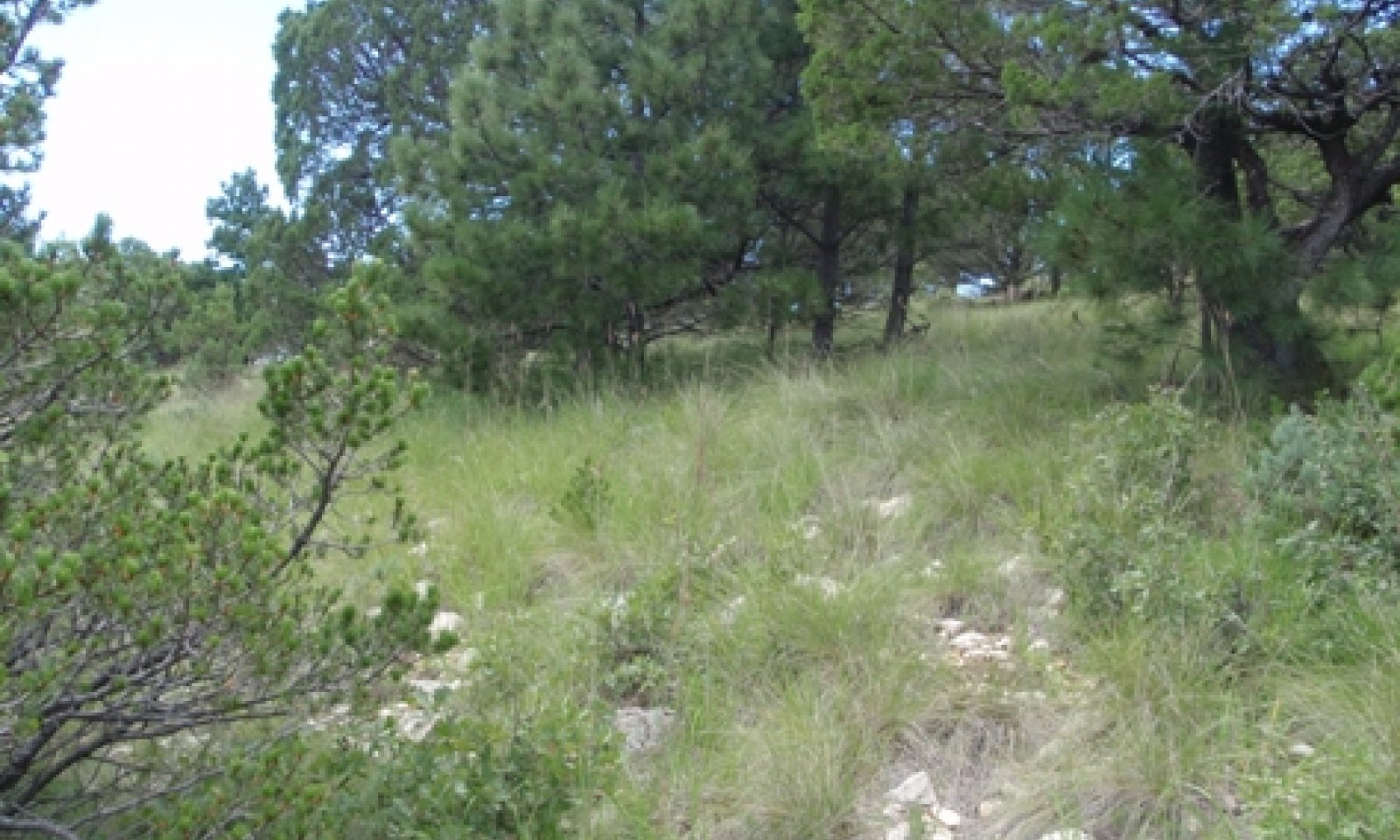
The reference plant community or potential for this site is considered to be a Ponderosa pine-pinyon pine-alligator juniper forest. Tree cover typically does not exceed 35 percent due limiting available soil moisture on south facing slopes. A mix of both warm and cool season grasses including big bluestem, yellow indiangrass, pine muhly, pinyon ricegrass, and bottlebrush squirrel tail comprise the herbaceous layer. Common shrubs include wavyleaf oak, mountain mahogany, cliff fendlerbush, and New Mexico agave. At the time of European settlement the site was most likely a heterogonous mix of plant communities that reflected the various stages of plant succession following natural disturbances. In addition to natural disturbances, forest composition is highly dependent on topographic position, elevation, and available soil moisture.
The natural disturbance that is the most influential driver of vegetation dynamics is fire. Historically, high frequency and low to mid severity fires shaped the plant communities (Ahlstrand 1980, Sakulich and Taylor 2007). In a fire scar study, Ahlstrand (1980) indentified a mean fire interval of 4.7 years for all fires occurring between 1554 and 1842. Most of these fires were sparked by lightening although some could have been started my Mescalero Apaches who inhabited the area in the 1800s. European settlement that introduced diseases and military campaigns brought an end to the Apache settlements. The reduction of fires slowly initiated during this time period. Other disturbances such as disease, falling of dead trees, and drought also influence the plant communities
A post-fire community phase would have a reduced tree and shrub canopy layer. Pinyon pine is very susceptible to fire damage depending on stand structure and understory and it is usually absent from a post-fire early successional stage (NPS 2005). Shade intolerant warm season grasses would dominate this phase.
At Guadalupe Mountains National Park, sheep and goat grazing began on this site in the 1920s about 40 years later that many similar areas in New Mexico. This coincides with the cessation of fire at the park (Sakulich and Taylor 2007). Overgrazing of livestock will reduce the fine fuels needed to carry fires and thereby increase the density of trees. A combination of fire suppression and fire will shift the dynamics of this forest ecosystem into an alternate state. Frequent low intensity burn will be limited if herbaceous layer and understory fuel is reduced. Vegetation composition and dynamics would be altered.
The following diagram suggests general pathways that the vegetation on this site might follow. There are other plant communities and states not shown on the diagram. This information is intended to show what might happen in a given set of circumstances; it does not mean that this would happen the same way in every instance. Local professional guidance should always be sought before pursuing a treatment scenario.
State and transition model
Custom diagramStandard diagram
More interactive model formats are also available. View Interactive Models
More interactive model formats are also available. View Interactive Models
Click on state and transition labels to scroll to the respective textEcosystem states
State 1 submodel, plant communities
State 2 submodel, plant communities
State 1
High Frequency Fire StateThe reference community is the Ponderosa Pine-Pinyon-Juniper/Oak/Bluestem-Muhly Community. It is characterized by a dominance of ponderosa pine. Associated trees include pinyon pine, alligator juniper, oneseed juniper, and Gambel’s oak. Big bluestem, little bluestem, yellow indiangrass, Muhlenbergia species, and needlegrasses are common warm and cool-season grasses. The south facing aspect prevents closed canopy forest from occurring.
The Ponderosa Pine-Juniper/Oak/Bluestem-Muhly Community is a post-fire community in an early to mid successional stage. Most tree and shrub cover is reduced. Wavyleaf oak will be a part of this community since in rapidly resprouts following fires. Shade intolerant warm-season grasses and will dominated the herbaceous layer with scattered forbs.
Community 1.1
Ponderosa Pine-Pinyon-Juniper/Oak/Bluestem-Muhly Community
Figure 4. 1.1 Pine-Pinyon-Juniper/Oak/Bluestem-Muhly (3)

Figure 5. 1.1 Pine-Pinyon-Juniper/Oak/Bluestem/Muh

Figure 6. 1.1 Pine-Pinyon-Juniper/Oak/Bluestem-Muhly (2)
This community is the potential or reference plant community. It is characterized by a dominance of ponderosa pine. Associated trees include pinyon pine, alligator juniper, oneseed juniper, and Gambel’s oak. Common shrubs include wavyleaf oak, mountain mahogany, cliff fendlerbush, banana yucca, and New Mexico agave. Big bluestem, little bluestem, yellow indiangrass, bull muhly, pine muhly, mountain muhly, pinyon ricegrass, squirreltail, and needlegrasses are common warm and cool season grasses. The south facing aspect prevents closed canopy forest from occurring. Abundant fuels are available to carry frequent lightning caused fires. Ecological processes are optimized in this phase.
Figure 7. Annual production by plant type (representative values) or group (midpoint values)
Table 5. Annual production by plant type
Plant type Low
(lb/acre)Representative value
(lb/acre)High
(lb/acre)Grass/Grasslike 2000 2500 3000 Shrub/Vine 400 600 800 Forb 50 100 150 Tree 0 0 0 Total 2450 3200 3950 Figure 8. Plant community growth curve (percent production by month). NM4327 , Pine-Pinyon-Juniper/Oak/Bluestem-Muhly. Characterized by a dominance of ponderosa pine. Associated trees include pinyon pine, alligator juniper, one-seed juniper, and Gambel’s oak. .
Jan Feb Mar Apr May Jun Jul Aug Sep Oct Nov Dec J F M A M J J A S O N D 1 1 1 3 3 10 15 25 25 10 5 1 Community 1.2
Ponderosa Pine-Juniper/Oak/Bluestem-Muhly CommunityThe Ponderosa Pine-Juniper/Oak/Bluestem-Muhly Community is a post-fire community in an early to mid successional stage. Most tree and shrub cover is reduced. Depending on fire severity, pinyon pine can be absent due to its fire sensitivity. Ponderosa pine can survive considerable scorching (FEIS 2010). Wavyleaf oak will be a part of this community since in rapidly resprouts following fires. Shade intolerant warm-season grasses and will dominated the herbaceous layer with scattered forbs.
Pathway 1.1A
Community 1.1 to 1.2Overstory reduced due to fire, disease, and drought conditions.
Pathway 1.2
Community 1.2 to 1.1No fire and tree establishment.
State 2
Low Frequency Fire StateThe Ponderosa Pine-Pinyon-Juniper/Oak/Threeawn Community is characterized by a low cover of grasses and increased woody shrubs and trees such as juniper and pinyon pine. Unpalatable grasses are common. Other grasses composition will fluctuate depending on grazing intensity.
The Ponderosa Pine-Juniper/Oak/Threeawn Community is a post-fire community in an early to mid successional stage. Most tree and shrub cover is reduced with the exception of wavyleaf oak which rapidly resprouts following fires. Depending on fire severity, pinyon pine can be absent due to its fire sensitivity.
Community 2.1
Ponderosa Pine-Pinyon-Juniper/Oak/Threeawn CommunityThis phase is characterized by a low cover of grasses and increased woody shrubs and trees such as juniper and pinyon pine. Unpalatable grasses are common. Other grasses composition will fluctuated depending on grazing intensity. Fuels needed to carry periodic fires have been reduced due to overgrazing. The relatively dry and warm south facing slopes will limit the canopy cover of trees. Prescribed grazing or nor grazing can help restore fire frequency.
Community 2.2
Ponderosa Pine-Juniper/Oak/Threeawn CommunityThis community phase is a post-fire community in an early to mid successional stage. Most tree and shrub cover is reduced with the exception of wavyleaf oak which rapidly resprouts following fires. Depending on fire severity, pinyon pine can be absent due to its fire sensitivity. Ponderosa pine can survive considerable scorching (FEIS 2010). Shade intolerant warm-season grasses and will dominated the herbaceous layer with scattered forbs. Composition of grasses will depend on grazing intensity.
Pathway 2.1A
Community 2.1 to 2.2When overstory is reduced due to intense fires, diseases, and drought conditions, the Ponderosa Pine-Pinyon-Juniper/Oak/Threeawn Community will shift to the Ponderosa Pine-Juniper/Oak/Threeawn Community.
Pathway 2.2A
Community 2.2 to 2.1With overgrazing and fire suppression, the Ponderosa Pine-Juniper/Oak/Threeawn Community will shift to the Ponderosa Pine-Pinyon-Juniper/Oak/Threeawn Community.
Transition T1A
State 1 to 2With overgrazing and fire suppression, the High Frequency Fires will shift to the Low Frequency Fires.
Restoration pathway R2A
State 2 to 1With no grazing, canopy thinning, and prescribed burning, the Low Frequency Fire State will be restored to the High Frequency Fire State.
Conservation practices
Prescribed Burning Additional community tables
Table 6. Community 1.1 plant community composition
Group Common name Symbol Scientific name Annual production () Foliar cover (%) Grass/Grasslike1 warm-season tallgrasses 1000–1500 big bluestem ANGE Andropogon gerardii 250–600 – bullgrass MUEM Muhlenbergia emersleyi 250–600 – little bluestem SCSC Schizachyrium scoparium 250–600 – Indiangrass SONU2 Sorghastrum nutans 250–600 – 2 warm-season midgrasses 600–900 pine muhly MUDU Muhlenbergia dubia 200–500 – longawn muhly MUSP4 Muhlenbergia spiciformis 200–500 – mountain muhly MUMO Muhlenbergia montana 50–150 – plains lovegrass ERIN Eragrostis intermedia 50–150 – cane bluestem BOBA3 Bothriochloa barbinodis 50–150 – sideoats grama BOCU Bouteloua curtipendula 25–75 – blue grama BOGR2 Bouteloua gracilis 25–75 – bulb panicgrass PABU Panicum bulbosum 25–75 – hairy grama BOHI2 Bouteloua hirsuta 10–50 – common wolfstail LYPH Lycurus phleoides 10–50 – Arizona threeawn ARAR6 Aristida arizonica 10–50 – 3 cool-season midgrasses 400–600 Arizona fescue FEAR2 Festuca arizonica 100–300 – New Mexico feathergrass HENE5 Hesperostipa neomexicana 50–100 – finestem needlegrass NATE3 Nassella tenuissima 50–100 – pinyon ricegrass PIFI Piptochaetium fimbriatum 50–100 – Pringle's speargrass PIPR2 Piptochaetium pringlei 25–75 – littleawn needlegrass ACLO7 Achnatherum lobatum 25–75 – nodding brome BRAN Bromus anomalus 25–75 – squirreltail ELEL5 Elymus elymoides 25–75 – prairie Junegrass KOMA Koeleria macrantha 25–75 – Tree4 Trees 0 alligator juniper JUDE2 Juniperus deppeana 0 5–15 ponderosa pine PIPOS Pinus ponderosa var. scopulorum 0 5–15 twoneedle pinyon PIED Pinus edulis 0 1–10 Gambel oak QUGA Quercus gambelii 0 1–5 oneseed juniper JUMO Juniperus monosperma 0 1–5 Shrub/Vine5 Shrubs 320–640 pungent oak QUPU Quercus pungens 200–500 – alderleaf mountain mahogany CEMO2 Cercocarpus montanus 100–200 – cliff fendlerbush FERU Fendlera rupicola 50–150 – desert ceanothus CEGR Ceanothus greggii 50–150 – eggleaf silktassel GAOV Garrya ovata 25–75 – 6 Fibrous/Succulents 80–160 Havard's century plant AGHA Agave havardiana 30–75 – tree cholla CYIMI Cylindropuntia imbricata var. imbricata 10–50 – Texas sacahuista NOTE Nolina texana 10–50 – pricklypear OPUNT Opuntia 10–50 – banana yucca YUBA Yucca baccata 10–50 – Forb7 Perennial forbs 50–140 Forb, perennial 2FP Forb, perennial 5–50 – white sagebrush ARLUM2 Artemisia ludoviciana ssp. mexicana 5–15 – buckwheat ERIOG Eriogonum 5–15 – Drummond's false pennyroyal HEDR Hedeoma drummondii 5–15 – slimleaf plainsmustard SCLI12 Schoenocrambe linearifolia 5–15 – 8 Annual forbs 0–10 Forb, annual 2FA Forb, annual 0–10 – Table 7. Community 1.2 plant community composition
Group Common name Symbol Scientific name Annual production () Foliar cover (%) Table 8. Community 2.1 plant community composition
Group Common name Symbol Scientific name Annual production () Foliar cover (%) Table 9. Community 2.2 plant community composition
Group Common name Symbol Scientific name Annual production () Foliar cover (%) Interpretations
Animal community
Slope gradients limit the use of this site for cattle. The site can potentially be suitable for a prescribed grazing system for sheep and goats but available water is a limiting factor. The site provides excellent habitat for wildlife.
Wildlife that utilized this site includes mule deer, elk, black bears, gray foxes, striped and hog-nosed skunks, porcupine, and mountain lions. Mountain short-horned lizards also utilized this site. In addition, mountaintop forests provide a unique habitat that attracts a variety of birds including the mountain chickadee, white-breasted nuthatch, dark-eyed junco, bushtit, acorn woodpecker, and the pine siskin. Chickadees and nuthatches are often seen in mixed species flocks flitting through the pines looking for seeds and insects. In the mid 1980’s, Montezuma quail were reintroduced in the Guadalupe Mountains after being eliminated in the mid 1900’s Western screech owl, great-horned owl, and flammulated owl can also be seen or heard in the forests (NPS 2010).
Plant Preference by Animal Kind:
These preferences are somewhat general in nature as the preferences for plants is dependent upon grazing experience, time of year, availability of choices, and total forage supply.
Legend: P=Preferred D=Desirable U=Undesirable N=Not Consumed T=Toxic X=Used, but not degree of utilization unknown
Preferred – Percentage of plant in animal diet is greater than it occurs on the land
Desirable – Percentage of plant in animal diet is similar to the percentage composition on the land
Undesirable – Percentage of plant in animal diet is less than it occurs on the land
Not Consumed – Plant would not be eaten under normal conditions. Only consumed when other forages not available.
Toxic – Rare occurrence in diet and, if consumed in any tangible amounts results in death or severe illness in animal
Hydrological functions
The site is located in both a surface water run-in and runoff position.
Recreational uses
The site is suited for hiking and camping.
Wood products
Not Available
Other products
Not Available
Other information
Not Available.
Supporting information
Inventory data references
Information presented here has been developed from NRCS clipping, composition, plant cover, soils data and ecological interpretations gained by field observation.
Other references
Alhstrand, G.M. 1981. High country fire history. P. 1-22 in G.M. Ecology of fire in the Guadalupe Mountains and adjacent Chihuahuan Desert. Carlsbad Caverns and Guadalupe Mountains National Parks, Carlsbad, NM.
National Park Service. 2005. Fire Management Plan: Guadalupe Mountains National Park, Pine Springs, TX.
National Park Service http://www.nps.gov/gumo/naturescience/animals.htm
Accessed September 2010.
Sakulich J. and A.H. Taylor .2007. Fire regimes and forest structure in a sky island mixed conifer forest, Guadalupe Mountains National Park, Texas, USA.
USDA-USFS- Fire Effects Information System. http://www.fs.fed.us/database/feis/
Accessed September 2010.
Personnel assisiting in the development of the site:
Mark Moseley, Rangeland Management Specialist, NRCS, Boerne, TX
Alan Stahnke, Soil Scientist, NRCS, Temple, TX
Justin Clary, Rangeland Management Specialist, NRCS, Temple, TX
Donnie Lunsford, Rangeland Management Specialist, NRCS, Sonora, TX
Alex Pehl, Soil Conservationist, NRCS Big Lake, TX
Scott Bryan, Rangeland Management Specialist, Midland, TX
Contributors
Michael Margo
Michael Margo, RMS, NRCS, Marfa, TexasRangeland health reference sheet
Interpreting Indicators of Rangeland Health is a qualitative assessment protocol used to determine ecosystem condition based on benchmark characteristics described in the Reference Sheet. A suite of 17 (or more) indicators are typically considered in an assessment. The ecological site(s) representative of an assessment location must be known prior to applying the protocol and must be verified based on soils and climate. Current plant community cannot be used to identify the ecological site.
Author(s)/participant(s) Contact for lead author Date Approved by Approval date Composition (Indicators 10 and 12) based on Annual Production Indicators
-
Number and extent of rills:
-
Presence of water flow patterns:
-
Number and height of erosional pedestals or terracettes:
-
Bare ground from Ecological Site Description or other studies (rock, litter, lichen, moss, plant canopy are not bare ground):
-
Number of gullies and erosion associated with gullies:
-
Extent of wind scoured, blowouts and/or depositional areas:
-
Amount of litter movement (describe size and distance expected to travel):
-
Soil surface (top few mm) resistance to erosion (stability values are averages - most sites will show a range of values):
-
Soil surface structure and SOM content (include type of structure and A-horizon color and thickness):
-
Effect of community phase composition (relative proportion of different functional groups) and spatial distribution on infiltration and runoff:
-
Presence and thickness of compaction layer (usually none; describe soil profile features which may be mistaken for compaction on this site):
-
Functional/Structural Groups (list in order of descending dominance by above-ground annual-production or live foliar cover using symbols: >>, >, = to indicate much greater than, greater than, and equal to):
Dominant:
Sub-dominant:
Other:
Additional:
-
Amount of plant mortality and decadence (include which functional groups are expected to show mortality or decadence):
-
Average percent litter cover (%) and depth ( in):
-
Expected annual annual-production (this is TOTAL above-ground annual-production, not just forage annual-production):
-
Potential invasive (including noxious) species (native and non-native). List species which BOTH characterize degraded states and have the potential to become a dominant or co-dominant species on the ecological site if their future establishment and growth is not actively controlled by management interventions. Species that become dominant for only one to several years (e.g., short-term response to drought or wildfire) are not invasive plants. Note that unlike other indicators, we are describing what is NOT expected in the reference state for the ecological site:
-
Perennial plant reproductive capability:
Print Options
Sections
Font
AAAAOther
PrintThe Ecosystem Dynamics Interpretive Tool is an information system framework developed by the USDA-ARS Jornada Experimental Range, USDA Natural Resources Conservation Service, and New Mexico State University.
Accessibility statement


