
Natural Resources
Conservation Service
-
Search


Major Land Resource Area or ecological site by name and/or ID.
PreviousSectionsNextGeneral information
Provisional. A provisional ecological site description has undergone quality control and quality assurance review. It contains a working state and transition model and enough information to identify the ecological site.
Click to explore map
Figure 1. Mapped extent
Areas shown in blue indicate the maximum mapped extent of this ecological site. Other ecological sites likely occur within the highlighted areas. It is also possible for this ecological site to occur outside of highlighted areas if detailed soil survey has not been completed or recently updated.
Associated sites
R042BB012NM Sandy, Desert Shrub
This site often integrades with Sandy Sites.
R042BB024NM Gravelly Sand, Desert Shrub
This site often integrades with Gravelly Sand sites.
Table 1. Dominant plant species
Tree Not specified
Shrub Not specified
Herbaceous Not specified
Physiographic features
This site occurs on level to gently sloping old eolian and alluvial deposits. Slopes range from 1 to 9 percent and average abut 3 percent. Elevations range from about 3,800 to 5,000 feet.
Table 2. Representative physiographic features
Landforms (1) Basin floor
(2) Sand sheet
(3) Fan remnant
Flooding duration Extremely brief (0.1 to 4 hours) to brief (2 to 7 days) Flooding frequency Very rare to rare Ponding frequency None Elevation 3800 – 5000 ft Slope 1 – 9 % Aspect Aspect is not a significant factor Climatic features
Annual average precipitation ranges from 7.35 to 11.90 inches. Wide fluctuations from year to year are common, ranging from a low of about 2 inches to a high of over 20 inches. At least one-half of the annual precipitation comes in the form of rainfall during July, August, and September. Precipitation in the form of snow or sleet averages less than 4 inches annually. The average annual air temperature is about 60 degree F. Summer maximums can exceed 100 degrees F. and winter minimums can go below zero. The average frost-free season exceeds 200 days and extends from April 1 to November 1. Both the temperature regime and rainfall distribution favor warm-season perennial plants on this site. Spring moisture conditions are only occasionally adequate to cause significant growth during this period of year. High winds from the west and southwest are common from March to June, which further tends to create poor soil moisture conditions in the springtime.
Climate data was obtained from
http://www.wrcc.dri.edu/summary/climsmnm.html
web siteTable 3 Representative climatic features
Frost-free period (average) 210 days Freeze-free period (average) 230 days Precipitation total (average) 10 in BarLineFigure 2. Monthly precipitation range
BarLineFigure 3. Monthly average minimum and maximum temperature
">Influencing water features
This site is not influenced by water from wetland or stream.
Soil features
The soils are moderately deep to deep. The surface layer is typically a sand or loamy sand overlying fine sandy loams, loamy sands to sands. They may have accumulations of calcium carbonate below 20 inches. The soils are frequently calcareous throughout. They are well drained and moderately rapid to rapidly permeable with moderate water-holding capacity. Because of the sandy surface and inability to hold a large amount of water, if unprotected, wind blowing becomes severe.
Table 4. Representative soil features
Surface texture (1) Loamy fine sand
(2) Loamy sand
(3) Sand
Family particle size (1) Sandy
Drainage class Well drained to excessively drained Permeability class Moderately slow to rapid Soil depth 24 – 60 in Surface fragment cover <=3" 0 – 5 % Surface fragment cover >3" Not specified Available water capacity
(0-40in)2 – 5 in Electrical conductivity
(0-40in)0 – 8 mmhos/cm Soil reaction (1:1 water)
(0-40in)7.4 – 8.4 Subsurface fragment volume <=3"
(Depth not specified)0 – 5 % Subsurface fragment volume >3"
(Depth not specified)Not specified Ecological dynamics
Overview:
This site often intergrades with either the Sandy or Gravelly sand sites. Deep sand sites located
on hills, known as Sandhills sites in Texas, are present in SD-2 and are included here. The soil
profiles of dunes in the mesquite-dominated state in the Sandy site are similar to those of Deep
sand sites, and this state and site have been equated. It is unknown, however, if mesquite coppice
dunes sites could support Deep sand plant communities. They may not, due perhaps to
differences in landscape position or the size of the deep sand soil patches, which are relatively
small in Sandy sites. Until it is demonstrated that Sandy-derived coppice dunes can be
rehabilitated as Deep sand sites (which has not yet been attempted so far as the author is aware)
it is best to treat these as separate classifications. The historic plant community type of the Deep
sand site is dominated by dropseeds (Sporobolus flexuosus, S. contractus, S. cryptandrus),
especially the giant dropseed (S. giganteus). Black grama (Bouteloua eriopoda) and bush muhly
(Muhlenbergia porteri) are also important grasses. Under heavy grazing pressure, the more
palatable black grama and bush muhly decline, and eventually dropseeds decline. Shrubs that are
common in the site, including sand sage (Artemisia filifolia) and broom dalea (Psorothamnus
scoparius), increase in representation and cover with grazing or perhaps due to climate change.
Honey mesquite (Prosopis glandulosa) may invade or increase. Shrub control and grazing
management results in varying degrees of restoration or grass cover in some cases. In other
cases, grass cover is highly reduced and broom dalea and/or sand sage persist as dominants or
mesquite dunes may persist. It is not known what soil or climatic changes underlie these
persistent vegetation changes.
No systematic studies of communities, states or transitions have been performed in Deep sand
sites in SD-2. Because of the unique plant communities and soils of these sites, studies of soil
variation among sites exhibiting different states would provide a useful contribution.State and transition model
Custom diagramStandard diagram
More interactive model formats are also available. View Interactive Models
More interactive model formats are also available. View Interactive Models
Click on state and transition labels to scroll to the respective textEcosystem states
State 1 submodel, plant communities
State 2 submodel, plant communities
State 3 submodel, plant communities
State 1
Historic Climax Plant CommunityCommunity 1.1
Historic Climax Plant Community
Figure 4. MLRA 42; SD-2; Deep sand
State Containing Historic Climax Plant Community:
Dropseed-dominated grassland: The historic community of this site is dominated by dropseeds
(dropseed/other grasses community) and features a significant cover of black grama and bush
muhly. Sand sage, broom dalea, yucca (Yucca elata), fourwing saltbush (Atriplex canescens) are
also common components. Dropseed abundance may fluctuate considerably with drought-wet
cycles. Grazing-induced retrogression leads initially to a loss of black grama and bush muhly
(dropseed/shrubs community) and eventually to a reduction in dropseeds (Shrubs/dropseed
community). Honey mesquite may encroach or invade under some circumstances, although there
are deep sand communities where this invasion seems to be limited. It is not known if the
nutrient redistribution processes and loss of inter-shrub soil fertility observed in Sandy sites (see
the Sandy model) is important in this site. It is believed that in the absence of grazing, invasion
and growth of saltbush (a highly palatable shrub) may eventually lead to mesquite mortality
(saltbush/shrubs community) and a return to dropseed dominance (if not a restoration of the
dropseed community). There are no data to suggest a mechanism for this pattern, nor are there
any rigorous documentations of the pattern. There are, however, areas on deep sand soils within
the city of Las Cruces, NM, that are ungrazed and are now dominated by saltbush and large
mesquite plants. Such locations may be the result of protection from grazing and saltbush
proliferation. If the saltbush-succession process does occur, then mesquite-invaded communities
can be considered to occur within the dropseed dominated state.
Diagnosis: Dropseed cover is dominant or substantial, black grama and bush muhly usually
present and may dominate in some cases.
Transition to broom dalea-sand sage state (1a): The causes of the transition from to the broom
dalea/sand sage state are unknown. Given the wide amplitude of conditions across which
dropseed communities are believed to be recoverable, it seems possible that shrubs may exert a
strong competitive influence over the system once they establish in high densities. Changes in
the seasonality of precipitation may be important.
Key indicators of approach to transition: Decreases in dropseeds may be a necessary prerequisite
for this transition but it is not sufficient to indicate it.
Transition to mesquite dune state (2a): The causes of the transition to domination by mesquite
are unknown. Heavy grazing or destruction of plants by trampling or vehicles with consequent
erosion from around mesquite and loss of soil fertility in shrub interspaces is one possible
mechanism. Autogenic (mesquite-caused) degradation of soils may also play a role.
Key indicators of approach to transition Decreases in dropseeds and other shrubs may be a
necessary prerequisite for this transition but it is not sufficient to indicate it. Changes in the
seasonality of precipitation may be important.
Figure 5. Annual production by plant type (representative values) or group (midpoint values)
Table 5. Annual production by plant type
Plant type Low
(lb/acre)Representative value
(lb/acre)High
(lb/acre)Grass/Grasslike 122 272 420 Shrub/Vine 32 70 108 Forb 21 46 72 Total 175 388 600 Table 6. Soil surface cover
Tree basal cover 0% Shrub/vine/liana basal cover 0% Grass/grasslike basal cover 20% Forb basal cover 0% Non-vascular plants 0% Biological crusts 0% Litter 10% Surface fragments >0.25" and <=3" 0% Surface fragments >3" 0% Bedrock 0% Water 0% Bare ground 80% Figure 6. Plant community growth curve (percent production by month). NM2503 , R042XB011NM-Deep Sand Warm Season Plant HCPC. SD-2 Deep Sand HCPC Warm Season Plant Community.
Jan Feb Mar Apr May Jun Jul Aug Sep Oct Nov Dec J F M A M J J A S O N D 0 0 0 5 10 10 25 30 15 5 0 0 State 2
Broom dalea-Sandsage StateCommunity 2.1
Broom dalea-Sandsage StateAdditional States:
Broom-dalea-sand sage: Dropseed abundance is normally variable across years as these grasses
are drought sensitive, but if seeds are depleted, or due to the persistent effects of soil degradation
or to the effects of herbivory by small animals (see Sandy model), the average abundance of
dropseeds at a site has declined. This may be coincident with abundant cover of broom dalea and
sand sage, as well as other shrubs including mesquite and little-leaf sumac (Rhus microphylla).
In some areas, broom dalea and other shrubs are extremely dominant and this appears to be
persistent. For example, these communities have been observed on the Fort Bliss, which has
been ungrazed for over 50 years. The causes of broom dalea or sand sage dominance are not
understood. A persistent broom dalea state may be associated with a petrocalcic horizon
underlying the soil at a depth of 100-150 cm (David Trujillo, NRCS, personal communication).
Diagnosis: Dropseed cover is sparse and patchy to absent. Bare ground cover may be low due to
the high cover of shrubs.
Transition to dropseed-dominated state (1b): Seeding and/or shrub removal with herbicides.
In many cases, dropseed cover recovers only partially and temporarily, and shrubs may recover.
Transition to mesquite dune state (3a): Causes are unknown. Mesquite invasion of the broom
dalea-sand sage state is possible.State 3
Mesquite dune StateCommunity 3.1
Mesquite dune State
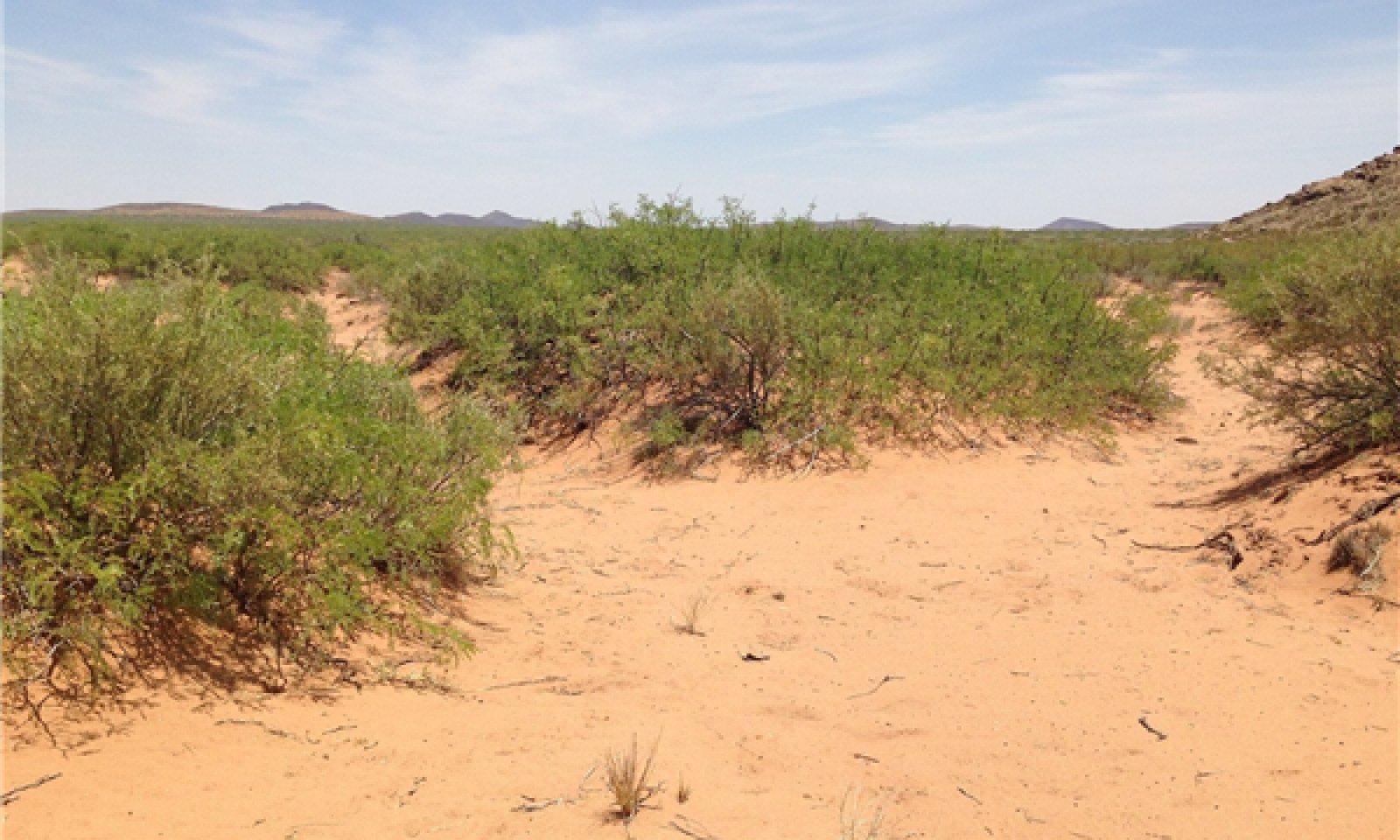
Figure 7. mesquite dune state
Mesquite dune: In many areas, only a few species of shrubs may dominate, shrub and grass
cover is sparse, and mesquite may form coppice dunes. Where gravel content is high (e.g., >5%),
creosotebush (Larrea tridentata) may also be present. In some cases, mesquite may be extremely
dominant and few other shrubs are present. On sandhills, little-leaf sumac may attain extreme
dominance instead of mesquite. Dynamics within this state may occur and be attributable to
climate or grazing-associated disturbances (e.g. trampling of shrubs) or to off-road vehicle activity. In general, wind and water erosion rates appear to be high in this state due to the low
plant cover, and this likely maintains very low soil fertility. The conditions under which
mesquite attains dominance are not understood.
Diagnosis: Dropseed cover sparse to absent. Bare ground patches are large, forming blowouts
and “streets” (i.e. elongated patches in the direction of prevailing winds). Evidence of interdune
erosion (pedestalling, blowouts) are present.
Transition to dropseed-dominated state (2b): Possibly with seeding and/or shrub removal with
herbicides. Soil stabilization and fertility amendments would probably be needed; this has not
been attempted.
Transition to broom dalea-sand sage state (3b): Strategy unknown.
Information sources and theoretical background: Communities, states, and transitions are based
upon information in the ecological site description and observations by Jim Powell, NRCS
(retiredAdditional community tables
Table 7. Community 1.1 plant community composition
Group Common name Symbol Scientific name Annual production () Foliar cover (%) Grass/Grasslike1 Warm Season 78–97 spike dropseed SPCO4 Sporobolus contractus 78–97 – sand dropseed SPCR Sporobolus cryptandrus 78–97 – mesa dropseed SPFL2 Sporobolus flexuosus 78–97 – 2 Warm Season 116–136 giant dropseed SPGI Sporobolus giganteus 116–136 – 3 Warm Season 19–39 black grama BOER4 Bouteloua eriopoda 19–39 – 4 Warm Season 4–19 bush muhly MUPO2 Muhlenbergia porteri 4–19 – 5 Warm Season 4–19 plains bristlegrass SEVU2 Setaria vulpiseta 4–19 – 6 Warm Season 4–12 threeawn ARIST Aristida 4–12 – low woollygrass DAPU7 Dasyochloa pulchella 4–12 – 7 Warm Season 4–12 Graminoid (grass or grass-like) 2GRAM Graminoid (grass or grass-like) 4–12 – Shrub/Vine8 Shrub 19–39 sand sagebrush ARFI2 Artemisia filifolia 19–39 – broom dalea PSSC6 Psorothamnus scoparius 19–39 – yucca YUCCA Yucca 19–39 – 9 Shrub 4–19 fourwing saltbush ATCA2 Atriplex canescens 4–19 – littleleaf sumac RHMI3 Rhus microphylla 4–19 – 10 Shrub 4–19 broom snakeweed GUSA2 Gutierrezia sarothrae 4–19 – 11 Shrub 4–19 mormon tea EPVI Ephedra viridis 4–19 – plains pricklypear OPPO Opuntia polyacantha 4–19 – Forb12 Forb 4–12 dwarf desertpeony ACNA2 Acourtia nana 4–12 – woolly plantain PLPA2 Plantago patagonica 4–12 – 13 Forb 4–12 herb sophia DESO2 Descurainia sophia 4–12 – touristplant DIWI2 Dimorphocarpa wislizeni 4–12 – redstem stork's bill ERCI6 Erodium cicutarium 4–12 – buckwheat ERIOG Eriogonum 4–12 – spurge EUPHO Euphorbia 4–12 – bladderpod LESQU Lesquerella 4–12 – 14 Forb 12–19 Indian blanket GAPU Gaillardia pulchella 12–19 – woolly paperflower PSTA Psilostrophe tagetina 12–19 – globemallow SPHAE Sphaeralcea 12–19 – 15 Annual Forbs 4–19 Forb, annual 2FA Forb, annual 4–19 – 16 Perennial Forbs 4–19 Forb, perennial 2FP Forb, perennial 4–19 – Table 8. Community 2.1 plant community composition
Group Common name Symbol Scientific name Annual production () Foliar cover (%) Table 9. Community 3.1 plant community composition
Group Common name Symbol Scientific name Annual production () Foliar cover (%) Interpretations
Animal community
This site provides habitat which supports a resident animal community that is characterized by pronghorn antelope, badger, kit fox, spotted ground squirrel, desert pocket mouse, Ord kangaroo rat, southern plains woodrat, scaled quail, pyrrhuloxia, roadrunner, burrowing owl, desert horned
lizard, and Couch’s spadefoot toad.
Where large mesquite and yucca ar4e present on this site, white necked raven and mourning dove nest. When site deterioration produces a dune-interdune aspect with mesquite invasion,
animal population densities shift in favor of burrowing mammals, their predators and hrubdependent birds.
Hydrological functions
The runoff curve numbers are determined by field investigations using hydraulic cover
conditions and hydrologic soil groups.
Hydrologic Interpretations
Soil Series-----------Hydrologic Group
Bluepoint-------------A
Pintura---------------A
Yturbide--------------A
Recreational uses
Suitability for camping and picnicking is fair, and hunting is fair for pronghorn antelope, quail, dove, small game, and waterfowl where seasonal open water occurs. Photography and bird watching for numerous birds, raptors and others can be fair to good, especially during migration seasons. Most small animals of the site are nocturnal and secretive, seen only at night, early morning or evening. Scenic beauty is greatest during spring and sometimes summer months when flowering of forbs, shrubs, and cacti occurs.
Wood products
The site has no significant value for wood products.
Other products
This site at its potential is suitable for grazing in all seasons of the year. Green forage in the form of forbs and a few early season grasses are occasionally produced in significant amounts in the spring. The dominant production comes in the summer. The site is suitable for use by all classes of livestock. Site deterioration caused by inadequate grazing management is characterized by a decrease or disappearance of black grama and bush muhly, an increase in sand sagebrush and broom delea, mesquite invasion, and eventual dunning or hummocking. The dropseeds may also decrease, coming and going with good and bad years but unable to hold a consistent footing even in normal years. Site recovery can be reasonably rapid following mesquite control coupled with good grazing management. Given adequate opportunity, secondary succession will take place, usually by fourwing saltbush replacing the mesquite, and after several years a gradual re-establishment of the dropseeds and other plants more typical of the natural potential for the site.
Other information
Guide to Suggested Initial Stocking Rate Acres per Animal Unit Month
Similarity Index----------Ac/AUM
100 - 76------------------5.0 – 5.9
75 – 51-------------------5.6 – 7.1
50 – 26-------------------6.8 – 16.0
25 – 0--------------------16.0 - +
Supporting information
Other references
Other References:
Data collection for this site was done in conjunction with the progressive soil surveys within the Southern Desertic Basins, Plains and Mountains, Major Land Resource Areas of New Mexico. This site has been mapped and correlated with soils in the following soil surveys. Sierra County Dona Ana County Grant County Hidalgo County Luna County Otero County
Characteristic Soils Are:
Bluepoint loamy fine sand
Pintura loamy fine sand
Yturbide loamy sand
Other Soils included are:
Wink loamy fine sand, more than 5”surface
Hucco loamy fine sand, more than 5”surface
Yturbide gravelly sand
Contributors
Don Sylvester
Dr. Brandon BestelmeyerRangeland health reference sheet
Interpreting Indicators of Rangeland Health is a qualitative assessment protocol used to determine ecosystem condition based on benchmark characteristics described in the Reference Sheet. A suite of 17 (or more) indicators are typically considered in an assessment. The ecological site(s) representative of an assessment location must be known prior to applying the protocol and must be verified based on soils and climate. Current plant community cannot be used to identify the ecological site.
Author(s)/participant(s) Contact for lead author Date Approved by Approval date Composition (Indicators 10 and 12) based on Annual Production Indicators
-
Number and extent of rills:
-
Presence of water flow patterns:
-
Number and height of erosional pedestals or terracettes:
-
Bare ground from Ecological Site Description or other studies (rock, litter, lichen, moss, plant canopy are not bare ground):
-
Number of gullies and erosion associated with gullies:
-
Extent of wind scoured, blowouts and/or depositional areas:
-
Amount of litter movement (describe size and distance expected to travel):
-
Soil surface (top few mm) resistance to erosion (stability values are averages - most sites will show a range of values):
-
Soil surface structure and SOM content (include type of structure and A-horizon color and thickness):
-
Effect of community phase composition (relative proportion of different functional groups) and spatial distribution on infiltration and runoff:
-
Presence and thickness of compaction layer (usually none; describe soil profile features which may be mistaken for compaction on this site):
-
Functional/Structural Groups (list in order of descending dominance by above-ground annual-production or live foliar cover using symbols: >>, >, = to indicate much greater than, greater than, and equal to):
Dominant:
Sub-dominant:
Other:
Additional:
-
Amount of plant mortality and decadence (include which functional groups are expected to show mortality or decadence):
-
Average percent litter cover (%) and depth ( in):
-
Expected annual annual-production (this is TOTAL above-ground annual-production, not just forage annual-production):
-
Potential invasive (including noxious) species (native and non-native). List species which BOTH characterize degraded states and have the potential to become a dominant or co-dominant species on the ecological site if their future establishment and growth is not actively controlled by management interventions. Species that become dominant for only one to several years (e.g., short-term response to drought or wildfire) are not invasive plants. Note that unlike other indicators, we are describing what is NOT expected in the reference state for the ecological site:
-
Perennial plant reproductive capability:
Print Options
Sections
Font
AAAAOther
PrintThe Ecosystem Dynamics Interpretive Tool is an information system framework developed by the USDA-ARS Jornada Experimental Range, USDA Natural Resources Conservation Service, and New Mexico State University.
Accessibility statement


