
Natural Resources
Conservation Service
Ecological site R041XA115AZ
Loamy Swale
16-20" p.z.
Last updated: 4/09/2021
Accessed: 09/30/2026
-
Search


Major Land Resource Area or ecological site by name and/or ID.
PreviousSectionsNextGeneral information
Provisional. A provisional ecological site description has undergone quality control and quality assurance review. It contains a working state and transition model and enough information to identify the ecological site.
Click to explore map
Figure 1. Mapped extent
Areas shown in blue indicate the maximum mapped extent of this ecological site. Other ecological sites likely occur within the highlighted areas. It is also possible for this ecological site to occur outside of highlighted areas if detailed soil survey has not been completed or recently updated.
MLRA notes
Major Land Resource Area (MLRA): 041X–Madrean Archipelago
AZ 41.1 – Mexican Oak-Pine Forest and Oak Savannah
Elevations range from 4500 to 10,700 feet and precipitation ranges from 16 to 30 inches. Vegetation includes Emory oak, Mexican blue oak, Arizona white oak, one-seed juniper, alligator juniper, sacahuista, California bricklebush, skunkbush sumac, Arizona rosewood, wait-a-bit mimosa, sideoats grama, blue grama, purple grama, wooly bunchgrass, plains lovegrass, squirreltail, and pinyon ricegrass. The soil temperature regime ranges from thermic to mesic and the soil moisture regime ranges from aridic ustic to typic ustic. This unit occurs within the Basin and Range Physiographic Province and is characterized by numerous mountain ranges that rise abruptly from broad, plain-like valleys and basins. Igneous and metamorphic rock classes dominate the mountain ranges and sediments filling the basins represent combinations of fluvial, lacustrine, colluvial and alluvial deposits.Associated sites
R041XA108AZ Loamy Upland 16-20" p.z.
R041XA114AZ Loamy Bottom 16-20" p.z.
R041XA104AZ Limy Slopes 16-20" p.z.
R041XA107AZ Loamy Slopes 16-20" p.z.
Similar sites
R041XA114AZ Loamy Bottom 16-20" p.z.
R041XC311AZ Loamy Swale 12-16" p.z.
Table 1. Dominant plant species
Tree Not specified
Shrub Not specified
Herbaceous (1) bouteloua gracilis
(2) bouteloua curtipendulaPhysiographic features
This site occurs in the middle elevations of the Madrean Basin and Range province in southeastern Arizona. It occurs in headwater areas; on floodplains of minor tributaries and in swales. It benefits on a regular basis from extra moisture received as runoff from adjacent upland sites. It does not benefit from any kind of water table.
Table 2. Representative physiographic features
Landforms (1) Flood plain
(2) Alluvial fan
(3) Swale
Flooding duration Extremely brief (0.1 to 4 hours) to very brief (4 to 48 hours) Flooding frequency Occasional to frequent Ponding duration Very brief (4 to 48 hours) Ponding frequency None to rare Elevation 4700 – 5500 ft Slope 0 – 3 % Aspect Aspect is not a significant factor Climatic features
Precipitation in this zone of the common resource area ranges from 16-20 inches per year with elevations from 4700-5500 feet. Approximately 40% of this moisture comes as gentle rain or snow during the winter-spring (Oct-Apr) season; originates in the north Pacific and Gulf of California and comes as frontal storms with long duration and low intensity. The remaining 60% falls in the summer season (May-Sep); originates in the Gulf of Mexico and are convective, usually brief, intense thunderstorms. Snow is common Dec-Mar, averaging 5-15 inches per year, but rarely lasts more than a week. May and June are the driest months. Humidity is low.
Temperatures are mild. Freezing temperatures are common at night from Oct-May, but daytime temperatures are almost always over 40 F. Below 0 F temperatures can occur Dec-Feb. Daytime summer highs rarely exceed 95 F.
Species like plains lovegrass, bottlebrush squirreltail, false mesquite, shrubby buckwheat and ratany begin growth in late March to April. Warm season grasses begin growth in July or August with receipt of the first summer rains.Table 3 Representative climatic features
Frost-free period (average) 200 days Freeze-free period (average) Precipitation total (average) 20 in BarLineFigure 2. Monthly precipitation range
BarLineFigure 3. Monthly average minimum and maximum temperature
">Influencing water features
There are no water features associated with this site.
Soil features
These are young soils on loamy to clayey alluvium of mixed origin. They are deep and dark colored. They do not have vertic properties. Plant-soil moisture relationships are excellent.
Soils mapped on this site include: SSA-666 Cochise county Northwestern part MU 54 Lanque; SSA-671 Cochise county Douglas-Tombstone part MU 4 Stanford & 96 Stanford.Table 4. Representative soil features
Surface texture (1) Sandy loam
(2) Loam
(3) Clay loam
Family particle size (1) Loamy
Drainage class Well drained Permeability class Moderate to moderately slow Soil depth 60 in Surface fragment cover <=3" 0 – 5 % Surface fragment cover >3" 0 – 1 % Available water capacity
(0-40in)9.2 – 12.6 in Calcium carbonate equivalent
(0-40in)0 – 20 % Electrical conductivity
(0-40in)0 – 2 mmhos/cm Sodium adsorption ratio
(0-40in)0 – 2 Soil reaction (1:1 water)
(0-40in)7.4 – 8.4 Subsurface fragment volume <=3"
(Depth not specified)0 – 5 % Subsurface fragment volume >3"
(Depth not specified)0 – 1 % Ecological dynamics
The plant communities found on an ecological site are naturally variable. Composition and production will vary with yearly conditions, location, aspect, and the natural variability of the soils. The Historical Climax Plant Community represents the natural potential plant communities found on relict or relatively undisturbed sites. Other plant communities described here represent plant communities that are known to occur when the site is disturbed by factors such as fire, grazing, or drought.
Production data provided in this site description is standardized to air dry weight at the end of the summer growing season. The plant communities described in this site description are based on near normal rainfall years.
NRCS uses a Similarity Index to compare existing plant communities to the plant communities described here. Similarity index is determined by comparing the production and composition of a plant community to the production and composition of a plant community described in this site description. To determine Similarity index, compare the production (air dry weight) of each species to that shown in the plant community description. For each species, count no more than the maximum amount shown for the species, and for each group, count no more than the maximum amount shown for each group. Divide the resulting total by the total normal year production shown in the plant community description. If the rainfall has been significantly above or below normal, use the total production shown for above or below normal years. If field data is not collected at the end of the summer growing season, then the field data must be corrected to the end of the year production before comparing it to the site description. The growth curve can be used as a guide for estimating production at the end of the summer growing season.
The site is dominated by warm season perennial grasses. Occasional clumps of trees and shrubs occur in the plant community. Fire was very important in the development of this plant community. The site is very susceptible to gully erosion. Base level changes in large watersheds can lead to erosion of these minor tributaries over time. Woody species like mesquite and juniper can invade and increase to dominate the site in the absence of fire for long periods. Johnson grass and bermuda grass are exotic species that occur on many areas of the site and may become dominant.State and transition model
Custom diagramStandard diagram
Figure 4. State and Transition, Loamy Swale 16-20" pz.
More interactive model formats are also available. View Interactive Models
More interactive model formats are also available. View Interactive Models
Click on state and transition labels to scroll to the respective textEcosystem states
State 1 submodel, plant communities
State 2 submodel, plant communities
State 3 submodel, plant communities
State 4 submodel, plant communities
State 5 submodel, plant communities
State 1
Historical Climax Plant CommunityCommunity 1.1
Historical Climax Plant Community
Figure 5. Loamy Swale 16-20" pz., HCPC

Figure 6. Loamy Swale 16-20" pz., HCPC
The historical native state includes the native plant communities that occur on the site, including the historic climax plant community. This state includes other plant communities that naturally occupy the site following fire, drought, flooding, herbivores, and other natural disturbances. The historic climax plant community represents the natural climax community that eventually reoccupies the site with proper management.
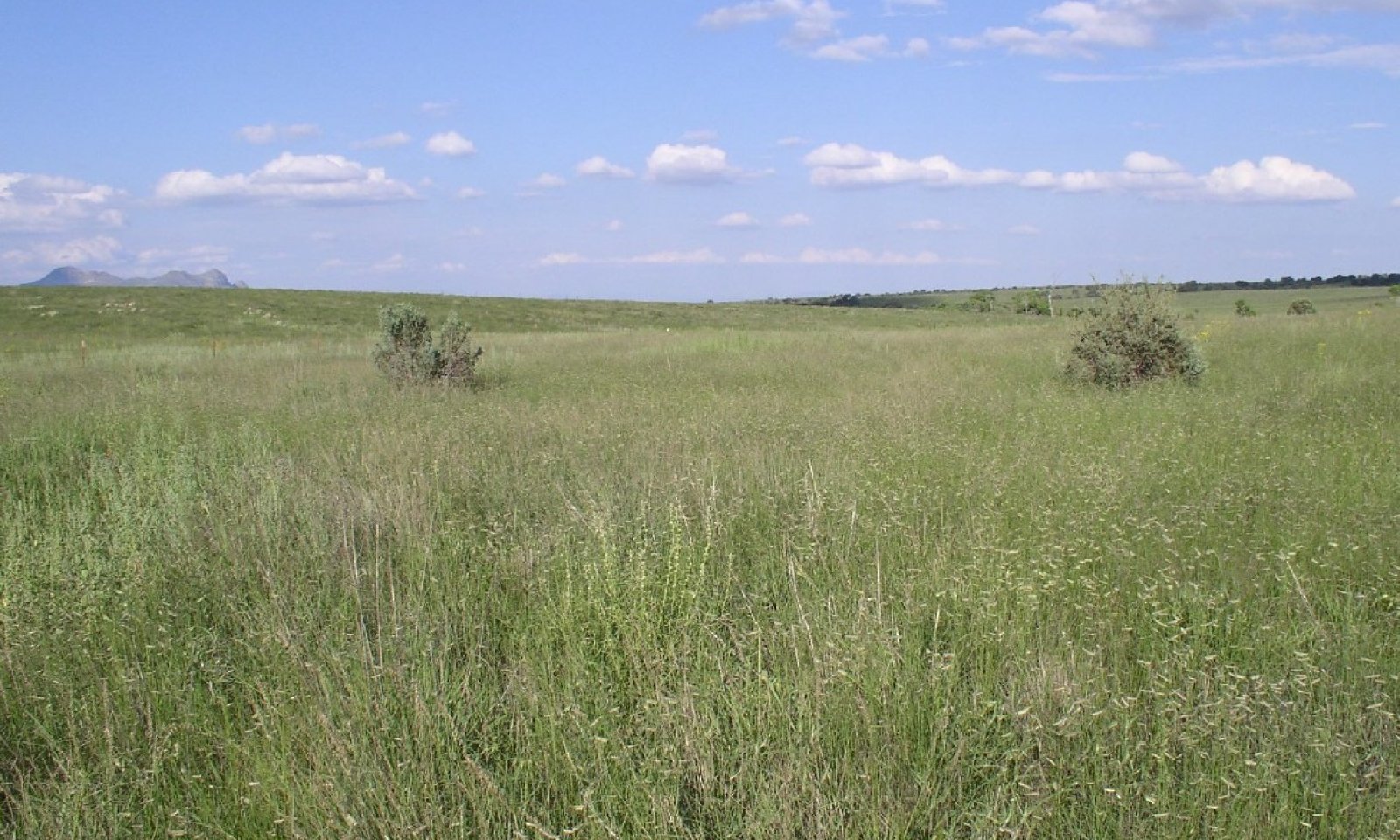
The potential plant community is dominated by warm season perennial grasses. Occasional trees and shrubs occur in the plant community. The major perennial grasses like blue grama, sideoats grama, tobosa, creeping muhly and vine mesquite, occur in large patches throughout the plant community. Giant sacaton can occur at about 10% cover in the plant community. Annual forbs and grasses can produce heavy stands in wet seasons following drought and/or fire. With continuous grazing, tall and mid grasses are replaced by short grasses like blue grama and creeping muhly. With grazing management the mid to tall species can resume dominance in the plant community. The aspect is grassland.Figure 7. Annual production by plant type (representative values) or group (midpoint values)
Table 5. Annual production by plant type
Plant type Low
(lb/acre)Representative value
(lb/acre)High
(lb/acre)Grass/Grasslike 1040 2000 3100 Forb 15 50 150 Tree 0 5 50 Shrub/Vine 1 5 20 Total 1056 2060 3320 Table 6. Soil surface cover
Tree basal cover 0-0% Shrub/vine/liana basal cover 0-0% Grass/grasslike basal cover 10-30% Forb basal cover 0-0% Non-vascular plants 0-0% Biological crusts 0-10% Litter 30-70% Surface fragments >0.25" and <=3" 0-10% Surface fragments >3" 0-0% Bedrock 0% Water 0% Bare ground 10-20% Table 7. Canopy structure (% cover)
Height Above Ground (ft) Tree Shrub/Vine Grass/
GrasslikeForb <0.5 – – 1-10% 0-2% >0.5 <= 1 – 0-1% 10-20% 1-5% >1 <= 2 – 0-5% 20-40% 1-10% >2 <= 4.5 – 0-1% 10-20% 0-10% >4.5 <= 13 0-1% 0-1% 0-10% – >13 <= 40 0-5% – – – >40 <= 80 – – – – >80 <= 120 – – – – >120 – – – – Figure 8. Plant community growth curve (percent production by month). AZ4111 , 41.1 16-30. Growth begins in the spring, semi-dormancy occurs during the June drought, most growth occurs during the summer rainy season..
Jan Feb Mar Apr May Jun Jul Aug Sep Oct Nov Dec J F M A M J J A S O N D 0 0 0 5 10 0 15 45 20 5 0 0 State 2
Exotic grassesCommunity 2.1
Exotic grassesThis state occurs where the native plant community has been replaced by non-native warm season perennial grasses like Lehmann, Boer, Weeping and Cochise lovegrass; and / or Johnson grass, yellow bluestem and bermuda grass. These species either were directly seeded or invaded areas of this site. In areas the natural flooding regime has been altered by diversions, ROWs, and drainage ditches, leaving the native plant community open to invasion by exotics.
State 3
Blue grama sodCommunity 3.1
Blue grama sodIn some areas the interaction of continuous heavy grazing with drought, flood and fire has removed native perennial mid-grass species from the plant community. Blue grama persists as a low growing sod with good basal cover but low production compared to the Native plant community. Native and non-native annual forbs and grasses are common in this state the site. Other perennial grasses are limited to threeawns and short lived natives like Rothrock grama.
State 4
Mesquite, juniper invadedCommunity 4.1
Mesquite, juniper invaded
Figure 9. Loamy Swales 16-20" pz. Mesquite
Mesquite and / or juniper has invaded the site in the absence of fire for long periods of time. Shrub canopy ranges from 2 to 15%. Native perennial grasses dominate the under-story. Annuals fluctuate with climate (drought / El Nino). Sediment accumulation around the base of trees protects them from the heat of fires. Non-native perennial grasses like bermuda and Johnson grass can exist in minor amounts.
State 5
Eroded with or w/o mesquiteCommunity 5.1
Eroded with or w/o mesquite
Figure 10. Loamy Swale 16-20" pz., gullied
The interaction of continuous heavy grazing with drought, flood and fire; with or without shrub invasion, can lead to gully formation. Other areas of this state are caused by head-ward gully erosion coming from the down-cutting of major stream systems. The site no longer holds the flood water it receives from adjacent upland areas. The under-story deteriorates to annual forbs and grasses. Other shrubs and cacti can grow in the under-story. Mesquite, juniper canopy ranges from 1 to 35%.
Additional community tables
Table 8. Community 1.1 plant community composition
Group Common name Symbol Scientific name Annual production () Foliar cover (%) Grass/Grasslike1 Dominant mid grasses 500–1500 sideoats grama BOCU Bouteloua curtipendula 300–600 – big sacaton SPWR2 Sporobolus wrightii 0–400 – cane bluestem BOBA3 Bothriochloa barbinodis 50–300 – Arizona cottontop DICA8 Digitaria californica 50–300 – green sprangletop LEDU Leptochloa dubia 10–200 – silver bluestem BOSA Bothriochloa saccharoides 0–100 – 2 Dominant short grasses 500–1000 blue grama BOGR2 Bouteloua gracilis 400–800 – creeping muhly MURE Muhlenbergia repens 10–300 – mat muhly MURI Muhlenbergia richardsonis 0–200 – vine mesquite PAOB Panicum obtusum 50–200 – tobosagrass PLMU3 Pleuraphis mutica 0–100 – 3 Misc. perennial grasses 20–200 Orcutt's threeawn ARSCO Aristida schiedeana var. orcuttiana 1–50 – spidergrass ARTE3 Aristida ternipes 10–50 – spidergrass ARTEG Aristida ternipes var. gentilis 0–50 – squirreltail ELEL5 Elymus elymoides 0–50 – hairy grama BOHI2 Bouteloua hirsuta 0–50 – plains bristlegrass SEVU2 Setaria vulpiseta 0–50 – plains lovegrass ERIN Eragrostis intermedia 0–25 – tanglehead HECO10 Heteropogon contortus 0–25 – curly-mesquite HIBE Hilaria belangeri 0–20 – common wolfstail LYPH Lycurus phleoides 0–20 – bullgrass MUEM Muhlenbergia emersleyi 0–20 – deergrass MURI2 Muhlenbergia rigens 0–20 – purple muhly MURI3 Muhlenbergia rigida 0–20 – sprucetop grama BOCH Bouteloua chondrosioides 0–20 – Rothrock's grama BORO2 Bouteloua rothrockii 0–20 – flatsedge CYPER Cyperus 0–20 – fall witchgrass DICO6 Digitaria cognata 0–20 – woolyspike balsamscale ELBA Elionurus barbiculmis 0–20 – Texas bluestem SCCI2 Schizachyrium cirratum 0–20 – spike dropseed SPCO4 Sporobolus contractus 0–20 – sand dropseed SPCR Sporobolus cryptandrus 0–20 – spiked crinkleawn TRSP12 Trachypogon spicatus 0–20 – alkali sacaton SPAI Sporobolus airoides 0–15 – Parish's threeawn ARPUP5 Aristida purpurea var. parishii 0–10 – sedge CAREX Carex 0–10 – slender grama BORE2 Bouteloua repens 0–10 – poverty threeawn ARDI5 Aristida divaricata 0–10 – Fendler threeawn ARPUL Aristida purpurea var. longiseta 0–5 – Hall's panicgrass PAHA Panicum hallii 0–5 – 4 Annual grasses 10–400 prairie threeawn AROL Aristida oligantha 1–100 – feather fingergrass CHVI4 Chloris virgata 1–100 – tapertip cupgrass ERACA Eriochloa acuminata var. acuminata 0–100 – bearded sprangletop LEFUF Leptochloa fusca ssp. fascicularis 1–100 – Mexican sprangletop LEFUU Leptochloa fusca ssp. uninervia 0–100 – mucronate sprangeltop LEPAB Leptochloa panicea ssp. brachiata 0–100 – sixweeks fescue VUOC Vulpia octoflora 0–100 – sticky sprangletop LEVI5 Leptochloa viscida 0–50 – Mexican panicgrass PAHI5 Panicum hirticaule 0–50 – Arizona signalgrass URAR Urochloa arizonica 0–50 – needle grama BOAR Bouteloua aristidoides 0–50 – sixweeks grama BOBA2 Bouteloua barbata 0–25 – sixweeks threeawn ARAD Aristida adscensionis 0–25 – Bigelow's bluegrass POBI Poa bigelovii 0–25 – witchgrass PACA6 Panicum capillare 0–25 – Arizona brome BRAR4 Bromus arizonicus 0–20 – Mexican lovegrass ERME Eragrostis mexicana 0–20 – desert lovegrass ERPEM Eragrostis pectinacea var. miserrima 0–20 – tufted lovegrass ERPEP2 Eragrostis pectinacea var. pectinacea 0–20 – delicate muhly MUFR Muhlenbergia fragilis 0–10 – littleseed muhly MUMI Muhlenbergia microsperma 0–10 – matted grama BOSI2 Bouteloua simplex 0–10 – pitscale grass HAGR3 Hackelochloa granularis 0–5 – poverty dropseed SPVA Sporobolus vaginiflorus 0–1 – prairie false oat TRIN5 Trisetum interruptum 0–1 – Eastwood fescue VUMIC Vulpia microstachys var. ciliata 0–1 – desert fescue VUMIM Vulpia microstachys var. microstachys 0–1 – Forb5 Perennial forbs 10–50 fingerleaf gourd CUDI Cucurbita digitata 0–25 – Missouri gourd CUFO Cucurbita foetidissima 0–25 – coyote gourd CUPA Cucurbita palmata 0–25 – Cooley's bundleflower DECO2 Desmanthus cooleyi 0–25 – gooseberryleaf globemallow SPGR2 Sphaeralcea grossulariifolia 1–25 – white prairie aster SYFAC Symphyotrichum falcatum var. commutatum 1–25 – weakleaf bur ragweed AMCO3 Ambrosia confertiflora 1–20 – Texas bindweed COEQ Convolvulus equitans 1–15 – spreading fleabane ERDI4 Erigeron divergens 0–15 – spear globemallow SPHA Sphaeralcea hastulata 0–15 – brownplume wirelettuce STPA4 Stephanomeria pauciflora 0–15 – silverleaf nightshade SOEL Solanum elaeagnifolium 1–10 – Wright's cudweed PSCAC2 Pseudognaphalium canescens ssp. canescens 0–10 – canaigre dock RUHY Rumex hymenosepalus 0–10 – whitemargin sandmat CHAL11 Chamaesyce albomarginata 0–10 – Cuman ragweed AMPS Ambrosia psilostachya 0–10 – melon loco APUN Apodanthera undulata 0–10 – white sagebrush ARLU Artemisia ludoviciana 0–10 – southwestern pricklypoppy ARPL3 Argemone pleiacantha 0–5 – tarragon ARDR4 Artemisia dracunculus 0–5 – desert marigold BAMU Baileya multiradiata 0–5 – lyreleaf greeneyes BELY Berlandiera lyrata 0–5 – scarlet spiderling BOCO Boerhavia coccinea 0–5 – dwarf stickpea CAHUR Calliandra humilis var. reticulata 0–5 – whitemouth dayflower COER Commelina erecta 0–5 – bluedicks DICA14 Dichelostemma capitatum 0–5 – spreading snakeherb DYSCD Dyschoriste schiedeana var. decumbens 0–5 – whiteflower prairie clover DAAL Dalea albiflora 0–5 – velvet leaf senna SELI4 Senna lindheimeriana 0–5 – New Mexico fanpetals SINE Sida neomexicana 0–5 – shrubby purslane POSU3 Portulaca suffrutescens 0–5 – lemon beebalm MOCIA Monarda citriodora ssp. austromontana 0–5 – tufted evening primrose OECA10 Oenothera caespitosa 0–5 – woodsorrel OXALI Oxalis 0–5 – slimleaf bean PHAN3 Phaseolus angustissimus 0–5 – wild dwarf morning-glory EVAR Evolvulus arizonicus 0–5 – ivyleaf groundcherry PHHE4 Physalis hederifolia 0–5 – scarlet beeblossom GACO5 Gaura coccinea 0–5 – Indian rushpea HOGL2 Hoffmannseggia glauca 0–5 – Trans-Pecos thimblehead HYWI Hymenothrix wislizeni 0–5 – Lewis flax LILE3 Linum lewisii 0–5 – Greene's bird's-foot trefoil LOGR4 Lotus greenei 0–5 – Wright's deervetch LOWR Lotus wrightii 0–5 – Sonoita noseburn TRLA Tragia laciniata 0–5 – American vetch VIAM Vicia americana 0–5 – Louisiana vetch VILUL2 Vicia ludoviciana ssp. ludoviciana 0–5 – desert globemallow SPAM2 Sphaeralcea ambigua 0–5 – Missouri goldenrod SOMI2 Solidago missouriensis 0–2 – jewels of Opar TAPA2 Talinum paniculatum 0–2 – Coulter's wrinklefruit TECO Tetraclea coulteri 0–2 – ragged nettlespurge JAMA Jatropha macrorhiza 0–2 – southwestern mock vervain GLGO Glandularia gooddingii 0–2 – trailing fleabane ERFL Erigeron flagellaris 0–2 – New Mexico fleabane ERNE3 Erigeron neomexicanus 0–2 – velvetseed milkwort POOB Polygala obscura 0–2 – Arizona snakecotton FRAR2 Froelichia arizonica 0–2 – orange fameflower PHAU13 Phemeranthus aurantiacus 0–2 – birdbill dayflower CODI4 Commelina dianthifolia 0–2 – desert mariposa lily CAKE Calochortus kennedyi 0–2 – sego lily CANU3 Calochortus nuttallii 0–2 – brownfoot ACWR5 Acourtia wrightii 0–2 – trailing windmills ALIN Allionia incarnata 0–2 – largeflower onion ALMA4 Allium macropetalum 0–2 – tuber anemone ANTU Anemone tuberosa 0–2 – Watson's dutchman's pipe ARWA Aristolochia watsonii 0–2 – Arizona milkvetch ASAR6 Astragalus arizonicus 0–1 – spider milkweed ASAS Asclepias asperula 0–1 – chaparral asphead ASHI3 Aspicarpa hirtella 0–1 – broadleaf milkweed ASLA4 Asclepias latifolia 0–1 – woolly locoweed ASMOB Astragalus mollissimus var. bigelovii 0–1 – sheep milkvetch ASNO3 Astragalus nothoxys 0–1 – horsetail milkweed ASSU2 Asclepias subverticillata 0–1 – Indianhemp APCA Apocynum cannabinum 0–1 – rose heath CHER2 Chaetopappa ericoides 0–1 – wholeleaf Indian paintbrush CAIN14 Castilleja integra 0–1 – slimflower scurfpea PSTE5 Psoralidium tenuiflorum 0–1 – slimleaf plainsmustard SCLI12 Schoenocrambe linearifolia 0–1 – Lemmon's ragwort SELE8 Senecio lemmonii 0–1 – Mexican fireplant EUHE4 Euphorbia heterophylla 0–1 – pearly globe amaranth GONI Gomphrena nitida 0–1 – small matweed GUDED Guilleminea densa var. densa 0–1 – San Pedro daisy LAPO4 Lasianthaea podocephala 0–1 – narrowleaf stoneseed LIIN2 Lithospermum incisum 0–1 – variableleaf bushbean MAGI2 Macroptilium gibbosifolium 0–1 – lacy tansyaster MAPI Machaeranthera pinnatifida 0–1 – Mexican star MIBI2 Milla biflora 0–1 – longstalk greenthread THLO Thelesperma longipes 0–1 – Hopi tea greenthread THME Thelesperma megapotamicum 0–1 – 6 Annual forbs 5–100 sensitive partridge pea CHNI2 Chamaecrista nictitans 1–50 – common sunflower HEAN3 Helianthus annuus 1–50 – longleaf false goldeneye HELOA2 Heliomeris longifolia var. annua 1–50 – camphorweed HESU3 Heterotheca subaxillaris 1–50 – San Pedro matchweed XAGY Xanthocephalum gymnospermoides 1–50 – longleaf false goldeneye HELOL Heliomeris longifolia var. longifolia 0–25 – sorrel buckwheat ERPO4 Eriogonum polycladon 1–25 – fewflower beggarticks BILE Bidens leptocephala 1–25 – New Mexico copperleaf ACNE Acalypha neomexicana 0–25 – redstar IPCO3 Ipomoea coccinea 0–20 – crestrib morning-glory IPCO2 Ipomoea costellata 0–15 – coastal bird's-foot trefoil LOSAB Lotus salsuginosus var. brevivexillus 0–15 – California poppy ESCAM Eschscholzia californica ssp. mexicana 0–15 – Arizona gumweed GRAR2 Grindelia arizonica 0–15 – New Mexico goosefoot CHNE3 Chenopodium neomexicanum 0–15 – wheelscale saltbush ATEL Atriplex elegans 0–15 – Coulter's spiderling BOCO2 Boerhavia coulteri 0–15 – scrambled eggs COAU2 Corydalis aurea 0–15 – horseweed CONYZ Conyza 0–15 – spreading fanpetals SIAB Sida abutifolia 0–15 – Arizona popcornflower PLAR Plagiobothrys arizonicus 0–15 – woolly plantain PLPA2 Plantago patagonica 0–15 – purslane PORTU Portulaca 0–10 – Arizona poppy KAGR Kallstroemia grandiflora 0–10 – foothill deervetch LOHU2 Lotus humistratus 0–10 – doubleclaw PRPA2 Proboscidea parviflora 0–10 – New Mexico thistle CINE Cirsium neomexicanum 1–10 – carelessweed AMPA Amaranthus palmeri 1–10 – sacred thorn-apple DAWR2 Datura wrightii 0–10 – western tansymustard DEPI Descurainia pinnata 1–10 – Thurber's morning-glory IPTH Ipomoea thurberi 0–10 – Gordon's bladderpod LEGO Lesquerella gordonii 0–10 – shaggyfruit pepperweed LELA Lepidium lasiocarpum 0–5 – intermediate pepperweed LEVIM Lepidium virginicum var. medium 0–5 – shortstem lupine LUBR2 Lupinus brevicaulis 0–5 – bajada lupine LUCOC Lupinus concinnus ssp. concinnus 0–5 – slender goldenweed MAGR10 Machaeranthera gracilis 0–5 – mesa tansyaster MATA Machaeranthera tagetina 0–5 – tanseyleaf tansyaster MATA2 Machaeranthera tanacetifolia 0–5 – whitestem blazingstar MEAL6 Mentzelia albicaulis 0–5 – poorjoe DITE2 Diodia teres 0–5 – wedgeleaf draba DRCU Draba cuneifolia 0–5 – blanketflower GAILL Gaillardia 0–5 – miniature woollystar ERDI2 Eriastrum diffusum 0–5 – star gilia GIST Gilia stellata 0–5 – pearly globe amaranth GONI Gomphrena nitida 0–5 – halfmoon milkvetch ASAL6 Astragalus allochrous 0–5 – smallflowered milkvetch ASNU4 Astragalus nuttallianus 0–5 – Thurber's milkvetch ASTH Astragalus thurberi 0–5 – fringed redmaids CACI2 Calandrinia ciliata 0–5 – pitseed goosefoot CHBE4 Chenopodium berlandieri 0–5 – hyssopleaf sandmat CHHY3 Chamaesyce hyssopifolia 0–5 – cryptantha CRYPT Cryptantha 0–5 – sawtooth sage SASU7 Salvia subincisa 0–5 – desert unicorn-plant PRAL4 Proboscidea althaeifolia 0–5 – warty caltrop KAPA Kallstroemia parviflora 0–5 – green carpetweed MOVE Mollugo verticillata 0–5 – desert evening primrose OEPR Oenothera primiveris 0–5 – Florida pellitory PAFL3 Parietaria floridana 0–5 – Mexican passionflower PAME2 Passiflora mexicana 0–5 – phacelia PHACE Phacelia 0–2 – rough cocklebur XAST Xanthium strumarium 0–2 – sleepy silene SIAN2 Silene antirrhina 0–2 – golden crownbeard VEEN Verbesina encelioides 0–2 – American wild carrot DAPU3 Daucus pusillus 0–2 – erect spiderling BOER Boerhavia erecta 0–2 – purple spiderling BOPU Boerhavia purpurascens 0–2 – crested anoda ANCR2 Anoda cristata 0–2 – Abert's buckwheat ERAB2 Eriogonum abertianum 0–2 – plains flax LIPU4 Linum puberulum 0–2 – El Paso skyrocket IPTH2 Ipomopsis thurberi 0–1 – sweet four o'clock MILO2 Mirabilis longiflora 0–1 – Fendler's desertdandelion MAFE Malacothrix fendleri 0–1 – lesser yellowthroat gilia GIFL Gilia flavocincta 0–1 – El Paso gilia GIME Gilia mexicana 0–1 – Dakota mock vervain GLBIB Glandularia bipinnatifida var. bipinnatifida 0–1 – threadstem sandmat CHRE4 Chamaesyce revoluta 0–1 – thymeleaf sandmat CHSE6 Chamaesyce serpyllifolia 0–1 – slimseed sandmat CHST8 Chamaesyce stictospora 0–1 – miner's lettuce CLPEP Claytonia perfoliata ssp. perfoliata 0–1 – Abert's creeping zinnia SAAB Sanvitalia abertii 0–1 – Arizona phacelia PHAR13 Phacelia arizonica 0–1 – Mangas Spring phacelia PHBO4 Phacelia bombycina 0–1 – yerba porosa PORU6 Porophyllum ruderale 0–1 – Shrub/Vine7 Miscellaneous shrubs 1–20 yerba de pasmo BAPT Baccharis pteronioides 0–10 – bastardsage ERWR Eriogonum wrightii 0–10 – Apache plume FAPA Fallugia paradoxa 0–10 – catclaw mimosa MIACB Mimosa aculeaticarpa var. biuncifera 0–5 – skunkbush sumac RHTR Rhus trilobata 0–5 – soaptree yucca YUEL Yucca elata 0–2 – threadleaf ragwort SEFLF Senecio flaccidus var. flaccidus 0–1 – velvetpod mimosa MIDY Mimosa dysocarpa 0–1 – sacahuista NOMI Nolina microcarpa 0–1 – cactus apple OPEN3 Opuntia engelmannii 0–1 – twistspine pricklypear OPMA2 Opuntia macrorhiza 0–1 – fringed twinevine FUCYC Funastrum cynanchoides ssp. cynanchoides 0–1 – broom snakeweed GUSA2 Gutierrezia sarothrae 0–1 – burroweed ISTE2 Isocoma tenuisecta 0–1 – trailing krameria KRLA Krameria lanceolata 0–1 – pale desert-thorn LYPA Lycium pallidum 0–1 – Drummond's clematis CLDR Clematis drummondii 0–1 – walkingstick cactus CYSP8 Cylindropuntia spinosior 0–1 – longleaf jointfir EPTR Ephedra trifurca 0–1 – prairie acacia ACAN Acacia angustissima 0–1 – catclaw acacia ACGR Acacia greggii 0–1 – Thurber's desert honeysuckle ANTH2 Anisacanthus thurberi 0–1 – pointleaf manzanita ARPU5 Arctostaphylos pungens 0–1 – fourwing saltbush ATCA2 Atriplex canescens 0–1 – Tree8 Trees 0–50 Arizona white oak QUAR Quercus arizonica 0–10 – Emory oak QUEM Quercus emoryi 0–10 – western soapberry SASAD Sapindus saponaria var. drummondii 0–5 – Arizona walnut JUMA Juglans major 0–5 – velvet mesquite PRVE Prosopis velutina 0–5 – netleaf hackberry CELAR Celtis laevigata var. reticulata 0–5 – desert willow CHLI2 Chilopsis linearis 0–5 – velvet ash FRVE2 Fraxinus velutina 0–5 – alligator juniper JUDE2 Juniperus deppeana 0–1 – Table 9. Community 2.1 plant community composition
Group Common name Symbol Scientific name Annual production () Foliar cover (%) Table 10. Community 3.1 plant community composition
Group Common name Symbol Scientific name Annual production () Foliar cover (%) Table 11. Community 4.1 plant community composition
Group Common name Symbol Scientific name Annual production () Foliar cover (%) Table 12. Community 5.1 plant community composition
Group Common name Symbol Scientific name Annual production () Foliar cover (%) Interpretations
Animal community
This site is suitable for grazing by domestic livestock at any time of the year. This site has a long green season, during and after the summer rainy season, has occasional free water in potholes and will often be overused before proper use is made of adjacent upland areas. Shade is lacking unless mesquite has increased on the site. The plant community is excellent habitat for a wide variety of native wildlife species of desert grasslands. Nesting cover for ground nesting birds is usually very good.
Hydrological functions
These small floodplains receive and hold flood water from adjacent upland areas for short periods of time (1-2 days). They are important in the hydrology of major streams by trapping sediment eroding from uplands and retaining flood waters for slower release to the larger stream system. Gullied swales pass large flood events in less than one day.
Recreational uses
Hunting, hiking, horseback riding, bird-watching, photography.
Wood products
Swales that are invaded by mesquite or juniper furnish good quantities of fuel-wood and limited quantities of posts.
Other products
Grass seed, medicinal plants like yerba de pasmo and herbs like wild oregano (monarda).
Supporting information
Inventory data references
Range 417s include 1 in excellent condition and 1 in good condition.
Type locality
Location 1: Santa Cruz County, AZ Township/Range/Section T21S R18E S23 General legal description Research Ranch Location 2: Pima County, AZ Township/Range/Section T20S R17E S15 General legal description Empire ranch at KA 14 in the Davis Pasture. Location 3: Santa Cruz County, AZ Township/Range/Section T20S R17E S33 General legal description Babocomari Ranch, Encinos pasture, headwaters swale of Cienega Creek, KA #7. Contributors
Dan Robinett
Larry D. EllicottApproval
Curtis Talbot, 4/09/2021
Rangeland health reference sheet
Interpreting Indicators of Rangeland Health is a qualitative assessment protocol used to determine ecosystem condition based on benchmark characteristics described in the Reference Sheet. A suite of 17 (or more) indicators are typically considered in an assessment. The ecological site(s) representative of an assessment location must be known prior to applying the protocol and must be verified based on soils and climate. Current plant community cannot be used to identify the ecological site.
Author(s)/participant(s) Wilma Renken, Dan Robinett, Larry Humphrey, Linda Kennedy Contact for lead author USDA-NRCS Tucson MLRA Soil Survey Office Date 05/01/2014 Approved by Approval date Composition (Indicators 10 and 12) based on Annual Production Indicators
-
Number and extent of rills:
None -
Presence of water flow patterns:
Shallow channels 2-3 ft wide, 50-100 ft in length are present. -
Number and height of erosional pedestals or terracettes:
Pedestals common on perennial grasses (1/2" height). No terrecettes. -
Bare ground from Ecological Site Description or other studies (rock, litter, lichen, moss, plant canopy are not bare ground):
Bare ground ranges from 10-50%, with higher values following fire. Bare ground diminishes to low values within 5 years. Non-vegetated areas are very small (<1 ft diam). -
Number of gullies and erosion associated with gullies:
Infrequent gullies, short (<100 ft in length) with active headcuts showing little movement. -
Extent of wind scoured, blowouts and/or depositional areas:
None -
Amount of litter movement (describe size and distance expected to travel):
All litter size classes stay in place. -
Soil surface (top few mm) resistance to erosion (stability values are averages - most sites will show a range of values):
Slake test values taken from under perennial grass and shrub cover were "5" and "6"; values from outside canopy ranged from "4" to "6". -
Soil surface structure and SOM content (include type of structure and A-horizon color and thickness):
Soil surface horizon was gravelly sandy loam, 0-6" depth, with granular structure. Color 10YR 3/4 moist. -
Effect of community phase composition (relative proportion of different functional groups) and spatial distribution on infiltration and runoff:
Perennial grass basal cover (15%) was evenly dispersed across site. Post-burn values for basal cover were lower (8%), recovering within five years. -
Presence and thickness of compaction layer (usually none; describe soil profile features which may be mistaken for compaction on this site):
No compaction. Soil penetrometer depth averaged 11.4 cm. No underlying soil feature that can be mistaken for compaction. -
Functional/Structural Groups (list in order of descending dominance by above-ground annual-production or live foliar cover using symbols: >>, >, = to indicate much greater than, greater than, and equal to):
Dominant:
Mid-grassesSub-dominant:
perennial forbs > short-grassesOther:
annual grasses and annual forbsAdditional:
-
Amount of plant mortality and decadence (include which functional groups are expected to show mortality or decadence):
Very little decadence or mortality. -
Average percent litter cover (%) and depth ( in):
Litter cover ranges from 40-75%, increasing with time after burning. -
Expected annual annual-production (this is TOTAL above-ground annual-production, not just forage annual-production):
1056 lbs/ac. in a below average year; 2060 lbs/ac. in an average year; 3320 lbs/ac. in an above average year. -
Potential invasive (including noxious) species (native and non-native). List species which BOTH characterize degraded states and have the potential to become a dominant or co-dominant species on the ecological site if their future establishment and growth is not actively controlled by management interventions. Species that become dominant for only one to several years (e.g., short-term response to drought or wildfire) are not invasive plants. Note that unlike other indicators, we are describing what is NOT expected in the reference state for the ecological site:
Lehmann lovegrass, Boer lovegrass, yellow bluestem, coastal bermudagrass, Johnsongrass, velvet mesquite, cocklebur -
Perennial plant reproductive capability:
Not impaired.
Print Options
Sections
Font
AAAAOther
PrintThe Ecosystem Dynamics Interpretive Tool is an information system framework developed by the USDA-ARS Jornada Experimental Range, USDA Natural Resources Conservation Service, and New Mexico State University.
Accessibility statement


