
Natural Resources
Conservation Service
Ecological site R041XA114AZ
Loamy Bottom
16-20" p.z.
Last updated: 4/09/2021
Accessed: 09/30/2026
-
Search


Major Land Resource Area or ecological site by name and/or ID.
PreviousSectionsNextGeneral information
Provisional. A provisional ecological site description has undergone quality control and quality assurance review. It contains a working state and transition model and enough information to identify the ecological site.
Click to explore map
Figure 1. Mapped extent
Areas shown in blue indicate the maximum mapped extent of this ecological site. Other ecological sites likely occur within the highlighted areas. It is also possible for this ecological site to occur outside of highlighted areas if detailed soil survey has not been completed or recently updated.
MLRA notes
Major Land Resource Area (MLRA): 041X–Madrean Archipelago
AZ 41.1 – Mexican Oak-Pine Forest and Oak Savannah
Elevations range from 4500 to 10,700 feet and precipitation ranges from 16 to 30 inches. Vegetation includes Emory oak, Mexican blue oak, Arizona white oak, one-seed juniper, alligator juniper, sacahuista, California bricklebush, skunkbush sumac, Arizona rosewood, wait-a-bit mimosa, sideoats grama, blue grama, purple grama, wooly bunchgrass, plains lovegrass, squirreltail, and pinyon ricegrass. The soil temperature regime ranges from thermic to mesic and the soil moisture regime ranges from aridic ustic to typic ustic. This unit occurs within the Basin and Range Physiographic Province and is characterized by numerous mountain ranges that rise abruptly from broad, plain-like valleys and basins. Igneous and metamorphic rock classes dominate the mountain ranges and sediments filling the basins represent combinations of fluvial, lacustrine, colluvial and alluvial deposits.Associated sites
F041XA112AZ Sandy Wash 16-20" p.z. woodland
F041XA113AZ Sandy Bottom 16-20" p.z. woodland
R041XA104AZ Limy Slopes 16-20" p.z.
R041XA108AZ Loamy Upland 16-20" p.z.
R041XA115AZ Loamy Swale 16-20" p.z.
Similar sites
R041XA115AZ Loamy Swale 16-20" p.z.
R041XC311AZ Loamy Swale 12-16" p.z.
R041XC312AZ Loamy Bottom 12-16" p.z.
Table 1. Dominant plant species
Tree Not specified
Shrub Not specified
Herbaceous (1) sporobolus wrightii
Physiographic features
This site occurs in the middle elevations of the Madrean Basin and Range province in southeastern Arizona. It occurs on floodplains and low stream terraces of major drainage-ways and first and second order tributaries. It benefits on a regular basis from extra moisture received as over-bank flooding. It also benefits from shallow water tables at depths of 5-20 feet.
Table 2. Representative physiographic features
Landforms (1) Flood plain
(2) Stream terrace
Flooding duration Very brief (4 to 48 hours) to brief (2 to 7 days) Flooding frequency Occasional to frequent Ponding duration Very brief (4 to 48 hours) Ponding frequency None to rare Elevation 4700 – 5500 ft Slope 0 – 3 % Aspect Aspect is not a significant factor Climatic features
Precipitation in this zone of the common resource area ranges from 16-20 inches per year with elevations from 4700-5500 feet. Approximately 40% of this moisture comes as gentle rain or snow during the winter-spring (Oct-Apr) season; originates in the north Pacific and Gulf of California and comes as frontal storms with long duration and low intensity. The remaining 60% falls in the summer season (May-Sep); originates in the Gulf of Mexico and are convective, usually brief, intense thunderstorms. Snow is common Dec-Mar, averaging 5-15 inches per year, but rarely lasts more than a week. May and June are the driest months. Humidity is low.
Temperatures are mild. Freezing temperatures are common at night from Oct-May, but daytime temperatures are almost always over 40 F. Below 0 F temperatures can occur Dec-Feb. Daytime summer highs rarely exceed 95 F.
Species like plains lovegrass, wooly bunchgrass, false mesquite, shrubby buckwheat and ratany begin growth in late March to April. Warm season grasses begin growth in July or August with receipt of the first summer rains.Table 3 Representative climatic features
Frost-free period (average) Freeze-free period (average) 180 days Precipitation total (average) 20 in BarLineFigure 2. Monthly precipitation range
BarLineFigure 3. Monthly average minimum and maximum temperature
Figure 4. Annual precipitation pattern
Figure 5 Annual average temperature pattern
">Influencing water features
There are no water features associated with this site.
Soil features
These are young soils on loamy to clayey alluvium of mixed origin. They are deep and dark colored. Plant-soil moisture relationships are excellent.
Soils mapped on this site include: SSA-661 Eastern Pinal & Southern Gila counties MU 94 Stanford; SSA-671 Cochise county Douglas-Tombstone part MU 26 Leslie creek.Table 4. Representative soil features
Surface texture (1) Fine sandy loam
(2) Silt loam
(3) Silty clay loam
Family particle size (1) Loamy
Drainage class Well drained Permeability class Moderately slow to moderately rapid Soil depth 60 in Surface fragment cover <=3" 0 – 5 % Surface fragment cover >3" 0 – 1 % Available water capacity
(0-40in)8.4 – 12.6 in Calcium carbonate equivalent
(0-40in)0 – 5 % Electrical conductivity
(0-40in)0 – 2 mmhos/cm Sodium adsorption ratio
(0-40in)0 – 2 Soil reaction (1:1 water)
(0-40in)7.4 – 8.4 Subsurface fragment volume <=3"
(Depth not specified)0 – 5 % Subsurface fragment volume >3"
(Depth not specified)0 – 1 % Ecological dynamics
The plant communities found on an ecological site are naturally variable. Composition and production will vary with yearly conditions, location, aspect, and the natural variability of the soils. The Historical Climax Plant Community represents the natural potential plant communities found on relict or relatively undisturbed sites. Other plant communities described here represent plant communities that are known to occur when the site is disturbed by factors such as fire, grazing, or drought.
Production data provided in this site description is standardized to air dry weight at the end of the summer growing season. The plant communities described in this site description are based on near normal rainfall years.
NRCS uses a Similarity Index to compare existing plant communities to the plant communities described here. Similarity index is determined by comparing the production and composition of a plant community to the production and composition of a plant community described in this site description. To determine Similarity index, compare the production (air dry weight) of each species to that shown in the plant community description. For each species, count no more than the maximum amount shown for the species, and for each group, count no more than the maximum amount shown for each group. Divide the resulting total by the total normal year production shown in the plant community description. If the rainfall has been significantly above or below normal, use the total production shown for above or below normal years. If field data is not collected at the end of the summer growing season, then the field data must be corrected to the end of the year production before comparing it to the site description. The growth curve can be used as a guide for estimating production at the end of the summer growing season.
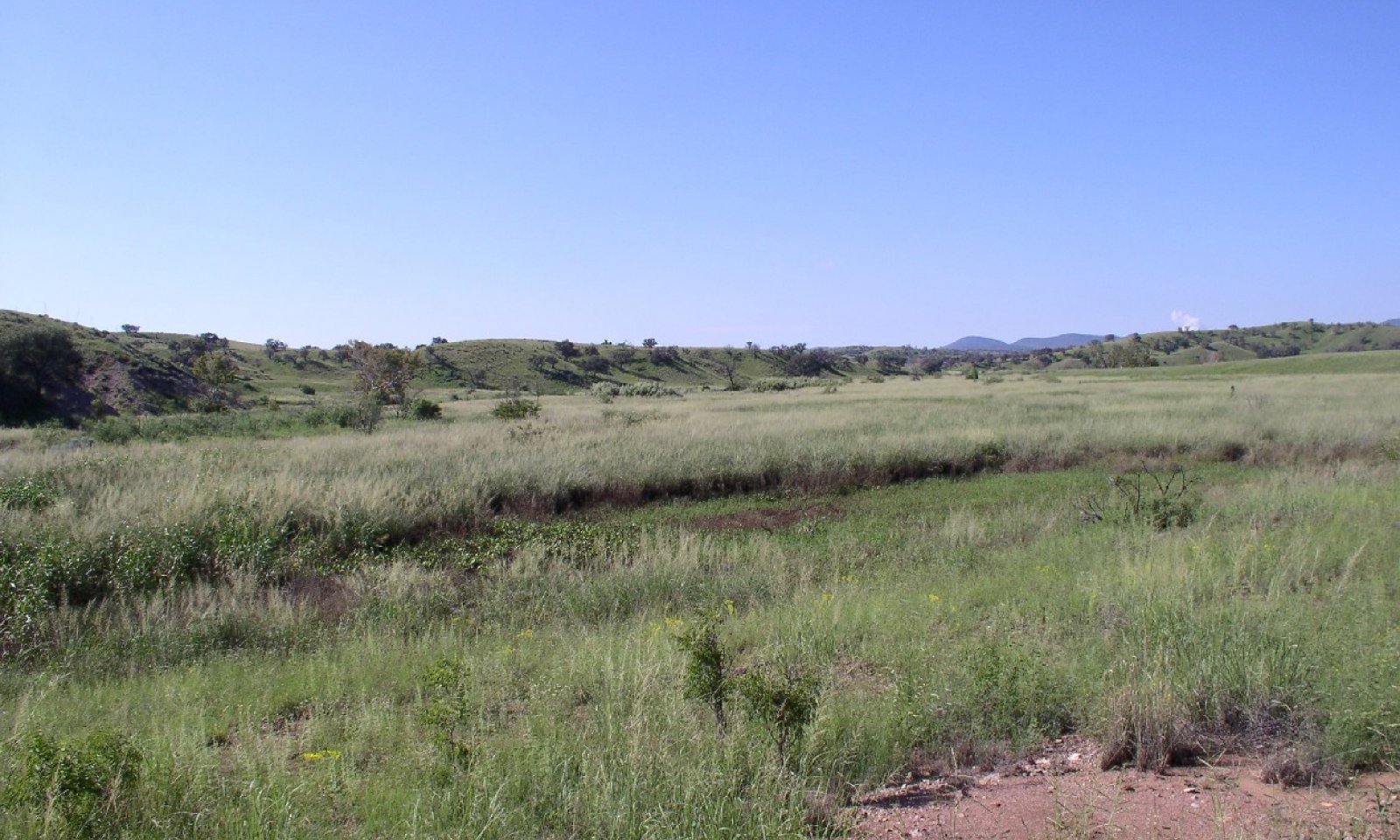
The potential plant community on this site is a giant sacaton grassland. Occasional clumps and strands of trees occur along shallow drainageways and discontinuous gullies. Natural fires during the summer months were important in maintaining the plant community.
The site is very susceptible to gully, channel and bank erosion, especially when the tall grass cover is depleted due to repeated burning and overgrazing or when structures such as dikes, roads, etc., are placed on the floodplain. The lowering of the base level of the main stream of a watershed will eventually cause channeling of the site. Grade stabilization will be required to prevent deterioration under such conditions. Excessive pumping of ground water can, over time, lower water tables causing depletion of grass cover and site deterioration from gully erosion. With severe erosion, the effectiveness of flooding is reduced, water tables are lowered, the grass cover is thinned and woody plants, especially mesquite, will increase to dominate the plant community. Bermuda grass and Johnson grass are introduced species which can be troublesome on this site.State and transition model
Custom diagramStandard diagram
Figure 6. State and Transition, Loamy Bottom 16-20" p.z.
More interactive model formats are also available. View Interactive Models
More interactive model formats are also available. View Interactive Models
Click on state and transition labels to scroll to the respective textEcosystem states
State 1 submodel, plant communities
State 2 submodel, plant communities
State 3 submodel, plant communities
State 4 submodel, plant communities
State 5 submodel, plant communities
State 1
ReferenceCommunity 1.1
Historic Climax Plant Community
Figure 7. Loamy Bottom 16-20" pz. HCPC
The historic native state includes the native plant communities that occur on the site, including the historic climax plant community. This state includes other plant communities that naturally occupy the site following fire, drought, flooding, herbivores, and other natural disturbances. The historic plant community represents the natural climax community that eventually re-occupies the site with proper management.
The potential plant community is dominated by nearly pure stands of giant sacaton. Frequent flooding and groundwater available within the rooting depth of sacaton (20 feet) account for dense and productive stands of grass. Occasional clumps and strands of trees occur along shallow drainages. Naturally occuring fires, June thru September, were an important factor in maintaining the plant community on this site. The aspect is tall grassland.
Mesquite can invade and increase in the native plant community; but high intensity fires can remove even well established mesquite trees as long as sediment accumulation around the stem bases has not occurred. Even repeated fires at these intensities will not remove established mesquite if their bud zones are buried by sediment. The interaction of drought, fire, flooding and grazing can reduce sacaton canopy to 25%. It will recover to normal levels in a short time.
Annual composite forbs like ragweed, goldeneye, sunflower and xanthocephalum can make tremendous stands in wet seasons after fire or drought has opened the grass community.
Figure 8. Annual production by plant type (representative values) or group (midpoint values)
Table 5. Annual production by plant type
Plant type Low
(lb/acre)Representative value
(lb/acre)High
(lb/acre)Grass/Grasslike 3035 4000 6450 Forb 20 75 600 Tree 10 20 150 Shrub/Vine 0 10 50 Total 3065 4105 7250 Table 6. Soil surface cover
Tree basal cover 0-0% Shrub/vine/liana basal cover 0-0% Grass/grasslike basal cover 20-40% Forb basal cover 0-0% Non-vascular plants 0-0% Biological crusts 0-10% Litter 30-70% Surface fragments >0.25" and <=3" 0-10% Surface fragments >3" 0-10% Bedrock 0% Water 0% Bare ground 10-50% Table 7. Canopy structure (% cover)
Height Above Ground (ft) Tree Shrub/Vine Grass/
GrasslikeForb <0.5 – – 0-5% 0-5% >0.5 <= 1 – – 0-10% 0-5% >1 <= 2 – – 0-5% 0-5% >2 <= 4.5 – 0-2% 30-70% 0-15% >4.5 <= 13 0-3% 0-2% 0-15% 0-5% >13 <= 40 0-2% – – – >40 <= 80 – – – – >80 <= 120 – – – – >120 – – – – Figure 9. Plant community growth curve (percent production by month). AZ4111 , 41.1 16-30. Growth begins in the spring, semi-dormancy occurs during the June drought, most growth occurs during the summer rainy season..
Jan Feb Mar Apr May Jun Jul Aug Sep Oct Nov Dec J F M A M J J A S O N D 0 0 0 5 10 0 15 45 20 5 0 0 Community 1.2
Scattered MesquiteMesquite and/or alligator juniper are sparsely scattered within the big sacaton grassland. The aspect is a savannah. This community phase rapidly returns to the reference state after summer fire.
State 2
Mesquite, SacatonCommunity 2.1
Tall Grass SavannahMesquite has invaded the site in the absence of fire for long periods of time. Mesquite canopy ranges from 5 to 30%. Trees are well established and the crowns are protected from the heat of surface fires due to sediment accumulation around the stem bases. Sacaton is co-dominant as the state still benefits from frequent flooding and groundwater within the reach of grass roots.
State 3
Eroded SacatonCommunity 3.1
Sacaton, eroded
Figure 10. Loamy Bottom 16-20" pz. gullied.
Head-cutting and gully erosion have drained the site. It no longer benefits from extra water received as flooding. The cover of sacaton thins to less than 25%. Groundwater may become out of reach to sacaton roots if incision is deeper than 20 feet. Annual production becomes a function of seasonal rainfall. Annual forbs and grasses may equal sacaton in production.
State 4
Annual Forbs and GrassesCommunity 4.1
Annual Forbs and GrassesSome areas of this state have been created by cultivation for irrigated farming and subsequent abandonment. Former cultivated areas usually have been altered by the diversion of floodwaters with dikes or drainage ditches. In other areas erosion and lowering of water tables have reduced sacaton to less than 5% canopy cover and allowed annual species to dominate. Native and non-native annual forbs and grasses dominate the plant community with minor amounts of sacaton and other native and non-native perennial grasses.
State 5
Exotic GrassesCommunity 5.1
Non-native grasslandThis state occurs where exotic perennial grasses like Johnson grass, common and coastal bermuda, and tall fescue have invaded the native plant community or been seeded on areas of the site. These species tend to make large monotypic patches within stands of sacaton. They may also be the result of cultivation and abandonment, leaving these species as remnants of the weeds that existed.
Additional community tables
Table 8. Community 1.1 plant community composition
Group Common name Symbol Scientific name Annual production () Foliar cover (%) Grass/Grasslike1 Dominant tall grass 3000–6000 big sacaton SPWR2 Sporobolus wrightii 3000–6000 – alkali sacaton SPAI Sporobolus airoides 0–500 – 2 Subdominant perennial grasses 25–200 sideoats grama BOCU Bouteloua curtipendula 0–100 – blue grama BOGR2 Bouteloua gracilis 0–100 – vine mesquite PAOB Panicum obtusum 0–100 – creeping muhly MURE Muhlenbergia repens 0–50 – 3 Miscellaneous perennial grasses 0–100 cane bluestem BOBA3 Bothriochloa barbinodis 0–50 – Rothrock's grama BORO2 Bouteloua rothrockii 0–25 – Arizona cottontop DICA8 Digitaria californica 0–25 – squirreltail ELELE Elymus elymoides ssp. elymoides 0–25 – green sprangletop LEDU Leptochloa dubia 0–25 – whiplash pappusgrass PAVA2 Pappophorum vaginatum 0–25 – plains bristlegrass SEVU2 Setaria vulpiseta 0–25 – deergrass MURI2 Muhlenbergia rigens 0–20 – spidergrass ARTE3 Aristida ternipes 0–20 – spidergrass ARTEG Aristida ternipes var. gentilis 0–15 – Orcutt's threeawn ARSCO Aristida schiedeana var. orcuttiana 0–15 – flatsedge CYPER Cyperus 0–15 – mat muhly MURI Muhlenbergia richardsonis 0–15 – bush muhly MUPO2 Muhlenbergia porteri 0–10 – tobosagrass PLMU3 Pleuraphis mutica 0–10 – spike dropseed SPCO4 Sporobolus contractus 0–10 – Texas bluestem SCCI2 Schizachyrium cirratum 0–10 – bulrush SCIRP Scirpus 0–10 – plains lovegrass ERIN Eragrostis intermedia 0–10 – mountain rush JUARL Juncus arcticus ssp. littoralis 0–10 – silver bluestem BOSA Bothriochloa saccharoides 0–10 – hairy grama BOHI2 Bouteloua hirsuta 0–10 – sand dropseed SPCR Sporobolus cryptandrus 0–5 – burrograss SCBR2 Scleropogon brevifolius 0–5 – purple muhly MURI3 Muhlenbergia rigida 0–5 – bulb panicgrass PABU Panicum bulbosum 0–5 – bullgrass MUEM Muhlenbergia emersleyi 0–5 – sedge CAREX Carex 0–5 – poverty threeawn ARDI5 Aristida divaricata 0–3 – densetuft hairsedge BUCA2 Bulbostylis capillaris 0–1 – common wolfstail LYPH Lycurus phleoides 0–1 – 4 Annual grasses 10–150 feather fingergrass CHVI4 Chloris virgata 0–50 – sticky sprangletop LEVI5 Leptochloa viscida 0–50 – Mexican sprangletop LEFUU Leptochloa fusca ssp. uninervia 0–50 – mucronate sprangeltop LEPAB Leptochloa panicea ssp. brachiata 0–25 – Mexican panicgrass PAHI5 Panicum hirticaule 0–25 – Arizona signalgrass URAR Urochloa arizonica 0–25 – sixweeks fescue VUOC Vulpia octoflora 0–25 – needle grama BOAR Bouteloua aristidoides 0–20 – tapertip cupgrass ERACA Eriochloa acuminata var. acuminata 0–15 – Mexican lovegrass ERME Eragrostis mexicana 0–5 – desert lovegrass ERPEM Eragrostis pectinacea var. miserrima 0–5 – tufted lovegrass ERPEP2 Eragrostis pectinacea var. pectinacea 0–5 – sixweeks grama BOBA2 Bouteloua barbata 0–5 – Arizona brome BRAR4 Bromus arizonicus 0–5 – Bigelow's bluegrass POBI Poa bigelovii 0–5 – delicate muhly MUFR Muhlenbergia fragilis 0–5 – littleseed muhly MUMI Muhlenbergia microsperma 0–5 – witchgrass PACA6 Panicum capillare 0–5 – sixweeks threeawn ARAD Aristida adscensionis 0–5 – prairie threeawn AROL Aristida oligantha 0–5 – pitscale grass HAGR3 Hackelochloa granularis 0–1 – Forb5 Perennial Forbs 10–100 sedge CAREX Carex 50–250 – flatsedge CYPER Cyperus 50–250 – slimleaf sneezeweed HELI Helenium linifolium 50–250 – rush JUNCU Juncus 50–250 – Missouri gourd CUFO Cucurbita foetidissima 0–50 – coyote gourd CUPA Cucurbita palmata 0–25 – weakleaf bur ragweed AMCO3 Ambrosia confertiflora 1–25 – fingerleaf gourd CUDI Cucurbita digitata 0–25 – gooseberryleaf globemallow SPGR2 Sphaeralcea grossulariifolia 0–20 – white sagebrush ARLU Artemisia ludoviciana 0–15 – scarlet spiderling BOCO Boerhavia coccinea 0–15 – spreading fleabane ERDI4 Erigeron divergens 0–10 – Indian rushpea HOGL2 Hoffmannseggia glauca 0–10 – spear globemallow SPHA Sphaeralcea hastulata 0–10 – slimleaf bean PHAN3 Phaseolus angustissimus 0–10 – canaigre dock RUHY Rumex hymenosepalus 0–10 – desert globemallow SPAM2 Sphaeralcea ambigua 0–10 – American vetch VIAM Vicia americana 0–5 – Louisiana vetch VILUL2 Vicia ludoviciana ssp. ludoviciana 0–5 – woodsorrel OXALI Oxalis 0–5 – Indianhemp APCA Apocynum cannabinum 0–5 – Wright's cudweed PSCAC2 Pseudognaphalium canescens ssp. canescens 0–5 – brownplume wirelettuce STPA4 Stephanomeria pauciflora 0–5 – white prairie aster SYFAC Symphyotrichum falcatum var. commutatum 0–5 – Lemmon's ragwort SELE8 Senecio lemmonii 0–5 – New Mexico fanpetals SINE Sida neomexicana 0–5 – silverleaf nightshade SOEL Solanum elaeagnifolium 0–5 – Missouri goldenrod SOMI2 Solidago missouriensis 0–5 – Trans-Pecos thimblehead HYWI Hymenothrix wislizeni 0–5 – Lewis flax LILE3 Linum lewisii 0–5 – Greene's bird's-foot trefoil LOGR4 Lotus greenei 0–5 – Wright's deervetch LOWR Lotus wrightii 0–5 – beeblossom GAURA Gaura 0–5 – southwestern mock vervain GLGO Glandularia gooddingii 0–5 – small matweed GUDED Guilleminea densa var. densa 0–5 – leastdaisy CHAET2 Chaetopappa 0–5 – bluedicks DICA14 Dichelostemma capitatum 0–5 – tarragon ARDR4 Artemisia dracunculus 0–5 – Cuman ragweed AMPS Ambrosia psilostachya 0–5 – melon loco APUN Apodanthera undulata 0–2 – yerba mansa ANCA10 Anemopsis californica 0–2 – whitemouth dayflower COER Commelina erecta 0–2 – wild dwarf morning-glory EVAR Evolvulus arizonicus 0–2 – ragged nettlespurge JAMA Jatropha macrorhiza 0–2 – jewels of Opar TAPA2 Talinum paniculatum 0–2 – orange fameflower PHAU13 Phemeranthus aurantiacus 0–2 – ivyleaf groundcherry PHHE4 Physalis hederifolia 0–2 – slimflower scurfpea PSTE5 Psoralidium tenuiflorum 0–1 – buffpetal RHPH2 Rhynchosida physocalyx 0–1 – Texas snoutbean RHSET Rhynchosia senna var. texana 0–1 – slimleaf plainsmustard SCLI12 Schoenocrambe linearifolia 0–1 – narrowleaf stoneseed LIIN2 Lithospermum incisum 0–1 – variableleaf bushbean MAGI2 Macroptilium gibbosifolium 0–1 – lemon beebalm MOCIA Monarda citriodora ssp. austromontana 0–1 – tufted evening primrose OECA10 Oenothera caespitosa 0–1 – scarlet beeblossom GACO5 Gaura coccinea 0–1 – trailing fleabane ERFL Erigeron flagellaris 0–1 – New Mexico fleabane ERNE3 Erigeron neomexicanus 0–1 – Mexican fireplant EUHE4 Euphorbia heterophylla 0–1 – birdbill dayflower CODI4 Commelina dianthifolia 0–1 – Texas bindweed COEQ Convolvulus equitans 0–1 – Arizona milkvetch ASAR6 Astragalus arizonicus 0–1 – spider milkweed ASAS Asclepias asperula 0–1 – milkweed ASCLE Asclepias 0–1 – broadleaf milkweed ASLA4 Asclepias latifolia 0–1 – horsetail milkweed ASSU2 Asclepias subverticillata 0–1 – 6 Annual forbs 10–500 common sunflower HEAN3 Helianthus annuus 1–200 – San Pedro matchweed XAGY Xanthocephalum gymnospermoides 1–200 – longleaf false goldeneye HELOL Heliomeris longifolia var. longifolia 1–150 – camphorweed HESU3 Heterotheca subaxillaris 0–100 – longleaf false goldeneye HELOA2 Heliomeris longifolia var. annua 1–100 – western tansymustard DEPI Descurainia pinnata 0–50 – carelessweed AMPA Amaranthus palmeri 0–50 – wheelscale saltbush ATEL Atriplex elegans 0–25 – Coulter's spiderling BOCO2 Boerhavia coulteri 0–25 – sensitive partridge pea CHNI2 Chamaecrista nictitans 0–25 – New Mexico thistle CINE Cirsium neomexicanum 0–25 – crestrib morning-glory IPCO2 Ipomoea costellata 0–15 – flaxflowered ipomopsis IPLOL Ipomopsis longiflora ssp. longiflora 0–15 – Arizona poppy KAGR Kallstroemia grandiflora 0–15 – intermediate pepperweed LEVIM Lepidium virginicum var. medium 0–15 – Nuttall's povertyweed MONU Monolepis nuttalliana 0–15 – Arizona popcornflower PLAR Plagiobothrys arizonicus 0–15 – horseweed CONYZ Conyza 0–15 – cryptantha CRYPT Cryptantha 0–15 – Wright's saltbush ATWR Atriplex wrightii 0–15 – New Mexico copperleaf ACNE Acalypha neomexicana 0–15 – woolly plantain PLPA2 Plantago patagonica 0–10 – purslane PORTU Portulaca 0–5 – desert unicorn-plant PRAL4 Proboscidea althaeifolia 0–5 – doubleclaw PRPA2 Proboscidea parviflora 0–5 – Wright's cudweed PSCAC2 Pseudognaphalium canescens ssp. canescens 0–5 – Florida pellitory PAFL3 Parietaria floridana 0–5 – combseed PECTO Pectocarya 0–5 – Mangas Spring phacelia PHBO4 Phacelia bombycina 0–5 – rough cocklebur XAST Xanthium strumarium 0–5 – golden crownbeard VEEN Verbesina encelioides 0–5 – sawtooth sage SASU7 Salvia subincisa 0–5 – spreading fanpetals SIAB Sida abutifolia 0–5 – warty caltrop KAPA Kallstroemia parviflora 0–5 – shaggyfruit pepperweed LELA Lepidium lasiocarpum 0–5 – foothill deervetch LOHU2 Lotus humistratus 0–5 – coastal bird's-foot trefoil LOSAB Lotus salsuginosus var. brevivexillus 0–5 – shortstem lupine LUBR2 Lupinus brevicaulis 0–5 – bajada lupine LUCOC Lupinus concinnus ssp. concinnus 0–5 – slender goldenweed MAGR10 Machaeranthera gracilis 0–5 – tanseyleaf tansyaster MATA2 Machaeranthera tanacetifolia 0–5 – whitestem blazingstar MEAL6 Mentzelia albicaulis 0–5 – El Paso skyrocket IPTH2 Ipomopsis thurberi 0–5 – scrambled eggs COAU2 Corydalis aurea 0–5 – poorjoe DITE2 Diodia teres 0–5 – Abert's buckwheat ERAB2 Eriogonum abertianum 0–5 – miniature woollystar ERDI2 Eriastrum diffusum 0–5 – sorrel buckwheat ERPO4 Eriogonum polycladon 0–5 – California poppy ESCAM Eschscholzia californica ssp. mexicana 0–5 – Arizona blanketflower GAAR2 Gaillardia arizonica 0–5 – southwestern pricklypoppy ARPL3 Argemone pleiacantha 0–5 – milkvetch ASTRA Astragalus 0–5 – American wild carrot DAPU3 Daucus pusillus 0–5 – jimsonweed DAST Datura stramonium 0–5 – sacred thorn-apple DAWR2 Datura wrightii 0–5 – hoary bowlesia BOIN3 Bowlesia incana 0–5 – pitseed goosefoot CHBE4 Chenopodium berlandieri 0–5 – hyssopleaf sandmat CHHY3 Chamaesyce hyssopifolia 0–5 – New Mexico goosefoot CHNE3 Chenopodium neomexicanum 0–5 – sleepy silene SIAN2 Silene antirrhina 0–3 – woolly tidestromia TILA2 Tidestromia lanuginosa 0–2 – Mexican passionflower PAME2 Passiflora mexicana 0–2 – lesser yellowthroat gilia GIFL Gilia flavocincta 0–2 – sweet four o'clock MILO2 Mirabilis longiflora 0–2 – Goodding's bladderpod LEGO2 Lesquerella gooddingii 0–2 – green carpetweed MOVE Mollugo verticillata 0–2 – plains flax LIPU4 Linum puberulum 0–2 – fringed redmaids CACI2 Calandrinia ciliata 0–2 – El Paso gilia GIME Gilia mexicana 0–1 – Dakota mock vervain GLBIB Glandularia bipinnatifida var. bipinnatifida 0–1 – Abert's creeping zinnia SAAB Sanvitalia abertii 0–1 – Shrub/Vine7 Miscellaneous shrubs 0–50 mule-fat BASA4 Baccharis salicifolia 0–10 – Apache plume FAPA Fallugia paradoxa 0–10 – American black elderberry SANIC4 Sambucus nigra ssp. canadensis 0–10 – canyon grape VIAR2 Vitis arizonica 0–5 – soaptree yucca YUEL Yucca elata 0–5 – rubber rabbitbrush ERNA10 Ericameria nauseosa 0–5 – fringed twinevine FUCYC Funastrum cynanchoides ssp. cynanchoides 0–5 – Drummond's clematis CLDR Clematis drummondii 0–5 – pale desert-thorn LYPA Lycium pallidum 0–5 – catclaw mimosa MIACB Mimosa aculeaticarpa var. biuncifera 0–5 – Texas mulberry MOMI Morus microphylla 0–5 – sacahuista NOMI Nolina microcarpa 0–5 – Thurber's desert honeysuckle ANTH2 Anisacanthus thurberi 0–5 – yerba de pasmo BAPT Baccharis pteronioides 0–2 – skunkbush sumac RHTR Rhus trilobata 0–2 – walkingstick cactus CYSP8 Cylindropuntia spinosior 0–2 – singlewhorl burrobrush HYMO Hymenoclea monogyra 0–1 – Tree8 Miscellaneous trees 10–150 Arizona sycamore PLWR2 Platanus wrightii 1–150 – Fremont cottonwood POFR2 Populus fremontii 0–50 – desert willow CHLI2 Chilopsis linearis 1–30 – Goodding's willow SAGO Salix gooddingii 0–25 – Arizona walnut JUMA Juglans major 1–25 – velvet ash FRVE2 Fraxinus velutina 1–20 – netleaf hackberry CELAR Celtis laevigata var. reticulata 0–10 – western soapberry SASAD Sapindus saponaria var. drummondii 0–10 – catclaw acacia ACGR Acacia greggii 0–5 – western honey mesquite PRGLT Prosopis glandulosa var. torreyana 0–2 – velvet mesquite PRVE Prosopis velutina 0–2 – Table 9. Community 1.2 plant community composition
Group Common name Symbol Scientific name Annual production () Foliar cover (%) Table 10. Community 2.1 plant community composition
Group Common name Symbol Scientific name Annual production () Foliar cover (%) Table 11. Community 3.1 plant community composition
Group Common name Symbol Scientific name Annual production () Foliar cover (%) Table 12. Community 4.1 plant community composition
Group Common name Symbol Scientific name Annual production () Foliar cover (%) Table 13. Community 5.1 plant community composition
Group Common name Symbol Scientific name Annual production () Foliar cover (%) Interpretations
Animal community
Big sacaton begins growth in the spring from April 15 to May 1st. The green season extends into September. Grazing must be concentrated on areas of this site to achieve reasonable utilization of sacaton and keep it in a vegetative state. Heat, humidity and insects are severe enough during summer flooding in July and August, to greatly affect livestock performance. Burning or mowing can be used periodically to freshen old growth sacaton. Burning should be done in February or early March; only in years when November thru February moisture equals or exceeds 4 inches. Burning can be done in July or August, after the first summer rains, to freshen sacaton for winter grazing. Areas of this site should be fenced exclusively for best management of the forage resources. Sacaton is very coarse and unpalatable, but provides adequate nutrition for livestock when green.
Sacaton bottoms are very important habitat for a variety of ground nesting birds and small mammals. They are important cover and foraging areas for javalina, whitetail and mule deer.Hydrological functions
Sacaton floodplains are extremely important in the hydrologic regime of southeastern Arizona stream systems. Intact sacaton floodplains retain floodwaters for 3 to 4 weeks after major flooding events. Channeled or gullied bottomlands often pass the same flood in 2 or 3 days. Water tables in healthy sacaton bottoms range from 5 to 20 feet alongside major streams and creeks and their larger tributaries.
Recreational uses
Hunting, bird-watching, hiking, horseback riding, photography.
Wood products
Sacaton bottoms invaded by mesquite furnish large quantities of fuelwood and posts.
Other products
Sacaton seed
Supporting information
Inventory data references
Range 417s include 1 in excellent condition and 1 in good condition.
Type locality
Location 1: Santa Cruz County, AZ Township/Range/Section T21S R18E S22 General legal description Audubon Research Ranch, O'Donnell Canyon bottom. Location 2: Santa Cruz County, AZ General legal description San Rafael Ranch, Santa Cruz River bottom Contributors
Dan Robinett
Larry D. EllicottApproval
Curtis Talbot, 4/09/2021
Rangeland health reference sheet
Interpreting Indicators of Rangeland Health is a qualitative assessment protocol used to determine ecosystem condition based on benchmark characteristics described in the Reference Sheet. A suite of 17 (or more) indicators are typically considered in an assessment. The ecological site(s) representative of an assessment location must be known prior to applying the protocol and must be verified based on soils and climate. Current plant community cannot be used to identify the ecological site.
Author(s)/participant(s) Wilma Renken, Dan Robinett, Larry Humphrey, Linda Kennedy Contact for lead author USDA-NRCS Tucson MLRA Soil Survey Office Date 05/01/2014 Approved by Approval date Composition (Indicators 10 and 12) based on Annual Production Indicators
-
Number and extent of rills:
None -
Presence of water flow patterns:
None present. Water movement is even sheet flow lacking energy. -
Number and height of erosional pedestals or terracettes:
Pedestals (2-4" height) common on big sacaton plants; pedestals disappear after fire and reform within 10 years after fire. No terracettes. -
Bare ground from Ecological Site Description or other studies (rock, litter, lichen, moss, plant canopy are not bare ground):
10% bare ground with bare areas 2-5 ft in diameter common across site. Bare ground exposed after fire is covered with litter within 1-2 years after burning. -
Number of gullies and erosion associated with gullies:
Discontinuous gullies, although infrequent, are occasionally present. When present, gullies are generally 100-200ft in length, 1-3ft wide, and 1-3 ft deep. -
Extent of wind scoured, blowouts and/or depositional areas:
None -
Amount of litter movement (describe size and distance expected to travel):
All litter remains in place. After fire, litter moves and deposits in debris dams. -
Soil surface (top few mm) resistance to erosion (stability values are averages - most sites will show a range of values):
Slake test values collected from under grass canopy were scored from 4 to 6 with 85% of the samples at 5 and 6; samples collect from outside of canopy also scored from 4 to 6 with 75% of the samples at 5 and 6. -
Soil surface structure and SOM content (include type of structure and A-horizon color and thickness):
Soil surface horizon 0-3" depth was silt loam with a weak platy structure. Color 7.5 YR 3/2 moist. -
Effect of community phase composition (relative proportion of different functional groups) and spatial distribution on infiltration and runoff:
Plant basal cover is well-dispersed across site (5-15% basal cover; tall grasses 50-80% foliar canopy cover) and dissipates overbank flood events resulting in sheet floods on the site 1-2" deep. -
Presence and thickness of compaction layer (usually none; describe soil profile features which may be mistaken for compaction on this site):
No compaction. Soil penetrometer averaged 6 cm with a range of depths from 4-10 cm. -
Functional/Structural Groups (list in order of descending dominance by above-ground annual-production or live foliar cover using symbols: >>, >, = to indicate much greater than, greater than, and equal to):
Dominant:
Tall grassesSub-dominant:
Sod-forming perennial midgrassesOther:
Perennial vining forbsAdditional:
Tall annual forbs fluctuate with rainfall -
Amount of plant mortality and decadence (include which functional groups are expected to show mortality or decadence):
Very little mortality or decadence (<5%) at 4 years after fire. Decadence increases with time post-burn. -
Average percent litter cover (%) and depth ( in):
Expect a marked reduction in litter cover after fire. Litter cover recovers within one year. -
Expected annual annual-production (this is TOTAL above-ground annual-production, not just forage annual-production):
3065 lbs/ac. in a below average year; 4105 lbs/ac. in an average year; 7250 lbs/ac. in an above average year. -
Potential invasive (including noxious) species (native and non-native). List species which BOTH characterize degraded states and have the potential to become a dominant or co-dominant species on the ecological site if their future establishment and growth is not actively controlled by management interventions. Species that become dominant for only one to several years (e.g., short-term response to drought or wildfire) are not invasive plants. Note that unlike other indicators, we are describing what is NOT expected in the reference state for the ecological site:
Johnson grass, hoary cress, bermudagrass, mesquite, burrobrush -
Perennial plant reproductive capability:
Not impaired.
Print Options
Sections
Font
AAAAOther
PrintThe Ecosystem Dynamics Interpretive Tool is an information system framework developed by the USDA-ARS Jornada Experimental Range, USDA Natural Resources Conservation Service, and New Mexico State University.
Accessibility statement


