
Natural Resources
Conservation Service
-
Search


Major Land Resource Area or ecological site by name and/or ID.
PreviousSectionsNextGeneral information
Provisional. A provisional ecological site description has undergone quality control and quality assurance review. It contains a working state and transition model and enough information to identify the ecological site.
Click to explore map
Figure 1. Mapped extent
Areas shown in blue indicate the maximum mapped extent of this ecological site. Other ecological sites likely occur within the highlighted areas. It is also possible for this ecological site to occur outside of highlighted areas if detailed soil survey has not been completed or recently updated.
MLRA notes
Major Land Resource Area (MLRA): 038X–Mogollon Transition South
AZ 38.1 – Lower Interior Chaparral
Elevations range from 3000 to 4500 feet and precipitation averages 12 to 16 inches per year. Vegetation includes canotia, one-seed juniper, mesquite, catclaw acacia, jojoba, turbinella oak, ratany, shrubby buckwheat, algerita, skunkbush, tobosa, vine mesquite, bottlebrush squirreltail, grama species, curly mesquite, desert needlegrass and New Mexico feathergrass. The soil temperature regime is thermic and the soil moisture regime is ustic aridic. This unit occurs within the Transition Zone Physiographic Province and is characterized by canyons and structural troughs or valleys. Igneous, metamorphic and sedimentary rock classes occur on rough mountainous terrain in association with less extensive sediment filled valleys exhibiting little integrated drainage.Associated sites
R038XA106AZ Limy Upland 12-16" p.z.
R038XA108AZ Clayey Slopes 12-16" p.z.
R038XA126AZ Limy Slopes 12-16" p.z.
Similar sites
R041XB204AZ Clay Loam Upland 8-12" p.z.
R041XC305AZ Clay Loam Upland 12-16" p.z.
R040XA120AZ Clay Loam Upland 10"-13" p.z.
R038XB203AZ Clay Loam Upland 16-20" p.z.
Table 1. Dominant plant species
Tree Not specified
Shrub (1) Opuntia engelmannii
(2) Calliandra eriophyllaHerbaceous (1) Pleuraphis mutica
(2) Hilaria belangeriPhysiographic features
This site occurs at the lowest elevations of the interior chaparral zone in the Mogollon Transition area. It occurs in an upland position. It is on gentle slopes, fan terraces, ridge-tops and mesa tops.
Table 2. Representative physiographic features
Landforms (1) Fan piedmont
(2) Mesa
(3) Lava flow
Flooding frequency None Elevation 3100 – 4600 ft Slope 15 – 45 % Aspect N, E, S Climatic features
Precipitation in this common resource area averages 12 to 16 inches annually. The winter-summer rainfall ratio ranges from about 60/40% in the northwest part of the area to 50/50% in the southeast part. Summer rains fall July through September; are from high-intensity, convective thunderstorms. This moisture originates primarily from the Gulf of Mexico, but can come from the remnants of Pacific hurricanes in September. Winter moisture is frontal, originates in the north Pacific, and falls as rain or snow in widespread storms of low intensity and long duration. Snowfall ranges from a trace to 10 inches per year and can occur from November through March. Snow seldom persists for more than a day except on north aspects. May and June are the driest months of the year. Humidity is generally low all year. Average annual air temperatures range from 59 to 70 degrees F (thermic temperature regime). Daytime temperatures in the summer are commonly in the high 90’s. Freezing temperatures are common from October through April, usually during the night or early morning hours. The actual precipitation, available moisture and temperature vary, depending on, region, elevation, rain shadow effect and aspect.
Table 3 Representative climatic features
Frost-free period (average) 230 days Freeze-free period (average) 290 days Precipitation total (average) 20 in BarLineFigure 2. Monthly precipitation range
BarLineFigure 3. Monthly average minimum and maximum temperature
">Influencing water features
There are no water features associated with this site.
Soil features
These soils are moderately deep to deep (30-60 inches) and dark colored in the surface (6-12 inches). They are clayey textured, gravelly to very gravelly and well drained. They have formed in alluvium and colluvium from a variety of parent materials. They do not exhibit vertic soil properties (cracking and churning). Soil surfaces can be covered by gravels, cobbles and/or stones. The erosion hazard is moderate to high where plant or gravel covers are inadequate. Typical taxonomic units mapped on this site include: SSA-627 Mohave County Southern Part MU's Arivaca-54, Penthouse-87 & Eloma-118; SSA-637 Yavapai County Western Part MU's Arp-AuC, AxD, AyC, Cabezon-ThC, Jacks-JaC, Thunderbird-TdC, ThC & VtC; SSA-639 Black Hills-Sedona Area MU's Mingus-420, Tapco-420, Ryallen-423, Eloma-424, Penthouse-437, 441, 541 & 641; SSA-675 San Carlos Indian Reservation Area MU Eloma-590; SSA-697 Mohave County Central Part MU's Arivaca-45 & Nuffel-81.
Table 4. Representative soil features
Surface texture (1) Gravelly clay loam
(2) Very gravelly loam
(3) Very gravelly clay loam
Family particle size (1) Clayey
Drainage class Well drained Permeability class Moderately slow to slow Soil depth 30 – 60 in Surface fragment cover <=3" 15 – 60 % Surface fragment cover >3" 1 – 10 % Available water capacity
(0-40in)3 – 7.5 in Calcium carbonate equivalent
(0-40in)1 – 15 % Electrical conductivity
(0-40in)0 – 2 mmhos/cm Sodium adsorption ratio
(0-40in)0 – 2 Soil reaction (1:1 water)
(0-40in)7 – 8.2 Subsurface fragment volume <=3"
(Depth not specified)5 – 55 % Subsurface fragment volume >3"
(Depth not specified)0 – 10 % Ecological dynamics
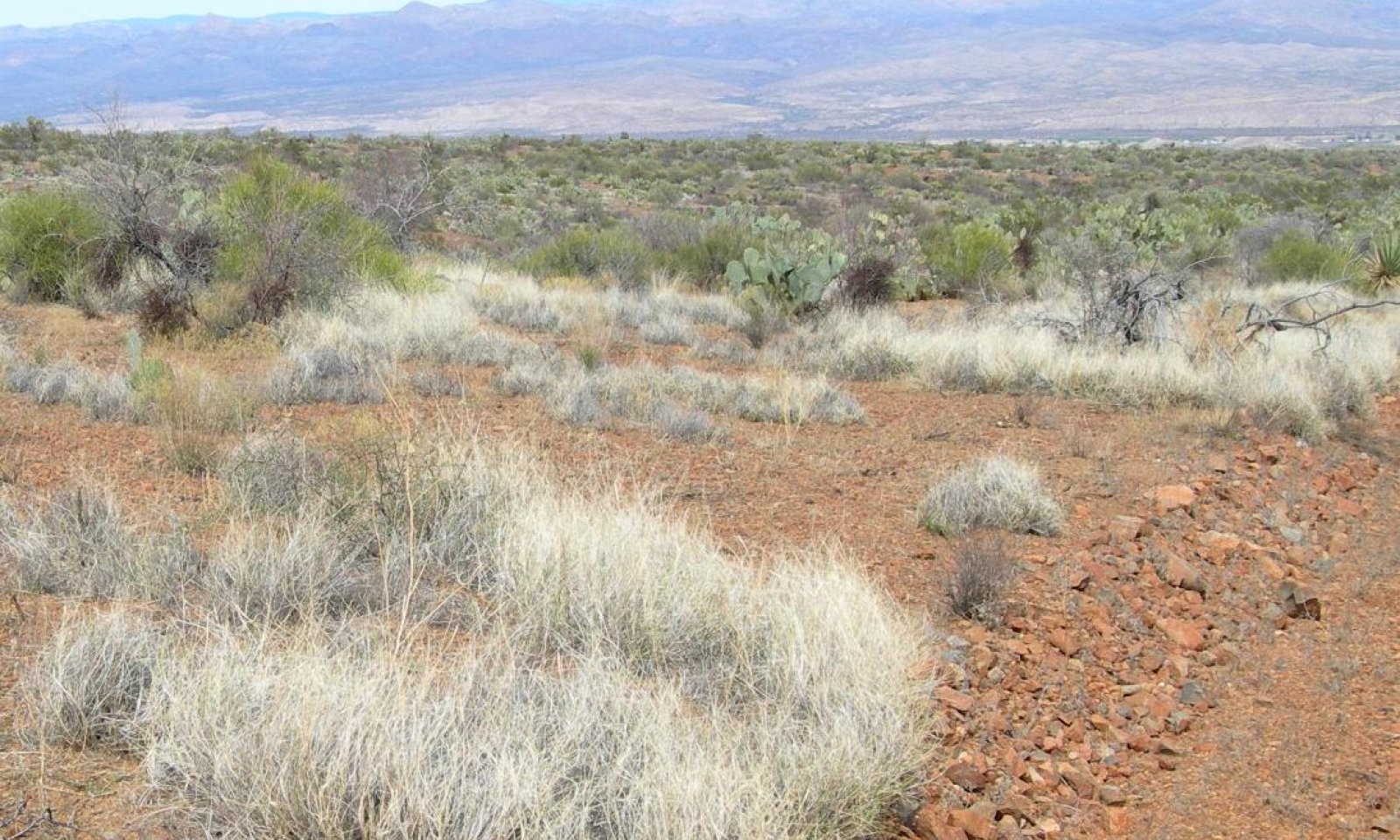
The historic native plant community is dominated by tobosa and other perennial warm season grasses with a mixture of desert shrubs, half shrubs, succulents and forbs. This includes a diverse flora of native annual grasses and forbs of both the winter and summer seasons. Periodic wildfires occurred at moderate intervals (15 to 30 years) and helped to maintain a balance between grasses and shrubs. The interactions of drought, fire and continuous livestock grazing can, over time, result in the loss of perennial grasses, half shrubs and suffrutescent forbs on this site. The lack of fire for very long periods can lead to increases in large shrubs/succulents like prickly pear, and whitethorn acacia. Trees like juniper, paloverde, mesquite and canotia can increase as well. In some situations non-native annuals can dominate the site. These species can, over time, diminish the soil seed-bank of native annual species. Non-native annuals can act to increase the fire frequency of areas of the site near roads and urban areas, where the incidence of man-made fires is high.
State and transition model
Custom diagramStandard diagram
More interactive model formats are also available. View Interactive Models
More interactive model formats are also available. View Interactive Models
Click on state and transition labels to scroll to the respective textEcosystem states
State 1 submodel, plant communities
State 2 submodel, plant communities
State 3 submodel, plant communities
State 4 submodel, plant communities
State 5 submodel, plant communities
State 6 submodel, plant communities
State 1
Native Mixed Grassland-Shrub StateCommunity 1.1
Historic Native Plant Community
Figure 4. Clayloam Upland 12-16" pz., HCPC

Figure 5. Clayloam Upland 12-16" pz., HCPC
The historic native plant community is dominated by tobosa and other warm season perennial grasses with a mixture of desert shrubs, half-shrubs, suffrutescent forbs and succulents. A rich flora of native annual forbs and grasses, of both the winter and summer seasons, exist in the plant community.
Natural fires, which burned at moderate intervals in this region, helped to maintain a balance between perennial grasses and shrubs.Figure 6. Annual production by plant type (representative values) or group (midpoint values)
Table 5. Annual production by plant type
Plant type Low
(lb/acre)Representative value
(lb/acre)High
(lb/acre)Grass/Grasslike 360 750 1100 Forb 7 50 240 Shrub/Vine 25 100 200 Tree 0 5 15 Total 392 905 1555 Table 6. Soil surface cover
Tree basal cover 0% Shrub/vine/liana basal cover 0-0% Grass/grasslike basal cover 10-10% Forb basal cover 0-0% Non-vascular plants 0% Biological crusts 0-10% Litter 10-60% Surface fragments >0.25" and <=3" 20-60% Surface fragments >3" 0-20% Bedrock 0% Water 0% Bare ground 10-60% Table 7. Canopy structure (% cover)
Height Above Ground (ft) Tree Shrub/Vine Grass/
GrasslikeForb <0.5 – 0-5% 1-10% 0-10% >0.5 <= 1 – 0-2% 5-10% 1-10% >1 <= 2 – 0-2% 10-20% 0-5% >2 <= 4.5 – 0-5% 0-5% 0-1% >4.5 <= 13 0-1% 0-1% – – >13 <= 40 0-1% – – – >40 <= 80 – – – – >80 <= 120 – – – – >120 – – – – Figure 7. Plant community growth curve (percent production by month). AZ3811 , 38.1 12-16" p.z. all sites. Growth begins in the spring, most growth occurs in the summer..
Jan Feb Mar Apr May Jun Jul Aug Sep Oct Nov Dec J F M A M J J A S O N D 0 0 1 7 15 20 22 20 10 5 0 0 Community 1.2
Short Grass Plant CommunityTobosa is removed from the plant community over time due to the interactions of fire, continuous grazing and drought. When the canopy cover of tobosa drops below 5% and the distribution of that cover is poor (clumped) then tobosa will not be able to recover on the site. Short grasses; especially curly mesquite and including slender and hairy grama will dominate the herbaceous layer of the plant community. These species fluctuate widely from drought to wet years.
State 2
Annuals StateCommunity 2.1
Annual Dominated Plant CommunityPalatable midgrasses have been replaced by annual species like tumble mustard and wild oats. Tobosa is still present in high levels.
State 3
Exotic Annuals Invaded StateCommunity 3.1
Exotic Annual invaded state
Figure 8. Annuals
Palatable midgrasses have been replaced by annual species. Tobosa still occurs in normal amounts. Non-native annual grasses like red brome, wild oats, mediterranean grass (schismus) and cheatgrass can invade and dominate areas of the site. These species can, over time, reduce the seed-bank of native annual grasses and forbs. Their presence can increase the fire frequency (of man made fires) especially where roads and urban areas are adjacent to areas of the site. Repeated fires tend to remove the native shrub, grass and forb canopy.
State 4
Shrub Dominated StateCommunity 4.1
Shrub Dominated Plant CommunityPalatable midgrasses have been replaced by annual species like tumble mustard and wild oats. Tobosa is still present, but at reduced levels. Through a combination of drought, continuous heavy grazing and lack of fire has reduced tobosa grass cover. Shrubs, like turpentine bush, prickly pear, and banana yucca can increase across the site.
State 5
Woody Shrub Invaded StateCommunity 5.1
Woody Shrub Dominated Plant Community
Figure 9. Clayloam Upland 12-16" pz., shrubby

Figure 10. Shrub Increase

Figure 11. Clayloam Upland 12-16" pz., shrubby
In the absence of fire for long periods of time and with continuous grazing, shrubs like mesquite, paloverde and whitethorn acacia and succulents like prickly pear and banana yucca can increase to dominate the plant community. Trees including oneseed and redberry juniper and canotia can increase also. Perennial grasses and forbs cannot recover in the face of increased shrub competition.
State 6
Eroded StateCommunity 6.1
Shrub Invaded, Eroded Plant Community
Figure 12. Clayloam Upland 12-16" pz., erosion

Figure 13. Eroded
Shrubs like mesquite, paloverde and whitethorn acacia; trees like juniper and canotia; and succulents like prickly pear and banana yucca can increase to dominate the site. Non-native annual forbs and grasses dominate the under-story. In "El Nino" years herbaceous fuels are sufficient for burning and repeat fires are especially common in areas close to residential zones and roads. Extreme rainfall events coupled with the fire, drought and grazing interaction, can lead to rilling of steep slopes.
Compaction of soils can occur with heavy trailing from continuous livestock use. Loss of plant cover after repeated fire can lead to accelerated sheet and rill erosion under these circumstances.Additional community tables
Table 8. Community 1.1 plant community composition
Group Common name Symbol Scientific name Annual production () Foliar cover (%) Grass/Grasslike1 Dominant perennial grasses 300–600 tobosagrass PLMU3 Pleuraphis mutica 250–500 – sideoats grama BOCU Bouteloua curtipendula 50–100 – 2 Cool season grasses 1–50 squirreltail ELEL5 Elymus elymoides 1–50 – 3 Misc. perennial grasses 50–250 curly-mesquite HIBE Hilaria belangeri 35–150 – black grama BOER4 Bouteloua eriopoda 5–50 – Parish's threeawn ARPUP5 Aristida purpurea var. parishii 1–50 – spidergrass ARTE3 Aristida ternipes 1–50 – hairy grama BOHI2 Bouteloua hirsuta 0–50 – slender grama BORE2 Bouteloua repens 0–50 – purple threeawn ARPU9 Aristida purpurea 5–50 – red grama BOTR2 Bouteloua trifida 0–20 – spidergrass ARTEG Aristida ternipes var. gentilis 0–15 – bush muhly MUPO2 Muhlenbergia porteri 0–15 – Hall's panicgrass PAHA Panicum hallii 0–15 – vine mesquite PAOB Panicum obtusum 0–15 – plains bristlegrass SEVU2 Setaria vulpiseta 0–15 – blue grama BOGR2 Bouteloua gracilis 0–15 – Fendler threeawn ARPUL Aristida purpurea var. longiseta 0–10 – green sprangletop LEDU Leptochloa dubia 0–5 – sand dropseed SPCR Sporobolus cryptandrus 0–5 – cane bluestem BOBA3 Bothriochloa barbinodis 0–5 – Arizona cottontop DICA8 Digitaria californica 0–5 – fall witchgrass DICO6 Digitaria cognata 0–2 – slim tridens TRMU Tridens muticus 0–2 – plains lovegrass ERIN Eragrostis intermedia 0–1 – tanglehead HECO10 Heteropogon contortus 0–1 – 4 Annual grasses 5–200 sixweeks fescue VUOC Vulpia octoflora 1–50 – mucronate sprangeltop LEPAB Leptochloa panicea ssp. brachiata 0–25 – sixweeks threeawn ARAD Aristida adscensionis 1–20 – small fescue VUMI Vulpia microstachys 0–20 – Arizona signalgrass URAR Urochloa arizonica 0–15 – Mexican panicgrass PAHI5 Panicum hirticaule 0–15 – Rothrock's grama BORO2 Bouteloua rothrockii 0–10 – Eastwood fescue VUMIC Vulpia microstachys var. ciliata 0–10 – witchgrass PACA6 Panicum capillare 0–5 – prairie threeawn AROL Aristida oligantha 0–5 – Arizona brome BRAR4 Bromus arizonicus 0–2 – feather fingergrass CHVI4 Chloris virgata 0–2 – delicate muhly MUFR Muhlenbergia fragilis 0–2 – littleseed muhly MUMI Muhlenbergia microsperma 0–2 – Bigelow's bluegrass POBI Poa bigelovii 0–1 – canyon cupgrass ERLE7 Eriochloa lemmonii 0–1 – tufted lovegrass ERPE Eragrostis pectinacea 0–1 – desert lovegrass ERPEM Eragrostis pectinacea var. miserrima 0–1 – little barley HOPU Hordeum pusillum 0–1 – Mexican sprangletop LEFUU Leptochloa fusca ssp. uninervia 0–1 – needle grama BOAR Bouteloua aristidoides 0–1 – sixweeks grama BOBA2 Bouteloua barbata 0–1 – Forb5 Perennial forbs 5–40 largeflower onion ALMA4 Allium macropetalum 0–5 – weakleaf bur ragweed AMCO3 Ambrosia confertiflora 1–5 – bluedicks DICA14 Dichelostemma capitatum 1–5 – slender janusia JAGR Janusia gracilis 0–5 – desert globemallow SPAM2 Sphaeralcea ambigua 1–5 – brownplume wirelettuce STPA4 Stephanomeria pauciflora 1–5 – Gila manroot MAGI Marah gilensis 0–2 – lacy tansyaster MAPI Machaeranthera pinnatifida 0–2 – Coues' cassia SECO10 Senna covesii 0–2 – wishbone-bush MILAV Mirabilis laevis var. villosa 0–2 – tuber anemone ANTU Anemone tuberosa 0–2 – perennial rockcress ARPE2 Arabis perennans 1–2 – dense ayenia AYMI Ayenia microphylla 0–1 – desert marigold BAMU Baileya multiradiata 0–1 – scarlet spiderling BOCO Boerhavia coccinea 0–1 – climbing wartclub BOSC Boerhavia scandens 0–1 – wavyleaf Indian paintbrush CAAPM Castilleja applegatei ssp. martinii 0–1 – Arizona wrightwort CAAR7 Carlowrightia arizonica 0–1 – desert mariposa lily CAKE Calochortus kennedyi 0–1 – sego lily CANU3 Calochortus nuttallii 0–1 – leatherweed CRPO5 Croton pottsii 0–1 – Gregg's prairie clover DAGR2 Dalea greggii 0–1 – Cooley's bundleflower DECO2 Desmanthus cooleyi 0–1 – desert larkspur DEPA Delphinium parishii 0–1 – tall mountain larkspur DESC Delphinium scaposum 0–1 – narrowleaf silverbush ARLA12 Argythamnia lanceolata 0–1 – white sagebrush ARLUM2 Artemisia ludoviciana ssp. mexicana 0–1 – New Mexico silverbush ARNE2 Argythamnia neomexicana 0–1 – dwarf desertpeony ACNA2 Acourtia nana 0–1 – brownfoot ACWR5 Acourtia wrightii 0–1 – San Felipe dogweed ADPO Adenophyllum porophylloides 0–1 – trailing windmills ALIN Allionia incarnata 0–1 – desert tobacco NIOB Nicotiana obtusifolia 0–1 – New Mexico groundsel PANE7 Packera neomexicana 0–1 – Oak Creek ragwort PAQU8 Packera quercetorum 0–1 – toadflax penstemon PELI2 Penstemon linarioides 0–1 – Parry's beardtongue PEPA24 Penstemon parryi 0–1 – desert penstemon PEPS Penstemon pseudospectabilis 0–1 – orange fameflower PHAU13 Phemeranthus aurantiacus 0–1 – slender poreleaf POGR5 Porophyllum gracile 0–1 – glandleaf milkwort POMA7 Polygala macradenia 0–1 – canaigre dock RUHY Rumex hymenosepalus 0–1 – twinleaf senna SEBA3 Senna bauhinioides 0–1 – ragged nettlespurge JAMA Jatropha macrorhiza 0–1 – longflower tube tongue JULO3 Justicia longii 0–1 – Wright's deervetch LOWR Lotus wrightii 0–1 – fleabane ERIGE2 Erigeron 0–1 – desert trumpet ERIN4 Eriogonum inflatum 0–1 – Mojave spurge EUSC6 Euphorbia schizoloba 0–1 – southwestern mock vervain GLGO Glandularia gooddingii 0–1 – desert rosemallow HICO Hibiscus coulteri 0–1 – Indian rushpea HOGL2 Hoffmannseggia glauca 0–1 – Lemmon's ragwort SELE8 Senecio lemmonii 0–1 – New Mexico fanpetals SINE Sida neomexicana 0–1 – silverleaf nightshade SOEL Solanum elaeagnifolium 0–1 – plains blackfoot MELE2 Melampodium leucanthum 0–1 – branched noseburn TRRA5 Tragia ramosa 0–1 – Louisiana vetch VILUL2 Vicia ludoviciana ssp. ludoviciana 0–1 – 6 Annual forbs 2–200 bristly fiddleneck AMTE3 Amsinckia tessellata 0–50 – Arizona popcornflower PLAR Plagiobothrys arizonicus 0–50 – longleaf false goldeneye HELOA2 Heliomeris longifolia var. annua 1–25 – California poppy ESCAM Eschscholzia californica ssp. mexicana 0–25 – Gordon's bladderpod LEGO Lesquerella gordonii 0–15 – Coulter's spiderling BOCO2 Boerhavia coulteri 0–15 – coastal bird's-foot trefoil LOSA Lotus salsuginosus 0–15 – Coulter's lupine LUSP2 Lupinus sparsiflorus 0–15 – desert Indianwheat PLOV Plantago ovata 0–15 – thelypody THELY Thelypodium 0–10 – exserted Indian paintbrush CAEXE Castilleja exserta ssp. exserta 0–10 – western tansymustard DEPI Descurainia pinnata 0–10 – Arizona poppy KAGR Kallstroemia grandiflora 0–10 – miniature woollystar ERDI2 Eriastrum diffusum 0–10 – carelessweed AMPA Amaranthus palmeri 0–10 – milkvetch ASTRA Astragalus 0–5 – shaggyfruit pepperweed LELA Lepidium lasiocarpum 0–5 – foothill deervetch LOHU2 Lotus humistratus 0–5 – desertparsley LOMAT Lomatium 0–5 – fivewing spiderling BOIN Boerhavia intermedia 0–5 – pitseed goosefoot CHBE4 Chenopodium berlandieri 0–5 – woolly tidestromia TILA2 Tidestromia lanuginosa 0–5 – phacelia PHACE Phacelia 0–5 – New Mexico plumeseed RANE Rafinesquia neomexicana 0–5 – woolly plantain PLPA2 Plantago patagonica 0–5 – slender goldenweed MAGR10 Machaeranthera gracilis 0–5 – tanseyleaf tansyaster MATA2 Machaeranthera tanacetifolia 0–5 – purslane PORTU Portulaca 0–2 – sawtooth sage SASU7 Salvia subincisa 0–2 – spreading fanpetals SIAB Sida abutifolia 0–2 – sleepy silene SIAN2 Silene antirrhina 0–2 – hyssopleaf sandmat CHHY3 Chamaesyce hyssopifolia 0–2 – wedgeleaf draba DRCU Draba cuneifolia 0–2 – American wild carrot DAPU3 Daucus pusillus 0–2 – New Mexico thistle CINE Cirsium neomexicanum 0–2 – miner's lettuce CLPEP Claytonia perfoliata ssp. perfoliata 0–2 – Thurber's pepperweed LETH2 Lepidium thurberi 0–2 – spurge EUPHO Euphorbia 0–2 – sorrel buckwheat ERPO4 Eriogonum polycladon 0–2 – crestrib morning-glory IPCO2 Ipomoea costellata 0–2 – redstar IPCO3 Ipomoea coccinea 0–1 – ivyleaf morning-glory IPHE Ipomoea hederacea 0–1 – Texas stork's bill ERTE13 Erodium texanum 0–1 – spreading fleabane ERDI4 Erigeron divergens 0–1 – star gilia GIST Gilia stellata 0–1 – California goldfields LACA7 Lasthenia californica 0–1 – scrambled eggs COAU2 Corydalis aurea 0–1 – cryptantha CRYPT Cryptantha 0–1 – sacred thorn-apple DAWR2 Datura wrightii 0–1 – flatcrown buckwheat ERDE6 Eriogonum deflexum 0–1 – Esteve's pincushion CHST Chaenactis stevioides 0–1 – brittle spineflower CHBR Chorizanthe brevicornu 0–1 – hoary bowlesia BOIN3 Bowlesia incana 0–1 – yellow tackstem CAPA7 Calycoseris parryi 0–1 – white tackstem CAWR Calycoseris wrightii 0–1 – annual agoseris AGHE2 Agoseris heterophylla 0–1 – woollyhead neststraw STMI2 Stylocline micropoides 0–1 – sand fringepod THCU Thysanocarpus curvipes 0–1 – chia SACO6 Salvia columbariae 0–1 – creamcups PLCA5 Platystemon californicus 0–1 – desert unicorn-plant PRAL4 Proboscidea althaeifolia 0–1 – doubleclaw PRPA2 Proboscidea parviflora 0–1 – Fendler's desertdandelion MAFE Malacothrix fendleri 0–1 – Arizona lupine LUAR4 Lupinus arizonicus 0–1 – miniature lupine LUBI Lupinus bicolor 0–1 – whitestem blazingstar MEAL6 Mentzelia albicaulis 0–1 – green carpetweed MOVE Mollugo verticillata 0–1 – desert evening primrose OEPR Oenothera primiveris 0–1 – Florida pellitory PAFL3 Parietaria floridana 0–1 – combseed PECTO Pectocarya 0–1 – manybristle chinchweed PEPA2 Pectis papposa 0–1 – Shrub/Vine7 Evergreen shrubs 1–50 Sonoran scrub oak QUTU2 Quercus turbinella 0–10 – jojoba SICH Simmondsia chinensis 0–10 – redberry buckthorn RHCR Rhamnus crocea 0–1 – longleaf jointfir EPTR Ephedra trifurca 0–1 – red barberry MAHA4 Mahonia haematocarpa 0–1 – algerita MATR3 Mahonia trifoliolata 0–1 – 8 Miscellaneous large shrubs 1–20 catclaw acacia ACGR Acacia greggii 1–5 – blue paloverde PAFL6 Parkinsonia florida 0–5 – yellow paloverde PAMI5 Parkinsonia microphylla 0–5 – whitethorn acacia ACCO2 Acacia constricta 0–2 – whitethorn acacia ACCOP9 Acacia constricta var. paucispina 0–1 – desert sweet CHMI2 Chamaebatiaria millefolium 0–1 – ocotillo FOSP2 Fouquieria splendens 0–1 – snapdragon penstemon KEANM Keckiella antirrhinoides ssp. microphylla 0–1 – creosote bush LATR2 Larrea tridentata 0–1 – water jacket LYAN Lycium andersonii 0–1 – Berlandier's wolfberry LYBE Lycium berlandieri 0–1 – Arizona desert-thorn LYEX Lycium exsertum 0–1 – catclaw mimosa MIACB Mimosa aculeaticarpa var. biuncifera 0–1 – littleleaf sumac RHMI3 Rhus microphylla 0–1 – skunkbush sumac RHTR Rhus trilobata 0–1 – lotebush ZIOBC Ziziphus obtusifolia var. canescens 0–1 – 9 Dominant half shrubs 15–100 fairyduster CAER Calliandra eriophylla 10–60 – bastardsage ERWR Eriogonum wrightii 1–15 – littleleaf ratany KRER Krameria erecta 1–10 – rough menodora MESC Menodora scabra 0–10 – desert zinnia ZIAC Zinnia acerosa 0–5 – prairie acacia ACAN Acacia angustissima 0–1 – Coulter's brickellbush BRCO Brickellia coulteri 0–1 – Eastern Mojave buckwheat ERFA2 Eriogonum fasciculatum 0–1 – 10 Succulents 5–55 cactus apple OPEN3 Opuntia engelmannii 5–20 – tulip pricklypear OPPH Opuntia phaeacantha 0–10 – banana yucca YUBA Yucca baccata 0–5 – devil's cholla GRKU Grusonia kunzei 0–2 – saguaro CAGI10 Carnegiea gigantea 0–2 – Christmas cactus CYLE8 Cylindropuntia leptocaulis 0–2 – walkingstick cactus CYSP8 Cylindropuntia spinosior 0–2 – common sotol DAWH2 Dasylirion wheeleri 0–1 – pinkflower hedgehog cactus ECBO2 Echinocereus bonkerae 0–1 – Arizona hedgehog cactus ECCOA Echinocereus coccineus var. arizonicus 0–1 – Engelmann's hedgehog cactus ECEN Echinocereus engelmannii 0–1 – redspine fishhook cactus ECER2 Echinomastus erectocentrus 0–1 – pinkflower hedgehog cactus ECFA Echinocereus fasciculatus 0–1 – spinystar ESVI2 Escobaria vivipara 0–1 – candy barrelcactus FEWI Ferocactus wislizeni 0–1 – goldenflower century plant AGCH2 Agave chrysantha 0–1 – Palmer's century plant AGPA3 Agave palmeri 0–1 – buck-horn cholla CYAC8 Cylindropuntia acanthocarpa 0–1 – jumping cholla CYFU10 Cylindropuntia fulgida 0–1 – Graham's nipple cactus MAGR9 Mammillaria grahamii 0–1 – sacahuista NOMI Nolina microcarpa 0–1 – purple pricklypear OPMA8 Opuntia macrocentra 0–1 – soaptree yucca YUEL Yucca elata 0–1 – 11 Increaser half-shrubs 2–25 broom snakeweed GUSA2 Gutierrezia sarothrae 1–20 – burroweed ISTE2 Isocoma tenuisecta 0–1 – yerba de pasmo BAPT Baccharis pteronioides 0–1 – button brittlebush ENFR Encelia frutescens 0–1 – turpentine bush ERLA12 Ericameria laricifolia 0–1 – threadleaf snakeweed GUMI Gutierrezia microcephala 0–1 – Tree12 Trees 0–15 redberry juniper JUCO11 Juniperus coahuilensis 0–5 – oneseed juniper JUMO Juniperus monosperma 0–5 – Utah juniper JUOS Juniperus osteosperma 0–5 – velvet mesquite PRVE Prosopis velutina 0–5 – crucifixion thorn CAHO3 Canotia holacantha 0–2 – western honey mesquite PRGLT Prosopis glandulosa var. torreyana 0–2 – Table 9. Community 1.2 plant community composition
Group Common name Symbol Scientific name Annual production () Foliar cover (%) Table 10. Community 2.1 plant community composition
Group Common name Symbol Scientific name Annual production () Foliar cover (%) Table 11. Community 3.1 plant community composition
Group Common name Symbol Scientific name Annual production () Foliar cover (%) Table 12. Community 4.1 plant community composition
Group Common name Symbol Scientific name Annual production () Foliar cover (%) Table 13. Community 5.1 plant community composition
Group Common name Symbol Scientific name Annual production () Foliar cover (%) Table 14. Community 6.1 plant community composition
Group Common name Symbol Scientific name Annual production () Foliar cover (%) Interpretations
Animal community
This site is suitable for grazing year round, and is easily traversed by livestock. Tobosa is very unpalatable and will be the last perennial grass species to be used on this site. Livestock grazing use is concentrated near trails, roads and waters. The site is susceptible to erosion in overgrazed areas like bed-grounds, livestock trails and slopes adjacent to water.
The site has good habitat diversity for a variety of desert wildlife species. It is home mainly to small mammals and birds and their associated predators. It is a foraging area for larger mammals like deer and javalina. Water developments are very important to both livestock and wildlife on this site.Hydrological functions
This site has a smooth to rough surface with variable covers of gravels and stones. Due to clayey textured soils it is a good producer of runoff. It produces exceptional runoff when heavy rain falls on snow or moist soils.
Recreational uses
Hunting, camping, horseback riding, backpacking, rock hounding, photography.
Wood products
Limited fuel-wood for campfires and branding fires. In areas where mesquite or juniper has increased there may be more wood available for fuel and for fence stays.
Other products
There is some harvest of food plants like prickly pear tunas, jojoba nuts, wild onions and grass nuts. There is limited harvest of medicinal plants like mormon tea. There is limited harvest of fibers from banana yucca. Clay for pot making.
Supporting information
Other references
Similar to Community type 5 of TES Map Unit # 370 on the Prescott National Forest.
Contributors
Dan Robinett
Larry D. EllicottRangeland health reference sheet
Interpreting Indicators of Rangeland Health is a qualitative assessment protocol used to determine ecosystem condition based on benchmark characteristics described in the Reference Sheet. A suite of 17 (or more) indicators are typically considered in an assessment. The ecological site(s) representative of an assessment location must be known prior to applying the protocol and must be verified based on soils and climate. Current plant community cannot be used to identify the ecological site.
Author(s)/participant(s) Karlyn Huling Contact for lead author NRCS Globe Soil Survey Office Date 05/15/2006 Approved by Approval date Composition (Indicators 10 and 12) based on Annual Production Indicators
-
Number and extent of rills:
Some rill formation may occur due to loam and clay loam surface soils, slow permeability, and medium runoff. Rills, if present, could be more common on steeper slopes and less common on the surfaces that are protected by rock fragment armor. -
Presence of water flow patterns:
Water flow patterns may be common due to the slow permeability and medium runoff. -
Number and height of erosional pedestals or terracettes:
Pedestals and terracettees may occur, but they should be very short. -
Bare ground from Ecological Site Description or other studies (rock, litter, lichen, moss, plant canopy are not bare ground):
This site has an average available water capacity of 4 inches, s it has a moderate potential to produce plant cover. One area had 35% bare ground and 25% rock fragment cover. Areas with a lot of rock fragment armor will have less bare ground. Drought may cause an increase in bare ground. -
Number of gullies and erosion associated with gullies:
None -
Extent of wind scoured, blowouts and/or depositional areas:
None -
Amount of litter movement (describe size and distance expected to travel):
Herbaceous and fine woody litter will be transported in water flow pathways. Coarse woody litter will remain under shrub and tree canopies. -
Soil surface (top few mm) resistance to erosion (stability values are averages - most sites will show a range of values):
Soil textures are generally clay loam or loam. Most surface soil horizons are gravelly or cobbly. The aggegate stability values can be fairly low due to the tendency for clayey soils to shrink/swell with changes in moisture. Aggretate stability values from one area averaging 6 under plant canopy (due to tobosa root mats) to only 1 in the interspaces. When well vegetated and/or protected by rock armor, these soils have a moderate to high resistance to both water and wind erosion. -
Soil surface structure and SOM content (include type of structure and A-horizon color and thickness):
Surface strucure is both granular (moderate, very fine to fine) and platy (moderate to strong, thin to medium). A few soils have a subangular blocky (weak to moderate, fine) surface structure. Surface thickness range is 1-4 inces. Color is variable depending upon parent material. -
Effect of community phase composition (relative proportion of different functional groups) and spatial distribution on infiltration and runoff:
This site is characterized by a fairly uniform distribution of mostly grasses with some shrubs and a few forbs. One area had 32% canopy cover (28% grass, 4% shrubs) and 16% basal cover (14% grass, 2% shrubs). Both canopy and basal cover values (especially canopy) decrease during a prolonged drought. This type of plant community is highly effective at capturing and storing precipitation. -
Presence and thickness of compaction layer (usually none; describe soil profile features which may be mistaken for compaction on this site):
None. Due to the loam and cla loam surface textures, all soils may be easily compacted at the very surface unless there are a lot of rock fragments in the surface hoizons. Most of the soils have gravelly or cobbly surfaces. Some of the sols have a naturally platy surface structure. -
Functional/Structural Groups (list in order of descending dominance by above-ground annual-production or live foliar cover using symbols: >>, >, = to indicate much greater than, greater than, and equal to):
Dominant:
warm season bunchgrasses >>Sub-dominant:
warm season colonizing grasses > cool seson bunchgrasses > deciduous shrub > forbs evergreen (chapparal) shrubs > cool season colonizing grasses > cacti = Agave family = treesOther:
Additional:
-
Amount of plant mortality and decadence (include which functional groups are expected to show mortality or decadence):
All plant funcional groups are adapted to surviva in all years except during the most severe droughts. Severe winter drought affects trees and shrubs most. Severe summer drought affects grasses most. -
Average percent litter cover (%) and depth ( in):
Mostly herbaceous litter with some woody litter. Litter amounts increase during the first few years of drought, but decrease in the later years. -
Expected annual annual-production (this is TOTAL above-ground annual-production, not just forage annual-production):
750-850 lbs/ac dry years; 850-1025 median years; 1025-1100 wet years. -
Potential invasive (including noxious) species (native and non-native). List species which BOTH characterize degraded states and have the potential to become a dominant or co-dominant species on the ecological site if their future establishment and growth is not actively controlled by management interventions. Species that become dominant for only one to several years (e.g., short-term response to drought or wildfire) are not invasive plants. Note that unlike other indicators, we are describing what is NOT expected in the reference state for the ecological site:
Broom snakewed, Utah juniper, prickly pear cacti and cholla cacti are all native to the site but can have the potential to increase and dominate the area after heavy grazing. Prosopis (mesquite) is natve to neighboring sites and can invade and dominate the site after heavy grazing. -
Perennial plant reproductive capability:
All plants native to this site are adapted to the climate and are capable of producing seeds, stolons, and rhizomes in most years except the most severe droughts.
Print Options
Sections
Font
AAAAOther
PrintThe Ecosystem Dynamics Interpretive Tool is an information system framework developed by the USDA-ARS Jornada Experimental Range, USDA Natural Resources Conservation Service, and New Mexico State University.
Accessibility statement


