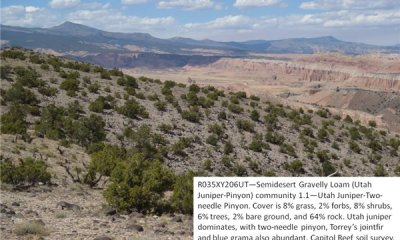
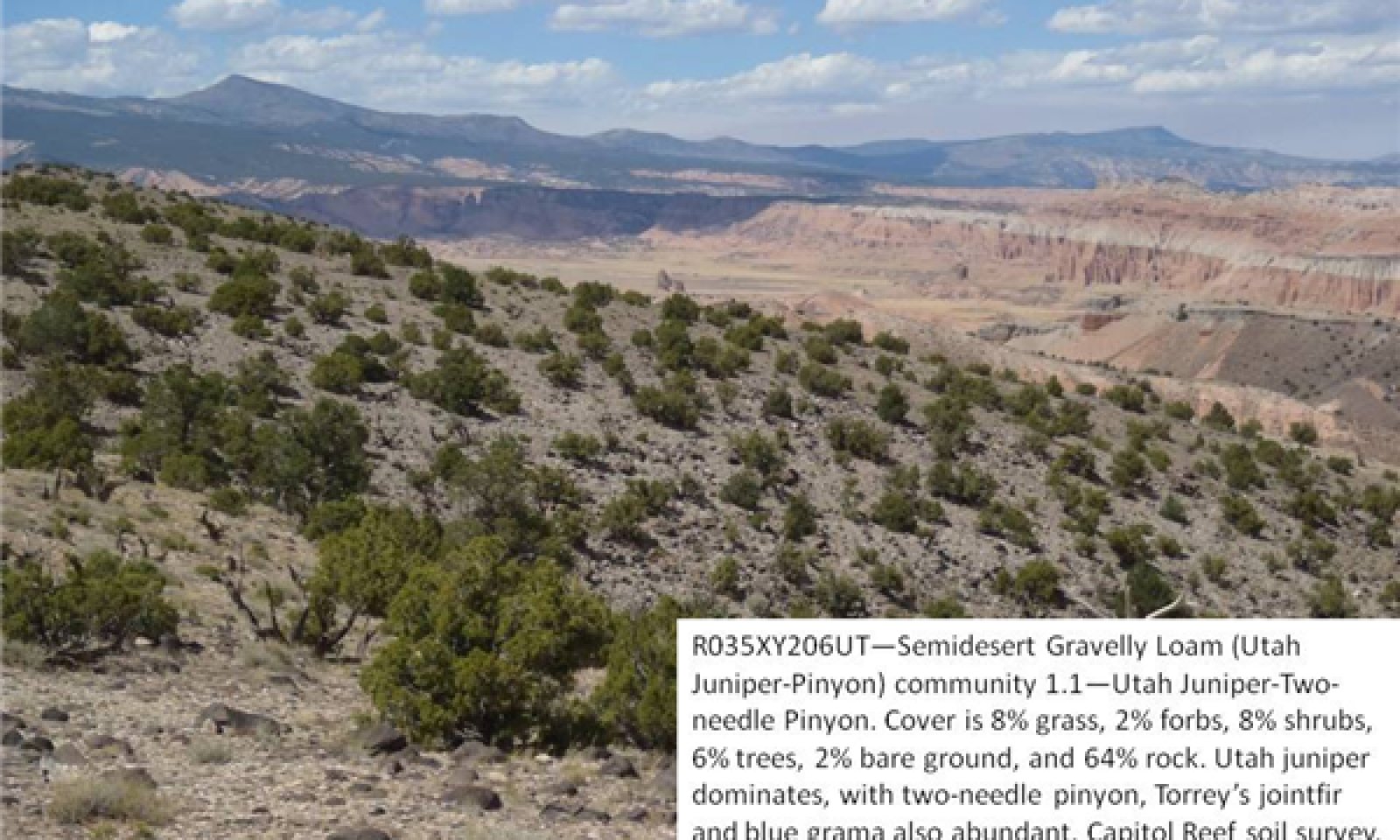
This state represents the natural range of variability that historically dominated the dynamics of this ecological site. This state includes the biotic communities that would be expressed on the ecological site if all successional sequences were completed without modern disturbances under the present environmental conditions; natural disturbances are inherent in its development. This state is dominated by Utah juniper and two-needle pinyon with a diverse understory of shrubs, perennial grasses and forbs. The primary disturbance mechanisms for this site in the reference condition include drought and insects.
Reference State: Two-needle pinyon and Utah juniper woodland
Indicators: A community dominated by Utah juniper with abundant two-needle pinyon; where shrubs, and native perennial grasses and forb production is variable.
Feedbacks: Disturbances that may allow for the establishment of invasive species.
At-risk Community Phase: this community is at risk when native plants are stressed and nutrients become available for invasive plants to establish.
Submodel
1.1. Reference State
Model keys
Briefcase
Add { ecological sites } and { Major Land Resource Areas } to your briefcase by clicking on the briefcase
() icon wherever it occurs. Drag and drop items to reorder. Cookies are used to store briefcase items between browsing sessions. Because of this, the number of items that can be added to your briefcase is limited, and briefcase items added on one device and browser cannot be accessed from another device or browser. Users who do not wish to place cookies on their devices should not use the briefcase tool. Briefcase cookies serve no other purpose than described here and are deleted whenever browsing history is cleared.
The Ecosystem Dynamics Interpretive Tool is an information system framework developed by the USDA-ARS Jornada Experimental Range, USDA Natural Resources Conservation Service, and New Mexico State University.




 ) icon wherever it occurs. Drag and drop items to reorder. Cookies are used to store briefcase items between browsing sessions. Because of this, the number of items that can be added to your briefcase is limited, and briefcase items added on one device and browser cannot be accessed from another device or browser. Users who do not wish to place cookies on their devices should not use the briefcase tool. Briefcase cookies serve no other purpose than described here and are deleted whenever browsing history is cleared.

