
Natural Resources
Conservation Service
-
Search


Major Land Resource Area or ecological site by name and/or ID.
PreviousSectionsNextGeneral information
Provisional. A provisional ecological site description has undergone quality control and quality assurance review. It contains a working state and transition model and enough information to identify the ecological site.
Click to explore map
Figure 1. Mapped extent
Areas shown in blue indicate the maximum mapped extent of this ecological site. Other ecological sites likely occur within the highlighted areas. It is also possible for this ecological site to occur outside of highlighted areas if detailed soil survey has not been completed or recently updated.
MLRA notes
Major Land Resource Area (MLRA): 035X–Colorado Plateau
This ecological site occurs in Common Resource Area 35.8 - the Colorado Plateau Ponderosa Pine Forests
The Common Resource Area occurs within the Colorado Plateau Physiographic Province. Elevations range from 6800 to 8500 feet and precipitation averages 17 to 25 inches per year. Vegetation includes ponderosa pine, white fir, aspen, pinyon, juniper, Gambel oak, big sagebrush, ceanothus, blue elderberry, muttongrass, upland sedge, and big wildrye, mountain muhly, Arizona fescue, pine dropseed, and blue grama. The soil temperature regime ranges from mesic to frigid and the soil moisture regime is typic ustic. This unit occurs within the Colorado Plateau Physiographic Province and is characterized by a sequence of flat to gently dipping sedimentary rocks eroded into plateaus, valleys and deep canyons. Sedimentary rock classes dominate the plateau with volcanic fields occurring for the most part near its margin.
Associated sites
DX035X03B826 Sandstone Upland 17-25" p.z. (PIPO)
DX035X03B827 Sandstone Hills 17-25" p.z. (PIPO)
R035XH821AZ Meadow 17-25" p.z.
Table 1. Dominant plant species
Tree (1) Pinus ponderosa
(2) Quercus gambeliiShrub (1) Artemisia tridentata ssp. wyomingensis
(2) Ceanothus fendleriHerbaceous (1) Poa fendleriana
(2) Carex rossiiLegacy ID
F035XH811AZ
Physiographic features
This ecological site occurs on toeslopes, fan terraces, backslopes and footslopes on stable landslides, plateaus and mesas. Soils are moderately deep to deep. Surface textures are sandy loam, fine sandy loam and loam. The site does not benefit from run-on moisture.
Table 2. Representative physiographic features
Landforms (1) Fan
(2) Terrace
(3) Landslide
Elevation 6800 – 8500 ft Slope 0 – 15 % Aspect Aspect is not a significant factor Climatic features
Winter-summer moisture ratios are typically 70:30 on the west side of this LRU and shift to 60:40 on the east side. Late spring is usually the driest period, and early fall moisture can be sporadic. Summer rains fall from June through September; moisture originates in the Gulf of Mexico and creates convective, usually brief, intense thunderstorms. Cool season moisture from October through May tends to be frontal; It originates in the Pacific Ocean and the Gulf of California and falls in widespread storms with longer duration and lower intensity. Precipitation generally comes as snow from October into April. Snowpack can persist for 3-4 months, although it may disappear in exposed areas during prolonged dry weather. Summer daytime temperatures are typically 80-90 but can exceed 95 degrees F. Winter temperatures of around 0 degrees F are common and can reach -25 degrees F.
Table 3 Representative climatic features
Frost-free period (average) 100 days Freeze-free period (average) 130 days Precipitation total (average) 30 in BarLineFigure 2. Monthly precipitation range
BarLineFigure 3. Monthly average minimum and maximum temperature
">Influencing water features
The soil moisture on this ecological site comes from precipitation. The site does not benefit significantly from run-on moisture. The loamy surface texture of the soil allows the site to capture the majority of the winter storms and the light to moderate summer storms if the site has good vegetative cover. Intense summer thunderstorms will produce runoff, reducing the amount of effective rainfall.
Soil features
Soils are deep to moderately deep. Surface textures are sandy loam to fine sandy loam. Subsoil textures are sandy loam, sandy, loam, loam and some deep soils will have clay horizon. Parent materials are alluvium and residuum from sandstone, shale and basalt. Available water capacity is moderate to very high. Water erosion hazard potential is slight to moderate; wind erosion potential is moderate to high. Soils are non-sodic, non-saline. pH range is 6.6-7.3.
Soil survey map unit components that have been correlated to this ecological site include:
SSA-699 Hualapai-Havasupai Area 030-Pinntank;
SSA-713 Chinle Area 56-Tuntsa moderately;
SSA-715 Fort Defiance Area NM/AZ MU 52-Kunz, 54 Klizhin family, 130-Manuelito;
SSA-717 Shiprock Area AZ/NM 600, 604 & 614 YahmoreTable 4. Representative soil features
Parent material (1) Alluvium – sandstone and shale
(2) Residuum – basalt
Surface texture (1) Sandy loam
(2) Fine sandy loam
(3) Loam
Family particle size (1) Loamy
Drainage class Moderately well drained to well drained Permeability class Moderately slow to moderate Soil depth 20 – 60 in Surface fragment cover <=3" 0 – 15 % Surface fragment cover >3" Not specified Available water capacity
(0-40in)4.3 – 9.6 in Calcium carbonate equivalent
(0-40in)Not specified Electrical conductivity
(0-40in)0 – 2 mmhos/cm Sodium adsorption ratio
(0-40in)0 – 5 Soil reaction (1:1 water)
(0-40in)6.6 – 7.3 Subsurface fragment volume <=3"
(Depth not specified)0 – 15 % Subsurface fragment volume >3"
(Depth not specified)Not specified Ecological dynamics
An ecological site is not a precise assemblage of species for which the proportions are the same from place to place or from year to year. In all plant communities, variability is apparent in productivity and occurrence of individual species. Spatial boundaries of the communities; however, can be recognized by characteristic patterns of species composition, association, and community structure. The historic climax plant community for this ecological site has been described by sampling relict or relatively undisturbed sites and/or reviewing historic records. The historic climax plant community is the plant community that evolved over time with the soil forming process and long term changes in climatic conditions of the area. It is the plant community that was best adapted to the unique combination of environmental factors associated with the site.
Natural disturbances, such as drought, fire, grazing of native fauna, and insects, are inherent in the development and maintenance of these plant communities. The effects of these disturbances are part of the range of characteristics of the ecological site. Fluctuations in plant community structure and function caused by the effects of natural disturbances help establish the boundaries and characteristics of an ecological site. They are accounted for as part of the range of characteristics of the ecological site. Recognizable plant community phases are identified in the reference state of the ecological site. Some sites may have a small range of variation, while others have a large range. Some plant community phases may exist for long periods of time, while others may only occur for a couple of years after a disturbance.
Deterioration of the plant community, hydrology, or soil site stability on an ecological site can result in crossing a threshold or potentially irreversible boundary to another state, or equilibrium. This can occur as a result of the loss of soil surface through erosion, the loss of the stability of the site due to disturbances that cause active erosion on the site, increases in the amounts and/or patterns or runoff from rainstorms, changes in availability of surface and subsurface water, significant changes in plant structural and functional types, or the introduction of non-native species. When these thresholds are crossed, the potential of the ecological site to return to the historic climax plant community can be lost, or restoration will require significant inputs . There may be multiple states possible for an ecological site, determined by the type and or severity of disturbance.
The known states and transition pathways for this ecological site are described in the state and transition model. Within each state, there may be one or more known plant community phases. These community phases describe the different plant community that can be recognized and mapped across this ecological site. The state and transition model is intended to help land users recognize the current plant community on the ecological site, and the management options for improving the plant community to the desired plant community.
Plant production information in this site description is standardized to the annual production on an air-dry weight basis in near normal rainfall years.
State and transition model
Custom diagramStandard diagram
Figure 4. 358 SandyLoamUpland S&T
More interactive model formats are also available. View Interactive Models
More interactive model formats are also available. View Interactive Models
Click on state and transition labels to scroll to the respective textEcosystem states
State 1 submodel, plant communities
State 2 submodel, plant communities
State 1
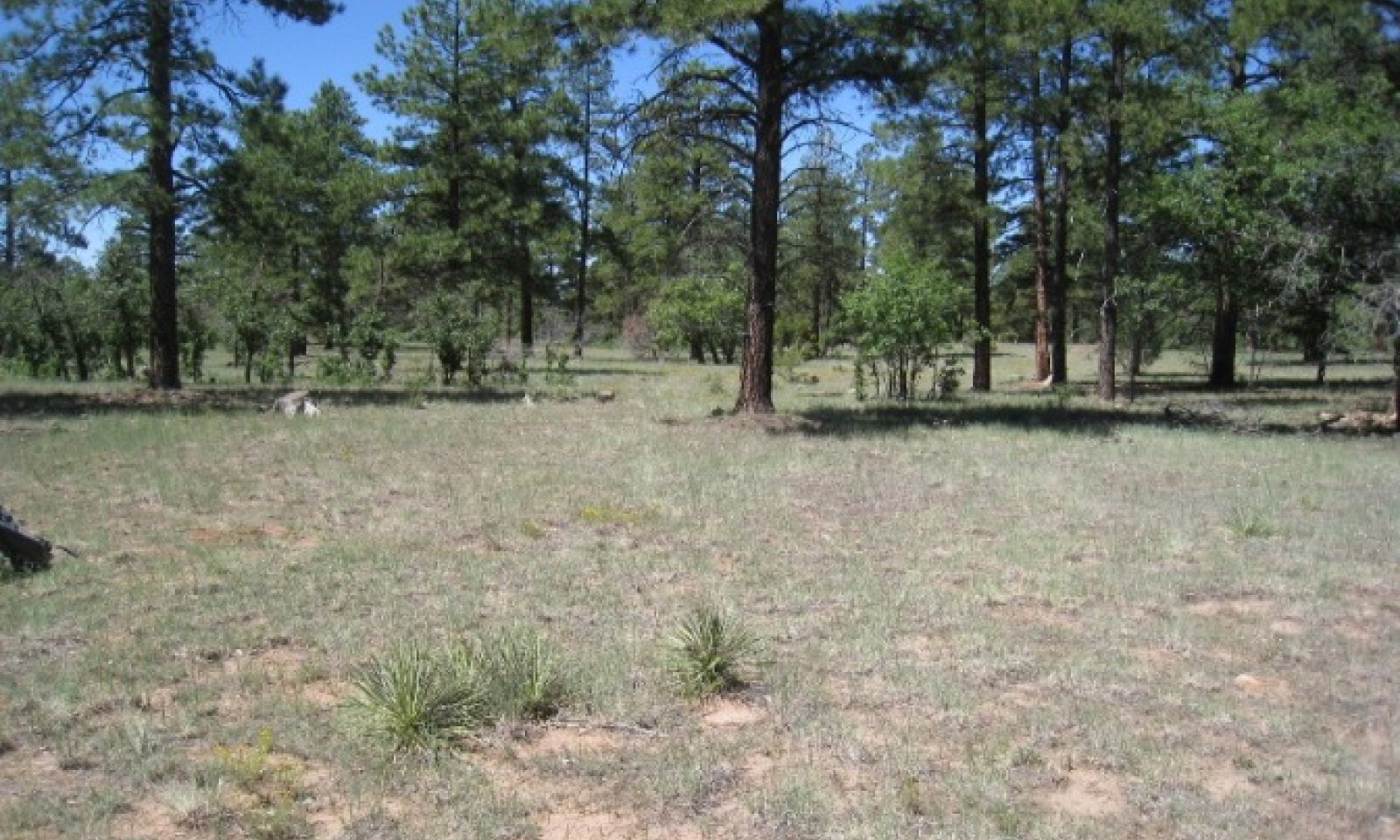
Reference StateThis state is comprised of mature ponderosa pines and tall Gambel oaks with a tree canopy of 40-55 percent. Other trees present in minor amounts include scattered twoneedle pinyon pine, Rocky Mountain juniper and shorter Gambel oaks. The understory is comprised mainly of grasses with a mix of annual and perennial forbs with scattered shrubs. Common grasses and grasslikes include blue grama, bottlebrush squirreltail, White Mountain sedge, needle and thread, muttongrass and mountain muhly. Shrubs occasionally present in small amounts include broom snakeweed, mountain big sagebrush, spineless horsebrush and rubber rabbitbrush.
Community 1.1
Historic Climax Plant Community
This potential plant community includes a tree canopy cover of 40-55%, with an understory of grasses, forbs, shrubs and small scattered trees.
Figure 5. Annual production by plant type (representative values) or group (midpoint values)
Table 5. Annual production by plant type
Plant type Low
(lb/acre)Representative value
(lb/acre)High
(lb/acre)Grass/Grasslike 200 275 350 Tree 75 125 175 Forb 50 82 115 Shrub/Vine 50 82 115 Total 375 564 755 Figure 6. Plant community growth curve (percent production by month). AZ3581 , 35.8 17-25" p.z. all sites. Growth begins in the spring, most growth occurs during the summer rainy season..
Jan Feb Mar Apr May Jun Jul Aug Sep Oct Nov Dec J F M A M J J A S O N D 0 0 0 4 10 24 21 23 13 5 0 0 Community 1.2
Light PIPO OverstoryPatchy mature PIPO reduced canopy cover, with less cover in understory trees.
Dense and abundant grass and forb cover.Community 1.3
Dense PIPO OverstoryPole sized PIPO with very dense overstory
Dense upper and lower canopies (50-60%) sparse understory.Pathway 1.1a
Community 1.1 to 1.2Partial removal of mature PIPO canopy through timber harvest, or Bark beetle infestation. This results in higher production on the forest floor of grass, forb and to some extent shrubs.
Conservation practices
Forage Harvest Management Forest Trails and Landings Forest Stand Improvement Woody Residue Treatment Prescribed Forestry Pathway 1.1b
Community 1.1 to 1.31.1B (1.2)Openings are filled in by natural regeneration of Ponderosa pine, forming an even aged tight canopy of sapling to pole size PIPO
Conservation practices
Tree/Shrub Pruning Forest Stand Improvement Prescribed Forestry Pathway 1.2a
Community 1.2 to 1.31.2a Openings are filled in by natural regeneration of Ponderosa pine, forming an even aged tight canopy of sapling to pole size PIPO
Pathway 1.3a
Community 1.3 to 1.11.3a Trees mature and are thinnned either naturally or through Pre-commercial thining forming a mature canopy.
Conservation practices
Forest Stand Improvement Pathway 1.3b
Community 1.3 to 1.21.3b Trees mature and are thinnned more heavily than pathway 1.3a, through fire or timber harvest forming a patchy and mature canopy.
Conservation practices
Forest Stand Improvement Prescribed Forestry State 2
Canopy removed Grass and Forb DominatedCommunity 2.1
Canopy removed Grass and Forb DominatedTree canopy has been severely reduced (
Transition 1
State 1 to 2Catastrophic wildfire event removes 90 to 95% of tree overstory.
Restoration pathway 1
State 2 to 1Tree planting and other Forest land improvements return site to a forested condition.
Conservation practices
Forest Stand Improvement Agroforestry Planting Additional community tables
Table 6. Community 1.1 plant community composition
Group Common name Symbol Scientific name Annual production () Foliar cover (%) Grass/Grasslike1 Grasses/Grasslikes 200–350 blue grama BOGR2 Bouteloua gracilis 83–138 – White Mountain sedge CAGE Carex geophila 55–110 – squirreltail ELEL5 Elymus elymoides 55–83 – needle and thread HECO26 Hesperostipa comata 6–28 – prairie Junegrass KOMA Koeleria macrantha 6–28 – mountain muhly MUMO Muhlenbergia montana 6–28 – western wheatgrass PASM Pascopyrum smithii 0–28 – muttongrass POFE Poa fendleriana 6–28 – Grass, perennial 2GP Grass, perennial 0–28 – sleepygrass ACRO7 Achnatherum robustum 0–11 – pine dropseed BLTR Blepharoneuron tricholepis 0–11 – little bluestem SCSC Schizachyrium scoparium 0–11 – sand dropseed SPCR Sporobolus cryptandrus 0–11 – Grass, annual 2GA Grass, annual 0–11 – Forb2 Forbs 50–115 pingue rubberweed HYRI Hymenoxys richardsonii 11–55 – silvery lupine LUAR3 Lupinus argenteus 6–28 – white sagebrush ARLU Artemisia ludoviciana 0–17 – spreading fleabane ERDI4 Erigeron divergens 0–17 – trailing fleabane ERFL Erigeron flagellaris 0–17 – redroot buckwheat ERRA3 Eriogonum racemosum 0–11 – pineywoods geranium GECA3 Geranium caespitosum 0–11 – hairy false goldenaster HEVI4 Heterotheca villosa 0–11 – Forb, perennial 2FP Forb, perennial 0–11 – western yarrow ACMIO Achillea millefolium var. occidentalis 0–11 – nodding onion ALCE2 Allium cernuum 0–11 – whitemargin pussytoes ANMA5 Antennaria marginata 0–11 – small-leaf pussytoes ANPA4 Antennaria parvifolia 0–11 – Carruth's sagewort ARCA14 Artemisia carruthii 0–11 – prairie sagewort ARFR4 Artemisia frigida 0–11 – upright blue beardtongue PEVI4 Penstemon virgatus 0–11 – broom-like ragwort SESPM Senecio spartioides var. multicapitatus 0–11 – globemallow SPHAE Sphaeralcea 0–11 – Forb, annual 2FA Forb, annual 0–6 – woolly plantain PLPA2 Plantago patagonica 0–6 – flatspine stickseed LAOC3 Lappula occidentalis 0–6 – Shrub/Vine3 Shrubs 50–115 mountain big sagebrush ARTRV Artemisia tridentata ssp. vaseyana 6–55 – broom snakeweed GUSA2 Gutierrezia sarothrae 6–28 – spineless horsebrush TECA2 Tetradymia canescens 0–22 – rubber rabbitbrush ERNA10 Ericameria nauseosa 0–22 – toadflax penstemon PELI2 Penstemon linarioides 0–11 – Navajo yucca YUBA2 Yucca baileyi 0–11 – creeping barberry MARE11 Mahonia repens 0–11 – Fendler's ceanothus CEFE Ceanothus fendleri 0–11 – Shrub (>.5m) 2SHRUB Shrub (>.5m) 0–11 – plains pricklypear OPPO Opuntia polyacantha 0–6 – pincushion cactus PEDIO Pediocactus 0–6 – Tree4 Trees (<4.5') 75–175 Gambel oak QUGA Quercus gambelii 83–138 – ponderosa pine PIPO Pinus ponderosa 6–55 – Rocky Mountain juniper JUSC2 Juniperus scopulorum 6–28 – twoneedle pinyon PIED Pinus edulis 6–28 – Table 7. Community 1.2 plant community composition
Group Common name Symbol Scientific name Annual production () Foliar cover (%) Table 8. Community 1.3 plant community composition
Group Common name Symbol Scientific name Annual production () Foliar cover (%) Table 9. Community 2.1 plant community composition
Group Common name Symbol Scientific name Annual production () Foliar cover (%) Interpretations
Animal community
Site is fairly suitable for grazing in the summer and early fall by cattle, sheep, goats and horses prior to tree canopy exceeding 45%.
Management considerations are grazing systems, proper grazing, and water developments to aid in livestock distribution. Grazing should not damage young trees.
Water is frequently found in scattered natural wetlands and springs. Cover is good for most species. Food has good potential except where grazing is unmanaged. Topography provides escape habitat.Recreational uses
Recreational activities include hiking, horseback riding, camping, wildlife observations and hunting. Landscape quality is good.
Wood products
All kinds of equipment is suitable for harvesting, site preparation, tree planting and precommercial thinning. Slopes are non-restrictive. Unsurfaced roads limit equipment when wet. Water erosion is slight to moderate in bare areas; wind erosion is moderate to high.
Compaction potential is good, but soils will rut when wet. Revegetation potential is good.
Harvest fully grown trees on a sustained yield basis. Final removal cuts and intermediate cuts are desirable. Thick stands need thinned to improve growth rates of trees left. Periodic ground fires will reduce dense understory vegetation competing for moisture. Slopes are gentle and soils are deep, so mechanical tree removal is not limited. Control unwanted pests to limit tree damage and loss. Fire hazard becomes extreme as understory fuel load builds. Site is good for replanting. There is slight limitation to seedling mortality; expected mortality rate is less than 25%. Natural regeneration is slightly limited; low end of productive pine sites. Seedlings need protection from grazing. Plant competition is moderately limited due to dense grass cover and grazing that may impede regeneration. Windthrow hazard: slight limitation, rooting depth greater than 30".Table 10. Representative site productivity
Common name Symbol Site index low Site index high CMAI low CMAI high Age of CMAI Site index curve code Site index curve basis Citation ponderosa pine PIPO 55 60 270 276 – – – Supporting information
Type locality
Location 1: San Juan County, NM Township/Range/Section T22N R19W S25 General legal description Washington Pass Quad, Chuska Mountains, Navajo Reservation Location 2: Apache County, AZ UTM zone N UTM northing 665157 UTM easting 3980735 General legal description Sawmill Quad, Defiance Plateau area, Navajo Reservation. About 5.5 miles due north of Sawmill on route 9702 Other references
Updates and revisions for this ESD were conducted as part of a 2007-2012 Interagency Technical Assistance Agreement between the Bureau of Indian Affairs–Navajo Region and the NRCS-Arizona.
Contributors
Dan Carroll
Dean Schlichting
HSH
Kenneth Gishi
Larry D. Ellicott
Steve BarkerRangeland health reference sheet
Interpreting Indicators of Rangeland Health is a qualitative assessment protocol used to determine ecosystem condition based on benchmark characteristics described in the Reference Sheet. A suite of 17 (or more) indicators are typically considered in an assessment. The ecological site(s) representative of an assessment location must be known prior to applying the protocol and must be verified based on soils and climate. Current plant community cannot be used to identify the ecological site.
Author(s)/participant(s) Contact for lead author Date Approved by Approval date Composition (Indicators 10 and 12) based on Annual Production Indicators
-
Number and extent of rills:
-
Presence of water flow patterns:
-
Number and height of erosional pedestals or terracettes:
-
Bare ground from Ecological Site Description or other studies (rock, litter, lichen, moss, plant canopy are not bare ground):
-
Number of gullies and erosion associated with gullies:
-
Extent of wind scoured, blowouts and/or depositional areas:
-
Amount of litter movement (describe size and distance expected to travel):
-
Soil surface (top few mm) resistance to erosion (stability values are averages - most sites will show a range of values):
-
Soil surface structure and SOM content (include type of structure and A-horizon color and thickness):
-
Effect of community phase composition (relative proportion of different functional groups) and spatial distribution on infiltration and runoff:
-
Presence and thickness of compaction layer (usually none; describe soil profile features which may be mistaken for compaction on this site):
-
Functional/Structural Groups (list in order of descending dominance by above-ground annual-production or live foliar cover using symbols: >>, >, = to indicate much greater than, greater than, and equal to):
Dominant:
Sub-dominant:
Other:
Additional:
-
Amount of plant mortality and decadence (include which functional groups are expected to show mortality or decadence):
-
Average percent litter cover (%) and depth ( in):
-
Expected annual annual-production (this is TOTAL above-ground annual-production, not just forage annual-production):
-
Potential invasive (including noxious) species (native and non-native). List species which BOTH characterize degraded states and have the potential to become a dominant or co-dominant species on the ecological site if their future establishment and growth is not actively controlled by management interventions. Species that become dominant for only one to several years (e.g., short-term response to drought or wildfire) are not invasive plants. Note that unlike other indicators, we are describing what is NOT expected in the reference state for the ecological site:
-
Perennial plant reproductive capability:
Print Options
Sections
Font
AAAAOther
PrintThe Ecosystem Dynamics Interpretive Tool is an information system framework developed by the USDA-ARS Jornada Experimental Range, USDA Natural Resources Conservation Service, and New Mexico State University.
Accessibility statement


