
Natural Resources
Conservation Service
Ecological site DX034A01X138
Saline Lowland Green River Basin
(SL GRB)
Last updated: 5/07/2025
Accessed: 10/16/2026
-
Search


Major Land Resource Area or ecological site by name and/or ID.
PreviousSectionsNextGeneral information
Provisional. A provisional ecological site description has undergone quality control and quality assurance review. It contains a working state and transition model and enough information to identify the ecological site.
MLRA notes
Major Land Resource Area (MLRA): 034A–Cool Central Desertic Basins and Plateaus
Major Land Resource Area (MLRA): 034A–Cool Central Desertic Basins and Plateaus
Major Land Resource Area (MLRA) 34A, Cool Central Desertic Basins and Plateaus, consists of approximately 21 million acres in Wyoming, Colorado and Utah, it consists of 10 Land Resource Units (LRU). These units are divisions of the MLRA based on geology, landscape, common soils, water resources and plant community potentials. The elevation ranges from approximately 5,600 feet (1,700 meters) along the Green River in Utah and Colorado to approximately 9,500 feet (2,900 meters) near Jeffrey City, Wyoming. Annual precipitation ranges from seven to 16 inches (177 to 406 millimeters), with the driest areas in the Green River and Great Divide Basins and the wettest areas in northern Carbon County, Southeast Fremont County and Albany County. There is a seasonal weather pattern that trends west to east, with more winter precipitation in the west and more spring/summer in the east, illustrated by diminishing amounts of big sagebrush in the eastern part of the MLRA.Associated sites
DX034A01X130 Overflow Green River Basin (Ov GRB)
Overflow Green River Basin - This site may occur in the same landforms as saline lowland sites but does not contain salts.
R034AY140WY Saline Lowland Drained Green River and Great Divide Basins (SLDr)
Saline Lowland, Drained Green River and Great Divide Basins - While saline lowland sites commonly occur in channels and fans, saline lowland, drained sites often occur on the adjacent tops of these channels and fans. Saline lowland, drained sites were once saline lowland sites, but the development of channels through these sites caused moisture to be redirected from the rest of the site into the channels, creating a drier saline lowland, drained site.
R034AY142WY Saline Subirrigated Green River and Great Divide Basins (SS)
Saline Subirrigated Green River and Great Divide Basins - This site may also occur in drainages and fans. Saline subirrigated sites usually occur at a lower point in the drainage that allows a water table to be present during most of the growing season, but these sites may also occur adjacent to drainageways. These sites may also occur in drainages next to saline lowland sites if the saline lowland sites occur on adjacent tops of the drainageway. In this scenario, the adjacent saline lowland site may still receive significant additional moisture that is not redirected into channels and drainages.
Similar sites
R034AY138WY Saline Lowland Green River and Great Divide Basins (SL)
Saline Lowland Green River and Great Divide Basins - a provisional ecological site with wider geographic scope encompassing both Green River Basin and Great Divide Basins. This site concept is more generalized in terms of delineation, precipitation, plant production, and other factors.
R034AY174WY Subirrigated Green River and Great Divide Basins (Sb)
Subirrigated Green River and Great Divide Basins - This site also occurs in drainages and alluvial fans but does not contain salts. The water table of these sites is typically closer to the soil surface and is present during most of the growing season.
R034AY142WY Saline Subirrigated Green River and Great Divide Basins (SS)
Saline Subirrigated Green River and Great Divide Basins - This site also occurs in drainages and alluvial fans but receives more moisture than saline lowland sites. The water table in this site is typically closer to the soil surface and is present during most of the growing season.
DX034A02X130 Overflow Pinedale Plateau (Ov PP)
Overflow - This site is similar to saline lowland sites but does not contain salts. This site occurs in drainages and alluvial fans, and water table depths may be similar.
Table 1. Dominant plant species
Tree Not specified
Shrub (1) Sarcobatus vermiculatus
(2) Atriplex gardneriHerbaceous (1) Leymus cinereus
(2) Achnatherum hymenoidesLegacy ID
R034AB138WY
Physiographic features
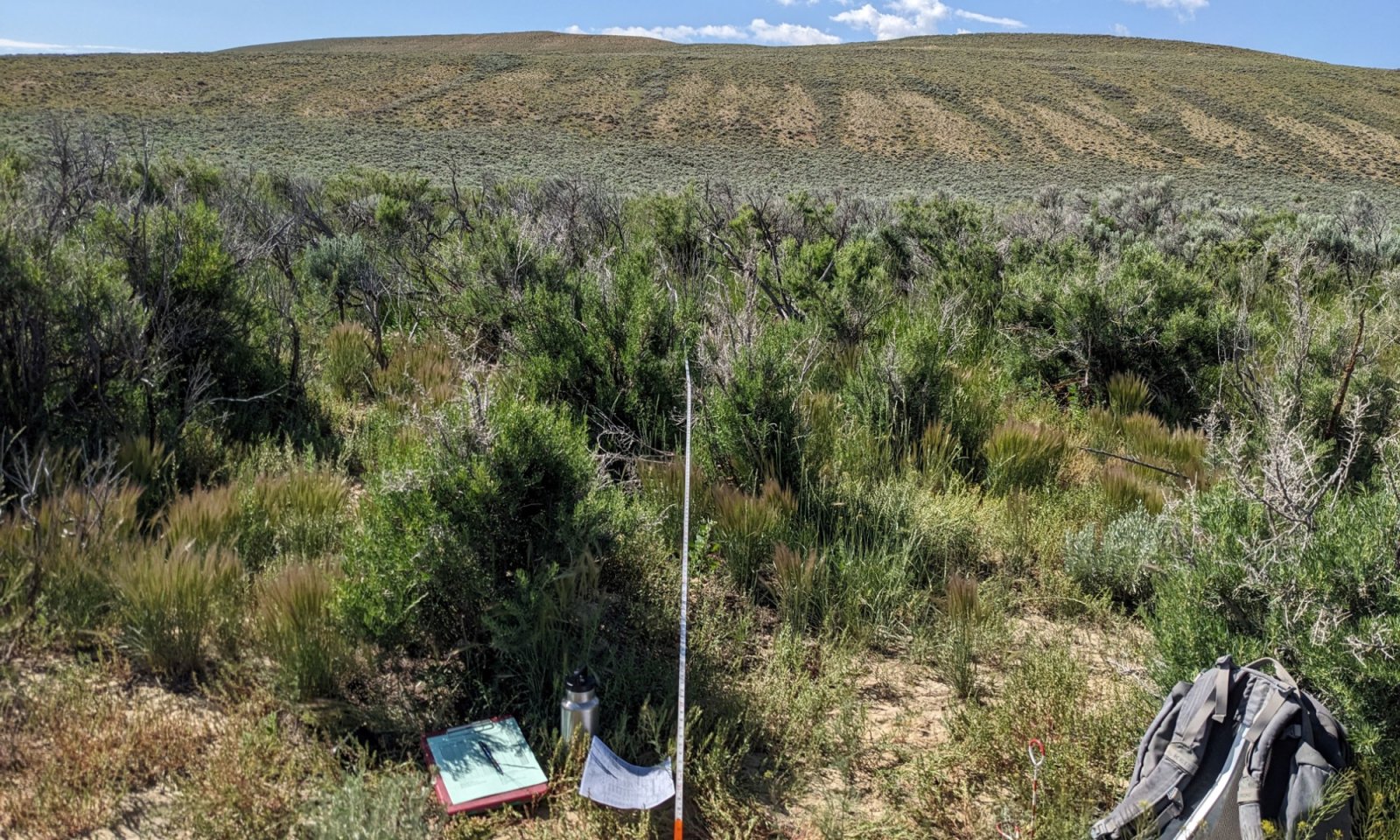
This site occurs on nearly level to gently sloping alluvial fans and alluvial bottoms. These sites receive additional run-in water from higher sites, but have a rare flood hazard because they normally have deep, well-defined stream channels. Slopes are mostly 0 to 2 percent. This site is found on alluvial fans and drainageways.
Table 2. Representative physiographic features
Landforms (1) Intermontane basin > Alluvial fan
(2) Intermontane basin > Drainageway
Flooding frequency None to rare Ponding frequency None Elevation 5800 – 6500 ft Slope 1 – 2 % Aspect Aspect is not a significant factor Table 3. Representative physiographic features (actual ranges)
Flooding frequency None to rare Ponding frequency None to frequent Elevation 5800 – 7180 ft Slope 1 – 8 % Climatic features
Annual precipitation ranges from 7 to 9 inches per year. Wide fluctuations may occur in yearly precipitation and result in more dry years than those with more than normal precipitation. Temperatures show a wide range between summer and winter and between daily maximums and minimums. This is predominantly due to the high elevation and dry air, which permits rapid incoming and outgoing radiation. Cold air outbreaks in winter move rapidly from northwest to southeast and account for extreme minimum temperatures. Extreme storms may occur during the winter, but most severely affect ranch operations during late winter and spring.
Daytime winds are generally stronger than nighttime and occasional strong storms may bring brief periods of high winds with gusts to more than 50 miles per hour.
Growth of native cool season plants begins about April 15 and continues to about August 15. Some green up of cool season plants usually occurs in September depending upon fall moisture occurrences.
For detailed information visit the Natural Resources Conservation Service National Water and Climate Center at http://www.wcc.nrcs.usda.gov/cgibin/state.pl?state=wy website.Table 4 Representative climatic features
Frost-free period (characteristic range) 70-90 days Freeze-free period (characteristic range) 110-120 days Precipitation total (characteristic range) 10-10 in Frost-free period (actual range) 70-90 days Freeze-free period (actual range) 100-130 days Precipitation total (actual range) 10-10 in Frost-free period (average) 80 days Freeze-free period (average) 110 days Precipitation total (average) 10 in Characteristic rangeActual rangeBarLineFigure 1. Monthly precipitation range
Characteristic rangeActual rangeBarLineFigure 2. Monthly minimum temperature range
Characteristic rangeActual rangeBarLineFigure 3. Monthly maximum temperature range
BarLineFigure 4. Monthly average minimum and maximum temperature
Figure 5. Annual precipitation pattern
Figure 6 Annual average temperature pattern
Climate stations used
-
(1) ROCK SPRINGS AP [USW00024027], Rock Springs, WY
-
(2) ROCK SPRINGS FIRE DEPARTMENT [USC00487847], Rock Springs, WY
-
(3) GREEN RIVER [USC00484065], Green River, WY
">Influencing water features
There are no water features associated with this site.
Wetland description
This site does not occur on wetlands but may occur adjacent to wetlands.
Soil features
The soils of this site are deep, loamy soils with high salinity. Parent material is from mixed sources. Surface textures may be sandy loam, fine sandy loam, loam, and silty clay loam with subsurface texture of clay loam, sandy clay loam, and silty clay.
Major soils correlated to this site include the Frandsen, Hawksell, and Alona series.Table 5. Representative soil features
Parent material (1) Alluvium – interbedded sedimentary rock
Surface texture (1) Sandy loam
(2) Fine sandy loam
(3) Loam
Family particle size (1) Clayey
Drainage class Somewhat poorly drained to well drained Permeability class Slow to moderately slow Soil depth 20 – 60 in Surface fragment cover <=3" 0 – 15 % Surface fragment cover >3" 0 – 10 % Available water capacity
(0-15in)1 – 3 in Calcium carbonate equivalent
(0-15in)5 – 15 % Electrical conductivity
(Depth not specified)8 – 16 mmhos/cm Sodium adsorption ratio
(0-15in)10 – 20 Soil reaction (1:1 water)
(0-15in)8.8 – 9.6 Subsurface fragment volume <=3"
(Depth not specified)0 – 15 % Subsurface fragment volume >3"
(Depth not specified)Not specified Table 6. Representative soil features (actual values)
Drainage class Well drained Permeability class Not specified Soil depth 0 in Surface fragment cover <=3" 0 % Surface fragment cover >3" 0 % Available water capacity
(0-15in)0.9 – 3 in Calcium carbonate equivalent
(0-15in)1 – 15 % Electrical conductivity
(Depth not specified)0 mmhos/cm Sodium adsorption ratio
(0-15in)2 – 15 Soil reaction (1:1 water)
(0-15in)0 Subsurface fragment volume <=3"
(Depth not specified)0 – 25 % Subsurface fragment volume >3"
(Depth not specified)0 % Ecological dynamics
As this site deteriorates from improper grazing management, species such as greasewood will increase and annual forbs will invade. Basin wildrye (Leymus cinereus) , Indian ricegrass (Achnatherum hymenoides), and Gardner’s saltbush (Atriplex gardneri) will decrease in frequency and production.
These plant communities narratives may not represent every possibility, but are the most prevalent and repeatable plant communities. The plant composition tables were developed from the best available knowledge at the time of this revision. As more data is collected, some of these plant communities may be revised or removed, and new ones may be added. None of these plant communities should necessarily be thought of as “Desired Plant Communities”. According to the USDA NRCS National Range and Pasture Handbook, Desired Plant Communities (DPCs) will be determined by the decision-makers and will meet minimum quality criteria established by the NRCS. The main purpose for including any description of a plant community here is to capture the current knowledge and experience at the time of this revision.
The Reference state (description follows in the plant community diagram) has been determined by study of rangeland relic areas, or areas protected from excessive disturbance. Trends in plant communities going from heavily grazed areas to lightly grazed areas, seasonal use pastures, and historical accounts have also been used.
The following is a state-and-transition model diagram that illustrates states and plant community phases that can occur on the site. The diagram also illustrates transitions and pathways between these states and community phases. The ecological processes will be discussed in more detail in the plant community narratives following the diagram.State and transition model
More interactive model formats are also available. View Interactive Models
Click on state and transition labels to scroll to the respective textEcosystem states
State 1 submodel, plant communities
State 2 submodel, plant communities
State 3 submodel, plant communities
State 1
Reference
The Reference state consists of three plant communities: the greasewood and basin wildrye community (1.1), the basin wildrye and greasewood community (1.2), and the basin wildrye and Gardner's saltbush community (1.3). Each plant community differs in percent composition and foliar cover of grasses and shrubs. Forbs are a minor component. The basin wildrye and greasewood plant community phase (1.2) is typically the early seral stages of this state. As greasewood becomes more dominant on this site, the site transitions to the greasewood and basin wildrye plant community (1.1). Drivers of these plant communities include: drought, fire, herbivory, and flood. To reach the greasewood and basin wildrye plant community, this ecological site must endure sufficient time without shrub killing events and overgrazing.
Dominant plant species
-
greasewood (Sarcobatus vermiculatus), shrub
-
basin wildrye (Leymus cinereus), grass
-
milkvetch (Astragalus), other herbaceous
-
aster (Aster), other herbaceous
Community 1.1
Greasewood and Basin Wildrye
This plant community is the reference plant community. This community usually consists of basin wildrye 20 to 40 percent, rhizomatous wheatgrass 5 to 10 percent, Sandberg bluegrass 5 to 10 percent, other perennial grasses 5 to 10 percent, perennial forbs 5 to 10 percent, greasewood 10 to 50 percent, Gardner's saltbush 5 to 15 percent, and 5 to 10 percent other woody plants. Ground cover, by ocular estimate, varies from 60 to 75 percent.
The total annual production (air-dry weight) of this state is about 1,000 pounds per acre, but it can range from about 700 pounds per acre in unfavorable years to about 1,300 pounds per acre in above average years.
This plant community is extremely stable and well adapted to the Cool Central Desertic Basins and Plateaus climatic conditions. The diversity in plant species and additional moisture allows for high drought tolerance. This is a sustainable plant community (site/soil stability, watershed function, and biologic integrity).
Events such as fire, flood, or continuous season long grazing will cause transitions to different plant communities and states. Shrub killing events such as fire will allow basin wildrye to become the dominant species and convert this plant community to the basin wildrye and greasewood plant community (1.2). Continuous season-long grazing will convert this plant community to the grazing resistant state in which basin greasewood and thickspike wheatgrass are the dominant plant species. Prolonged grazing reduces perennial bunchgrasses such as basin wildrye and increases rhizomatous grasses such as thickspike wheatgrass and Sandberg bluegrass.Dominant plant species
-
greasewood (Sarcobatus vermiculatus), shrub
-
basin wildrye (Leymus cinereus), grass
-
milkvetch (Astragalus), other herbaceous
-
aster (Aster), other herbaceous
Figure 7. Annual production by plant type (representative values) or group (midpoint values)
Table 7. Annual production by plant type
Plant type Low
(lb/acre)Representative value
(lb/acre)High
(lb/acre)Shrub/Vine 350 500 650 Grass/Grasslike 280 400 520 Forb 70 100 130 Total 700 1000 1300 Table 8. Ground cover
Tree foliar cover 0% Shrub/vine/liana foliar cover 30-60% Grass/grasslike foliar cover 20-50% Forb foliar cover 0-10% Non-vascular plants 0% Biological crusts 0% Litter 80-90% Surface fragments >0.25" and <=3" 0% Surface fragments >3" 0% Bedrock 0% Water 0% Bare ground 0-10% Table 9. Soil surface cover
Tree basal cover 0% Shrub/vine/liana basal cover 0-10% Grass/grasslike basal cover 0-0% Forb basal cover 0-0% Non-vascular plants 0% Biological crusts 0% Litter 0% Surface fragments >0.25" and <=3" 0% Surface fragments >3" 0% Bedrock 0% Water 0% Bare ground 100-100% Table 10. Canopy structure (% cover)
Height Above Ground (ft) Tree Shrub/Vine Grass/
GrasslikeForb <0.5 – 1-5% 1-20% 1-5% >0.5 <= 1 – 5-15% 20-40% 5-10% >1 <= 2 – 15-40% 40-60% – >2 <= 4.5 – 30-50% – – >4.5 <= 13 – – – – >13 <= 40 – – – – >40 <= 80 – – – – >80 <= 120 – – – – >120 – – – – Community 1.2
Basin Wildrye and Greasewood
This community usually consists of basin wildrye 20 to 40 percent, rhizomatous wheatgrass 5 to 10 percent, Sandberg bluegrass 10 to 20 percent, other perennial grasses 5 to 15 percent, perennial forbs 5 to 10 percent, greasewood 10 to 30 percent, Gardner's saltbush 5 to 15 percent, and 5 to 10 percent other woody plants. Ground cover, by ocular estimate, varies from 60 to 75 percent.
The total annual production (air-dry weight) of this state is about 1,000 pounds per acre, but it can range from about 700 pounds per acre in unfavorable years to about 1,300 pounds per acre in above average years.
This plant community is extremely stable and well adapted to the Cool Central Desertic Basins and Plateaus climatic conditions. The diversity in plant species and additional moisture allows for high drought tolerance. This is a sustainable plant community (site/soil stability, watershed function, and biologic integrity).
Events such as fire, flood, or continuous season long grazing will cause transitions to different plant communities and states. Shrub killing events such as fire will allow basin wildrye to become the dominant species and convert this plant community to the basin wildrye and greasewood plant community (1.2). Continuous season-long grazing will convert this plant community to the grazing resistant state in which basin greasewood and thickspike wheatgrass are the dominant plant species. Prolonged grazing reduces perennial bunchgrasses such as basin wildrye and increases rhizomatous grasses such as thickspike wheatgrass and Sandberg bluegrass.Dominant plant species
-
greasewood (Sarcobatus vermiculatus), shrub
-
basin wildrye (Leymus cinereus), grass
-
cryptantha (Cryptantha), other herbaceous
-
aster (Aster), other herbaceous
Figure 8. Annual production by plant type (representative values) or group (midpoint values)
Table 11. Annual production by plant type
Plant type Low
(lb/acre)Representative value
(lb/acre)High
(lb/acre)Grass/Grasslike 420 600 780 Shrub/Vine 245 350 455 Forb 35 50 65 Total 700 1000 1300 Table 12. Ground cover
Tree foliar cover 0% Shrub/vine/liana foliar cover 30-40% Grass/grasslike foliar cover 20-60% Forb foliar cover 0-10% Non-vascular plants 0% Biological crusts 0% Litter 0% Surface fragments >0.25" and <=3" 80-90% Surface fragments >3" 0% Bedrock 0% Water 0% Bare ground 0-10% Table 13. Soil surface cover
Tree basal cover 0% Shrub/vine/liana basal cover 0-10% Grass/grasslike basal cover 0-10% Forb basal cover 0-0% Non-vascular plants 0% Biological crusts 0% Litter 0% Surface fragments >0.25" and <=3" 0% Surface fragments >3" 0% Bedrock 0% Water 0% Bare ground 90-100% Table 14. Canopy structure (% cover)
Height Above Ground (ft) Tree Shrub/Vine Grass/
GrasslikeForb <0.5 – 1-5% 2-20% 1-5% >0.5 <= 1 – 5-15% 20-40% 5-10% >1 <= 2 – 15-30% 40-60% – >2 <= 4.5 – 20-30% – – >4.5 <= 13 – – – – >13 <= 40 – – – – >40 <= 80 – – – – >80 <= 120 – – – – >120 – – – – Pathway 1.1A
Community 1.1 to 1.2
Greasewood and Basin Wildrye
Basin Wildrye and GreasewoodShrub removing events such as fire, flood, drought, or chemical or mechanical treatments
Context dependence.A transition to a grass dominated phase is most commonly caused by fire, flood, or other shrub killing events. This site must be rested from grazing after such events, or this site will transition to the grazing resistant state (2.1).
Pathway 1.2A
Community 1.2 to 1.1
Basin Wildrye and Greasewood
Greasewood and Basin WildryeNatural succession, rest from grazing, fire, flood, and other disturbances. Summer grazing also accelerates this transition as grasses are preferred over shrubs during the summer.
Context dependence.A transition from the basin wildrye/greasewood community to the greasewood/basin wildrye community occurs through natural succession over time. Rest from grazing and other disturbance events allows this community to become shrub dominant. Additionally, this plant community should be grazed in the summer as grasses are preferred over shrubs during this time. Reduction of grass accelerates progression to a shrub dominated community (1.1).
State 2
Grazing Resistant
This state develops as a result of continuous grazing by wildlife and domestic livestock. Dominant grasses include thickspike wheatgrass and Sandberg bluegrass. Greasewood has increased, with annual production often reaching 65 percent. Rubber and yellow rabbitbrush may occur but typically do not exceed 10 percent combined. The total annual production (air-dry weight) of this state is about 600 pounds per acre, but it can range from about 400 pounds per acre in unfavorable years to about 1100 pounds per acre in above average years. The state is moderately stable and somewhat vulnerable to excessive erosion. The biotic integrity of this plant community is usually intact. However, this state can be at risk depending on how far a shift has occurred in plant composition towards greasewood. The watershed is usually functioning. However, it can become at risk when canopy cover of greasewood and/or bare ground increases.
Brush Management followed by deferment for 1 to 2 years as part of a prescribed grazing plan will eventually result in a plant community very similar to the reference plant community (greasewood and basin wildrye state). Care should be taken when planning brush management to consider wildlife habitat and critical winter ranges. Wildfire followed by heavy continuous season-long grazing will result in the invaded state.Dominant plant species
-
greasewood (Sarcobatus vermiculatus), shrub
-
thickspike wheatgrass (Elymus lanceolatus), grass
-
aster (Aster), other herbaceous
Community 2.1
Greasewood and Thickspike Wheatgrass
This plant community is a result of continuous grazing. Basin wildrye and other perennial bunchgrasses have decreased, and rhizomatous grasses such as thickspike wheatgrass have increased. Greasewood is the dominant shrub, often reaching 50 percent canopy cover. Yellow rabbitbrush and rubber rabbitbrush may be present, but typically never exceed 10 percent production. Production is normally around 600 pounds per acre but ranges from 400 pounds per acre on below average years to 1100 pounds per acre on above average years.
This plant community can return to the reference state or transition to the invaded state. To return to the reference state, brush management followed by deferment for 1 to 2 years as part of a prescribed grazing plan will eventually result in a plant community very similar to the greasewood and basin wildrye plant community (1.1). Care should be taken when planning brush management to consider wildlife habitat and critical winter ranges. A transition to the invaded state would be triggered by continuous heavy grazing and/or continuous heavy grazing after fire. Annuals such as cheatgrass and mustard may establish on the site, and the site may become more susceptible to erosion.Dominant plant species
-
greasewood (Sarcobatus vermiculatus), shrub
-
thickspike wheatgrass (Elymus lanceolatus), grass
-
aster (Aster), other herbaceous
Figure 9. Annual production by plant type (representative values) or group (midpoint values)
Table 15. Annual production by plant type
Plant type Low
(lb/acre)Representative value
(lb/acre)High
(lb/acre)Shrub/Vine 300 450 750 Grass/Grasslike 80 120 200 Forb 20 30 50 Total 400 600 1000 Table 16. Ground cover
Tree foliar cover 0% Shrub/vine/liana foliar cover 40-60% Grass/grasslike foliar cover 20-30% Forb foliar cover 0-10% Non-vascular plants 0% Biological crusts 0% Litter 80-90% Surface fragments >0.25" and <=3" 0% Surface fragments >3" 0% Bedrock 0% Water 0% Bare ground 0-0% Table 17. Soil surface cover
Tree basal cover 0% Shrub/vine/liana basal cover 0-0% Grass/grasslike basal cover 0-0% Forb basal cover 0-0% Non-vascular plants 0% Biological crusts 0% Litter 0% Surface fragments >0.25" and <=3" 0% Surface fragments >3" 0% Bedrock 0% Water 0% Bare ground 90-100% Table 18. Canopy structure (% cover)
Height Above Ground (ft) Tree Shrub/Vine Grass/
GrasslikeForb <0.5 – 1-5% 1-10% 1-5% >0.5 <= 1 – 5-15% 5-20% 5-10% >1 <= 2 – 10-45% 20-40% – >2 <= 4.5 – 45-60% – – >4.5 <= 13 – – – – >13 <= 40 – – – – >40 <= 80 – – – – >80 <= 120 – – – – >120 – – – – State 3
Invaded
This plant community is a result of heavy, season-long grazing by wildlife and livestock. Halogeton, Gardner’s saltbush, rhizomatous wheatgrass, and bare ground are also a major part of this state. Greasewood dominates, often exceeding 60 percent of the annual production. Sparse saline tolerant grasses and annual forbs make up the majority of the understory. The total annual production (air-dry weight) of this state is about 300 pounds per acre, but it can range from about 100 pounds per acre in unfavorable years to about 500 pounds per acre in above average years. The site is at risk and not well protected from excessive erosion. Grazing for wildlife and cattle has been reduced. The biotic integrity of this plant community is not intact. The amount of bare ground puts the watershed at risk for increased runoff. Chemical brush management and re-seeding followed by deferment for 1 to 2 years as part of a prescribed grazing plan may return this state to near reference plant community (greasewood and basin wildrye). Additional deferment may be necessary and should be prescribed on an individual site basis.
Dominant plant species
-
greasewood (Sarcobatus vermiculatus), shrub
-
yellow rabbitbrush (Chrysothamnus viscidiflorus), shrub
-
rubber rabbitbrush (Ericameria nauseosa), shrub
-
Gardner's saltbush (Atriplex gardneri), shrub
-
Sandberg bluegrass (Poa secunda), grass
-
thickspike wheatgrass (Elymus lanceolatus), grass
-
saltlover (Halogeton glomeratus), other herbaceous
Community 3.1
Greasewood and Cheatgrass
This plant community is a result of continuous grazing, or continuous grazing after a disturbance event such as fire. Basin wildrye and other perennial bunchgrasses are likely not present on the site. Halogeton usually dominates this site. Rhizomatous grasses such as thickspike wheatgrass have increased, and cheatgrass may be present on the site. Greasewood is the dominant shrub, sometimes reaching up to 40 percent canopy cover. Gardner's saltbush has also increased but never reaches above 15 percent production. Yellow rabbitbrush and rubber rabbitbrush may be present, but typically never exceed 10 percent production. Production is normally around 400 pounds per acre but ranges from 200 pounds per acre on below average years to 600 pounds per acre on above average years. Bare ground may exceed 50 percent, which puts this site at risk for excessive erosion and runoff.
This community will likely not return to the reference state without input. To return to the reference state, brush management and removal of halogeton through chemical or mechanical means will be necessary. Such treatments should be followed by deferment for two years or greater as part of a prescribed grazing plan. Such input will eventually result in a plant community very similar to the greasewood and basin wildrye plant community (1.1). Care should be taken when planning brush management to consider wildlife habitat and critical winter ranges.Dominant plant species
-
greasewood (Sarcobatus vermiculatus), shrub
-
cheatgrass (Bromus tectorum), grass
-
saltlover (Halogeton glomeratus), other herbaceous
Figure 10. Annual production by plant type (representative values) or group (midpoint values)
Table 19. Annual production by plant type
Plant type Low
(lb/acre)Representative value
(lb/acre)High
(lb/acre)Shrub/Vine 220 385 550 Grass/Grasslike 140 245 350 Forb 40 70 100 Total 400 700 1000 Table 20. Ground cover
Tree foliar cover 0% Shrub/vine/liana foliar cover 40-60% Grass/grasslike foliar cover 10-20% Forb foliar cover 10-40% Non-vascular plants 0% Biological crusts 0% Litter 70-90% Surface fragments >0.25" and <=3" 0% Surface fragments >3" 0% Bedrock 0% Water 0% Bare ground 0-10% Table 21. Soil surface cover
Tree basal cover 0% Shrub/vine/liana basal cover 0-0% Grass/grasslike basal cover 0-0% Forb basal cover 0-10% Non-vascular plants 0% Biological crusts 0% Litter 0% Surface fragments >0.25" and <=3" 0% Surface fragments >3" 0% Bedrock 0% Water 0% Bare ground 100-100% Table 22. Canopy structure (% cover)
Height Above Ground (ft) Tree Shrub/Vine Grass/
GrasslikeForb <0.5 – 1-5% 1-5% 10-20% >0.5 <= 1 – 5-15% 5-10% 5-60% >1 <= 2 – 10-45% 5-10% – >2 <= 4.5 – 45-60% – – >4.5 <= 13 – – – – >13 <= 40 – – – – >40 <= 80 – – – – >80 <= 120 – – – – >120 – – – – Transition T1A
State 1 to 2
Reference
Grazing ResistantContinuous grazing
Context dependence.A transition to the grazing resistant state depends on landform and severity of grazing, flooding, and fire. Narrow channels are usually more desirable to wildlife and livestock than surrounding upland areas, so these areas are grazed more intensely. Native bunchgrasses will be utilized quickly. Continuous grazing without rest will allow thickspike wheatgrass and greasewood to increase.
Transition T1B
State 1 to 3
Reference
InvadedContinuous grazing without sufficient rest after disturbance events
Context dependence.Fire, flood, or other disturbance events followed by insufficient rest from grazing can trigger a transition from the reference state to the invaded state. Such a transition must occur rapidly and depends on severity of disturbance events and grazing. Landform also affects the likelihood of such a transition; narrow channels are less susceptible to fire, despite being more desirable to wildlife and livestock than surrounding upland areas. Severe flooding followed by erosion, grazing, and compaction are the primary mechanisms for transition in a narrow channel. Such events allow invasive plants such as cheatgrass and halogeton to establish. In larger and less concave areas such as a flood plane, fire followed by erosion, grazing, and compaction allow invasive plants to establish.
Restoration pathway R2A
State 2 to 1
Grazing Resistant
ReferenceRest from grazing
Context dependence.Restoration to reference state depends on land form, severity of grazing, flooding, and fire. In narrow channels, native shrubs and bunchgrasses may be harder to restore because these areas are grazed more intensely than nearby upland areas. Restoration of shrubs after fire and flooding events is less likely in narrow channels if these areas are continuously grazed by livestock and wildlife. In larger areas such as floodplains, restoration is more likely to succeed as long as the area is rested from grazing. Reseeding and/or mechanical treatments may be necessary if the understory is overtaken by Gardner's saltbush. Such practices may allow native bunchgrasses to reestablish.
Transition T2A
State 2 to 3
Grazing Resistant
InvadedContinuous Grazing
Context dependence.As bare ground increases, invasive plants such as cheatgrass and halogeton establish on this site. A transition to the grazing resistant state depends on landform and severity of grazing, flooding, and fire. Disturbances such as fire will accelerate a transition from the grazing resistant state to the invaded state. Narrow channels are usually more desirable to wildlife and livestock than surrounding upland areas, so these areas are grazed more intensely and may become invaded more quickly.
Restoration pathway R3A
State 3 to 1
Invaded
ReferenceRest from grazing or rest from grazing with reseeding, mechanical, or herbicide treatments
Context dependence.Restoration to reference state depends on severity of prior disturbance events, grazing, landform, and prevalence of invasive plants. In narrow channels, native shrubs and bunchgrasses may be harder to restore because these areas are grazed more intensely than nearby upland areas. Restoration of shrubs after fire and flooding events is less likely in narrow channels if these areas are continuously grazed by livestock and wildlife. In larger areas such as floodplains, restoration is more likely to succeed as long as the area is rested from grazing. In all cases, additional input may be needed to restore native grasses and shrubs. Such input may include reseeding, herbicide treatments to remove cheatgrass and halogeton, and exclosure cages.
Restoration pathway R3B
State 3 to 2
Invaded
Grazing ResistantRest from grazing
Context dependence.Severity of grazing and compaction will determine how quickly shrubs and perennial bunchgrasses can reestablish. In some cases, annual grasses and undesirable forbs may completely dominate the site. Inputs such as herbicide treatment or prescribed fire may be necessary to return the state to the grazing resistant state, which will eventually return to the reference state.
Additional community tables
Table 23. Community 1.1 plant community composition
Group Common name Symbol Scientific name Annual production () Foliar cover (%) Grass/Grasslike1 Perennial Mid-Size Cool Season Bunchgrasses 50–250 basin wildrye LECI4 Leymus cinereus 50–250 5–25 Indian ricegrass ACHY Achnatherum hymenoides 10–100 1–10 squirreltail ELEL5 Elymus elymoides 0–100 0–10 needle and thread HECO26 Hesperostipa comata 0–100 0–10 slender wheatgrass ELTR7 Elymus trachycaulus 0–50 0–5 Sandberg bluegrass POSE Poa secunda 0–50 0–5 2 Rhizomatous Grasses 10–50 thickspike wheatgrass ELLAL Elymus lanceolatus ssp. lanceolatus 10–50 1–5 western wheatgrass PASM Pascopyrum smithii 0–50 0–5 3 Miscellaneous Grasses/Grass-likes 20–100 Sandberg bluegrass POSE Poa secunda 10–50 1–5 Grass, perennial 2GP Grass, perennial 0–50 0–5 Forb4 Perennial Forbs 20–90 aster SYMPH4 Symphyotrichum 0–50 0–5 lupine LUPIN Lupinus 10–50 1–5 hoary tansyaster MACA2 Machaeranthera canescens 0–30 0–3 bluebells MERTE Mertensia 0–30 0–3 locoweed OXYTR Oxytropis 0–30 0–3 tapertip hawksbeard CRAC2 Crepis acuminata 0–30 0–3 fleabane ERIGE2 Erigeron 0–30 0–3 buckwheat ERIOG Eriogonum 0–30 0–3 western yarrow ACMIO Achillea millefolium var. occidentalis 10–30 1–3 agoseris AGOSE Agoseris 0–30 0–3 flaxleaf plainsmustard SCLI Schoenocrambe linifolia 0–30 0–3 ragwort SENEC Senecio 0–30 0–3 beardtongue PENST Penstemon 0–30 0–3 longleaf phlox PHLO2 Phlox longifolia 0–30 0–3 cinquefoil POTEN Potentilla 0–30 0–3 sagebrush buttercup RAGL Ranunculus glaberrimus 0–10 0–1 onion ALLIU Allium 0–10 0–1 hollyleaf clover TRGY Trifolium gymnocarpon 0–10 0–1 clover TRIFO Trifolium 0–10 0–1 violet VIOLA Viola 0–10 0–1 Forb, perennial 2FP Forb, perennial 0–10 0–1 ipomopsis IPOMO2 Ipomopsis 0–10 0–1 Rocky Mountain iris IRMI Iris missouriensis 0–10 0–1 povertyweed IVAX Iva axillaris 0–10 0–1 Lewis flax LILE3 Linum lewisii 0–10 0–1 desertparsley LOMAT Lomatium 0–10 0–1 rockcress ARABI2 Arabis 0–10 0–1 milkvetch ASTRA Astragalus 0–10 0–1 Indian paintbrush CASTI2 Castilleja 0–10 0–1 pale bastard toadflax COUMP Comandra umbellata ssp. pallida 0–10 0–1 cryptantha CRYPT Cryptantha 0–10 0–1 larkspur DELPH Delphinium 0–10 0–1 5 Annual Forbs 0–10 rockjasmine ANDRO3 Androsace 0–10 0–1 goosefoot CHENO Chenopodium 0–10 0–1 bushy bird's beak CORA5 Cordylanthus ramosus 0–10 0–1 yellow owl's-clover ORLU2 Orthocarpus luteus 0–10 0–1 Forb, annual 2FA Forb, annual 0–10 0–1 Shrub/Vine6 Sagebrush 90–400 greasewood SAVE4 Sarcobatus vermiculatus 100–400 10–40 7 Miscellaneous Shrubs 20–100 basin big sagebrush ARTRT Artemisia tridentata ssp. tridentata 90–100 9–10 Wyoming big sagebrush ARTRW8 Artemisia tridentata ssp. wyomingensis 0–100 0–10 Gardner's saltbush ATGA Atriplex gardneri 10–100 1–10 yellow rabbitbrush CHVI8 Chrysothamnus viscidiflorus 10–50 1–5 rubber rabbitbrush ERNA10 Ericameria nauseosa 10–50 1–5 granite prickly phlox LIPU11 Linanthus pungens 0–30 0–3 Shrub (>.5m) 2SHRUB Shrub (>.5m) 0–10 0–1 Table 24. Community 1.2 plant community composition
Group Common name Symbol Scientific name Annual production () Foliar cover (%) Grass/Grasslike1 Perennial Mid-Size Cool Season Bunchgrasses 100–450 basin wildrye LECI4 Leymus cinereus 80–450 8–45 slender wheatgrass ELTR7 Elymus trachycaulus 50–200 5–20 needle and thread HECO26 Hesperostipa comata 0–100 0–10 Indian ricegrass ACHY Achnatherum hymenoides 10–100 1–10 squirreltail ELEL5 Elymus elymoides 0–100 0–10 Sandberg bluegrass POSE Poa secunda 50–100 5–10 2 Rhizomatous Grasses 10–50 thickspike wheatgrass ELLAL Elymus lanceolatus ssp. lanceolatus 0–50 0–5 western wheatgrass PASM Pascopyrum smithii 10–50 1–5 3 Miscellaneous Grasses 20–100 needleleaf sedge CADU6 Carex duriuscula 0–50 0–5 Sandberg bluegrass POSE Poa secunda 10–50 1–5 Grass, perennial 2GP Grass, perennial 0–50 0–5 Forb4 Perennial Forbs 10–40 aster SYMPH4 Symphyotrichum 0–50 0–5 fleabane ERIGE2 Erigeron 0–30 0–3 hoary tansyaster MACA2 Machaeranthera canescens 0–30 0–3 locoweed OXYTR Oxytropis 0–30 0–3 ragwort SENEC Senecio 0–30 0–3 agoseris AGOSE Agoseris 0–30 0–3 milkvetch ASTRA Astragalus 10–30 1–3 tapertip hawksbeard CRAC2 Crepis acuminata 0–30 0–3 cryptantha CRYPT Cryptantha 0–10 0–1 pale bastard toadflax COUMP Comandra umbellata ssp. pallida 0–10 0–1 onion ALLIU Allium 0–10 0–1 sagebrush buttercup RAGL Ranunculus glaberrimus 0–10 0–1 povertyweed IVAX Iva axillaris 0–10 0–1 Forb, perennial 2FP Forb, perennial 0–10 0–1 5 Annual Forbs 0–10 rockjasmine ANDRO3 Androsace 0–10 0–1 goosefoot CHENO Chenopodium 0–10 0–1 bushy bird's beak CORA5 Cordylanthus ramosus 0–10 0–1 yellow owl's-clover ORLU2 Orthocarpus luteus 0–10 0–1 Forb, annual 2FA Forb, annual 0–10 0–1 Shrub/Vine6 Greasewood 60–300 greasewood SAVE4 Sarcobatus vermiculatus 100–300 10–30 7 Miscellaneous Shrubs 10–50 basin big sagebrush ARTRT Artemisia tridentata ssp. tridentata 0–50 0–5 Wyoming big sagebrush ARTRW8 Artemisia tridentata ssp. wyomingensis 10–50 1–5 yellow rabbitbrush CHVI8 Chrysothamnus viscidiflorus 0–50 0–5 rubber rabbitbrush ERNA10 Ericameria nauseosa 0–50 0–5 granite prickly phlox LIPU11 Linanthus pungens 0–30 0–3 shortspine horsebrush TESP2 Tetradymia spinosa 0–10 0–1 Shrub (>.5m) 2SHRUB Shrub (>.5m) 0–10 0–1 Table 25. Community 2.1 plant community composition
Group Common name Symbol Scientific name Annual production () Foliar cover (%) Grass/Grasslike1 Perennial Mid-Size Cool season Bunchgrasses 12–20 Sandberg bluegrass POSE Poa secunda 6–70 3–35 Indian ricegrass ACHY Achnatherum hymenoides 6–20 3–10 squirreltail ELEL5 Elymus elymoides 0–20 0–10 needle and thread HECO26 Hesperostipa comata 0–20 0–10 slender wheatgrass ELTR7 Elymus trachycaulus 0–10 0–5 2 Rhizomatous Grasses 18–30 thickspike wheatgrass ELLAL Elymus lanceolatus ssp. lanceolatus 0–30 0–15 western wheatgrass PASM Pascopyrum smithii 16–30 8–15 3 Miscellaneous Grasses/Grasslikes 6–10 needleleaf sedge CADU6 Carex duriuscula 0–10 0–5 Sandberg bluegrass POSE Poa secunda 2–10 1–5 Grass, perennial 2GP Grass, perennial 0–10 0–5 Forb4 Perennial Forbs 6–8 aster SYMPH4 Symphyotrichum 0–8 0–4 ragwort SENEC Senecio 0–6 0–3 agoseris AGOSE Agoseris 0–6 0–3 milkvetch ASTRA Astragalus 2–6 1–3 tapertip hawksbeard CRAC2 Crepis acuminata 0–6 0–3 fleabane ERIGE2 Erigeron 0–6 0–3 hoary tansyaster MACA2 Machaeranthera canescens 0–6 0–3 locoweed OXYTR Oxytropis 0–6 0–3 western yarrow ACMIO Achillea millefolium var. occidentalis 2–4 1–2 onion ALLIU Allium 0–2 0–1 sagebrush buttercup RAGL Ranunculus glaberrimus 0–2 0–1 povertyweed IVAX Iva axillaris 0–2 0–1 cryptantha CRYPT Cryptantha 0–2 0–1 pale bastard toadflax COUMP Comandra umbellata ssp. pallida 0–2 0–1 Forb, perennial 2FP Forb, perennial 0–2 0–1 5 Annual Forbs 0–2 rockjasmine ANDRO3 Androsace 0–2 0–1 goosefoot CHENO Chenopodium 0–2 0–1 bushy bird's beak CORA5 Cordylanthus ramosus 0–2 0–1 yellow owl's-clover ORLU2 Orthocarpus luteus 0–2 0–1 Forb, annual 2FA Forb, annual 0–2 0–1 Shrub/Vine6 Greasewood 76–120 greasewood SAVE4 Sarcobatus vermiculatus 76–120 38–60 7 Miscellaneous Shrubs 6–10 yellow rabbitbrush CHVI8 Chrysothamnus viscidiflorus 2–10 1–5 rubber rabbitbrush ERNA10 Ericameria nauseosa 2–10 1–5 currant RIBES Ribes 0–10 0–5 Woods' rose ROWOW Rosa woodsii var. woodsii 0–10 0–5 granite prickly phlox LIPU11 Linanthus pungens 0–6 0–3 Shrub (>.5m) 2SHRUB Shrub (>.5m) 0–2 0–1 Table 26. Community 3.1 plant community composition
Group Common name Symbol Scientific name Annual production () Foliar cover (%) Grass/Grasslike1 Perennial Mid-Size Cool Season Bunchgrasses 28–35 Indian ricegrass ACHY Achnatherum hymenoides 7–35 1–5 squirreltail ELEL5 Elymus elymoides 0–35 0–5 slender wheatgrass ELTR7 Elymus trachycaulus 28–35 5 needle and thread HECO26 Hesperostipa comata 0–35 0–5 basin wildrye LECI4 Leymus cinereus 28–35 4–5 2 Rhizomatous Grasses 28–35 crested wheatgrass AGCR Agropyron cristatum 0–35 0–5 thickspike wheatgrass ELLAL Elymus lanceolatus ssp. lanceolatus 0–35 0–5 western wheatgrass PASM Pascopyrum smithii 0–35 4–5 3 Miscellaneous Grasses 35 needleleaf sedge CADU6 Carex duriuscula 0–35 0–5 Sandberg bluegrass POSE Poa secunda 1–35 1–5 Grass, perennial 2GP Grass, perennial 0–35 0–5 4 Annual Grasses 119–140 cheatgrass BRTE Bromus tectorum 7–140 1–20 Forb5 Perennial Forbs 0–7 saltlover HAGL Halogeton glomeratus 0–63 0–9 clasping pepperweed LEPE2 Lepidium perfoliatum 0–35 0–5 desert madwort ALDE Alyssum desertorum 0–35 0–5 goosefoot CHENO Chenopodium 0–14 0–2 bushy bird's beak CORA5 Cordylanthus ramosus 0–7 0–1 yellow owl's-clover ORLU2 Orthocarpus luteus 0–7 0–1 Forb, annual 2FA Forb, annual 0–7 0–1 Forb, annual 2FA Forb, annual 0–7 0–1 Shrub/Vine6 Greasewood 252–315 greasewood SAVE4 Sarcobatus vermiculatus 280–315 40–45 7 Miscellaneous Shrubs 56–70 Wyoming big sagebrush ARTRW8 Artemisia tridentata ssp. wyomingensis 0–70 0–10 Gardner's saltbush ATGA Atriplex gardneri 10–70 1–10 yellow rabbitbrush CHVI8 Chrysothamnus viscidiflorus 7–35 1–5 rubber rabbitbrush ERNA10 Ericameria nauseosa 7–35 1–5 currant RIBES Ribes 0–35 0–5 Woods' rose ROWOW Rosa woodsii var. woodsii 0–35 0–5 granite prickly phlox LIPU11 Linanthus pungens 0–21 0–3 Shrub (>.5m) 2SHRUB Shrub (>.5m) 0–7 0–1 Interpretations
Animal community
Animal Community – Wildlife Interpretations
Indian Ricegrass/Greasewood Plant Community (HCPC): The predominance of woody plants in this plant community provides winter grazing for deer and antelope. Suitable thermal and escape cover for deer may be limited due to the low quantities of tall woody plants. Structural diversity provides foraging, roosting, and nesting areas for song birds as well as desirable habitat for jackrabbits and cottontail rabbits. Sagebrush obligate species may frequent the area, but do not prefer this habitat.
Greasewood/Gardner’s Saltbush Plant Community: The predominance of woody plants in this plant community provides winter grazing for deer and antelope. Suitable thermal and escape cover for deer may be slightly improved from the Historical Climax Plant Community. Structural diversity provides foraging, roosting, and nesting areas for song birds as well as desirable habitat for jackrabbits and cottontail rabbits. Sagebrush obligate species may frequent the area, but do not prefer this habitat.
Animal Community – Grazing Interpretations
The following table lists suggested stocking rates for cattle under continuous season-long grazing under normal growing conditions. These are conservative estimates that should be used only as guidelines in the initial stages of the conservation planning process. Often, the current plant composition does not entirely match any particular plant community (as described in this ecological site description). Because of this, a field visit is recommended, in all cases, to document plant composition and production. More precise carrying capacity estimates should eventually be calculated using this information along with animal preference data, particularly when grazers other than cattle are involved. Under more intensive grazing management, improved harvest efficiencies can result in an increased carrying capacity.
Plant Community Production (lb./ac) and Carrying Capacity* (AUM/ac)
Indian Ricegrass/Greasewood (HCPC) 800-1600 lb./ac and .4 AUM/ac
Greasewood/Gardner’s Saltbush 300-800 lb./ac and .1 AUM/ac
* - Continuous, season-long grazing by cattle under average growing conditions.
Grazing by domestic livestock is one of the major income-producing industries in the area. Rangeland in this area may provide yearlong forage for cattle, sheep, or horses. During the dormant period, the forage for livestock use needs to be supplemented with protein because the quality does not meet minimum livestock requirements.Supporting information
Inventory data references
Ten low intensity plots collected by soil scientists in from 2021 to 2023 entered into NASIS. Individual observations are listed in EDIT and are viewable behind login.
References
-
Bestelmeyer, B., J.R. Brown, K.M. Havstad, B. Alexander, G. Chavez, and J.E. Herrick. 2003. Development and Use of State and Transition Models for Rangelands. Jornal of Range Management 56:114–126.
-
Bestelmeyer, B., J.R. Brown, J.E. Herrick, D.A. Trujillo, and K.M. Havstad. 2004. Land Management in the American Southwest: a state-and-transition approach to ecosystem
complexity. Environmental Management 34:38–51. -
Bestelmeyer, B.T., K. Moseley, P.L. Shaver, H. Sanchez, D.D. Briske, and M.E. Fernandez-Gimenez. 2010. Practical guidance for developing state-and-transition models. Rangelands 32:23–30.
-
Bestelmeyer, J., J.E. Herrick, J.R. Brown, D.A. Truillo, and K.M. Havstad. 2005. Land Management in the American Southwest: a State-and-Transition approach to ecosystem complexity. Environmental Management 34:38–51.
-
Bowker, K.A. 2000. Jonah Field: A Shallow Sweetspot in the Basin-Centered Gas Accumulation of the Northern Green River Basin, Wyoming..
-
Innes, R.J. 2019. Fire regimes of Wyoming big sagebrush and basin big sagebrush communities.. Fire Effects Information System. U.S. Department of Agriculture, Forest Service, Rocky Mountain Research Station, Missoula Fire Sciences Laboratory.
-
USDA, N. 2018 (Date accessed). The PLANTS Database. http://plants.usda.gov.
Other references
Species: Sarcobatus Vermiculatus. Fire Effects Information System. https://www.fs.usda.gov/database/feis/plants/shrub/sarver/all.html
Approval
Kirt Walstad, 5/07/2025
Rangeland health reference sheet
Interpreting Indicators of Rangeland Health is a qualitative assessment protocol used to determine ecosystem condition based on benchmark characteristics described in the Reference Sheet. A suite of 17 (or more) indicators are typically considered in an assessment. The ecological site(s) representative of an assessment location must be known prior to applying the protocol and must be verified based on soils and climate. Current plant community cannot be used to identify the ecological site.
Author(s)/participant(s) Contact for lead author Date 01/08/2025 Approved by Approval date Composition (Indicators 10 and 12) based on Annual Production Indicators
-
Number and extent of rills:
-
Presence of water flow patterns:
-
Number and height of erosional pedestals or terracettes:
-
Bare ground from Ecological Site Description or other studies (rock, litter, lichen, moss, plant canopy are not bare ground):
-
Number of gullies and erosion associated with gullies:
-
Extent of wind scoured, blowouts and/or depositional areas:
-
Amount of litter movement (describe size and distance expected to travel):
-
Soil surface (top few mm) resistance to erosion (stability values are averages - most sites will show a range of values):
-
Soil surface structure and SOM content (include type of structure and A-horizon color and thickness):
-
Effect of community phase composition (relative proportion of different functional groups) and spatial distribution on infiltration and runoff:
-
Presence and thickness of compaction layer (usually none; describe soil profile features which may be mistaken for compaction on this site):
-
Functional/Structural Groups (list in order of descending dominance by above-ground annual-production or live foliar cover using symbols: >>, >, = to indicate much greater than, greater than, and equal to):
Dominant:
Sub-dominant:
Other:
Additional:
-
Amount of plant mortality and decadence (include which functional groups are expected to show mortality or decadence):
-
Average percent litter cover (%) and depth ( in):
-
Expected annual annual-production (this is TOTAL above-ground annual-production, not just forage annual-production):
-
Potential invasive (including noxious) species (native and non-native). List species which BOTH characterize degraded states and have the potential to become a dominant or co-dominant species on the ecological site if their future establishment and growth is not actively controlled by management interventions. Species that become dominant for only one to several years (e.g., short-term response to drought or wildfire) are not invasive plants. Note that unlike other indicators, we are describing what is NOT expected in the reference state for the ecological site:
-
Perennial plant reproductive capability:
Print Options
Sections
Font
AAAAOther
PrintThe Ecosystem Dynamics Interpretive Tool is an information system framework developed by the USDA-ARS Jornada Experimental Range, USDA Natural Resources Conservation Service, and New Mexico State University.
Accessibility statement


