
Natural Resources
Conservation Service
Ecological site R030XY038CA
Flooded Gravelly Fans
Last updated: 10/21/2024
Accessed: 10/19/2026
-
Search


Major Land Resource Area or ecological site by name and/or ID.
PreviousSectionsNextGeneral information
Provisional. A provisional ecological site description has undergone quality control and quality assurance review. It contains a working state and transition model and enough information to identify the ecological site.
Click to explore map
Figure 1. Mapped extent
Areas shown in blue indicate the maximum mapped extent of this ecological site. Other ecological sites likely occur within the highlighted areas. It is also possible for this ecological site to occur outside of highlighted areas if detailed soil survey has not been completed or recently updated.
MLRA notes
Major Land Resource Area (MLRA): 030X–Mojave Basin and Range
MLRA statement:
Major Land Resource Area (MLRA) 30, Mojave Desert, is found in southern California, southern Nevada, the extreme southwest corner of Utah and northwestern Arizona within the Basin and Range Province of the Intermontane Plateaus. The climate of the area is hot (primarily hyperthermic and thermic; however at higher elevations, generally above 5000 feet, mesic, cryic and frigid) and dry (aridic). Elevations range from below sea level to over 12,000 feet in the higher mountain areas found within the MLRA. Due to the extreme elevational range found within this MLRA, land resource units (LRUs) were designated to group the MLRA into similar land units.LRU notes
"XY" LRU:
This LRU is found throughout the Mojave Desert MLRA. This LRU designation is set aside for ecological sites that are ubiquitous throughout the MLRA. These sites are driven by environmental or chemical features that override the climatic designations of the other LRU’s or are atypical compared to the surrounding landscape. Common overriding XY characteristics within this MLRA include: ephemeral streams subject to flash flood events, riparian areas or other water features, and soils with strong chemical influence (Na, Ca, etc).Ecological site concept
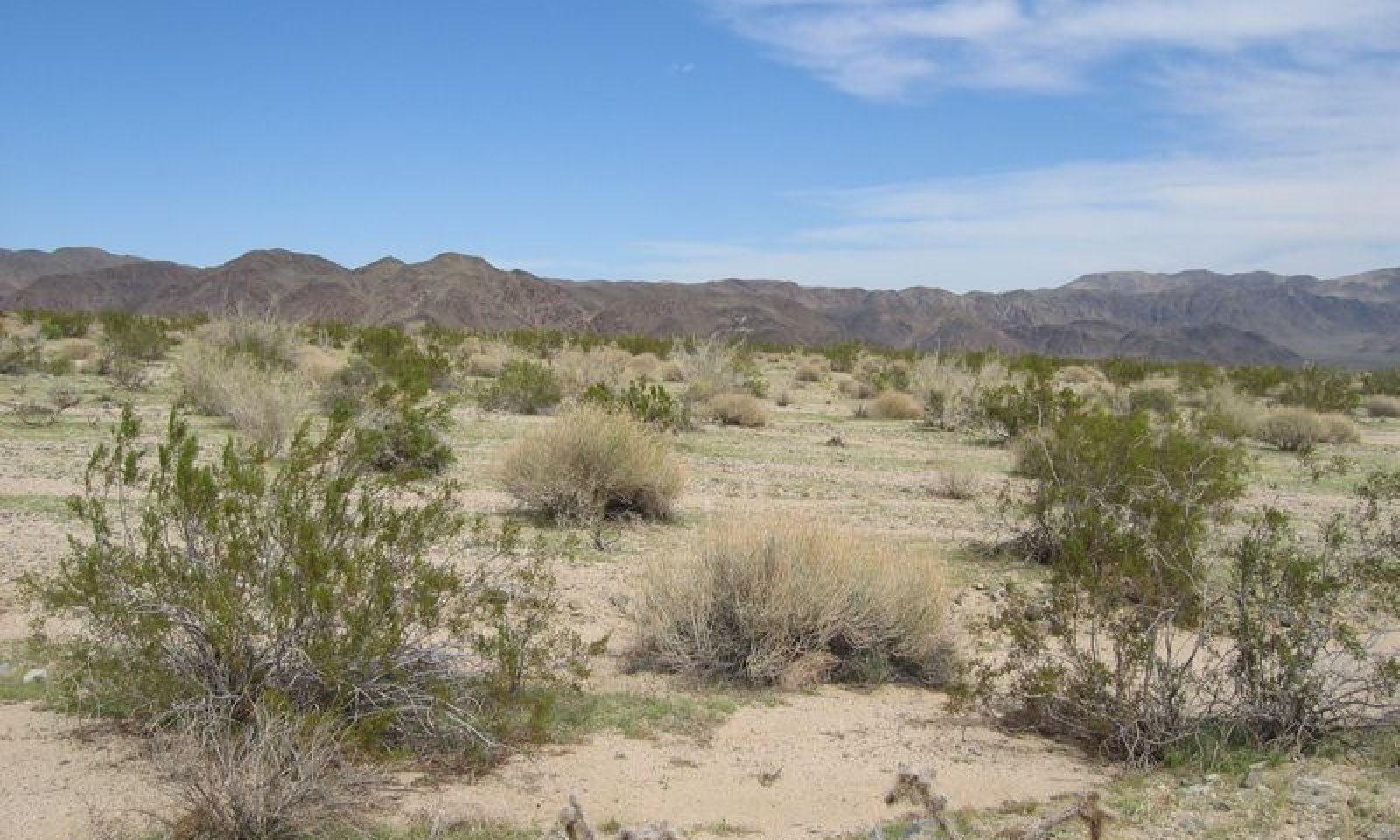
This ecological site occurs on channeled, rarely flooded alluvial fans and fan aprons that are within the transitional zone between thermic and hyperthermic soil temperatures. This site has rare sheet flood events. Soils are very deep sands with very gravelly to extremely gravelly modifiers. Flooding, gravelly soils, a channeled topography, and a transitional climate support a diverse shrub mixture, co-dominated by Schott’s dalea (Psorothamnus schottii), creosote bush (Larrea tridentata) and desertsenna (Senna armata).
Data ranges in the physiographic data, climate data, water features, and soil data sections of this Ecological Site Description are based on major and minor components.
This site is part of provisional group concept R030XB103NV.Associated sites
R030XB005NV Arid Active Alluvial Fans
This ecological site is on adjacent fan remnants with thermic soil temperatures, creosote bush, burrobush, and Mojave yucca are present.
R030XB186CA Mid Size Thermic To Hyperthermic Ephemeral Stream
This ephemeral stream is in drainageways with occasional to frequent flooding, and catclaw acacia is common.
R030XD002CA Desert Pavement
This is a hyperthermic desert pavement ecological site present on nearby stable fan remnants.
R030XD015CA Hyper-Arid Fans
This ecological site is on adjacent alluvial fans, which receive less intense flooding and creosote bush and burrobush are dominant.
R030XY001CA Occasionally Flooded, Hyperthermic, Diffuse Ephemeral Stream
This ephemeral stream is in drainageways and inset fans with occasional flooding and Schott's dalea and creosote bush are present.
R030XY092NV DESERT PATINA
This ecological site is on thermic desert pavement, on stable fan remnants with sparse creosote bush.
Similar sites
R030XY001CA Occasionally Flooded, Hyperthermic, Diffuse Ephemeral Stream
This ephemeral stream ecological site is in drainageways with occasional flooding, and lacks desertsenna and other species.
R030XY128CA Broad, Gravelly, Hyperthermic Ephemeral Stream
This ecological site has a large braided drainageway with an active channel dominated by burrobrush. Desert lavender is common and smoketree is occasionally present.
R030XB192CA Very Rarely Flooded, Warm Thermic Fan Piedmonts
This flooded alluvial fan has more jojoba and Schott's dalea is absent. It is generally at higher elevations, with cooler temperatures.
Table 1. Dominant plant species
Tree Not specified
Shrub (1) Larrea tridentata
(2) Senna armataHerbaceous (1) Pectocarya recurvata
(2) Malacothrix glabrataPhysiographic features
This ecological site is found on lower alluvial fans and fan aprons at elevations of 1510 to 3280 feet with slopes of 2 to 8 percent. The site experiences rare sheet flooding of extremely to very brief duration, no ponding, and the runoff class is very low.
Table 2. Representative physiographic features
Landforms (1) Fan apron
(2) Alluvial fan
Flooding duration Extremely brief (0.1 to 4 hours) to very brief (4 to 48 hours) Flooding frequency Rare Ponding frequency None Elevation 1510 – 3280 ft Slope 2 – 8 % Aspect Aspect is not a significant factor Climatic features
The climate is arid with hot, dry summers and warm, moist winters. The mean annual precipitation is 75 to 178 millimeters (3 to 7 inches) and the mean annual air temperature is 17 to 23 degrees C (63 to 73 degrees F.). The frost-free season is 270 to 340 days, and the freeze-free season is 320 to 360 days.
The tabular climate summary for this ESD was generated by the Climate Summarizer
(http://www.nm.nrcs.usda.gov/technical/handbooks/nrph/Climate_Summarizer.xls) using data from the climate stations listed below (results are unweighted averages).
Table 3 Representative climatic features
Frost-free period (average) 340 days Freeze-free period (average) 360 days Precipitation total (average) 10 in BarLineFigure 2. Monthly precipitation range
BarLineFigure 3. Monthly average minimum and maximum temperature
">Influencing water features
The site is subject to rare sheet flood events.
Soil features
The soils associated with this ecological site are very deep, excessively drained, and formed in alluvium from gneiss and/or granitoid parent material. The surface textures are loamy sand and gravelly sand. Subsurface horizons (1 to 59 inches) are composed of layers of sandy textures with very gravelly to extremely gravelly modifiers. Surface rock fragments less than 3 inches range from 22 to 42 percent cover, and fragments greater than 3 inches range from 3 to 17 percent cover. Subsurface volume of rock fragments less than 3 inches ranges from 40 to 60 percent, and greater that 3 inch fragments range from 0 to 30 percent.
This ecological site is correlated with the Carrizo and Arizo soil series. The Carrizo soils are: sandy-skeletal, mixed, hyperthermic Typic Torriorthents. The Arizo soils are: sandy-skeletal, mixed, thermic Typic Torriorthents. This ecological site exists along the transition between warm thermic soils and hyperthermic soils.
This ecological site is associated with the following map units and soil components within the Joshua Tree National Park Soil Survey (CA794):
Map unit ID; Map unit name; Component; Percent
4403; Arizo complex, 2 to 8 percent slopes; Arizo; rarely flooded, channeled; 50
1511; Carrizo complex, 2 to 8 percent slopes, flooded; Carrizo; channeled; 75
1512; Carrizo extremely gravelly loamy sand, 2 to 8 percent slopes; Carrizo; channeled; 3Table 4. Representative soil features
Parent material (1) Alluvium – granite
Surface texture (1) Loamy sand
(2) Gravelly sand
Family particle size (1) Sandy
Drainage class Excessively drained Permeability class Rapid Soil depth 59 – 0 in Surface fragment cover <=3" 22 – 42 % Surface fragment cover >3" 3 – 17 % Available water capacity
(0-40in)0.6 – 2.2 in Calcium carbonate equivalent
(0-40in)0 – 3 % Electrical conductivity
(0-40in)Not specified Sodium adsorption ratio
(0-40in)Not specified Soil reaction (1:1 water)
(0-40in)6.4 – 8.4 Subsurface fragment volume <=3"
(Depth not specified)40 – 60 % Subsurface fragment volume >3"
(Depth not specified)0 – 30 % Ecological dynamics
This ecological site occurs on channeled, rarely flooded alluvial fans and fan aprons that are within the transitional zone between thermic and hyperthermic soil temperatures. This site has rare sheet flood events. Soils are very deep sands with very gravelly to extremely gravelly modifiers. Flooding, very deep gravelly soils, a channeled topography, and a transitional climate support a diverse shrub mixture, co-dominated by Schott’s dalea, creosote bush and desertsenna.
This site is not considered an ephemeral stream as it does not have a defined drainageway or channel and is primarily a zone of infiltration. This site is on alluvial fans, near the mountain base. This area receives surface flow from mountain runoff. In addition, overflow from adjacent large drainageways may occur during large flood events. Since this site is adjacent to the mountains, there are larger rock fragments and high percentage of gravels on the soil surface and in the soil profile. Because, of the variation of disturbance across the alluvial fan, there is a high degree of temporal and spatial variability in the plant composition.
Lower and more channeled positions tend to have more frequent or intense flooding, and have higher diversity of species, while less flooded topographic positions are dominated by a more homogeneous creosote bush – burrobush (Ambrosia dumosa) shrubland. Creosote bush, Schott’s dalea, and desertsenna are dominant in areas with more flooding. Creosote bush is a dominant species throughout the Mojave and Sonoran Deserts on fan piedmonts with deep soils with thermic to hyperthermic soil temperatures. When disturbance rates are low, extreme longevity and low mortality rates allow creosote bush to be strongly dominant, but with recurrent disturbance, shorter-lived species are able to establish and persist in the plant community. Schott's dalea is a leguminous shrub, which depends on flood water for dispersal and seed germination (Vogl and McHargue 1966), and occurs on hyperthermic soils in habitats receiving additional run-on such as rocky hill-slopes, washes, and alluvial fans with regular sheet-flow. Desertsenna is also a leguminous shrub commonly found in Mojave and Sonoran desert wash habitats (Baldwin et al. 2002), and is associated with creosote bush communities subject to disturbances (Sawyer et al. 2009).
This ecological site is located near the northern distribution ranges of Schott’s dalea, teddy bear cholla (Cylindropuntia bigelovii) and ocotillo (Fouquieria splendens). These species are more common in the Sonoran Desert, which has hotter temperatures and receives a larger proportion of precipitation during summer from monsoons. Ocotillo has low cover, but a distinctive presence in portions of this ecological site. Its tall, thin, spiny branches stand above the shrub canopy, and its red flowers are striking in early spring. Ocotillo is also present in the Chihuahuan Desert in New Mexico and western Texas. Ocotillo is often associated with shallow rocky soils, but exists on very deep soils on this site. It has a shallow root system, quickly sheds its leaves in response to drought, and remains dormant after leaf abscission to avoid water stress. Ocotillo produces leaves immediately after precipitation, and retains them for a few weeks, but multiple leaf flushes can occur in a year. Ocotillo produces multiple winged seeds during winters of ample precipitation, but requires summer rains for seed germination and survival (Matthews 1994). Dense teddy bear cholla patches may occur within this ecological site. Teddy bear cholla is present in the warmer parts of the Mojave Desert, and in the hotter, drier parts of the Sonoran Desert. Teddy bear cholla seldom regenerates from seed, and reproduces primarily by vegetative means from joint segments that detach, develop roots, and new plants. The terminal joints detach easily in the cooler months, by a slight touch or wind. These large cholla gardens may be clones of one plant (Nabhan 2006). Sheet floods associated with this area may help break and disperse cholla pieces.
Other disturbances such as drought, fire, and human hydrologic alterations can affect the community composition and/or hydrologic process of this site. Drought is characteristic of the desert, and can cause mortality or die-back of vegetation. Decreased vegetative cover can lead to increased erosion and change sediment deposition patterns.
Historically fire was very uncommon in these ephemeral drainages; however the presence of continuous and flashy fuels from non-native grasses in adjacent upland sites can increase the likelihood of fire. Invasion by non-native annual grasses has increased the flammability of desert vegetation communities ( Brooks , Brooks et al. 2004), and after fire, Mojave Desert ecosystems appear to be more susceptible to invasion by exotic grasses, leading to a grass-fire cycle (D'Antonio and Vitousek 1992). Very wet (El Nino) years followed by severe drought produce conditions where large areas where creosote scrub burn (Brown and Minnich 1986, DeFalco et al. 2010).
Although not truly an ephemeral stream, this site maintains water quality by allowing energy dissipation during high water flow, and store sediments and nutrients in deposition zones. This site also provides temporary storage of surface water, and longer duration storage of subsurface water. The structure and forage provided by diverse vegetation, and the availability of water (although brief), significantly increases animal abundance in this diverse area, relative to unflooded sites (Levick et al. 2008).
Modifications to hydrology such as surface flow alterations and loss of vegetative cover can have irreversible impacts on hydrologic processes (Nishikawa et al. 2004, Levick et al. 2008). Altered surface flow can alter flow direction, and cause changes in erosion and sedimentation. The site may remain similar, as it has developed with disturbances. However, if water flow is eliminated from an area more stable upland species will dominate, similar to the drought phase described below. An increase in cover of impermeable surfaces (such as pavement, homes, malls, etc.) will reduce the amount of runoff that can infiltrate into the soil creating higher surface runoff and greater peak flows.State and transition model
Custom diagramStandard diagram
Figure 4. R030XY038CA Model
More interactive model formats are also available. View Interactive Models
More interactive model formats are also available. View Interactive Models
Click on state and transition labels to scroll to the respective textEcosystem states
Land use 2 submodel, ecosystem states
State 2 submodel, plant communities
State 1
Historic StateState 1 represents the historic-natural condition for this ecological site. It is similar to State 2, but has only native species. If we were to include dynamics for this state it would be the same as displayed in State 2. The presence of non-native species is minimal in State 2, and has not altered the hydrology or fire frequency.
State 2
Reference StateThis state represents the most common and most ecologically intact condition for this ecological site at the present time.
Community 2.1
Reference Community
Figure 5. Community Phase 2.1

Figure 6. Community Phase 2.1
This community is present on fan aprons and alluvial fans that are subject to sheet floods during larger precipitation events. Smaller precipitation events may create surface flow more frequently in the channeled positions of the fans. Sheet floods provide additional moisture and soil disturbance, which encourage the establishment of Schott's dalea, dessertsenna, and burrobrush (Hymenoclea salsola). Other shrubs include burrobush (Ambrosia dumosa), Wiggins' cholla (Cylindropuntia echinocarpa), branched pencil cholla (Cylindropuntia ramosissima), ocotillo, pricklypear (Opuntia basilaris), and jojoba (Simmondsia chinensis). Teddy bear cholla occurs primarily in one dense patch, and was not present in sampled plots.
The presence and abundance of annual forbs is dependent upon precipitation. The annual present at time of survey include: bristly fiddleneck (Amsinckia tessellate), whitemargin sandmat (Chamaesyce albomarginata), cryptantha (Cryptantha sp.), brittle spineflower (Chorizanthe brevicornu), pincushion flower (Chaenactis fremontii), sowthistle desertdandelion (Malacothrix sonchoides), smooth desertdandelion (Malacothrix glabrata), Mojave desertstar (Monoptilon bellioides), chuckwalla combseed (Pectocarya heterocarpa) curvenut combseed (Pectocarya recurvata), desert Indianwheat (Plantago ovata), and chia (Salvia columbariae). Perennials include grape soda lupine (Lupinus excubitus) and Parry's false prairie-clover (Marina parryi).
The non-native annual grasses, red brome (Bromus rubens) and Mediterranean grass (Schismus sp.) are present with low cover and production.Figure 7. Annual production by plant type (representative values) or group (midpoint values)
Table 5. Annual production by plant type
Plant type Low
(lb/acre)Representative value
(lb/acre)High
(lb/acre)Forb 0 120 550 Shrub/Vine 60 120 200 Grass/Grasslike 0 1 15 Total 60 241 765 Community 2.2
Drought ResponseThis community phase is characterized by strong dominance by creosote bush and Schott's dalea, with a decline in desertsenna and other short-lived species due to mortality and a lack of conditions suitable for establishment. Creosote bush is an evergreen species capable of utilizing moisture at any time of the year. This ability buffers populations from the effects of drought that occur as the absence of the winter rains (the primary source of moisture for this ecological site). Further, creosote bush germinates in response to moisture during the warm season, so may still recruit if warm season rains occur during winter drought (Hereford et al. 2006). Creosote bush exhibits branch-pruning during severe drought, but mortality during drought in the Mojave Desert is very low (Webb et al. 2003, Hereford et al. 2006). Schott's dalea depends on flood water for dispersal and seed germination (Vogl and McHargue 1966), so it will start to decline in the absence of sheet floods.
Community 2.3
Post-fire RegenerationThe postfire plant community is initially dominated by annuals and short-lived perennials. With time, short-lived shrubs capable of quickly colonizing after fire include desertsenna, burrobrush, and burrobush increase. These species produce abundant seeds that are easily dispersed to the burn after fire. Creosote bush is generally killed by fire, and is slow to re-colonize burned areas due to specific recruitment requirements (Brown and Minnich 1986, Brooks et al. 2007, Steers and Allen 2011). Schott's dalea, jojoba, and ocotillo are capable of resprouting after low or moderate intensity fire, but will take time to recover to previous stature and cover.
Pathway 2.1a
Community 2.1 to 2.2This pathway is caused by a prolonged or severe drought.
Pathway 2.1b
Community 2.1 to 2.3This pathway is caused by moderate to severe fire.
Pathway 2.2a
Community 2.2 to 2.1This pathway occurs with the return of average to above average precipitation and flood events.
Pathway 2.2b
Community 2.2 to 2.3This pathway occurs as a result of fire. Given low cover of annuals during drought, this pathway is unlikely except in periods immediately following heavy precipitation years.
Pathway 2.3a
Community 2.3 to 2.1This pathway occurs in response to the passing of time with average precipitation events and rare sheet floods.
Pathway 2.3b
Community 2.3 to 2.2This pathway occurs in response to the passing of time with drought conditions and absence of flooding.
Additional community tables
Table 6. Community 2.1 plant community composition
Group Common name Symbol Scientific name Annual production () Foliar cover (%) Shrub/Vine1 Native shrubs 60–200 creosote bush LATR2 Larrea tridentata 30–135 8–12 desertsenna SEAR8 Senna armata 10–50 1–5 Schott's dalea PSSC5 Psorothamnus schottii 3–10 3–5 ocotillo FOSP2 Fouquieria splendens 0–5 0–1 burrobush AMDU2 Ambrosia dumosa 0–2 1–2 Wiggins' cholla CYEC3 Cylindropuntia echinocarpa 0–1 0–1 branched pencil cholla CYRA9 Cylindropuntia ramosissima 0–1 0–1 burrobrush HYSA Hymenoclea salsola 0–1 0–1 jojoba SICH Simmondsia chinensis 0–1 0–1 beavertail pricklypear OPBA2 Opuntia basilaris 0–1 0–1 Forb2 Native forbs 0–550 curvenut combseed PERE Pectocarya recurvata 0–480 0–10 chuckwalla combseed PEHE Pectocarya heterocarpa 0–450 0–10 smooth desertdandelion MAGL3 Malacothrix glabrata 0–450 0–4 cryptantha CRYPT Cryptantha 0–80 0–3 brittle spineflower CHBR Chorizanthe brevicornu 0–72 0–2 pincushion flower CHFR Chaenactis fremontii 0–5 0–1 whitemargin sandmat CHAL11 Chamaesyce albomarginata 0–3 0–1 desert Indianwheat PLOV Plantago ovata 0–3 0–1 chia SACO6 Salvia columbariae 0–1 0–1 grape soda lupine LUEX Lupinus excubitus 0–1 0–1 bristly fiddleneck AMTE3 Amsinckia tessellata 0–1 0–1 Parry's false prairie-clover MAPA7 Marina parryi 0–1 0–1 sowthistle desertdandelion MASO Malacothrix sonchoides 0–1 0–1 Mojave desertstar MOBE2 Monoptilon bellioides 0–1 0–1 Grass/Grasslike3 Non-native annual grasses 0–15 Mediterranean grass SCHIS Schismus 0–15 0–1 red brome BRRU2 Bromus rubens 0–5 0–1 Table 7. Community 2.2 plant community composition
Group Common name Symbol Scientific name Annual production () Foliar cover (%) Table 8. Community 2.3 plant community composition
Group Common name Symbol Scientific name Annual production () Foliar cover (%) Interpretations
Animal community
This ecological site is habitat for the threatened desert tortoise (Gopherus agassizii agassizii). Creosote bush shrublands provides a home for an abundance of specialist insect species, for example, creosote bush flowers provide nutrition for over twenty species of bees, and the creosote bush grasshopper (Bootettix argentatus) feeds solely on creosote leaves (Pavlik 2008). The diverse vegetation provides shelter and forage for rodents, lizards, and birds. The cactus fruits are edible and nutritious. Some birds build their nest in the protection of the spiny chollas.
Hydrological functions
Water and sediments are dispersed across the alluvial fans, and surface flow infiltrates into the subsurface to provide deeper water storage.
Recreational uses
This ecological site has a variety of shrubs, which provide a display of colors when they bloom, dominated by yellow from desertsenna, and the red flowers of ocotillo. The cholla gardens are a popular tourist attraction, with a short nature trail.
Other products
Creosote bush is an important medicinal plant for Native Americans. It has a very wide range of uses from treatment for consumption, bowl complaints, and menstrual cramps, to induce vomiting, relief for arthritis, rheumatism, aching bones and sprains, congestion and cold, as an antiseptic and disinfectant, dandruff, antispasmodic, to induce urination, gonorrhea, and to cancer treatment. (This list is not exhaustive). http://herb.umd.umich.edu/herb/search.pl?searchstring=Larrea+tridentata.
Creosote bush stems are used to make weapons, digging tools, and basket handles, and creosote gum is used for knife and awl handles. Creosote bush branches are used as thatch in dwelling construction. http://herb.umd.umich.edu/herb/search.pl?searchstring=Larrea+tridentata.
The cholla fruits are edible and the prickly pear stems can be eaten once spines are removed (Phillips and Wentworth 2000).Supporting information
Inventory data references
1249704002 12495-162 12495-162-2 (Type location)
Type locality
Location 1: Riverside County, CA UTM zone N UTM northing 3754420 UTM easting 601077 General legal description The type location is about .1 mile north of the Pintobasin road, about 3 miles east of the Cholla Gardens, in Joshua Tree National Park. Other references
Baldwin, B. G., S. Boyd, B. J. Ertter, R. W. Patterson, T. J. Rosatti, and D. H. Wilken. 2002. The Jepson Desert Manual. University of California Press, Berkeley and Los Angeles, California.
Brooks, M. L. 1999. Habitat invasibility and dominance by alien annual plants in the western Mojave Desert. Biological Invasions 1:325-337.
Brooks, M. L., C. M. D'Antonio, D. M. Richardson, J. B. Grace, J. E. Keeley, J. M. DiTomaso, R. J. Hobbs, M. Pellant, and D. Pyke. 2004. Effects of invasive alien plants on fire regimes. Bioscience 54:677-689.
Brooks, M. L., T. C. Esque, and T. Duck. 2007. Creosotebush, blackbrush, and interior chaparral shrublands. RMRS-GTR-202.
Brown, D. E. and R. A. Minnich. 1986. Fire and Changes in Creosote Bush Scrub of the Western Sonoran Desert, California. American Midland Naturalist 116:411-422.
D'Antonio, C. M. and P. M. Vitousek. 1992. Biological invasions by exotic grasses, the grass/fire cycle, and global change. Annual Review of Ecology and Systematics 23:63-87.
DeFalco, L. A., T. C. Esque, S. J. Scoles-Sciulla, and J. Rodgers. 2010. Desert wildfire and severe drought diminish survivorship of the long-lived Joshua tree (Yucca brevifolia; Agavaceae). American Journal of Botany 97:243-250.
Levick, L., J. .Fonseca, D. Goodrich, M. Hernandez, D. Semmens, J. Stromberg, R. Leidy, M. Scianni, D. P. Guertin, M. Tluczek, and W. Kepner. 2008. The ecological and hydrological significance of ephemeral and intermittent streams in the arid and semi-arid American Southwest.
Matthews, R. F. 1994. Fouquieria splendens. In: Fire Effects Information System. U.S. Department of Agriculture, Forest Service, Rocky Mountain Research Station, Fire Sciences Laboratory
Nabhan, G. C. 2006. A Natural History of the Sonoran Desert. Genus Opuntia (incl. Cylindropuntia, Grusonia, and Corynopuntia), Flowering Plants of the Sonora Desert. . Arizona-Sonora Desert Museum, Tucson, Arizona.
Nishikawa, T., J. A. Izbicki, C. L. Stamos, and P. Martin. 2004. Evaluation of geohydrologic framework, recharge estimates, and ground-water flow of the Joshua Tree area, San Bernardino County, California., U.S. Geological Survey.
Pavlik, B. M. 2008. The California Deserts: an ecological rediscovery. University of California Press, Ltd., Berkeley and Los Angeles, California.
Phillips, S. and P. C. Wentworth. 2000. Genus Opuntia (incl. Cylidropuntia, Grusonia, and Corynopuntia). A natural history of the Sonoran Desert. Arizona-Sonora Desert Museum.
Sawyer, J. O., T. Keeler-Woolf, and J. M. Evans. 2009. A manual of California vegetation. 2nd edition. California Native Plant Society, Sacramento, California.
Steers, R. J. and E. B. Allen. 2011. Fire effects on perennial vegetation in the western Colorado Desert, USA. Fire Ecology 7:59-74.
Vogl, R. J. and L. T. McHargue. 1966. Vegetation of California palm oases on the San Andreas Fault. Ecology 47:532-540.Contributors
Marchel M. Munnecke
Marchel MunneckeApproval
Kendra Moseley, 10/21/2024
Rangeland health reference sheet
Interpreting Indicators of Rangeland Health is a qualitative assessment protocol used to determine ecosystem condition based on benchmark characteristics described in the Reference Sheet. A suite of 17 (or more) indicators are typically considered in an assessment. The ecological site(s) representative of an assessment location must be known prior to applying the protocol and must be verified based on soils and climate. Current plant community cannot be used to identify the ecological site.
Author(s)/participant(s) Contact for lead author Date 10/19/2026 Approved by Approval date Composition (Indicators 10 and 12) based on Annual Production Indicators
-
Number and extent of rills:
-
Presence of water flow patterns:
-
Number and height of erosional pedestals or terracettes:
-
Bare ground from Ecological Site Description or other studies (rock, litter, lichen, moss, plant canopy are not bare ground):
-
Number of gullies and erosion associated with gullies:
-
Extent of wind scoured, blowouts and/or depositional areas:
-
Amount of litter movement (describe size and distance expected to travel):
-
Soil surface (top few mm) resistance to erosion (stability values are averages - most sites will show a range of values):
-
Soil surface structure and SOM content (include type of structure and A-horizon color and thickness):
-
Effect of community phase composition (relative proportion of different functional groups) and spatial distribution on infiltration and runoff:
-
Presence and thickness of compaction layer (usually none; describe soil profile features which may be mistaken for compaction on this site):
-
Functional/Structural Groups (list in order of descending dominance by above-ground annual-production or live foliar cover using symbols: >>, >, = to indicate much greater than, greater than, and equal to):
Dominant:
Sub-dominant:
Other:
Additional:
-
Amount of plant mortality and decadence (include which functional groups are expected to show mortality or decadence):
-
Average percent litter cover (%) and depth ( in):
-
Expected annual annual-production (this is TOTAL above-ground annual-production, not just forage annual-production):
-
Potential invasive (including noxious) species (native and non-native). List species which BOTH characterize degraded states and have the potential to become a dominant or co-dominant species on the ecological site if their future establishment and growth is not actively controlled by management interventions. Species that become dominant for only one to several years (e.g., short-term response to drought or wildfire) are not invasive plants. Note that unlike other indicators, we are describing what is NOT expected in the reference state for the ecological site:
-
Perennial plant reproductive capability:
Print Options
Sections
Font
AAAAOther
PrintThe Ecosystem Dynamics Interpretive Tool is an information system framework developed by the USDA-ARS Jornada Experimental Range, USDA Natural Resources Conservation Service, and New Mexico State University.
Accessibility statement


