
Natural Resources
Conservation Service
Ecological site R030XD015CA
Hyper-Arid Fans
Last updated: 10/21/2024
Accessed: 10/16/2026
-
Search


Major Land Resource Area or ecological site by name and/or ID.
PreviousSectionsNextGeneral information
Provisional. A provisional ecological site description has undergone quality control and quality assurance review. It contains a working state and transition model and enough information to identify the ecological site.
Click to explore map
Figure 1. Mapped extent
Areas shown in blue indicate the maximum mapped extent of this ecological site. Other ecological sites likely occur within the highlighted areas. It is also possible for this ecological site to occur outside of highlighted areas if detailed soil survey has not been completed or recently updated.
MLRA notes
Major Land Resource Area (MLRA): 030X–Mojave Basin and Range
MLRA Description:
Major Land Resource Area (MLRA) 30, Mojave Desert, is found in southern California, southern Nevada, the extreme southwest corner of Utah and northwestern Arizona within the Basin and Range Province of the Intermontane Plateaus. The climate of the area is hot (primarily hyperthermic and thermic; however at higher elevations, generally above 5000 feet, mesic, cryic and frigid) and dry (aridic). Elevations range from below sea level to over 12,000 feet in the higher mountain areas found within the MLRA. Due to the extreme elevational range found within this MLRA, Land Resource Units (LRUs) were designated to group the MLRA into similar land units.LRU notes
This Land Resource Unit (designated by ‘XD’) is found on the eastern side of California. Elevations range from 400 to 2200 feet on average, but may be found up to 4000 feet on southern exposures. Precipitation ranges from 1 to 6 inches per year, but averages between 2-4 inches. This LRU is characterized primarily by the extreme aridity, hot temperatures, hyperthermic soil temperatures and low stature of widely spaced vegetation. Temperatures can reach over 110 degrees Fahrenheit for several weeks in July and August. Summer precipitation falls between July and September, ranging from 20-33% in the form of rain, and winter precipitation falls starting in November and ends between February and March, ranging from 56-70%, also mostly in the form of rain. Vegetation is primarily small, widely-spaced, low-producing creosote bush (Larrea tridentata), burrobush (Ambrosia dumosa), and brittlebush (Encelia farinosa).
Classification relationships
Mojave Creosote Bush (Holland 1986).
Larrea tridentata Shrubland Alliance (Sawyer et al. 2009).Ecological site concept
This ecological site occurs on gently sloping alluvial fans, fan aprons, and fan remnants at elevations of 960 to 2810 feet. Soils are typically very deep, but may be moderately deep to deep over a duripan. This site typically has rare sheet-flow due to flash-flooding events.
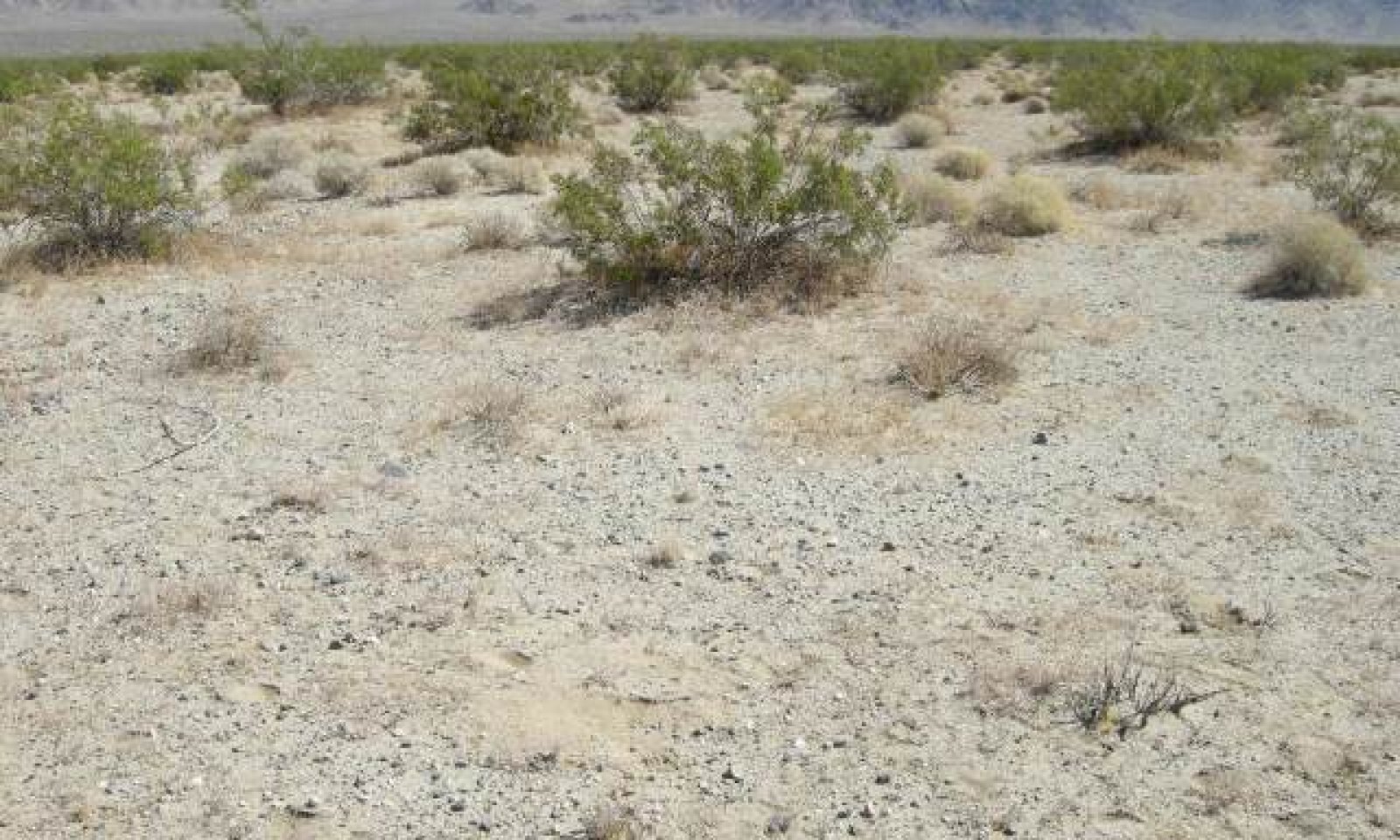
Production reference value (RV) is 139 pounds per acre, and ranges from 75 to 291 pounds per acre depending on annual precipitation. The site is co-dominated by creosote bush (Larrea tridentata) and burrobush (Ambrosia dumosa). A hyperthermic climate with rare additional run-on from sheet flooding drives the vegetation community of this ecological site. Creosote bush and burrobush are widespread dominants across the fan piedmont landscape of the Mojave Desert. Production, cover, density and diversity in this site are lower than the thermic equivalent of this site; however they are higher than on sites receiving no additional run-on.
The data in the following sections is from major (15% of map unit or greater) components only.
This is a group concept and provisional STM that also covers R030XB141NV.Associated sites
R030XD001CA Hyperthermic Dry Hills
This ecological site is found on north-facing hill and mountain slopes. Creosote bush (Larrea tridentata) and burrobush (Ambrosia dumosa) are dominant.
R030XD003CA Hyperthermic Steep South Slopes
This ecological site is found on adjacent south-facing mountain slopes. Brittlebush (Encelia farinosa) is dominant.
R030XD004CA Low-Production Hyperthermic Hills
This ecological site is found on adjacent steep sideslopes of fan remnants. Sparse vegetation is dominated by creosote bush (Larrea tridentata).
R030XD006CA Abandoned Fan
This ecological site occurs on adjacent fan aprons with no surface flooding. Creosote bush (Larrea tridentata) is dominant.
R030XD014CA Hyperthermic Sandy Plains
This ecological site is found on adjacent semi-active sandsheets. Big galleta (Pleuraphis rigida) is dominant.
R030XD025CA Hyperthermic Sandsheets
This ecological site is found on adjacent sandsheets. Creosote bush (Larrea tridentata) and big galleta (Pleuraphis rigida) dominate.
R030XD041CA Channeled Warm Alluvial Fans
This ecological site occurs on adjacent channeled, rarely flooded fan aprons. Creosote bush (Larrea tridentata), burrobush (Ambrosia dumosa) and brittlebush (Encelia farinosa) are co-dominant.
R030XD042CA Hyperthermic Shallow To Moderately Deep Fan Remnants
This ecological site is found on adjacent stable fan remnants with a high degree of soil horizon development. Vegetation is sparse and dominated by creosote bush (Larrea tridentata).
R030XY001CA Occasionally Flooded, Hyperthermic, Diffuse Ephemeral Stream
This ecological site occurs on adjacent occasionally flooded drainageways. Creosote bush (Larrea tridentata) and Schott's dalea (Psorothamnus schottii) dominate.
R030XY038CA Flooded Gravelly Fans
This ecological site is found on adjacent channeled inset fans. Vegetation is diverse and co-dominated by creosote bush (Larrea tridentata), desertsenna (Senna armata), and Schott's dalea (Psorothamnus schottii).
R030XY092NV DESERT PATINA
This ecological site occurs on adjacent very stable fan remnants with desert pavement surfaces. Vegetation is very sparse, and dominated by creosote bush (Larrea tridentata).
Similar sites
R030XB005NV Arid Active Alluvial Fans
This ecological site occurs on thermic soils at higher elevations. Shrub production, cover, density and diversity are higher.
R030XD041CA Channeled Warm Alluvial Fans
This ecological site occurs on rarely flooded, channeled, typically upper, fan aprons. Production is higher, shrub diversity is higher, and brittlebush (Encelia farinosa) is co-dominant with creosote bush (Larrea tridentata) and burrobush (Ambrosia dumosa).
R030XD042CA Hyperthermic Shallow To Moderately Deep Fan Remnants
This ecological site occurs on very stable fan remnants with a high degree of soil horizon development. Shrub production, cover and density are lower. Creosote bush (Larrea tridentata) is strongly dominant.
R030XD006CA Abandoned Fan
This ecological site occurs on landform positions receiving no additional sheet flooding, and/or in otherwise drier, hotter environments. Production, shrub cover, density and diversity are lower. Creosote bush (Larrea tridentata) is strongly dominant, and burrobush (Ambrosia dumosa) is trace if present.
Table 1. Dominant plant species
Tree Not specified
Shrub (1) Larrea tridentata
(2) Ambrosia dumosaHerbaceous Not specified
Physiographic features
This ecological site occurs on alluvial fans, fan aprons, and infrequently, fan remnants, at elevations of 960 to 2810 feet. Slopes range from 0 to 15 percent, but slopes under 8 percent are typical. The site experiences no to rare sheet flooding of extremely brief to very brief duration, and no ponding. Runoff class is negligible to low.
Table 2. Representative physiographic features
Landforms (1) Alluvial fan
(2) Fan apron
(3) Fan remnant
Flooding duration Extremely brief (0.1 to 4 hours) to very brief (4 to 48 hours) Flooding frequency None to rare Ponding frequency None Elevation 960 – 2810 ft Slope 0 – 15 % Aspect Aspect is not a significant factor Climatic features
The climate of this ecological site is characterized by hot temperatures, aridity, and a bimodal precipitation pattern. Precipitation falls as rain, with 30 percent falling in summer between July and October, and 65 percent falling in winter between November and March. The mean annual precipitation is 3 to 5 inches and mean annual air temperature is 68 to 73 degrees F. The frost free period is 300 to 340 days.
Maximum and minimum monthly climate data for this ESD were generated by the Climate Summarizer
(http://www.nm.nrcs.usda.gov/technical/handbooks/nrph/Climate_Summarizer.xls) using data
from the following climate stations (results are unweighted averages):
42598, Eagle Mountain, CA (Period of record = 1933 to 2011) [1]
43855, Hayfield Reservoir, CA (Period of record = 1933 to 2011) [1]
049099, Twentynine Palms, California (Period of record = 1935 to 2011) [1]
The data from multiple weather were combined to most accurately reflect the climatic conditions of this ecological site.
Table 3 Representative climatic features
Frost-free period (average) 340 days Freeze-free period (average) Precipitation total (average) 10 in BarLineFigure 2. Monthly precipitation range
BarLineFigure 3. Monthly average minimum and maximum temperature
">Influencing water features
Soil features
The soils associated with this ecological site are typically very deep, well to excessively drained and formed in alluvium from predominantly granitoid and/or gneissic (but may include igneous) sources. Less commonly, soils may be moderately deep to deep over a duripan. Dominant soils are sandy or sandy skeletal in the particle size control section, and permeability is moderately rapid to rapid. Surface textures include fine sand, loamy sand, sand and sandy loam with gravelly, very gravelly and extremely gravelly modifiers. Subsurface horizons (1 to 59 inches) are typically composed of stratified layers of sand and loamy sand textures with gravelly to extremely gravelly modifiers. However, subsurface horizons may also include a sandy clay loam argillic horizon, a cemented sand or gravelly loamy sand duripan horizon, or a calcic horizon. Surface gravels (< 3 mm in diameter) range from 30 to 75 percent, and larger fragments range from 0 to 11 percent. Subsurface gravels by volume (for a depth of 0 to 59 inches) range from 1 to 50 percent and larger fragments by volume range from 0 to 5 percent.
The associated soil series that are 15 percent or greater of any one map unit are: Pintobasin (mixed, hyperthermic Typic Torripsamments); Carrizo (sandy-skeletal, mixed, hyperthermic Typic Torriorthents); Perurose (sandy, mixed, hyperthermic Cambidic Haplodurids); Joetree (mixed, hyperthermic Typic Torripsamments); Patscamp (fine-loamy, mixed, superactive, hyperthermic calcic paleargids); and Buzzardsprings series (sandy, mixed, hyperthermic Typic Haplocalcids). Other soils on which this site is found are typically 10 percent or less of any map unit when associated with this site. They are: Rubylee (coarse-loamy, mixed, superactive, hyperthermic typic haplargids); Sunmill (coarse-loamy, mixed, superactive, hyperthermic Typic Calciargids); and Duric Petroargids. Buzzardsprings soils often have a desert pavement surface, but when associated with this ecological site, the pavement is incipient.
The Pintobasin and Carrizo soils are the soils most frequently associated with this ecological site. These soils are stratified layers of very deep sands with little horizon development. The Carrizo soils have coarser textures and are sandy-skeletal in the particle size control section. Joetree soils are also very deep sands, but have a buried argillic horizon below 100 centimeters. Buzzardsprings soils are very deep sands that include a calcic horizon. Patscamp soils are very deep, and have an abrupt textural change from gravelly sand to sandy clay loam where the argillic horizon starts at 10 inches below the soil surface. These soils have a high calcium carbonate content, with calcium carbonate equivalent up to 25 percent. Perurose soils are found on fan remnants, formed from igneous rocks, and are moderately deep to a duripan. When associated with this ecological site, these soils are rarely flooded. The Rubylee soils have a well developed argillic horizon beginning at 3 inches below the surface. These soils typically have a desert pavement surface, but do not when associated with this ecological site. Sunmill soils are very deep, and have an argillic horizon that begins 18 inches below the soil surface. The Duric Petroargids have loamy textures over a deep duripan.
This ecological site is correlated with the following map units and soil components in the Joshua Tree National Park Soil Survey:
Mapunit;Mapunit name; Component; Phase; Percent
2100;Perurose-Coxpin-Pintobasin association, 2 to 15 percent slopes;
1510;Carrizo very gravelly sandy loam, 2 to 4 percent slopes;Carrizo;very gravelly sandy loam;85
1512;Carrizo extremely gravelly loamy sand, 2 to 8 percent slopes;Carrizo;extremely gravelly loamy sand;80; Carrizo;rarely flooded;10
1514;Carrizo-Pintobasin-Rubylee complex, 0 to 4 percent slopes;Carrizo;rarely flooded;40
1520;Pintobasin loamy sand, 2 to 4 percent slopes;Carrizo;rarely flooded;5; Joetree; 5; Pintobasin;loamy sand;80
2405;Carrizo complex, 0 to 4 percent slopes;Carrizo;rarely flooded;65
1515;Pintobasin-Carrizo complex, 2 to 8 percent slopes;Duric Petroargids;;2
1520;Pintobasin loamy sand, 2 to 4 percent slopes;Joetree; 5
1526;Pintobasin-Joetree-Joetree complex, 2 to 8 percent slopes;Joetree; 20; Patscamp; 15; Sunmill;3
2101;Perurose-Pintobasin complex, 2 to 4 percent slopes;Perurose;rarely flooded;601516;Pintobasin fine sandy loam, 0 to 2 percent slopes;Pintobasin;rarely flooded;7; Pintobasin;rarely flooded;35
1517;Pintobasin-Dalelake complex, 2 to 8 percent slopes;Pintobasin;rarely flooded;3
1522;Pintobasin sand, 1 to 3 percent slopes, rarely flooded;Pintobasin;rarely flooded;85
1523;Pintobasin-Aquapeak association, 2 to 4 percent slopes;Pintobasin;rarely flooded;50; Rubylee; 5
1524;Pintobasin sand, 0 to 2 percent slopes;Pintobasin;rarely flooded;90
1525;Pintobasin complex, 2 to 4 percent slopes, flooded;Pintobasin;rarely flooded;35; Rubylee;5
1526;Pintobasin-Joetree-Joetree complex, 2 to 8 percent slopes;Pintobasin;rarely flooded;55; Sunmill; 3
1531;Dalelake-Pintobasin complex, 0 to 4 percent slopes;Pintobasin;rarely flooded;30; Rubylee; 3
2406;Pintobasin-Carrizo association, 0 to 2 percent slopes;Pintobasin;rarely flooded;10
2407;Pintobasin-Carrizo association, 2 to 4 percent slopes;Pintobasin;rarely flooded;45
Table 4. Representative soil features
Parent material (1) Alluvium – granite
Surface texture (1) Sand
(2) Loamy sand
(3) Very gravelly sand
Family particle size (1) Sandy
Drainage class Well drained to excessively drained Permeability class Moderate to rapid Soil depth 28 – 80 in Surface fragment cover <=3" 15 – 75 % Surface fragment cover >3" 0 – 35 % Available water capacity
(0-40in)0.9 – 5.6 in Calcium carbonate equivalent
(0-40in)0 – 25 % Electrical conductivity
(0-40in)0 – 2 mmhos/cm Sodium adsorption ratio
(0-40in)0 – 4 Soil reaction (1:1 water)
(0-40in)6 – 8.8 Subsurface fragment volume <=3"
(Depth not specified)1 – 50 % Subsurface fragment volume >3"
(Depth not specified)0 – 25 % Ecological dynamics
Abiotic Factors
This ecological site occurs on gently sloping alluvial fans, fan aprons, and fan remnants at elevations of 660 to 2810 feet. Soils are typically very deep, but may be shallow to a duripan when there is enough additional run-on. This site typically has rare sheet-flow due to flash-flooding events. A hyperthermic climate with rare additional run-on from sheet flooding drives the vegetation community of this ecological site. The reference plant community is a relatively sparse, open, low diversity and small-statured shrub community dominated by creosote bush (Larrea tridentata) and burrobush (Ambrosia dumosa). White ratany (Krameria grayi) is a common secondary shrub, and the perennial bunchgrass big galleta (Pleuraphis rigida) may be present at up to 1 percent cover.
Creosote bush – burrobush shrublands dominate fan piedmont landscapes at elevations below 4000 feet in the Mojave Desert (Rundel and Gibson 1996). In arid regions, the availability of moisture is the key resource driving the productivity and composition of vegetation (Noy-Meir 1973, McAuliffe 1994, Hamerlynk et al. 2000, Martre et al. 2002, Austin et al. 2004). Where soil temperature regimes are thermic (above approximately 2800 feet) and soil moisture availability is higher, shrub production, cover, density and diversity are higher (Bedford et al. 2009). Where the soil temperature regime is hyperthermic and moisture becomes more limiting such as this ecological site, shrub production, cover, density and diversity decline. When soil moisture become even more limiting, due to very low elevations and hot temperatures, absence of sheet-flow, restrictive surface cover such as desert pavement, or the presence of subsurface horizons that limit infiltration, the shrub community typically becomes even sparser, and is restricted to widely spaced, small creosote bush.
The soils associated with this ecological site are typically stratified layers of very deep sands with gravelly to extremely gravelly sand textures. However, subsurface horizons may also include a sandy clay loam argillic horizon, a duripan horizon, or a calcic horizon. In the hyperthermic environment of this ecological site, water availability is highest on coarse soils with little horizon development. This is because water drains rapidly through coarse textured, sandy soils, with minimal loss due to run-off and evaporation (Noy-Meir 1973, Austin et al. 2004). Deep, free-draining soils promote dominance by the deep-rooted, long-lived evergreen creosote bush (McAuliffe 1994, Hamerlynk et al. 2002, Hamerlynk and McAuliffe 2008). Rare sheet flow provides additional run-on moisture that increases water availability, and provides soil disturbance, which provides opportunities for establishment of secondary, shorter-lived shrub species such as burrobush. Additional horizon development, such as an argillic horizon, reduces infiltration and increases the availability of water at near surface depths, which also favors the shallow-rooted, drought-deciduous burrobush (Hamerlynk et al. 2002, Hamerlynk and McAuliffe 2008); and these soils do not need surface flooding to maintain the reference plant community.
Disturbance dynamics
The primary disturbances influencing this ecological site are drought, invasion by non-native annual plants, and fire, all of which interact. Drought is an important shaping force in Mojave Desert plant communities (Webb et al. 2003, Bowers 2005, Hereford et al. 2006, Miriti et al. 2007). Short-lived perennial shrubs and perennial grasses demonstrate the highest rates of mortality (Webb et al. 2003, Bowers 2005, Hereford et al. 2006, Miriti et al. 2007), and annual species remain dormant in the soil seedbank (Beatley 1969, 1974, 1976). Long-lived shrubs and trees are more likely to exhibit branch-pruning, and or limited recruitment during drought (e.g. Hereford et al. 2006, Miriti et al. 2007), leading to reduced cover and biomass in drought-afflicted communities.
Non-native annual species such as red brome (Bromus rubens), Mediterranean grass (Schismus barbatus), redstem stork’s bill (Erodium cicutarium) and Asian mustard (Brassica tournefortii) have become naturalized throughout the Mojave Desert over the past century (Rickard and Beatley 1965, D'Antonio and Vitousek 1992, Brooks 1999, Reid et al. 2006, Norton et al. 2007). In lower elevations, where soil temperature regimes are hyperthermic and soil moisture is more limiting, Mediterranean grass is the dominant non-native grass (Brooks and Berry 2006). Like native annuals, nonnative annual cover and production is directly related to winter precipitation (Beatley 1969, Brooks and Berry 2006, Barrows et al. 2009).
Invasion by non-native annual grasses has increased the flammability of Mojave Desert vegetation communities by providing a continuous fine fuel layer between widely spaced shrubs (Brown and Minnich 1986, Brooks 1999, Brooks et al. 2004, Rao and Allen 2010, Rao et al. 2010). After fire, these communities appear to be more susceptible to invasion by exotic grasses, leading to a grass-fire cycle (D'Antonio and Vitousek 1992). The low potential for high productivity of annual species in this ecological site means that it is relatively resilient to fire. However, after years of extremely high winter precipitation, this site may burn (Brown and Minnich 1986, Brooks et al. 2007).State and transition model
Custom diagramStandard diagram
Figure 4. R030XD015CA
More interactive model formats are also available. View Interactive Models
More interactive model formats are also available. View Interactive Models
Click on state and transition labels to scroll to the respective textEcosystem states
Land use 2 submodel, ecosystem states
Land use 3 submodel, ecosystem states
State 2 submodel, plant communities
State 3 submodel, plant communities
State 1
Historic StateState 1 represents the historic range of variability for this ecological site. This state no longer exists due to the ubiquitous naturalization of non-native species in the Mojave Desert. Periodic drought and rare fire were the natural disturbances influencing this ecological site. Fire would have been a very rare occurrence due to the lack of a continuous fine fuel layer between shrubs.
Data for this State does not exist, but dynamics and composition would have been similar to State 2, except with only native species present. See State 2 narrative for more detailed information.
State 2
Reference StateState 2 represents the current range of variability for this site. Non-native annuals, including red brome, Mediterranean grass, red-stem stork’s bill, and Asian mustard are naturalized in this plant community. Their abundance varies with precipitation, but they are at least sparsely present (as current year’s growth or present in the soil seedbank).
Community 2.1
Reference plant community
Figure 5. Community Phase 2.1
The reference plant community is maintained by periods of average climatic conditions and the absence of fire. It is co-dominated by creosote bush and burrobush. White ratany is typically present as a secondary shrub, and big galleta may be present at up to 1 percent cover. Native annual forbs are seasonally abundant, and common species include Cryptantha (Cryptantha spp.), sowthistle desertdandelion (Malacothrix sonchoides), smooth desert dandelion (Malacothrix glabrata), desert Indianwheat (Plantago ovata), and pincushion flower (Chaenactis fremontii). Red brome, Mediterranean grass and redstem stork’s bill are typically present at low levels, and Asian mustard may be present at up to 4 percent cover.
Figure 6. Annual production by plant type (representative values) or group (midpoint values)
Table 5. Annual production by plant type
Plant type Low
(lb/acre)Representative value
(lb/acre)High
(lb/acre)Shrub/Vine 75 128 205 Forb 0 9 80 Grass/Grasslike 0 2 6 Total 75 139 291 Community 2.2
Drought responseThis community phase is characterized by an overall decline in cover due to branch-pruning and lack of recruitment of longer-lived species, mortality of shorter-lived perennials, and lack of emergence of annual forbs and grasses. Burrobush and big galleta are likely to decline due to drought-induced mortality, while creosote bush remains stable.
Creosote bush is an evergreen species capable of utilizing moisture at any time of the year. This ability buffers populations from the effects of drought that occur as the absence of the winter rains (the primary source of moisture for this ecological site). Further, creosote bush germinates in response to moisture during the warm season, so may still recruit if warm season rains occur during winter drought (Hereford et al. 2006). Creosote bush exhibits branch-pruning during severe drought, but mortality during drought in the Mojave Desert is very low (Webb et al. 2003, Hereford et al. 2006). Nevertheless, during severe drought, creosote bush mortality may occur. Big galleta may suffer very high rates of drought-induced mortality (Webb et al. 2003; Hereford et al. 2006); however, big galleta can respond very quickly to brief, intermittent rain during rare summer monsoonal events, which can buffer big galleta populations in the absence of more predictable winter rains.
This community is at reduced risk of burning, and if it is ignited, will experience lower severity, smaller fires because of reductions in annual and perennial biomass (Minnich 2003). However, drought immediately after a period of heavy moisture, results in standing biomass of native fuels that may carry a fire one year post-production (Minnich 2003), and standing dead biomass of non-native annuals that may provide fuel for 2 -3 years post-fire (Minnich 2003; Rao et al. 2010).Community 2.3
Fire regeneration communityThis community phase is characterized by severe declines in creosote bush, and an increase in shrub diversity. Creosote bush is generally killed by fire, and is slow to re-colonize burned areas due to specific recruitment requirements (Brown and Minnich 1986, Brooks et al. 2007, Steers and Allen 2011). Creosote bush communities in the Mojave Desert may resemble the natural range of variation found in pre-fire conditions in terms of species composition in as little as nineteen years (Engel and Abella 2011), but creosote communities in the Colorado Desert may show little recovery after 30 years (Steers and Allen 2011). The timing and severity of fire, as well as post-fire climate conditions determines trajectories of recovery (Brown and Minnich 1986, Steers and Allen 2011).
Initially, the post-burn community is dominated by big galleta, non-native grasses, native annuals and native subshrubs. Native annuals likely to be present include smooth desertdandelion, pincushion flower, and cryptantha, but many different species could be at a particular site. Subshrubs that often become dominant after fire include desert globemallow (Sphaeralcea ambigua), desert trumpet (Eriogonum inflatum), brownplume wirelettuce (Stephanomeria pauciflora), and desert marigold (Baileya multiradiata). With time, shrub cover increases with colonization by short-lived shrubs from off-site dispersal (including burrobush, Cooper’s goldenbush (Ericameria cooperi), and snakeweed (Gutierrezia spp.). With a long period of time without fire, creosote bush begins to regain dominance as shorter-lived species die out (Vasek 1983, Abella 2009, Vamstad 2009).
This community is an at-risk phase, as the increased cover and biomass of big galleta and non-native annual grasses increases the likelihood of repeat burning.If the fire return interval is less than 20 years, this community is very likely to transition to State 3.
Pathway 2.1a
Community 2.1 to 2.2This pathway occurs with prolonged or severe drought.
Pathway 2.1b
Community 2.1 to 2.3This pathway occurs with moderate to severe fire.
Pathway 2.2a
Community 2.2 to 2.1This pathway occurs with a return to average or above average precipitation.
Pathway 2.2b
Community 2.2 to 2.3This pathway occurs with moderate to severe fire, and takes place within three years of a very wet period. At longer than three years of drought, the community is at low risk of burning.
Pathway 2.3a
Community 2.3 to 2.1This pathway occurs with time without fire and without other additional disturbance.
State 3
Repeated FireThis state develops when the fire return interval is less than 20 years. This state has been significantly altered from the natural range of variability found in States 1 and 2. Creosote bush is lost, and non-native annual grasses, native sub-shrubs, and short-lived shrubs dominate the community. Annual grasses and forbs are abundant immediately post-fire, with dominance by perennial grasses, subshrubs and short-lived perennials several years post-fire.
Community 3.1
Subshrubs/Short-lived shrubsThis community phase develops with time without fire (5-20 years), and is dominated by big galleta, subshrubs (desert globemallow, desert trumpet, brownplume wirelettuce and desert marigold) and short-lived shrubs (burrobush, Cooper’s goldenbush, snakeweed species). There is high cover of non-native and native annuals during wet years.
This community is at high risk of repeat burning due to high cover of fine fuels.
Community 3.2
Annual grass/forbsThis community phase occurs one to five years post-fire. The community is dominated by non-native annual species including red brome, Mediterranean grass and red-stem stork’s bill, and native forbs. Native subshrubs including globemallow, desert trumpet, brownplume wirelettuce and desert marigold may be abundant. Big galleta cover is relatively high. Seedlings of short-lived shrubs may be present, and may include burrobush, Cooper’s goldenbush, and snakeweed species. .
This community is at high-risk of repeat burning due to high fine fuel cover. This community is also susceptible to wind and water erosion, due to the loss of stabilizing shrub cover (Bull 1997). This can lead to arroyo development near ephemeral drainage channels. Furthermore, the loss of vegetation structure present in the historic and reference state decreases the suitability of this habitat for wildlife (Brooks et al. 2007, Vamstad 2009). Since rodent seed caching is important for the dispersal and establishment of many desert species this can further inhibit recovery.
Pathway 3.1a
Community 3.1 to 3.2This pathway occurs with fire.
Pathway 3.2a
Community 3.2 to 3.1This pathway occurs with time without fire (> 5 years).
Transition 1
State 1 to 2This transition occurred with the naturalization of non-native species in this ecological site. Non-native species were introduced with settlement of the Mojave Desert region in the 1860s. Post-settlement cattle and sheep grazing, as well as dryland farming, helped to spread and facilitate their establishment (Brooks and Pyke 2000, Brooks et al. 2007).
Transition 2
State 2 to 3This transition occurs when the fire return interval is less than 20 years, or when the fire regeneration community suffers additional disturbance such as off-road vehicle use.
Restoration pathway 1
State 3 to 2Restoration of arid desert communities severely altered by repeat fire at the landscape scale is very difficult (Allen 1993). Reducing invasion of non-native grasses that increase after fire may help promote native plant recovery, and reduce the probability of repeat burning (Fuhrmann et al. 2009, Matchett et al. 2009, Steers and Allen 2010); however, accomplishing this at a landscape scale, for a time period long enough to be effective, has not yet been accomplished. In small-scale trials, Fusilade, a grass-specific herbicide, was successful in reducing invasive grasses in burned creosote bush communities in the Colorado Desert in the initial three years after fire (Steers and Allen 2010). The long-term efficacy of such treatments on a landscape scale, and non-target effects have not yet been determined. The pre-emergent herbicide Plateau was applied in conjunction with aerial seeding of natives after fire in Zion National Park (Fuhrmann et al. 2009, Matchett et al. 2009). Initial results indicate that autumn application of Plateau after fire is most effective for reducing cheatgrass (<a class="species-link" href="https://plants.usda.gov/core/profile?symbol=BRTE" target="_blank" title="Open in plants.usda.gov"><i>Bromus tectorum</i></a>), but longer-term monitoring is needed to evaluate long-term and non-target effects. In addition to controlling invasive species, active recovery of native vegetation may be attempted. Methods may include seeding of early native colonizers such as desert globemallow, burrobrush, threeawns (Aristida spp.), and desert marigold (e.g. Abella et al. 2009, Abella et al. 2012). Increased native cover may help to reduce non-native plant invasion, helps to stabilize soils, provides a source of food and cover for wildlife, including desert tortoise (Gopherus agassizii), and provides microsites that facilitate creosote bush establishment. However, the amount of seed required for success is often prohibitive. Large-scale planting of both early colonizers and community dominants tends to be more successful in terms of plant survival, especially if outplants receive supplemental watering during the first two years (Allen 1993). Creosote bush and burrobush can be successfully propagated and outplanted (Joshua Tree National Park).
Additional community tables
Table 6. Community 2.1 plant community composition
Group Common name Symbol Scientific name Annual production () Foliar cover (%) Shrub/Vine1 Native shrubs 75–205 creosote bush LATR2 Larrea tridentata 16–195 3–13 burrobush AMDU2 Ambrosia dumosa 5–65 1–4 white ratany KRGR Krameria grayi 0–12 0–2 Grass/Grasslike2 Native grass 0–6 big galleta PLRI3 Pleuraphis rigida 0–6 0–1 5 Non-native annual grasses 0–1 red brome BRRU2 Bromus rubens 0–1 0–1 Mediterranean grass SCHIS Schismus 0 0–1 Forb3 Native Forbs 0–140 cryptantha CRYPT Cryptantha 0–113 0–13 sowthistle desertdandelion MASO Malacothrix sonchoides 0–54 0–7 smooth desertdandelion MAGL3 Malacothrix glabrata 0–11 0–9 desert Indianwheat PLOV Plantago ovata 0–4 0–8 pincushion flower CHFR Chaenactis fremontii 0–3 0–1 buckwheat ERIOG Eriogonum 0–1 0–1 4 Non-native annual forbs 0–20 Asian mustard BRTO Brassica tournefortii 0–20 0–4 redstem stork's bill ERCI6 Erodium cicutarium 0–1 0 Table 7. Community 2.2 plant community composition
Group Common name Symbol Scientific name Annual production () Foliar cover (%) Table 8. Community 2.3 plant community composition
Group Common name Symbol Scientific name Annual production () Foliar cover (%) Table 9. Community 3.1 plant community composition
Group Common name Symbol Scientific name Annual production () Foliar cover (%) Table 10. Community 3.2 plant community composition
Group Common name Symbol Scientific name Annual production () Foliar cover (%) Interpretations
Animal community
This ecological site provides critical habitat for the threatened desert tortoise (Gopherus agassizii agassizii). Creosote bush shrublands provides a home for an abundance of specialist insect species, for example, creosote bush flowers provide nutrition for over twenty species of bees, and the creosote bush grasshopper (Bootettix argentatus) feeds solely on creosote leaves (Pavlik 2008).
Recreational uses
This site is highly valued for open space and those interested in desert ecology. Desert tortoise, annual wildflowers and shrubs may also attract visitors during the spring months.
Other products
Creosote bush is an important medicinal plant for Native Americans. It has a very wide range of uses from treatment for consumption, bowl complaints, and menstrual cramps, to induce vomiting, relief for arthritis, rheumatism, aching bones and sprains, congestion and cold, as an antiseptic and disinfectant, dandruff, antispasmodic, to induce urination, gonorrhea, and to cancer treatment. (This list is not exhaustive). http://herb.umd.umich.edu/herb/search.pl?searchstring=Larrea+tridentata.
Creosote bush stems are used to make weapons, digging tools, and basket handles, and creosote gum is used for knife and awl handles. Creosote bush branches are used as thatch in dwelling construction. http://herb.umd.umich.edu/herb/search.pl?searchstring=Larrea+tridentata.
Supporting information
Inventory data references
The following NRCS plots were used to describe this ecological site: FRWA-02 (Type location) COMO-01 F1-L FL-D FRWA-03 G1-F I4-D I5-F J1-B J3-E J3-G Jtee-1 PIMO-03 PIMO-05 PIMO-09 PIWE-05 X-11 X-16 OD-D 217-180-2 CC-11b CC-12 CC-18 CC-2 CC-5 CC-6b CC-8
Type locality
Location 1: San Bernardino County, CA UTM zone N UTM northing 3752900 UTM easting 606325 General legal description The type location is in the Pinto Basin in Joshua Tree National Park, approximately 1 mile west of the Turkey Flat Trailhead and 0.37 miles north of the Pinto Basin Road. Other references
Abella, S. R., D. J. Craig, S. D. Smith, and A. C. Newton. 2012. Identifying native vegetation for reducing exotic species during the restoration of desert ecossytems. Restoration Ecology.
Abella, S. R., J. L. Gunn, M. L. Daniels, J. D. Springer, and S. E. Nyoka. 2009. Using a diverse seed mix to establish native plants on a Sonoran Desert burn. Native Plants Journal 10:21-31.
Abella, S. R. 2009. Post-fire plant recovery in the Mojave and Sonoran Deserts of western North America. Journal of Arid Environments 73:699-707.
Allen, E. B. 1993. Restoration ecology: limits and possibilities in arid and semiarid lands. Pages 7-15 in Wildland shrub and arid land restoration symposium. U.S. Department of Agriculture, Forest Service, Intermountain Research Station, Las Vegas, NV.
Austin, A. T., L. Yahdjian, J. M. Stark, J. Belnap, A. Porporato, U. Norton, D. A. Ravetta, and S. M. Scheaeffer. 2004. Water pulses and biogeochemical cycles in arid and semiarid ecosystems. Oecologia 141:221-235.
Barrows, C. W., E. B. Allen, M. L. Brooks, and M. F. Allen. 2009. Effects of an invasive plant on a desert sand dune landscape. Biological Invasions 11:673-686.
Beatley, J. C. 1969. Dependence of desert rodents on winter annuals and precipitation. Ecology 50:721-724.
Beatley, J. C. 1974. Effects of rainfall and temperature on the distribution and behavior of Larrea tridentata (Creosote-bush) in the Mojave Desert of Nevada. Ecology 55:245-261.
Beatley, J. C. 1976. Rainfall and fluctuating plant populations in relation to distributions and numbers of desert rodents in southern Nevada. Oecologia 24:21-42.
Bedford, D. R., D. M. Miller, K. M. Schmidt, and G. A. Phelps. 2009. Landscape-scale relationships between surficial geology, soil texture, topography, and creosote bush size and density in the eastern Mojave Desert of California. Pages 252-277 in R. H. Webb, L. F. Fenstermaker, J. S. Heaton, D. L. Hughson, E. V. McDonald, and D. H. Miller, editors. The Mojave Desert: ecosystem processes and sustainability. University of Nevada Press, Reno, NV.
Bowers, J. E. 2005. Effects of drought on shrub survival and longevity in the northern Sonoran Desert. Journal of the Torrey Botanical Society 132:421-431.
Brooks, M. L. 1999. Habitat invasibility and dominance by alien annual plants in the western Mojave Desert. Biological Invasions 1:325-337.
Brooks, M. L. and K. H. Berry. 2006. Dominance and environmental correlates of alien annual plants in the Mojave Desert, USA. Journal of Arid Environments 67:100-124.
Brooks, M. L., C. M. D'Antonio, D. M. Richardson, J. B. Grace, J. E. Keeley, J. M. DiTomaso, R. J. Hobbs, M. Pellant, and D. Pyke. 2004. Effects of invasive alien plants on fire regimes. Bioscience 54:677-689.
Brooks, M. L., T. C. Esque, and T. Duck. 2007. Creosotebush, blackbrush, and interior chaparral shrublands. RMRS-GTR-202.
Brooks, M. L. and D. A. Pyke. 2000. Invasive plants and fire in the deserts of North America. Pages 1-14 in Fire conference 2000: the first national congress on fire ecology, prevention, and management. Tall Timbers Research Station, Tallahassee, FL.
Brown, D. E. and R. A. Minnich. 1986. Fire and Changes in Creosote Bush Scrub of the Western Sonoran Desert, California. American Midland Naturalist 116:411-422.
Bull, W. B. 1997. Discontinuous ephemeral streams. Geomorphology 19:227-276.
D'Antonio, C. M. and P. M. Vitousek. 1992. Biological invasions by exotic grasses, the grass/fire cycle, and global change. Annual Review of Ecology and Systematics 23:63-87.
Engel, E. C. and S. R. Abella. 2011. Vegetation recovery in a desert landscape after wildfires: influences of community type, time since fire and contingency effects. Journal of Applied Ecology 48:1401-1410.
Fuhrmann, K., K. Weber, and C. Decker. 2009. Restoring burned areas at Zion National Park (Utah). Restoration Ecology 27:132-133.
Hamerlynk, E. P. and J. R. McAuliffe. 2008. Soil-dependent canopy die-back and plant mortality in two Mojave Desert shrubs. Journal of Arid Environments 72:1793-1802.
Hamerlynk, E. P., J. R. McAuliffe, E. V. McDonald, and S. D. Smith. 2002. Ecological responses of two Mojave desert shrubs to soil horizon development and soil water dynamics. Ecology 83:768-779.
Hamerlynk, E. P., J. R. McAuliffe, and S. D. Smith. 2000. Effects of surface and sub-surface soil horizons on the seasonal performance of Larrea tridentata (creosotebush). Functional Ecology 14:596-606.
Hereford, R., R. H. Webb, and C. I. Longpre. 2006. Precipitation history and ecosystem response to multidecadal precipitation variability in the Mojave Desert region, 1893-2001. Journal of Arid Environments 67:13-34.
Holland, R. F. 1986. Preliminary descriptions of the terrestrial natural communities of California. State of California Department of Fish and Game, Sacramento, CA.
Martre, P., G. B. North, E. G. Bobich, and P. S. Nobel. 2002. Root deployment and shoot growth for two desert species in response to soil rockiness. American Journal of Botany 89:1933-1939.
Matchett, J. R., A. O'Neill, M. Brooks, C. Decker, J. Vollmer, and C. Deuser. 2009. Reducing fine fuel loads, controlling invasive annual grasses, and manipulating vegetation composition in Zion Canyon, Utah. Joint Fire Science Program, El Portal, California.
McAuliffe, J. R. 1994. Landscape evolution, soil formation, and ecological patterns and processes in Sonoran Desert bajadas. Ecological Monographs 64:112-148.
Minnich, R. A. 2003. Fire and dynamics of temperature desert woodlands in Joshua Tree National Park. Contract, Joshua Tree National Park.
Miriti, M. N., S. Rodriguez-Buritica, S. J. Wright, and H. F. Howe. 2007. Episodic death across species of desert shrubs. Ecology 88:32-36.
Norton, J. B., T. A. Monaco, and U. Norton. 2007. Mediterranean annual grasses in western North America: kids in a candy store. Plant Soil 298:1-5.
Noy-Meir, I. 1973. Desert ecosystems: environment and producers. Annual Review of Ecology and Systematics 4:25-51.
Pavlik, B. M. 2008. The California Deserts: an ecological rediscovery. University of California Press, Ltd., Berkeley and Los Angeles, California.
Rao, L. E. and E. B. Allen. 2010. Combined effects of precipitation and nitrogen deposition on native and invasive winter annual production in California deserts. Oecologia 162:1035-1046.
Rao, L. E., E. B. Allen, and T. M. Meixner. 2010. Risk-based determination of critical nitrogen deposition loads for fire spread in southern California deserts. Ecological Applications 20:1320-1335.
Reid, C. R., S. Goodrich, and J. E. Bowns. 2006. Cheatgrass and red brome: history and biology of two invaders. Pages 27-32 in Shrublands under fire: disturbance and recovery in a changing world. U.S. Department of Agriculture, Forest Service, Rocky Mountain Research Station, Cedar City, Utah.
Rickard, W. H. and J. C. Beatley. 1965. Canopy-coverage of the desert shrub vegetation mosaic of the Nevada test site. Ecology 46:524-529.
Rundel, P. W. and A. C. Gibson. 1996. Ecological communities and processes in a Mojave Desert Ecosystem: Rock Valley Nevada. Cambridge University Press, Cambridge, England.
Sawyer, J. O., T. Keeler-Woolf, and J. M. Evans. 2009. A manual of California vegetation. 2nd edition. California Native Plant Society, Sacramento, California.
Steers, R. J. and E. B. Allen. 2010. Post-fire control of invasive plants promotes native recovery in a burned desert shrubland. Restoration Ecology 18:334-343.
Steers, R. J. and E. B. Allen. 2011. Fire effects on perennial vegetation in the western Colorado Desert, USA. Fire Ecology 7:59-74.
Vamstad, M. S. 2009. Effects of fire on vegetation and small mammal communities in a Mojave Desert Joshua tree woodland. M.S. University of California, Riverside, Riverside, Ca.
Vasek, F. C. 1983. Plant succession in the Mojave Desert. Crossosoma 9:1-23.
Webb, R. H., M. B. Muroy, T. C. Esque, D. E. Boyer, L. A. DeFalco, D. F. Haines, D. Oldershaw, S. J. Scoles, K. A. Thomas, J. B. Blainey, and P. A. Medica. 2003. Perennial vegetation data from permanent plots on the Nevada Test Site, Nye County, Nevada. U.S. Geological Society, Tucson, AZ.
Contributors
Alice Lee Miller
Heath McAllisterApproval
Kendra Moseley, 10/21/2024
Rangeland health reference sheet
Interpreting Indicators of Rangeland Health is a qualitative assessment protocol used to determine ecosystem condition based on benchmark characteristics described in the Reference Sheet. A suite of 17 (or more) indicators are typically considered in an assessment. The ecological site(s) representative of an assessment location must be known prior to applying the protocol and must be verified based on soils and climate. Current plant community cannot be used to identify the ecological site.
Author(s)/participant(s) Dustin Detweiler Contact for lead author Dustin Detweiler Date 10/29/2014 Approved by Approval date Composition (Indicators 10 and 12) based on Annual Production Indicators
-
Number and extent of rills:
Rills are none to few. Rills may increase shortly after intense storms, especially on steeper slopes due to the extremely arid conditions of this site. -
Presence of water flow patterns:
Water flow patterns are none to few. Patterns may increase in areas recently subject to intense summer rainfall, on steeper slopes and adjacent to wash areas. Water flow patterns are generally greater than 100 feet apart. -
Number and height of erosional pedestals or terracettes:
Pedestals are rare with occurrence typically limited to areas within water flow patterns. -
Bare ground from Ecological Site Description or other studies (rock, litter, lichen, moss, plant canopy are not bare ground):
There may be as much as 60% bare ground at this site. Areas with lower bare ground percentages usually have higher gravel cover. In general, perennial plant cover is less than 15% with the majority of the remaining cover being some form of bare ground, gravel, cobble or litter cover. -
Number of gullies and erosion associated with gullies:
None -
Extent of wind scoured, blowouts and/or depositional areas:
There are no blowouts at this site. Wind scoured areas are somewhat common due to the sparse vegetation cover and high wind storms which generate dust devils. Areas with higher gravel cover may be wind scoured areas. Depositional mounds beneath shrubs and dust devils are common to this site. -
Amount of litter movement (describe size and distance expected to travel):
Fine herbaceous litter is usually moved until it is trapped by vegetation. Intershrub areas are usually devoid of any fine herbaceous litter. Fine woody litter may be moved up to five feet from plants. -
Soil surface (top few mm) resistance to erosion (stability values are averages - most sites will show a range of values):
Subsurface and surface areas without any biological crusts can have a soil stability value up to 1. Incipient algal/fungal crusts can have a stability rating between 4 and 5. Biological soil crusts may be under shrubs or in the intershrub spaces. -
Soil surface structure and SOM content (include type of structure and A-horizon color and thickness):
Soil surface structure is weak thin platy structure to moderate very thick platy structure with light colors. A horizons are from 1 to 15 centimeters thick with 0 to 0.5 % organic matter. -
Effect of community phase composition (relative proportion of different functional groups) and spatial distribution on infiltration and runoff:
Shrubs trap eolian material which increase infiltration at the base of the shrubs. Incipient algal/fungal crusts may reduce infiltration in the intershrub spaces while redistributing runoff to the shrub patches. It is possible that this interaction may be critical to the rangeland health of this ecological site. Disturbance of biological soil crust cover has the potential to increase infiltration in the intershrub spaces but because of limited water availability, increased infiltration within the intershrub spaces could lead to decreased plant vigor and may limit seed germination and seedling establishment at this site. The effects of disturbance on biological crusts are not fully understood at this time. -
Presence and thickness of compaction layer (usually none; describe soil profile features which may be mistaken for compaction on this site):
None. Platy or massive sub-surface horizons, subsoil argillic horizons or hardpans shallow to the surface are not to be interpreted as compacted layers. -
Functional/Structural Groups (list in order of descending dominance by above-ground annual-production or live foliar cover using symbols: >>, >, = to indicate much greater than, greater than, and equal to):
Dominant:
Creosote bush > burrobushSub-dominant:
Native annual forbs > native annual grasses > perennial grassesOther:
Additional:
-
Amount of plant mortality and decadence (include which functional groups are expected to show mortality or decadence):
Dead branches within individual shrubs are common. Burrobush and perennial grasses are the first to exhibit mortality during drought. A lack in the presence of annual species, live or standing dead may suggest extreme drought conditions exist where grazing is not present. -
Average percent litter cover (%) and depth ( in):
Litter cover at this site can range from 1 to 15 % and is based on plant material separated from the plant. This litter determination does not include standing dead annual or dead perennial plants. Much of the litter at this site is found beneath plants. If precipitation in the past year has produced an abundance of annuals in the inter-shrub spaces, the percent litter cover can be expected to increase as annuals break down and standing dead capture moving plant debris. Litter is usually very small pieces of plant debris. Trace amounts of some fine woody litter may also be present. -
Expected annual annual-production (this is TOTAL above-ground annual-production, not just forage annual-production):
For normal or average growing season ± 150 lbs/ac. -
Potential invasive (including noxious) species (native and non-native). List species which BOTH characterize degraded states and have the potential to become a dominant or co-dominant species on the ecological site if their future establishment and growth is not actively controlled by management interventions. Species that become dominant for only one to several years (e.g., short-term response to drought or wildfire) are not invasive plants. Note that unlike other indicators, we are describing what is NOT expected in the reference state for the ecological site:
Potential invaders on this site include red brome, redstem filaree, and Mediterranean grass. Although a potential exists for these species to become invaders, the harsh conditions of this ecological site are likely to prevent dominance by any of these non-native species. In some cases these species may have the potential to exist as a co-dominant. -
Perennial plant reproductive capability:
Droughty conditions greatly restrict abundant seed crops when compared to similar ecological sites at higher elevations. Creosote bush may depend solely on clonal reproduction at this site. Burrobush establishment may depend on favorable years. Also there is sparse vegetation cover which in combination with little seed production greatly limits the perennial plant reproductive capability at this site.
Print Options
Sections
Font
AAAAOther
PrintThe Ecosystem Dynamics Interpretive Tool is an information system framework developed by the USDA-ARS Jornada Experimental Range, USDA Natural Resources Conservation Service, and New Mexico State University.
Accessibility statement


