
Natural Resources
Conservation Service
-
Search


Major Land Resource Area or ecological site by name and/or ID.
General information
Provisional. A provisional ecological site description has undergone quality control and quality assurance review. It contains a working state and transition model and enough information to identify the ecological site.
Click to explore map
Figure 1. Mapped extent
Areas shown in blue indicate the maximum mapped extent of this ecological site. Other ecological sites likely occur within the highlighted areas. It is also possible for this ecological site to occur outside of highlighted areas if detailed soil survey has not been completed or recently updated.
MLRA notes
Major Land Resource Area (MLRA): 030X–Mojave Basin and Range
MLRA Description:
Major Land Resource Area (MLRA) 30, Mojave Desert, is found in southern California, southern Nevada, the extreme southwest corner of Utah and northwestern Arizona within the Basin and Range Province of the Intermontane Plateaus. The climate of the area is hot (primarily hyperthermic and thermic; however at higher elevations, generally above 5000 feet, mesic, cryic and frigid) and dry (aridic). Elevations range from below sea level to over 12,000 feet in the higher mountain areas found within the MLRA. Due to the extreme elevational range found within this MLRA, Land Resource Units (LRUs) were designated to group the MLRA into similar land units.
LRU Description:
The XD LRU is essentially equivalent to the Death Valley/Mojave Central Trough EPA Level IV Ecoregion and associated Mojave Sand Dunes and Mojave Playas Ecoregions. Extremely-arid conditions often extend to ranges and footslopes exposed to this region as well as portions of the Mojave bordering the Central Sonoran/Colorado Desert Basins and the Imperial/Lower Coachella Valleys. Generally below 1650 ft (500 m), higher elevations exist, up to 2500 ft (750 m), on southern exposures or slopes exposed to hot air convection currents from extremely low elevations. Higher elevations can occur when extremely-arid conditions exist such as mean annual precipitation is less than 4 inches (110 mm) and/OR average summer maximum temperatures for August is roughly greater than 40 degrees C. Also, areas where soil surfaces have a very low albedo, are heavily armored with surface fragments and vesicular horizons prevent moisture infiltration; vegetation is sparse enough to drive a vehicle between shrubs.
Classification relationships
The Encelia farinosa Association of the Encelia farinosa shrubland alliance (Sawyer et al. 2009) is found within this ecological site.
Ecological site concept
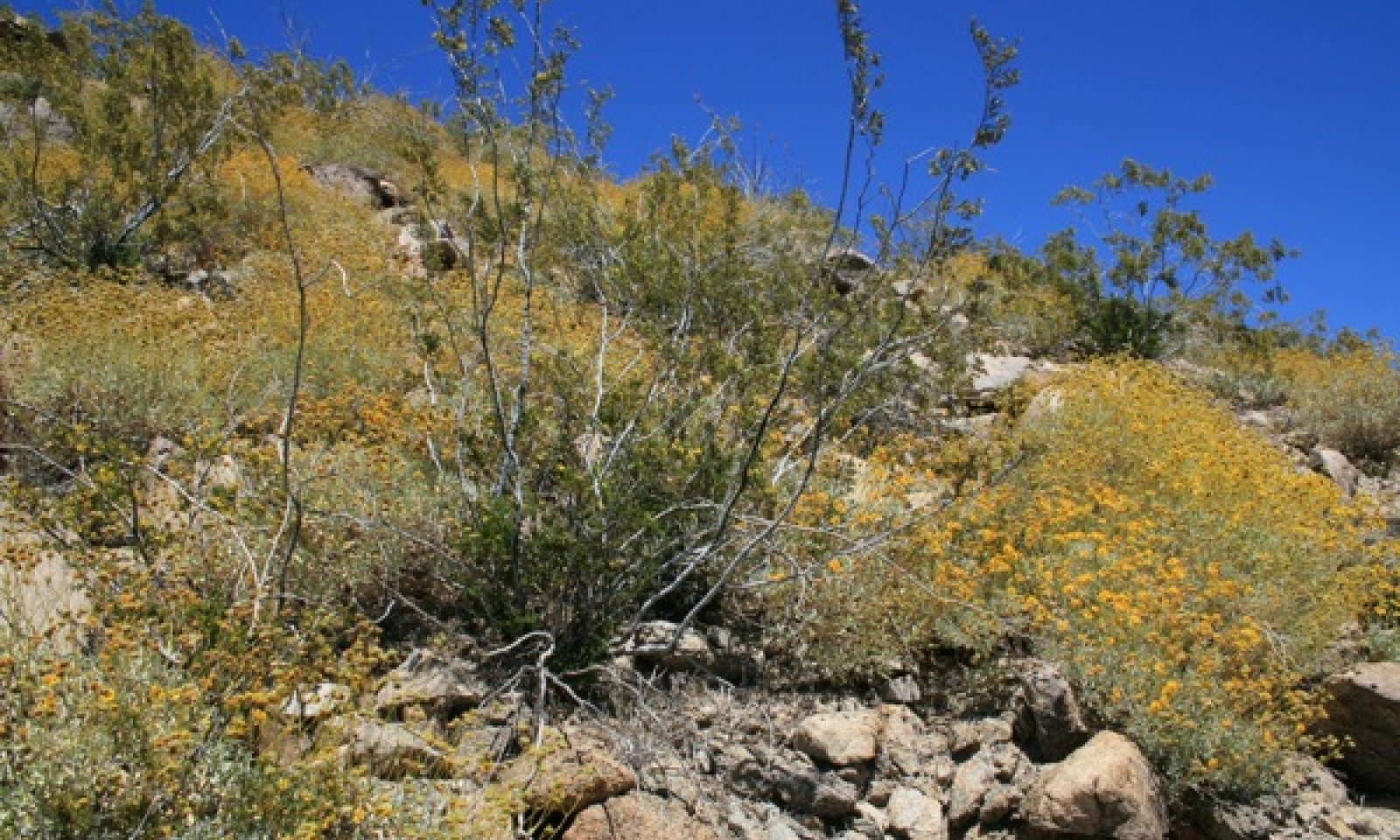
This ecological site occurs on steep arid sideslopes of fan remnants, hillslopes and mountain slopes at elevations of 390 to 4000 feet. This site is associated with hot landscape positions, typically occurring on south-facing aspects, but at lower elevations it may occur on all aspects. Soils are typically skeletal, with gravel surface textures, and range from very shallow to deep. Annual production reference value (RV) is 257 pounds per acre and ranges from 159 to 356 pounds per acre, depending on precipitation. This site is dominated by brittlebush (Encelia farinosa), and creosote bush (Larrea tridentata) is an important secondary shrub. Hot soil temperatures on warm landscape positions favor dominance by the drought-tolerant but cold-intolerant brittlebush.
The data in the following sections is from major (15% of map unit or greater) components only.
Associated sites
R030XB172CA Warm Gravelly Shallow Hills
R030XB172CA is found on adjacent warm thermic slopes. Creosote bush (Larrea tridentata) and Parish's goldeneye (Viguiera parishii) dominate.
R030XB213CA Moderately Deep Gravelly Mountain Slopes
R030XB213CA occurs on thermic slopes at higher elevations. Eastern mojave buckwheat (Eriogonum fasciculatum), desert needlegrass (Achnatherum speciosum) and California juniper (Juniperus californica) are dominant species.
R030XD001CA Hyperthermic Dry Hills
R030XD001CA occurs on adjacent north-facing slopes. Burrobush (Ambrosia dumosa) and creosote bush (Larrea tridentata) dominate.
R030XD004CA Low-Production Hyperthermic Hills
R030XD004CA occurs on adjacent slopes. Creosote bush (Larrea tridentata) dominates.
R030XD008CA Hyperthermic Sandhill
R030XD008CA is found on adjacent sand hills. Big galleta (Pleuraphis rigida) and creosote bush (Larrea tridentata) are dominant.
R030XY023CA Hyperthermic Dissected Shallow Pediment
R030XD023CA is found on adjacent pediments. Mojave indigobush (Psorothamnus arborescens), desertsenna (Senna armata), and burrobush (Ambrosia dumosa) are dominant species.
R030XD025CA Hyperthermic Sandsheets
R030XD025CA is found on adjacent sandsheets. Big galleata (Pleuraphis rigida) and creosote bush (Larrea tridentata) dominate.
R030XD039CA Coarse Gravelly Fans
R030XD039CA occurs on alluvial fan remnants below this site. Brittlebush (Encelia farinosa) and creosote bush (Larrea tridenata) dominante.
R030XD040CA Hyperthermic Steep North Slopes
R030XD040CA occurs on adjacent north-facing mountain slopes. Burrobush (Ambrosia dumosa) co-dominates with creosote bush (Larrea tridentata) and brittlebush (Encelia farinosa).
R030XD042CA Hyperthermic Shallow To Moderately Deep Fan Remnants
R030XD042CA is found on adjacent fan remnants. Vegetation is sparse, and dominated by creosote bush (Larrea tridentata), with burrobush (Ambrosia dumosa) and white ratany (Krameria grayi).
R030XY128CA Broad, Gravelly, Hyperthermic Ephemeral Stream
R030XY128CA occurs in medium-sized drainageways adjacent to this site. Desert lavender (Hyptis emoryi), creosote bush (Larrea tridentata) and burrobrush (Hymenoclea salsola) are dominant species.
R040XD030CA Extremely Stony Fan Remnants
R031XY030CA is found on adjacent stony fan remnants. Teddybear cholla (Cylindropuntia bigelovii) and creosote bush (Larrea tridentata) are dominant species.
Similar sites
R030XB164CA Steep South Slopes
R030XB164CA occurs on warm thermic soils. Production, density and diversity are typically higher than this site, and secondary species composition is different.
R030XD039CA Coarse Gravelly Fans
R030XD039CA occurs on fan remnants. Production is lower than this site, and ocotillo (Foequieria splendens)is often present.
Table 1. Dominant plant species
Tree Not specified
Shrub (1) Encelia farinosa
(2) Larrea tridentataHerbaceous Not specified


