
Natural Resources
Conservation Service
-
Search


Major Land Resource Area or ecological site by name and/or ID.
PreviousSectionsNextGeneral information
Provisional. A provisional ecological site description has undergone quality control and quality assurance review. It contains a working state and transition model and enough information to identify the ecological site.
Ecological site concept
This site occurs on inset fans. Slopes range from 2 to 15 percent, but slope gradients of 2 to 8 are most typical. Elevations range from 5900 to 6600 feet. The soils associated with this site are deep to very deep, well drained, and formed in alluvium derived from limestone.
Similar sites
R030XC046NV LOAMY SLOPE 9-11 PZ
BOGR2 important grass; less productive, occurs on sideslopes.
Table 1. Dominant plant species
Tree Not specified
Shrub (1) Artemisia tridentata ssp. vaseyana
Herbaceous (1) Hesperostipa comata
(2) Achnatherum hymenoidesPhysiographic features
This site occurs on inset fans. Slopes range from 2 to 15 percent, but slope gradients of 2 to 8 are most typical. Elevations range from 5900 to 6600 feet.
Table 2. Representative physiographic features
Landforms (1) Inset fan
Elevation 5900 – 6600 ft Slope 2 – 8 % Climatic features
The climate is semiarid with cool, moist winters and warm intermittently moist summers. Precipitation is greatest in the winter with a lesser secondary peak in the summer, typical of the Mojave Desert transitional to the Great Basin. Average annual precipitation is 9 to 11 inches. Mean annual air temperature is 46 to 54 degrees F. The average growing season is about 90 to 135 days.
Table 3 Representative climatic features
Frost-free period (average) 150 days Freeze-free period (average) Precipitation total (average) 10 in BarLineFigure 1. Monthly precipitation range
BarLineFigure 2. Monthly average minimum and maximum temperature
">Influencing water features
There are no influencing water features associated with this site.
Soil features
The soils associated with this site are deep to very deep, well drained, and formed in alluvium derived from limestone. The available water holding capacity is moderate and runoff is low. The soil temperature regime is mesic and the soil moisture regime is aridic bordering on ustic. The soil surface is covered by approximately 30 to 60 percent gravels. Run-in moisture positively influences available soil moisture. Soils correlated to this ecological site are classified as coarse-loamy, carbonatic, mesic Ustic Haplocambids.
Table 4. Representative soil features
Parent material (1) Alluvium – limestone
Surface texture (1) Very gravelly loam
(2) Gravelly fine sandy loam
Family particle size (1) Loamy
Drainage class Well drained Permeability class Moderate Soil depth 60 – 84 in Surface fragment cover <=3" 30 – 60 % Surface fragment cover >3" 0 – 5 % Available water capacity
(0-40in)4.7 – 7.57 in Calcium carbonate equivalent
(0-40in)40 – 55 % Electrical conductivity
(0-40in)0 – 2 mmhos/cm Sodium adsorption ratio
(0-40in)0 – 5 Soil reaction (1:1 water)
(0-40in)7.9 – 8.3 Ecological dynamics
The plant communities of this site are dynamic in response to changes in disturbance regimes and weather patterns. Plant community structure is controlled in part by infrequent wildfire and in part by pulses of seedling recruitment. Mountain big sagebrush grows at relatively high elevations and precipitation zones, when compared to other species of big sagebrush. It is commonly associated with pinyon pine, juniper, mountain browse and ponderosa pine habitats. Sagebrush species set seed in the late summer and fall. Seeds ripen from September through October and fall from the plant. Cold, moist conditions and exposure to light increase germination in the spring (Johnson 2000). Seeds of sagebrush species are best adapted to germinate in habitats with conditions similar to that of the collection site (USDA-NRCS 2011). Survival of sagebrush seedlings is dependent on adequate moisture conditions. Young plants are susceptible to less than desirable conditions for several years following germination.
Mountain big sagebrush communities are generally long-lived, therefore it is not necessary for new individuals to recruit every year for perpetuation of the stand. Infrequent large recruitment events and simultaneous low, continuous recruitment is the foundation of population maintenance (Noy-Meir 1973). Mature properly functioning sagebrush communities have higher infiltration rates and lower sediment production, than degraded systems. Reoccurring disturbances, natural or anthropogenic, will result in decreased sagebrush cover and increased cover of disturbance tolerant shrubs and non-natives. Loss of structural and functional groups affects ecosystem functioning and can result in soil loss.
Carbon and nitrogen concentrations are higher under sagebrush canopies when compared to interspaces (Chen and Stark 2000). The root systems of sagebrush maximizes water uptake with a deep taproot and shallow branching roots. The combination of deep and shallow roots also provides excellent soil stabilization. The breakdown of aging roots also contributes to organic matter and nutrient cycling in the sagebrush system.
Fire Ecology:
Pre-settlement fire return intervals in mountain big sagebrush communities varied from 15 to >50 years (Johnson 2000). Mountain big sagebrush is readily killed by wildfire and depends on seed for regeneration. Periodic wildfire helps to maintain the balance between structural and functional groups in the plant community. Lack of naturally occurring wildfires will result in decadent sagebrush stands and loss of important understory species. Long-term exclusion of wildfire may also result in invasion of pinyon and juniper. However, drastically shorter fire return intervals will result in loss of the shrub community and an increase in annual biomass. Species likely to invade this site include non-native annuals, such as cheatgrass.
Mountain big sagebrush is readily killed by fire and does not resprout. Regeneration solely occurs from seedling establishment which is dependent on favorable climatic conditions and seed source. Ephedra and desert ceanothus are tolerant of fire and may increase following burning. Ephedra sprouts vigorously from the root crown following disturbance and is also capable of establishing from seed. Desert ceanothus is a weak sprouter, but it's seeds require scarification and germinate profusely the first spring after fire. Fire reduces the dominance of mountain big sagebrush and alters plant community composition for the first few years. If non-natives have not altered successional pathways, mountain big sagebrush will recover and vegetation returns to its previous composition (Johnson 2000). Needleandthread can be slightly to severely damaged by fire. It sprouts from the caudex following fire, if heat has not been sufficient to kill underground parts. Recovery usually takes 2 to 10 years. Indian ricegrass can be killed by fire, depending on severity and season of burn. Indian ricegrass reestablishes on burned sites through seed dispersed from adjacent unburned areas. Blue grama has variable fire tolerance; it has fair tolerance when dormant but experiences some damage if burned during active growth, especially during drought. Fire generally favors blue grama, generally increasing its occurrence, production, and percent cover.State and transition model
Custom diagramStandard diagram
More interactive model formats are also available. View Interactive Models
More interactive model formats are also available. View Interactive Models
Click on state and transition labels to scroll to the respective textEcosystem states
State 1 submodel, plant communities
State 2 submodel, plant communities
State 3 submodel, plant communities
State 1
Reference StateThe reference state is representative of the natural range of variability under pristine conditions. It is dominated by an evergreen shrub community with a significant amount of perennial grass. Plant community phase changes are primarily driven by periodic wildfire, insect/disease attack and long-term drought. Plant community dynamics are driven by interactions between climatic patterns and disturbance regimes.
Community 1.1
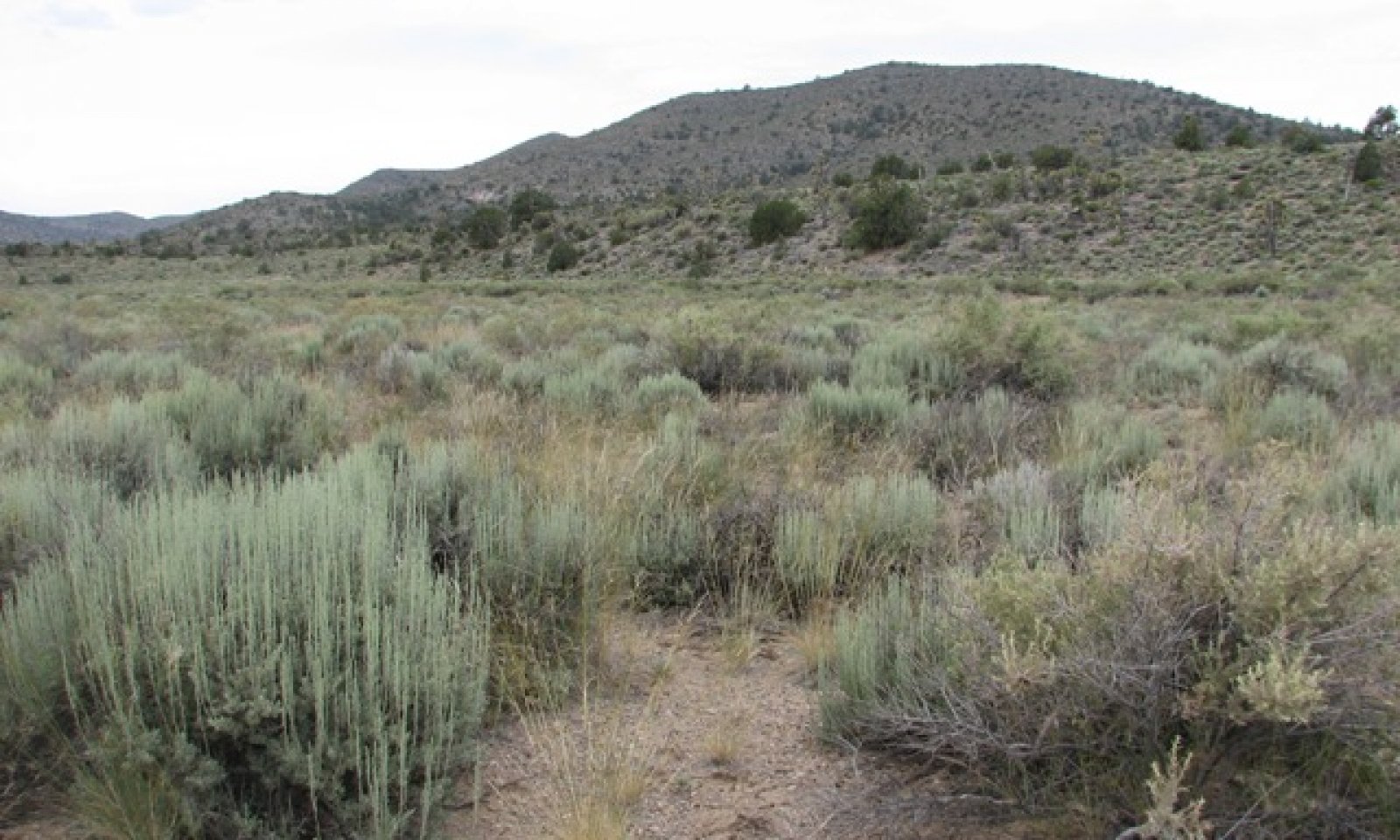
Reference Plant Community
Figure 3. reference plant community
The reference plant community is dominated by mountain big sagebrush and is characteristic of a mid-seral, healthy condition. Needleandthread and Indian ricegrass are important associated species. The historic fire return interval for mountain big sagebrush communities ranges from 15 to >50 years. Establishment of sagebrush occurs solely from seed and recruitment pulses are episodic, based on favorable climatic conditions. Potential vegetative composition is approximately 60 percent shrubs, 30 percent perennial native grasses and 10 percent forbs.
Figure 4. Annual production by plant type (representative values) or group (midpoint values)
Table 5. Annual production by plant type
Plant type Low
(lb/acre)Representative value
(lb/acre)High
(lb/acre)Shrub/Vine 360 480 600 Grass/Grasslike 180 240 300 Forb 60 80 100 Total 600 800 1000 Community 1.2
Plant Community 1.2This plant community is representative of a post-disturbance, early seral community phase. It is characterized by increased herbaceous vegetation and decreased woody perennials. Sprouting shrubs quickly recover and provide favorable conditions for establishment of other shrub seedlings, such as mountain big sagebrush. Fast moving, low intensity fires result in the incomplete removal of mountain big sagebrush and allows for direct reestablishment through on-site seed source. Needleandthread grass may temporally decrease following wildfire. Desert ceanothus seeds germinate prolifically following fire and may experience a sharp population increase. This plant community phase is ‘at risk’ of invasion by non-native annuals. Invasion of non-natives will cause this plant community to cross a biotic threshold (T1a) into state 2.
Community 1.3
Plant Community 1.3This plant community is characterized by the encroachment of pinyon and juniper trees. Exclusion of fire can lead to invasion of pinyon and juniper into mountain big sagebrush communities. Mountain big sagebrush can serve as a nurse plant for tree seedlings. This plant community is identified as ‘at risk’, total tree cover is near 20 percent and without fire or other disturbance this community phase will cross an irreversible threshold (T1b) into state 3. Management options to keep this plant community from crossing a threshold include cutting trees and decreasing dominance by woody perennials.
Figure 5. Annual production by plant type (representative values) or group (midpoint values)
Table 6. Annual production by plant type
Plant type Low
(lb/acre)Representative value
(lb/acre)High
(lb/acre)Tree 280 400 530 Shrub/Vine 245 305 400 Grass/Grasslike 70 105 150 Forb 55 90 120 Total 650 900 1200 Pathway 1.1a
Community 1.1 to 1.2Wildfire, insect/disease attack or prolonged drought.
Pathway 1.1b
Community 1.1 to 1.3Absence of disturbance.
Pathway 1.2a
Community 1.2 to 1.1Absence of disturbance and natural regeneration over time. Complete recovery of sagebrush communities may take greater than 20 years.
Pathway 1.3a
Community 1.3 to 1.2Absence from disturbance and natural regeneration over time.
State 2
Invaded StateThis state is characterized by the presence of non-native species in the understory. Introduced annuals such as cheatgrass have invaded the plant community. A biotic threshold is crossed with the introduction of non-native annuals that are difficult to remove from the system and have the potential to significantly alter disturbance regimes from their historic range of variation. These non-native annuals are highly flammable and can promote wildfire where fires historically have been infrequent. Recovery of sagebrush to pre-fire conditions is dependent on available seed source and favorable weather conditions and may take an extended period of time.
Community 2.1
Plant Community 2.1This plant community is compositionally similar to the reference plant community, with a trace of non-natives in the understory. Ecological function has not changed as this time. However, the presence of non-natives has reduced the ecological resilience of the site and it will respond differently following a disturbance. Management focused on reducing anthropogenic impacts is important for maintaining the health of this mountain big sagebrush community phase.
Community 2.2
Plant Communtity 2.2This plant community is characteristic of a post-disturbance, early seral, plant community. Early successional plant communities in the invaded state may or may not be dominated by non-native annuals. Sprouting shrub species quickly recover and provide favorable sites for shrub seedling establishment. Fast moving, low intensity fires result in the incomplete removal of sagebrush, allowing for direct reestablishment. Remnant patches of mature sagebrush will result in a faster recovery. Needleandthread grass may temporally decrease following wildfire. Desert ceanothus seeds germinate prolifically following fire and may experience a sharp population increase. The abundance on non-native biomass depends on weather conditions, drought may favor native perennials and decrease abundance of non-natives.
Community 2.3
Plant Community 2.3This plant community is characterized by the encroachment of pinyon and juniper trees with non-natives in the understory. Exclusion of fire can lead to invasion of pinyon and juniper into mountain big sagebrush communities. Mountain big sagebrush can serve as a nurse plant for tree seedlings. This plant community is identified as ‘at risk’, total tree cover is near 20 percent and without fire or other disturbance this community phase will cross an irreversible threshold (T2) into state 3. Management options to keep this plant community from crossing a threshold include cutting trees and decreasing dominance by woody perennials.
Pathway 2.1a
Community 2.1 to 2.2Wildfire, insect/disease attack and/or prolonged drought.
Pathway 2.1b
Community 2.1 to 2.3Absence of disturbance and natural regeneration over time.
Pathway 2.2a
Community 2.2 to 2.1Natural regeneration over time and absence from disturbance. Complete recovery of sagebrush communities may take greater than 20 years.
Pathway 2.3a
Community 2.3 to 2.2Wildfire, insect/disease attack or prolonged drought.
State 3
Tree StateThis state is characterized by the invasion of pinyon and juniper and tree cover of greater than 20 percent. Lack of fire, insect/disease attack and drought allows seedlings and saplings to infill and eventually dominate the plant community, changing the ecological dynamics of the site. Non-native annuals may or may not be present in the understory. This state experiences reduced infiltration and increased runoff during precipitation events, diminishing soil moisture. Feedbacks contributing to the stability of this state include reduced understory vegetation resulting from decreased soil moisture and overstory shading.
Community 3.1
Plant Community 3.1This plant community is characterized by an immature forest, trees dominate the visual aspect of the plant community. Understory is moderately influenced by overstory shading, duff accumulation and competition, shrubs and native grasses are decreasing. Non-natives may or may not be present in the understory. Mountain big sagebrush is shade intolerant and declines rapidly with increased canopy cover. Tree canopy is greater than 20 percent.
Community 3.2
Plant Community 3.2This plant community is dominated by grasses and forbs under full sunlight. Standing snags remaining after disturbance have little to no effect on composition or production of herbaceous vegetation. Sprouting shrubs and those that readily establish from seed are the first to appear and provide favorable microsites for the establishment of mountain big sagebrush. Long-lived perennials including sagebrush will colonize the site, given protection from large scale disturbance and abusive land use practices. Increased availability of critical resources following wildfire or other disturbance may result in increase non-native biomass, if present in the plant community.
Community 3.3
Plant Community 3.3This plant community is characterized by trees that have reached or are near the maximal height for the site. Without disturbance, the trees on this site become very old. Remaining understory vegetation is severely reduced or even absent due to overstory shading, competition and duff accumulation. Dead shrubs are common in the understory, perennial grasses and forbs are mostly absent. Surface erosion is common and bare ground is dominant. Non-native species may or may not be present in the understory. Tree canopy ranges from 30 to >50 percent.
Pathway 3.1b
Community 3.1 to 3.2Wildfire, insect/disease attack or prolonged drought.
Pathway 3.1a
Community 3.1 to 3.3Absence of disturbance and natural regeneration over time.
Pathway 3.2a
Community 3.2 to 3.1Absence of disturbance and natural regeneration over time.
Pathway 3.3a
Community 3.3 to 3.2Wildfire, insect/disease attack or prolonged drought.
Transition T1a
State 1 to 2Introduction of non-native species due to a combination of factors including: 1) surface disturbance, 2) changes in the kinds of animals and their grazing patterns, 3) drought and/or 4) changes in fire history.
Transition T1b
State 1 to 3Continued lack of disturbance. Encroachment and establishment of pinyon and juniper. Tree canopy is greater than 20 percent and bare ground is increasing.
Transition T2
State 2 to 3Continued lack of disturbance. Encroachment and establishment of pinyon and juniper. Tree canopy is greater than 20 percent and bare ground is increasing.
Additional community tables
Table 7. Community 1.1 plant community composition
Group Common name Symbol Scientific name Annual production () Foliar cover (%) Grass/Grasslike1 Primary Perennial Grasses 120–320 needle and thread HECO26 Hesperostipa comata 40–120 – Indian ricegrass ACHY Achnatherum hymenoides 40–120 – blue grama BOGR2 Bouteloua gracilis 40–80 – 2 Secondary Perennial Grasses 1–40 squirreltail ELEL5 Elymus elymoides 4–24 – Sandberg bluegrass POSE Poa secunda 4–24 – Forb3 Perennial Forbs 16–40 Torrey's milkvetch ASCA9 Astragalus calycosus 4–16 – leastdaisy CHAET2 Chaetopappa 4–16 – bird's-beak CORDY Cordylanthus 4–16 – spurge EUPHO Euphorbia 4–16 – desert frasera FRAL5 Frasera albomarginata 4–16 – hoary tansyaster MACA2 Machaeranthera canescens 4–16 – longleaf phlox PHLO2 Phlox longifolia 4–16 – desert globemallow SPAM2 Sphaeralcea ambigua 4–16 – Shrub/Vine4 Primary Shrubs 400–480 mountain big sagebrush ARTRV Artemisia tridentata ssp. vaseyana 400–480 – 5 Secondary Shrubs 40–120 fourwing saltbush ATCA2 Atriplex canescens 4–16 – desert ceanothus CEGR Ceanothus greggii 4–16 – yellow rabbitbrush CHVI8 Chrysothamnus viscidiflorus 4–16 – mormon tea EPVI Ephedra viridis 4–16 – slender buckwheat ERMI4 Eriogonum microthecum 4–16 – sulphur-flower buckwheat ERUM Eriogonum umbellatum 4–16 – Stansbury cliffrose PUST Purshia stansburiana 4–16 – Joshua tree YUBR Yucca brevifolia 4–16 – grizzlybear pricklypear OPPOE Opuntia polyacantha var. erinacea 1–4 – Table 8. Community 1.2 plant community composition
Group Common name Symbol Scientific name Annual production () Foliar cover (%) Table 9. Community 1.3 plant community composition
Group Common name Symbol Scientific name Annual production () Foliar cover (%) Grass/Grasslike1 Primary Perennial Grasses 65–120 blue grama BOGR2 Bouteloua gracilis 18–45 – needle and thread HECO26 Hesperostipa comata 18–45 – 2 Secondary Perennial Grass 18–45 Indian ricegrass ACHY Achnatherum hymenoides 4–18 – squirreltail ELEL5 Elymus elymoides 4–18 – Sandberg bluegrass POSE Poa secunda 4–18 – Forb3 Primary Forbs 20–90 milkvetch ASTRA Astragalus 4–14 – Indian paintbrush CASTI2 Castilleja 4–14 – Cooper's rubberweed HYCO2 Hymenoxys cooperi 4–14 – hoary tansyaster MACA2 Machaeranthera canescens 4–14 – firecracker penstemon PEEA Penstemon eatonii 4–14 – desert globemallow SPAM2 Sphaeralcea ambigua 4–14 – Shrub/Vine4 Primary Shrubs 180–340 mountain big sagebrush ARTRV Artemisia tridentata ssp. vaseyana 135–225 – 5 Secondary Shrubs 45–135 fourwing saltbush ATCA2 Atriplex canescens 4–18 – desert ceanothus CEGR Ceanothus greggii 4–18 – yellow rabbitbrush CHVI8 Chrysothamnus viscidiflorus 4–18 – mormon tea EPVI Ephedra viridis 4–18 – slender buckwheat ERMI4 Eriogonum microthecum 4–18 – sulphur-flower buckwheat ERUM Eriogonum umbellatum 4–18 – grizzlybear pricklypear OPPOE Opuntia polyacantha var. erinacea 4–18 – Stansbury cliffrose PUST Purshia stansburiana 4–18 – Joshua tree YUBR Yucca brevifolia 4–18 – Tree6 Evergeen Trees 350–540 Utah juniper JUOS Juniperus osteosperma 180–270 – singleleaf pinyon PIMO Pinus monophylla 180–270 – Table 10. Community 2.1 plant community composition
Group Common name Symbol Scientific name Annual production () Foliar cover (%) Table 11. Community 2.2 plant community composition
Group Common name Symbol Scientific name Annual production () Foliar cover (%) Table 12. Community 2.3 plant community composition
Group Common name Symbol Scientific name Annual production () Foliar cover (%) Table 13. Community 3.1 plant community composition
Group Common name Symbol Scientific name Annual production () Foliar cover (%) Table 14. Community 3.2 plant community composition
Group Common name Symbol Scientific name Annual production () Foliar cover (%) Table 15. Community 3.3 plant community composition
Group Common name Symbol Scientific name Annual production () Foliar cover (%) Interpretations
Animal community
Livestock Interpretations:
This site is suitable for livestock grazing. Grazing management should be keyed to dominant grasses and palatable shrub production. Mountain big sagebrush is eaten by domestic livestock but has long been considered to be of low palatability, and a competitor to more desirable species. Needleandthread provides highly palatable forage, especially in the spring before fruits have developed. Needlegrasses are grazed in the fall only if the fruits are softened by rain. Indian ricegrass is highly palatable to all classes of livestock in both green and cured condition. It supplies a source of green feed before most other native grasses have produced much new growth. Blue grama is valuable forage for all classes of domestic livestock, providing excellent forage for cattle and sheep. Blue grama tends to be most productive following summer rains, but it cures well and provides forage year round.
Stocking rates vary over time depending upon season of use, climate variations, site, kinds and class of grazing animals, and previous and current management goals. A safe starting stocking rate is an estimated stocking rate that is fine tuned by the client by adaptive management through the year and from year to year. Actual use records for individual sites, a determination of the degree to which the sites have been grazed, and an evaluation of trend in the site condition offer the most reliable basis for developing initial stocking rates.
Wildlife Interpretations:
This elevational zone is home to many wildlife species, including various species of bats, cottontail rabbits, ground squirrels and coyotes. Mountain big sagebrush is highly preferred and nutritious winter forage for mule deer and elk. Additional shrubs species provide some degree of browsing resource but are present in limited quantities. Shrubs provide valuable cover for birds and small mammals throughout the year. Needleandthread is moderately important spring forage for mule deer, but use declines considerably as more preferred forages become available. Indian ricegrass is eaten by pronghorn in moderate amounts whenever available. A number of heteromyid rodents inhabiting desert rangelands show preference for seed of Indian ricegrass. Indian ricegrass is an important component of jackrabbit diets in spring and summer. Indian ricegrass seed provides food for many species of birds. Doves, for example, eat large amounts of shattered Indian ricegrass seed lying on the ground. Blue grama also provides important forage for mule deer. Quail and some songbirds eat the seeds of blue grama. Small mammals also eat blue grama seeds and stems. Flower heads and seeds of blue grama are also consumed by grasshoppers, which can all but eliminate an annual seed crop.Hydrological functions
The soils associated with this site are characterized by low runoff and moderate permeability.
Recreational uses
Aesthetic value is derived from the diverse floral and faunal composition and the colorful flowering of wild flowers and shrubs during the spring and early summer. This site offers rewarding opportunities to photographers and for nature study. This site is used for camping and hiking and has potential for upland and big game hunting.
Other products
Native Americans used big sagebrush leaves and branches for medicinal teas, and the leaves as a fumigant. Bark was woven into mats, bags and clothing. Indian ricegrass was traditionally eaten by some Native Americans. The Paiutes used the seed as a reserve food source.
Other information
Needleandthread is useful for stabilizing eroded or degraded sites. Because of its wide adaptation, ease of establishment, and economic value, blue grama is used extensively for conservation purposes, rangeland seeding, and landscaping. Blue grama is useful for reclamation and for erosion control in arid and semiarid regions.
Supporting information
Type locality
Location 1: Clark County, NV Township/Range/Section T16S R61E S12 UTM zone N UTM northing 4046703 UTM easting 670124 Latitude 36° 33′ 2″ Longitude 115° 5′ 57″ General legal description SE1/4 sec12, T.16S, R.61E; Approximately 13 kilometers north and 23 kilometers east of Corn Creek, at the north end of Peekaboo Canyon; approximately 10 kilometers south-southwest of Wamp Spring; USGS Hayford Peak SE, NV 7.5 minute topographic quadrangle. Other references
Chen, J. and J.M. Stark. 2000. Plant species effect and carbon and nitrogen cycling in sagebrush-crested wheatgrass soil. Soil Biology and Biochemistry. 32:47-57.
Johnson, K.A. 2000. Artemisia tridentata subsp. vaseyana. In: Fire Effects Information System, [Online]. U.S. Department of Agriculture, Forest Service, Rocky Mountain Research Station, Fire Sciences Laboratory (Producer). Available: http://www.fs.fed.us/database/feis/ [ 2011, August 16].
Noy-Meir, I. 1973. Desert Ecosystem: Environmental and Producers. Annual Review of Ecology and Systematics. 4:25-51.
USDA-NRCS. 2011. Big Sagebrush Plant Guide. Available on line < http://plants.usda.gov/plantguide/pdf/pg_artrv.pdf>
USDA-NRCS Plants Database (Online; http://www.plants.usda.gov).
Contributors
PN-E
Approval
Sarah Quistberg, 2/25/2025
Rangeland health reference sheet
Interpreting Indicators of Rangeland Health is a qualitative assessment protocol used to determine ecosystem condition based on benchmark characteristics described in the Reference Sheet. A suite of 17 (or more) indicators are typically considered in an assessment. The ecological site(s) representative of an assessment location must be known prior to applying the protocol and must be verified based on soils and climate. Current plant community cannot be used to identify the ecological site.
Author(s)/participant(s) Patti Novak-Echenique Contact for lead author State Rangeland Management Specialist Date 06/30/2011 Approved by Approval date Composition (Indicators 10 and 12) based on Annual Production Indicators
-
Number and extent of rills:
Rills are none to rare. -
Presence of water flow patterns:
Water flow patterns are none to rare. -
Number and height of erosional pedestals or terracettes:
Pedestals are none to rare. Occurrence is usually limited to areas of water flow patterns. -
Bare ground from Ecological Site Description or other studies (rock, litter, lichen, moss, plant canopy are not bare ground):
Bare ground 10-20% depending on amount of surface rock fragments. -
Number of gullies and erosion associated with gullies:
None. -
Extent of wind scoured, blowouts and/or depositional areas:
None. -
Amount of litter movement (describe size and distance expected to travel):
Fine litter (foliage from grasses and annual & perennial forbs) expected to move distance of slope length (<10 ft) during intense summer convection storms or rapid snowmelt events. Persistent litter (large woody material) will remain in place except during catastrophic events. -
Soil surface (top few mm) resistance to erosion (stability values are averages - most sites will show a range of values):
stability values should be 3 to 6 on most soil textures found on this site. (To be field tested.) -
Soil surface structure and SOM content (include type of structure and A-horizon color and thickness):
A horizon thickness 0-3 inches. Surface structure is typically strong, thick platy. Soil surface colors are brown and soils are typified by an ochric epipedon. Organic matter of the surface 2 to 3 inches is typically 1 to 1.5 percent dropping off quickly below. Organic matter content can be more or less depending on micro-topography. -
Effect of community phase composition (relative proportion of different functional groups) and spatial distribution on infiltration and runoff:
Perennial herbaceous plants (especially deep-rooted bunchgrasses [i.e., Indian ricegrass & needleandthread] slow runoff and increase infiltration. Shrub canopy and associated bunchgrasses break raindrop impact and provide opportunity for snow catch and accumulation on site. -
Presence and thickness of compaction layer (usually none; describe soil profile features which may be mistaken for compaction on this site):
Compacted layers are none. Platy or massive sub-surface horizons or subsoil argillic horizons are not to be interpreted as compacted layers. -
Functional/Structural Groups (list in order of descending dominance by above-ground annual-production or live foliar cover using symbols: >>, >, = to indicate much greater than, greater than, and equal to):
Dominant:
Reference Plant Community: Mountain big sagebrush >> deep-rooted, cool season, perennial bunchgrasses >associated shrubs > warm-season bunchgrasses > shallow-rooted, cool season, perennial bunchgrasses > deep-rooted, cool season, perennial forbs=fibrous, shallow-rooted, cool season, perennial and annual forbs.Sub-dominant:
Other:
Additional:
-
Amount of plant mortality and decadence (include which functional groups are expected to show mortality or decadence):
Dead branches within individual shrubs common and standing dead shrub canopy material may be as much as 25% of total woody canopy; some of the mature bunchgrasses (<20%) have dead centers. -
Average percent litter cover (%) and depth ( in):
Mostly concentrated under shrubs; total cover under and between plants: 20-30% and depth of litter is <½ inch. -
Expected annual annual-production (this is TOTAL above-ground annual-production, not just forage annual-production):
For normal or average growing season (end of May) ± 800 lbs/ac. -
Potential invasive (including noxious) species (native and non-native). List species which BOTH characterize degraded states and have the potential to become a dominant or co-dominant species on the ecological site if their future establishment and growth is not actively controlled by management interventions. Species that become dominant for only one to several years (e.g., short-term response to drought or wildfire) are not invasive plants. Note that unlike other indicators, we are describing what is NOT expected in the reference state for the ecological site:
Potential invaders on this site include cheatgrass, singleleaf pinyon and Utah juniper. -
Perennial plant reproductive capability:
All functional groups should reproduce in average (or normal) and above average growing season years. Less reproduction on below-average precipitation years.
Print Options
Sections
Font
AAAAOther
PrintThe Ecosystem Dynamics Interpretive Tool is an information system framework developed by the USDA-ARS Jornada Experimental Range, USDA Natural Resources Conservation Service, and New Mexico State University.
Accessibility statement


