
Natural Resources
Conservation Service
Ecological site R030XB213CA
Moderately Deep Gravelly Mountain Slopes
Last updated: 10/21/2024
Accessed: 10/15/2026
-
Search


Major Land Resource Area or ecological site by name and/or ID.
PreviousSectionsNextGeneral information
Provisional. A provisional ecological site description has undergone quality control and quality assurance review. It contains a working state and transition model and enough information to identify the ecological site.
Click to explore map
Figure 1. Mapped extent
Areas shown in blue indicate the maximum mapped extent of this ecological site. Other ecological sites likely occur within the highlighted areas. It is also possible for this ecological site to occur outside of highlighted areas if detailed soil survey has not been completed or recently updated.
MLRA notes
Major Land Resource Area (MLRA): 030X–Mojave Basin and Range
MLRA Description:
Major Land Resource Area (MLRA) 30, Mojave Desert, is found in southern California, southern Nevada, the extreme southwest corner of Utah and northwestern Arizona within the Basin and Range Province of the Intermontane Plateaus. The climate of the area is hot (primarily hyperthermic and thermic; however at higher elevations, generally above 5000 feet, mesic, cryic and frigid) and dry (aridic). Elevations range from below sea level to over 12,000 feet in the higher mountain areas found within the MLRA. Due to the extreme elevational range found within this MLRA, Land Resource Units (LRUs) were designated to group the MLRA into similar land units.LRU notes
This LRU (designated by ’XB’) is found across the eastern half of California, much of the mid-elevations of Nevada, the southernmost portions of western Utah, and the mid-elevations of northwestern Arizona. Elevations range from 1800 to 5000 feet and precipitation ranges from 4 to 9 inches per year, but is generally between 5-6 inches. This LRU is characterized primarily by the summer precipitation it receives, ranging from 18 – 35% but averages 25%. Summer precipitation falls between July and September in the form of rain, and winter precipitation falls starting in November and ends between February and March, also mostly in the form of rain; however it does receive between 0 and 3 inches of snow, with an average of 1 inch. The soil temperature regime is thermic and the soil moisture regime is typic-aridic. Vegetation includes creosote bush, burrobush, Nevada jointfir, ratany, Mojave yucca, Joshua tree, chollas, cactus, big galleta grass and several other warm season grasses. At the upper portions of the LRU, plant production and diversity are greater and blackbrush is a common dominant shrub.
Classification relationships
The Eriogonum fasciculatum shrubland alliance (Sawyer et al. 2009) and the Juniperus californica woodland alliance (Sawyer et al. 2009) occur within this ecological site.
The Achnatherum speciosum herbaceous alliance (Sawyer et al. 2009) may occur in Community Phase 2.3 and State 3 of this ecological site.Ecological site concept
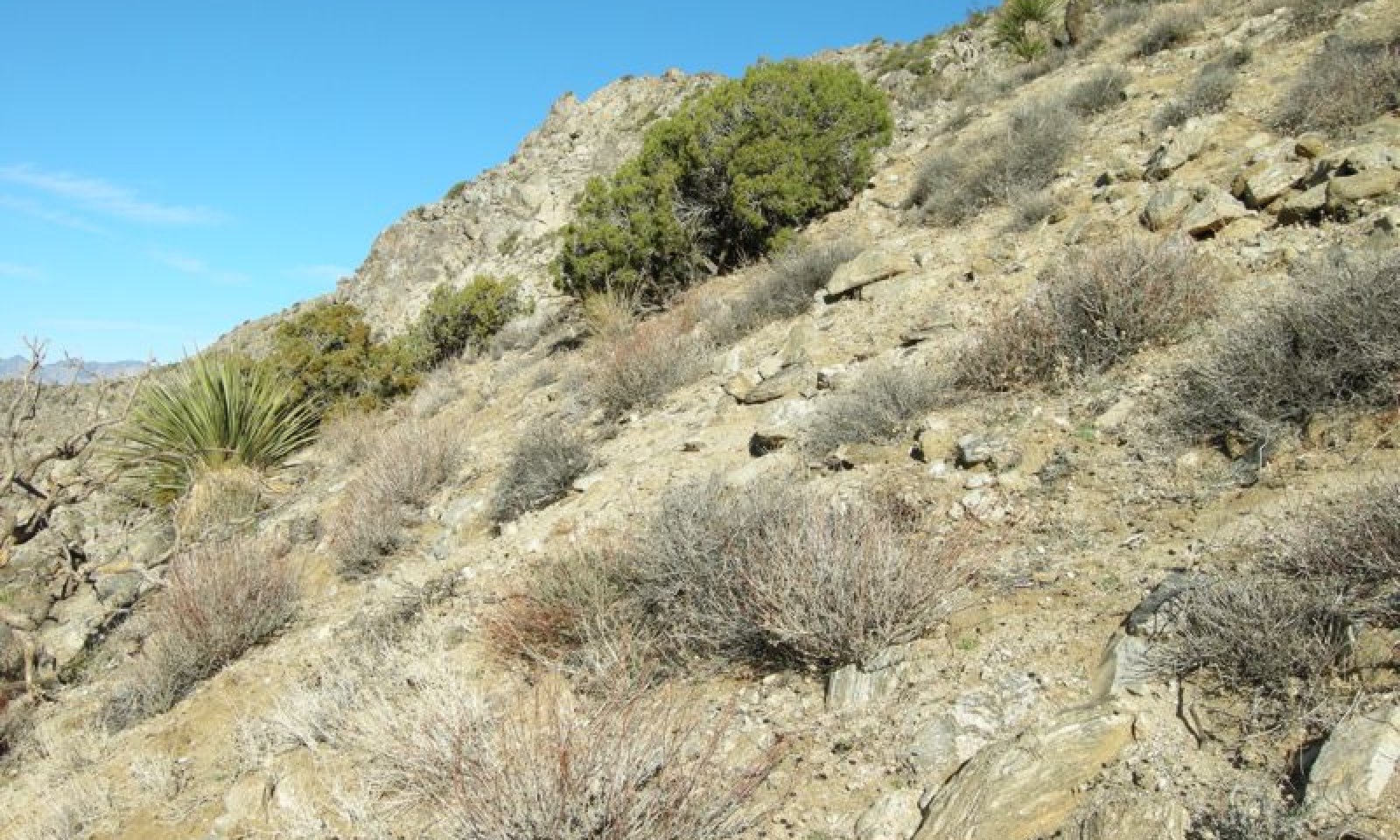
This ecological site occurs on steep mountain slopes at elevations of approximately 2800 to 4800 feet on soils with a warm thermic temperature regime. Soils are moderately deep over weathered bedrock, and are sandy skeletal.
Production RV is 345 pounds per acre and ranges from 111 to 495 pounds per acre. Vegetative cover is relatively sparse, and is dominated by eastern Mojave buckwheat (Eriogonum fasciculatum) with California juniper (Juniperus californica), desert needlegrass (Achnatherum speciosum) and a diverse assemblage of secondary shrubs. Steep slopes and sandy-skeletal soils increase soil erosion, and this favors short-lived species like eastern Mojave buckwheat and desert needlegrass (Achnatherum speciosum).
Data ranges in the physiographic data, climate data, water features, and soil data sections of this Ecological Site Description are based on major components only (15 percent of map unit or greater).
This site is part of ecological site group R030XB140CA.Associated sites
R030XE191CA Dry Sandy Mountain Slopes
R030XE191CA is found on adjacent slopes with a xeric soil moisture regime and very shallow to shallow soils. Muller's oak (Quercus cornelius-mulleri) and California juniper (Juniperus californica) dominate.
R030XB189CA Shallow Cool Hills
R030XB189CA is found on mountain ridges near this site. Blackbrush (Coleogyne ramosissima) dominates with California juniper (Juniperus californica).
R030XD003CA Hyperthermic Steep South Slopes
R030XD003CA is found on adjacent hyperthermic, south-facing mountain slopes, and is dominated by Brittlebush (Encelia farinosa).
R030XD040CA Hyperthermic Steep North Slopes
R030XD040CA is found on adjacent lower elevation slopes with north-facing aspects and hyperthermic soil temperature regimes. Burrobush (Ambrosia dumosa) is a dominant species.
R030XE196CA Sandy Xeric-Intergrade Slopes
R030XE196CA is found an adjcacent slopes with a xeric soil moisture regime and very shallow to shallow soils. Single-leaf pinyon pine (Pinus monophylla) and California juniper (Juniperus californica) dominate.
R030XY128CA Broad, Gravelly, Hyperthermic Ephemeral Stream
R030XY128CA is found on medium-sized drainageways of inset fans draining these mountain slopes. Desert lavender (Hyptis emoryi), catclaw acacia (Acacia gregii), burrobush (Hymenoclea salsola) and creosote bush (Larrea tridentata) dominate.
Similar sites
R030XB189CA Shallow Cool Hills
R030XB189CA occurs on slopes with very shallow to shallow soils. Production and cover are higher, and blackbrush (Coleogyne ramosissima) dominates. California juniper (Juniperus californica) is an important species, but is not dominant.
R030XE196CA Sandy Xeric-Intergrade Slopes
R030XE196CA occurs on very shallow to shallow soils with a xeric soil moisture regime. Production and cover are higher, and single-leaf pinyon pine (Pinus monophylla) co-dominates with California juniper (Juniperus californica) over a diverse shrub understory.
R030XE191CA Dry Sandy Mountain Slopes
R030XE191CA occurs on very shallow to shallow soils with a xeric soil moisture regime, and is Muller's oak (Quercus cornelius-mulleri) co-dominates with California juniper (Juniperus californica).
Table 1. Dominant plant species
Tree (1) Juniperus californica
Shrub (1) Eriogonum fasciculatum
Herbaceous (1) Achnatherum speciosum
Physiographic features
This ecological site occurs on mountain slopes and ridges on slopes of 30 to 75 percent at elevations of 2790 to 4760 feet. The site may occur on all aspects, but at lower elevations and warmer locations, the site is associated with north-facing aspects. The site experiences no flooding or ponding, and runoff class is medium.
Table 2. Representative physiographic features
Landforms (1) Mountain slope
(2) Ridge
Elevation 2790 – 4760 ft Slope 30 – 75 % Aspect Aspect is not a significant factor Climatic features
The climate on this site is arid characterized by cool, somewhat moist winters and hot, dry summers. The average annual precipitation ranges from 4 to 7 inches with most falling as rain from November to March. Mean annual air temperature ranges from 63 to 68 degrees F. The frost free period is 270 to 320 days.
Maximum and minimum monthly climate data for this ESD were generated by the Climate Summarizer
(http://www.nm.nrcs.usda.gov/technical/handbooks/nrph/Climate_Summarizer.xls) using data
from the following climate stations:
44467, Kee Ranch, California (Period of record = 1948 - 1979) [1]
LTHC1 Lost Horse, Joshua Tree National Park (Period of record = 1991 to 2011) [1]
Table 3 Representative climatic features
Frost-free period (average) 320 days Freeze-free period (average) Precipitation total (average) 10 in BarLineFigure 2. Monthly precipitation range
BarLineFigure 3. Monthly average minimum and maximum temperature
">Influencing water features
Soil features
The soils associated with this ecological site formed in colluvium derived from gneiss and/or granitoid bedrock and/or residuum weathered from granitoid and/or from gneiss. Soils are moderately deep over weathered bedrock. Surface textures are gravelly loamy sand, with very gravelly loamy sand and very gravelly sand beneath. Surface rock fragments less than or equal to three inches in diameter range from 15 to 60 percent, and rock fragments greater than 3 inches in diameter range from 1 to 17 percent. Subsurface fragments less than or equal to three inches in diameter range from 5 to 33 percent, and subsurface fragments greater than 3 inches in diameter range from 5 to 28 percent (subsurface fragments by volume for a depth of 0 to 24 inches). Bedrock is encountered at 20 to 39 inches, and is moderately cemented with cracks greater than 10 centimeters apart; with common very fine and fine roots in matted at top of horizon. These soils are somewhat excessively drained with rapid permeability.
The associated soils that are greater than 15 percent of any one map unit are: Bigbernie (sandy-skeletal, mixed, thermic Typic Torriorthents) and Bigcanyon (mixed, thermic Typic Torripsamments) soils. Other soils on which this site is found are typically 3 percent or less of any map unit when associated with this site. They are: Ironped (mixed, thermic, shallow Typic Torripsamments) and Pinecity (mixed, thermic, shallow Typic Torripsamments) soils. Ironped and Pinecity soils are very shallow to shallow. Pinecity soils are found on cool thermic slopes, and Ironped soils are found on warm thermic slopes.
This ecological site is correlated with the following map units and soil components in the Joshua Tree National Park Soil Survey:
1260;Whiterobe-Bigbernie complex, 30 to 75 percent slopes; Bigbernie;;20; Bigbernie;strongly sloping;7
3336;Xeric Torriorthents-Bigbernie association, 30 to 75 percent slopes;Bigbernie;;25; Pinecity;warm;3
3345; Bigcanyon association, 30 to 75 percent slopes; Bigcanyon, cool; 20
1250;Ironlung-Rock outcrop complex, 30 to 75 percent slopes;Ironped;cool;3
1255;Goldenhills-Bulletproof-Fanhill-Whiterobe complex, 30 to 75 percent slopes;Ironped;cool;2
Table 4. Representative soil features
Parent material (1) Colluvium – granite
(2) Residuum – gneiss
Surface texture (1) Gravelly loamy sand
Family particle size (1) Sandy
Drainage class Somewhat excessively drained Permeability class Rapid Soil depth 20 – 39 in Surface fragment cover <=3" 15 – 60 % Surface fragment cover >3" 1 – 17 % Available water capacity
(0-40in)0.5 – 1 in Calcium carbonate equivalent
(0-40in)0 – 1 % Electrical conductivity
(0-40in)0 – 2 mmhos/cm Sodium adsorption ratio
(0-40in)0 – 4 Soil reaction (1:1 water)
(0-40in)6.6 – 8.4 Subsurface fragment volume <=3"
(Depth not specified)5 – 33 % Subsurface fragment volume >3"
(Depth not specified)5 – 28 % Ecological dynamics
Abiotic features
The most important abiotic factors driving this ecological site are steep mountain slopes, a warm thermic climate with a typic-aridic soil moisture regime, and moderately deep sandy and sandy-skeletal soils.
This site occurs at elevations of approximately 2800 to 4800 feet on steep slopes with a high percentage of rock outcrops. Vegetative cover is relatively sparse, and is dominated by eastern Mojave buckwheat (Eriogonum fasciculatum) with California juniper (Juniperus californica), desert needlegrass (Achnatherum speciosum) and a diverse assemblage of secondary shrubs.
The steep slopes and loose, sandy-textured soils of this site increase soil erosion and surface creep, which favors short-lived species like eastern Mojave buckwheat and desert needlegrass, or deep-rooted species like California juniper. Eastern Mojave buckwheat is short-lived shrub found in a wide range of habitats throughout California, Nevada, Utah and Arizona. It establishes after disturbance, and stands do not persist in sites with long periods without disturbance (Sawyer et al. 2009). Desert needlegrass is a cool-season perennial bunchgrass widely distributed throughout desert woodland and scrub habitats in North America. It also establishes after disturbance, and large stands are associated with fire or land-clearing (Sawyer et al. 2009).
California juniper is a long-lived small tree or large shrub that is a co-dominant in arid woodlands and scrub throughout California, achieving maximum dominance where mean annual precipitation is above 9.5 inches (Rhode 2002). The precipitation range for this ecological site (4 to 7 inches) is below the optimum for California juniper, preventing the establishment of Juniper woodlands. However, the moderately deep soils of this site increase soil moisture holding capacity, which increases the cover and production of California juniper relative to nearby cool thermic slopes with shallow soils. These coarse, moderately deep soils with no horizon development also enhance habitat for desert needlegrass, which self-plants by twisting fruit awns into the soil (Pavek 1993).
Disturbance
Invasion by non-native species, drought, and fire are the primary disturbances affecting this ecological site.
Non-native annual grasses (red brome [Bromus rubens] and cheatgrass [Bromus tectorum]) have become naturalized throughout the Mojave Desert over the past century (Rickard and Beatley 1965, D'Antonio and Vitousek 1992, Brooks 1999, Reid et al. 2006, Norton et al. 2007). The abundance and biomass of these grasses is highest on sandy soils where nitrogen deposition from air pollution from adjacent urban areas is high (Rao and Allen 2010, Rao et al. 2010). Invasion by non-native annual grasses has increased the flammability of Mojave Desert shrub communities by providing a continuous fine fuel layer between widely spaced shrubs (Brown and Minnich 1986, Brooks 1999, Brooks et al. 2004, Rao and Allen 2010 2010, Rao et al. 2010). After fire, these communities appear to be more susceptible to invasion by exotic grasses, leading to a grass-fire cycle (D'Antonio and Vitousek 1992). Nitrogen deposition may also enhance juniper productivity (Allen et al. 2010), further increasing fuel loads. A shortened fire return interval due to annual grass invasion is threatening the persistence of desert needlegrass, eastern Mojave buckwheat and California juniper stands (Sawyer et al. 2009). This ecological site is susceptible to high biomass loads of non-native annual grasses due to its sandy soils and proximity to the greater Los Angeles area.
Drought is an important shaping force in Mojave Desert shrub communities, causing reductions in cover and production, and in some cases, high rates of mortality (Webb et al. 2003, Mueller et al. 2005, Hereford et al. 2006, Miriti et al. 2007). Short-lived species suffer the highest-rates of drought-induced mortality (Hereford et al. 2006, Miriti et al. 2007). Annual species remain dormant in the soil seedbank (Beatley 1969, 1974, 1976), and several years of drought can cause significant declines in non-native annual grasses because seeds are short-lived (Minnich 2003). Differential mortality of long-lived species in response to drought can have long-lasting impacts on the trajectory of the vegetation (Breshears et al. 2005, Mueller et al. 2005).State and transition model
Custom diagramStandard diagram
Figure 4. R030XB213CA
More interactive model formats are also available. View Interactive Models
More interactive model formats are also available. View Interactive Models
Click on state and transition labels to scroll to the respective textEcosystem states
Land use 2 submodel, ecosystem states
Land use 3 submodel, ecosystem states
State 2 submodel, plant communities
State 3 submodel, plant communities
State 1
Historic StateState 1 represents the historic range of variability for this ecological site. This state no longer exists due to the ubiquitous naturalization of non-native species in the Mojave Desert. Periodic drought and very rare fire were the natural disturbances influencing this ecological site.
Historically, stand-replacing fire was probably very rare in this ecological site due to the absence of non-native grasses to fuel fires (Sawyer et al. 2009). When fire did occur, it was probably low severity surface fire that promoted regeneration of short-lived species, but did not cause widespread mortality in California juniper (Sawyer et al. 2009). In the current potential plant community, fires tend to be larger and of moderate to high severity due to the buildup of non-native annual grasses. A recurrence of fire may cause this ecological site to transition to a state dominated by non-native annual grasses.
Data for this State does not exist, but it would have been similar to State 2, except with only native species present. See State 2 narrative for more detailed information.
State 2
Reference StateState 2 represents the current range of variability for this site. Non-native annuals, including red brome and cheatgrass are naturalized in this plant community. Their abundance varies with precipitation, but they are at least sparsely present (as current year's growth or present in the soil seedbank).
Community 2.1
Reference Plant Community
Figure 5. Community Phase 2.1
The reference plant community is dominated by eastern Mojave buckwheat and California juniper, and desert needlegrass is an important species. Trace cover of single-leaf pinyon pine (Pinus monophylla), Joshua tree (Yucca brevifolia) and Muller’s oak may be present. Secondary shrubs may include bastardsage (Eriogonum wrightii), green rabbitbrush (Ericameria teretifolia), blackbrush, Parish’s goldeneye (Viguiera parishii) and Mojave yucca (Yucca schidigera). Subshrubs typically present include wishbone-bush (Mirabalis laevis var. villosa) and shrubby deervetch (Lotus rigidus). Winter annuals typically seasonally present are likely to include chia (Salvia columbariae), pincushion flower (Chaenactis fremontii) and bristly fiddleneck (Amsinckia tessellata). The non-native annual grasses red brome and cheatgrass are often abundant in this site.
Figure 6. Annual production by plant type (representative values) or group (midpoint values)
Table 5. Annual production by plant type
Plant type Low
(lb/acre)Representative value
(lb/acre)High
(lb/acre)Shrub/Vine 90 155 260 Grass/Grasslike 8 135 155 Forb 2 35 50 Tree 12 20 30 Total 112 345 495 Community 2.2
Drought ResponseThis community phase is characterized by an overall decline in cover and production due to mortality of eastern Mojave buckwheat, desert needlegrass, and other short-lived species, lack of emergence of annual forbs and grasses, and relative stability in California juniper. Mortality of eastern Mojave buckwheat can be severe in response to drought; Miriti et al. (2007) measured 100% mortality during the drought of 2002. Desert needlegrass can also have severe drought-induced mortality (Schultz and Ostler 1993, Hereford et al. 2006), with close to 100% loss of cover. California juniper is extremely drought-tolerant (Willson et al. 2008), with relatively low rates of mortality during drought (Breshears et al. 2005, Shaw 2006, Breshears et al. 2008, Floyd et al. 2009, Allen et al. 2010). Mortality rates of juniper species in response to drought in the early 2000s range from 2 to 26% (Breshears et al. 2005, Mueller et al. 2005, Floyd et al. 2009), although they tend to be at the lower end of this range (3 to 10%).
Community 2.3
Fire regeneration communityThis community phase is characterized by high mortality of California juniper, and an increase in cover eastern Mojave buckwheat, desert needlegrass and secondary shrubs. California juniper is generally killed by even moderate fire, and is not capable of resprouting (Sawyer et al. 2009). Eastern Mojave buckwheat has limited sprouting ability after fire, but is capable of rapid colonization from the seedbank which does survive fire (Sawyer et al. 2009). Desert needlegrass quickly resprouts after fire (Sawyer et al. 2009). Other species capable of resprouting include Mojave yucca, Muller’s oak, Nevada jointfir (Ephedra nevadensis), Mojave sage (Salvia mohavensis), Mexican bladdersage (Salazaria mexicana), shrubby deervetch, wish-bone bush, and desert bitterbrush (Purshia glandulosa). Short-lived shrubs capable of quickly recolonizing from seed include green rabbitbrush, Parish’s goldeneye, bastardage Mexican bladdersage, Mojave sage, and Mojave aster (Xylorhiza tortifolia).
Initially, native and non-native annual forbs are most abundant. As tall shrub cover increases, shade-dependent seedlings of California juniper begin to establish. Tree establishment may also occur in the shelter of boulders and rock outcrops (Pearson and Theimer 2004). Pre-burn communities may take up to 125 to re-establish (Sawyer et al. 2009).
This community is an at-risk phase. High biomass of non-native annual grasses, and of desert needle-grass after fire increases the susceptibility of this site to repeat burning. With frequent burning (i.e. if the fire return interval is less than 30 years), the seedbank of eastern Mojave buckwheat may be depleted, desert needlegrass will be outcompeted by non-native grasses, and the fire return interval is too short to allow re-establishment of California juniper. Repeat burning may trigger a transition to an altered state.
Pathway 2.1a
Community 2.1 to 2.2This pathway occurs with severe or prolonged drought.
Pathway 2.1b
Community 2.1 to 2.3This pathway occurs with moderate to severe fire.
Pathway 2.2a
Community 2.2 to 2.1This pathway occurs with a return to average climatic conditions. Cover and production increase with colonization by eastern Mojave buckwheat, desert needlegrass, and other short-lived species, and with emergence of annual species.
Pathway 2.2b
Community 2.2 to 2.3This pathway occurs with moderate to severe fire. Although live annuals are largely absent from Community Phase 2.2, standing annual biomass in drought years immediately following a period of heavy precipitation poses a severe risk for fire. Cured native annual cover may pose a risk during the first year of drought, and non-native annual grasses pose a risk for three or more years (Minnich 2003, Brooks et al. 2007).
Pathway 2.3a
Community 2.3 to 2.1This pathway occurs with a long period of time without disturbance (60 - 200 years).
State 3
Repeated fireThis state develops when the fire return interval is less than 30 years. This state has been significantly altered from the natural range of variability found in States 1 and 2. California juniper is lost from the plant community. The loss of this deep-rooted species may increase soil erosion on these steep, loose slopes. The seedbank of eastern Mojave buckwheat declines, causing this species to decline in importance. Desert needlegrass may continue to be a dominant species. Non-native annual grasses, native forbs and short-lived perennials dominate this phase.
Community 3.1
Desert needlegrass/short-lived speciesThis community phase develops with time without fire (5-30 years), and is dominated by desert needlegrass with a sparse cover of short-lived shrubs and subshrubs, and longer-lived shrubs that have resprouted may be patchily present. There is high cover of non-native and native annuals during wet years.
This community is at high risk of repeat burning due to high cover of fine fuels.
Community 3.2
Annuals/Desert needlegrassThis community phase occurs one to five years post-fire. The community is dominated by non-native annual species including red brome, and cheatgrass, and native forbs, including bristly fiddleneck, chia and pincushion flower (many other native forbs could also be present). Desert needlegrass may be abundant, although if the fire return interval becomes too short, this species may decline in importance relative to non-native annual grasss (Sawyer et al. 2009). Native subshrubs including shrubby deervetch, globemallow, desert trumpet, wishbone bush and brownplume wirelettuce may be abundant. There may be very sparse cover of resprouting shrubs including Mojave yucca, Muller’s oak, desert bitterbrush and Nevada ephedra. Seedlings of short-lived shrubs may be present, and may include eastern Mojave buckwheat, bastardsage and green rabbitbrush.
This community is at high-risk of repeat burning due to high fine fuel cover. This community is also susceptible to wind and water erosion, due to the loss of stabilizing shrub cover (Bull 1997).
Pathway 3.1a
Community 3.1 to 3.2This pathway occurs with fire.
Pathway 3.2a
Community 3.2 to 3.1This pathway occurs with time without fire (> 5 years).
Transition 1
State 1 to 2This transition occurred with the naturalization of non-native species in this ecological site. Non-native species were introduced with settlement of the Mojave Desert region in the 1860s.
Transition 2
State 2 to 3This transition occurs when the fire return interval is less than 30 years
Restoration pathway 1
State 3 to 2Restoration of communities severely altered by repeat fire at the landscape scale is extremely difficult, and especially so on the steep, rugged and remote slopes of this ecological site. Methods may include aerial seeding of early native colonizers such as desert needlegrass,sandberg bluegrass, desert globemallow, deervetch, and eastern Mojave buckwheat. Increased native cover may help to reduce non-native plant invasion, helps to stabilize soils, provides a source of food and cover for wildlife, and provides microsites that facilitate California juniper establishment. However, the amount of seed required for success is often prohibitive. Stabilization of soils using mulch or straw is sometimes used on severe burns on steep slopes to prevent soil erosion, but the effectiveness of this is not clear, and in National Park lands, the benefits of introducing foreign material into wilderness have to be carefully weighed with the potential benefits. Large-scale planting of both early colonizers and community dominants tends to be more successful than seeding, especially if outplants receive supplemental watering during the first two years. Pre-emergent herbicides (Plateau) have been used in the year immediately post-fire to attempt to inhibit or reduce brome invasion. How successful this is on a landscape scale, and the non-target effects have not yet been determined.
Additional community tables
Table 6. Community 2.1 plant community composition
Group Common name Symbol Scientific name Annual production () Foliar cover (%) Shrub/Vine1 Native shrubs 90–260 Eastern Mojave buckwheat ERFA2 Eriogonum fasciculatum 15–250 0–14 bastardsage ERWR Eriogonum wrightii 0–30 0–3 green rabbitbrush ERTE18 Ericameria teretifolia 3–30 0–2 blackbrush CORA Coleogyne ramosissima 0–20 0–1 Parish's goldeneye VIPA14 Viguiera parishii 0–10 0–1 Mojave yucca YUSC2 Yucca schidigera 0–10 0–1 Mexican bladdersage SAME Salazaria mexicana 0–6 0–1 Nevada jointfir EPNE Ephedra nevadensis 0–4 0–1 Muller oak QUCO7 Quercus cornelius-mulleri 0–3 0–1 Mojave sage SAMO3 Salvia mohavensis 0–2 0–1 desert bitterbrush PUGL2 Purshia glandulosa 0–2 0–1 Mojave woodyaster XYTO2 Xylorhiza tortifolia 0–1 0–1 Tree2 Trees 12–30 California juniper JUCA7 Juniperus californica 12–30 5–12 singleleaf pinyon PIMO Pinus monophylla 0–1 0–1 Joshua tree YUBR Yucca brevifolia 0–1 0–1 Grass/Grasslike3 Native perennial grasses 2–30 desert needlegrass ACSP12 Achnatherum speciosum 2–25 0–1 big galleta PLRI3 Pleuraphis rigida 0–6 0–1 5 Non-native annual grasses 0–200 red brome BRRU2 Bromus rubens 0–120 0–10 cheatgrass BRTE Bromus tectorum 0–80 0–3 Forb4 Native forbs 2–50 wishbone-bush MILAV Mirabilis laevis var. villosa 2–26 0–2 chia SACO6 Salvia columbariae 0–20 0–1 pincushion flower CHFR Chaenactis fremontii 0–20 0–1 bristly fiddleneck AMTE3 Amsinckia tessellata 0–10 0–1 shrubby deervetch LORI3 Lotus rigidus 0–3 0–1 Lichen 2LICHN Lichen 1 – Table 7. Community 2.2 plant community composition
Group Common name Symbol Scientific name Annual production () Foliar cover (%) Table 8. Community 2.3 plant community composition
Group Common name Symbol Scientific name Annual production () Foliar cover (%) Table 9. Community 3.1 plant community composition
Group Common name Symbol Scientific name Annual production () Foliar cover (%) Table 10. Community 3.2 plant community composition
Group Common name Symbol Scientific name Annual production () Foliar cover (%) Interpretations
Animal community
This ecological site provides habitat for desert bighorn sheep (Ovis canadensis nelsoni), southern mule deer (Odocoileus hemionus fuliginatus), California mountain lion (Felis concolor californica), California ringtail (Bassariscus astutus ocatvus), Desert bobcat (Lynx rufus baileyi) agassizii), and may be home to transient California black bear (Ursus Americanus californianus). A list of the reptiles and mammals likely to be found in this site (based on habitat preferences) includes:
Lizards:
Desert banded Gecko (Coleonyx variegatus variegatus)
Mojave collared lizard (Crotaphytus bicinctores)
Long-nosed leopard lizard (Gambelia wislizenii wislizenii)
Western chuckwalla (Sauromalus ater obesus)
San Diego horned lizard (Phrynosoma coronatum blainvilii)
Great Basin fence lizard (Sceloporus biseriatus longipes)
Western brush lizard (Urosaurus graciosus graciosus)
Desert side-blotched lizard (Uta stansburiana stejnegeri)
Snakes:
Southwestern blind snake (Leptotyphlops humilis humilis_
Desert rosy boa (Lichanura trivirgata gracia)
Mojave glossy snake (Arizona occidentalis eburnata)
Desert night snake (Hypsiglena torquata deserticola)
California kingsnake (Lampropeltis getula californae)
Red coachwhip (Masticophis flagellum piceus)
California striped racer (Masticophis lateralis lateralis)
Western leaf-nosed snake (Phyllorynchus decurtatus perkinsi)
Smith's black-headed snake (Tantilla hobartsmithi)
California lyre snake (Trimorphodon biscutatus vandenburghi)
Southwestern speckled rattlesnake (Crotalus mitchelli Pyrrhus)
Mammals:
Western spotted skunk (Spilogale gracilis gracilis)
Long-tailed weasel (Mustela frenata latirosta)
California desert bat (Myotis californicus stephensi)
Hoary bat (Lasiurus cinereus cinereus)
Spotted bat (Euderma maculatum)
Western mastiff bat (Macrotus californicus)
Western pipistrelle (Pipistrellus hesperus hesperus)
Desert big brown bat (Eptesicus fuscus pallidus)
Pallid bat (Antrozous pallidus minor)
Desert coyote (Canis macrotis arsipus)
Common gray fox (Urocyon cinereoargenteus scottii)
California mountain lion (Felis concolor californica)
Desert bobcat (Lynx rufus baileyi)
California ringtail (Bassariscus astutus ocatvus)
Southern mule deer (Odocoileus hemionus fuliginatus)
Desert bighorn sheep (Ovis Canadensis nelsoni)
Southern Desert cottontail (Sylvilagus audobonii arizonae)
Whitetail antelope squirrel (Ammospermphilus leucurus leucurus)
Western Mojave ground squirrel (Spermophilus beecheyi parvulus)
Long-tailed pocket mouse (Chaetodipus formosus mojavensis)
Merriam's kangaroo rat (Dipodomys merriami merriami)
Desert harvest mouse (Reithrodontomys megalotis megalotis)
Eastern dusky-footed wood rat (Neotoma fuscipes simplex)
White-throated wood rat (Neotoma albigula venusta)
Desert wood rat (Neotoma fuscipes simplex)
Desert canyon mouse (Peromyscus crinitus stephensi)
Sonoran deer mouse (Peromyscus maniculatus sonoriensis)
Desert grasshopper mouse (Onychomys torridus pulcher)
Desert shrew (Notiosorex crawfordi crawfordi
Recreational uses
This site offers opportunities for cross-country hiking, although much of the terrain covered by this site is steep, remote, and difficult to access.
Wood products
California juniper is a poor source of lumber because of low volume and multi-stemmed growth form. However, early ranchers used juniper for fenceposts, and it is used for fuel and as Christmas trees (Cope 1992).
Other products
California juniper is used by Native Americans for a variety of medicinal purposes, including cold remedies, cough treatment, anticonvulsive, to induce sweating, for hangovers, for hypotension, fever and as a muscle relaxant for childbirth relief. Berries are eaten fresh, and dried for later use, when they are ground to make porridge or to make bread. Juniper bark is used as a building cover, and wood is used to make arrows and cooking utensils. (http://herb.umd.umich.edu/herb/search.pl?searchstring=Juniperus+californica).
Eastern Mojave buckwheat is also used by Native Americans for a variety of medicinal purposes, including stomach upsets and headaches, for infant diarrhea, and colds. (http://herb.umd.umich.edu/herb/search.pl?searchstring=Eriogonum+fasciculatum).
Desert needlegrass seeds are used for porridge. http://herb.umd.umich.edu/herb/search.pl?searchstring=Achnatherum+speciosum.
Supporting information
Inventory data references
The following NRCS plots were used to describe this ecological site: Community Phase 2.1: 1249810009 (Type locations) JUCAERFA1 JUCAERFA2
Type locality
Location 1: San Bernardino County, CA UTM zone N UTM northing 3769684 UTM easting 552804 General legal description The type location is in Joshua Tree National Park, approximately 1.75 miles southwest (203 degrees) from the intersection of San Andreas Road and Elata Avenue in the town of Yucca Valley. Other references
Allen, M. F., E. B. Allen, J. L. Lansing, K. S. Pregitzer, R. L. Hendrick, R. W. Ruess, and S. L. Collins. 2010. Responses to chronic N fertilization of ectomycorrhizal pinon but not arbuscular mycorrhizal juniper in a pinon-juniper woodland. Journal of Arid Environments.
Beatley, J. C. 1969. Dependence of desert rodents on winter annuals and precipitation. Ecology 50:721-724.
Beatley, J. C. 1974. Effects of rainfall and temperature on the distribution and behavior of Larrea tridentata (Creosote-bush) in the Mojave Desert of Nevada. Ecology 55:245-261.
Beatley, J. C. 1976. Rainfall and fluctuating plant populations in relation to distributions and numbers of desert rodents in southern Nevada. Oecologia 24:21-42.
Breshears, D. D., N. S. Cobb, P. M. Rich, K. P. Price, C. D. Allen, R. G. Balice, W. H. Romme, J. H. Kastens, M. L. Floyd, J. Belnap, J. J. Anderson, O. B. Myers, and C. W. Meyer. 2005. Regional vegetation die-off in response to global-change-type drought. Proceedings of the National Academy of Sciences of the United States of America 102:15144-15148.
Breshears, D. D., N. G. McDowell, K. L. Goddard, K. E. Dayem, S. N. Martens, C. W. Meyer, and K. M. Brown. 2008. Foliar absorption of intercepted rainfall improves woody plant water status during drought. Ecology 89:41-47.
Brooks, M. L. 1999. Habitat invasibility and dominance by alien annual plants in the western Mojave Desert. Biological Invasions 1:325-337.
Brooks, M. L., C. M. D'Antonio, D. M. Richardson, J. B. Grace, J. E. Keeley, J. M. DiTomaso, R. J. Hobbs, M. Pellant, and D. Pyke. 2004. Effects of invasive alien plants on fire regimes. Bioscience 54:677-689.
Brooks, M. L., T. C. Esque, and T. Duck. 2007. Creosotebush, blackbrush, and interior chaparral shrublands. RMRS-GTR-202.
Brown, D. E. and R. A. Minnich. 1986. Fire and Changes in Creosote Bush Scrub of the Western Sonoran Desert, California. American Midland Naturalist 116:411-422.
Bull, W. B. 1997. Discontinuous ephemeral streams. Geomorphology 19:227-276.
Cope, Amy B. 1992. Juniperus californica. In: Fire Effects Information System, [Online]. U.S. Department of Agriculture, Forest Service, Rocky Mountain Research Station, Fire Sciences Laboratory (Producer).Available: http://www.fs.fed.us/database/feis/ [2012, April 2].
D'Antonio, C. M. and P. M. Vitousek. 1992. Biological invasions by exotic grasses, the grass/fire cycle, and global change. Annual Review of Ecology and Systematics 23:63-87.
Floyd, M. L., M. Clifford, N. S. Cobb, D. Hanna, R. Delph, P. Ford, and D. Turner. 2009. Relationship of stand characteristics to drought-induced mortality in three southwestern pinon-juniper woodlands. Ecological Applications 19:1223-1230.
Hereford, R., R. H. Webb, and C. I. Longpre. 2006. Precipitation history and ecosystem response to multidecadal precipitation variability in the Mojave Desert region, 1893-2001. Journal of Arid Environments 67:13-34.
Minnich, R. A. 2003. Fire and dynamics of temperature desert woodlands in Joshua Tree National Park. Contract, Joshua Tree National Park.
Miriti, M. N., S. Rodriguez-Buritica, S. J. Wright, and H. F. Howe. 2007. Episodic death across species of desert shrubs. Ecology 88:32-36.
Mueller, R. C., C. M. Scudder, M. E. Porter, R. T. T. III, C. A. Gehring, and T. G. Whitham. 2005. Differential tree mortality in response to severe drought: evidence for long-term vegetation shifts. Journal of Ecology.
Norton, J. B., T. A. Monaco, and U. Norton. 2007. Mediterranean annual grasses in western North America: kids in a candy store. Plant Soil 298:1-5.
Pavek, Diane S. 1993. Achnatherum speciosum. In: Fire Effects Information System, [Online]. U.S. Department of Agriculture, Forest Service, Rocky Mountain Research Station, Fire Sciences Laboratory (Producer). Available: http://www.fs.fed.us/database/feis/ [2012, January 19].
Pearson, K. M. and T. C. Theimer. 2004. Seed-caching responses to substrate and rock cover by two Peromyscus species: implications for pinyon pine establishment. Oecologia 141:76-83.
Rao, L. E. and E. B. Allen. 2010. Combined effects of precipitation and nitrogen deposition on native and invasive winter annual production in California deserts. Oecologia 162:1035-1046.
Rao, L. E., E. B. Allen, and T. M. Meixner. 2010. Risk-based determination of critical nitrogen deposition loads for fire spread in southern California deserts. Ecological Applications 20:1320-1335.
Reid, C. R., S. Goodrich, and J. E. Bowns. 2006. Cheatgrass and red brome: history and biology of two invaders. Pages 27-32 in Shrublands under fire: disturbance and recovery in a changing world. U.S. Department of Agriculture, Forest Service, Rocky Mountain Research Station, Cedar City, Utah.
Rhode, D. 2002. Early Holocene juniper woodland and chaparral taxa in the central Baja California Peninsula, Mexico. Quaternary Research 57:102-108.
Rickard, W. H. and J. C. Beatley. 1965. Canopy-coverage of the desert shrub vegetation mosaic of the Nevada test site. Ecology 46:524-529.
Sawyer, J. O., T. Keeler-Woolf, and J. M. Evans. 2009. A manual of California vegetation. 2nd edition. California Native Plant Society, Sacramento, California.
Schultz, B. W. and W. K. Ostler. 1993. Effects of prolonged drought on vegetation associations in the northern Mojave Desert. Pages 228-235 in Wildland shrub and arid land restoration symposium. US Department of Agriculture adn Forest Survey, Last Vegas, Nevada.
Shaw, J. D. 2006. Population-wide changes in Pinyon-Juniper woodlands caused by drought in the American Southwest: effects on structure, composition, and distribution. Page 8 in IUFRO Landscape Ecology Conference, Locorontondo, Bari (Italy).
Tausch, R. J. and N. E. West. 1988. Differential establishment of pinyon and juniper following fire. The American Midland Naturalist 119:174-184.
Wangler, M. J. and R. A. Minnich. 1996. Fire and succession in pinyon-junipe woodlands of the San Bernardino Mountains, California. Madroño 43:493-514.
Webb, R. H., M. B. Muroy, T. C. Esque, D. E. Boyer, L. A. DeFalco, D. F. Haines, D. Oldershaw, S. J. Scoles, K. A. Thomas, J. B. Blainey, and P. A. Medica. 2003. Perennial vegetation data from permanent plots on the Nevada Test Site, Nye County, Nevada. U.S. Geological Society, Tucson, AZ.
Willson, C. J., P. S. Manos, and R. B. Jackson. 2008. Hydraulic traits are influenced by phylogenetic history in the drought-resistant, invasive genus Juniperus (Cupressaceae). American Journal of Botany 95:299-314.
Contributors
Alice Lee Miller
Allison TokunagaApproval
Kendra Moseley, 10/21/2024
Rangeland health reference sheet
Interpreting Indicators of Rangeland Health is a qualitative assessment protocol used to determine ecosystem condition based on benchmark characteristics described in the Reference Sheet. A suite of 17 (or more) indicators are typically considered in an assessment. The ecological site(s) representative of an assessment location must be known prior to applying the protocol and must be verified based on soils and climate. Current plant community cannot be used to identify the ecological site.
Author(s)/participant(s) Contact for lead author Date 10/15/2026 Approved by Approval date Composition (Indicators 10 and 12) based on Annual Production Indicators
-
Number and extent of rills:
-
Presence of water flow patterns:
-
Number and height of erosional pedestals or terracettes:
-
Bare ground from Ecological Site Description or other studies (rock, litter, lichen, moss, plant canopy are not bare ground):
-
Number of gullies and erosion associated with gullies:
-
Extent of wind scoured, blowouts and/or depositional areas:
-
Amount of litter movement (describe size and distance expected to travel):
-
Soil surface (top few mm) resistance to erosion (stability values are averages - most sites will show a range of values):
-
Soil surface structure and SOM content (include type of structure and A-horizon color and thickness):
-
Effect of community phase composition (relative proportion of different functional groups) and spatial distribution on infiltration and runoff:
-
Presence and thickness of compaction layer (usually none; describe soil profile features which may be mistaken for compaction on this site):
-
Functional/Structural Groups (list in order of descending dominance by above-ground annual-production or live foliar cover using symbols: >>, >, = to indicate much greater than, greater than, and equal to):
Dominant:
Sub-dominant:
Other:
Additional:
-
Amount of plant mortality and decadence (include which functional groups are expected to show mortality or decadence):
-
Average percent litter cover (%) and depth ( in):
-
Expected annual annual-production (this is TOTAL above-ground annual-production, not just forage annual-production):
-
Potential invasive (including noxious) species (native and non-native). List species which BOTH characterize degraded states and have the potential to become a dominant or co-dominant species on the ecological site if their future establishment and growth is not actively controlled by management interventions. Species that become dominant for only one to several years (e.g., short-term response to drought or wildfire) are not invasive plants. Note that unlike other indicators, we are describing what is NOT expected in the reference state for the ecological site:
-
Perennial plant reproductive capability:
Print Options
Sections
Font
AAAAOther
PrintThe Ecosystem Dynamics Interpretive Tool is an information system framework developed by the USDA-ARS Jornada Experimental Range, USDA Natural Resources Conservation Service, and New Mexico State University.
Accessibility statement


