
Natural Resources
Conservation Service
Ecological site R030XB193CA
Very Shallow To Moderately Deep Gravelly Slopes
Accessed: 10/15/2026
-
Search


Major Land Resource Area or ecological site by name and/or ID.
PreviousSectionsNextGeneral information
Provisional. A provisional ecological site description has undergone quality control and quality assurance review. It contains a working state and transition model and enough information to identify the ecological site.
Click to explore map
Figure 1. Mapped extent
Areas shown in blue indicate the maximum mapped extent of this ecological site. Other ecological sites likely occur within the highlighted areas. It is also possible for this ecological site to occur outside of highlighted areas if detailed soil survey has not been completed or recently updated.
MLRA notes
Major Land Resource Area (MLRA): 030X–Mojave Basin and Range
MLRA Description:
Major Land Resource Area (MLRA) 30, Mojave Desert, is found in southern California, southern Nevada, the extreme southwest corner of Utah and northwestern Arizona within the Basin and Range Province of the Intermontane Plateaus. The climate of the area is hot (primarily hyperthermic and thermic; however at higher elevations, generally above 5000 feet, mesic, cryic and frigid) and dry (aridic). Elevations range from below sea level to over 12,000 feet in the higher mountain areas found within the MLRA. Due to the extreme elevational range found within this MLRA, Land Resource Units (LRUs) were designated to group the MLRA into similar land units.
LRU Description:
This LRU (designated by ’XB’) is found across the eastern half of California, much of the mid-elevations of Nevada, the southernmost portions of western Utah, and the mid-elevations of northwestern Arizona. Elevations range from 1800 to 5000 feet and precipitation ranges from 4 to 9 inches per year, but is generally between 5-6 inches. This LRU is characterized primarily by the summer precipitation it receives, ranging from 18 – 35% but averages 25%. Summer precipitation falls between July and September in the form of rain, and winter precipitation falls starting in November and ends between February and March, also mostly in the form of rain; however it does receive between 0 and 3 inches of snow, with an average of 1 inch. The soil temperature regime is thermic and the soil moisture regime is typic-aridic. Vegetation includes creosote bush, burrobush, Nevada jointfir, ratany, Mojave yucca, Joshua tree, chollas, cactus, big galleta grass and several other warm season grasses. At the upper portions of the LRU, plant production and diversity are greater and blackbrush is a common dominant shrub.
Ecological Site Concept -
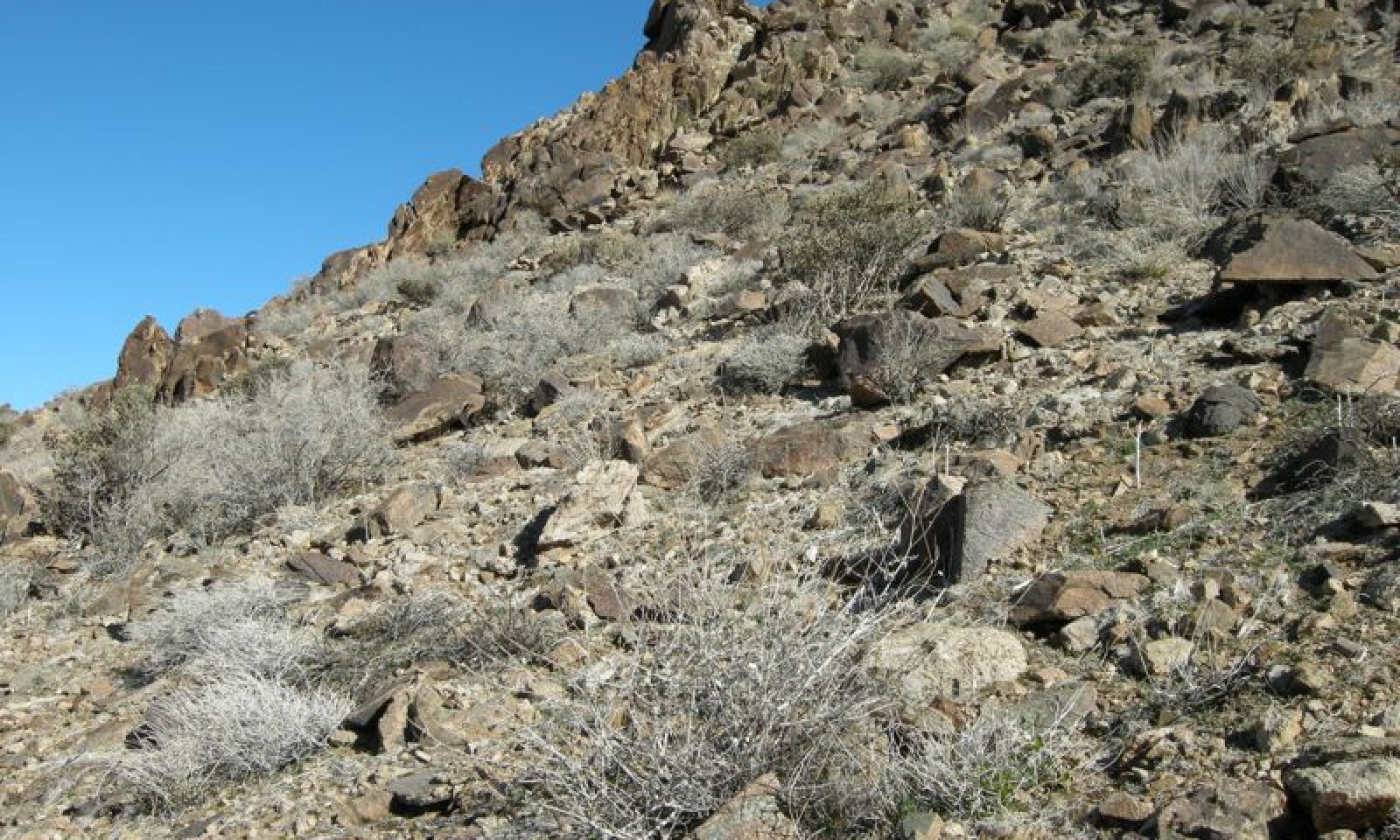
This site occurs on steep mountain slopes at elevations of 2300 to 4820 feet. Soils are very shallow to moderately deep to weathered gneissic or granitoid-dominant bedrock, have a thermic temperature regime, and typically have an argillic horizon within 5 inches of the soil surface.
Production reference value (RV) is 300 pounds per acre and ranges from 160 to 730 pounds per acre with variability due to precipitation-dependent production of annuals. It is characterized by a diverse shrub assemblage comprised of burrobush (Ambrosia dumosa), Parish’s goldeneye (Viguiera parishii), Nevada jointfir (Ephedra nevadensis), jojoba (Simmondsia chinensis) and waterjacket (Lycium andersonii), with a lack of dominance by any one species.
Data ranges in the physiographic data, climate data, water features, and soil data sections of this Ecological Site Description are based on major components only (15 percent of map unit or greater).
Classification relationships
The Ephedra nevadensis Shrubland Alliance (Sawyer et al. 2009) is found within this ecological site.
The Lycium andersonii - Simmondsia chinensis - Pleuraphis rigida Association of the Lycium andersonii Shrubland Alliance (Sawyer et al. 2009) is found within this ecological site.
The Viguiera parishii Shrubland Alliance (Sawyer et al. 2009) is found within this ecological site.Associated sites
R030XB005NV Arid Active Alluvial Fans
R030XB005NV occurs on adjacent fan remnants. Creosote bush (Larrea tridentata) and burrobush (Ambrosia dumosa) dominate.
R030XB140CA Shallow Hill 4-6" P.Z.
R030XB140CA occurs on adjacent slopes. Burrobush (Ambrosia dumosa) and creosote bush (Larrea tridentata) dominate.
R030XB164CA Steep South Slopes
R030XB164CAis found on adjacent slopes. Brittlebush (Encelia farinosa) dominates.
R030XB166CA Dissected Pediment, Cool
R030XB166CA occurs on adjacent pediments at the base of slopes. Blackbrush (Coleogyne ramosissima) and California juniper (Juniperus californica) dominate.
R030XB170CA Bouldery Very Shallow To Shallow Gravelly Slopes
R030XB170CA occurs on adjacent, higher elevation, cool thermic slopes. Blackbrush (Coleogyne ramosissima), Muller's oak (Quercus cornelius-mulleri), single-leaf pinyon pine (Pinus monophylla) and California juniper (Juniperus californica) dominate.
R030XB172CA Warm Gravelly Shallow Hills
R030XB172CA occurs on adjacent slopes. Creosote bush (Larrea tridentata) and Parish's goldeneye (Viguiera parishii) dominate.
R030XB189CA Shallow Cool Hills
R030XB189CA is found on adjacent slopes with a cool thermic soil temperature regime. Blackbrush (Coleogyne ramosissima) and California juniper (Juniperus californica) dominate.
R030XE196CA Sandy Xeric-Intergrade Slopes
R030XE196CA is found on adjacent slopes aridic bordering on xeric soil moisture regimes. Single-leaf pinyon pine (Pinus monophylla) and California juniper (Juniperus californica) dominate.
Similar sites
R030XB164CA Steep South Slopes
This ecological site occurs on south-facing slopes with soils with warm thermic soil temperature regimes, and is strongly dominated by brittlebush (Encelia farinosa).
R030XB140CA Shallow Hill 4-6" P.Z.
This ecological site is co-dominated by burrobush (Ambrosia dumosa) and creosote bush (Larrea tridentata), and has higher production.
R030XB139CA Shallow Dry Hill 4-6 P.Z.
This ecological site is dominated by creosote bush (Larrea tridentata), and production is lower.
R030XB172CA Warm Gravelly Shallow Hills
This ecological site occurs on slopes with a high percentage of large surface fragments and warm thermic soils. The site is dominated by creosote bush (Larrea tridentata) and Parish's goldeneye (Viguiera parishii).
Table 1. Dominant plant species
Tree Not specified
Shrub (1) Ambrosia dumosa
(2) Viguiera parishiiHerbaceous (1) Pleuraphis rigida
Physiographic features
This ecological site occurs on hills and mountain slopes at elevations of 2300 to 4820 feet. Slopes range from 15 to 60 percent. Runoff class is medium to high.
Table 2. Representative physiographic features
Landforms (1) Mountain
(2) Hill
Flooding frequency None Ponding frequency None Elevation 2300 – 4820 ft Slope 15 – 60 % Aspect Aspect is not a significant factor Climatic features
The climate is arid with hot, dry summers and warm, moist winters. The mean annual precipitation is 4 to 7 inches; mean annual air temperature is 55 to 68 F and the frost-free period is 210 to 320 days. Freeze free period was not entered and defaults to zero.
Maximum and minimum monthly climate data for this ESD were generated by the Climate Summarizer
(http://www.nm.nrcs.usda.gov/technical/handbooks/nrph/Climate_Summarizer.xls) using data
from the following climate stations (results are weighted averages; numbers in square brackets represent relative weights):
44405 JOSHUA TREE, CA (Period of record = 1959 to 2011) [1]
LTHC1 Lost Horse, Joshua Tree National Park
(Period of record = 1991 to 2011) [1]
049099, Twentynine Palms, California (Period of record = 1935 – 2011) [1]
The data from multiple weather were combined to most accurately reflect the climatic conditions of this ecological site.
Table 3 Representative climatic features
Frost-free period (average) 320 days Freeze-free period (average) 0 days Precipitation total (average) 10 in BarLineFigure 2. Monthly precipitation range
BarLineFigure 3. Monthly average minimum and maximum temperature
">Influencing water features
Soil features
The soils associated with this ecological site formed in colluvium or residuum derived from granitoid and gneiss. They are typically found on steep hillslopes and mountain slopes (15 to 60 percent slopes). They are very shallow to moderately deep over weathered bedrock. With the exception of Seanna, there is an argillic horizon within 5 inches of the soil surface. Surface textures are sandy loams, gravelly sandy loams, and very gravelly sandy loams with sandy loams or loams beneath. Surface rock fragments less than or equal to three inches in diameter range from 0 to 65 percent, and rock fragments greater than 3 inches in diameter range from 0 to 26 percent. Subsurface fragments less than or equal to three inches in diameter range from 10 to 47 percent, and subsurface fragments greater than 3 inches in diameter range from 0 to 30 percent (subsurface fragments by volume for a depth of 0 to 39 inches). These soils are well-drained with moderately rapid permeability.
The associated soils that are greater than 15 percent of any one map unit are: Desertqueen series (loamy, mixed, superactive, thermic, shallow Typic Haplargids); and Hexie series (coarse-loamy, mixed, superactive, thermic Typic Haplargids). Other soils on which this site is found are typically 5 percent or less of any map unit when associated with this site. They are: Seanna series (loamy-skeletal, mixed, superactive, calcareous, thermic, shallow Typic Torriorthents); Whipple series (loamy-skeletal, mixed, superactive, hyperthermic Lithic Haplargids); Contactmine series (fine-loamy, mixed, superactive, thermic Typic Haplargids); and Typic Argidurids. Seanna soils are the soils that lack an argillic horizon above the weathered bedrock, and the Whipple soils have more than 35 percent rock fragments above the weathered bedrock contact and are found on hot, hyperthermic slopes. Contactmine soils are fine loamy in the particle control section. Typic Argidurids have more than 35 percent rock fragments within the argillic horizon, and the argillic sits on top of an indurated duripan that is silica-cemented. It is not common for this ecological site to be found on Seanna, Whipple, Contactmine, or Typic Argidurid soils.
This ecological site is associated with the following map units and soil component in the Joshua Tree National Park Soil Survey (CA794):
3295;Desertqueen-Hexie-Rock outcrop, 15 to 50 percent slopes;Desertqueen;dry;40; Hexie;;20; Contactmine;warm;5
3325;Ironped-Rock outcrop-Hexie complex, 30 to 60 percent slopes;Hexie;;15
3340;Seanna-Grubstake-Pinecity complex, 30 to 75 percent slopes;Hexie;;2; Seanna;warm;2
4285;Typic Argidurids-Jiblette-Minhoyt complex, 4 to 30 percent slopes;Typic Argidurids;steep;4
1225;Blackeagle-Rock outcrop complex, 15 to 75 percent slopes;Whipple;moist;5
Table 4. Representative soil features
Parent material (1) Colluvium – gneiss
(2) Residuum – granite
Surface texture (1) Sandy loam
(2) Very gravelly fine sandy loam
(3) Gravelly sandy loam
Family particle size (1) Loamy
Drainage class Well drained Permeability class Moderately rapid Soil depth 5 – 39 in Surface fragment cover <=3" 0 – 65 % Surface fragment cover >3" 0 – 26 % Available water capacity
(0-40in)0.9 – 3.8 in Calcium carbonate equivalent
(0-40in)0 – 3 % Electrical conductivity
(0-40in)0 – 2 mmhos/cm Sodium adsorption ratio
(0-40in)0 – 5 Soil reaction (1:1 water)
(0-40in)6.1 – 8 Subsurface fragment volume <=3"
(Depth not specified)10 – 47 % Subsurface fragment volume >3"
(Depth not specified)0 – 30 % Ecological dynamics
Abiotic factors
This ecological site is found on steep mountain slopes on soils with thermic temperature regimes. A high percentage of surface rock fragments and outcrops contributes to high species diversity with a lack of strong dominance by one or two species. The reference plant community is comprised of a diverse shrub assemblage, co-dominated by burrobush, Parish’s goldeneye, jojoba, water jacket, and Nevada jointfir. Other important species include the perennial bunchgrasses big galleta (Pleuraphis rigida) and/or desert needle grass (Achnatherum speciosum). Perennial canopy cover (shrubs, perennial grasses and forbs) ranges from 20 to 40 percent. Annual forb and grass cover is dependent on seasonal precipitation and disturbance, and ranges from 0 to 40 percent. A diverse assemblage of native annual forbs may be present. The non-native annual forb redstem stork’s bill (Erodium cicutarium) is often present, as is the invasive annual grass red brome (Bromus rubens).
Disturbance dynamics
Drought, invasion by non-native annual grasses, and fire are the major disturbances impacting this ecological site.
Drought is an important shaping force in Mojave Desert plant communities (Webb et al. 2003, Bowers 2005, Hereford et al. 2006, Miriti et al. 2007). Short-lived perennial shrubs and perennial grasses demonstrate the highest rates of mortality (Webb et al. 2003, Bowers 2005, Hereford et al. 2006, Miriti et al. 2007), and annual species remain dormant in the soil seedbank (Beatley 1969, 1974, 1976). Long-lived shrubs and trees are more likely to exhibit branch-pruning, and or limited recruitment during drought (e.g. Hereford et al. 2006, Miriti et al. 2007), leading to reduced cover and biomass in drought-afflicted communities.
Fluctuations in precipitation can interact with other disturbances such as fire (Hereford et al. 2006). For example, whole-plant mortality and branch-pruning in response to drought can increase fuel loads, which, coupled with a high biomass of annual species following above-average precipitation, can increase flammability (Hereford et al. 2006). Drought following fire increases mortality of long-lived individuals that may have initially survived the fire (DeFalco et al. 2010). Short-lived shrub species are the first to colonize following fire, and are the most susceptible to drought, so the effects of drought are exacerbated in post-fire regeneration communities.
Non-native annual grasses (red brome [Bromus rubens], cheatgrass [Bromus tectorum] and Mediterranean grass [Schismus species]) have become naturalized throughout the Mojave Desert over the past century (Rickard and Beatley 1965, D'Antonio and Vitousek 1992, Brooks 1999, Reid et al. 2006, Norton et al. 2007). Annual grass cover and production is directly related to winter precipitation (Beatley 1969, Brooks and Berry 2006, Hereford et al. 2006, Allen et al. 2009, DeFalco et al. 2010, Rao and Allen 2010), and several years of drought may reduce the abundance of non-native annuals in the soil seedbank (Minnich 2003). Non-native annual cover and biomass may be reduced on rocky or clay rich soils (Rao et al. 2010), because of the lower availability of water in these soils (Noy-Meir, 1973, Austin et al. 2004), and reduced microsites for plant establishment. (Rao et al. 2010)
Invasion by non-native annual grasses has increased the flammability of desert vegetation communities (e.g. Brooks 1999, Brooks et al. 2004), and after fire, Mojave Desert ecosystems appear to be more susceptible to invasion by exotic grasses, leading to a grass-fire cycle (D’Antonio and Vitousek 1992). Increased soil nitrogen due to air pollution has been shown to increase the productivity of exotic annual grasses across the Mojave Desert (Brooks 1999, Brooks 2003). In Joshua Tree National Park, elevated soil nitrogen is decreasing the diversity and cover of native forb species in the park, and at the same time increasing the cover of exotic annual grasses (Rao and Allen 2010).
State and transition model
Custom diagramStandard diagram
Figure 4. R030XB193CA
More interactive model formats are also available. View Interactive Models
More interactive model formats are also available. View Interactive Models
Click on state and transition labels to scroll to the respective textEcosystem states
Land use 2 submodel, ecosystem states
Land use 3 submodel, ecosystem states
State 2 submodel, plant communities
State 3 submodel, plant communities
State 1
Historic StateState 1 represents the historic range of variability for this ecological site. This state no longer exists due to the ubiquitous naturalization of non-native species in the Mojave Desert. Periodic drought and rare fire were the natural disturbances influencing this ecological site. Fire would have been a very rare occurrence due to the lack of a continuous fine fuel layer between shrubs (Webb 1987). If we were to include dynamics for this state it would be similar to that displayed in State 2, but the Transition to State 3 would not be present.
State 2
Reference StateState 2 represents the current range of variability for this site. Non-native annuals, including red brome and red-stem stork’s bill (Erodium cicutarium) are naturalized in this plant community. Their abundance varies with precipitation, but they are at least sparsely present (as current year's growth or present in the soil seedbank).
Community 2.1
Reference plant community
Figure 5. Community Phase 2.1
The reference plant community is dominated by burrobush, Parish's goldeneye, waterjacket, jojoba and Nevada jointfir. Waterjacket is typically more dominant downslope of large rock outcrops. A diverse range of secondary shrubs and cacti may be present. The perennial bunchgrasses big galleta and desert needlegrass are typically present. A diverse range of native winter annuals may be seasonally abundant, and species most frequently encountered include bristly fiddleneck (Amsinckia tesselata), combseed (Pectocarya spp.), and chia (Salvia columbariae). The plant non-native annual grass red brome is typically present as is the non-native annual forb red-stem stork's bill.
Figure 6. Annual production by plant type (representative values) or group (midpoint values)
Table 5. Annual production by plant type
Plant type Low
(lb/acre)Representative value
(lb/acre)High
(lb/acre)Shrub/Vine 162 275 443 Grass/Grasslike 0 25 155 Forb 2 6 130 Total 164 306 728 Community 2.2
Drought ResponseThis community phase develops after a period of extended or severe drought (less than 20 percent of mean annual winter precipitation). We do not have data to support this community phase, but can extrapolate based on research. Total canopy cover declines by 20 to 30 percent, and site diversity declines with a loss of short-lived perennial species, perennial grasses, and annual forbs (although annual forbs remain present in the soil seed bank). The site is dominated by the long-lived shrubs jojoba, Nevada jointfir, and waterjacket. White bursage and Parish’s goldeneye persist around outcrops and boulders where additional runoff is available.
Burrobush is a short-lived (< 50 years), shallow-rooted, drought-deciduous shrub that may experience high mortality with extended periods of severe drought (Miriti et al. 2007). Parish’s goldeneye is also a short-lived, drought-deciduous shrub. It flowers profusely in response to high rainfall, and remains dormant during low-rainfall years (Green et al. 1993, Sawyer et al. 2009). It may persist through periods of drought, in microsites receiving additional run-on, such as sites downslope of surface boulders (Green et al. 1993). Jojoba is a long-lived (> 100 years), evergreen shrub found in a range of habitats throughout the Sonoran Desert. Both drought and freezing temperatures may limit recruitment by inhibiting or reducing germination and/or increased seedling mortality (Matthews 1994). Jojoba seedlings are sensitive to hot dry temperatures during their first year, and survival is often limited to protected sites, unless there is abundant precipitation (Matthews 1994). Waterjacket is a long-lived, drought-deciduous shrub that occurs in the Southern Great Basin, Mojave and Sonoran Deserts. It has an extensive root system that allows it to exploit soil water from fractured bedrock. Webb et al. (2003) suggest that waterjacket may be particularly susceptible to drought. Nevada jointfir is a long-lived (>100 years), evergreen shrub that occurs throughout western North America, and is associated with shallow, rocky soils (Anderson 2004). Seed set is prolific in wet years, but variable otherwise (Sawyer et al. 2009), with a lack of available soil water potentially limiting cone production (Anderson 2004). Seedlings are tolerant of drought and establish readily following fall or winter rain (Anderson 2004).Community 2.3
Fire regeneration community
Figure 7. Community Phase 2.3
This community phase develops after a moderate or severe burn. After a low-intensity burn, the dominant species in this community are capable of either reprouting (e.g. jojoba, waterjacket, Nevada jointfir, big galleta), or colonizing burned areas from off-site disperal (e.g. burrobush, Parish’s goldeneye). With average to above average precipitation, the regeneration community has higher shrub diversity, and a greater proportion of perennial and non-native annual grasses than the reference community 2.1. Total annual production is also higher, and ranges from 445 to 847 lbs/acre. Canopy cover is also higher, because of the prevalence of non-native annual grasses in intershrub spaces, and ranges from 45 to 83 percent cover. Depending on the severity of the burn, some longer-lived species may be lost for several years.
Burrobush has limited sprouting ability following fire, but relatively rapidly colonizes disturbed areas from adjacent seed sources. Parish’s goldeneye has no to low sprouting ability following fire, but stands may establish in newly burned areas following fire from adjacent seed sources (Sawyer et al. 2009). Jojoba sprouts following fire, but establishment of new seedlings may be limited if suitable nurse plants are not available. Waterjacket sprouts readily after low intensity fire, but may be killed if fire is severe (Brooks and Matchett 2006), and may take decades to return to pre-burn stature and density (Tesky 1992). Nevada jointfir sprouts following low to moderate intensity fires, but may be killed by high intensity fires (Anderson 2004). Some studies have found a decrease in Nevada jointfir abundance after fire, while others have found an increase (Anderson 2004).
This community is an At-risk phase, as the increased cover and biomass of non-native annual grasses increases the likelihood of repeat burning (D'Antonio and Vitousek 1992, Brooks et al. 2004). If the fire return interval is less than 35 years, this community is very likely to transition to State 3.Figure 8. Annual production by plant type (representative values) or group (midpoint values)
Table 6. Annual production by plant type
Plant type Low
(lb/acre)Representative value
(lb/acre)High
(lb/acre)Shrub/Vine 230 325 425 Grass/Grasslike 150 265 375 Forb 1 15 42 Total 381 605 842 Pathway 2.1a
Community 2.1 to 2.2This community pathway occurs in response to a prolonged or severe drought.
Pathway 2.1b
Community 2.1 to 2.3
Reference plant community
Fire regeneration communityThis community pathway occurs in response to a moderate to high intensity fire.
Pathway 2.2a
Community 2.2 to 2.1This community pathway occurs with an end of drought conditions.
Pathway 2.2b
Community 2.2 to 2.3This pathway occurs with moderate to severe fire, and takes place within three years of a very wet period. At longer than three years of drought, the community is at low risk of burning.
Pathway 2.3a
Community 2.3 to 2.1
Fire regeneration community
Reference plant communityThis community pathway occurs with time (> 35 years with no fire)
State 3
Repeated fireThis state develops when the fire return interval is less than 35 years. This state has been significantly altered from the natural range of variability found in States 1 and 2. Big galleta, non-native annual grasses, native sub-shrubs, and short-lived shrubs dominate the community. Annual grasses and forbs are abundant immediately post-fire, with dominance by big galleta, subshrubs and short-lived perennials several years post-fire.
Community 3.1
Subshrubs/Short-lived shrubsThis community phase develops with time without fire (5-20 years), and is dominated by big galleta, subshrubs (desert globemallow, desert trumpet, brownplume wirelettuce and desert marigold) and short-lived shrubs (Cooper’s goldenbush, snakeweed species, burrobrush, eastern Mojave buckwheat). Longer-lived shrubs that have resprouted may be patchily present. There is high cover of non-native and native annuals during wet years.
This community is at high risk for repeat burning.Community 3.2
Annual grass/forbsThis community phase occurs one to five years post-fire. The community is dominated by non-native annual species including red brome, cheatgrass, Mediterranean grass and red-stem stork’s bill, and native forbs, including desert dandelion, bristly fiddleneck and pincushion flower (many other native forbs could also be present). Native subshrubs including globemallow, desert trumpet, brownplume wirelettuce and desert marigold may be abundant. Big galleta cover is high, and there may be very sparse cover of resprouting shrubs including Mojave yucca, waterjacket, catclaw acacia and Nevada jointfir. Seedlings of short-lived shrubs may be present, and may include Cooper’s goldenbush (Ericameria cooperi), snakeweed species (Gutierrezia spp.), burrobrush (Hymenoclea salsola), eastern Mojave buckwheat (Eriogonum fasciculatum), and rayless goldenhead (Acamptopappus sphaerocephalus).
This community is at high-risk of repeat burning due to high fine fuel cover.
Pathway 3.1a
Community 3.1 to 3.2This community pathway occurs with fire.
Pathway 3.2a
Community 3.2 to 3.1This pathway occurs with time without fire (> 5 years).
Transition T1
State 1 to 2This transition occurred with the naturalization of non-native species in this ecological site. Non-native species were introduced with settlement of the Mojave Desert region in the 1860s. Post-settlement cattle and sheep grazing helped to spread and facilitate their establishment (Brooks and Pyke 2000, Brooks et al. 2007).
Transition T2
State 2 to 3This Transition occurs when the fire return interval is less than 35 years.
Restoration pathway 1
State 3 to 2Restoration of communities severely altered by repeat fire at the landscape scale is difficult. Methods may include aerial seeding of early native colonizers such as desert globemallow, big galleta, desert trumpet, brownplume wirelettuce, and desert marigold. Increased native cover may help to reduce non-native plant invasion, helps to stabilize soils, provides a source of food and cover for wildlife, and provides microsites that facilitate shrub colonization. However, the amount of seed required for success is often prohibitive. Large-scale planting of both early colonizers and community dominants tends to be more successful in terms of plant survival, especially if outplants receive supplemental watering during the first two years. Pre-emergent herbicides (Plateau) have been used in the year immediately post-fire to attempt to inhibit or reduce brome invasion. How successful this is on a landscape scale, and the non-target effects have not yet been determined.
Additional community tables
Table 7. Community 2.1 plant community composition
Group Common name Symbol Scientific name Annual production () Foliar cover (%) Shrub/Vine1 Shrub/Vine 95–443 jojoba SICH Simmondsia chinensis 3–88 1–8 water jacket LYAN Lycium andersonii 6–80 3–6 burrobush AMDU2 Ambrosia dumosa 11–75 3–6 white ratany KRGR Krameria grayi 0–70 0–2 Parish's goldeneye VIPA14 Viguiera parishii 25–67 2–9 Nevada jointfir EPNE Ephedra nevadensis 5–50 1–6 wishbone-bush MILAV Mirabilis laevis var. villosa 7–29 0–2 desert globemallow SPAM2 Sphaeralcea ambigua 4–21 1–3 narrowleaf bedstraw GAAN2 Galium angustifolium 0–15 0–1 creosote bush LATR2 Larrea tridentata 0–10 0–1 burrobrush HYSA Hymenoclea salsola 0–9 0–1 Mojave woodyaster XYTO2 Xylorhiza tortifolia 0–8 0–1 desert pepperweed LEFR2 Lepidium fremontii 0–6 0–2 Mexican bladdersage SAME Salazaria mexicana 0–5 0–2 Eastern Mojave buckwheat ERFA2 Eriogonum fasciculatum 0–3 0–2 cottontop cactus ECPO2 Echinocactus polycephalus 0–1 0–1 Grass/Grasslike2 Native perennial grasses 0–75 big galleta PLRI3 Pleuraphis rigida 0–51 0–3 desert needlegrass ACSP12 Achnatherum speciosum 0–22 0–2 5 Non-native annual grasses 0–80 red brome BRRU2 Bromus rubens 0–80 0–8 Forb3 Native forbs 19–90 chia SACO6 Salvia columbariae 0–30 0–1 bristly fiddleneck AMTE3 Amsinckia tessellata 0–20 0–3 combseed PECTO Pectocarya 0–16 0–2 Forb, annual 2FA Forb, annual 0–10 0–3 desert larkspur DEPA Delphinium parishii 0–6 0 pincushion flower CHFR Chaenactis fremontii 0–5 0–2 miniature woollystar ERDI2 Eriastrum diffusum 0–1 0–1 spotted hideseed EUCH Eucrypta chrysanthemifolia 0 0–1 cryptantha CRYPT Cryptantha 0 0–1 New Mexico plumeseed RANE Rafinesquia neomexicana 0 0 Nevada gilia GIBR Gilia brecciarum 0 0 desert calico LOMA10 Loeseliastrum matthewsii 0 0 4 Non-native annual forbs 0–40 redstem stork's bill ERCI6 Erodium cicutarium 0–40 0–9 Table 8. Community 2.2 plant community composition
Group Common name Symbol Scientific name Annual production () Foliar cover (%) Table 9. Community 2.3 plant community composition
Group Common name Symbol Scientific name Annual production () Foliar cover (%) Shrub/Vine1 Native shrubs 230–425 brownplume wirelettuce STPA4 Stephanomeria pauciflora 20–200 0–2 Mojave yucca YUSC2 Yucca schidigera 0–45 0–3 Parish's goldeneye VIPA14 Viguiera parishii 5–40 1–3 burrobush AMDU2 Ambrosia dumosa 15–35 0–5 desert globemallow SPAM2 Sphaeralcea ambigua 5–30 0–2 water jacket LYAN Lycium andersonii 0–25 0–3 Nevada jointfir EPNE Ephedra nevadensis 0–20 0–2 white ratany KRGR Krameria grayi 0–13 0–1 San Felipe dogweed ADPO Adenophyllum porophylloides 0–12 0–1 jojoba SICH Simmondsia chinensis 3–9 0–2 Mojave woodyaster XYTO2 Xylorhiza tortifolia 0–8 0–1 turpentinebroom THMO Thamnosma montana 0–6 0–1 narrowleaf bedstraw GAAN2 Galium angustifolium 0–5 0–1 burrobrush HYSA Hymenoclea salsola 0–3 0–1 Eastern Mojave buckwheat ERFA2 Eriogonum fasciculatum 0–3 0–1 cushion foxtail cactus ESAL2 Escobaria alversonii 0–3 0–1 branched pencil cholla CYRA9 Cylindropuntia ramosissima 0–3 0 wishbone-bush MILAV Mirabilis laevis var. villosa 0–1 0 beavertail pricklypear OPBA2 Opuntia basilaris 0–1 0 Grass/Grasslike2 Native perennial grasses 50–185 big galleta PLRI3 Pleuraphis rigida 35–165 2–7 desert needlegrass ACSP12 Achnatherum speciosum 0–21 0–1 3 Non-native annual grasses 100–190 red brome BRRU2 Bromus rubens 100–190 25–65 Forb4 Native forbs 0–35 desert larkspur DEPA Delphinium parishii 0–12 0–1 curvenut combseed PERE Pectocarya recurvata 0–1 0 New Mexico plumeseed RANE Rafinesquia neomexicana 0–1 0 spineflower CHORI2 Chorizanthe 0–1 0 cryptantha CRYPT Cryptantha 0–1 0 5 Non-native annual forbs 1–7 redstem stork's bill ERCI6 Erodium cicutarium 1–7 0–2 Table 10. Community 3.1 plant community composition
Group Common name Symbol Scientific name Annual production () Foliar cover (%) Table 11. Community 3.2 plant community composition
Group Common name Symbol Scientific name Annual production () Foliar cover (%) Interpretations
Animal community
This ecological site is extensive in mountainous areas, and is important habitat for many native mammals and reptiles. The diversity of shrubs in this ecological site provides an important source of forage for Desert bighorn sheep. The following mammals and reptiles are likely to occur in this ecological site (based on habitat preference):
MAMMALS:
Desert bighorn sheep (Ovis canadensis nelson)
Southern mule deer (Odocoileus hemionus fuliginatus)
Western spotted skunk (Spigale gravilis gracilis)
Long-tailed weasel (Mustela latirosta)
California desert bat (Myotis californicus stephensi)
Western pipistrelle (Pipistrellus hesperus hesperus)
Desert big brown bat (Eptesicus fuscus pallidus)
Pallid bat (Antrozous pallidus minor)
Desert coyote (Canis macrotis arsipus)
Common gray fox (Urocyon cinereoargeneus scottii)
California Mountain Lion (Felis concolor californica)
Desert bobcat (Lynx rufus baileyi)
California ringtail (Bassariscus astutus ocatvus)
Southern Desert cottontail (Sylvilagus audobonii arizonae)
Rodents:
Whitetail antelope squirrel (Ammospermphilus leucurus leucurus)
Western Mojave ground squirrel (Spermophilus beecheyi parvulus)
Long-tailed pocket mouse (Chaetodipus formosus mojavensis)
Merriam's kangaroo rat (Dipodomys deserti)
Desert wood rat (Neotoma fuscipes simplex)
White-throated wood rat (Neotoma albigula venusta)
Sonoran deer mouse (Peromyscus maniculatus sonoriensis)
Desert grasshopper mouse (Onychomys torridus pulcher)
Desert shrew (Notiosorex crawfordi crawfordi)
REPTILES
Mojave Desert Tortoise (Gopherus agassizii agassizii) may occasionally occur in this ecological site, but it is not optimum habitat.
Lizards:
Desert Banded Gecko (Coleonyx variegatus variegatus)
Mojave Collared Lizard(Crotaphytus bicinctores)
Western Chuckwalla(Sauromalus ater obesus)
Great Basin Fence Lizard (Sceloporus biseriatus longipes)
Western Brush Lizard(Urosaurus graciosus graciosus)
Snakes:
Desert Rosy Boa (Lichanura trivirgata gracia)
Mojave Glossy Snake (Arizona occidentalis candida)
Mojave Shovel-nosed Snake (Chionactis occipitalis occipitalis)
Desert Night Snake (Hypsiglena torquata deserticola)
California Kingsnake (Lampropeltis getula californiae)
Great Basin Gopher Snake (Pituophis catenifer deserticola)
Smith’s Black-headed Snake (Tantilla hobartsmithi)
California Lyre Snake (Trimorphodon biscutatus vandenburghi)
Western Diamondback Snake (Crotalus atrox)
Southwestern Speckled Rattlesnake (Crotalus mitchelli pyrrhus)
Red Diamond Rattlesnake (Crotalus ruber ruber)Recreational uses
This ecological site provides aesthetic values, wilderness, and opportunities for cross-country hiking and scrambling.
Other products
Jojoba seed oil has great value economically. It is used in cosmetics, pharmaceuticals, detergents, and in a range of commercial products including wax, varnishes, lubricants, adhesives and linoleum. Jojaba has widespread medicinal use by Native Americans. Native Americans and early settlers in the Southwest used jojoba nuts to make a substitute for coffee (Matthews 1994).
Supporting information
Inventory data references
The following NRCS vegetation plots were used to describe this ecological site: Community Phase 2.1: 1249712917 12497-054-01 (Type location) 12497-054-A 12497-057-02 12497-057-F 12497-59-20 4605AM1 4605AM3 Community Phase 2.3: 1249712801
Type locality
Location 1: Riverside County, CA UTM zone N UTM northing 3749597 UTM easting 590540 General legal description The type location is approximately 2.8 miles southeast of the intersection of Geology Tour Road and Berdoo Canyon Road in Joshua Tree National Park. Other references
Allen, E. B., L. E. Rao, R. J. Steers, A. Bytnerowicz, and M. E. Fenn. 2009. Impacts of atmospheric nitrogen deposition on vegetation and soils at Joshua Tree National Park. Pages 78-100 in R. H. Webb, L. F. Fenstermaker, J. S. Heaton, D. L. Hughson, E. V. McDonald, and D. M. Miller, editors. The Mojave Desert. University of Nevada Press, Reno, Nevada.
Anderson, Michelle D. 2004. Ephedra nevadensis. In: Fire Effects Information System, [Online]. U.S. Department of Agriculture, Forest Service, Rocky Mountain Research Station, Fire Sciences Laboratory (Producer). Available: http://www.fs.fed.us/database/feis/ [2011, August 15].
Austin, A. T., L. Yahdjian, J. M. Stark, J. Belnap, A. Porporato, U. Norton, D. A. Ravetta, and S. M. Scheaeffer. 2004. Water pulses and biogeochemical cycles in arid and semiarid ecosystems. Oecologia 141:221-235.
Beatley, J. C. 1969. Dependence of desert rodents on winter annuals and precipitation. Ecology 50:721-724.
Beatley, J. C. 1974. Effects of rainfall and temperature on the distribution and behavior of Larrea tridentata (Creosote-bush) in the Mojave Desert of Nevada. Ecology 55:245-261.
Beatley, J. C. 1976. Rainfall and fluctuating plant populations in relation to distributions and numbers of desert rodents in southern Nevada. Oecologia 24:21-42.
Bowers, J. E. 2005. Effects of drought on shrub survival and longevity in the northern Sonoran Desert. Journal of the Torrey Botanical Society 132:421-431.
Brooks, M. L. 1999. Habitat invasibility and dominance by alien annual plants in the western Mojave Desert. Biological Invasions 1:325-337.
Brooks, M. L. 2003. Effects of increased soil nitrogen on the dominance of alien annual plants in the Mojave Desert. Journal of Applied Ecology 40:344-353.
Brooks, M. L., C. M. D'Antonio, D. M. Richardson, J. B. Grace, J. E. Keeley, J. M. DiTomaso, R. J. Hobbs, M. Pellant, and D. Pyke. 2004. Effects of invasive alien plants on fire regimes. Bioscience 54:677-689.
Brooks, M. L. and K. H. Berry. 2006. Dominance and environmental correlates of alien annual plants in the Mojave Desert, USA. Journal of Arid Environments 67:100-124.
Brooks, M. L. and J. R. Matchett. 2006. Spatial and temporal patterns of wildfires in the Mojave Desert, 1980-2004. Journal of Arid Environments 67:148-164.
Brooks, M. L., T. C. Esque, and T. Duck. 2007. Creosotebush, blackbrush, and interior chaparral shrublands. RMRS-GTR-202.
Brown, D. E. and R. A. Minnich. 1986. Fire and Changes in Creosote Bush Scrub of the Western Sonoran Desert, California. American Midland Naturalist 116:411-422.
D'Antonio, C. M. and P. M. Vitousek. 1992. Biological invasions by exotic grasses, the grass/fire cycle, and global change. Annual Review of Ecology and Systematics 23:63-87.
DeFalco, L. A., T. C. Esque, S. J. Scoles-Sciulla, and J. Rodgers. 2010. Desert wildfire and severe drought diminish survivorship of the long-lived Joshua tree (Yucca brevifolia; Agavaceae). American Journal of Botany 97:243-250.
Green, J. F., D. H. Headrick, and R. D. Goeden. 1993. Life history and description of immature stages of Procecidochares stonei Blanc & Foote on Viguiera spp. in southern California (Diptera: Tephritidae). Pan-Pacific Entomologist 69:18-32.
Goldberg, D. E. and R. M. Turner. 1986. Vegetation change and plant demography in permanent plots in the Sonoran Desert. Ecology 67:695-712.
Hamerlynk, E. P. and J. R. McAuliffe. 2008. Soil-dependent canopy die-back and plant mortality in two Mojave Desert shrubs. Journal of Arid Environments 72:1793-1802.
Hereford, R., R. H. Webb, and C. I. Longpre. 2006. Precipitation history and ecosystem response to multidecadal precipitation variability in the Mojave Desert region, 1893-2001. Journal of Arid Environments 67:13-34.
Matthews, Robin F. 1994. Simmondsia chinensis. In: Fire Effects Information System, [Online]. U.S. Department of Agriculture, Forest Service, Rocky Mountain Research Station, Fire Sciences Laboratory (Producer). Available: http://www.fs.fed.us/database/feis/ [2011, August 15].
Norton, J. B., T. A. Monaco, and U. Norton. 2007. Mediterranean annual grasses in western North America: kids in a candy store. Plant Soil 298:1-5.
Minnich, R. A. 2003. Fire and dynamics of temperature desert woodlands in Joshua Tree National Park. Contract, Joshua Tree National Park.
Miriti, M. N., S. Rodriguez-Buritica, S. J. Wright, and H. F. Howe. 2007. Episodic death across species of desert shrubs. Ecology 88:32-36.
Noy-Meir, I. 1973. Desert ecosystems: environment and producers. Annual Review of Ecology and Systematics 4:25-51.
Rao, L. E., Allen, E.B. 2010. Combined effects of precipitation and nitrogen deposition on native and invasive winter annual production in California deserts. Oecologia 162:1035-1046.
Rao, L. E., E. B. Allen, and T. M. Meixner. 2010. Risk-based determination of critical nitrogen deposition loads for fire spread in southern California deserts. Ecological Applications 20:1320-1335.
Reid, C. R., S. Goodrich, and J. E. Bowns. 2006. Cheatgrass and red brome: history and biology of two invaders. Pages 27-32 in Shrublands under fire: disturbance and recovery in a changing world. U.S. Department of Agriculture, Forest Service, Rocky Mountain Research Station, Cedar City, Utah.
Rickard, W. H. and J. C. Beatley. 1965. Canopy-coverage of the desert shrub vegetation mosaic of the Nevada test site. Ecology 46:524-529.
Sawyer, J. O., T. Keeler-Woolf, and J. M. Evans. 2009. A manual of California vegetation. 2nd edition. California Native Plant Society, Sacramento, California.
Tesky, Julie L. 1992. Lycium andersonii. In: Fire Effects Information System, [Online]. U.S. Department of Agriculture, Forest Service, Rocky Mountain Research Station, Fire Sciences Laboratory (Producer). Available: http://www.fs.fed.us/database/feis/ [2011, August 15].
Turner, F. B. and D. C. Randall. 1987. The phenology of desert shrubs in southern Nevada. Journal of Arid Environments 13:119-128.
Webb, R. H., Steiger, J.W., Turner, R.M. 1987. Dynamics of Mojave Desert shrub assemblages in the Panamint Mountains, California. Ecology 68:478-490.
Webb, R. H., M. B. Muroy, T. C. Esque, D. E. Boyer, L. A. DeFalco, D. F. Haines, D. Oldershaw, S. J. Scoles, K. A. Thomas, J. B. Blainey, and P. A. Medica. 2003. Perennial vegetation data from permanent plots on the Nevada Test Site, Nye County, Nevada. U.S. Geological Society, Tucson, AZ.
Contributors
Alice Lee Miller
Allison TokunagaRangeland health reference sheet
Interpreting Indicators of Rangeland Health is a qualitative assessment protocol used to determine ecosystem condition based on benchmark characteristics described in the Reference Sheet. A suite of 17 (or more) indicators are typically considered in an assessment. The ecological site(s) representative of an assessment location must be known prior to applying the protocol and must be verified based on soils and climate. Current plant community cannot be used to identify the ecological site.
Author(s)/participant(s) Contact for lead author Date Approved by Approval date Composition (Indicators 10 and 12) based on Annual Production Indicators
-
Number and extent of rills:
-
Presence of water flow patterns:
-
Number and height of erosional pedestals or terracettes:
-
Bare ground from Ecological Site Description or other studies (rock, litter, lichen, moss, plant canopy are not bare ground):
-
Number of gullies and erosion associated with gullies:
-
Extent of wind scoured, blowouts and/or depositional areas:
-
Amount of litter movement (describe size and distance expected to travel):
-
Soil surface (top few mm) resistance to erosion (stability values are averages - most sites will show a range of values):
-
Soil surface structure and SOM content (include type of structure and A-horizon color and thickness):
-
Effect of community phase composition (relative proportion of different functional groups) and spatial distribution on infiltration and runoff:
-
Presence and thickness of compaction layer (usually none; describe soil profile features which may be mistaken for compaction on this site):
-
Functional/Structural Groups (list in order of descending dominance by above-ground annual-production or live foliar cover using symbols: >>, >, = to indicate much greater than, greater than, and equal to):
Dominant:
Sub-dominant:
Other:
Additional:
-
Amount of plant mortality and decadence (include which functional groups are expected to show mortality or decadence):
-
Average percent litter cover (%) and depth ( in):
-
Expected annual annual-production (this is TOTAL above-ground annual-production, not just forage annual-production):
-
Potential invasive (including noxious) species (native and non-native). List species which BOTH characterize degraded states and have the potential to become a dominant or co-dominant species on the ecological site if their future establishment and growth is not actively controlled by management interventions. Species that become dominant for only one to several years (e.g., short-term response to drought or wildfire) are not invasive plants. Note that unlike other indicators, we are describing what is NOT expected in the reference state for the ecological site:
-
Perennial plant reproductive capability:
Print Options
Sections
Font
AAAAOther
PrintThe Ecosystem Dynamics Interpretive Tool is an information system framework developed by the USDA-ARS Jornada Experimental Range, USDA Natural Resources Conservation Service, and New Mexico State University.
Accessibility statement


