
Natural Resources
Conservation Service
-
Search


Major Land Resource Area or ecological site by name and/or ID.
General information
Provisional. A provisional ecological site description has undergone quality control and quality assurance review. It contains a working state and transition model and enough information to identify the ecological site.
Click to explore map
Figure 1. Mapped extent
Areas shown in blue indicate the maximum mapped extent of this ecological site. Other ecological sites likely occur within the highlighted areas. It is also possible for this ecological site to occur outside of highlighted areas if detailed soil survey has not been completed or recently updated.
MLRA notes
Major Land Resource Area (MLRA): 030X–Mojave Basin and Range
MLRA Description:
Major Land Resource Area (MLRA) 30, Mojave Desert, is found in southern California, southern Nevada, the extreme southwest corner of Utah and northwestern Arizona within the Basin and Range Province of the Intermontane Plateaus. The climate of the area is hot (primarily hyperthermic and thermic; however at higher elevations, generally above 5000 feet, mesic, cryic and frigid) and dry (aridic). Elevations range from below sea level to over 12,000 feet in the higher mountain areas found within the MLRA. Due to the extreme elevational range found within this MLRA, Land Resource Units (LRUs) were designated to group the MLRA into similar land units.
LRU Description:
This LRU (designated by ’XB’) is found across the eastern half of California, much of the mid-elevations of Nevada, the southernmost portions of western Utah, and the mid-elevations of northwestern Arizona. Elevations range from 1800 to 5000 feet and precipitation ranges from 4 to 9 inches per year, but is generally between 5-6 inches. This LRU is characterized primarily by the summer precipitation it receives, ranging from 18 – 35% but averages 25%. Summer precipitation falls between July and September in the form of rain, and winter precipitation falls starting in November and ends between February and March, also mostly in the form of rain; however it does receive between 0 and 3 inches of snow, with an average of 1 inch. The soil temperature regime is thermic and the soil moisture regime is typic-aridic. Vegetation includes creosote bush, burrobush, Nevada jointfir, ratany, Mojave yucca, Joshua tree, chollas, cactus, big galleta grass and several other warm season grasses. At the upper portions of the LRU, plant production and diversity are greater and blackbrush is a common dominant shrub.
Ecological Site Concept -
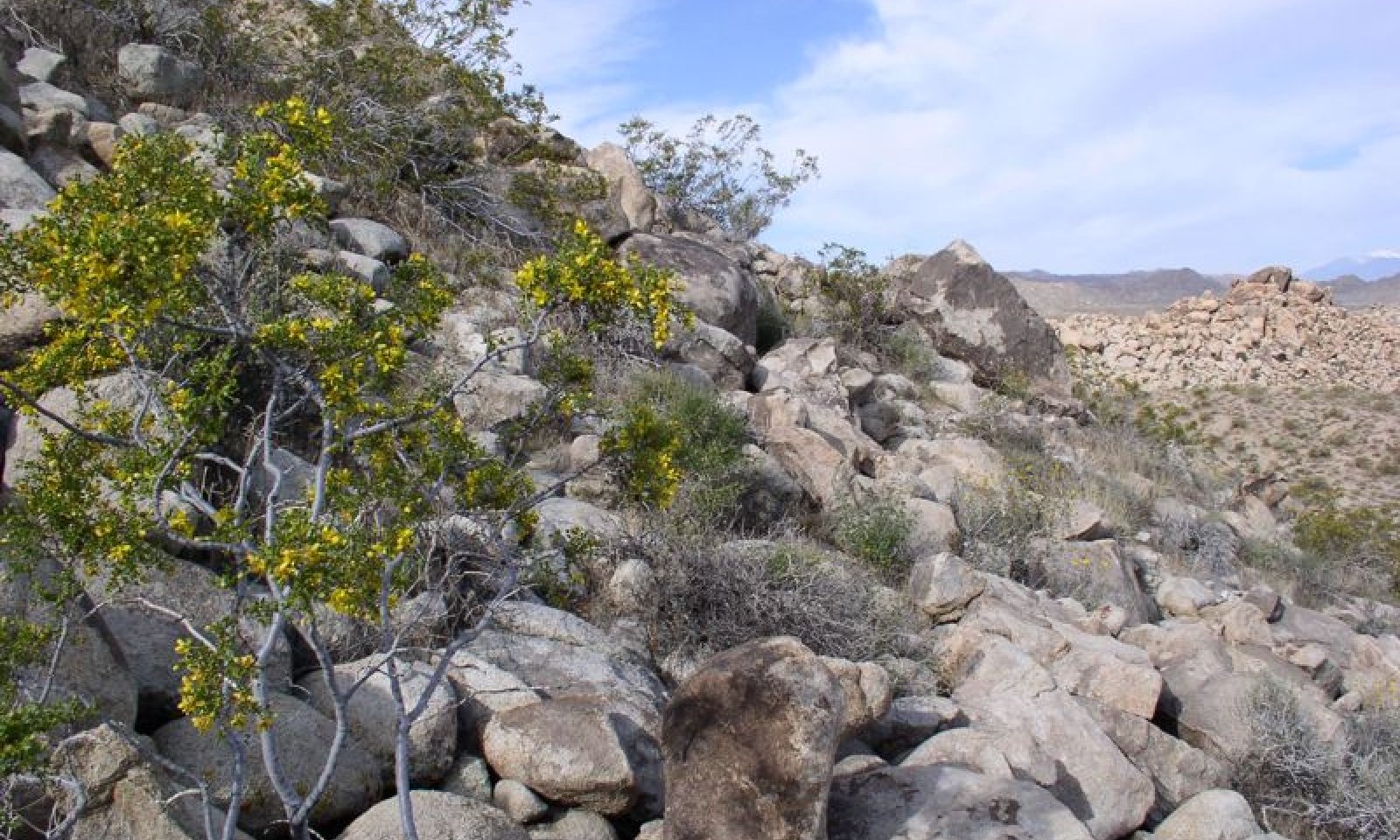
This site is found on steep stony slopes with shallow to moderately deep soils at elevations of 2100 to 4720 feet. Slopes are generally greater than 30 percent, and surface stones have greater than 10 percent cover. This site is associated with warm thermic soil temperatures. Production reference value (RV) is 246 pounds per acre and ranges from 105 to 442 pounds per acre depending on annual precipitation and annual species production. Creosote bush (Larrea tridentate) and Parish’s goldeneye (Viguiera parishi) dominate the site, but a high diversity of other shrub species may be present. A high percentage of large surface fragments restricts plant cover, but the additional run-on provided by surface fragments allows for increased diversity. Creosote bush is tolerant of hot temperatures, and deep taproots can access cracks in fractured or weathered bedrock to obtain moisture. Parish’s goldeneye is drought-tolerant, and can efficiently use moisture available from run-on when it is available.
Data ranges in the physiographic data, climate data, water features, and soil data sections of this Ecological Site Description are based on major components only (15 percent of mapunit or greater).
Classification relationships
The Viguiera parishii Shrubland Alliance and the Larrea tridentata Shrubland Alliance (Sawyer et al. 2009) occur within this ecological site.
Associated sites
R030XA178CA Moderately Deep Sandy Slopes
This ecological site occurs on adjacent slopes in the XA LRU (i.e. areas receiving predominately winter precipitation). It is dominated by California juniper (Juniperus californica) and Parry's jujube (Ziziphus parryi).
R030XB139CA Shallow Dry Hill 4-6 P.Z.
This ecological site is found on adjacent slopes with less large fragment cover. Creosote bush (Larrea tridentata) and burrobush (Ambrosia dumosa) dominate.
R030XB170CA Bouldery Very Shallow To Shallow Gravelly Slopes
This ecological site is found on higher elevation, cool thermic slopes. Single-leaf pinyon pine (Pinus monophylla), Muller's oak (Quercus cornelius-mulleri), blackbrush (Coleogyne ramosissima) and California juniper (Juniperus californica) dominate.
R030XB171CA Dissected Pediment
This ecological site is found on pediment below this site. The dominant species are blackbrush (Coleogyne ramosissima), creosote bush (Larrea tridentata), and burrobush (Ambrosia dumosa).
R030XB189CA Shallow Cool Hills
This ecological site is found on adjacent, higher elevation, cool thermic slopes. Blackbrush (Coleogyne ramosissima) and California juniper (Juniperus californica) dominate.
R030XB193CA Very Shallow To Moderately Deep Gravelly Slopes
This ecological site is found on adjacent slopes on soils with an argillic horizon. Burrobush (Ambrosia dumosa), jojoba (Simmondsia chinensis), waterjacket (Lycium andersonii), Parish's goldeneye (Viguiera parishii) and Nevada jointfir (Ephedra nevadensis) are all important species.
R030XD003CA Hyperthermic Steep South Slopes
This ecological site is found on adjacent, lower elevation, hyperthermic slopes. Brittlebush (Encelia farinosa) dominates the site.
Similar sites
R030XB164CA Steep South Slopes
This ecological site is found on soils with fewer large surface fragments, and is dominated by brittlebush (Encelia farinosa).
R030XB140CA Shallow Hill 4-6" P.Z.
This ecological site is found on slopes with fewer large surface fragments. White bursage and creosote bush co-dominate and production is higher.
R030XB139CA Shallow Dry Hill 4-6 P.Z.
This ecological site is found on slopes with fewer large surface fragments. It is dominated by creosote bush (Larrea tridentata) and burrobush (Ambrosia dumosa) is an important species. Parish's goldeneye (Viguiera parishii) is trace if present.
R030XB193CA Very Shallow To Moderately Deep Gravelly Slopes
This ecological site occurs on slopes with fewer large surface fragments, and typically is associated with soils with an argillic horizon. Creosote bush (Larrea tridentata) is not a dominant species.
Table 1. Dominant plant species
Tree Not specified
Shrub (1) Viguiera parishii
(2) Larrea tridentataHerbaceous Not specified


