
Natural Resources
Conservation Service
Ecological site R030XB141NV
GRAVELLY FAN APRON
5-7 PZ
Last updated: 3/10/2025
Accessed: 10/06/2026
-
Search


Major Land Resource Area or ecological site by name and/or ID.
PreviousSectionsNextGeneral information
Provisional. A provisional ecological site description has undergone quality control and quality assurance review. It contains a working state and transition model and enough information to identify the ecological site.
Ecological site concept
This site occurs on fan aprons. Slopes range from 2 to 8 percent. Elevations range from 1800 to 3800 feet. The soils of this site are very deep, well drained, and formed in alluvium derived from limestone.
This site is part of group concept R030XD015CA.Associated sites
R030XB137NV GRAVELLY WASH 5-7 P.Z.
R030XB139NV COBBLY FAN 5-7 P.Z.
Similar sites
R030XB039NV LIMY FAN 5-7 P.Z.
Shrubs minor component, much more productive.
R030XB043NV CLAYPAN 5-7 P.Z.
More productive site. MUPO2 and KRLA2 important species.
Table 1. Dominant plant species
Tree Not specified
Shrub (1) Ambrosia dumosa
Herbaceous (1) Pleuraphis rigida
Physiographic features
This site occurs on fan aprons. Slopes range from 2 to 8 percent. Elevations range from 1800 to 3800 feet.
Table 2. Representative physiographic features
Landforms (1) Fan apron
Flooding duration Very brief (4 to 48 hours) Flooding frequency Very rare Elevation 549 – 1158 m Slope 2 – 8 % Aspect Aspect is not a significant factor Climatic features
The climate is typical of the Mojave Desert transitional to Sonoran Desert with hot, dry summers and cool, moist winters. Majority of precipitation comes in the winter with a lesser secondary peak in the summer. The average annual precipitation ranges from 5 to 7 inches. Mean annual air temperature is about 64 degrees F. The average frost-free period is 210 to 250 days.
Table 3 Representative climatic features
Frost-free period (average) 250 days Freeze-free period (average) Precipitation total (average) 180 mm BarLineFigure 1. Monthly precipitation range
BarLineFigure 2. Monthly average minimum and maximum temperature
">Influencing water features
This site is very rarely flooded during intense summer convective storms.
Soil features
The soils of this site are very deep, well drained, and formed in alluvium derived from limestone. The soil profile is modified with 40 to 70 percent gravels. The soils are rarely flooded, have moderately high saturated hydraulic conductivity, and medium runoff. The soil series correlated to this ecological site includes Elbowcanyon, classified as a loamy-skeletal, carbonatic, thermic Typic Torriorthent.
Table 4. Representative soil features
Parent material (1) Alluvium – limestone
Surface texture (1) Very gravelly fine sandy loam
Family particle size (1) Loamy
Drainage class Well drained Permeability class Moderately rapid Soil depth 183 – 213 cm Surface fragment cover <=3" 75 – 95 % Surface fragment cover >3" 3 – 8 % Available water capacity
(0-101.6cm)3.18 – 7.8 cm Calcium carbonate equivalent
(0-101.6cm)30 – 50 % Electrical conductivity
(0-101.6cm)Not specified Sodium adsorption ratio
(0-101.6cm)Not specified Soil reaction (1:1 water)
(0-101.6cm)8 – 8.2 Subsurface fragment volume <=3"
(Depth not specified)60 – 85 % Subsurface fragment volume >3"
(Depth not specified)0 – 20 % Ecological dynamics
The topographic position of this site results in increased run-in moisture from the surrounding landscape, increasing the abundance of warm season perennial bunchgrasses. Warm season grasses have higher light and temperature requirements to begin photosynthesis and grow most actively during the summer, when precipitation is lowest. Primary production in this system is largely constrained by drought. High temperatures and small rainfall events allow nutrients to accumulate during extended dry periods when plant and microbial growth is restricted. When precipitation events do occur, they trigger a pulse of biological activities including plant growth and nutrient uptake (Collins et al 2008). The resource pulses influence plant community structure through annual growth and seedling recruitment.
Grasses are intensive exploiters; they extract a large portion of their moisture from shallow soil horizons through their dense network of shallow roots (Burgess 1995). This trait makes grasses very efficient competitors for limited shallow soil moisture, especially during summer precipitation events. The shrubs of this site are extensive exploiters; they have roots systems that penetrate large volumes of soil both shallow and deep layers (Burgess 1995). This allows shrubs to extract moisture from layers that are too deep or distributed too erratically for intensive exploiters.
Vegetation plays an important role in reducing the erodibilty of the soil surface. Incorrect management actions may result in reduced vegetative cover and increased soil erosion. Long-term surface disturbance or reoccurring wildfire will reduce native plant cover, plant density, and species diversity of this site. As ecological condition deteriorates big galleta and perennial forbs decrease, short-lived perennials initially increase. Non-native annual grasses and forbs may increase as native perennial vegetation is lost.
Fire Ecology:
Historically this plant community was influenced by infrequent, low severity fires due to low herbaceous production and widely spaced shrubs. Big galleta’s clumped rhizomatous growth form and rigid clums make it relatively resistant to trampling and other disturbance. Big galleta sprouts from the root crown following fire. Litter and old shoots from galleta provide valuable organic matter when incorporated into the soil. White bursage is tolerant of disturbance and is a common pioneer species on disturbed areas in the Mojave Desert. White bursage is generally killed by wildfire. It reproduces both vegetatively and sexually and will quickly recover. Creosotebush reproduces vegetatively and is able to sprout from the root crown following disturbance. Fire generally kills creosotebush. It has limited sprouting ability following low severity fire, damage can vary depending on season of burning. White ratany is generally completely top killed by fire, but readily sprouts from the root crown and quickly recovers.State and transition model
Custom diagramStandard diagram
More interactive model formats are also available. View Interactive Models
More interactive model formats are also available. View Interactive Models
Click on state and transition labels to scroll to the respective textEcosystem states
State 1 submodel, plant communities
State 2 submodel, plant communities
State 1
Reference StateThe Reference State is representative of the natural range of variability under pristine conditions. Plant communities are dynamic in response to changes in disturbance regimes and weather patterns. Plant community phase changes are primarily driven by long-term drought, wildfire, disease and insect attack. This state is maintained by infrequent disturbances that allow native grasses to flourish while keeping the shrubs from dominating the site. Plant communities of the reference state are stable and long lived, both creosotebush and white bursage persist in the plant community even though their relative percentages may change over time.
Community 1.1
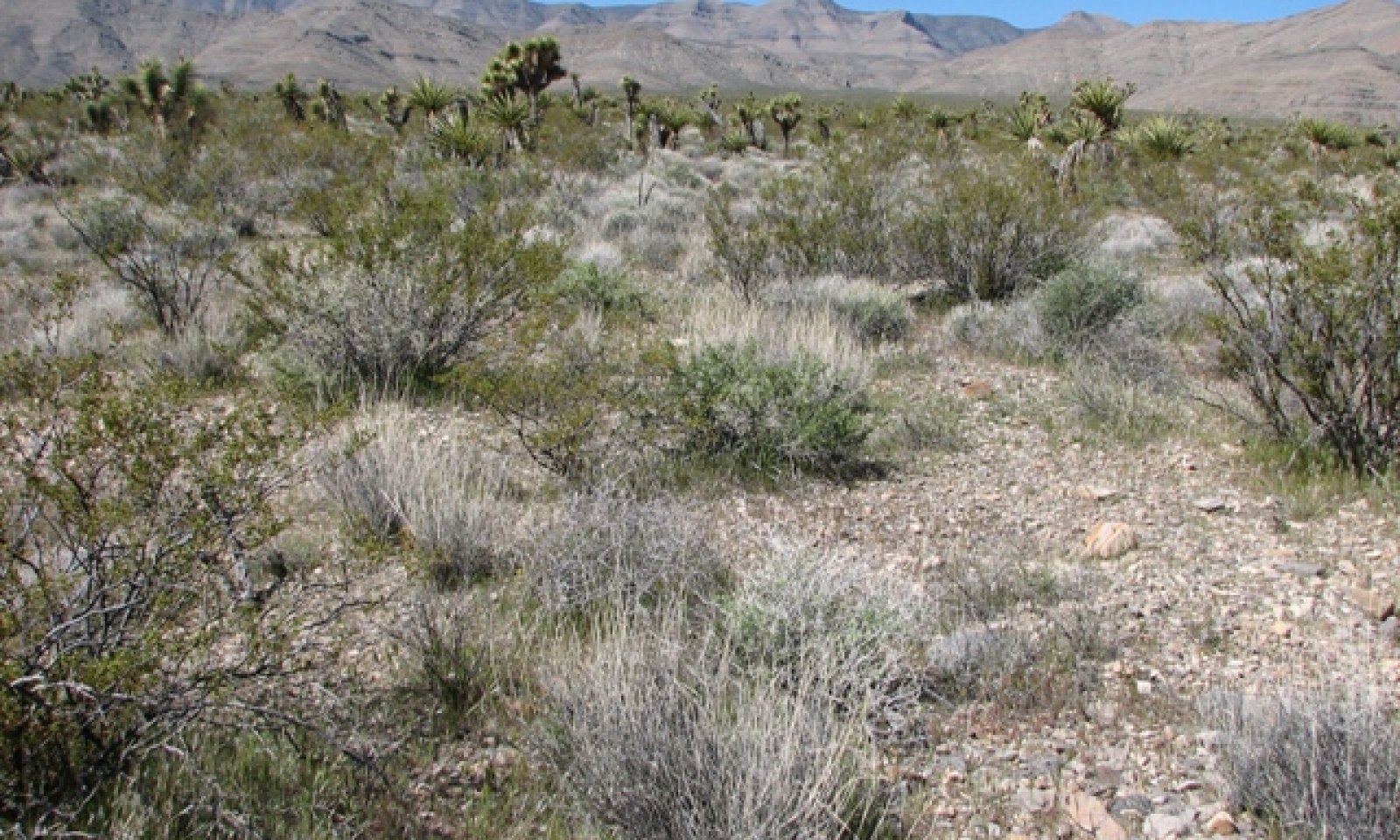
Reference Plant CommunityThe reference plant community is characteristic of a mid to late-seral, healthy condition. It is dominated by white bursage and big galleta. Creosotebush and range ratany are other important species associated with this ecological site. Potential vegetative composition is about 35 percent annual and perennial grasses, 10 percent annual and perennial forbs, and 55 percent shrubs. Approximate ground cover, (basal and crown) is 15 to 25 percent.
Figure 3. Annual production by plant type (representative values) or group (midpoint values)
Table 5. Annual production by plant type
Plant type Low
(kg/hectare)Representative value
(kg/hectare)High
(kg/hectare)Shrub/Vine 123 216 340 Grass/Grasslike 78 137 215 Forb 22 39 62 Total 223 392 617 Community 1.2
Plant Community 1.2This plant community is characteristic of a post-disturbance plant community. Initially it is heavily dominated by herbaceous vegetation. Sprouting shrubs quickly recover and provide favorable microsites for shrub seedlings to establish, contributing to increased overall canopy cover. This plant community is at-risk of invasion by non-native species. Non-natives are able to take advantage of increased availability of typically limited resources following a disturbance.
Pathway 1.1a
Community 1.1 to 1.2Wildfire, prolonged drought, disease and/or insect attack.
Pathway 1.2a
Community 1.2 to 1.1Absence of disturbance and natural regeneration overtime.
State 2
Invaded StateThe Invaded State is characterized by the presence of non-native annuals in the understory. Introduced annuals such as red brome and redstem filaree have invaded the reference plant community. A biotic threshold is crossed, with the introduction of non-native annuals that are difficult to remove from the system and have the potential to alter disturbance regimes significantly from their natural or historic range of variation. These non-natives annuals are highly flammable and promote wildfires where fires historically have been infrequent. The presence of non-natives has reduced the ecological resilience of the site.
Community 2.1
Invaded Plant Community 2.1
Figure 4. Invaded Plant Community with trace of non-natives
This plant community is compositionally similar to the reference community with a trace of non-native annuals in the understory. Ecological processes have not changed at this time, although resilience is reduced by the presence of non-native species. This plant community may respond differently following fire or other disturbance, when compared to non-invaded plant communities.
Community 2.2
Invaded Plant Community 2.2This plant community is characterized by a post-disturbance plant community phase. Initially it is heavily dominated by herbaceous biomass which may or may not be non-native. Non-native species take advantage of increased light and nutrient resources following disturbance. Perennial bunchgrasses and some shrubs are able to sprout from the root crown and quickly recover and serve as nurse plants for other shrub seedlings. Fine fuels provided by non-native annuals provides a continuous fuel bed that promotes the spread of fire.
Community 2.3
Invaded Plant Community 2.3This plant community is dominated by non-native annuals, minor amounts of perennial bunchgrasses and shrubs remain. Loss of perennial vegetation leads to altered ecological processes including increased erosion and changes in the nutrient cycling dynamics. This plant community is considered ‘at-risk’ of crossing an irreversible threshold. Feedbacks contributing to the establishment of an alternative stable state include increase in density and rate of spread of non-natives and the loss of native perennials and important functional groups. Non-native annuals thrive under an high frequency disturbance regimes due to their annual growth form, competitive ability and persistent seed bank.
Pathway 2.1a
Community 2.1 to 2.2Wildfire, prolonged drought, disease, and/or insect attack.
Pathway 2.2a
Community 2.2 to 2.1Absence from disturbance and natural regeneration over time.
Pathway 2.2b
Community 2.2 to 2.3Reoccurring disturbances on a shortened return interval.
Pathway 2.3a
Community 2.3 to 2.1Exclusion of fire and surface disturbance and time allows resilient native species to regenerate.
Transition T1
State 1 to 2Introduction of non-native species due to a combination of factors including: 1) surface disturbance, 2) changes in the kinds of animals and their grazing patterns, 3) drought and/or 4) changes in fire history.
Additional community tables
Table 6. Community 1.1 plant community composition
Group Common name Symbol Scientific name Annual production () Foliar cover (%) Grass/Grasslike1 Primary Perennial Grasses 78–98 big galleta PLRI3 Pleuraphis rigida 78–98 – 2 Secondary Perennial Grasses 8–39 Indian ricegrass ACHY Achnatherum hymenoides 2–12 – low woollygrass DAPU7 Dasyochloa pulchella 2–12 – bush muhly MUPO2 Muhlenbergia porteri 2–12 – redroot cryptantha CRMIM Cryptantha micrantha var. micrantha 1–4 – Fremont's phacelia PHFR2 Phacelia fremontii 1–4 – Forb2 Annual Forbs 1–8 smallflowered milkvetch ASNU4 Astragalus nuttallianus 2–8 – desert marigold BAMU Baileya multiradiata 2–8 – desert trumpet ERIN4 Eriogonum inflatum 2–8 – desert globemallow SPAM2 Sphaeralcea ambigua 2–8 – 3 Perennial Forbs 8–39 Shrub/Vine5 Primary Shrubs 122–188 burrobush AMDU2 Ambrosia dumosa 78–118 – creosote bush LATR2 Larrea tridentata 39–59 – white ratany KRGR Krameria grayi 4–11 – 6 Secondary Shrubs 19–59 rayless goldenhead ACSP Acamptopappus sphaerocephalus 4–12 – Nevada jointfir EPNE Ephedra nevadensis 4–12 – Eastern Mojave buckwheat ERFAP Eriogonum fasciculatum var. polifolium 4–12 – spiny hopsage GRSP Grayia spinosa 4–12 – winterfat KRLA2 Krascheninnikovia lanata 4–12 – water jacket LYAN Lycium andersonii 4–12 – Joshua tree YUBR Yucca brevifolia 4–12 – Mojave yucca YUSC2 Yucca schidigera 4–12 – beavertail pricklypear OPBA2 Opuntia basilaris 1–4 – grizzlybear pricklypear OPPOE Opuntia polyacantha var. erinacea 1–4 – California barrel cactus FECYC Ferocactus cylindraceus var. cylindraceus 1–4 – Wiggins' cholla CYEC3 Cylindropuntia echinocarpa 1–4 – Table 7. Community 1.2 plant community composition
Group Common name Symbol Scientific name Annual production () Foliar cover (%) Table 8. Community 2.1 plant community composition
Group Common name Symbol Scientific name Annual production () Foliar cover (%) Table 9. Community 2.2 plant community composition
Group Common name Symbol Scientific name Annual production () Foliar cover (%) Table 10. Community 2.3 plant community composition
Group Common name Symbol Scientific name Annual production () Foliar cover (%) Interpretations
Animal community
Livestock Interpretations:
This site is suitable for livestock grazing. Big galleta dominates the site and is considered fair forage for domestic livestock. Other grasses comprise less than ten percent of the total annual production and provide a relatively unimportant grazing resource. White bursage is of intermediate forage value. In areas where little else is available is can be extremely important. White ratany is an important forage for all classes of livestock. White ratany will decrease in response to heavy grazing pressure. Creosotebush is unpalatable to livestock, however, it is used as bedding cover.
Stocking rates vary over time depending upon season of use, climatic variations, site and previous and current management goals. A safe starting stocking rate is an estimated stocking rate that is fine tuned by the client by adaptive management through the year and from year to year.
Wildlife Interpretations:
Many wildlife species find valuable foraging and habitat resources on this ecological site. Big galleta is extensively used by bighorn sheep and is preferred habitat in some areas. White bursage is an important browse species, especially on ranges where little else is available. White ratany is heavily used by mule deer and desert bighorn sheep. Black-tailed jackrabbits rely almost exclusively on white ratany during the winter. The seeds of white ratany comprise up to 5 percent of the diet of quail in some areas. Many species bed under creosotebush. Desert reptiles and amphibians use creosotebush as a food source, a perch site and also burrow under the shrub to avoid high daytime temperatures. Black-tailed jackrabbits heavily depend on creosotebush for forage throughout the year.
Hydrological functions
This ecological site is characterized by medium runoff and moderately rapid permeability. Rills and waterflow patterns are none to rare. Sparse shrub canopy and associated litter provide some protection from raindrop impact. Perennial herbaceous plants slow runoff and increase infiltration.
Recreational uses
Aesthetic value is derived from the diverse floral and faunal composition and the colorful flowering of wild flowers and shrubs during the spring and early summer. This site offers rewarding opportunities for photography and nature study. This site is used for hiking and has potential for upland and big game hunting.
Other products
Native Americans have used white ratany for many medicinal puposes. An infusion of the roots was used to treat skin irritations and sores. Roots were also used to produce a reddish-yellow dye. The flowers were used to treat upset stomach and diarrhea. The stems were dried and ground and applied to sores. Creosotebush is used by Native Americans to treat many illnesses. Twigs and leaves may be boiled as tea, steamed, pounded into a powder, pressed into a poultice, or heated into an infusion.
Supporting information
Type locality
Location 1: Clark County, NV Township/Range/Section T15S R63E S7 UTM zone N UTM northing 4057383 UTM easting 681167 Latitude 36° 38′ 41″ Longitude 114° 58′ 24″ General legal description Approximately 5 miles from Wamp Spring in Desert National Wildlife Refuge, west U.S. Highway 93.USGS Arrow Canyon NW 7.5 minute topographic Quadrangle. Other references
Burgess, T.L. 1995. Desert Grassland, Mixed Shrub Savanna, Shrub Steppe, or Semidesert Scrub? Pp. 31-67 in M.P. McClaran and T.R. Van Devender (eds.), the Desert Grassland. University of Arizona Press, Tucson Arizona.
Collins, S.L., R.L. Sinsabaugh, C. Crenshaw, L. Green, A. Porras-Alfaro, M. Stursova and L.H. Zeglin. 2008. Pulse dynamics and microbial processes in aridland ecosystems. J. of Ecology. 96: 413-420.
Fire Effects Information System (Online; http://www.fs.fed.us/database/feis/plants/)
USDA-NRCS Plants Database (Online; http://plants.usda.gov)
Contributors
E. Hourihan
PNOVAK-ECHENIQUEApproval
Kendra Moseley, 3/10/2025
Rangeland health reference sheet
Interpreting Indicators of Rangeland Health is a qualitative assessment protocol used to determine ecosystem condition based on benchmark characteristics described in the Reference Sheet. A suite of 17 (or more) indicators are typically considered in an assessment. The ecological site(s) representative of an assessment location must be known prior to applying the protocol and must be verified based on soils and climate. Current plant community cannot be used to identify the ecological site.
Author(s)/participant(s) P. Novak-Echenique Contact for lead author State Rangeland Management Specialist Date 06/29/2011 Approved by Approval date Composition (Indicators 10 and 12) based on Annual Production Indicators
-
Number and extent of rills:
Rills are none to rare. Surface rock fragments armor the surface. -
Presence of water flow patterns:
Water flow patterns none to rare and may be evident in areas recently subject to intense summer rainfall. -
Number and height of erosional pedestals or terracettes:
Pedestals are none to rare with occurrence typically limited to areas within water flow patterns. -
Bare ground from Ecological Site Description or other studies (rock, litter, lichen, moss, plant canopy are not bare ground):
Bare Ground up to 10%, depending on amount of surface rock fragments. -
Number of gullies and erosion associated with gullies:
None. -
Extent of wind scoured, blowouts and/or depositional areas:
None. -
Amount of litter movement (describe size and distance expected to travel):
Fine litter (foliage from grasses and annual & perennial forbs) expected to move distance of slope length (<10 ft) during intense summer convection storms or rapid snowmelt events. Persistent litter (large woody material) will remain in place except during large rainfall events. -
Soil surface (top few mm) resistance to erosion (stability values are averages - most sites will show a range of values):
Soil stability values should be 1 to 3 in interspaces and 3 to 6 under canopy. (To be field tested.) -
Soil surface structure and SOM content (include type of structure and A-horizon color and thickness):
Surface structure is typically moderate, very thick platy. Soil surface colors are yellowish browns and soils are typified by an ochric epipedon. Organic matter of the surface 2 to 3 inches is less than 1 percent. -
Effect of community phase composition (relative proportion of different functional groups) and spatial distribution on infiltration and runoff:
Sparse shrub canopy and associated litter break raindrop impact. Perennial herbaceous plants slow runoff and increase infiltration. -
Presence and thickness of compaction layer (usually none; describe soil profile features which may be mistaken for compaction on this site):
None. Platy or subangular blocky structure is not to be interpreted as compacted layers. -
Functional/Structural Groups (list in order of descending dominance by above-ground annual-production or live foliar cover using symbols: >>, >, = to indicate much greater than, greater than, and equal to):
Dominant:
Reference Plant Community: Mojave Desert shrubs > >Sub-dominant:
deep-rooted, warm-season, bunchgrasses > perennial forbs > annual forbs > deep-rooted, cool-season, bunchgrasses > annual grassesOther:
succulentsAdditional:
-
Amount of plant mortality and decadence (include which functional groups are expected to show mortality or decadence):
Dead branches within individual shrubs common and standing dead shrub canopy material may be as much as 25% of total woody canopy; mature bunchgrasses commonly (<20%) have dead centers. -
Average percent litter cover (%) and depth ( in):
Between and under canopy 20-25% and depth (<¼-inch) -
Expected annual annual-production (this is TOTAL above-ground annual-production, not just forage annual-production):
For normal or average growing season ±350 lbs/ac. Favorable years 550 lbs/ac and unfavorable years 200 lbs/ac. -
Potential invasive (including noxious) species (native and non-native). List species which BOTH characterize degraded states and have the potential to become a dominant or co-dominant species on the ecological site if their future establishment and growth is not actively controlled by management interventions. Species that become dominant for only one to several years (e.g., short-term response to drought or wildfire) are not invasive plants. Note that unlike other indicators, we are describing what is NOT expected in the reference state for the ecological site:
Potential invaders on this site include red brome, redstem filaree, and Mediterranean grass. -
Perennial plant reproductive capability:
All functional groups should reproduce in above average and normal growing season years. Less reproduction will occur in below average precipitation years. Some functional groups may not reproduce during below average years.
Print Options
Sections
Font
AAAAOther
PrintThe Ecosystem Dynamics Interpretive Tool is an information system framework developed by the USDA-ARS Jornada Experimental Range, USDA Natural Resources Conservation Service, and New Mexico State University.
Accessibility statement


