
Natural Resources
Conservation Service
-
Search


Major Land Resource Area or ecological site by name and/or ID.
PreviousSectionsNextGeneral information
Draft. A draft ecological site description is either incomplete or has not undergone quality control and quality assurance review.
MLRA notes
Major Land Resource Area (MLRA): 028A–Ancient Lake Bonneville
MLRA 28A occurs in Utah (82%), Nevada (16%), and Idaho (2%). It makes up about 36,775 square miles (95,300 square kilometers). About three-fifths of this area is federally owned land, large tracts of which are used for military training and testing purposes by the. A large area west and southwest of Great Salt Lake is a salty playa. This area is the farthest eastern extent of the Great Basin Section of the Basin and Range Province of the Intermontane Plateaus. It is an area of nearly level basins between widely separated mountain ranges trending north to south. The basins are bordered by long, gently sloping alluvial fans. The mountains are uplifted fault blocks with steep side slopes. They are not well dissected because of low rainfall in the MLRA. Most of the valleys are closed basins containing sinks or playa lakes. Elevation ranges from 3,950 to 6,560 feet (1,205 to 2,000 meters) in the basins and from 6,560 to 11,150 feet (2,000 to 3,400 meters) in the mountains.
Most of this area has alluvial valley fill and playa lakebed deposits at the surface. Great Salt Lake is all that remains of glacial Lake Bonneville, which covered this area during the most recent ice age. A level line on some mountain slopes indicates the former extent of this glacial lake. The uplifted mountains have exposed some Precambrian rocks at their margins. Most of the mountains in the interior of this area consist of tilted blocks of marine sediments from Cambrian to Mississippian age. Scattered outcrops of Tertiary continental sediments and volcanic rocks are throughout the area.
The average annual precipitation is 5 to 12 inches (125 to 305 millimeters) in the valleys and is as much as 49 inches (1,245 millimeters) in the mountains. Most of the rainfall occurs as high-intensity, convective thunderstorms during the growing season. The driest period is from midsummer to early autumn. Precipitation in winter typically occurs as snow. The average annual temperature is 39 to 53 degrees F (4 to 12 degrees C). The freeze-free period averages 165 days and ranges from 110 to 215 days, decreasing in length with elevation.
The dominant soil orders in this MLRA are Aridisols, Entisols, and Mollisols. The soils in the area dominantly have a mesic or frigid soil temperature regime, an aridic or xeric soil moisture regime, and mixed mineralogy. They generally are well drained or somewhat excessively drained, loamy or loamy-skeletal, and very deep.
Ecological site concept
This forestland site occurs on mountains, stream terraces, and ground moraines on all aspects. Slopes range from 8 to 75 percent, but slopes of 8 to 30 percent are most typical. Elevations are 7200 to over 11,250 feet.
Average annual precipitation is over 25 inches. Mean annual air temperature is 40 to 43 degrees F. The average growing season is 50 to 70 days.
The soils associated with this site are very deep and well drained. These soils are formed in colluvium and alluvium derived from quartzite or welded tuff. These soils have a mollic or umbric epipedon. Soils are neutral to strongly acid. The soil profile is modified with a high volume of rock fragments.
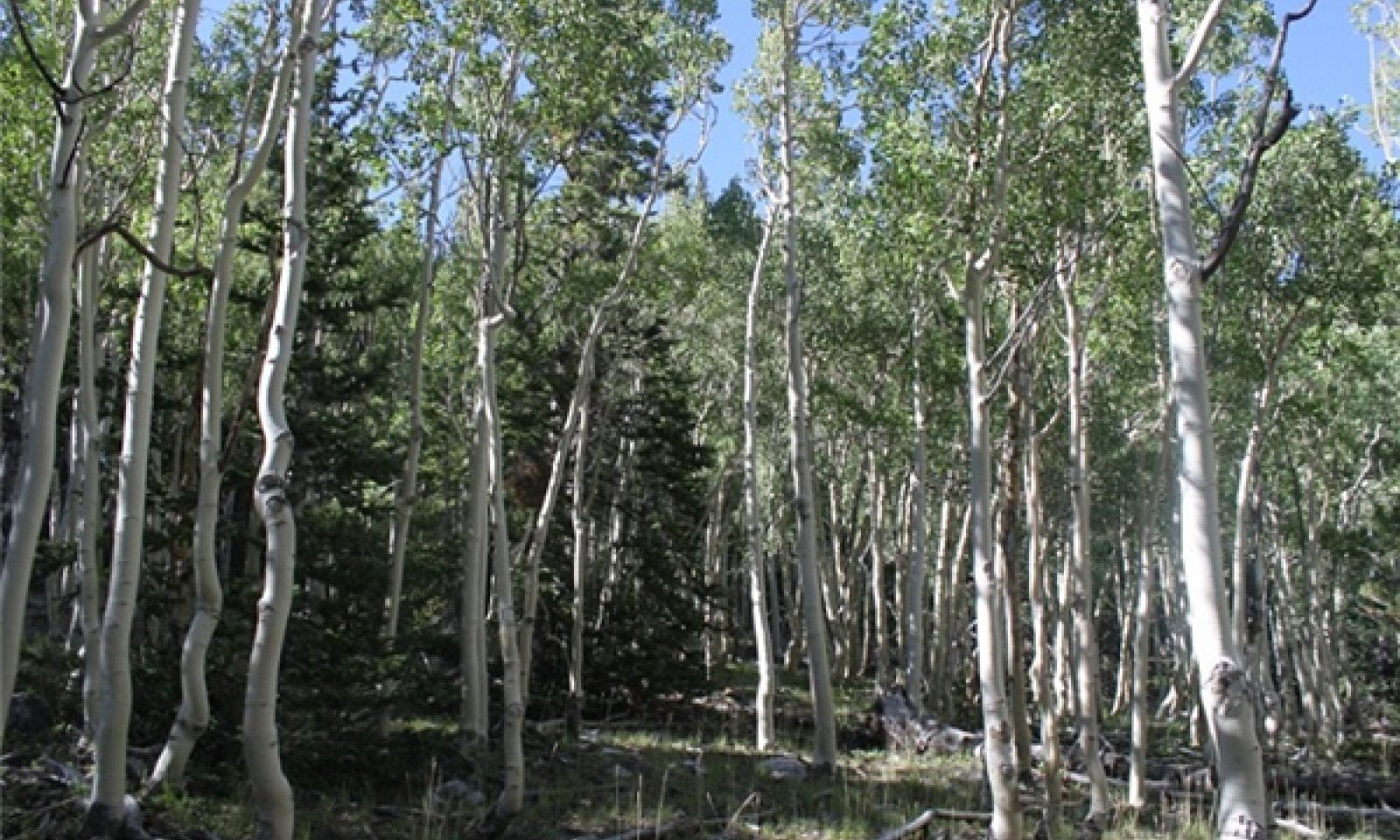
The reference state is dominated by quaking aspen and Engelmann''s spruce (Picea Engelmannii). Engelmann''s spruce is most prevalent within uneven-aged aspen stands of this forest site. An overstory canopy cover of about 40 percent is assumed to be representative of tree dominance on this site in the pristine environment. Rocky Mountain white fir (Abies concolor var. concolor) and limber pine (Pinus flexilis) are species commonly associated with this site. Mountain brome, slender wheatgrass, skyline bluegrass, and Ross'' sedge are common understory grasses and grass-like plants. Mountain snowberry and creeping barberry are the principal understory shrubs. An overstory canopy cover of about 55 percent is assumed to be representative of tree dominance on this site in the pristine environment. This site is composed of one to several quaking aspen clones, each with a common genetic makeup and individual phenological and physiological characteristics. Overstory tree canopy composition is about 65 to 85 percent quaking aspen, 15 to 35 percent Engelmann''s spruce, and less than 10 percent white fir and/or limber pine. Production ranges from 100 to 500 pounds per acre.
Table 1. Dominant plant species
Tree (1) Populus tremuloides
(2) Picea engelmanniiShrub (1) Symphoricarpos oreophilus
Herbaceous (1) Bromus marginatus
(2) Elymus trachycaulus ssp. trachycaulusPhysiographic features
This forestland site occurs on mountains, stream terraces, and ground moraines on all aspects. Slopes range from 8 to 75 percent, but slopes of 8 to 30 percent are most typical. Elevations are 7200 to over 11,250 feet.
Table 2. Representative physiographic features
Landforms (1) Mountain
(2) Stream terrace
(3) Ground moraine
Flooding duration Brief (2 to 7 days) Flooding frequency Occasional Elevation 7200 – 11250 ft Slope 8 – 75 % Water table depth 35 – 54 in Aspect Aspect is not a significant factor Climatic features
Nevada’s climate is predominantly arid, with large daily ranges of temperature, infrequent severe storms, heavy snowfall in the higher mountains, and great location variations with elevation. Three basic geographical factors largely influence Nevada’s climate: continentality, latitude, and elevation. Continentality is the most important factor. The strong continental effect is expressed in the form of both dryness and large temperature variations. Nevada lies on the eastern, lee side of the Sierra Nevada Range, a massive mountain barrier that markedly influences the climate of the State. The prevailing winds are from the west, and as the warm moist air from the Pacific Ocean ascend the western slopes of the Sierra Range, the air cools, condensation occurs and most of the moisture falls as precipitation. As the air descends the eastern slope, it is warmed by compression, and very little precipitation occurs. The effects of this mountain barrier are felt not only in the West but throughout the state, with the result that the lowlands of Nevada are largely desert or steppes. The temperature regime is also affected by the blocking of the inland-moving maritime air. Nevada sheltered from maritime winds, has a continental climate with well-developed seasons and the terrain responds quickly to changes in solar heating.
Nevada lies within the mid-latitude belt of prevailing westerly winds which occur most of the year. These winds bring frequent changes in weather during the late fall, winter and spring months, when most of the precipitation occurs. To the south of the mid-latitude westerlies, lies a zone of high pressure in subtropical latitudes, with a center over the Pacific Ocean. In the summer, this high-pressure belt shifts northward over the latitudes of Nevada, blocking storms from the ocean. The resulting weather is mostly clear and dry during the summer and early fall, with scattered thundershowers. The eastern portion of the state receives significant summer thunderstorms generated from monsoonal moisture pushed up from the Gulf of California, known as the North American monsoon. The monsoon system peaks in August and by October the monsoon high over the Western U.S. begins to weaken and the precipitation retreats southward towards the tropics (NOAA 2004).
Average annual precipitation is over 25 inches. Mean annual air temperature is 40 to 43 degrees F. The average growing season is 50 to 70 days.Table 3 Representative climatic features
Frost-free period (average) 60 days Freeze-free period (average) 150 days Precipitation total (average) 30 in BarLineFigure 1. Monthly precipitation range
BarLineFigure 2. Monthly average minimum and maximum temperature
Figure 3. Annual precipitation pattern
Figure 4 Annual average temperature pattern
Climate stations used
-
(1) GREAT BASIN NP [USC00263340], Baker, NV
">Influencing water features
There are no influencing water features associated with this site.
Soil features
The soils associated with this site are very deep and well drained. These soils are formed in colluvium and alluvium derived from quartzite or welded tuff. These soils have a mollic or umbric epipedon. Soils are neutral to strongly acid. The soil profile is modified with a high volume of rock fragments. The soil series associated with this site include: Berrycreek, Brokit, Greengrove, Hackwood, Snacreek, and Timmercrek.
The representative soil series is Greengrove, a Ashy-skeletal, glassy Vitrandic Haplocryolls. Diagnostic horizons include an Mollic epipedon from 12 to 45 cm, and a Cambic horizon from 25 to 45 cm. Clay content in the particle control sections average 10 to 18 percent. Rock fragments range from 35 to 55 percent mainly cobbles. Reaction is neutral. Effervescence is none. Lithology consists of welded tuff.Table 4. Representative soil features
Parent material (1) Alluvium – quartzite
(2) Colluvium – welded tuff
Surface texture (1) Very gravelly loam
(2) Ashy very fine sandy loam
(3) Very stony loam
Family particle size (1) Loamy
Drainage class Somewhat poorly drained to well drained Permeability class Slow to moderate Soil depth 55 – 60 in Surface fragment cover <=3" 15 – 35 % Surface fragment cover >3" 0 – 10 % Available water capacity
(0-40in)2.5 – 5.3 in Calcium carbonate equivalent
(0-40in)Not specified Electrical conductivity
(0-40in)0 – 2 mmhos/cm Sodium adsorption ratio
(0-40in)Not specified Soil reaction (1:1 water)
(0-40in)5.4 – 7.3 Subsurface fragment volume <=3"
(Depth not specified)10 – 20 % Subsurface fragment volume >3"
(Depth not specified)25 – 35 % Ecological dynamics
An ecological site is the product of all the environmental factors responsible for its development and it has a set of key characteristics that influence a site’s resilience to disturbance and resistance to invasives. Key characteristics include 1) climate (precipitation, temperature), 2) topography (aspect, slope, elevation, and landform), 3) hydrology (infiltration, runoff), 4) soils (depth, texture, structure, organic matter), 5) plant communities (functional groups, productivity), and 6) natural disturbance regime (fire, herbivory, etc.) (Caudle et al. 2013). Biotic factors that influence resilience include site productivity, species composition and structure, and population regulation and regeneration (Chambers et al. 2013).
Common disturbances in aspen stands include fire, insect and disease outbreaks, wind storms and avalanches. Aspen stands have also shown some sensitivity to drought (Hogg et al 2008). Quaking aspen is considered one of the most widely distributed forest plants in North America (Potter 1998). Mature aspen stands (80 to 100 years) can reach heights up to 100 feet depending on the site. Most stands contain a variety of medium-high shrubs and tall herbs in the understory (DeByle and Winokur 1985). Wildfire maintained the dynamics of these communities, but with fire suppression mature aspen stands can be susceptible to stand decline. Typically as stands begin to decline aspen suckers and saplings are able to regenerate the stand. As aspen trees mature and tree canopy begins to close the perennial understory becomes dominated by shade tolerant species. Conifers, when present, can eventually increase and overtop the aspen trees. The increase in conifers can be attributed to both fire suppression and grazing pressure by both livestock and wildlife (Potter 2005, Strand et al. 2009, Bartos and Campbell 1998). Using a habitat model Strand et al. 2009 computed aspen occurrence probability across the landscape of the Owyhee Plateau. They visited 41 sites where they modeled aspen occurrence; 37% they found dead aspen stems with no aspen regeneration, 51% had scattered aspen ramets and aspen was regenerating in forest gaps, and 12% there was no evidence that aspen had ever occurred on or near the site. Their aspen successional model theorized that non-producing aspen stands can be permanently converted to a conifer stand and the aspen clone can be lost. They estimated that over 60% of aspen woodlands have been or are in the process of converting to conifer woodlands within 80-200 years. Whether or not these stands can be converted back to aspen with disturbance is inconclusive.
An additional threat to aspen sustainability is limited aspen regeneration due to the shading by conifer trees or herbivory. Overstory clearing, whether in small gaps or in large openings, provides the needed light for aspen suckers to sprout (Shepperd et al 2006). A limited aspen root system resulting from previous conifer dominance and/or persistent shading from surrounding uncut trees may require additional disturbance to initiate suckering. Additional management actions such as root ripping may be needed to stimulate root suckering (Shepperd et al 2006). Continuous browsing by livestock or wildlife may also limit aspen regeneration. Herbivory can reduce community resilience and alter future aspen cover (Rogers et al 2013).
There are many environmental factors that can contribute to stand decline or die-off. The major underlying cause can be attributed to tree and/or stand stress. Drought, low soil oxygen, and cold soil temperatures all limit soil water uptake and can contribute to xylem cavitation. Cavitation causes much of the aspen die-off but the created stress can also leave the stand open to secondary factors such as wood boring insects and fungal pathogens (Frey et al. 2004). Drought has been attributed to the decline and death of aspen trees, but also contributes to secondary factors such as insects (Frey et al. 2004).
Aspen stands possess three characteristics that provide suitable sites for invasive plants: 1) deep, rich soils, 2) proximity to moist meadows and riparian areas with open water, 3) their dependency on disturbance and open light. This site has moderate resilience to disturbance and resistance to invasion. Human disturbance associated with recreation and animal (domestic and wildlife) disturbance may lead to the spread of invasive species such as Kentucky bluegrass (Poa pratensis), common dandelion (Taraxacum officinale) and thistles (Cirsium sp.). Additionally, the ecological sites contained within this site are moderately resilient and resistant due to productive soils, additional soil moisture and aspens ability to sprout following fire or other stand or tree removal processes. Three stable states have been identified for this site, a reference state, current potential state and a third state where conifers have encroached and dominated the site. The research is inconclusive if these conifer dominated aspen stands can regenerate with fire.
Fire Ecology:
Wildfire is recognized as a natural disturbance that influenced the structure and composition of the historic climax vegetation of this woodland site. It is hypothesized that many of the fires that maintained these communities were set by the Native population, who used fire to manage plant communities for human benefit (Kay 1997). Specific fire intervals are dependent upon surrounding vegetation communities. Intense fires that kill the aspen overstory usually stimulate abundant suckering (DeByle and Winokur 1985). Although aspen stands rely on fire for successful regeneration, aspen stands don’t readily carry fire (Fechner and Barrows 1976, Debyle and Winokur 1985, Debyle et al. 1987). The tree itself is extremely fire sensitive (Baker 1925); with its thin bark most aspens are killed by fire, and those left with scarring are usually killed within the next growing season from rot and disease (Bradley et al. 1992,Davidson et al. 1959, Meinecke 1929). Periodic wildfires prevent over-mature aspen stands and maintain a naturally stratified mosaic of even-aged aspen communities in various stages of successional development. Uneven-aged stands form under stable conditions where the overstory gradually disintegrates with disease or age, and is replaced by aspen suckers. Historic heavy grazing has been attributed to the reduction of fine fuels within stands; without the fuels to burn fires seldom occur within aspen forests (DeByle and Winokur 1985).
Mountain big sagebrush is killed by fire (Neuenschwander 1980, Blaisdell et al. 1982), and does not resprout (Blaisdell 1953). Post fire regeneration occurs from seed and will vary depending on site characteristics, seed source, and fire characteristics. Mountain big sagebrush seedlings can grow rapidly and may reach reproductive maturity within 3 to 5 years (Bunting et al. 1987). Mountain big sagebrush may return to pre-burn density and cover within 15-20 years following fire, but establishment after severe fires may proceed more slowly and can take up to 50 years (Bunting et al. 1987, Ziegenhagen 2003, Miller and Heyerdahl 2008, Ziegenhagen and Miller 2009).
Mountain snowberry is top-killed by fire, but resprouts after fire from rhizomes (Leege and Hickey 1971, Noste and Bushey 1987). Snowberry has been noted to regenerate well and exceed pre-burn biomass in the third season after fire (Merrill et al. 1982). Was currant, a minor component of this site, is known as a weak sprouter from the root crown but usually regenerates from soil stored seeds after fire. It is susceptible to fire kill and rarely survives fire (Crane and Fischer 1986). If balsamroot or mules ear is common before fire, these plants will increase after fire or with heavy grazing (Wright 1985).
The effect of fire on bunchgrasses relates to culm density, culm-leaf morphology, and the size of the plant. The initial condition of bunchgrasses within the site along with seasonality and intensity of the fire all factor into the individual species response. For most forbs and grasses the growing points are located at or below the soil surface providing relative protection from disturbances which decrease above ground biomass, such as grazing or fire. Thus, fire mortality is more correlated to duration and intensity of heat which is related to culm density, culm-leaf morphology, size of plant and abundance of old growth (Wright 1971, Young 1983).
Mountain brome the dominate grass found on this site is a robust, coarse-stemmed, short lived perennial bunchgrass that can grow from 1 to 5 feet in height (Dayton 1937, Tilley et al. 2004). It is commonly seeded after wildfires due to its ability to establish quickly and reduce erosion (Tilley et al. 2004). Mountain brome significantly decreases after burning (Nimir and Payne 1978). Slender wheatgrass, a sub-dominate grass on this site, may increase after fire. In a study by Nimir and Payne (1978) slender wheatgrass increased significantly in burned than in non-burned sites, although the species did not appear in measurable quantities until mid-July.
Sandberg bluegrass (Poa secunda), a minor component of this ecological site, has been found to increase following fire likely due to its low stature and productivity (Daubenmire 1975). Sandberg bluegrass may retard reestablishment of deeper rooted bunchgrasses. Mutton grass (Poa fendleriana), also a minor component on this site, is top killed by fire but will resprout after low to moderate severity fires. A study by Vose and White (1991) in an open sawtimber site, found minimal difference in overall effect of burning on mutton grass.State and transition model
Custom diagramStandard diagram
Figure 5. State and Transition Model

Figure 6. Legend
More interactive model formats are also available. View Interactive Models
More interactive model formats are also available. View Interactive Models
Click on state and transition labels to scroll to the respective textState 1 submodel, plant communities
State 2 submodel, plant communities
State 3 submodel, plant communities
State 1
Reference StateThe Reference State 1.0 is a representative of the natural range of variability under pristine conditions. This site has four general community phases; a mature woodland phase, a sucker/sapling phase, an immature woodland phase and an over mature woodland/conifer phase. State dynamics are maintained by interactions between climatic patterns and disturbance regimes. Negative feedbacks enhance ecosystem resilience and contribute to the stability of the state. These include the presence of all structural and functional groups, fuel loads, and retention of organic matter and nutrients. Plant community phase changes are primarily driven by fire, periodic drought and/or insect or disease attack.
Community 1.1
Community PhaseThe visual aspect and vegetal structure are dominated by single-storied aspen that have reached or are near maximal heights for the site. Tree heights range from 60 to 80 feet, depending upon site. Tree canopy cover ranges from 25 to about 35 percent. Despite considerable understory forage production, the overstory trees compete with the undergrowth plants for moisture, light, nutrients, and space. Vegetative shoots and/or saplings of aspen occur in the understory, but they are inconspicuous and have a high mortality rate. Engelmann's spruce, Rocky Mountain fir, and other conifers may be present to increasing in the understory, because of their shade tolerance these trees can multiply and eventually dominate the site.
Forest overstory.MATURE FOREST: Diameter growth of aspen shows strong recovery with reduced competition during this stage. Diameter growth of Engelmann's spruce continues but spruce height growth is restricted. The visual aspect and vegetal structure are dominated by single-storied aspen and Engelmann's spruce that have reached or are near maximal heights for the site. Engelmann's spruce canopy composition is 15 to 35 percent. Tree heights range from 60 to 80 feet, depending upon site. Tree canopy cover ranges from 35 to 50 percent. Despite considerable understory forage production, the overstory trees do compete with the undergrowth plants for moisture, light, nutrients, and space. Vegetative shoots and/or saplings of aspen occur in the understory, but they are inconspicuous and have a high mortality rate. White fir and/or limber pine seedlings and saplings occur in the understory and mature individuals may contribute up to 10 percent of the total tree canopy cover.
Forest understory. Understory vegetative composition is about 40 percent grasses, 15 percent forbs, and 45 percent shrubs and young trees when the average overstory canopy is medium (35 to 50 percent). Average understory production ranges from 600 to 1200 pounds per acre with a medium canopy cover. Understory production includes the total annual production of all species within 4½ feet of the ground surface.
Figure 7. Annual production by plant type (representative values) or group (midpoint values)
Table 5. Annual production by plant type
Plant type Low
(lb/acre)Representative value
(lb/acre)High
(lb/acre)Grass/Grasslike 160 280 400 Shrub/Vine 10 175 250 Tree 80 140 200 Forb 60 105 150 Total 310 700 1000 Community 1.2
Community PhaseHerbaceous vegetation dominates the site. Quaking aspen suckers are evident. If the aspen stand is healthy, this stage will only last from one to two years. However, if competing brush and herbaceous plants grow for a full season before aspen suckers emerge, or with excessive herbivory from large ungulates such as elk, a reduction in growth and survival of aspen suckers may occur. Early growth of quaking aspen suckers ranges from less than 1 foot to more than 3 feet per year for shoots having good competitive position. In the absence of disturbance, suckers develop into saplings (to 4½ feet in height) with a range in canopy cover of about 5 to 15 percent. Vegetation consists of grasses, forbs and a few shrubs in association with tree saplings.
Forest overstory.Herbaceous vegetation and regenerating shrubs dominate this community phase. Quaking aspen suckers are evident. If the aspen stand is healthy the potential for root suckering is great. However, aspen suckers are sensitive to competition for sunlight, space and nutrients. Natural thinning is heavy and effective. The least vigorous suckers die within 1 to 2 years. Over time most sucker clumps reduce to a single stem. <br /> <br /> Early growth of quaking aspen suckers ranges from less than 1 foot to more than 3 feet per year for shoots having good competitive position. In the absence of disturbance, suckers develop into saplings (to 4.5 feet in height) with a range in canopy cover of about 5 to 15 percent.
Forest understory. Vegetation consists of grasses, forbs and a few shrubs in association with tree saplings. Understory production ranges from 900 to 1600 pounds per acre.
Community 1.3
Community PhaseThis stage is characterized by rapid growth of the aspen trees, both in height and canopy cover. Aspen stands are self-thinning, especially at young ages. After the canopy closes, trees stratify into crown classes quickly, despite genetic uniformity within clones. The visual aspect and vegetal structure are dominated by aspen ranging from about 10 to 20 feet in height, and having a diameter at breast height of about 2 to 4 inches. Understory vegetation is moderately influenced by a tree overstory canopy of about 40 to over 60 percent. Growth of the aspen begins to slow and there is a fairly continual adjustment of trees to growing space. As competition becomes intense enough to affect the diameter growth of dominants, mortality quickly reduces the number of trees in the lower crown classes. There are periodic surges in mortality, with a large number of trees dying within a short time. The visual aspect and vegetal structure are dominated by aspen mostly greater than 25 feet in height. Understory vegetation is moderately influenced by a tree overstory canopy of about 25 to 40 percent.
Forest overstory.Growth of the aspen slows during this stage and there is a fairly continual adjustment of trees to growing space. As competition becomes intense enough to affect the diameter growth of dominants, mortality quickly reduces the number of trees in the lower crown classes. There are periodic surges in mortality, with a large number of trees dying within a short time. Understory vegetation is moderately influenced by a tree overstory canopy of about 25 to 40 percent. Young Engelmann's spruce trees are common in the aspen understory. The visual aspect and vegetal structure are dominated by aspen mostly greater than 25 feet in height.
Forest understory. Seedlings and saplings of other shade tolerant conifers such as white fir and limber pine may occur in the understory. Understory production ranges from 700 to 1200 pounds per acre.
Community 1.4
Community PhaseIn the absence of wildfire or other naturally occurring disturbances, the tree canopy on this site can become very dense. This stage is normally dominated by aspen and/or conifers that have reached maximal heights for the site. Engelmann's spruce, Rocky Mountain fir, and other conifers may dominate the overstory canopy in over-mature, aspen stands. Aspen trees may be decadent. In the absence of disturbance, over-mature, even-aged aspen stands slowly die. Tree canopy cover is commonly more than 50 percent. Understory production is strongly influenced by the overstory, as is species composition. Shade tolerant forbs and a few grasses will dominate the understory.
Forest overstory.In the absence of wildfire or other naturally occurring disturbances, the tree canopy on this site can become very dense. This stage is normally dominated by aspen that have reached maximal heights for the site. Engelmann's spruce, white fir, and other conifers may comprise as much as 50 percent of the total tree canopy in stable, over-mature, aspen stands. Aspen trees have straight, clear stems with short, high-rounded crowns. In the absence of disturbance, over-mature, even-aged aspen stands slowly die. The aspen canopy opens up, and otherwise inconspicuous aspen suckers survive and grow in the openings not shaded by the remaining conifers. These suckers typically arise over a period of several years; the resulting stand is broadly even-aged. If broadly even-aged stands reach old age without disturbance, their deterioration is likely to extend over a longer period than before because of the range of tree ages. That, in turn, will result in a longer regeneration period and a new stand with an even greater range of ages. If this continues over several generations, all-aged stands will result. Tree canopy cover is commonly more than 50 percent.
Forest understory. Understory production is strongly influenced by the overstory, as is species composition. Shade tolerant forbs and a few grasses will dominate the understory. It is acknowledged that over a very long period of time and in the absence of disturbance this stage can progress to a climatic climax forest dominated by white fir. As white fir claims dominance of the overstory, the forest floor becomes littered with fallen quaking aspen and Engelmann's spruce logs. Understory production ranges from 100 to 500 pounds per acre.
Pathway a
Community 1.1 to 1.2Fire would reduce the mature aspen and allow for the suckers, saplings and the herbaceous understory to increase.
Pathway b
Community 1.1 to 1.4Time and lack of disturbance will allow for the conifer trees in the understory to mature and dominate the site.
Pathway a
Community 1.2 to 1.3Time and lack of disturbance, release from herbivory will allow for the aspen suckers to mature
Pathway a
Community 1.3 to 1.1Time and lack of disturbance, release from herbivory will allow for the aspen trees to mature.
Pathway b
Community 1.3 to 1.2Fire, insects, disease or wind damage can reduce the aspen canopy and the subsequent competition with the understory allowing the understory herbaceous community to increase. Excessive herbivory while trees are still within reach to browse may also reduce aspen growth.
Pathway a
Community 1.4 to 1.2Fire would decrease the conifer canopy and allow for the aspen suckers to increase.
State 2
Current Potential StateThis state is similar to the Reference State 1.0 with four similar community phases. Ecological function has not changed, however the resiliency of the state has been reduced by the presence of invasive weeds. Non-natives may increase in abundance but will not become dominant within this State. These non-natives can be highly flammable and can promote fire where historically fire had been infrequent. Negative feedbacks enhance ecosystem resilience and contribute to the stability of the state. These feedbacks include the presence of all structural and functional groups, low fine fuel loads, and retention of organic matter and nutrients. Positive feedbacks decrease ecosystem resilience and stability of the state. These include the non-natives’ high seed output, persistent seed bank, rapid growth rate, ability to cross pollinate, and adaptations for seed dispersal.
Community 2.1
Community Phase
Figure 8. POTR5-PIEN (F028AY078NV) T. Stringham July 2012
This community phase is similar to the Reference State Community Phase 1.1, with the presence of non-native species in trace amounts such as common dandelion and cheatgrass. The visual aspect and vegetal structure are dominated by single-storied aspen that have reached or are near maximal heights for the site. Tree heights range from 60 to 80 feet, depending upon site. Tree canopy cover ranges from 25 to about 35 percent. Despite considerable understory forage production, the overstory trees do compete with the undergrowth plants for moisture, light, nutrients, and space. Vegetative shoots and/or saplings of aspen occur in the understory, but they are inconspicuous and have a high mortality rate.
Forest overstory.MATURE FOREST: Diameter growth of aspen shows strong recovery with reduced competition during this stage. Diameter growth of Engelmann's spruce continues but spruce height growth is restricted. The visual aspect and vegetal structure are dominated by single-storied aspen and Engelmann's spruce that have reached or are near maximal heights for the site. Engelmann's spruce canopy composition is 15 to 35 percent. Tree heights range from 60 to 80 feet, depending upon site. Tree canopy cover ranges from 35 to 50 percent. Despite considerable understory forage production, the overstory trees do compete with the undergrowth plants for moisture, light, nutrients, and space. Vegetative shoots and/or saplings of aspen occur in the understory, but they are inconspicuous and have a high mortality rate. White fir and/or limber pine seedlings and saplings occur in the understory and mature individuals may contribute up to 10 percent of the total tree canopy cover.
Forest understory. Understory vegetative composition is about 40 percent grasses, 15 percent forbs, and 45 percent shrubs and young trees when the average overstory canopy is medium (35 to 50 percent). Average understory production ranges from 400 to 1200 pounds per acre with a medium canopy cover. Understory production includes the total annual production of all species within 4½ feet of the ground surface.
Community 2.2
Community PhaseHerbaceous vegetation dominates the site. Quaking aspen suckers are evident. If the aspen stand is healthy, these first two stages will only last from one to two years. However, if competing brush and herbaceous plants grow for a full season before aspen suckers emerge sucker survival and growth may be reduced. With excessive grazing from large ungulates such as elk and cattle, a reduction in growth and survival of aspen suckers may occur, this may last until season of grazing is changed, or grazing is reduced/excluded. Early growth of quaking aspen suckers ranges from less than 1 foot to more than 3 feet per year for shoots having good competitive position. In the absence of disturbance, suckers develop into saplings (to 4½ feet in height) with a range in canopy cover of about 5 to 15 percent. Vegetation consists of grasses, forbs and a few shrubs in association with tree saplings. Annual non-native species are stable to increasing within the community.
Forest overstory.Herbaceous vegetation and regenerating shrubs dominate this community phase. Quaking aspen suckers are evident. If the aspen stand is healthy the potential for root suckering is great. However, aspen suckers are sensitive to competition for sunlight, space and nutrients. Natural thinning is heavy and effective. The least vigorous suckers die within 1 to 2 years. Over time most sucker clumps reduce to a single stem. <br /> <br /> Early growth of quaking aspen suckers ranges from less than 1 foot to more than 3 feet per year for shoots having good competitive position. In the absence of disturbance, suckers develop into saplings (to 4.5 feet in height) with a range in canopy cover of about 5 to 15 percent.
Forest understory. Vegetation consists of grasses, forbs and a few shrubs in association with tree saplings. Understory production ranges from 900 to 1600 pounds per acre.
Community 2.3
Community PhaseThis stage is characterized by rapid growth of the aspen trees, both in height and canopy cover. Aspen stands are self-thinning, especially at young ages. After the canopy closes, trees stratify into crown classes quickly, despite genetic uniformity within clones. The visual aspect and vegetal structure are dominated by aspen ranging from about 10 to 20 feet in height, and having a diameter at breast height of about 2 to 4 inches. Understory vegetation is moderately influenced by a tree overstory canopy of about 40 to over 60 percent. Growth of the aspen begins to slow and there is a fairly continual adjustment of trees to growing space. As competition becomes intense enough to affect the diameter growth of dominants, mortality quickly reduces the number of trees in the lower crown classes. There are periodic surges in mortality, with a large number of trees dying within a short time. The visual aspect and vegetal structure are dominated by aspen mostly greater than 25 feet in height. Understory vegetation is moderately influenced by a tree overstory canopy of about 25 to 40 percent.
Forest overstory.Growth of the aspen slows during this stage and there is a fairly continual adjustment of trees to growing space. As competition becomes intense enough to affect the diameter growth of dominants, mortality quickly reduces the number of trees in the lower crown classes. There are periodic surges in mortality, with a large number of trees dying within a short time. Understory vegetation is moderately influenced by a tree overstory canopy of about 25 to 40 percent. Young Engelmann's spruce trees are common in the aspen understory. The visual aspect and vegetal structure are dominated by aspen mostly greater than 25 feet in height.
Forest understory. Seedlings and saplings of other shade tolerant conifers such as white fir and limber pine may occur in the understory. Understory production ranges from 700 to 1200 pounds per acre.
Community 2.4
Community PhaseIn the absence of wildfire or other naturally occurring disturbances, the tree canopy on this site can become very dense. This stage is normally dominated by aspen that have reached maximal heights for the site. Engelmann's spruce, Rocky mountain fir, and other conifers may comprise as much as 50 percent of the total tree canopy in stable, over-mature, aspen stands. Aspen trees have straight, clear stems with short, high-rounded crowns. In the absence of disturbance, over-mature, even-aged aspen stands slowly die. The aspen canopy opens up, and otherwise inconspicuous aspen suckers survive and grow in the openings not shaded by the remaining conifers. These suckers typically arise over a period of several years; the resulting stand is broadly even-aged. If broadly even-aged stands reach old age without disturbance, their deterioration is likely to extend over a longer period than before because of the range of tree ages. That, in turn, will result in a longer regeneration period and a new stand with an even greater range of ages. If this continues over several generations, all-aged stands will result. Tree canopy cover is commonly more than 50 percent. Understory production is strongly influenced by the overstory, as is species composition. Shade tolerant forbs and a few grasses will dominate the understory.
Forest overstory.In the absence of wildfire or other naturally occurring disturbances, the tree canopy on this site can become very dense. This stage is normally dominated by aspen that have reached maximal heights for the site. Engelmann's spruce, white fir, and other conifers may comprise as much as 50 percent of the total tree canopy in stable, over-mature, aspen stands. Aspen trees have straight, clear stems with short, high-rounded crowns. In the absence of disturbance, over-mature, even-aged aspen stands slowly die. The aspen canopy opens up, and otherwise inconspicuous aspen suckers survive and grow in the openings not shaded by the remaining conifers. These suckers typically arise over a period of several years; the resulting stand is broadly even-aged. If broadly even-aged stands reach old age without disturbance, their deterioration is likely to extend over a longer period than before because of the range of tree ages. That, in turn, will result in a longer regeneration period and a new stand with an even greater range of ages. If this continues over several generations, all-aged stands will result. Tree canopy cover is commonly more than 50 percent.
Forest understory. Understory production is strongly influenced by the overstory, as is species composition. Shade tolerant forbs and a few grasses will dominate the understory. It is acknowledged that over a very long period of time and in the absence of disturbance this stage can progress to a climatic climax forest dominated by white fir. As white fir claims dominance of the overstory, the forest floor becomes littered with fallen quaking aspen and Engelmann's spruce logs. Understory production ranges from 100 to 500 pounds per acre.
Pathway a
Community 2.1 to 2.2Fire would reduce the mature aspen and allow for the suckers, saplings and the herbaceous understory to increase. Annual non-natives are likely to increase after fire.
Pathway b
Community 2.1 to 2.4Time and lack of disturbance will allow for the conifers in the understory to mature and dominate the site.
Pathway a
Community 2.2 to 2.3Time and lack of disturbance, changing of grazing season or grazing reduction/exclusion will allow for the aspen suckers to mature
Pathway a
Community 2.3 to 2.1Time and lack of disturbance release from browsing, will allow for the aspen trees to mature.
Pathway b
Community 2.3 to 2.2Fire, insects, disease or wind damage can reduce the aspen canopy and the subsequent competition with the understory allowing the understory herbaceous community to increase. Inappropriate grazing especially by sheep, and/or herbivory by large ungulates while trees are still within reach to browse may also reduce aspen growth.
Pathway a
Community 2.4 to 2.2Fire, or equivalent such as clearcutting/harvesting of the conifers would allow for the aspen suckers to increase.
State 3
Conifer Tree StateThis state is characterized by one community phase dominated by Rocky Mountain fir and Engelmann's spruce. Aspen may be present in trace amounts however trees are decadent and little to no regeneration is present. Understory vegetation is sparse. Negative feedbacks enhance ecosystem resilience and contribute to the stability of the state. These feedbacks include the dense canopy cover of conifer creating a shade rich environment that facilitates the germination and establishment of conifers and retards the growth and suckering of aspen. Positive feedbacks decrease ecosystem resilience and stability of the state. These include high fuel loads from canopy closure and dead and down wood leading to the potential for stand replacing fire.
Community 3.1
Community PhaseThis community phase is dominated by Rocky Mountain fir and Engelmann’s spruce. Aspen trees may be present but show decadence and are significantly reduced. Understory vegetation is reduced due to competition of the overstory canopy. Annual non-native species may be present.
Forest overstory.In the absence of wildfire or other naturally occurring disturbances, the tree canopy on this site can become very dense. This stage is normally dominated by aspen that have reached maximal heights for the site. Engelmann's spruce, white fir, and other conifers may comprise as much as 50 percent of the total tree canopy in stable, over-mature, aspen stands. Aspen trees have straight, clear stems with short, high-rounded crowns. In the absence of disturbance, over-mature, even-aged aspen stands slowly die. The aspen canopy opens up, and otherwise inconspicuous aspen suckers survive and grow in the openings not shaded by the remaining conifers. These suckers typically arise over a period of several years; the resulting stand is broadly even-aged. If broadly even-aged stands reach old age without disturbance, their deterioration is likely to extend over a longer period than before because of the range of tree ages. That, in turn, will result in a longer regeneration period and a new stand with an even greater range of ages. If this continues over several generations, all-aged stands will result. Tree canopy cover is commonly more than 50 percent.
Forest understory. Understory production is strongly influenced by the overstory, as is species composition. Shade tolerant forbs and a few grasses will dominate the understory. It is acknowledged that over a very long period of time and in the absence of disturbance this stage can progress to a climatic climax forest dominated by white fir. As white fir claims dominance of the overstory, the forest floor becomes littered with fallen quaking aspen and Engelmann's spruce logs. Understory production ranges from 100 to 500 pounds per acre.
Transition A
State 1 to 2Trigger: This transition is caused by the introduction of non-native annual plants, such as Kentucky bluegrass, thistles and common dandelion. Slow variables: Over time the annual non-native species will increase within the community. Threshold: Any amount of introduced non-native species causes an immediate decrease in the resilience of the site. Annual non-native species cannot be easily removed from the system and have the potential to significantly alter disturbance regimes from their historic range of variation.
Restoration pathway A
State 3 to 2Prescribed fire or mechanical removal of trees potentially coupled with root ripping to stimulate suckering.
Additional community tables
Table 6. Community 1.1 plant community composition
Group Common name Symbol Scientific name Annual production () Foliar cover (%) Grass/Grasslike1 Primary Perennial Grasses 175–315 nodding brome BRAN Bromus anomalus 35–63 – mountain brome BRMA4 Bromus marginatus 35–63 – slender wheatgrass ELTR7 Elymus trachycaulus 35–63 – Cusick's bluegrass POCUE2 Poa cusickii ssp. epilis 35–63 – 2 Secondary Perennial Grasses/Grasslikes 35–175 Letterman's needlegrass ACLE9 Achnatherum lettermanii 7–35 – western needlegrass ACOCO Achnatherum occidentale ssp. occidentale 7–35 – sedge CAREX Carex 7–35 – muttongrass POFE Poa fendleriana 7–35 – spike trisetum TRSP2 Trisetum spicatum 7–35 – Forb3 Perennial 105–189 ragwort SENEC Senecio 35–63 – Fendler's meadow-rue THFE Thalictrum fendleri 35–63 – clover TRIFO Trifolium 35–63 – Shrub/Vine4 Primary Shrubs 70–126 willow SALIX Salix 35–63 – mountain snowberry SYOR2 Symphoricarpos oreophilus 35–63 – 5 Secondary Shrubs 21–105 Utah serviceberry AMUT Amelanchier utahensis 7–35 – creeping barberry MARE11 Mahonia repens 7–35 – currant RIBES Ribes 7–35 – Tree6 Deciduous 35–63 quaking aspen POTR5 Populus tremuloides 35–63 – 7 Evergreen 48–112 Engelmann spruce PIEN Picea engelmannii 35–63 – Rocky Mountain juniper JUSC2 Juniperus scopulorum 3–7 – limber pine PIFL2 Pinus flexilis 3–7 – Table 7. Community 1.1 forest overstory composition
Common name Symbol Scientific name Nativity Height ft Canopy cover (%) Diameter in Basal area (square ft/acre) Treequaking aspen POTR5 Populus tremuloides Native – 65-85 – 0 Engelmann spruce PIEN Picea engelmannii Native – 15-35 – 0 limber pine PIFL2 Pinus flexilis Native – 0-5 – 0 Table 8. Community 1.2 plant community composition
Group Common name Symbol Scientific name Annual production () Foliar cover (%) Table 9. Community 1.3 plant community composition
Group Common name Symbol Scientific name Annual production () Foliar cover (%) Table 10. Community 1.4 plant community composition
Group Common name Symbol Scientific name Annual production () Foliar cover (%) Table 11. Community 2.1 plant community composition
Group Common name Symbol Scientific name Annual production () Foliar cover (%) Table 12. Community 2.2 plant community composition
Group Common name Symbol Scientific name Annual production () Foliar cover (%) Table 13. Community 2.3 plant community composition
Group Common name Symbol Scientific name Annual production () Foliar cover (%) Table 14. Community 2.4 plant community composition
Group Common name Symbol Scientific name Annual production () Foliar cover (%) Table 15. Community 3.1 plant community composition
Group Common name Symbol Scientific name Annual production () Foliar cover (%) Interpretations
Animal community
Domestic livestock, wild ungulates, rodents and hares utilize aspen stands and can have a measurable impact. A study by Krebill (1972) found that the majority of aspen decline within their study area was due to a combination of pathogenic fungi and insects which invade aspen trees damaged by big game (Krebill 1972). Browsing during the sapling stage reduces aspen growth, vigor and numbers (DeByle and Winokur 1985). Heavy browsing on aspen suckers may result in lower clone vigor to the point that suckering no longer takes place. Browsing pressure may allow aspen to regenerate but prevent the development of trees, and the aspen will grow instead as a dense shrub (Bradley et al. 1992). Because aspen stands are grazed by cattle and/or sheep and also have a significant population of wild ungulates, grazing management and game management are important for the health of aspen communities.
Fecal samples from ungulates in Montana showed that bighorn sheep, mule deer, and elk all consumed mountain big sagebrush in small amounts in winter, while cattle had no sign of sagebrush use. This same study found that juniper (mostly Juniperus horizontalis) constituted half of the diet of mule deer and approximately 1/6 of the late winter diets of elk and bighorn sheep (Kasworm et al. 1984).
Mountain brome increases with grazing (Leege et al. 1981). A study by Mueggler (1967), found that with clipping, mountain brome increased in herbage production when clipped in June. When clipped in July mountain brome increased due to reduced competition from forb species. The study also found that after three successive years of clipping mountain brome started to show adverse effects. Mountain brome is ranked as highly valuable as elk winter forage (Kufeld 1973).
Slender wheatgrass is a perennial bunchgrass that tends to be short lived, however it spreads well by natural reseeding (Monsen et al. 2004). It is widely used in restoration seedings (Monsen et al. 2004). Slender wheatgrass tends to persists for a longer time than other perennial grasses when subjected to heavy grazing (Monsen et al. 1996, Monsen et al. 2004). Slender wheatgrass is palatable and nutritious for livestock. It is also grazed by wild ungulates and used for cover by small birds and mammals (Tilley et al. 2011, Hallsten et al. 1987).
Sandberg bluegrass increases under grazing pressure (Tisdale and Hironaka 1981) and is capable of co-existing with cheatgrass. Excessive sheep grazing favors Sandberg bluegrass; however, where cattle are the dominant grazers, cheatgrass often dominates (Daubenmire 1970). Thus, depending on the season of use, the grazer and site conditions, either Sandberg bluegrass or cheatgrass may become the dominant understory with inappropriate grazing management.
Livestock/Wildlife Grazing Interpretations:
Domestic livestock, wild ungulates, rodents and hares utilize aspen stands and can have a measurable impact. A study by Krebill (1972) found that the majority of aspen decline within their study area was due to a combination of pathogenic fungi and insects which invade aspen trees damaged by big game (Krebill 1972). Browsing during the sapling stage reduces aspen growth, vigor and numbers (DeByle and Winokur 1985). Heavy browsing on aspen suckers may result in lower clone vigor to the point that suckering no longer takes place. Browsing pressure may allow aspen to regenerate but prevent the development of trees, and the aspen will grow instead as a dense shrub (Bradley et al. 1992). Because aspen stands are grazed by cattle and/or sheep and also have a significant population of wild ungulates, grazing management and game management are important for the health of aspen communities.
Fecal samples from ungulates in Montana showed that bighorn sheep, mule deer, and elk all consumed mountain big sagebrush in small amounts in winter, while cattle had no sign of sagebrush use. This same study found that juniper (mostly Juniperus horizontalis) constituted half of the diet of mule deer and approximately 1/6 of the late winter diets of elk and bighorn sheep (Kasworm et al. 1984).
Mountain brome increases with grazing (Leege et al. 1981). A study by Mueggler (1967), found that with clipping, mountain brome increased in herbage production when clipped in June. When clipped in July mountain brome increased due to reduced competition from forb species. The study also found that after three successive years of clipping mountain brome started to show adverse effects. Mountain brome is ranked as highly valuable as elk winter forage (Kufeld 1973).
Slender wheatgrass is a perennial bunchgrass that tends to be short lived, however it spreads well by natural reseeding (Monsen et al. 2004). It is widely used in restoration seedings (Monsen et al. 2004). Slender wheatgrass tends to persists for a longer time than other perennial grasses when subjected to heavy grazing (Monsen et al. 1996, Monsen et al. 2004). Slender wheatgrass is palatable and nutritious for livestock. It is also grazed by wild ungulates and used for cover by small birds and mammals (Tilley et al. 2011, Hallsten et al. 1987).
Sandberg bluegrass increases under grazing pressure (Tisdale and Hironaka 1981) and is capable of co-existing with cheatgrass (Bromus tectorum). Excessive sheep grazing favors Sandberg bluegrass; however, where cattle are the dominant grazers, cheatgrass often dominates (Daubenmire 1970). Thus, depending on the season of use, the grazer and site conditions, either Sandberg bluegrass or cheatgrass may become the dominant understory with inappropriate grazing management.
Hydrological functions
Permeability is slow to moderate. Runoff is medium to high. Hydrologic soil group is A, B, and C.
Recreational uses
Aesthetic value is derived from the rich hues and textures of the aspen trees, particularly in the fall. The diverse flora and fauna, and the colorful wildflowers in the summer enhance the beauty of this site. The site offers rewarding opportunities to photographers and for nature study. It has high value for hunting, camping, picnicking, cross country skiing and family wood gathering. Management of the aspen woodland should include small, irregularly shaped clearcuts that blend into the natural landscape. Harvesting plans should include a mix of even-aged aspen patches in all size classes. Aspen fits well into management for dispersed recreation activities, but does not tolerate concentrated use such as found in established campgrounds. Encouraging concentrated recreation or developing campgrounds within aspen stands can lead to serious damage, including carving on trees, vandalism, destruction or removal of young suckers and trampling and disturbance of the soil.
Wood products
Historically, quaking aspen has been used for mine props, posts, bridge planking, flooring, furniture and fuelwood. This tree has a considerable potential for increased utilization. It makes excellent pulp, excelsior, door corestock, paper, particleboard, matchsticks, structural flakeboard, lumber products and boxwood. Aspen propagates almost entirely by vegetative means throughout the Great Basin. Regeneration by seed is very rare, although aspen in this area produce large quantities of viable seed. Aspen seeds require a continually moist seedbed and the dry spring and summers of the Great Basin are not conducive to seedling survival.
PRODUCTIVE CAPACITY
This site is of low site quality for tree production. Site indexes range from 40 to 50 for quaking aspen (Baker, 1925) and 60 to 74 (Alexander and Edminster, 1980) for the Engelmann's spruce.
Productivity class: Quaking Aspen - 1
Engelmann's Spruce - 4
CMAI*: Quaking aspen: 16 to 25 ft3/ac/yr
1.1 to 1.7 m3/ha/yr
Engelmann's Spruce: 50 to 68 ft3/ac/yr
3.5 to 4.8 m3/ha/yr
*CMAI: is the culmination of mean annual increment or highest average growth rate of the stand in the units specified.
Basal Area: Aspen - 95 to 120 square feet/acre for stands averaging 50 feet in height at 100 years of age.
Fuelwood Production: Engelmann spruce - 5 to 10 cords per acre for mixed stands averaging 60 feet in height and 7 inches diameter at breast height. Quaking aspen - about 15 cords per acre for stands averaging 7 inches in diameter at breast height.
Tree Volume per Acre: Engelmann's spruce: 75 to 100 cu ft/ac for stands averaging 7 inches diameter at breast height and 60 feet in total height. Quaking aspen: 1500 to 2400 cu ft/ac for stands averaging 50 feet in height and 7 inches diameter at breast height.
MANAGEMENT GUIDES AND INTERPRETATIONS
1. LIMITATIONS AND CONSIDERATIONS
a. Potential for sheet and rill erosion is moderate to severe depending on slope.
b. Severe equipment limitations on slopes over 30 percent.
b. Proper spacing is the key to a well managed, multiple use and multi-product aspen woodland.
c. To begin short-rotation management, older stands with larger trees will have to be utilized.
d. Cut residual, unmerchantable, trees to stimulate maximum sucker regeneration and rapid development of a replacement stand – thin resulting sucker stands.
2. ESSENTIAL REQUIREMENTS
a. Adequately protect from high intensity wildfire.
b. Protect soils from accelerated erosion.
c. Apply proper grazing management.
3. SILVICULTURAL PRACTICES
a. Harvest Cutting: Selectively harvest surplus trees to achieve desired spacing. Harvest stands in small blocks of 1/5 to 1/2 acre with slash left in place to shelter emerging aspen suckers from browsing.
1) Clear-Cutting - Clear-cutting is appropriate when the primary management objective is sustained production of forest products, either saw timber or fiber. Cutting sub-merchantable stems along with the merchantable ones will maximize sucker production, minimize the presence of diseased or defective growing stock in the new stand, and avoid suppression of the new crop by residual overstory stems.
2) Partial Cutting - Partial cutting may be feasible in some uneven-aged stands where management objectives require vertical canopy diversity or retention of some overstory; partial cutting may result in enough sprouting to adequately regenerate stands. Individual tree or group selection cutting methods can be applied. Extreme care is necessary to avoid injury to residual stems during logging. Partial cutting is not worthwhile in deteriorated aspen clones where root system die back has reduced suckering.
3) Selective Tree Removal - Remove selected trees on suitable sites to enhance forage production and manage site reproduction.
b. Thinning - Ordinarily, only stands on saw timber sites should be thinned. Pre-commercial thinning may be uneconomical as the low productivity of this site would not justify thinning costs.
c. Protection from Disease - There are no proven forest stand treatments that successfully prevent or control disease in aspen. Maintenance of well-stocked stands, minimizing wounding of stems and control of damaging agents, and harvesting at the proper rotation age are the best management recommendations that can be made today.
d. Protection from Insects - Direct control of insects in aspen forests has not been practical. The environmental side-effects from chemical pesticide spraying usually has not been acceptable in the aspen ecosystem. Maintenance of a well-stocked stand and protection from wounding is the most practical method of coping with insects in the aspen forest.
e. Protection from Mammals - Domestic livestock, wild ungulates, porcupines, rodents and hares utilize aspen as food and can have measurable impacts on some stands. Most animal damage can be prevented by careful husbandry of domestic livestock and by population control of wild game. Because most aspen stands are grazed by cattle and/or sheep and have a significant population of wild ungulates, grazing management and game management are important to aspen communities.
f. Fire Management - Fire is a natural feature of the aspen ecosystem. Fire is considered responsible for the abundance of aspen in the west as well as the even-aged structure of many stands. Without human intervention, fire appears to be necessary for the continued well-being of aspen on sites where natural degeneration of the clone occurs, or where insects or pests are especially harmful to the stand. Fires in aspen generally are infrequent, spread slowly, are of low intensity, and are easy to control. Although aspen forests do not burn readily, aspen trees are extremely sensitive to fire. Even very light fires will kill aspen because the bark is thin and green, and lacks protective corky layers.Other products
Native Americans used Engelmann spruce for numerous purposes. The bark was often peeled into sheets and used for making canoes, baskets, and roofing. The fibrous roots were used to make rope, and the boughs and needles to make incense, body scents, and cleansing agents. Various teas and poultices were made from Engelmann spruce for medicinal purposes. Native Americans occasionally ate the inner bark.
Other information
An undesirable characteristic of the quaking aspen is their heavy drain on available water in the soil. Quaking aspens are used to stabilize soil and watersheds. The trees produce abundant litter that contains more nitrogen, phosphorus, potash and calcium than leaf litter of most other hardwoods. The litter decays rapidly, forming nutrient-rich humus that may amount to 25 tons per acre (oven-dry basis). The humus reduces runoff and aids in percolation and recharge of ground water. Engelmann spruce is sometimes used as an ornamental landscape plant. It has been used for screenings, windbreaks, and as a specimen tree. Mountain snowberry is useful for establishing cover on bare sites and has done well when planted onto roadbanks. Mountain brome is an excellent native bunchgrass for seeding alone or in mixtures in disturbed areas, including depleted rangelands, burned areas, roadways, mined lands, and degraded riparian zones. Slender wheatgrass is widely used for revegetating disturbed lands. Slender wheatgrass is a short-lived perennial with good seedling vigor. It germinates and establishes quickly when seeded making it a good choice for quick cover on disturbed sites. It persists long enough for other, slower developing species to establish. It is especially valuable for use in saline soils. It has been used for rehabilitating mine spoils, livestock ranges, and wildlife habitat and watershed areas.
Table 16. Representative site productivity
Common name Symbol Site index low Site index high CMAI low CMAI high Age of CMAI Site index curve code Site index curve basis Citation Engelmann spruce PIEN 60 74 50 68 – 412 100BH Alexander, Robert R. 1967. Site indexes for Engelmann spruce. USDA, Forest Service. Rocky Mountain Forest and Range Experiment Station Research Paper RM-32. Engelmann spruce PIEN 60 70 50 68 – – – quaking aspen POTR5 40 50 16 25 – 730 80TA Baker, F.S. 1925. Aspen in the Central Rocky Mountain Region. United States Department of Agriculture Bulletin 1291. Supporting information
Type locality
Location 1: White Pine County, NV Township/Range/Section T13N R69E S31 Latitude 38° 57′ 21″ Longitude 114° 16′ 14″ General legal description SE¼ Along Timber Creek trail about 2 miles east of Johnson Lake, Snake Range, Great Basin National Park, White Pine County, Nevada. Other references
Airola, D. A. 1980. Northeast Interior Zone: Vol. III - Birds & Vol. IV - Mammals. U.S. Gov. Printing Off.: 1980 -- 690-082/26.
Baker, F. S. 1925. Aspen in the central Rocky Mountain region. U.S. Department of Agriculture, Bulletin 1291. Washington D.C. p. 47
Blaisdell, J. P. 1953. Ecological effects of planned burning of sagebrush-grass range on the upper Snake River Plains. Technical Bulletin 1075. US Dept. of Agriculture, Washington D.C. p. 39
Blaisdell, J. P., R. B. Murray, and E. D. McArthur. 1982. Managing intermountain rangelands-sagebrush-grass ranges. Gen. Tech. Rep. INT-134. U.S. Department of Agriculture, Forest Service, Intermountain Forest and Range Experiment Station, Ogden, UT.
Bradley, A. F., N. V. Noste, and W. C. Fischer. 1992. Gen. Tech. Rep. INT-287: Fire ecology of forests and woodlands in Utah. . U.S. Department of Agriculture, Forest Service, Intermountain Research Station, Ogden, UT.
Bunting, S. C., B. M. Kilgore, and C. L. Bushey. 1987. Guidelines for prescribed burning sagebrush-grass rangelands in the northern Great Basin. US Department of Agriculture, Forest Service, Intermountain Research Station Ogden, UT, USA.
Caudle, D., J. DiBenedetto, M. Karl, H. Sanchez, and C. Talbot. 2013. Interagency Ecological Site Handbook for Rangelands. Available at: http://jornada.nmsu.edu/sites/jornada.nmsu.edu/files/InteragencyEcolSiteHandbook.pdf. Accessed 4 October 2013.
Chambers, J., B. Bradley, C. Brown, C. D’Antonio, M. Germino, J. Grace, S. Hardegree, R. Miller, and D. Pyke. 2013. Resilience to stress and disturbance, and resistance to Bromus tectorum L. invasion in cold desert shrublands of western North America. Ecosystems 17:1-16.
Crane, M. F. and W. C. Fischer. 1986. Fire ecology of the forest habitat types of central Idaho. p. 86.
Daubenmire, R. 1970. Steppe vegetation of Washington. Technical Bulletin 62. Washington State University, College of Agriculture, Washington Agriculture Experiment Station, Pullman, WA.
Daubenmire, R. 1975. Plant succession on abandoned fields, and fire influences in a steppe area in southeastern Washington. Northwest Science 49:36-48.
Davidson, Ross W., T. Hinds, F. Hawksworth. 1959. Decay of aspen in Colorado. U.S. Department of Agriculture, Forest Service, Rocky Mountain Research Station, Station Paper 45. Fort Collins, Colo. p. 14
DeByle, N. V., and R.P. Winokur, editors. Aspen: Ecology and Management in the Western United States. General Technical Report RM-119, Rocky Mtn For & Rng Exp Sta, FS, USDA.
DeByle, N.V., P.J. Urness, and D.L. Blank. 1989. Forage Quality in Burned and Un-burned Aspen Communities. Research Paper INT-404. Inter. Res. Sta., FS, USDA.
Debyle, Norbert V., and Robert P. Winokur, editors. 1985. Aspen: ecology and management in the western United States. USDA Forest Service General Technical Report RM-119. Rocky Mountain Forest and Range Experiment Station, Fort Collins, Colo. p. 283
Debyle, N. V., C.D. Bevins, W.C. Fischer. 1987. Wildfire occurrence in aspen in the interior western United States. Western jounal of applied forestry 2: 73-76.
Dayton, W. 1937. Range Plant Handbook. USDA, Forest Service. Bull.
Fechner, G. H., and Barrows, J. S. 1976. Aspen stands as wildfire fuel breaks. Aspen bibliography. Paper 5029. http://digitalcommons.usu.edu/aspen_bib/5029
Fire Effects Information System (Online; http://www.fs.fed.us/database/feis/plants/).
Frey, B. R., V. J. Lieffers, E. H. Hogg, and S. M. Landhäusser. 2004. Predicting landscape patterns of aspen dieback: mechanisms and knowledge gaps. Canadian Journal of Forest Research 34:1379-1390.
Hallsten, G.P., Q.D. Skinner, A.A. Beetle. 1987. Grasses of Wyoming. 3d ed. Laramie: University of Wyoming, Agricultural Experiement Station. 432 p.
Houghton, J.G., C.M. Sakamoto, and R.O. Gifford. 1975. Nevada’s Weather and Climate, Special Publication 2. Nevada Bureau of Mines and Geology, Mackay School of Mines, University of Nevada, Reno, NV.
Kasworm, W. F., L. R. Irby, and H. B. I. Pac. 1984. Diets of ungulates using winter ranges in northcentral Montana. Journal of Range Management 37:67-71.
Kay, C. E. 1997. Is aspen doomed?. Aspen bibliography. Paper 1478.
http://digitalcommons.usu.edu/aspen_bib/1478
Krebill, R. G. 1972. Mortality of aspen on the Gros Ventre elk winter range. Aspen Bibliography. Paper 5398. http://digitalcommons.usu.edu/aspen_bib/5398
Kufeld, R. C. 1973. Foods eaten by the Rocky Mountain Elk. Journal of Range Management 26:106-113.
Leege, T. A., D. J. Herman, and B. Zamora. 1981. Effects of cattle grazing on mountain meadows in Idaho. Journal of Range Management 34:324-328.
Leege, T. A. and W. O. Hickey. 1971. Sprouting of northern Idaho shrubs after prescribed burning. The Journal of Wildlife Management 35:508-515.
Meinecke, E. P. 1929. Quaking aspen: A study in applied forest pathology. U.S. Department of Agriculture, Technical Bulletin 155. Washington D.C. p. 34
Merrill, E. H., H. Mayland, and J. Peek. 1982. Shrub responses after fire in an idaho ponderosa pine community. The Journal of Wildlife Management 46:496-502.
Miller, R. F. and E. K. Heyerdahl. 2008. Fine-scale variation of historical fire regimes in sagebrush-steppe and juniper woodland: an example from California, USA. International Journal of Wildland Fire 17:245-254.
Monsen, S. B., R. Stevens, S. C. Walker, and N. E. West. 1996. The competitive influence of seeded smooth brome (Bromus inermis) and intermediate wheatgrass (Thinopyron intermedium) within aspen-mountain brush communities of central Utah. In: Rangelands in a Sustainable Biosphere: Proceedings of the Fifth International Rangeland Congress, Salt Lake City, Utah, USA, 23-28 July, 1995. Volume 1.
Monsen, S. B., R. Stevens, and N. L. Shaw. 2004. Grasses. Pp. 295-424 In: S.B. Monsen, R. Stevens [eds.] Restoring Western Ranges and Wildlands, vol. 2. Gen. Tech. Rep. RMRS-GTR-136-vol-2. USDA: Forest Service, Rocky Mountain Research Station, Fort Collins, CO.
Mueggler, W. F. 1967. Response of mountain grassland vegetation to clipping in southwestern Montana. Ecology 48:942-949.
National Oceanic and Atmospheric Administration. 2004. The North American Monsoon. Reports to the Nation. National Weather Service, Climate Prediction Center. Available online: http://www.weather.gov/
Neuenschwander, L. 1980. Broadcast burning of sagebrush in the winter. Journal of Range Management 33:233-236.
Nimir, M. B. and G. F. Payne. 1978. Effects of spring burning on a mountain range. Journal of Range Management 31:259-263.
Noste, N. V. and C. L. Bushey. 1987. Fire response of shrubs of dry forest habitat types in Montana and Idaho. Gen. Tech. Rep. INT-239.
Potter, Donald A. 1998. Forested Communities of the Upper Montane in the Central and Southern
Sierra Nevada. Gen. Tech. Rep. PSW-GTR-169. Albany, CA: Pacific Southwest Research
Station, Forest Service, U.S. Department of Agriculture. 319 p.
Strand, Eva K., L. A. Vierling, S. C. Bunting, P. E. Gessler. 2009. Quantifying successional rates in western aspen woodlands: Current conditions, future predictions. Forest Ecology and Management 257: 1705-1715.
Stringham, T.K., P. Novak-Echenique, P. Blackburn, C. Coombs, D. Snyder and A. Wartgow. 2015. Final Report for USDA Ecological Site Description State-and-Transition Models, Major Land Resource Area 28A and 28B Nevada. University of Nevada Reno, Nevada Agricultural Experiment Station Research Report 2015-01. p. 1524.
Tilley, D. J., D. Ogle, L. St. John, L. Holzworth, W. Crowder, and M. Majerus. 2004. Mountain Brome. USDA NRCS plant guide. USDA NRCS Plant Materials Center. USDA NRCS Idaho State Office, Idaho. p. 5
Tisdale, E. W. and M. Hironaka. 1981. The sagebrush-grass region: A review of the ecological literature. University of Idaho, Forest, Wildlife and Range Experiment Station.
USDA-NRCS Plants Database (Online; http://www.plants.usda.gov).
USDA-NRCS. National Forestry Manual - Part 537. Washington, D.C.
Vose, J. M. and A. S. White. 1991. Biomass response mechanisms of understory species the first year after prescribed burning in an Arizona ponderosa-pine community. Forest Ecology and Management 40:175-187.
Wright, H. A. 1971. Why squirreltail Is more tolerant to burning than needle-and-thread. Journal of Range Management 24:277-284.
Wright, H. A. 1985. Effects of fire on grasses and forbs in sagebrush-grass communities. Pages 12-21 In K. Sanders, J. Durham [eds.] Rangeland Fire Effects; A Symposium: Boise, ID, USDI-BLM.
Young, R. P. 1983. Fire as a vegetation management tool in rangelands of the intermountain region. In S.B. Monsen, N. Shaw [eds.] Proceedings: Managing intermountain rangelands - improvement of range and wildlife habitats Gen. Tech. Rep. INT-GTR-157. U.S. Department of Agriculture, Forest Service. P. 18-31.
Ziegenhagen, L. L. 2003. Shrub reestablishment following fire in the mountain big sagebrush (Artemisia tridentata Nutt. ssp. vaseyana (Rydb.) Beetle) alliance. Thesis. Oregon State University.
Ziegenhagen, L. L. and R. F. Miller. 2009. Postfire recovery of two shrubs in the interiors of large burns in the Intermountain West, USA. Western North American Naturalist 69:195-205.
Contributors
DBP/GKB
Rangeland health reference sheet
Interpreting Indicators of Rangeland Health is a qualitative assessment protocol used to determine ecosystem condition based on benchmark characteristics described in the Reference Sheet. A suite of 17 (or more) indicators are typically considered in an assessment. The ecological site(s) representative of an assessment location must be known prior to applying the protocol and must be verified based on soils and climate. Current plant community cannot be used to identify the ecological site.
Author(s)/participant(s) Contact for lead author Date Approved by Approval date Composition (Indicators 10 and 12) based on Annual Production Indicators
-
Number and extent of rills:
-
Presence of water flow patterns:
-
Number and height of erosional pedestals or terracettes:
-
Bare ground from Ecological Site Description or other studies (rock, litter, lichen, moss, plant canopy are not bare ground):
-
Number of gullies and erosion associated with gullies:
-
Extent of wind scoured, blowouts and/or depositional areas:
-
Amount of litter movement (describe size and distance expected to travel):
-
Soil surface (top few mm) resistance to erosion (stability values are averages - most sites will show a range of values):
-
Soil surface structure and SOM content (include type of structure and A-horizon color and thickness):
-
Effect of community phase composition (relative proportion of different functional groups) and spatial distribution on infiltration and runoff:
-
Presence and thickness of compaction layer (usually none; describe soil profile features which may be mistaken for compaction on this site):
-
Functional/Structural Groups (list in order of descending dominance by above-ground annual-production or live foliar cover using symbols: >>, >, = to indicate much greater than, greater than, and equal to):
Dominant:
Sub-dominant:
Other:
Additional:
-
Amount of plant mortality and decadence (include which functional groups are expected to show mortality or decadence):
-
Average percent litter cover (%) and depth ( in):
-
Expected annual annual-production (this is TOTAL above-ground annual-production, not just forage annual-production):
-
Potential invasive (including noxious) species (native and non-native). List species which BOTH characterize degraded states and have the potential to become a dominant or co-dominant species on the ecological site if their future establishment and growth is not actively controlled by management interventions. Species that become dominant for only one to several years (e.g., short-term response to drought or wildfire) are not invasive plants. Note that unlike other indicators, we are describing what is NOT expected in the reference state for the ecological site:
-
Perennial plant reproductive capability:
Print Options
Sections
Font
AAAAOther
PrintThe Ecosystem Dynamics Interpretive Tool is an information system framework developed by the USDA-ARS Jornada Experimental Range, USDA Natural Resources Conservation Service, and New Mexico State University.
Accessibility statement


