
Natural Resources
Conservation Service
-
Search


Major Land Resource Area or ecological site by name and/or ID.
PreviousSectionsNextGeneral information
Draft. A draft ecological site description is either incomplete or has not undergone quality control and quality assurance review.
MLRA notes
Major Land Resource Area (MLRA): 028A–Ancient Lake Bonneville
MLRA 28A occurs in Utah (82%), Nevada (16%), and Idaho (2%). It makes up about 36,775 square miles (95,300 square kilometers). About three-fifths of this area is federally owned land, large tracts of which are used for military training and testing purposes by the. A large area west and southwest of Great Salt Lake is a salty playa. This area is the farthest eastern extent of the Great Basin Section of the Basin and Range Province of the Intermontane Plateaus. It is an area of nearly level basins between widely separated mountain ranges trending north to south. The basins are bordered by long, gently sloping alluvial fans. The mountains are uplifted fault blocks with steep side slopes. They are not well dissected because of low rainfall in the MLRA. Most of the valleys are closed basins containing sinks or playa lakes. Elevation ranges from 3,950 to 6,560 feet (1,205 to 2,000 meters) in the basins and from 6,560 to 11,150 feet (2,000 to 3,400 meters) in the mountains.
Most of this area has alluvial valley fill and playa lakebed deposits at the surface. Great Salt Lake is all that remains of glacial Lake Bonneville, which covered this area during the most recent ice age. A level line on some mountain slopes indicates the former extent of this glacial lake. The uplifted mountains have exposed some Precambrian rocks at their margins. Most of the mountains in the interior of this area consist of tilted blocks of marine sediments from Cambrian to Mississippian age. Scattered outcrops of Tertiary continental sediments and volcanic rocks are throughout the area.
The average annual precipitation is 5 to 12 inches (125 to 305 millimeters) in the valleys and is as much as 49 inches (1,245 millimeters) in the mountains. Most of the rainfall occurs as high-intensity, convective thunderstorms during the growing season. The driest period is from midsummer to early autumn. Precipitation in winter typically occurs as snow. The average annual temperature is 39 to 53 degrees F (4 to 12 degrees C). The freeze-free period averages 165 days and ranges from 110 to 215 days, decreasing in length with elevation.
The dominant soil orders in this MLRA are Aridisols, Entisols, and Mollisols. The soils in the area dominantly have a mesic or frigid soil temperature regime, an aridic or xeric soil moisture regime, and mixed mineralogy. They generally are well drained or somewhat excessively drained, loamy or loamy-skeletal, and very deep.
Ecological site concept
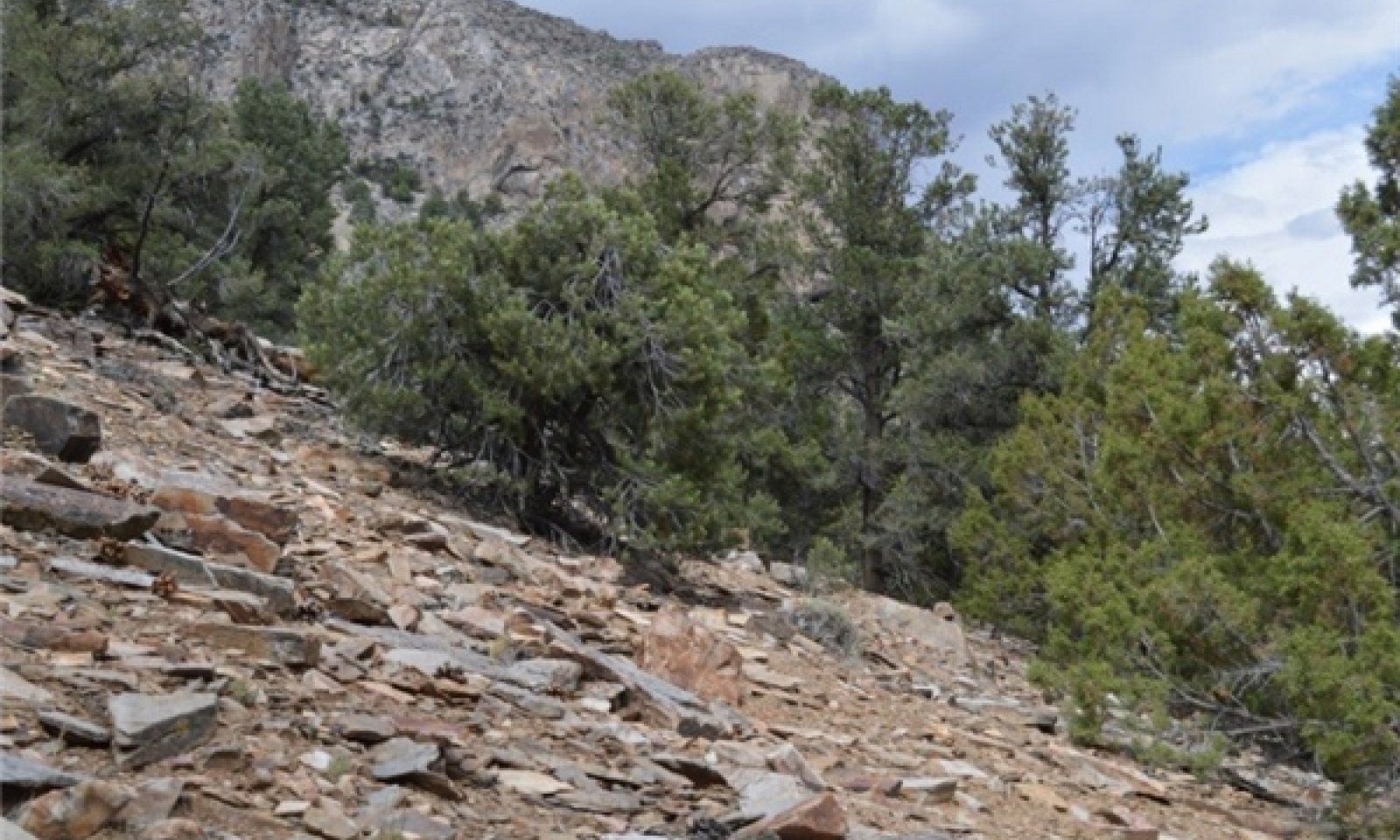
This forest site occurs on hills, mountains, and fan remnants on all exposures. Slopes range from 2 to 70 percent, but slopes of 15 to 50 percent are most typical. Elevations are 5800 to 8600 feet.
Average annual precipitation is 12 to 20 inches. Mean annual air temperature is 43 to 45 degrees F. The average growing season is 70 to 100 days.
The soils associated with this are shallow to moderately deep and well drained. The soils are formed in colluvium from andesite and/or welded tuff. The soil profile is modified with high volume of rock fragments. Available water holding capacity is very low.
The reference state is dominated by singleleaf pinyon. Mountain big sagebrush is the principal understory shrub. Utah serviceberry, antelope bitterbrush and snowberry are other important shrubs in the understory community. Bluebunch wheatgrass, muttongrass and Indian ricegrass are the most prevalent understory grasses. An overstory canopy of 15 to 25 percent is assumed to be representative of tree dominance on this site in the pristine environment. Overstory tree canopy composition is 90 to 100 percent singleleaf pinyon and 10 percent, or less, Utah juniper. Production ranges from 200 to 500 pounds per acre.
Associated sites
F028AY074NV PIMO JUOS/ARNO4/PSSP-ACHY
R028AY064NV SHALLOW LOAM 10-14 P.Z.
R028AY094NV CLAYPAN 12-14 P.Z.
Similar sites
F028AY077NV PIMO-CELE3/ARTRV/PSSPS-POFE
Higher site index. Curlleaf mountain mahogany is common in the overstory.
Table 1. Dominant plant species
Tree (1) Pinus monophylla
Shrub (1) Artemisia tridentata subsp. vaseyana
Herbaceous (1) Pseudoroegneria spicata
(2) Poa fendlerianaPhysiographic features
This forest site occurs on hills, mountains, and fan remnants on all exposures. Slopes range from 2 to 70 percent, but slopes of 15 to 50 percent are most typical. Elevations are 5800 to 8600 feet.
Table 2. Representative physiographic features
Landforms (1) Hill
(2) Mountain
(3) Fan remnant
Elevation 5800 – 8600 ft Slope 2 – 70 % Aspect Aspect is not a significant factor Climatic features
Nevada’s climate is predominantly arid, with large daily ranges of temperature, infrequent severe storms, heavy snowfall in the higher mountains, and great location variations with elevation. Three basic geographical factors largely influence Nevada’s climate: continentality, latitude, and elevation. Continentality is the most important factor. The strong continental effect is expressed in the form of both dryness and large temperature variations. Nevada lies on the eastern, lee side of the Sierra Nevada Range, a massive mountain barrier that markedly influences the climate of the State. The prevailing winds are from the west, and as the warm moist air from the Pacific Ocean ascend the western slopes of the Sierra Range, the air cools, condensation occurs and most of the moisture falls as precipitation. As the air descends the eastern slope, it is warmed by compression, and very little precipitation occurs. The effects of this mountain barrier are felt not only in the West but throughout the state, with the result that the lowlands of Nevada are largely desert or steppes. The temperature regime is also affected by the blocking of the inland-moving maritime air. Nevada sheltered from maritime winds, has a continental climate with well-developed seasons and the terrain responds quickly to changes in solar heating.
Nevada lies within the mid-latitude belt of prevailing westerly winds which occur most of the year. These winds bring frequent changes in weather during the late fall, winter and spring months, when most of the precipitation occurs. To the south of the mid-latitude westerlies, lies a zone of high pressure in subtropical latitudes, with a center over the Pacific Ocean. In the summer, this high-pressure belt shifts northward over the latitudes of Nevada, blocking storms from the ocean. The resulting weather is mostly clear and dry during the summer and early fall, with scattered thundershowers. The eastern portion of the state receives significant summer thunderstorms generated from monsoonal moisture pushed up from the Gulf of California, known as the North American monsoon. The monsoon system peaks in August and by October the monsoon high over the Western U.S. begins to weaken and the precipitation retreats southward towards the tropics (NOAA 2004).
Average annual precipitation is 12 to 20 inches. Mean annual air temperature is 43 to 45 degrees F. The average growing season is 70 to 100 days.
Mean annual precipitaion at the GREAT BASIN NATL PARK,NEVADA climate station (263340) is 13.33 inches.
monthly mean precipitation is:
January 1.05; February 1.18; March 1.37; April 1.21;
May 1.24; June 0.87; July 0.97; August 1.18;
September 1.08; October 1.24;
November 0.97; December 0.96.Table 3 Representative climatic features
Frost-free period (average) 110 days Freeze-free period (average) 150 days Precipitation total (average) 10 in BarLineFigure 1. Monthly precipitation range
BarLineFigure 2. Monthly average minimum and maximum temperature
Figure 3. Annual precipitation pattern
Figure 4 Annual average temperature pattern
Climate stations used
-
(1) GREAT BASIN NP [USC00263340], Baker, NV
">Influencing water features
There are no influencing water features associated with this site.
Soil features
The soils associated with this site are shallow to moderately deep and well drained. The soils are formed in colluvium from quartzite, andesite and/or welded tuff. The soils have an argillic horizon and a mollic epipedon. The soil profile is modified with high volume of rock fragments. Available water holding capacity is very low. The soil temperature regime is frigid and the soil moisture regime is aridic bordering on xeric. The soil series associated with this site include: Cagas, Garnel, Itca, and Tractuff.
The representative soil component is Tractuff (NV779, MU3458), classified as a Loamy-skeletal, mixed, superactive, frigid Aridic Lithic Argixerolls. Diagnostic horizons include an mollic epipedon from the soil surface to 12 inches, and an argillic horizon from 3 to 19 inches. Clay content in the particle control sections average 18 to 27 percent. Depth to bedrock is 14 to 20 inches. Rock fragments range from 45 to 65 percent, mainly quartzite gravel. Reaction is neutral to moderately alkaline. Effervescence is strong to violently effervescent. Lithology consists of quartzite.Table 4. Representative soil features
Parent material (1) Colluvium – andesite
(2) Residuum – welded tuff
(3) Alluvium – quartzite
Surface texture (1) Extremely cobbly loam
(2) Very gravelly loam
(3) Extremely stony loam
Family particle size (1) Loamy
Drainage class Well drained Permeability class Slow to moderate Soil depth 14 – 40 in Surface fragment cover <=3" 25 – 55 % Surface fragment cover >3" 20 – 50 % Available water capacity
(0-40in)0.9 – 2.7 in Calcium carbonate equivalent
(0-40in)0 – 10 % Electrical conductivity
(0-40in)0 – 4 mmhos/cm Sodium adsorption ratio
(0-40in)Not specified Soil reaction (1:1 water)
(0-40in)6.6 – 8 Subsurface fragment volume <=3"
(Depth not specified)35 – 60 % Subsurface fragment volume >3"
(Depth not specified)25 – 40 % Ecological dynamics
An ecological site is the product of all the environmental factors responsible for its development and it has a set of key characteristics that influence a site’s resilience to disturbance and resistance to invasives. Key characteristics include 1) climate (precipitation, temperature), 2) topography (aspect, slope, elevation, and landform), 3) hydrology (infiltration, runoff), 4) soils (depth, texture, structure, organic matter), 5) plant communities (functional groups, productivity), and 6) natural disturbance regime (fire, herbivory, etc.) (Caudle et al 2013). Biotic factors that influence resilience include site productivity, species composition and structure, and population regulation and regeneration (Chambers et al. 2013).
Pinyon- and juniper-dominated plant communities in the cold desert of the Intermountain West occupy over 18 million ha (44,600,000 acres) (Miller and Tausch 2001). In the mid to late 1900’s, the number of pinyon and juniper trees establishing per decade began to increase compared to the previous several hundred years. The substantial increase in conifer establishment is attributed to a number of factors, the most important being: (1) cessation of the aboriginal burning (Tausch 1999), (2) change in climate with rising temperatures (Heyerdahl et al. 2006), (3) the reduced frequency of fire likely driven by the introduction of domestic livestock, (4) a decrease in wildfire frequency along with improved wildfire suppression efforts and (5) potentially increased CO2 levels favoring woody plant establishment (Tausch 1999, Bunting 1994). Miller et al. (2008) found presettlement tree densities averaged 2 to 11 per acre in six woodlands studied across the Intermountain West. Current stand densities range from 80 to 358 trees/ac. In Utah, Nevada, and Oregon, trees established prior to 1860 account for only 2 percent or less of the total population of pinyon and juniper (Miller et al. 2008). The research strongly suggests that for over 200 years prior to settlement, woodlands in the Great Basin were relatively low density with limited rates of establishment (Miller et al. 2008, Miller and Tausch 2001). Tree canopy cover of 10 to 20% may be more representative of these sites in pristine condition. Increases in pinyon and juniper densities post-settlement were the result of both infill in mixed age tree communities and expansion into shrub-steppe communities. Pre-settlement trees accounted for less than two percent of the stands sampled in Nevada, Oregon and Utah (Miller et al. 2008, Miller and Tausch 2001, Miller et al. 1999). However, the proportion of old-growth can vary depending on disturbance regimes, soils and climate. Some ecological sites are capable of supporting persistent woodlands, likely due to specific soils and climate resulting in infrequent stand replacement disturbance regimes. In the Great Basin, old-growth trees have been found to typically grow on rocky shallow or sandy soils that support little understory vegetation to carry a fire (Holmes et al. 1986, Miller and Rose 1995, West et al. 1998).
Singleleaf pinyon and Utah juniper are long-lived tree species with wide ecological amplitudes (Tausch et al 1981, Weisberg and Dongwook 2012, West et al 1998). Maximum ages of pinyon and juniper exceed 1000 years and stands with maximum age classes are only found on steep rocky slopes with no evidence of fire (West et al 1975). Singleleaf pinyon is slow-growing and very intolerant to shade with the exception of young plants, usually first year seedlings (Tueller and Clark 1975). Singleleaf pinyon seedling establishment is episodic. Population age structure is affected by drought, which reduces seedling and sapling recruitment more than other age classes. The ecotones between singleleaf pinyon woodlands and adjacent shrublands and grasslands provide favorable microhabitats for singleleaf pinyon seedling establishment since they are active zones for seed dispersal, nurse plants are available, and singleleaf pinyon seedlings are only affected by competition from grass and other herbaceous vegetation for a couple of years.
Juniper litter has an allelopathic effect on some understory species, especially Sandberg bluegrass, and blue grama. This effect is particularly evident on heavy, poorly drained clay soils. Broadcasting grass seeds over litter appeared to lower the allelopathic effects.
Pinyon and juniper growth is dependent mostly upon soil moisture stored from winter precipitation, mainly snow. Much of the summer precipitation is ineffective, being lost in runoff after summer convection storms or by evaporation and interception (Tueller and Clark 1975). Pinyon and juniper are highly resistant to drought which are common in the Great Basin. Tap roots of pinyon and juniper have a relatively rapid rate of root elongation and are thus able to persist until precipitation conditions are more favorable (Emerson 1932).
Infilling by younger trees increases canopy cover causing a decrease in understory perennial vegetation and an increase in bare ground. As pinyon and juniper trees increase in density so has their litter. Phenolic compounds of juniper scales can have an inhibitory effect on grass growth (Jameson 1970). Furthermore, infilling shifts stand level biomass from ground fuels to canopy fuels which has the potential to significantly impact fire behavior. The more tree dominated pinyon and juniper woodlands become, the less likely they are to burn under moderate conditions, resulting in infrequent high intensity fires (Gruell 1999, Miller et al. 2008). Additionally, as the understory vegetation declines in vigor and density with increased canopy the seed and propagules of the understory plant community also decrease significantly. The increase in bare ground allows for the invasion of non-native annual species such as cheatgrass and with intensive wildfire the potential for conversion to annual exotics is a serious threat (Tausch 1999, Miller et al. 2008).
Specific successional pathways after disturbance in pinyon-juniper stands are dependent on a number of variables such as plant species present at the time of disturbance and their individual responses to disturbance, past management, type and size of disturbance, available seed sources in the soil or adjacent areas, and site and climatic conditions throughout the successional process.
Utah juniper can be killed by a fungus called Juniper Pocket Rot (Pyrofomes demidoffi), also known as white truck rot (Eddleman et al. 1994 and Durham 2014). Pocket rot enters the tree through any wound or opening that exposes the heartwood. In an advanced stage, this fungus can cause high mortality (Durham 2014). Dwarf mistletoe (Phorandendron spp.) a parasitic plant, may also affect Utah juniper and without treatment or pruning, may kill the tree 10-15 years after infection. Seedlings and saplings are most susceptible to the parasite (Christopherson 2014). Other diseases capable of affecting juniper include: witches’-broom (Gymnosporangium sp.), which may girdle and kill branches; leaf rust (Gymnosporangium sp.) on leaves and young branches; and juniper blight (Phomopsis sp.). Insections include: flat-head borers (Chrysobothris sp.) that attack the wood; long-horned beetles (Methia juniper, Styloxus bicolor) that girdle limbs and twigs; and round-head borers (Callidium spp.) that attack twigs and limbs (Tueller and Clark 1975).
Phillips (1909) recognized that the pinyons are more resistant to disease than most of the conifers with which it associates. Hepting (1971) lists several diseases affecting pinyon including: foliage diseases, a tarspot needle cast, stem diseases such as blister rust and dwarf mistletoe, root diseases and trunk rots, red heart rot, and but rot. The pinyon ips beetle (Ips confuses) and pinyon needle scale (Matsucoccus acalyptus) are both native insects to Nevada that attack pinyon pines throughout their range. The pinyon needle scale weakens trees by killing needles older than 1 year. Sometimes small trees are killed by repeated feeding and large trees are weakened to the point that they are attacked by the pinyon ips beetle. The beetle typically kills weak and damaged trees (Phillips 2014). During periods of chronic drought the impact of these two insects on singleleaf pinyon can be substantial.
Mountain big sagebrush is generally long-lived; therefore it is not necessary for new individuals to recruit every year for perpetuation of the stand. Infrequent large recruitment events and simultaneous low, continuous recruitment is the foundation of population maintenance (Noy-Meir 1973). Survival of the seedlings is dependent on adequate moisture conditions. Aroga moth can partially or entirely kill individual big sagebrush plants (Furniss and Barr 1975), however it is unlikely that entire stands of sagebrush will be severely affected in sites at high elevation such as this.
The perennial bunchgrasses that are co-dominant with the shrubs include bluebunch wheatgrass, muttongrass, and Indian ricegrass. These species generally have somewhat shallower root systems than the shrubs, but root densities are often as high as or higher than those of shrubs in the upper 0.5 m of the soil profile. General differences in root depth distributions between grasses and shrubs results in resource partitioning in these shrub/grass systems. Muttongrass may be more shade tolerant than other perennial bunchgrasses and will persist in the understory as the canopy closes (Erdman 1970).
Three possible alternative stable states have been identified for this site.
Fire Ecology:
Replacement fires were uncommon to rare (100-600 years) and occurred primarily during extreme fire behavior conditions. Spreading, low-intensity surface fires had a very limited role in molding stand structure and dynamics. Surface spread was more likely to occur in higher-density woodlands growing on more productive sites (Romme et al 2007). Pre-settlement fire return intervals in the Great Basin National Park, Nevada were found to have a mean range between 50 to 100 years with north-facing slopes burning every 15 to 20 years and rocky landscapes with sparse understory very infrequently (Gruell 1999). Woodland dynamics are largely attributed to long-term climatic shifts (temperature, amounts and distribution of precipitation) and the extent and return intervals of fire (Miller and Tausch 2001). Limited data exists that describes fire histories across woodlands in the Great Basin. The infilling of younger trees into the old-growth stands and the expansion of trees into the surrounding sagebrush steppe ecological sites has increased the risk of loss of pre-settlement trees due to increased fire severity and size resulting from the increase in the abundance and landscape level continuity of fuels (Miller et al. 2008).
Utah juniper is usually killed by fire, and is most vulnerable to fire when it is under four feet tall (Bradley et al. 1992). Because they have foliage farther from the ground and thicker bark, larger trees can survive low severity fires but mortality does occur when 60% or more of the crown is scorched (Bradley et al. 1992). Singleleaf pinyons are also most vulnerable to fire when less than four feet tall, however mature trees do not self-prune their dead branches allowing for accumulated fuel in the crowns. This characteristic and the relative flammability of the foliage make individual mature trees susceptible to fire (Bradley et al. 1992). With the low production of the understory vegetation and low density of trees per acre, high severity fires within this plant community were not likely and rarely became crown fires (Bradley et al. 1992, Miller and Tausch 2001).
Singleleaf pinyon and juniper reestablish by seed from nearby seed sources or surviving seeds. Junipers have a long-lived seed bank due to delayed germination by impermeable seed coats, immature or dormant embryos and germination inhibitors (Chambers et al. 1999). Singleleaf pinyon trees have relatively short-lived seeds with little innate dormancy that form only temporary seed banks with most seeds germinating the spring following dispersal (Meewig and Bassett 1983). Density of pinyon seeds in the seed bank is dependent upon the current year’s cone crop. Singleleaf pinyon are known to have favorable cone production every two to three years thus the potential for a large temporary seed bank is high during mast years and likely low during non-mast years (Chambers et al. 1999). The role of nurse plant requirements between the two tree species is important to post-fire establishment. Chambers et al. (1999) found that singleleaf pinyon seedlings rarely establish in interspaces or open environments. In contrast, Utah juniper seedlings were found capable of establishing in interspace microhabitats as frequently as under sagebrush. Therefore, fire that removes both trees and understory shrubs in pinyon-juniper woodlands may have a relatively greater effect on the establishment of pinyon than juniper.
The pinyon jay (Gymnorhinus cyanocephalus) and other members of the seed caching corvids play an important role in pinyon pine regeneration. These birds cache the seeds in the soil for future use. Those seeds that escape harvesting by the birds and rodents have the opportunity to germinate under favorable soil and climatic conditions (Lanner 1981). A mutualistic relationship exists between the trees that produce food and the animals that disperse the seeds, thereby insuring perpetuation of the trees. Large crops of seeds may stimulate reproduction in birds, especially the pinyon jay (Ligon 1974).
Initial response of native understory species following fire correlates closely with percent crown cover. In general, research indicates that understory response to disturbance is most productive when crown cover is at or below 20%. Beyond 30%, there is a rapid decline in understory species and soil seed reserves (Huber et al. 1999). The reference state understory vegetation of mountain big sagebrush, bluebunch wheatgrass and muttongrass further supports the evidence of a presettlement community with an open overstory and infrequent ground fire.
Mountain big sagebrush is killed by fire (Neuenschwander 1980, Blaisdell et al. 1982) and does not resprout (Blaisdell 1953). Post fire regeneration occurs from seed and will vary depending on site characteristics, seed source, and fire characteristics. Mountain big sagebrush seedlings can grow rapidly and may reach reproductive maturity within 3 to 5 years (Bunting et al. 1987). Mountain big sagebrush may return to pre-burn density and cover within 15-20 years following fire, but establishment after severe fires may proceed more slowly (Bunting et al. 1987).
Antelope bitterbrush, a minor component on these sites, is moderately fire tolerant (McConnell and Smith 1977). It regenerates by seed and resprouting (Blaisdell and Mueggler 1956, McArthur et al. 1982), though sprouting ability is highly variable and has been attributed to genetics, plant age, phenology, soil moisture and texture, and fire severity (Blaisdell and Mueggler 1956, Blaisdell et al. 1982, Clark et al. 1982, Cook et al. 1994). Bitterbrush sprouts from a region on the stem approximately 1.5 inches above and below the soil surface; the plant rarely sprouts if the root crown is killed by fire (Blaisdell and Mueggler 1956). Low intensity fires may allow for bitterbrush to sprout; however, community response also depends on soil moisture levels at time of fire (Murray 1983). Lower soil moisture allows more charring of the stem below ground level (Blaisdell and Mueggler 1956), thus sprouting will usually be more successful after a spring fire than after a fire in summer or fall (Murray 1983, Busse et al. 2000, Kerns et al. 2006). If cheatgrass is present, bitterbrush seedling success is much lower. The factor that most limits establishment of bitterbrush seedlings is competition for water resources with cheatgrass, an invasive species (Clements and Young 2002).
The effect of fire on bunchgrasses relates to culm density, culm-leaf morphology, and the size of the plant. The initial condition of bunchgrasses within the site along with seasonality and intensity of the fire factor into the individual species’ responses. For most forbs and grasses, the growing points are located at or below the soil surface, providing relative protection from disturbances which decrease above ground biomass, such as grazing or fire. Thus, fire mortality is more correlated to duration and intensity of heat (Wright 1971, Young 1983). Season and severity of the fire will also influence plant response, which will vary depending on post-fire soil moisture availability.
Fire will remove aboveground biomass from bluebunch wheatgrass but plant mortality is generally low (Robberecht and Defossé 1995) because the buds are underground (Conrad and Poulton 1966) or protected by foliage. Uresk et al. (1976) reported burning increased vegetative and reproductive vigor of bluebunch wheatgrass. Thus, bluebunch wheatgrass is considered to experience slight damage to fire but is more susceptible in drought years (Young 1983). Plant response will vary depending on season, fire severity, fire intensity and post-fire soil moisture availability.
Muttongrass is top killed by fire but will resprout after low to moderate severity fires. A study by Vose and White (1991) in an open sawtimber site found minimal difference in overall effect of burning on muttongrass.
Indian ricegrass is fairly fire tolerant (Wright 1985), which is likely due to its low culm density and below ground plant crowns. Vallentine (1989) cites several studies in the sagebrush zone that classified Indian ricegrass as being slightly damaged from late summer burning. Indian ricegrass has also been found to reestablish on burned sites through seed dispersed from adjacent unburned areas (Young 1983, West 1994). Thus the presence of surviving, seed producing plants facilitates the reestablishment of Indian ricegrass. Grazing management following fire to promote seed production and establishment of seedlings is important.
Sandberg bluegrass, a minor component of this ecological site, has been found to increase following fire likely due to its low stature and productivity (Daubenmire 1975). Sandberg bluegrass may retard reestablishment of deeper rooted bunchgrass.State and transition model
Custom diagramStandard diagram
Figure 5. State and Transition Model

Figure 6. Legend
More interactive model formats are also available. View Interactive Models
More interactive model formats are also available. View Interactive Models
Click on state and transition labels to scroll to the respective textEcosystem states
State 1 submodel, plant communities
State 2 submodel, plant communities
State 3 submodel, plant communities
State 4 submodel, plant communities
State 1
Reference StateReference State 1.0: The Reference State 1.0 is representative of the natural range of variability under pristine conditions. This Reference State has four general community phases: an old-growth woodland phase, a shrub-herbaceous phase, an immature tree phase, and an infilled tree phase. State dynamics are maintained by interactions between climatic patterns and disturbance regimes. Negative feedbacks enhance ecosystem resilience and contribute to the stability of the state. These include the presence of all structural and functional groups, low fine fuel loads, and retention of organic matter and nutrients. Plant community phase changes are primarily driven by fire, periodic drought, and/or insect or disease attack.
Community 1.1
Community PhaseThe plant community is dominated by singleleaf pinyon. Mountain big sagebrush is the principal understory shrub. Utah serviceberry, antelope bitterbrush and snowberry are other important shrubs in the understory community. Bluebunch wheatgrass, muttongrass and Indian ricegrass are the most prevalent understory grasses. An overstory canopy of 15 to 25 percent is assumed to be representative of tree dominance on this site in the pristine environment. Overstory tree canopy composition is 90 to 100 percent singleleaf pinyon and 10 percent, or less, Utah juniper.
Forest overstory.OLD GROWTH: The visual aspect and vegetal structure is dominated by singleleaf pinyon that have reached or are near maximal heights for the site. Dominant trees average greater than five inches in diameter at one-foot stump height. Upper crowns are typically either irregularly or smoothly flat-topped or rounded. Tree canopy cover is about 20 percent. Infrequent, yet periodic wildfire is a natural factor influencing the understory of mature forestlands. Few seedlings and/or saplings occur in the understory.
Forest understory. Understory vegetative composition is about 50 percent grasses, 10 percent forbs and 40 percent shrubs and young trees when the average overstory canopy is medium (15 to 25 percent). Average understory production ranges from 200 to 500 pounds per acre with a medium canopy cover. Understory production includes the total annual production of all species within 4½ feet of the ground surface. Production ranges from 200 to 500 pounds per acre.
Figure 7. Annual production by plant type (representative values) or group (midpoint values)
Table 5. Annual production by plant type
Plant type Low
(lb/acre)Representative value
(lb/acre)High
(lb/acre)Grass/Grasslike 100 175 250 Shrub/Vine 70 123 175 Forb 20 35 50 Tree 10 17 25 Total 200 350 500 Community 1.2
Community PhaseThis community phase is characterized by a post-fire shrub and herbaceous community. Bluebunch wheatgrass and other perennial grasses dominate. Thurber’s needlegrass can experience high mortality from fire and may be reduced in the community for several years. Forbs may increase post-fire but will likely return to pre-burn levels within a few years. Singleleaf pinyon and Utah juniper seedlings up to 20 inches in height may be present. Mountain big sagebrush may be present in unburned patches. Burned tree skeletons may be present; however these have little or no effect on the understory vegetation.
Forest overstory.Singleleaf pinyon and Utah juniper seedlings up to 20 inches in height may be present.
Forest understory. Herbaceous vegetation and woody shrubs dominate the site. Production ranges from 400 to 800 pounds per acre.
Community 1.3
Community PhaseThis community phase is characterized as an immature woodland with singleleaf pinyon and Utah juniper trees averaging over 4.5 feet in height. Pinyon and juniper canopy cover is between 10 to 20 percent. Tree crowns are typically cone- or pyramidal-shaped. Understory vegetation consists of smaller tree seedling and saplings, as well as perennial bunchgrasses and sagebrush.
Forest overstory.IMMATURE WOODLAND: The visual aspect and vegetal structure are dominated by singleleaf pinyon and Utah juniper greater than 4½ feet in height. The upper crown of dominant and codominant trees are cone or pyramidal shaped. Understory vegetation is moderately influenced by a tree overstory canopy of about 10 to 25 percent.
Forest understory. Seedlings and saplings are present in the understory. Production ranges from 200 to 600 pounds per acre.
Community 1.4
Community PhaseThis phase is dominated by Utah juniper and singleleaf pinyon. The stand exhibits mixed age classes and canopy cover exceeds 20 percent. The density and vigor of the mountain big sagebrush and perennial bunchgrass understory is decreased. Bare ground areas are likely to increase. Mat-forming forbs may increase. This community is at risk of crossing a threshold; without proper management this phase will transition to the infilled woodland state 3.0.
Forest overstory.MATURE WOODLAND: The visual aspect and vegetal structure is dominated by singleleaf pinyon that have reached or are near maximal heights for the site. Dominant trees average greater than five inches in diameter at one-foot stump height. Upper crowns are typically either irregularly or smoothly flat-topped or rounded. Few seedlings and/or saplings occur in the understory. Tree canopy cover is about 20 percent.
Forest understory. The understory is a mix of shrubs, grasses and forbs. Production ranges from 200 to 500 pounds per acre.
Pathway a
Community 1.1 to 1.2A high-severity crown fire will eliminate or reduce the singleleaf pinyon and Utah juniper overstory and the shrub component. This allows for the perennial bunchgrasses and sprouting shrubs to dominate the site.
Pathway b
Community 1.1 to 1.4Time without disturbance such as fire, drought, or disease will allow for the gradual infilling of singleleaf pinyon and Utah juniper.
Pathway a
Community 1.2 to 1.3Time without disturbance such as fire, drought, or disease will allow for the gradual maturation of the singleleaf pinyon and Utah Juniper component. Mountain big sagebrush reestablishes.
Pathway b
Community 1.3 to 1.1Time without disturbance such as fire, drought, or disease will allow for the gradual maturation of singleleaf pinyon and Utah juniper. Infilling by younger trees continues.
Pathway a
Community 1.3 to 1.2Fire reduces or eliminates tree canopy, allowing perennial grasses and sprouting shrubs to dominate the site.
Pathway a
Community 1.4 to 1.1Low intensity fire, insect infestation, or disease kills individual trees within the stand reducing canopy cover to less than 20 percent. Over time young trees mature to replace and maintain the old-growth woodland. The mountain big sagebrush and perennial bunchgrass community increases in density and vigor.
Pathway b
Community 1.4 to 1.2A high-severity crown fire will eliminate or reduce the singleleaf pinyon and Utah juniper overstory and the shrub component which will allow for the perennial bunchgrasses and sprouting shrubs to dominate the site.
State 2
Current Potential StateCurrent Potential State 2.0: This state is similar to the Reference State 1.0, with four general community phases: an old-growth woodland phase, a shrub-herbaceous phase, an immature tree phase, and an infilled tree phase. Ecological function has not changed, however the resiliency of the state has been reduced by the presence of non-native species. These non-natives, particularly cheatgrass, can be highly flammable and promote fire where historically fire had been infrequent. Negative feedbacks enhance ecosystem resilience and contribute to the stability of the state. These include the presence of all structural and functional groups, low fine fuel loads and retention of organic matter and nutrients. Positive feedbacks decrease ecosystem resilience and stability of the state. These include the non-natives’ high seed output, persistent seed bank, rapid growth rate, ability to cross pollinate, and adaptations for seed dispersal. Fires within this community with the small amount of non-native annual species present are likely still small and patchy due to low fuel loads. This fire type will create a plant community mosaic that will include all/most of the following community phases within this state.
Community 2.1
Community PhaseThis phase is characterized by a widely dispersed old-growth singleleaf pinyon and Utah juniper trees with an understory of mountain big sagebrush and perennial bunchgrasses. The visual aspect is dominated by singleleaf pinyon and Utah juniper which make up 10 to 25 percent of the overstory canopy cover. Trees have reached maximal or near maximal heights for the site and many tree crowns may be flat- or round-topped. Bluebunch wheatgrass, Indian ricegrass, and muttongrass are the most prevalent grasses in the understory. Mountain big sagebrush is the primary understory shrub. Forbs such as rockcress and goldenweed are common. Annual non-native species are present in trace amounts.
Forest overstory.OLD GROWTH: The visual aspect and vegetal structure is dominated by singleleaf pinyon that have reached or are near maximal heights for the site. Dominant trees average greater than five inches in diameter at one-foot stump height. Upper crowns are typically either irregularly or smoothly flat-topped or rounded. Tree canopy cover is 10 to 25 percent. Infrequent, yet periodic wildfire is a natural factor influencing the understory of mature forestlands. Few seedlings and/or saplings occur in the understory.
Forest understory. Understory vegetative composition is about 50 percent grasses, 10 percent forbs and 40 percent shrubs and young trees when the average overstory canopy is medium (10 to 25 percent). Average understory production ranges from 200 to 500 pounds per acre with a medium canopy cover.
Community 2.2
Community PhaseThis community phase is characterized by a post-fire shrub and herbaceous community. Bluebunch wheatgrass and other perennial grasses dominate. Forbs may increase post-fire but will likely return to pre-burn levels within a few years. Pinyon and juniper seedlings up to 20 inches in height may be present. Mountain big sagebrush may be present in unburned patches. Burned tree skeletons may be present; however these have little or no effect on the understory vegetation. Annual non-native species generally respond well after fire and may be stable or increasing within the community.
Forest overstory.Various amounts of tree seedlings (less than 20 inches in height) may be present up to the point where they are obviously a major component of the vegetal structure.
Forest understory. Herbaceous vegetation and sprouting woody shrubs dominate the site. Production ranges from 400 to 800 pounds per acre.
Community 2.3
Community PhaseThis community phase is characterized by an immature woodland, with singleleaf pinyon and Utah juniper trees averaging over 4.5 feet in height. Tree canopy cover is between 10 to 20 percent. Tree crowns are typically cone- or pyramidal-shaped. Understory vegetation consists of smaller tree seedling and saplings, as well as perennial bunchgrasses and shrubs. Annual non-native species are present.
Forest overstory.IMMATURE WOODLAND: The visual aspect and vegetal structure are dominated by singleleaf pinyon and Utah juniper greater than 4½ feet in height. The upper crown of dominant and codominant trees are cone or pyramidal shaped.
Forest understory. The understory is a mix of shrubs, forbs and grasses. Understory vegetation is moderately influenced by a tree overstory canopy of about 10 to 20 percent. Production ranges from 200 to 600 pounds per acre.
Community 2.4
Community PhaseThis phase is dominated by singleleaf pinyon and Utah juniper. The stand exhibits mixed age classes and canopy cover exceeds 20 percent. The density and vigor of the mountain big sagebrush and perennial bunchgrass understory is decreased. Bare ground areas are likely to increase. Mat-forming forbs may increase. Annual non-native species are present primarily under tree canopies. This community is at risk of crossing a threshold, without proper management this phase will transition to the infilled tree state 3.0.
Forest overstory.MATURE WOODLAND: The visual aspect and vegetal structure is dominated by singleleaf pinyon that have reached or are near maximal heights for the site. Dominant trees average greater than five inches in diameter at one-foot stump height. Upper crowns are typically either irregularly or smoothly flat-topped or rounded. Few seedlings and/or saplings occur in the understory. Tree canopy cover is about 20 percent.
Forest understory. The understory is a mix of shrubs, grasses and forbs. Production ranges from 200 to 500 pounds per acre.
Pathway a
Community 2.1 to 2.2A high-severity crown fire will eliminate or reduce the singleleaf pinyon overstory and the shrub component. This allows for sprouting shrubs and perennial bunchgrasses to dominate the site.
Pathway b
Community 2.1 to 2.4Time without disturbance such as fire, drought, or disease will allow for the gradual infilling of singleleaf pinyon.
Pathway a
Community 2.2 to 2.3Time without disturbance such as fire, drought, or disease will allow for the gradual maturation of the singleleaf pinyon and Utah juniper component. Mountain big sagebrush reestablishes.
Pathway b
Community 2.3 to 2.1Fire reduces or eliminates tree canopy, allowing perennial grasses and sprouting shrubs to dominate the site.
Pathway a
Community 2.3 to 2.2Time without disturbance such as fire, drought, or disease will allow for the gradual maturation of singleleaf pinyon and Utah juniper. Infilling by younger trees continues.
Pathway a
Community 2.4 to 2.1Low intensity fire, insect infestation, or disease kills individual trees within the stand reducing canopy cover to less than 20 percent. Over time young trees mature to replace and maintain the old-growth woodland. The mountain big sagebrush and perennial bunchgrass community increases in density and vigor. Annual non-natives are present in trace amounts.
Pathway b
Community 2.4 to 2.2A high-severity crown fire will eliminate or reduce the singleleaf pinyon and Utah juniper overstory and the shrub component which will allow for the perennial bunchgrasses to dominate the site. Annual non-native grasses typically respond positively to fire and may increase in the post-fire community.
State 3
Infilled Woodland StateThis state has two community phases that are characterized by the dominance of Utah juniper and singleleaf pinyon in the overstory. This state is identifiable by 30 to over 50 percent cover of Utah juniper and singleleaf pinyon. This stand exhibits a mixed age class. Older trees are at maximal height and upper crowns may be flat-topped or rounded. Younger trees are typically cone- or pyramidal-shaped. Understory vegetation is sparse due to increasing shade and competition from trees.
Community 3.1
Community PhaseSingleleaf pinyon and Utah juniper dominate the aspect. Understory vegetation is thinning. Perennial bunchgrasses are sparse and mountain big sagebrush skeletons are as common as live shrubs due to tree competition for soil water, overstory shading, and duff accumulation. Tree canopy cover is greater than 30 percent. Annual non-native species are present or co-dominate in the understory. Bare ground areas are prevalent and soil redistribution is evident. This community phase is typically described as a Phase II woodland (Miller et al. 2008).
Forest overstory.This stage is dominated by singleleaf pinyon and Utah juniper that have reached maximal heights for the site. Dominant and codominant trees average greater than five inches in diameter at one-foot stump height. Upper crowns are typically irregularly flat-topped or rounded. Tree canopy cover is at a maximum for the site and is commonly more than 30 percent.
Forest understory. Understory vegetation is strongly influenced by tree competition, overstory shading, duff accumulation, etc. Production ranges from 100 to 350 pounds per acre.
Community 3.2
Community Phase
Figure 8. T. Stringham August 2013, NV708, MU 2432, Tractuff soil series
Singleleaf pinyon and Utah juniper dominate the aspect. Tree canopy cover exceeds 40 percent and may be as high as 50 percent. Understory vegetation is sparse to absent. Perennial bunchgrasses, if present exist in the dripline or under the canopy of trees. Mountain sagebrush skeletons are common or the sagebrush has been extinct long enough that only scattered limbs remain. Mat-forming forbs or muttongrass and Sandberg’s bluegrass may dominate interspaces. Annual non-native species are present and are typically found under the trees. Bare ground areas are large and interconnected. Soil redistribution may be extensive. This community phase is typically described as a Phase III woodland (Miller et al. 2008). Tree recruitment is limited. Trees are the dominant vegetation and are controlling ecological processes on the site.
Forest overstory.This stage is dominated by singleleaf pinyon and Utah juniper that have reached maximal heights for the site. Dominant and codominant trees average greater than five inches in diameter at one-foot stump height. Upper crowns are typically irregularly flat-topped or rounded. Tree canopy cover is at a maximum for the site and is commonly more than 50 percent.
Forest understory. Understory vegetation is strongly influenced by tree competition, overstory shading, duff accumulation, etc. Production ranges is less than 200 pounds per acre.
Pathway a
Community 3.1 to 3.2Time without disturbance such as fire, drought, or disease will allow for the gradual maturation of singleleaf pinyon and Utah juniper. Infilling by younger trees continues.
State 4
Annual StateThis community is characterized by the dominance of annual non-native species such as cheatgrass and tansy mustard in the understory. Rabbitbrush may dominate the overstory. Annual non-native species dominate the understory.
Community 4.1
Community PhaseCheatgrass, mustards and other non-native annual species dominate the site. Trace amounts of perennial bunchgrasses may be present.
Transition A
State 1 to 2Trigger: Introduction of non-native annual species Slow variables: Over time the annual non-native plants will increase within the community. Threshold: Any amount of introduced non-native species causes an immediate decrease in the resilience of the site. Annual non-native species cannot be easily removed from the system and have the potential to significantly alter disturbance regimes from their historic range of variation.
Transition B
State 1 to 3Trigger: Time and a lack of disturbance allow trees to dominate site resources; may be coupled with inappropriate grazing management that favors shrub and tree dominance. Slow variables: Over time the abundance and size of trees will increase. Threshold: Juniper and pinyon canopy cover is greater than 30 percent. Little understory vegetation remains due to competition with trees for site resources.
Transition A
State 2 to 3Trigger: Time and a lack of disturbance allow trees to dominate site resources; may be coupled with inappropriate grazing management that favors shrub and tree dominance. Slow variables: Over time the abundance and size of trees will increase. Threshold: Juniper and pinyon canopy cover is greater than 30%. Little understory vegetation remains due to competition with trees for site resources.
Transition B
State 2 to 4Trigger: Catastrophic crown fire facilitates the establishment of non-native, annual weeds. Slow variables: Increase in tree crown cover, loss of perennial understory and an increase in annual non-native species. Threshold: Cheatgrass or other non-native annuals dominate understory. Loss of deep-rooted perennial bunchgrasses changes spatial and temporal nutrient cycling and nutrient redistribution, and reduces soil organic matter. Increased canopy cover of trees allows severe stand-replacing fire. The increased seed bank of non-native, annual species responds positively to post-fire conditions facilitating the transition to an Annual State.
Restoration pathway A
State 3 to 2Manual or mechanical thinning of trees coupled with seeding. Probability of success is highest from community phase 3.1.
Conservation practices
Brush Management Range Planting Transition A
State 3 to 4Trigger: Fire reduces the tree overstory and allows for the annual non-native species in the understory to dominate the site. Soil disturbing treatments such as slash and burn may also reduce tree canopy and allow for non-native annual species to increase. Slow variables: Over time, cover and production of annual non-native species increases. Threshold: Loss of deep-rooted perennial bunchgrasses and shrubs changes temporal and spatial nutrient capture and cycling within the community. Increased, continuous fine fuels modify the fire regime by increasing frequency, size, and spatial variability of fires.
Additional community tables
Table 6. Community 1.1 plant community composition
Group Common name Symbol Scientific name Annual production () Foliar cover (%) Grass/Grasslike1 Primary Perennial Grasses 123–259 bluebunch wheatgrass PSSPS Pseudoroegneria spicata ssp. spicata 88–175 – muttongrass POFE Poa fendleriana 35–84 – 2 Secondary Perennial Grasses 12–54 Indian ricegrass ACHY Achnatherum hymenoides 4–18 – squirreltail ELEL5 Elymus elymoides 4–18 – Sandberg bluegrass POSE Poa secunda 4–18 – Forb3 16–72 rockcress ARABI2 Arabis 4–18 – milkvetch ASTRA Astragalus 4–18 – phlox PHLOX Phlox 4–18 – stemless mock goldenweed STAC Stenotus acaulis 4–18 – shaggy fleabane ERPU2 Erigeron pumilus 1–5 – Shrub/Vine4 Primary Shrubs 70–168 Utah serviceberry AMUT Amelanchier utahensis 35–84 – mountain big sagebrush ARTRV Artemisia tridentata ssp. vaseyana 35–84 – 5 Secondary Shrubs 44–100 curl-leaf mountain mahogany CELE3 Cercocarpus ledifolius 18–32 – yellow rabbitbrush CHVI8 Chrysothamnus viscidiflorus 4–18 – mormon tea EPVI Ephedra viridis 4–18 – Tree6 Evergreen 5–20 singleleaf pinyon PIMO Pinus monophylla 4–18 – Utah juniper JUOS Juniperus osteosperma 1–2 – Table 7. Community 1.1 forest overstory composition
Common name Symbol Scientific name Nativity Height ft Canopy cover (%) Diameter in Basal area (square ft/acre) Treesingleleaf pinyon PIMO Pinus monophylla Native – 90-100 – 0 Utah juniper JUOS Juniperus osteosperma Native – 0-10 – 0 Table 8. Community 1.2 plant community composition
Group Common name Symbol Scientific name Annual production () Foliar cover (%) Table 9. Community 1.3 plant community composition
Group Common name Symbol Scientific name Annual production () Foliar cover (%) Table 10. Community 1.4 plant community composition
Group Common name Symbol Scientific name Annual production () Foliar cover (%) Table 11. Community 2.1 plant community composition
Group Common name Symbol Scientific name Annual production () Foliar cover (%) Table 12. Community 2.2 plant community composition
Group Common name Symbol Scientific name Annual production () Foliar cover (%) Table 13. Community 2.3 plant community composition
Group Common name Symbol Scientific name Annual production () Foliar cover (%) Table 14. Community 2.4 plant community composition
Group Common name Symbol Scientific name Annual production () Foliar cover (%) Table 15. Community 3.1 plant community composition
Group Common name Symbol Scientific name Annual production () Foliar cover (%) Table 16. Community 3.2 plant community composition
Group Common name Symbol Scientific name Annual production () Foliar cover (%) Table 17. Community 4.1 plant community composition
Group Common name Symbol Scientific name Annual production () Foliar cover (%) Interpretations
Animal community
Livestock Interpretations:
The history of livestock grazing in the pinyon-juniper ecosystem goes back to more than 200 years, depending on the particular locality within the ecosystem (Hurst 1975). Historically, pinyon-juniper woodlands were much more open and supported a diverse understory that provided forage for both livestock and wildlife. Historic livestock overuse and increased stand densities have reduced the carrying capacity of these pinyon-juniper stands and many current stands only provide shade and shelter for livestock.
Inappropriate grazing management during the growing season will cause a decline in understory plants such as bluebunch wheatgrass and Indian ricegrass. Bluebunch wheatgrass is moderately grazing tolerant and is very sensitive to defoliation during the active growth period (Blaisdell and Pechanec 1949, Laycock 1967, Anderson and Scherzinger 1975, Britton et al. 1990). Herbage and flower stalk production was reduced with clipping at all times during the growing season; however, clipping was most harmful during the boot stage (Blaisdell and Pechanec 1949). Tiller production and growth of bluebunch was greatly reduced when clipping was coupled with drought (Busso and Richards 1995). Mueggler (1975) estimated that low vigor bluebunch wheatgrass may need up to 8 years rest to recover. Although an important forage species, it is not always the preferred species by livestock and wildlife.
Indian ricegrass is a preferred forage species for livestock and wildlife (Cook 1962, Booth et al. 2006). This species is often heavily utilized in winter because it cures well (Booth et al. 2006). It is also readily utilized in early spring, being a source of green feed before most other perennial grasses have produced new growth (Quinones 1981). Booth et al. (2006) note that the plant does well when utilized in winter and spring. Cook and Child (1971) however, found that repeated heavy grazing reduced crown cover, which may reduce seed production, density, and basal area of these plants. Additionally, heavy early spring grazing reduces plant vigor and stand density (Stubbendieck 1985). In eastern Idaho, productivity of Indian ricegrass was at least 10 times greater in undisturbed plots than in heavily grazed ones (Pearson 1965). Cook and Child (1971) found significant reduction in plant cover after 7 years of rest from heavy (90%) and moderate (60%) spring use. The seed crop may be reduced where grazing is heavy (Bich et al. 1995). Tolerance to grazing increases after May, thus spring deferment may be necessary for stand enhancement (Pearson 1964, Cook and Child 1971); however, utilization of less than 60% is recommended.
Reduced bunchgrass vigor or density provides an opportunity for Sandberg bluegrass, mat forming forbs and/or cheatgrass and other invasive species to occupy interspaces. Sandberg bluegrass increases under grazing pressure (Tisdale and Hironaka 1981) and is capable of co-existing with cheatgrass. Field surveys indicate native, mat-forming forbs may also increase with decreased bunchgrass density.
Wildlife Interpretations:
Pinyon-juniper woodlands provide a diversity of habitat for wildlife. Although the foliage of pinyon and juniper varies in palatability among fauna, the pinyon nuts and juniper berries are preferred by many species. The understory species provide fruits and browse for large ungulates, small mammals, birds and beaver (Wildlife Action Plan Team 2012).
Ungulates will use pinyon and juniper trees for cover and graze the foliage. The understory species also provide critical browse for deer. The trees provide important cover for mule deer (Odocoileus heminous), elk (Cervus canadensis) wild horses, mountain lion (Puma concolor), bobcat (Lynx rufus) and pronghorn (Antilocapra americana) (Gottfried and Severson 1994, Coates and Schemnitz 1994, Logan and Irwin 1985, Evans 1988).
Mule deer is considered the dominant big game species in the pinyon-juniper woodland and depend heavily on these woodlands for cover, shelter, and emergency forage during severe winters (Frischknecht 1975). Mule deer will eat singleleaf pinyon and juniper foliage, using the foliage moderately in winter, spring, and summer (Kufeld et al. 1973). Deep snows in higher elevation forest zones force mule deer and elk down into pinyon-juniper habitats during winter. This change in habitat allows mule deer and elk to browse the dwarf trees and shrubs (Gottfried and Severson 1994).
The diet of pronghorn antelope varies considerably; however, singleleaf pinyon was shown to comprise 1 to 2 percent of winter diet of pronghorn antelope that occur in pinyon-juniper habitat. Desert bighorn sheep (Ovis nelson) may utilize pinyon-juniper habitat, but only where the terrain is rocky and steep (Gottfried et al. 2000). Gray foxes, bobcats (Lynx rufus), coyotes (Canis latrans), weasels (Mustela frenata), skunks (Mephitis spp.), badgers (Taxidea taxus), and ringtail cats (Bassariscus astutus) search for prey in pinyon-juniper habitat woodlands (Short and McCulloch 1977).
Juniper "berries" or berry-cones are eaten by black-tailed jackrabbits, Lepus californicus, and coyotes (Gese et al. 1988, Kitchen et al. 2000). A study by Kitchen et al (1999) conducted in juniper-pinion habitat found vegetation in coyote scats was mainly grass seeds or juniper berries. Jackrabbits are a major dispenser of juniper seeds (Schupp et al. 1999). The pinyon mouse (Peromyscus truei) is a pinyon-juniper obligate and uses the woodlands for cover and food (Hoffmeister 1981). Other small mammals include the porcupine (Hystricomorph hystricidae), desert cottontail (Sylvilagus audubonii), Nuttall’s cottontail (S. nuttallii), deer mouse (Peromyscus maniculatus), Great Basin pocket mouse (Perognathus parvus), chisel-toothed kangaroo rat (Dipodomys microps) and desert woodrat (Neotoma lepida) (Turkowski and Watkins 1976).
Many bird species are associated with the pinyon-juniper habitat; some are permanent residents, some summer residents, and some winter residents, depending upon location. For birds and bats, the woodland provides structure for nesting and roosting, and locations for foraging. Singleleaf pinyon provides a number of cavities and the stringy, fibrous bark provides quality nesting material as well as the food provided by the tree’s seeds and berries (Short and McCulloch 1977). Many bird species depend on juniper berry-cones and pine nuts for fall and winter food (Balda and Masters 1980). Several bird species are obligates including (gray flycatcher (Epidonax wrightii) scrub jay (Aphelocoma californica), plain titmouse (Parus inornatus ridgwayi), and gray vireo (Vireo vicinior) and several species are semi-obligates including black-chinned hummingbird (Archilochus alexandri), ash-throated flycatcher (Myiarchus cinerascens), pinion jay (Gymnorhinus cyanocephalus), American bushtit (Psaltriparus minimus), Bewick’s wren (Thryomanes bewickii), Northern mockingbird (Mimus polyglottos), blue-gray gnatcatcher (Polioptila caerulea), black-throated gray warbler (Dendroica nigrescens), house finch (Haemorhous mexicanus), spotted towhee (Pipilo maculatus), lark sparrow (Chondestes grammacus) and black-chinned sparrow (Zonotrichia atricapilla) (Balda and Masters 1980). Ferruginous hawk (Buteo regalis), a conservation priority species due to recent population declines in Nevada, nest in older trees of sufficient size and structure to support their large nest platforms. (Holechek 1981).
Diurnal reptiles include the sagebrush swift (Sceloporus graciosus), the blue-bellied lizard (Sceloporus elongates) the western collard lizard, the Great Basin rattlesnake, the Great Basin gopher snake (Pituophis catenifer) and horned lizard, also occur in Utah juniper habitat (Frischknecht 1975). However, the distribution of most of herpetofauna present in pinyon-juniper woodlands is poorly understood and more research and management are needed.
Hydrological functions
Permeability is slow to moderate. Runoff is high to very high. Hydrologic soil groups are C and D. Hydrologic processes are influenced by species composition, structural development and density patterns of the tree overstories and the nature of precipitation events occurring. Interception of precipitation is related to the composition, distribution, and density of trees in the overstory and intensity, duration, and type of precipitation. Infiltration rates are typically greater beneath tree overstories than on sites supporting herbaceous plants because the trees reduce the raindrop impact. The litter accumulation beneath the trees also slows overland flows. Evapotranspiration is generally the largest route of water outflow from the site (Ffolliott and Gottfried. 2012).
Recreational uses
The trees on this site provide a welcome break in an otherwise open landscape. It has potential for hiking, cross-country skiing, camping, and deer and upland game hunting.
Wood products
Singleleaf pinyon has, historically, played an important role in Nevada as a source of fuelwood, charcoal for use in ore smelting and for use as mine props. Other important products of this tree include Christmas trees and the pinyon nut which is used as a food source for wildlife and humans.
PRODUCTIVE CAPACITY
This site has a very low site quality for tree production. Site index ranges from about 15 to 25 (Howell, 1946).
Productivity Class: 0.1
CMAI*: <1.3 to 1.7 ft3/ac/yr;
0.19 to 0.36 m3/ha/yr.
Culmination is estimated to be > 100 years.
*CMAI: is the culmination of mean annual increment or highest average growth rate of the stand in the units specified.
Fuelwood Production: About 1 to 3 cords per acre for stands averaging 5 inches in diameter at 1 foot height. There are about 289,000 gross British Thermal Units (BTUs) heat content per cubic foot of pinyon wood. Firewood is commonly measured by cord, or a stacked unit equivalent to 128 cubic feet. Solid wood volume in a cord varies, but usually ranges from 65 to 90 cubic feet. Assuming an average of 75 cubic feet of solid wood per cord, there are about 22 million BTUs of heat value in a cord of singleleaf pinyon.
Christmas trees: Less than 10 trees per acre per year in stands of medium canopy.
Pinyon nuts: Production varies year to year, but mature woodland stage can yield about 100 pounds per acre in favorable years.
MANAGEMENT GUIDES AND INTERPRETATIONS
1. LIMITATIONS AND CONSIDERATIONS
a. Severe equipment limitations due to steep slopes and extreme surface stoniness.
b. Protect soils from accelerated erosion.
2. ESSENTIAL REQUIREMENTS
a. Adequately protect from uncontolled burning.
b. Protect soils from accelerated erosion.
c. Apply proper grazing management.
3. SILVICULTURAL PRACTICES
Silvicultural treatments are not reasonably applied on this site due to poor site quality and severe limitations for equipment and tree harvest.Other products
These trees have provided Native Americans with food for centuries. Today, thousands of pounds of pinyon nuts are harvested each year and sold on markets throughout the United States. Singleleaf pinyon is also used in the manufacture of particle board and specialty products utilizing the distinctive oils and resins of this tree. Native Americans used big sagebrush leaves and branches for medicinal teas, and the leaves as a fumigant. Bark was woven into mats, bags and clothing. Pinyon-juniper ecosystems have had subsistence, cultural, spiritual, economic, aesthetic and medicinal value to Native American peoples for centuries, and singleleaf pinyon has provided food, fuel, medicine and shelter to Native Americans for thousands of years. The pitch of singleleaf pinyon was used as adhesive, caulking material, and a paint binder. It may also be used medicinally and chewed like gum. Pinyon seeds are a valuable food source for humans, and a valuable commercial crop. Native Americans used big sagebrush leaves and branches for medicinal teas, and the leaves as a fumigant. Bark was woven into mats, bags and clothing.
Table 18. Representative site productivity
Common name Symbol Site index low Site index high CMAI low CMAI high Age of CMAI Site index curve code Site index curve basis Citation singleleaf pinyon PIMO 15 25 1 2 100 200 N/A Howell, Joseph Jr. 1940. Pinon [sic] and juniper, a preliminary study of volume, growth and yield. USDA, Soil Conservation Service. Region 8 Regional Bulletin 71, Forest Series 12. Supporting information
Type locality
Location 1: White Pine County, NV Township/Range/Section T14N R69E S29 Latitude 39° 3′ 26″ Longitude 114° 15′ 7″ General legal description About ½ mile south of Strawberry Creek, Snake Range, Great Basin National Park, White Pine County, Nevada. Also occurs in Lincoln County, Nevada. Other references
Anderson, E. W. and R. J. Scherzinger. 1975. Improving quality of winter forage for elk by cattle grazing.Journal of Range Management 28:120-125.
Baker, W.L. and D.J. Shinneman, 2004. Fire and restoration of pinon-juniper woodlands in the western United States. A review. Forest Ecology and Management 189:1-21.
Balda, R. P. and N. Masters. 1980. Avian communities in the pinyon-juniper woodland: a descriptive analysis. In: DeGraaf, R. M., technical coordinator. Management of Western Forests and Grasslands for Nongame Birds: Workshop proceedings. 1980 February 11-14; Salt Lake City, UT. Gen. Tech. Rep. INT-86.
Ogden, UT: U.S. Department of Agriculture, Forest Service, Intermountain Forest and Range Experiment Station. p. 146-169.
Beardall, L. E. and V. E. Sylvester. 1976. Spring burning of removal of sagebrush competition in Nevada.
Pages 539-547 In: Proceedings- Tall Timbers fire ecology conference and fire and land management symposium. Tall Timbers Research Station.
Bich, B. S., J. L. Butler, and C. A. Schmidt. 1995. Effects of differential livestock use on key plant species and rodent populations within selected Oryzopsis hymenoides/Hilaria jamesii communities of Glen Canyon National Recreation Area. The Southwestern Naturalist 40:281-287.
Blaisdell, J. P. 1953. Ecological effects of planned burning of sagebrush-grass range on the upper Snake River Plains. Technical bulletin 1075. US Department of Agriculture. p. 39
Blaisdell, J. P. and J. F. Pechanec. 1949. Effects of herbage removal at various dates on vigor of bluebunch wheatgrass and arrowleaf balsamroot. Ecology 30: 298-305.
Blaisdell, J. P., R. B. Murray, and E. D. McArthur. 1982. Managing intermountain rangelands-sagebrush- grass ranges. Gen. Tech. Rep. INT-134. U.S. Department of Agriculture, Forest Service, Intermountain Forest and Range Experiment Station, Ogden, UT. p. 41
Booth, D. T., C. G. Howard, and C. E. Mowry. 2006. 'Nezpar' Indian ricegrass: description, justification for release, and recommendations for use. Rangelands Archives 2:53-54.
Bradley, A. F., N. V. Noste, and W. C. Fischer. 1992. Gen. Tech. Rep. INT-287: Fire Ecology of Forests and Woodlands in Utah. U.S. Department of Agriculture, Forest Service, Intermountain Research Station, Ogden, UT. p. 128
Britton, C. M., G. R. McPherson, and F. A. Sneva. 1990. Effects of burning and clipping on five bunchgrasses in eastern Oregon. Great Basin Naturalist 50:115-120.
Bunting, S. 1994. Effects of Fire on Juniper woodland ecosystems in the great basin. In: Monsen, S.B. and
S.G. Kitchen (compilers). Proceedings--ecology and management of annual rangelands, 18-22 May 1992, Boise, ID. Ogden, UT: U.S. Department of Agriculture, Forest Service, Intermountain Research Station. Gen. Tech. Rep. INT-GTR-313.
Bunting, S. C., B. M. Kilgore, and C. L. Bushey. 1987. Guidelines for prescribed burning sagebrush-grass rangelands in the northern Great Basin. Gen. Tech. Rep. INT-231. US Department of Agriculture, Forest Service, Intermountain Research Station Ogden, UT, USA. p. 33
Burkhardt, J. W. and E. W. Tisdale. 1969. Nature and successional status of Western Juniper vegetation in Idaho. Journal of Range Management 22:264-270.
Busso, C. A. and J. H. Richards. 1995. Drought and clipping effects on tiller demography andgrowth of two tussock grasses in Utah. Journal of Arid Environments 29:239-251.
Caudle, D., J. DiBenedetto, M. Karl, H. Sanchez, and C. Talbot. 2013. Interagency Ecological Site Handbook for Rangelands. Available at: http://jornada.nmsu.edu/sites/jornada.nmsu.edu/files/InteragencyEcolSiteHandbook.pdf. Accessed 4 October 2013.
Chambers, J., B. Bradley, C. Brown, C. D’Antonio, M. Germino, J. Grace, S. Hardegree, R. Miller, and D. Pyke. 2013. Resilience to stress and disturbance, and resistance to Bromus tectorum L. invasion in cold desert shrublands of western North America. Ecosystems :1-16.
Chambers, J.C., E.W. Schupp and S.B. Vander Wall. 1999. Seed dispersal and seedling establishment of pinyon and juniper species within the pinon-juniper woodland. In: Proceedings: Ecology and Management of Pinyon–Juniper Communities Within the Interior West. Ogden, UT, USA: US Department of Agriculture, Forest Service, Rocky Mountain Research Station, RMRS-P-9. p. 29- 34.
Christopherson, J. 2014. Dwarf Mistletoe (Arceuthobium spp.). Nevada Division of Forestry, 2478 Fairview Drive Carson City, Nevada 89701.
Coates, K.P. and S.D. Schemnitz. 1994. Habitat use and behavior of male mountain sheep in foraging associations with wild horses. Great Basin Naturalist. 54:86-90
Conrad, C. E. and C. E. Poulton. 1966. Effect of a wildfire on Idaho fescue and bluebunch wheatgrass. Journal of Range Management 19:138-141.
Daubenmire, R. 1970. Steppe Vegetation of Washington. 131 pp.
Daubenmire, R. 1975. Plant succession on abandoned fields, and fire influences in a steppe area in southeastern Washington. Northwest Science 49:36-48.
Durham, G. 2014. Juniper Pocket Rot (Pyrofomes demidoffii.). Nevada Division of Forestry, 2478 Fairview Drive, Carson City, Nevada 89701.
Eckert, R. E., Jr. and J. S. Spencer. 1987. Growth and reproduction of grasses heavily grazed under rest- rotation management. Journal of Range Management 40:156-159.
Eddleman, L.E., P.M. Miller, R.F. Miller, P.L. Dysart. 1994. Western juniper woodlands of the pacific northwest: science assessment. Department of Rangeland Resources, Oregon State University, Corvallis, OR.
Emerson, F.W. 1932. The tension zone between the grama grass and pinyon-juniper associations in northeastern New Mexico. Ecology: 13: 347-358.
Evans, Raymond A. 1988. Management of pinyon-juniper woodlands. Gen. Tech. Rep. INT-249. Ogden, UT: U.S. Department of Agriculture, Forest Service, Intermountain Research Station. 34 pp.
Evans, R. A. and J. A. Young. 1978. Effectiveness of rehabilitation practices following wildfire in a degraded big sagebrush-downy brome community. Journal of Range Management 31:185-188.
Everett, R. L. and K. Ward. 1984. Early plant succession on pinyon-juniper controlled burns. Northwest Science 58:57-68.
Fire Effects Information System (Online; http://www.fs.fed.us/database/feis/plants/).
Ffolliott, P.F. and G.J. Gottfried. 2012. Hydrologic processes in the pinyon-juniper woodlands: A literature review. Gen. Tech. Rep. RMRS-GTR-271. Fort Collins, CO. U.S. Department of Agriculture, Forest Service, Rocky Mountain Research Station. 20 pp.
Frischknecht, N.C. 1975. Native faunal relationships within the pinyon-juniper ecosystem. Pp. 55-65. In: Proceedings of The Pinyon-Juniper Ecosystem: A Symposium. May 1975. Utah State University. Logan, UT.
Furniss, M. M. and W. F. Barr. 1975. Insects affecting important native shrubs of the northwestern United States. US Intermountain Forest And Range Experiment Station. General Technical Report INT-19. U.S. Department of Agriculture, Forest Service, Intermountain Forest and Range Experiment Station. Ogden UT. p. 64.
Ganskopp, D. 1988. Defoliation of Thurber needlegrass: herbage and root responses. Journal of Range Management 41:472-476.
Gese, E.M., O.J. Rongstad and W.R. Mytton 1988. Home range and habitat use of coyotes in southeastern Colorado. Journal of Wildlife Management 52:640-646.
Gottfried, G.J. and K.E. Severson. 1994. Managing pinyon-juniper woodlands. Rangelands 16:234-236 Gottfried, G.J.; Folliott, P.F.; Baker, M.B., Jr. 2000. Measurement of historical inventory locations to
assess changes in forest and woodlands in Arizona. In: Cook, J.E.; Oswald, B.P. (comp). First Biennial North American Forest Ecology Workshop. June 24-26, 1997; North Carolina State University, Raleigh, NC. 51-52 p.
Gruell, G.E. 1999. Historical and modern roles of fire in pinyon-juniper. In: S. B. Monsen, R. Stevens [comps.] Proceedings: ecology and management of pinyon–juniper communities within the Interior West. RMRS-P-9. Ogden, UT, USA: US Department of Agriculture, Forest Service, Rocky Mountain Research Station. p. 24-28.
Hepting, G.H. 1971. Diseases of Forest and Shade Trees of the United States. U.S. Department of Agriculture Handbook 386. 658 pp.
Heyerdahl, E.K., Miller, R.F, and Parsons, R.A. 2006. History of fire and Douglas-fir establishment in a savanna and sagebrush grassland mosaic, southwestern Montana, USA. Forest Ecology and Management. 230:107-118.
Hironaka, M., M. A. Fosberg, and A. H. Winward. 1983. Sagebrush-grass habitat types of southern Idaho.
Bulletin Number 35. University of Idaho, Forest, Wildlife and Range Experiment Station, Moscow, ID.
Hoffmeister, D.F. 1981. Mammalian species: Peromyscus truei. The American Society of Mammologists 161:1-5.
Holechek, J. L. 1981. Brush control impacts on rangeland wildlife. Journal of Soil and Water Conservation 36: 265-269.
Holmes, R.L., R.K., Adams, H.C. Fritts. 1986. Tree ring chronologies of western North America: California, eastern Oregon and northern Great Basin. Chronology Series VI. Laboratory of Tree Ring Research, University of Arizona, Tucson, AZ 183 pp.
Houghton, J.G., C.M. Sakamoto, and R.O. Gifford. 1975. Nevada’s Weather and Climate, Special Publication 2. Nevada Bureau of Mines and Geology, Mackay School of Mines, University of Nevada, Reno, NV.
Howell, J., 1940. Pinyon and juniper: a preliminary study of volume, growth, and yield. Regional Bulletin 71. Albuquerque, NM: USDA, SCS; 90p.
Houston, D. B. 1973. Wildfires in northern Yellowstone National Park. Ecology 54:1111-1117.
Huber, A., S. Goodrich, K. Anderson. 1999. Diversity with successional status in the pinyon-juniper/mountain mahogany/bluebunch wheatgrass community type near Dutch John, Utah. In: S. B. Monsen, R. Stevens [comps.] Proceedings ecology and management of pinyon-juniper communities within the Interior West; 1997 September 15-18. RMRS-P-9. US Department of Agriculture, Forest Service, Rocky Mountain Research Station Proceedings. p. 114-117.
Hurst, W.D. 1975. Management strategies within the pinyon-juniper ecosystem. Pp. 187-192.
Proceedings of The Pinyon-Juniper Ecosystem: A Symposium. Utah State University, Logan, UT.
Jameson, D.A. 1970. Degradation and accumulation on inhibitory substances from Juniperus osteosperma (Torr.) Little. Plant Soil 33: 213-224.
Kitchen, A.M., E.M. Gese, and E.R. Schauster. 2000. Changes in coyote activity patterns due to reduced exposure to human persecution. Canada Journal of Zoology. 78:853-857.
Koniak, S. 1985. Succession in pinyon-juniper woodlands following wildfire in the Great Basin. The Great Basin Naturalist 45:556-566.
Kufeld, R.C., O.C. Wallmo and C. Feddema. 1973. Foods of the Rocky Mountain Mule Deer. Rocky Mountain Forest and Range Experiment Station. USDA Forest Service, Research Paper RM-111. P. 31.
Lanner, R.M. 1981. The Pinon Pine – A Natural and Cultural history. University of Nevada Press, Reno, NV.
Laycock, W. A. 1967. How heavy grazing and protection affect sagebrush-grass ranges. Journal of Range Management 20:206-213.
Ligon, J. D. 1974. Green cones of the pinon pine stimulate late breeding in the pinon jay. Nature 250 (5461): 80-82.
Logan, K. A., Irwin, L. L. 1985. Mountain lion habitats in the Big Horn Mountains, Wyoming. Wildlife Society Bulletin 13: 257-262.
McArthur, E. D., A. Blaner, A. P. Plummer, and R. Stevens. 1982. Characteristics and hybridization of important Intermountain shrubs: 3. Sunflower family. En Ref. in Forest. Abstr 43:2176.
Meewig, R.O. and R.L. Bassett. 1983. Pinyon-juniper. In: R. Burns [comp.] Silvicultural Systems for the Major Forest Types of the United States. Pp. 84-86. Agric. Handbook. 455, Washington, D.C., USA.
Miller, R.F. and T.J. Rose. 1995. Historic expansion of Juniperus occidentalis (western juniper) in southeastern Oregon. Great Basin Naturalist. 55:37-45.
Miller, R.F. and T.J. Rose. 1999. Fire history and western juniper encroachment in sagebrush steppe. Journal of Range Management.52:550-559.
Miller, R.F. R.J. Tausch and W. Waichler. 1999. Old-growth juniper and pinyon woodlands. In: Monsen,S.D. and R. Stevens. Comps. Proceedings: Ecology and Management of Pinyon-Juniper communities within the interior West; 1997 September 15-18; Provo, UT. USDA, Forest Service RMRS-P-9: 375-384 Logan Ut.
Miller, R.F. and R.J. Tausch. 2001. The role of fire in pinyon and juniper woodlands: a descriptive analysis. In: Galley, K.E.M., Wilson, T.P. eds. Invasive Species: the role of fire in the control and spread of invasive species symposium. Miscellaneous Publication No. 11, Tall Timbers Research Station, Tallahassee, FL. 15-30.
Miller, R. F. and E. K. Heyerdahl. 2008. Fine-scale variation of historical fire regimes in sagebrush-steppe and juniper woodland: an example from California, USA. International Journal of Wildland Fire 17:245-254.
Miller, R.F. R.J. Tasuch, E.D. McArthur, D.D. Johnson and S.C. Sanderson. 2008. Age Structure and Expansion of Pinon-Juniper Woodlands: A Regional Perspective in the Intermountain West. Res. Pap. RMRS-RP-69. Fort Collins CO: U.S. Department of Agriulture, Forest Service, Rocky Mountain Research Station. p. 15.
Mueggler, W. F. 1975. Rate and pattern of vigor recovery in Idaho fescue and bluebunch wheatgrass. Journal of Range Management 28:198-204.
National Oceanic and Atmospheric Administration. 2004. The North American Monsoon. Reports to the Nation. National Weather Service, Climate Prediction Center. Available online: http://www.weather.gov/
Neuenschwander, L. 1980. Broadcast burning of sagebrush in the winter. Journal of Range Management 33:233-236.
Noy-Meir, I. 1973. Desert Ecosystems: Environment and Producers. Annual Review of Ecology and Systematics 4:25-51.
Pearson, L. 1964. Effect of harvest date on recovery of range grasses and shrubs. Agronomy Journal 56:80-82.
Pearson, L. C. 1965. Primary Production in Grazed and Ungrazed Desert Communities of Eastern Idaho. Ecology 46:278-285.
Phillips, F. J. 1909. A study of pinyon pine. Bot. Gaz. 48: 216-223.
Phillips, G. 2014. Pinyon Needle Scales. Nevada Divison of Forestry, 2478 Fairview Drive, Carson City, Nevada.
Quinones, F. A. 1981. Indian ricegrass evaluation and breeding. Bulletin 681. Page 19. New Mexico State University, Agricultural Experiment Station, Las Cruces, NM.
Robberecht, R. and G. Defossé. 1995. The relative sensitivity of two bunchgrass species to fire. International Journal of Wildland Fire 5:127-134.
Romme, W., C.Allen, J. Bailey, W.Baker, B. Bestelmeyer, P. Brown, K. Eisenhart, L. Floyd-Hanna, D. Huffman, B.Jacobs, R. Miller, E. Muldavin, T. Swetnam, R. Tausch, and P. Weisberg. 2007. Historical and Modern Disturbance Regimes of Pinon-Juniper Vegetation in the Western U.S. 13pp.
Schupp, E.W., J.C. Chambers, S.B. Vander Wall, J.M. Gomez, M. Fuentes. 1999. Piñon and juniper seed dispersal and seedling recruitment at woodland ecotones. In: E. D. McArthur, K. W. Ostler, L. Carl [comps.] Proceedings: Shrubland ecotones; 1998 August 12-14; Ephraim UT. Proc. RMRS-P-
11. Ogden UT: U.S. Department of Agriculture, Forest Service, Rocky Mountain Research Station. p. 66-70
Sheehy, D. P. and A. H. Winward. 1981. Relative palatability of seven Artemisia taxa to mule deer and sheep. Journal of Range Management 34:397-399.
Short, H.L. and C.Y. McCulloch. 1977. Managing Pinyon-Juniper Ranges for Wildlife. USDA For. Ser. Gen Tech Rept. RM-47. Rocky Mountain Forest and Range Experiment Station, Fort Collins, CO. 10 pp.
Stringham, T.K., P. Novak-Echenique, P. Blackburn, C. Coombs, D. Snyder and A. Wartgow. 2015. Final Report for USDA Ecological Site Description State-and-Transition Models, Major Land Resource Area 28A and 28B Nevada. University of Nevada Reno, Nevada Agricultural Experiment Station Research Report 2015-01. p. 1524.
Tausch, R. J. 1999. Historic pinyon and juniper woodland development. In: S. B. Monsen, R. Stevens [comps.] Proceedings ecology and management of pinyon-juniper communities within the Interior West; 1997 September 15-18. RMRS-P-9. US Department of Agriculture, Forest Service, Rocky Mountain Research Station Proceedings. p. 12-19.
Tausch, R. J. and N. E. West. 1988. Differential establishment of pinyon and juniper following fire. American Midland Naturalist 119:174-184.
Tausch, R.J., N.E. West, and A.A. Nabi. 1981. Tree age and dominance patterns in Great Basin pinyon- juniper woodlands. Journal of Range Management 34: 259-264.
Tisdale, E. W. and M. Hironaka. 1981. The sagebrush-grass region: A review of the ecological literature. University of Idaho, Forest, Wildlife and Range Experiment Station.
Tueller, P.T., and J.E. Clark. 1975. Autecology of pinyon-juniper species of the Great Basin and Colorado Plateau. Pp. 27-40. Proceedings of The Pinyon-Juniper Ecosystem: A Symposium. Utah State University, Logan, UT.
Turkowski, F. J. and R. K. Watkins. 1976. White-throated woodrat (Neotoma albigula) habitat relations in modified pinyon-juniper woodland of southwestern New Mexico. Journal of Mammalogy. 57: 586-591.
Uresk, D. W., J. F. Cline, and W. H. Rickard. 1976. Impact of wildfire on three perennial grasses in south- central Washington. Journal of Range Management 29:309-310.
USDA-NRCS Plants Database (Online; http://www.plants.usda.gov).
USDA-NRCS. National Forestry Manual - Part 537. Washington, D.C.
Vallentine, J. F. 1989. Range Development and Improvements. Academic Press, Inc. San Diego, CA. p.524.
Vose, J. M. and A. S. White. 1991. Biomass response mechanisms of understory species the first year after prescribed burning in an Arizona ponderosa-pine community. Forest Ecology and Management 40:175-187.
Weisberg, P.J. and W.K. Dongwook. 2012. Old tree morphology in singleleaf pinyon pine (Pinus monophylla). Forest Ecology and Management 263:67-73.
West, N. E. 1994. Effects of fire on salt-desert shrub rangelands. In: S. B. Monsen [ed.] Proceedings-- Ecology and Management of Annual Rangelands, General Technical Report INT-313. U.S. Department of Agriculture, Forest Service, Intermountain Research Station, Boise, ID. p. 71-74.
West, N.E., K.H. Rea, and R.J. Tausch. 1975. Basic synecological relationships in juniper-pinyon woodlands. Pp 41-52. Proceedings of The Pinyon-Juniper Ecosystem: A Symposium. Utah State University, Logan, UT.
West, N.E. R.J. Tausch and P.T. Tueller. 1998. A Management Oriented Classificaton of Pinyon-juniper Woodlands in the Great Basin. Gen. Tech. Rep. RMRS-GTR-12. Ogden, UT: U.S. Department of Agriculture, Forest Service, Rocky Mountain Research Station. p. 42.
Wildlife Action Plan Team. 2012. Nevada Wildlife Action Plan. Nevada Department of Wildlife, Reno, NV.
Wright, H. A. 1985. Effects of fire on grasses and forbs in sagebrush-grass communities. Pages 12-21 in: K. Sanders, J. Durham [eds.] Rangeland Fire Effects; A Symposium: Boise, ID, USDI-BLM.
Wright, H. A. and J. O. Klemmedson. 1965. Effect of fire on bunchgrasses of the sagebrush-grass region in southern Idaho. Ecology 46:680-688.
Wright, H. A. 1971. Why squirreltail is more tolerant to burning than needle-and-thread. Journal of Range Management 24:277-284.
Contributors
DBP/GKB
P NovakEchenique
T StringhamRangeland health reference sheet
Interpreting Indicators of Rangeland Health is a qualitative assessment protocol used to determine ecosystem condition based on benchmark characteristics described in the Reference Sheet. A suite of 17 (or more) indicators are typically considered in an assessment. The ecological site(s) representative of an assessment location must be known prior to applying the protocol and must be verified based on soils and climate. Current plant community cannot be used to identify the ecological site.
Author(s)/participant(s) Contact for lead author Date Approved by Approval date Composition (Indicators 10 and 12) based on Annual Production Indicators
-
Number and extent of rills:
-
Presence of water flow patterns:
-
Number and height of erosional pedestals or terracettes:
-
Bare ground from Ecological Site Description or other studies (rock, litter, lichen, moss, plant canopy are not bare ground):
-
Number of gullies and erosion associated with gullies:
-
Extent of wind scoured, blowouts and/or depositional areas:
-
Amount of litter movement (describe size and distance expected to travel):
-
Soil surface (top few mm) resistance to erosion (stability values are averages - most sites will show a range of values):
-
Soil surface structure and SOM content (include type of structure and A-horizon color and thickness):
-
Effect of community phase composition (relative proportion of different functional groups) and spatial distribution on infiltration and runoff:
-
Presence and thickness of compaction layer (usually none; describe soil profile features which may be mistaken for compaction on this site):
-
Functional/Structural Groups (list in order of descending dominance by above-ground annual-production or live foliar cover using symbols: >>, >, = to indicate much greater than, greater than, and equal to):
Dominant:
Sub-dominant:
Other:
Additional:
-
Amount of plant mortality and decadence (include which functional groups are expected to show mortality or decadence):
-
Average percent litter cover (%) and depth ( in):
-
Expected annual annual-production (this is TOTAL above-ground annual-production, not just forage annual-production):
-
Potential invasive (including noxious) species (native and non-native). List species which BOTH characterize degraded states and have the potential to become a dominant or co-dominant species on the ecological site if their future establishment and growth is not actively controlled by management interventions. Species that become dominant for only one to several years (e.g., short-term response to drought or wildfire) are not invasive plants. Note that unlike other indicators, we are describing what is NOT expected in the reference state for the ecological site:
-
Perennial plant reproductive capability:
Print Options
Sections
Font
AAAAOther
PrintThe Ecosystem Dynamics Interpretive Tool is an information system framework developed by the USDA-ARS Jornada Experimental Range, USDA Natural Resources Conservation Service, and New Mexico State University.
Accessibility statement


