
Natural Resources
Conservation Service
Ecological site R025XY056NV
LOAMY 14-16 P.Z.
Last updated: 4/25/2024
Accessed: 09/20/2026
-
Search


Major Land Resource Area or ecological site by name and/or ID.
PreviousSectionsNextGeneral information
Provisional. A provisional ecological site description has undergone quality control and quality assurance review. It contains a working state and transition model and enough information to identify the ecological site.
MLRA notes
Major Land Resource Area (MLRA): 025X–Owyhee High Plateau
MLRA Notes 25—Owyhee High Plateau
This area is in Nevada (56 percent), Idaho (30 percent), Oregon (12 percent), and Utah (2 percent). It makes up about 27,443 square miles. MLRA 25 is characteristically cooler and wetter than the neighboring MLRAs of the Great Basin. The western boundary is marked by a gradual transition to the lower and warmer basins of MLRA 24. The boundary to the south-southeast, with MLRA 28B, is marked by gradual changes in geology marked by an increased dominance of singleleaf pinyon and Utah juniper and a reduced presence of Idaho fescue. The boundary to the north, with MLRA 11, is a rapid transition from the lava plateau topography to the lower elevation Snake River Plain.
Physiography:
All of this area lies within the Intermontane Plateaus. The southern half is in the Great Basin section of the Basin and Range province. This part of the MLRA is characterized by isolated, uplifted fault-block mountain ranges separated by narrow, aggraded desert plains. This geologically older terrain has been dissected by numerous streams draining to the Humboldt River.
The northern half of the area lies within the Columbia Plateaus province. This part of the MLRA forms the southern boundary of the extensive Columbia Plateau basalt flows. Most of the northern half is in the Payette section, but the northeast corner is in the Snake River Plain section. Deep, narrow canyons draining into the Snake River have been incised into this broad basalt plain. Elevation ranges from 3,000 to 7,550 feet on rolling plateaus and in gently sloping basins. It is more than 9,840 feet on some steep mountains. The Humboldt River crosses the southern half of this area
Geology:
The dominant rock types in this MLRA are volcanic. They include andesite, basalt, tuff, and rhyolite. In the north and west parts of the area, Cretaceous granitic rocks are exposed among Miocene volcanic rocks in mountains. A Mesozoic igneous and metamorphic rock complex dominates the south and east parts of the area. Upper and Lower Paleozoic calcareous sediments, including oceanic deposits, are exposed with limited extent in the mountains. Alluvial fan and basin fill sediments occur in the valleys.
Climate:
The average annual precipitation in most of this area is typically 11 to 22 inches. It increases to as much as 49 inches at the higher elevations. Rainfall occurs in spring and sporadically in summer. Precipitation occurs mainly as snow in winter. The precipitation is distributed fairly evenly throughout fall, winter, and spring. The amount of precipitation is lowest from midsummer to early autumn. The average annual temperature is 33 to 51 degrees F. The freeze-free period averages 130 days and ranges from 65 to 190 days, decreasing in length with elevation. It is typically less than 70 days in the mountains.
Water:
The supply of water from precipitation and streamflow is small and unreliable, except along the Owyhee, Bruneau, and Humboldt Rivers. Streamflow depends largely on accumulated snow in the mountains. Surface water from mountain runoff is generally of excellent quality and suitable for all uses. The basin fill sediments in the narrow alluvial valleys between the mountain ranges provide some ground water for irrigation. The alluvial deposits along the large streams have the most ground water. Based on measurements of water quality in similar deposits in adjacent areas, the basin fill deposits probably contain moderately hard water. The water is suitable for almost all uses. The carbonate rocks in this area are considered aquifers, but they are little used. Springs are common along the edges of the limestone outcrops.
Soils:
The dominant soil orders in this MLRA are Aridisols and Mollisols. The soils in the area dominantly have a mesic or frigid temperature regime and an aridic, aridic bordering on xeric, or xeric moisture regime. Soils with aquic moisture regimes are limited to drainage or spring areas, where moisture originates or runs on and through. These soils are of a very limited extent throughout the MLRA. They generally are well drained, clayey or loamy, and shallow or moderately deep. Most of the soils formed in mixed parent material. Volcanic ash and loess mantle the landscape. Surface soil textures are loam and silt loam with ashy texture modifiers in some areas. Argillic horizons occur on the more stable landforms. They are exposed nearer the soil surface on convex landforms, where ash and loess deposits are more likely to erode. Soils that formed in carbonatic parent material in areas that receive less than 12 inches of precipitation are characterized by calcic horizons throughout the profile, while soils in areas that receive more than 12 inches of precipitation do not have calcic horizons in the upper part of the profile. Soils that formed on stable landforms at the lower elevations are dominated by ochric horizons. Soils that formed at the middle and upper elevations are characterized by mollic epipedons. Soils in drainage areas at all elevations that receive moisture running on or through them are characterized by thicker mollic epipedons.
Biological Resources:
This MLRA supports shrub-grass vegetation. Lower elevations are characterized by Wyoming big sagebrush associated with bluebunch wheatgrass, western wheatgrass, and Thurber’s needlegrass. Other important plants include bluegrass, squirreltail, penstemon, phlox, milkvetch, lupine, Indian paintbrush, aster, and rabbitbrush. Black sagebrush occurs but is less extensive. Singleleaf pinyon and Utah juniper occur in limited areas. With increasing elevation and precipitation, vast areas characterized by mountain big sagebrush or low sagebrush/early sagebrush in association with Idaho fescue, bluebunch wheatgrass, needlegrasses, and bluegrass become common. Snowberry, curl-leaf mountain mahogany, ceanothus, and juniper also occur. Mountains at the highest elevations support whitebark pine, Douglas-fir, limber pine, Engelmann spruce, subalpine fir, aspen, and curl-leaf mountain mahogany.
Major wildlife species include mule deer, bighorn sheep, pronghorn, mountain lion, coyote, bobcat, badger, river otter, mink, weasel, golden eagle, red-tailed hawk, ferruginous hawk, Swainson’s hawk, northern harrier, prairie falcon, kestrel, great horned owl, short-eared owl, long-eared owl, burrowing owl, pheasant, sage grouse, chukar, gray partridge, and California quail. Reptiles and amphibians include western racer, gopher snake, western rattlesnake, side-blotched lizard, western toad, and spotted frog. Fish species include bull, red band, and rainbow trout.Ecological site concept
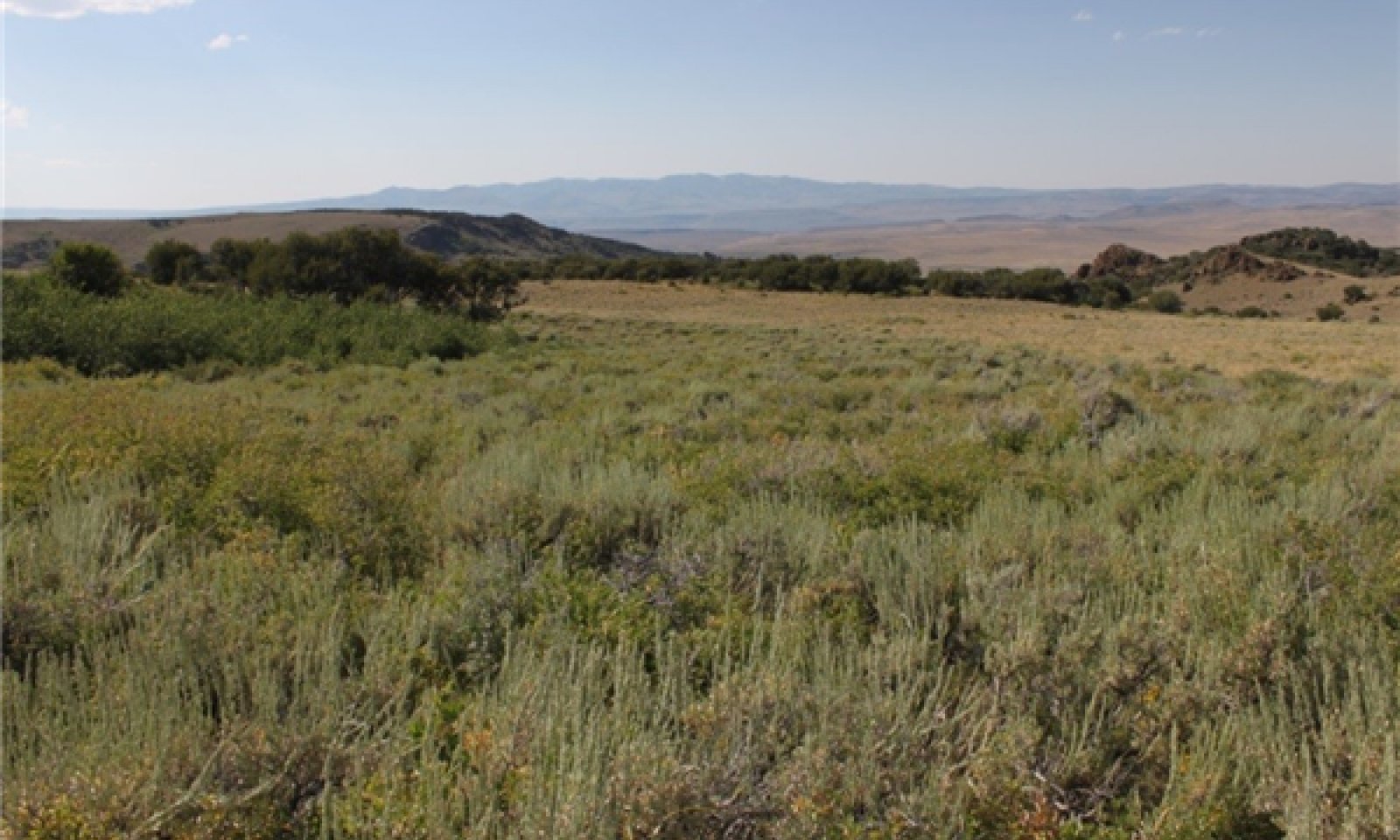
This site occurs on mountain sideslopes and mountain valley fans on all aspects. Slopes range from 4 to 50 percent, but slope gradients of 8 to 30 percent are most typical. Elevations range from 6,000 to 8,800 feet. The average growing season is about 50 to 70 days.
The soils associated with this site are deep and very deep and well drained. The soils are formed in residuum and colluvium from welded tuff, rhyolite and/or andesite. These soils have moderate to moderately rapid permeability and runoff is usually medium to rapid. Available water capacity is medium to high.
The reference plant community is dominated by Idaho fescue, bluebunch wheatgrass and mountain big sagebrush. Potential vegetative composition is about 70% grasses, 10% forbs and 20% shrubs. Approximate ground cover (basal and crown) is 40 to 60 percent.Associated sites
F025XY065NV Backslope Aspen
R025XY004NV LOAMY SLOPE 16+ P.Z.
R025XY071NV MAHOGANY SAVANNA 14-16 P.Z.
Similar sites
R025XY012NV LOAMY SLOPE 12-16 P.Z.
PSSPS-FEID codominant grasses
R025XY027NV LOAMY 12-14 P.Z.
ARTRT dominant shrub
R025XY004NV LOAMY SLOPE 16+ P.Z.
BRMA4-ELTR7 codominant grasses; more productive site
R025XY029NV DEEP LOAMY 14+ P.Z.
LECI4-FEID codominant grasses
R025XY010NV STEEP NORTH SLOPE
Occurs on steep, convex to straight, north aspects; less productive site
Table 1. Dominant plant species
Tree Not specified
Shrub (1) Artemisia tridentata subsp. vaseyana
Herbaceous (1) Festuca idahoensis
Physiographic features
This site occurs on mountain sideslopes and mountain valley fans on all aspects. Slopes range from 4 to 50 percent, but slope gradients of 8 to 30 percent are most typical. Elevations are 6000 to 8800 feet.
Table 2. Representative physiographic features
Landforms (1) Mountain slope
(2) Mountain valley
Runoff class Medium to high Flooding frequency None Ponding frequency None Elevation 6000 – 8800 ft Slope 4 – 50 % Water table depth 0 – 84 in Aspect Aspect is not a significant factor Climatic features
The climate associated with this site is semiarid, characterized by cold, moist winters and warm, dry summers.
The average annual precipitation ranges from 14 or more inches. Mean annual air temperature is typically <45 degrees F.
Mean annual precipitation across the range in which this ES occurs is 18.58".
Monthly mean precipitation: January 1.65”; February 1.68”; March 1.98”; April 2.43”; May 2.41”; June 1.62”; July 0.61”; August 0.63”; September 0.84”; October 1.41”; November 1.51”; December 1.79”.
*The above data is averaged from the Jarbridge 4N and Lamoille PH WRCC climate stations.Table 3 Representative climatic features
Frost-free period (average) 80 days Freeze-free period (average) 110 days Precipitation total (average) 20 in BarLineFigure 1. Monthly precipitation range
BarLineFigure 2. Monthly average minimum and maximum temperature
Figure 3. Annual precipitation pattern
Figure 4 Annual average temperature pattern
Climate stations used
-
(1) JARBIDGE 7 N [USC00264039], Jackpot, NV
-
(2) LAMOILLE YOST [USC00264394], Spring Creek, NV
">Influencing water features
There are no influencing water features associated with this site.
Soil features
The soils associated with this site are deep and very deep and well drained. The soils are formed in residuum and colluvium from welded tuff, rhyolite and/or andesite. These soils have moderate to moderately rapid permeability and runoff is usually medium to rapid. Available water capacity is medium to high.
The soil series correlated with this site include: Croesus, Glean, and Keman.
A representative soil series is Glean, classified as a loamy-skeletal, mixed, superactive, frigid Pachic Haploxeroll. This soil is well drained and was formed in colluvium derived from mixed rocks including metamorphic rocks, basalt, rhyolite and andesite. Reaction is slightly acid through slightly alkaline. Diagnostic horizons include a pachic horizon that occurs from the soil surface to approximately 29 inches. Clay content in the particle-size control section averages 8 to 18 percent. Rock fragments average 40 to 70 percent by volume of gravel, cobblestones and stones.Table 4. Representative soil features
Parent material (1) Colluvium – welded tuff
(2) Residuum – rhyolite
Surface texture (1) Gravelly loam
(2) Very gravelly loam
Family particle size (1) Loamy-skeletal
Drainage class Well drained Permeability class Moderate to moderately rapid Depth to restrictive layer 60 – 84 in Soil depth 60 – 84 in Surface fragment cover <=3" 30 – 50 % Surface fragment cover >3" 0 – 5 % Available water capacity
(0-40in)1.7 – 5.1 in Calcium carbonate equivalent
(0-40in)0 – 1 % Electrical conductivity
(0-40in)Not specified Sodium adsorption ratio
(0-40in)Not specified Soil reaction (1:1 water)
(0-40in)5.1 – 7.3 Subsurface fragment volume <=3"
(Depth not specified)30 – 55 % Subsurface fragment volume >3"
(Depth not specified)0 – 30 % Ecological dynamics
An ecological site is the product of all the environmental factors responsible for its development and has a set of key characteristics that influence a site’s resilience to disturbance and resistance to invasives. Key characteristics include 1) climate (precipitation and temperature), 2) topography (aspect, slope, elevation, and landform), 3) hydrology (infiltration and runoff), 4) soils (depth, texture, structure, and organic matter), 5) plant communities (functional groups and productivity), and 6) natural disturbance regime (fire, herbivory, etc.) (Caudle et al. 2013). Biotic factors that influence resilience include site productivity, species composition and structure, and population regulation and regeneration (Chambers et al. 2013).
This ecological site is dominated by deep-rooted cool season, perennial bunchgrasses and long-lived shrubs (50+ years) with high root to shoot ratios. The dominant shrubs usually root to the full depth of the winter-spring soil moisture recharge, which ranges from 1.0 to over 3.0 meters (Dobrowolski et al. 1990). Root length of mature sagebrush plants was measured to a depth of 2 meters in alluvial soils in Utah (Richards and Caldwell 1987). Tap roots of antelope bitterbrush have been documented from 4.5 to 5.4 meters in length (McConnell 1961). These shrubs have a flexible generalized root system with development of both deep taproots and laterals near the surface (Comstock and Ehleringer 1992).
Periodic drought regularly influences sagebrush ecosystems and drought duration and severity has increased throughout the 20th century in much of the Intermountain West. Major shifts away from historical precipitation patterns have the greatest potential to alter ecosystem function and productivity. Species composition and productivity can be altered by the timing of precipitation and water availability within the soil profile (Bates et al. 2006).
Mountain big sagebrush and antelope bitterbrush are generally long-lived; therefore it is unnecessary for new individuals to recruit every year for perpetuation of the stand. Simultaneous low, continuous recruitment and infrequent large recruitment events are the foundation of population maintenance (Noy-Meir 1973). Survival of the seedlings is dependent upon adequate moisture conditions.
Native insect outbreaks are also important drivers of ecosystem dynamics in sagebrush communities. Climate is generally believed to influence the timing of insect outbreaks especially with regard to Aroga moth (Aroga websteri), a sagebrush defoliator. Aroga moth infestations have occurred in the Great Basin in the 1960s, early 1970s, and have been ongoing in Nevada since 2004 (Bentz et al 2008). Thousands of acres of big sagebrush have been impacted, with partial to complete die-off observed in both individual plants and entire stands (Furniss and Barr 1975).
The Great Basin sagebrush communities have high spatial and temporal variability in precipitation both among years and within growing seasons. Nutrient availability is typically low but increases with elevation and closely follows moisture availability. The invasibility of plant communities is often linked to resource availability. Disturbance can decrease resource uptake due to damage or mortality of the native species and depressed competition. It can also increase resource pools via the decomposition of dead plant material following disturbance. The invasion of sagebrush communities by cheatgrass (Bromus tectorum) has been linked to disturbances (fire, abusive grazing) that have resulted in fluctuations in resources (Chambers et al. 2007).
The perennial bunchgrasses that are co-dominant with the shrubs include Idaho fescue and bluebunch wheatgrass. These species generally have somewhat shallower root systems than the shrubs, but root densities are often as high as or higher than those of shrubs in the upper 0.5 m of the soil profile. The root systems of short lived perennial grasses such as Sandberg bluegrass and mountain brome penetrate only the upper 40cm of the soil, whereas longer lived perennial bunchgrasses can reach depths up to 160 cm (Spence 1937). General differences in root depth distributions between grasses and shrubs results in resource partitioning in these shrub/grass systems.
South-facing slopes will generally express a higher abundance of bluebunch wheatgrass, while north-facing slopes will contain more Idaho fescue. Production will be higher on sites with deeper soils. Overgrazing by livestock and horses will cause a decrease in deep-rooted perennial bunchgrasses, mainly Idaho fescue and bluebunch wheatgrass. As grass cover declines, the potential for invasion by annual non-native species (such as cheatgrass), singleleaf pinyon (Pinus monophylla) and Utah juniper (Juniperus osteosperma) will increase. Continued inappropriate grazing management may result in an increase in Sandberg bluegrass (Poa secunda), balsamroot, lupine, sagebrush, and rabbitbrush (Chrysothamnus viscidiflorus).
As ecological condition declines, mountain big sagebrush, rabbitbrush and snowberry increase as Idaho fescue, bluebunch wheatgrass and mountain brome decrease.
This ecological site has low to high resilience to disturbance and resistance to invasion. Increased resilience increases with elevation, aspect, increased precipitation and increased nutrient availability. Four possible stable states have been identified for the Loamy 14-16” ecological site.
Fire Ecology:
Pre-settlement fire return intervals in mountain big sagebrush communities varies from 15 to 25 years (Burkhardt and Tisdale 1969, Houston 1973, Miller 2000). Mountain big sagebrush is killed by fire (Neuenschwander 1980, Blaisdell et al. 1982), and does not resprout (Blaisdell 1953). Post-fire regeneration occurs from seed and will vary depending on site characteristics, seed source, and fire characteristics. Mountain big sagebrush seedlings can grow rapidly and may reach reproductive maturity within 3 to 5 years (Bunting et al. 1987). Mountain big sagebrush may return to pre-burn density and cover within 15-20 years following fire, but establishment after severe fires may proceed more slowly and can take up to 50 years (Bunting et al. 1987, Ziegenhagen 2003, Miller and Heyerdahl 2008, Ziegenhagen and Miller 2009). The introduction of annual weedy species such as cheatgrass may cause an increase in fire frequency and eventually lead to an annual dominated community. Conversely, without fire, sagebrush will increase and the potential for encroachment by pinyon and juniper also increases. Without fire or changes in management, pinyon and juniper will dominate the site and mountain big sagebrush will be severely reduced. The herbaceous understory will also be reduced; Idaho fescue may remain underneath trees on north facing slopes. The potential for soil erosion increases as the woodland matures and the understory plant community cover declines. Catastrophic wildfire in these tree-controlled sites may lead to an annual weed dominated site.
Antelope bitterbrush is moderately fire tolerant (McConnell and Smith 1977). It regenerates by seed and resprouting (Blaisdell and Mueggler 1956, McArthur et al. 1982), however sprouting ability is highly variable and has been attributed to genetics, plant age, phenology, soil moisture and texture, and fire severity (Blaisdell and Mueggler 1956, Blaisdell et al. 1982, Clark et al. 1982, Cook et al. 1994). Bitterbrush sprouts from a region on the stem approximately 1.5 inches above and below the soil surface; the plant rarely sprouts if the root crown is killed by fire (Blaisdell and Mueggler 1956). Low intensity fires may allow for bitterbrush to sprout; however, community response also depends on soil moisture levels at time of fire (Murray 1983). Lower soil moisture allows more charring of the stem below ground level (Blaisdell and Mueggler 1956), thus sprouting will usually be more successful after a spring fire than after a fire in summer or fall (Murray 1983, Busse et al. 2000, Kerns et al. 2006). If cheatgrass is present, bitterbrush seedling success is much lower. The factor that most limits establishment of bitterbrush seedlings is competition for water resources with cheatgrass, an invasive species (Clements and Young 2002).
Depending on fire severity, rabbitbrush, Utah serviceberry (Amelanchier utahensis) and mountain snowberry (Symphoricarpos orbiculatus) may increase after fire. Mountain snowberry is also top-killed by fire, but resprouts after fire from rhizomes (Leege and Hickey 1971, Noste and Bushey 1987). Snowberry has been noted to regenerate well and exceed pre-burn biomass in the third season after a fire (Merrill et al. 1982). Utah serviceberry resprouts from the root crown. Douglas’ rabbitbrush is top-killed by fire, but sprouts vigorously after fire (Kuntz 1982, Akinsoji 1988). As cheatgrass increases, fire frequencies also increase to between 0.23 and 0.43 times a year; at this rate, even sprouting rabbitbrush will not survive (Whisenant 1990).
The effect of fire on bunchgrasses relates to culm density, culm-leaf morphology, and the size of the plant. The initial condition of bunchgrasses within the site, coupled with seasonality and intensity of the fire factor into individual species’ responses. For most forbs and grasses, the growing points are located at or below the soil surface providing relative protection from disturbances which decrease above ground biomass, such as grazing or fire. Thus, fire mortality is more correlated to duration and intensity of heat which is related to culm density, culm-leaf morphology, size of plant and abundance of old growth (Wright 1971, Young 1983).
Idaho fescue’s response to fire varies with condition and size of the plant, season and severity of fire, and ecological conditions. Mature Idaho fescue plants are commonly reported to be severely damaged by fire in all seasons (Wright et al. 1979). Initial mortality may be high (in excess of 75%) on severe burns, but usually varies from 20 to 50% (Barrington et al 1988). Rapid burns have been found to leave little damage to root crowns, and new tillers are produced with onset of fall moisture (Johnson et al. 1994). However, Wright and others (1979) found the dense, fine leaves of Idaho fescue provided enough fuel to burn for hours after a fire had passed, thereby killing or seriously injuring the plant regardless of the intensity of the fire (Wright et al. 1979). Idaho fescue is commonly reported to be more sensitive to fire than the other prominent grass on this site, bluebunch wheatgrass (Conrad and Poulton 1966). Robberecht and Defosse (1995) suggested the latter was more sensitive, however. They observed culm and biomass reduction with moderate fire severity in bluebunch wheatgrass, whereas a high fire severity was required for this reduction in Idaho fescue. Given the same fire severity treatment, post-fire culm production was initiated earlier and more rapidly in Idaho fescue (Robberecht and Defosse 1995).
Bluebunch wheatgrass has coarse stems with little leafy material, therefore the aboveground biomass burns rapidly and little heat is transferred downward into the crowns (Young 1983). Bluebunch wheatgrass was described as fairly tolerant of burning, other than in May in eastern Oregon (Britton et al. 1990). Uresk et al. (1976) reported burning increased vegetative and reproductive vigor of bluebunch wheatgrass. Thus, bluebunch wheatgrass is considered to experience slight damage to fire but is more susceptible in drought years (Young 1983). Most authors classify the plant as undamaged by fire (Kuntz 1982).
Basin wildrye is relatively resistant to fire, particularly dormant season fire, as plants sprout from surviving root crowns and rhizomes (Zschaechner 1985). Miller et al. (2013) reported increased total shoot and reproductive shoot densities in the first year following fire; by year two, however, there was little difference between burned and control treatments.State and transition model
Custom diagramStandard diagram
Figure 5. T. Stringham July 2015

Figure 6. T. Stringham July 2015
More interactive model formats are also available. View Interactive Models
More interactive model formats are also available. View Interactive Models
Click on state and transition labels to scroll to the respective textState 1 submodel, plant communities
State 2 submodel, plant communities
State 3 submodel, plant communities
State 4 submodel, plant communities
State 1
Reference StateThe Reference State is a representative of the natural range of variability under pristine conditions. The reference state has three general community phases: a shrub-grass dominant-phase, a perennial grass-dominant phase and a shrub-dominant phase. State dynamics are maintained by interactions between climatic patterns and disturbance regimes. Negative feedbacks enhance ecosystem resilience and contribute to the stability of the state. These include the presence of all structural and functional groups, low fine fuel loads, and retention of organic matter and nutrients. Plant community phase changes are primarily driven by fire, periodic drought and/or insect or disease attack.
Community 1.1
Community PhaseThe reference plant community is dominated by Idaho fescue, bluebunch wheatgrass and mountain big sagebrush. Potential vegetative composition is about 70% grasses, 10% forbs and 20% shrubs. Approximate ground cover (basal and crown) is 40 to 60 percent.
Figure 7. Annual production by plant type (representative values) or group (midpoint values)
Table 5. Annual production by plant type
Plant type Low
(lb/acre)Representative value
(lb/acre)High
(lb/acre)Grass/Grasslike 490 770 1050 Shrub/Vine 140 220 300 Forb 70 110 150 Total 700 1100 1500 Community 1.2
Community PhaseThis community phase is characteristic of a post-disturbance, early seral community phase. Idaho fescue, bluebunch wheatgrass and other perennial grasses dominate. Douglas rabbitbrush, mountain snowberry and Utah serviceberry may be resprouting. Big sagebrush is killed by fire, therefore decreasing within the burned community. Depending on fire severity or intensity of Aroga moth infestations, patches of intact sagebrush may remain. Perennial forbs may increase post-fire but will likely return to pre-burn levels within a few years.
Community 1.3
Community Phase
Figure 8. Loamy 14-16” (R025XY056NV) Phase 1.3 T. K. Stringham, August 2011

Figure 9. Loamy 14-16” (R025XY056NV) Phase 1.3 T. K. Stringham, August 2011
Mountain big sagebrush increases in the absence of disturbance. Decadent sagebrush dominates the overstory and the deep-rooted perennial bunchgrasses in the understory are reduced either from competition with shrubs and/or from herbivory. Sandberg bluegrass and/or squirreltail will likely increase in the understory and may be the dominant grass on the site.
Pathway a
Community 1.1 to 1.2Fire will decrease or eliminate the overstory of sagebrush and allow for the perennial bunchgrasses to dominate the site. Fires will typically be low severity resulting in a mosaic pattern due to low fuel loads. A fire following an unusually wet spring or a change in management may be more severe and reduce sagebrush cover to trace amounts. A severe infestation of Aroga moth could also cause a large decrease in sagebrush within the community, giving a competitive advantage to the perennial grasses and forbs.
Pathway b
Community 1.1 to 1.3Time and lack of disturbance such as fire allows for sagebrush to increase and become decadent. Long-term drought, herbivory, or combinations of these will cause a decline in perennial bunchgrasses and fine fuels leading to a reduced fire frequency allowing big sagebrush to dominate the site.
Pathway a
Community 1.2 to 1.1Time and lack of disturbance will allow the mountain big sagebrush to recover/increase.
Pathway a
Community 1.3 to 1.1A low severity fire, Aroga moth or combinations will reduce the sagebrush overstory and create a sagebrush/grass mosaic with sagebrush and perennial bunchgrasses codominant.
Pathway b
Community 1.3 to 1.2Fire will decrease or eliminate the overstory of sagebrush and allow for the perennial bunchgrasses to dominate the site. Fires will typically be low severity due to low fine fuel loads. A fire following an unusually wet spring or a change in management may be more severe and reduce sagebrush cover to trace amounts. A severe infestation of Aroga moth could also cause a large decrease in sagebrush within the community, giving a competitive advantage to the perennial grasses and forbs.
State 2
Current Potential StateThis state is similar to the Reference State 1.0 with four similar community phases. Ecological function has not changed, however the resiliency of the state has been reduced by the presence of invasive weeds. Non-natives may increase in abundance but will not become dominant within this state. These non-natives can be highly flammable, and can promote fire where historically fire had been infrequent. Negative feedbacks enhance ecosystem resilience and contribute to the stability of the state. These include the presence of all structural and functional groups, low fine fuel loads and retention of organic matter and nutrients. Positive feedbacks decrease ecosystem resilience and stability of the state. These include the non-natives’ high seed output, persistent seed bank, rapid growth rate, ability to cross pollinate and adaptations for seed dispersal.
Community 2.1
Community PhaseThis community phase is similar to the Reference State Community Phase 1.1, with the presence of non-native species in trace amounts. The plant community is dominated by Idaho fescue, bluebunch wheatgrass and basin wildrye. Mountain big sagebrush is the dominant shrub with antelope bitterbrush also common on this site. Smooth brome or other perennial non-native bunchgrasses may be present. Cheatgrass is the most likely species to invade.
Community 2.2
Community PhaseThis community phase is characteristic of a post-disturbance, early seral community phase where non-native species are present. Idaho fescue, bluebunch wheatgrass and other perennial grasses dominate. Douglas rabbitbrush, mountain snowberry and Utah serviceberry may be resprouting. Depending on fire severity or intensity of Aroga moth infestations, patches of intact sagebrush may remain. Perennial forbs may increase post-fire but will likely return to pre-burn levels within a few years. Annual non-native species are stable or increasing within the community.
Community 2.3
Community Phase (at risk)Mountain big sagebrush, rabbitbrush and bitterbrush increase; Idaho fescue and bluebunch wheatgrass decrease. Sandberg bluegrass may be increasing. Smooth brome and other non-native species are stable to increasing. Juniper and pinyon may be present as a result of encroachment from neighboring sites, and lack of disturbance.
Community 2.4
Community PhaseLupine and other perennial forbs dominate the site. Mountain big sagebrush may be present in trace amounts. Snowberry may be sprouting. Perennial bunchgrasses are present. Smooth brome and/or other perennial non-native bunchgrasses may be present. This community phase can be maintained for several years with spring grazing and poor distribution of grazing animals. With a change in grazing management mountain big sagebrush will increase and perennial forb community will eventually decrease.
Pathway a
Community 2.1 to 2.2Fire will decrease or eliminate the overstory of sagebrush and allow for the perennial bunchgrasses to dominate the site. Fires will typically be small and patchy due to low fuel loads. A fire following an unusually wet spring or a change in management may be more severe and reduce sagebrush cover to trace amounts. A severe infestation of Aroga moth could also cause a large decrease in sagebrush within the community, giving a competitive advantage to the perennial grasses and forbs.
Pathway b
Community 2.1 to 2.3Time and lack of disturbance allows for sagebrush to increase and become decadent. Chronic drought will reduce fine fuels and lead to a reduced fire frequency allowing big sagebrush to dominate the site. Inappropriate grazing management will reduce the perennial bunchgrass understory; conversely Sandberg bluegrass may increase in the understory depending on grazing management. Excessive sheep grazing favors Sandberg bluegrass; however, where cattle are the dominant grazers, cheatgrass often increases.
Pathway c
Community 2.1 to 2.4Grazing and/or drought
Pathway a
Community 2.2 to 2.1Time and lack of disturbance and/or grazing management that favors the establishment and growth of sagebrush allows the shrub component to recover. The establishment of big sagebrush may take many years.
Pathway a
Community 2.3 to 2.1A low severity fire, Aroga moth or combinations will reduce the sagebrush overstory and create a sagebrush/grass mosaic.
Pathway b
Community 2.3 to 2.2Fire reduces the shrub overstory and allows for perennial bunchgrasses to dominate the site. Fires are typically low severity resulting in a mosaic pattern due to low fuel loads. A fire following an unusually wet spring or a change in management favoring an increase in fine fuels may be more severe and reduce sagebrush cover to trace amounts. A severe infestation of Aroga moth could also cause a large decrease in sagebrush within the community, giving a competitive advantage to the perennial grasses and forbs. Annual non-native species are likely to increase after fire.
Pathway c
Community 2.3 to 2.4High severity fire following inappropriate grazing management (spring grazing suppresses perennial bunchgrass response) increases the forb community response.
Pathway a
Community 2.4 to 2.1Time and lack of disturbance combined with grazing management to facilitate perennial bunchgrass production such as fall season grazing.
State 3
Shrub StateThis state has two community phases: a mountain big sagebrush-dominated phase and a rabbitbrush-dominated phase. This state is a product of many years of heavy grazing during time periods harmful to perennial bunchgrasses. Sandberg bluegrass will increase with a reduction in deep rooted perennial bunchgrass competition and become the dominant grass on this site. Sagebrush dominates the overstory and rabbitbrush may be a significant component. Sagebrush cover exceeds site concept and may be decadent, reflecting stand maturity and lack of seedling establishment due to competition with mature plants.
Community 3.1
Community PhaseThis site has crossed a biotic threshold and site processes (soil hydrology, nutrient cycling, and energy capture) are being controlled by the shrub component of the plant community along with Sandberg bluegrass in the understory. Decadent big sagebrush and rabbitbrush dominate overstory. Deep-rooted perennial bunchgrasses may be present in trace amounts or absent from the community. Sandberg bluegrass and annual non-native species increase, and the amount of bare ground increases. Utah juniper may be present as a result of encroachment from neighboring sites and lack of natural fire. Singleleaf pinyon may be invading.
Community 3.2
Community PhaseBluegrass dominates the site; annual non-native species may be present but are not dominant. Trace amounts of sagebrush, snowberry and/or rabbitbrush may be present.
Pathway a
Community 3.1 to 3.2Fire, heavy fall grazing causing mechanical damage to shrubs, and/or brush treatments with minimal soil disturbance, will greatly reduce the overstory shrubs to trace amounts and allow for Sandberg bluegrass to dominate the site.
Pathway a
Community 3.2 to 3.1Absence of disturbance over time will allow for the sagebrush and other shrubs to recover.
State 4
Forb StateThis state has one community phase that is dominated by deep-rooted perennial forbs. This state may be the result of many years of abusive grazing allowing the perennial forbs to increase. It may also be compounded by fire. This may occur as “pockets” or inclusions within other states of the same site, and can appear to be localized. The positive feedbacks in this state include the presence of a competitive functional group that possesses deep-rooted taproots and strong lateral roots, the sprouting ability of roots or root crown, high seed production and the ability to monopolize soil moisture.
Community 4.1
Community PhaseMule’s ear (Wyethia amplexicaulis), and/or other perennial forbs dominate the site. Mountain big sagebrush is likely present. Sandberg bluegrass may be stable to increasing, and perennial bunchgrasses are a minor component.
Transition A
State 1 to 2Trigger: Introduction of annual non-native species. Slow variable: Over time the annual non-native plants will increase within the community decreasing organic matter inputs from deep-rooted perennial bunchgrasses resulting in reductions in soil water availability for perennial bunchgrasses. Threshold: Any amount of introduced non-native species causes an immediate decrease in the resilience of the site. Annual non-native species cannot be easily removed from the system and have the potential to significantly alter disturbance regimes from their historic range of variation.
Transition A
State 2 to 3Trigger: To Community Phase 3.1: Inappropriate grazing will decrease or eliminate deep rooted perennial bunchgrasses, increase Sandberg bluegrass and favor shrub growth and establishment. To Community Phase 3.2: Severe fire in community phase 2.3 will remove sagebrush overstory, decrease perennial bunchgrasses and enhance Sandberg bluegrass. Annual non-native species will increase. Slow variables: Long term decrease in deep-rooted perennial grass density resulting in decreased organic matter inputs and reduced soil water. Threshold: Loss of deep-rooted perennial bunchgrasses changes nutrient cycling, nutrient redistribution, and reduces soil organic matter.
Transition B
State 2 to 4Trigger: Inappropriate grazing management and/or fire promote mule ears and other perennial forbs to dominate the site. Persistent spring grazing after a fire will suppress perennial grasses and promote forb production. Slow variable: Increasing density of perennial forbs and soil erosion. Threshold: Loss of deep-rooted perennial bunchgrasses and shrubs changes nutrient capture and cycling within the community and reduced organic matter inputs and soil water.
Restoration pathway A
State 3 to 2Brush management with minimal soil disturbance/seeding of desired species.
Conservation practices
Brush Management Range Planting Transition A
State 3 to 4Trigger: Fire in combination with inappropriate grazing management can eliminate Sandberg bluegrass understory and transition to 4.1. Slow variable: Increasing density of perennial forbs and soil erosion. Threshold: Loss of deep-rooted perennial bunchgrasses and shrubs changes nutrient capture and cycling within the community and reduced organic matter inputs and reduced soil water.
Restoration pathway A
State 4 to 2Herbicide treatment to reduce perennial forbs may be coupled with seeding of perennial bunchgrasses and other desirable species (Mueggler and Blaisdell 1951).
Additional community tables
Table 6. Community 1.1 plant community composition
Group Common name Symbol Scientific name Annual production () Foliar cover (%) Grass/Grasslike1 Primary Perennial Grasses 517–1188 Idaho fescue FEID Festuca idahoensis 275–440 – bluebunch wheatgrass PSSPS Pseudoroegneria spicata ssp. spicata 55–165 – Columbia needlegrass ACNE9 Achnatherum nelsonii 55–165 – mountain brome BRMA4 Bromus marginatus 55–165 – slender wheatgrass ELTR7 Elymus trachycaulus 55–165 – Cusick's bluegrass POCU3 Poa cusickii 8–30 – Sandberg bluegrass POSE Poa secunda 7–29 – 2 Secondary Perennial Grasses 55–165 needlegrass ACHNA Achnatherum 6–55 – basin wildrye LECI4 Leymus cinereus 6–55 – melicgrass MELIC Melica 6–55 – Forb3 Perennial Forbs 55–165 melicgrass MELIC Melica 6–55 – aster ASTER Aster 6–33 – arrowleaf balsamroot BASA3 Balsamorhiza sagittata 6–33 – tapertip hawksbeard CRAC2 Crepis acuminata 6–33 – buckwheat ERIOG Eriogonum 6–33 – lupine LUPIN Lupinus 6–33 – Shrub/Vine4 Primary Shrubs 100–363 mountain big sagebrush ARTRV Artemisia tridentata ssp. vaseyana 55–165 – snowberry SYMPH Symphoricarpos 22–88 – antelope bitterbrush PUTR2 Purshia tridentata 1–55 – Utah serviceberry AMUT Amelanchier utahensis 22–55 – 5 Secondary Shrubs 22–88 yellow rabbitbrush CHVIL4 Chrysothamnus viscidiflorus ssp. lanceolatus 6–22 – Woods' rose ROWO Rosa woodsii 6–22 – Table 7. Community 1.2 plant community composition
Group Common name Symbol Scientific name Annual production () Foliar cover (%) Table 8. Community 1.3 plant community composition
Group Common name Symbol Scientific name Annual production () Foliar cover (%) Table 9. Community 2.1 plant community composition
Group Common name Symbol Scientific name Annual production () Foliar cover (%) Table 10. Community 2.2 plant community composition
Group Common name Symbol Scientific name Annual production () Foliar cover (%) Table 11. Community 2.3 plant community composition
Group Common name Symbol Scientific name Annual production () Foliar cover (%) Table 12. Community 2.4 plant community composition
Group Common name Symbol Scientific name Annual production () Foliar cover (%) Table 13. Community 3.1 plant community composition
Group Common name Symbol Scientific name Annual production () Foliar cover (%) Table 14. Community 3.2 plant community composition
Group Common name Symbol Scientific name Annual production () Foliar cover (%) Table 15. Community 4.1 plant community composition
Group Common name Symbol Scientific name Annual production () Foliar cover (%) Interpretations
Animal community
Livestock Interpretations:
This site is suited for livestock grazing. Grazing management should be keyed to Idaho fescue. Considerations for grazing management include timing, intensity and duration of grazing. Stocking rates vary over time depending upon season of use, climate variations, site, and previous and current management goals. A safe starting stocking rate is an estimated stocking rate that is fine-tuned by the client by adaptive management through the year and from year to year.
Overgrazing leads to an increase in sagebrush and a decline in understory plants like bluebunch wheatgrass and Idaho fescue. Squirreltail or Sandberg bluegrass will increase temporarily with further degradation. Invasion of annual weedy forbs and cheatgrass could occur with further grazing degradation, leading to a decline in squirreltail and bluegrass and an increase in bare ground. A combination of overgrazing and prolonged drought leads to soil erosion, increased bare ground, and a loss in plant production. Wildlife in sites with cheatgrass present could transition to cheatgrass-dominated communities, and without management, cheatgrass and annual forbs are likely to dominate.
Reduced bunchgrass vigor or density provides an opportunity for Sandberg bluegrass expansion and/or cheatgrass and other invasive species to occupy interspaces, leading to increased fire frequency and potentially an annual plant community. Sandberg bluegrass increases under grazing pressure (Tisdale and Hironaka 1981) and is capable of co-existing with cheatgrass. Excessive sheep grazing favors Sandberg bluegrass; however, where cattle are the dominant grazers, cheatgrass often dominates (Daubenmire 1970). Thus, depending on the season of use, the grazer and site conditions, either Sandberg bluegrass or cheatgrass may become the dominant understory with inappropriate grazing management.
Long-term disturbance response may be influenced by small differences in landscape topography. Concave areas hold a little more moisture and may retain deep-rooted perennial grasses whereas convex areas are slightly less resilient and may have more Sandberg bluegrass present.
Idaho fescue provides important forage for many types of domestic livestock. The foliage cures well and is preferred by livestock in the late fall and winter. Idaho fescue tolerates light to moderate grazing (Ganskopp and Bedell 1980) and is moderately resistant to trampling (Cole 1987). Heavy grazing may lead to replacement of Idaho fescue with non-native species such as cheatgrass (Mueggler 1984).
Bluebunch wheatgrass is moderately grazing tolerant and is very sensitive to defoliation during the active growth period (Blaisdell and Pechanec 1949, Laycock 1967, Anderson and Scherzinger 1975, Britton et al. 1990). Herbage and flower stalk production was reduced with clipping at all times during the growing season; however, clipping was most harmful during the boot stage (Blaisdell and Pechanec 1949). Tiller production and growth of bluebunch was greatly reduced when clipping was coupled with drought (Busso and Richards 1995). Mueggler (1975) estimated that low vigor bluebunch wheatgrass may need up to 8 years rest to recover. Although an important forage species, it is not always the preferred species by livestock and wildlife.
Mountain big sagebrush is eaten by domestic livestock but has long been considered to be of low palatability, and a competitor to more desirable species.
Antelope bitterbrush is an important shrub species to domestic livestock. Antelope bitterbrush is most commonly found on soils which provide minimal restriction to deep root penetration such as coarse textured soil, or finer textured soil with high stone content (Driscoll 1964, Clements and Young 2002). Grazing tolerance of antelope bitterbrush is dependent on site conditions (Garrison 1953).
Wildlife Interpretations:
Idaho fescue is an important source of forage for pronghorn and deer in ranges of northern Nevada.
Mountain big sagebrush is a highly preferred winter forage for mule deer: In a study by Personius et al. (1987), mountain big sagebrush was the most preferred sagebrush species. Fecal samples from ungulates in Montana showed that bighorn sheep, mule deer, and elk all consumed mountain big sagebrush in small amounts in winter, while cattle showed no sign of sagebrush use. Reliance on the big sagebrush ecosystem by many wild animals for both food and cover has been documented and reviewed extensively. Sagebrush-grassland communities provide critical sage-grouse breeding and nesting habitats. Meadows surrounded by sagebrush may be used as feeding and strutting grounds. Sagebrush is a crucial component of their diet year-round, and sage-grouse select sagebrush almost exclusively for cover. Sage-grouse prefer mountain big sagebrush and Wyoming big sagebrush communities to basin big sagebrush communities.
Antelope bitterbrush is critical browse for mule deer, as well as domestic livestock, antelope, and elk (Wood 1995).
Recreational uses
Aesthetic value is derived from the diverse floral and faunal composition and the colorful flowering of wild flowers and shrubs during the spring and early summer. This site offers rewarding opportunities to photographers and for nature study. This site is used for camping and hiking and has potential for upland and big game hunting.
Other products
Native peoples used big sagebrush leaves and branches for medicinal teas, and the leaves as a fumigant. Bark was woven into mats, bags and clothing.
Supporting information
Type locality
Location 1: Elko County, NV Township/Range/Section T47N R62E S1 General legal description Near the Idaho and Nevada stateline, Brown's Bench area, west of Jackpot, Elko County, Nevada. Other references
Akinsoji, A. 1988. Postfire vegetation dynamics in a sagebrush steppe in southeastern Idaho, USA. Vegetatio 78:151-155.
Anderson, E. W. and R. J. Scherzinger. 1975. Improving quality of winter forage for elk by cattle grazing. Journal of Range Management 28:120-125.
Barrington, M., S. Bunting, and G. Wright. 1988. A Fire Management Plan for Craters of the Moon National Monument. Cooperative Agreement CA-9000-8-0005. Moscow, ID: University of Idaho, Range Resources Department. 52 p. Draft.
Bates, J. D., T. Svejcar, R. F. Miller, and R. A. Angell. 2006. The effects of precipitation timing on sagebrush steppe vegetation. Journal of Arid Environments 64: 670-697.
Bentz, B., D. Alston, and T. Evans. 2008. Great Basin insect outbreaks. In: J. Chambers, N. Devoe, A. Evenden [eds]. Collaborative management and research in the Great Basin -- Examining the issues and developing a framework for action. Gen. Tech. Rep. RMRS-GTR-204. U.S. Department of Agriculture, Forest Service, Rocky Mountain Research Station, Fort Collins, CO. p. 45-48.
Blaisdell, J. P. 1953. Ecological effects of planned burning of sagebrush-grass range on the Upper Snake River Plains. US Dept. of Agriculture.
Blaisdell, J. P. and W. F. Mueggler. 1956. Sprouting of bitterbrush (Purshia tridentata) following burning or top removal. Ecology 37: 365-370.
Blaisdell, J. P., R. B. Murray, and E. D. McArthur. 1982. Managing intermountain rangelands - sagebrush-grass ranges. USDA Forest Serv. Intermountain Forest and Range Exp. Sta. Gen. Tech. Rep. INT-134.
Blaisdell, J. P. and J. F. Pechanec. 1949. Effects of herbage removal at various dates on vigor of bluebunch wheatgrass and arrowleaf balsamroot. Ecology 30: 298-305.
Bradley, A. F. 1984. Rhizome morphology, soil distribution, and the potential fire survival of eight woody understory species in western Montana. University of Montana.
Britton, C. M., G. R. McPherson, and F. A. Sneva. 1990. Effects of burning and clipping on five bunchgrasses in eastern Oregon. Great Basin Naturalist 50:1 15-120.
Bunting, S. C., B. M. Kilgore, and C. L. Bushey. 1987. Guidelines for prescribed burning sagebrush-grass rangelands in the northern Great Basin. US Department of Agriculture, Forest Service, Intermountain Research Station Ogden, UT, USA.
Burkhardt, J. W. and E. Tisdale. 1969. Nature and successional status of western Juniper vegetation in Idaho. Journal of Range Management:264-270.
Busse, D., A. Simon, and M. Riegel. 2000. Tree-growth and understory responses to low-severity prescribed burning in thinned Pinus ponderosa forests of central Oregon. Forest Science 46: 258-268.
Caudle, D., J. DiBenedetto, M. Karl, H. Sanchez, and C. Talbot. 2013. Interagency Ecological Site Handbook for Rangelands. Available at: http://jornada.nmsu.edu/sites/jornada.nmsu.edu/files/InteragencyEcolSiteHandbook.pdf. Accessed 4 October 2013.
Chambers, J., B. Bradley, C. Brown, C. D’Antonio, M. Germino, J. Grace, S. Hardegree, R. Miller, and D. Pyke. 2013. Resilience to stress and disturbance, and resistance to Bromus tectorum L. invasion in cold desert shrublands of western North America. Ecosystems 17: 1-16.
Chambers, J. C., B. A. Roundy, R. R. Blank, S. E. Meyer, and A. Whittaker. 2007. What makes Great Basin sagebrush ecosystems invasible by Bromus tectorum? Ecological Monographs 77:117-145.
Clark, R. G., M. B. Carlton, and F. A. Sneva. 1982. Mortality of bitterbrush after burning and clipping in eastern Oregon. Journal of Range Management 35: 711-714.
Clements, C. D. and J. A. Young. 2002. Restoring antelope bitterbrush. Rangelands 24: 3-6.
Comstock, J. P. and J. R. Ehleringer. 1992. Plant adaptation in the Great Basin and Colorado plateau. Western North American Naturalist 52:195-215.
Conrad, C. E. and C. E. Poulton. 1966. Effect of a wildfire on Idaho fescue and bluebunch wheatgrass. Journal of Range Management 19:138-141.
Cook, J. G., T. J. Hershey, and L. L. Irwin. 1994. Vegetative response to burning on Wyoming mountain-shrub big game ranges. Journal of Range Management 47: 296-302.
Daubenmire, R. 1970. Steppe vegetation of Washington. 131 pp.
Daubenmire, R. 1975. Plant succession on abandoned fields, and fire influences in a steppe area in southeastern Washington. Northwest Science 49: 36-48.
Driscoll, R. S. 1964. A relict area in the central Oregon juniper zone. Ecology 45:345-353.
Dobrowolski, J. P., M. M. Caldwell, and J. H. Richards. 1990. Basin hydrology and plant root systems. In: C. B. Osmand, L. F. Pitelka, G. M. Hildy [eds]. Plant biology of the basin and range. Ecological Studies. 80: 243-292.
Eckert Jr, R. E. and J. S. Spencer. 1986. Vegetation response of allotments grazed under rest-rotation management. Journal of Range Management: 166-174.
Eckert, R. E., Jr. and J. S. Spencer. 1987. Growth and reproduction of grasses heavily grazed under rest-rotation management. Journal of Range Management 40:156-159.
Fire Effects Information System [Online]. http://www.fs.fed.us/database/feis.
Furniss, M. M. and W. F. Barr. 1975. Insects affecting important native shrubs of the northwestern United States General Technical Report INT-19. Intermountain Forest and Range Experiment Station, U.S. Department of Agriculture, Forest Service. Ogden, UT. p. 68.
Gaffney, W. S. 1941. The effects of winter elk browsing, South Fork of the Flathead River, Montana. The Journal of Wildlife Management 5:427-453.
Ganskopp, D., L. Aguilera, and M. Vavra. 2007. Livestock Forage Conditioning Among Six Northern Great Basin Grasses. Rangeland Ecology & Management 60: 71-78.
Garrison, G. A. 1953. Effects of clipping on some range shrubs. Journal of Range Management 6:309-317.
Houghton, J.G., C.M. Sakamoto, and R.O. Gifford. 1975. Nevada’s weather and climate, special publication 2. Nevada Bureau of Mines and Geology, Mackay School of Mines, University of Nevada, Reno, NV.
Houston, D. B. 1973. Wildfires in northern Yellowstone National Park. Ecology 54:1111-1117.
Johnson, C. G., R. R. Clausnitzer, P. J. Mehringer, and C. Oilver. 1994. Biotic and abiotic processes of eastside ecosystems: The effects of management on plant and community ecology, and on stand and landscape vegetation dynamics. Forest Service General Technical Report. Forest Service, Portland, OR (United States). Pacific Northwest Research Station.
Kasworm, W. F., L. R. Irby, and H. B. I. Pac. 1984. Diets of ungulates using winter ranges in northcentral Montana. Journal of Range Management 37:67-71.
Kerns, B. K., W. G. Thies, and C. G. Niwa. 2006. Season and severity of prescribed burn in ponderosa pine forests: Implications for understory native and exotic plants. Ecoscience 13:44-55.
Krall, J. L., J. R. Stroh, C. S. Cooper, and S. R. Chapman. 1971. Effect of time and extent of harvesting basin wildrye. Journal of Range Management 24: 414-418.
Kuntz, D. E. 1982. Plant response following spring burning Plant in an Artemisia tridentata subsp. vaseyana/Festuca Idahoensis habitat type. University of Idaho.
Laycock, W. A. 1967. How heavy grazing and protection affect sagebrush-grass ranges. Journal of Range Management: 206-213.
Leege, T. A. and W. O. Hickey. 1971. Sprouting of northern Idaho shrubs after prescribed burning. The Journal of Wildlife Management: 508-515.
Majerus, M. E. 1992. High-stature grasses for winter grazing. Journal of Soil and Water Conservation 47: 224-225.
McArthur, E. D., A. Blaner, A. P. Plummer, and R. Stevens. 1982. Characteristics and hybridization of important intermountain shrubs: 3. sunflower family. U.S. Department of Agriculture, Forest Service, Intermountain Forest and Range Experiment Station. Research Paper INT-177 43.
McConnell, B. R. 1961. Notes on some rooting characteristics of antelope bitterbrush. PNW Old Series Research Note No. 204:1-5.
McConnell, B. R. and J. G. Smith. 1977. Influence of grazing on age-yield interactions in bitterbrush. Journal of Range Management 30: 91-93.
Merrill, E. H., H. Mayland, and J. Peek. 1982. Shrub responses after fire in an Idaho ponderosa pine community. The Journal of Wildlife Management 46: 496-502.
Miller, R. F. and E. K. Heyerdahl. 2008. Fine-scale variation of historical fire regimes in sagebrush-steppe and juniper woodland: An example from California, USA. International Journal of Wildland Fire 17:245-254.
Miller, R. F. R. J. T. 2000. The role of fire in juniper and pinyon woodlands: A descriptive analysis. Pages p. 15-30 in Proceedings of the Invasive Species Workshop: The Role of Fire in the Control and Spread of Invasive Species. Tallahassee, Florida.
Miller, R. F. C., Jeanne C.; Pyke, David A.; Pierson, Fred B.; Williams, C. Jason 2013. A review of fire effects on vegetation and soils in the Great Basin region: Response and ecological site characteristics. Gen. Tech. Rep. RMRS-GTR-308. Fort Collins CO: U.S. Department of Agriculture, United State Forest Service, Rocky Mountain Research Station. p. 126.
Mueggler, W. F. and J. P. Blaisdell. 1951. Replacing wyethia with desireable forage species. Journal of Range Management 4:143-150.
Murray, R. 1983. Response of antelope bitterbrush to burning and spraying in southeastern Idaho. Tiedemann, Arthur R.; Johnson, Kendall L., compilers. Research and management of bitterbrush and cliffrose in western North America. General Technical Report INT-152. Ogden, UT: US Department of Agriculture, Forest Service, Intermountain Forest and Range Experiment Station: 142-152.
National Oceanic and Atmospheric Administration. 2004. The North American Monsoon. Reports to the Nation. Weather Service, Climate Prediction Center. Available online: http://www.weather.gov/
Neuenschwander, L. 1980. Broadcast burtning of sagebrush in the winter. Journal of Range Management: 233-236.
Noste, N. V. and C. L. Bushey. 1987. Fire response of shrubs of dry forest habitat types in Montana and Idaho. General technical report INT.
Noy-Meir, I. 1973. Desert ecosystems: Environment and producers. Annual Review of ecology and systematics. Vol. 4:25-51.
Personius, T.L., C. L. Wambolt, J. R. Stephens and R. G. Kelsey. 1987. Crude terpenoid influence on mule deer preference for sagebrush. Journal of Range Management, 40:1 p. 84-88.
NRCS Plants Database. (http://plants.usda.gov/)
Richards, J. H. and M. M. Caldwell. 1987. Hydraulic lift: Substantial nocturnal water transport between soil layers by Artemisia tridentata roots. Oecologia 73: 486-489.
Robberecht, R. and G. Defossé. 1995. The relative sensitivity of two bunchgrass species to fire. International Journal of Wildland Fire 5:127-134.
Sheehy, D. P. and A. Winward. 1981. Relative palatability of seven Artemisia taxa to mule deer and sheep. Journal of Range Management 34: 397-399.
Smith, J. K. and W. C. Fischer. 1997. Fire ecology of the forest habitat types of northern Idaho. US Department of Agriculture, Forest Service, Intermountain Research Station.
Tisdale, E. W. and M. Hironaka. 1981. The sagebrush-grass region: A review of the ecological literature. University of Idaho, Forest, Wildlife and Range Experiment Station.
Uresk, D. W., J. F. Cline, and W. H. Rickard. 1976. Impact of wildfire on three perennial grasses in south-central Washington. Journal of Range Management 29: 309-310.
Whisenant, S. G. 1990. Changing fire frequencies on Idaho's Snake River Plains: Ecological and management implications. Pages 4-10 in Symposium on cheatgrass invasion, shrub die-off, and other aspects of shrub biology and management. General Technical Report, Intermountain Research Station, USDA Forest Service.
Wood, M. K., Bruce A. Buchanan, & William Skeet. 1995. Shrub preference and utilization by big game on New Mexico reclaimed mine land. Journal of Range Management 48: 431-437.
Wright, H. A. 1971. Why squirreltail is more tolerant to burning than needle-and-thread. Journal of Range Management 24: 277-284.
Wright, H. A. 1985. Effects of fire on grasses and forbs in sagebrush-grass communities. Pages 12-21 in Rangeland Fire Effects; A Symposium: Boise, ID, USDI-BLM.
Wright, H.A., L.F. Neuenschwander, and C.M. Britton. 1979. The role and use of fire in sagebrush-grass and pinyon-juniper plant communities: a state-of-the-art review. Gen. Tech. Rep. INT-58. Ogden, UT: U.S. Department of Agriculture, Forest Service, Intermountain Forest and Range Experiment Station. 48 p.
Young, R.P. 1983. Fire as a vegetation management tool in rangelands of the intermountain region. In: Monsen, S.B. and N. Shaw (eds). Managing intermountain rangelands - improvement of range and wildlife habitats: Proceedings of symposia; 1981 September 15-17; Twin Falls, ID; 1982 June 22-24; Elko, NV. Gen. Tech. Rep. INT-157. Ogden, UT. U.S. Department of Agriculture, Forest Service, Intermountain Forest and Range Experiment Station. Pgs 18-31.
Ziegenhagen, L. L. 2003. Shrub reestablishment following fire in the mountain big sagebrush (Artemisia tridentata Nutt. ssp. vaseyana (Rydb.) Beetle) alliance. M.S. Oregon State University.
Ziegenhagen, L. L. and R. F. Miller. 2009. Postfire recovery of two shrubs in the interiors of large burns in the intermountain west, USA. Western North American Naturalist 69:195-205.
Zschaechner, G. A. 1985. Studying rangeland fire effects: A case study in Nevada. Pages 66-84 in Rangeland Fire Effects, a Symposium. Bureau of Land Management, Boise, Idaho.
Contributors
RK/GKB
Approval
Kendra Moseley, 4/25/2024
Rangeland health reference sheet
Interpreting Indicators of Rangeland Health is a qualitative assessment protocol used to determine ecosystem condition based on benchmark characteristics described in the Reference Sheet. A suite of 17 (or more) indicators are typically considered in an assessment. The ecological site(s) representative of an assessment location must be known prior to applying the protocol and must be verified based on soils and climate. Current plant community cannot be used to identify the ecological site.
Author(s)/participant(s) Contact for lead author Date 09/20/2026 Approved by Approval date Composition (Indicators 10 and 12) based on Annual Production Indicators
-
Number and extent of rills:
-
Presence of water flow patterns:
-
Number and height of erosional pedestals or terracettes:
-
Bare ground from Ecological Site Description or other studies (rock, litter, lichen, moss, plant canopy are not bare ground):
-
Number of gullies and erosion associated with gullies:
-
Extent of wind scoured, blowouts and/or depositional areas:
-
Amount of litter movement (describe size and distance expected to travel):
-
Soil surface (top few mm) resistance to erosion (stability values are averages - most sites will show a range of values):
-
Soil surface structure and SOM content (include type of structure and A-horizon color and thickness):
-
Effect of community phase composition (relative proportion of different functional groups) and spatial distribution on infiltration and runoff:
-
Presence and thickness of compaction layer (usually none; describe soil profile features which may be mistaken for compaction on this site):
-
Functional/Structural Groups (list in order of descending dominance by above-ground annual-production or live foliar cover using symbols: >>, >, = to indicate much greater than, greater than, and equal to):
Dominant:
Sub-dominant:
Other:
Additional:
-
Amount of plant mortality and decadence (include which functional groups are expected to show mortality or decadence):
-
Average percent litter cover (%) and depth ( in):
-
Expected annual annual-production (this is TOTAL above-ground annual-production, not just forage annual-production):
-
Potential invasive (including noxious) species (native and non-native). List species which BOTH characterize degraded states and have the potential to become a dominant or co-dominant species on the ecological site if their future establishment and growth is not actively controlled by management interventions. Species that become dominant for only one to several years (e.g., short-term response to drought or wildfire) are not invasive plants. Note that unlike other indicators, we are describing what is NOT expected in the reference state for the ecological site:
-
Perennial plant reproductive capability:
Print Options
Sections
Font
AAAAOther
PrintThe Ecosystem Dynamics Interpretive Tool is an information system framework developed by the USDA-ARS Jornada Experimental Range, USDA Natural Resources Conservation Service, and New Mexico State University.
Accessibility statement


