
Natural Resources
Conservation Service
-
Search


Major Land Resource Area or ecological site by name and/or ID.
PreviousSectionsNextGeneral information
Provisional. A provisional ecological site description has undergone quality control and quality assurance review. It contains a working state and transition model and enough information to identify the ecological site.
MLRA notes
Major Land Resource Area (MLRA): 025X–Owyhee High Plateau
MLRA Notes 25—Owyhee High Plateau
This area is in Nevada (56 percent), Idaho (30 percent), Oregon (12 percent), and Utah (2 percent). It makes up about 27,443 square miles. MLRA 25 is characteristically cooler and wetter than the neighboring MLRAs of the Great Basin. The western boundary is marked by a gradual transition to the lower and warmer basins of MLRA 24. The boundary to the south-southeast, with MLRA 28B, is marked by gradual changes in geology marked by an increased dominance of singleleaf pinyon and Utah juniper and a reduced presence of Idaho fescue. The boundary to the north, with MLRA 11, is a rapid transition from the lava plateau topography to the lower elevation Snake River Plain.
Physiography:
All of this area lies within the Intermontane Plateaus. The southern half is in the Great Basin section of the Basin and Range province. This part of the MLRA is characterized by isolated, uplifted fault-block mountain ranges separated by narrow, aggraded desert plains. This geologically older terrain has been dissected by numerous streams draining to the Humboldt River.
The northern half of the area lies within the Columbia Plateaus province. This part of the MLRA forms the southern boundary of the extensive Columbia Plateau basalt flows. Most of the northern half is in the Payette section, but the northeast corner is in the Snake River Plain section. Deep, narrow canyons draining into the Snake River have been incised into this broad basalt plain. Elevation ranges from 3,000 to 7,550 feet on rolling plateaus and in gently sloping basins. It is more than 9,840 feet on some steep mountains. The Humboldt River crosses the southern half of this area
Geology:
The dominant rock types in this MLRA are volcanic. They include andesite, basalt, tuff, and rhyolite. In the north and west parts of the area, Cretaceous granitic rocks are exposed among Miocene volcanic rocks in mountains. A Mesozoic igneous and metamorphic rock complex dominates the south and east parts of the area. Upper and Lower Paleozoic calcareous sediments, including oceanic deposits, are exposed with limited extent in the mountains. Alluvial fan and basin fill sediments occur in the valleys.
Climate:
The average annual precipitation in most of this area is typically 11 to 22 inches. It increases to as much as 49 inches at the higher elevations. Rainfall occurs in spring and sporadically in summer. Precipitation occurs mainly as snow in winter. The precipitation is distributed fairly evenly throughout fall, winter, and spring. The amount of precipitation is lowest from midsummer to early autumn. The average annual temperature is 33 to 51 degrees F. The freeze-free period averages 130 days and ranges from 65 to 190 days, decreasing in length with elevation. It is typically less than 70 days in the mountains.
Water:
The supply of water from precipitation and streamflow is small and unreliable, except along the Owyhee, Bruneau, and Humboldt Rivers. Streamflow depends largely on accumulated snow in the mountains. Surface water from mountain runoff is generally of excellent quality and suitable for all uses. The basin fill sediments in the narrow alluvial valleys between the mountain ranges provide some ground water for irrigation. The alluvial deposits along the large streams have the most ground water. Based on measurements of water quality in similar deposits in adjacent areas, the basin fill deposits probably contain moderately hard water. The water is suitable for almost all uses. The carbonate rocks in this area are considered aquifers, but they are little used. Springs are common along the edges of the limestone outcrops.
Soils:
The dominant soil orders in this MLRA are Aridisols and Mollisols. The soils in the area dominantly have a mesic or frigid temperature regime and an aridic, aridic bordering on xeric, or xeric moisture regime. Soils with aquic moisture regimes are limited to drainage or spring areas, where moisture originates or runs on and through. These soils are of a very limited extent throughout the MLRA. They generally are well drained, clayey or loamy, and shallow or moderately deep. Most of the soils formed in mixed parent material. Volcanic ash and loess mantle the landscape. Surface soil textures are loam and silt loam with ashy texture modifiers in some areas. Argillic horizons occur on the more stable landforms. They are exposed nearer the soil surface on convex landforms, where ash and loess deposits are more likely to erode. Soils that formed in carbonatic parent material in areas that receive less than 12 inches of precipitation are characterized by calcic horizons throughout the profile, while soils in areas that receive more than 12 inches of precipitation do not have calcic horizons in the upper part of the profile. Soils that formed on stable landforms at the lower elevations are dominated by ochric horizons. Soils that formed at the middle and upper elevations are characterized by mollic epipedons. Soils in drainage areas at all elevations that receive moisture running on or through them are characterized by thicker mollic epipedons.
Biological Resources:
This MLRA supports shrub-grass vegetation. Lower elevations are characterized by Wyoming big sagebrush associated with bluebunch wheatgrass, western wheatgrass, and Thurber’s needlegrass. Other important plants include bluegrass, squirreltail, penstemon, phlox, milkvetch, lupine, Indian paintbrush, aster, and rabbitbrush. Black sagebrush occurs but is less extensive. Singleleaf pinyon and Utah juniper occur in limited areas. With increasing elevation and precipitation, vast areas characterized by mountain big sagebrush or low sagebrush/early sagebrush in association with Idaho fescue, bluebunch wheatgrass, needlegrasses, and bluegrass become common. Snowberry, curl-leaf mountain mahogany, ceanothus, and juniper also occur. Mountains at the highest elevations support whitebark pine, Douglas-fir, limber pine, Engelmann spruce, subalpine fir, aspen, and curl-leaf mountain mahogany.
Major wildlife species include mule deer, bighorn sheep, pronghorn, mountain lion, coyote, bobcat, badger, river otter, mink, weasel, golden eagle, red-tailed hawk, ferruginous hawk, Swainson’s hawk, northern harrier, prairie falcon, kestrel, great horned owl, short-eared owl, long-eared owl, burrowing owl, pheasant, sage grouse, chukar, gray partridge, and California quail. Reptiles and amphibians include western racer, gopher snake, western rattlesnake, side-blotched lizard, western toad, and spotted frog. Fish species include bull, red band, and rainbow trout.Ecological site concept
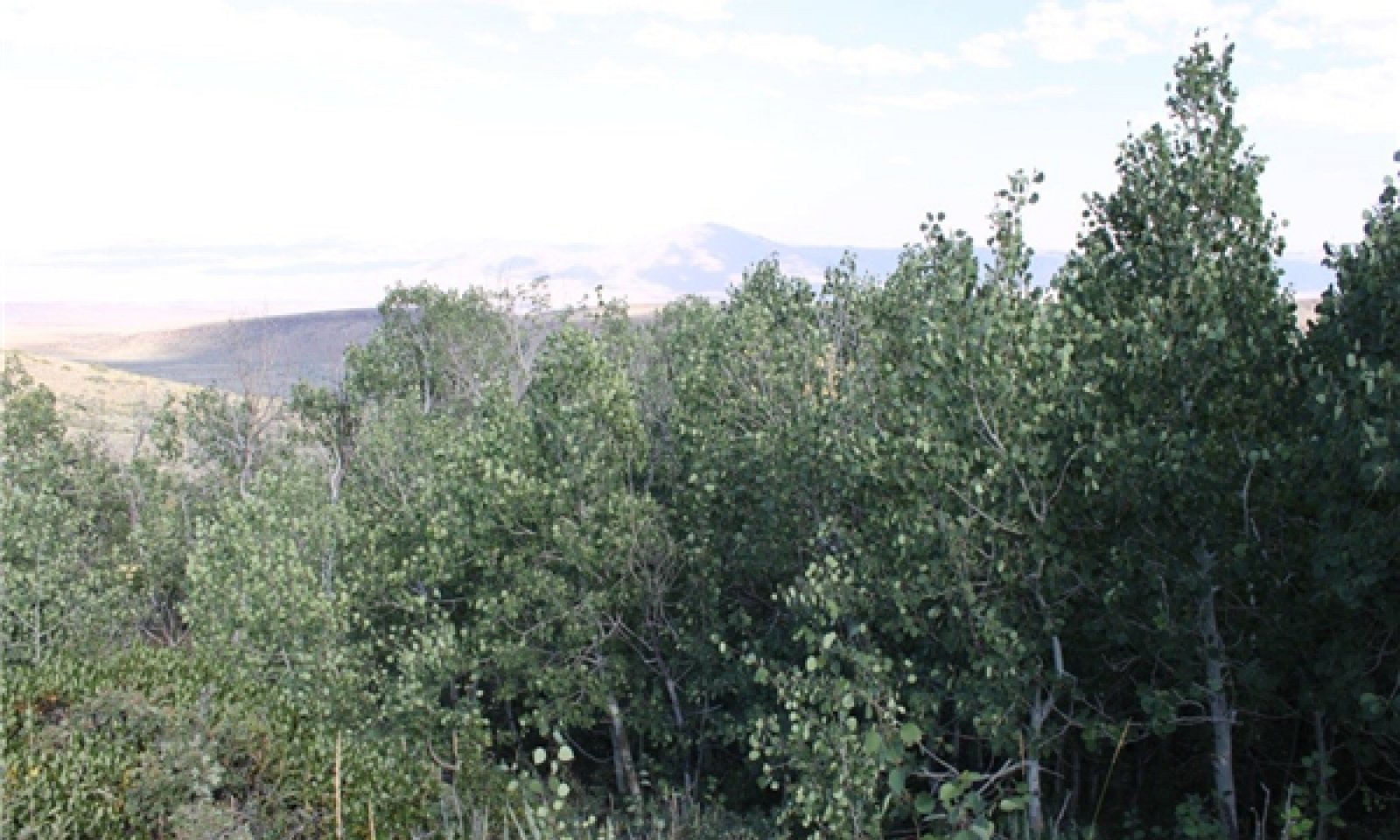
This forest site occurs on cool, moist linear to concave mountain sideslopes of mostly northerly aspects. Slopes range from 4 to over 50 percent, but are typically 15 to 50 percent. Elevations range from 7,000 to over 9,500 feet. The average growing season is 50 to 70 days.
The soils associated with this site are generally moderately deep to very deep and well drained. These soils have a mollic or umbric epipedon. Soils are slighty acid or neutral. The soil profile is contains a high volume of rock fragments.
The reference state is dominated by quaking aspen and overstory tree canopy composition is typically 100 percent quaking aspen. This site is composed of one to several quaking aspen clones, each with a common genetic makeup and individual phenological and physiological characteristics. An total overstory canopy cover of 30 percent is assumed to be representative of tree dominance on this site in the pristine environment. Mountain brome, slender wheatgrass, Idaho fescue, and Ross' sedge are common understory grasses and grass-like plants. Mountain snowberry, Utah serviceberry, and creeping barberry are the principal understory shrubs.Associated sites
R025XY024NV MOUNTAIN RIDGE
Mountain Ridge has lithic bedrock within 20
R025XY016NV SOUTH SLOPE 14-18 P.Z.
South Slopes 8-14 temperature regime is frigid. Dominant plants are ARTRV-PUTR2/PSSPS-BRMA4.
Similar sites
F025XY064NV Streambank Aspen
Occurs on stream terraces. Understory vegetation dominated by Wood's rose, Nevada bluegrass, sedge and slender wheatgrass. CMAI 20-28 cubic feet/ac/year
R025XY002NV ASPEN THICKET
Occurs on the lee-side of mountain shoulders and plateaus. Dominated by clones of low-growing aspen, less than 15 feet tall.
Table 1. Dominant plant species
Tree (1) Populus tremuloides
Shrub (1) Symphoricarpos oreophilus
Herbaceous (1) Bromus marginatus
(2) Elymus trachycaulusPhysiographic features
This forest site occurs on cool, moist linear to concave mountain sideslopes of mostly northerly aspects. Slopes range from 4 to over 50 percent, but are typically 15 to 50 percent. Typically, elevations range from 7000 to over 9500 feet.
Table 2. Representative physiographic features
Landforms (1) Mountains > Mountain slope
Runoff class Medium to very high Flooding frequency None Ponding frequency None Elevation 7000 – 9500 ft Slope 15 – 50 % Water table depth 40 – 0 in Aspect NW, N, NE Table 3. Representative physiographic features (actual ranges)
Runoff class Not specified Flooding frequency Not specified Ponding frequency Not specified Elevation 5700 – 10000 ft Slope 4 – 50 % Water table depth 0 in Climatic features
The climate associated with this site is semiarid, characterized by cold, moist winters and warm, dry summers.
The average annual precipitation is near 15 inches. Mean annual air temperature is typically less than 45 degrees F. The average growing season is 50 to 70 days.
Mean annual precipitation across the range in which this ES occurs is 18.58".
Monthly mean precipitation: January 1.65”; February 1.68”; March 1.98”; April 2.43”; May 2.41”; June 1.62”; July 0.61”; August 0.63”; September 0.84”; October 1.41”; November 1.51”; December 1.79”.
*The above data is averaged from the Jarbridge 4N and Lamoille PH WRCC climate stations.Table 4 Representative climatic features
Frost-free period (characteristic range) 50-60 days Freeze-free period (characteristic range) 90-90 days Precipitation total (characteristic range) 10-20 in Frost-free period (actual range) 50-60 days Freeze-free period (actual range) 90-90 days Precipitation total (actual range) 10-20 in Frost-free period (average) 50 days Freeze-free period (average) 90 days Precipitation total (average) 20 in Characteristic rangeActual rangeBarLineFigure 1. Monthly precipitation range
Characteristic rangeActual rangeBarLineFigure 2. Monthly minimum temperature range
Characteristic rangeActual rangeBarLineFigure 3. Monthly maximum temperature range
BarLineFigure 4. Monthly average minimum and maximum temperature
Figure 5. Annual precipitation pattern
Figure 6 Annual average temperature pattern
Climate stations used
-
(1) JARBIDGE 7 N [USC00264039], Jackpot, NV
-
(2) LAMOILLE YOST [USC00264394], Spring Creek, NV
">Influencing water features
This site may be adjacent to perennial and ephemeral stream channels.
Soil features
The soils associated with this site are generally very deep and well drained. These soils have a mollic or umbric epipedon. Soils are slighty acid or neutral. The soils are usually moist from late fall through early summer and dry during September and October. Soils are completely moist for more than 150 days following the winter solstice. The soil moisture regime is xeric or xeric bordering on aridic.
Soil series associated with this site include: Argee, Hackwood, Dehana and Tosp.
A representative soil series is Hackwood, classified as a fine-loamy, mixed, superactive Pachic Haplocryoll. This soil is a very deep, well drained soil that formed in alluvium and colluvium derived from quartzite, conglomerate, and igneous rocks with a component of loess. Reaction is neutral or slighty acid, decreasing with depth. Diagnostic horizons include a mollic epipedon that occurs from the mineral soil surface (approximately 1 inch) to 21 inches. Clay content in the particle-size control section averages 18 to 30 percent. Rock fragments average 15 to 35 percent, mainly gravel.Table 5. Representative soil features
Parent material (1) Colluvium
(2) Slope alluvium
Surface texture (1) Loam
(2) Silt loam
(3) Gravelly loam
(4) Bouldery loam
Family particle size (1) Fine-loamy
(2) Coarse-loamy
Drainage class Well drained Permeability class Very slow to moderately rapid Soil depth 40 – 60 in Surface fragment cover <=3" 0 – 15 % Surface fragment cover >3" 0 – 10 % Available water capacity
(0-40in)3.8 – 7.3 in Calcium carbonate equivalent
(0-40in)Not specified Electrical conductivity
(0-40in)0 – 2 mmhos/cm Sodium adsorption ratio
(0-40in)Not specified Soil reaction (1:1 water)
(0-40in)6.2 – 7 Subsurface fragment volume <=3"
(Depth not specified)0 – 35 % Subsurface fragment volume >3"
(Depth not specified)0 – 10 % Ecological dynamics
An ecological site is the product of all the environmental factors responsible for its development and has a set of key characteristics that influence a site’s resilience to disturbance and resistance to invasives. Key characteristics include 1) climate (precipitation and temperature), 2) topography (aspect, slope, elevation, and landform), 3) hydrology (infiltration and runoff), 4) soils (depth, texture, structure, and organic matter), 5) plant communities (functional groups and productivity), and 6) natural disturbance regime (fire, herbivory, etc.) (Caudle et al. 2013). Biotic factors that that influence resilience include site productivity, species composition and structure, and population regulation and regeneration (Chambers et al. 2013).
Common disturbances in aspen stands include fire, insect and disease outbreaks, wind storms and avalanches. Aspen stands have also shown some sensitivity to drought (Hogg et al 2008). Quaking aspen is considered one of the most widely distributed forest plants in North America (Potter 1998). Mature aspen stands (80 to 100 years) can reach heights up to 100 feet depending on the site. Most stands contain a variety of medium-high shrubs and tall herbs in the understory (DeByle and Winokur 1985).
Wildfire maintains the dynamics of these communities, but with fire suppression, mature aspen stands can be susceptible to stand decline. Typically, as stands begin to decline, aspen suckers and saplings are able to regenerate the stand. As aspen trees mature and tree canopy begins to close, the perennial understory becomes dominated by shade tolerant species. Conifers, when present, can eventually increase and overtop the aspen trees. The increase in conifers can be attributed to both fire suppression and grazing pressure by both livestock and wildlife (Potter 2005, Strand et al. 2009, Bartos and Campbell 1998). Using a habitat model, Strand et al. (2009) computed aspen occurrence probability across the landscape of the Owyhee Plateau. They visited 41 sites where they modeled aspen occurrence; in 37% of these sites, they found dead aspen stems with no aspen regeneration. 51% contained scattered aspen ramets and observed regeneration of aspen in forest gaps, and in 12%, there was no evidence that aspen had ever occurred on or near the site. Their aspen successional model theorized that non-producing aspen stands can be permanently converted to a conifer stand and the aspen clone can be lost. They estimated that over 60% of aspen woodlands have been or are in the process of converting to conifer woodlands within 80-200 years. Whether these stands can be converted back to aspen with disturbance is inconclusive.
An additional threat to aspen sustainability is limited aspen regeneration due to shading by conifer trees (see 028BY067NV; Stringham et al. 2015) or herbivory. Overstory clearing, whether in small gaps or in large openings, provides the needed light for aspen suckers to sprout (Shepperd et al 2006). A limited aspen root system resulting from previous conifer dominance and/or persistent shading from surrounding uncut trees may require additional disturbance to initiate suckering. Additional management actions such as root ripping may be needed to stimulate root suckering (Shepperd et al 2006). Continuous browsing by livestock or wildlife may also limit aspen regeneration. Herbivory can reduce community resilience and alter future aspen cover (Rogers et al 2013).
There are many environmental factors that can contribute to stand decline or die-off. The major underlying cause can be attributed to tree and/or stand stress. Drought, low soil oxygen, and cold soil temperatures all limit soil water uptake and can contribute to xylem cavitation. Cavitation causes much of the aspen die-off but the created stress can also leave the stand open to secondary factors, such as wood-boring insects and fungal pathogens (Frey et al. 2004). Drought has been attributed to the decline and death of aspen trees but also contributes to secondary factors such as insects (Frey et al. 2004).
As ecological condition deteriorates, the aspen overstory is thinned out and permanent openings in the canopy are often created. If aspen sucker reproduction is inadequate to replace the overstory mortality, snowberry, big sagebrush and other shrubs, grasses, and forbs increase in the understory and eventually become dominant on the site. With further decline in condition, aspen may be completely eliminated from the site. Kentucky bluegrass is likely to invade this site. Some of the current combinations of species in aspen communities might be considered relatively stable grazing disclimaxes. Such communites apparently are no longer able to return to their original compositions due to environmental changes caused by abusive grazing or the competitive dominance of invader species.
Aspen stands possess three characteristics that provide suitable sites for invasive plants: 1) deep, rich soils, 2) proximity to moist meadows and riparian areas with open water, and 3) their dependency on disturbance and open light. This site has moderate resilience to disturbance and resistance to invasion. Human disturbance associated with recreation and animal (domestic and wildlife) disturbance may lead to the spread of invasive species such as Kentucky bluegrass (Poa pratensis), common dandelion (Taraxacum officinale) and thistles (Cirsium sp.). Additionally, this ecological site is moderately resilient and resistant due to productive soils, additional soil moisture and aspen’s ability to sprout following fire or other stand or tree removal processes. Three stable states have been identified for this site: A Reference State, a Current Potential State and a Tree State.
Fire Ecology:
The most important agent of disturbance in aspen forests before 1900 was fire, although other natural disturbances were locally important including windthrow, snow damage, hail, lightning, fungal diseases and insect damage. Most aspen forests in the West are seral and have been dependent upon fire for their perpetuation. If fire occurs at infrequent intervals (e.g. 50-150 years) and is intense enough to kill most of the aspen and competing conifers, then most aspen sites in the West will retain viable stands of aspen. Periodic wildfires prevent over-mature aspen stands and maintain a naturally stratified mosaic of even-aged aspen communities in various stages of successional development. Uneven-aged stands form under stable conditions where the overstory gradually disintegrates with disease or age, and is replaced by aspen suckers. Although aspen forests do not burn readily, aspen trees are extremely sensitive to fire. A severe fire will top-kill the aspen overstory and will stimulate abundant suckering. A severe fire also removes the duff and may kill roots. Repeated fires have a detrimental effect on site quality and can eliminate aspen from a site. Aspen is highly competitive on burned sites and has several adaptations to fire including the following: a) the thin bark has little heat resistance, and aspen is easily top-killed by fire, b) root systems of top-killed stems send up a profusion of sprouts for several years after fire, c)sprouts grow rapidly by extracting water, nutrients, and photosynthate from an extant root system, and may outcompete other woody vegetation, d)following fire, a new, even-aged quaking aspen stand can develop within a decade, and e) aspen is self-thinning and a mature forest of healthy trees can develop from dense sprouts.
Willow will generally sprout from its root crown or stem base following fire. However, severe fires can completely remove organic soil layers, leaving willow roots exposed and charred, thus eliminating basal sprouting.
Mountain snowberry is top-killed by fire, but resprouts after fire from rhizomes (Leege and Hickey 1971, Noste and Bushey 1987). It has also been noted to regenerate well and exceed pre-burn biomass in the third season after fire (Merrill et al. 1982). Currant, a minor component of this site, is known as a weak sprouter from the root crown but usually regenerates from soil stored seeds after fire. It is susceptible to fire kill and rarely survives fire (Crane and Fischer 1986). If mule-ears or balsamroot is common before fire, these plants will increase after fire or with heavy grazing (Wright 1985).
Mountain big sagebrush, a minor component on these sites, is killed by fire (Neuenschwander 1980, Blaisdell et al. 1982), and does not resprout (Blaisdell 1953). Post fire regeneration occurs from seed and will vary depending on site characteristics, seed source, and fire characteristics. Mountain big sagebrush seedlings can grow rapidly and may reach reproductive maturity within 3 to 5 years (Bunting et al. 1987). Mountain big sagebrush may return to pre-burn density and cover within 15 to 20 years following fire, but establishment after severe fires may proceed more slowly and can take up to 50 years (Bunting et al. 1987, Ziegenhagen 2003, Miller and Heyerdahl 2008, Ziegenhagen and Miller 2009).
The effect of fire on bunchgrasses relates to culm density, culm-leaf morphology, and the size of the plant. The initial condition of bunchgrasses within the site along with seasonality and intensity of the fire all factor into the individual species response. For most forbs and grasses, the growing points are located at or below the soil surface. This provides relative protection from disturbances which decrease above ground biomass, such as grazing or fire. Thus, fire mortality is more correlated to duration and intensity of heat which is related to culm density, culm-leaf morphology, size of plant and abundance of old growth (Wright 1971, Young 1983).
Mountain brome, the dominant grass found on this site, is a robust, coarse-stemmed, short lived perennial bunchgrass that can grow from 1 to 5 feet in height (Dayton 1937, Tilley et al. 2004). It is commonly seeded after wildfires due to its ability to establish quickly and reduce erosion (Tilley et al. 2004). Mountain brome significantly decreases after burning (Nimir and Payne 1978).
Slender wheatgrass, a sub-dominant grass on this site, may increase after fire. In a study by Nimir and Payne (1978), slender wheatgrass increased significantly in burned versus non-burned sites, although the species did not appear in measurable quantities until mid-July. The effects of fire on slender wheatgrass are dependent on its growth form. Tall, decadent plants with many leaves sustain the most fire damage, while those with short, sparse growth form, is the least likely to sustain damage to the root system during a fire.
Sandberg bluegrass (Poa secunda), a minor component of this ecological site, has been found to increase following fire likely due to its low stature and productivity (Daubenmire 1975). Sandberg bluegrass may retard reestablishment of deeper rooted bunchgrasses.State and transition model
Custom diagramStandard diagram
Figure 7. T Stringham 3/2015

Figure 8. Legend
More interactive model formats are also available. View Interactive Models
More interactive model formats are also available. View Interactive Models
Click on state and transition labels to scroll to the respective textEcosystem states
State 1 submodel, plant communities
1.1a - This pathway is when fire reduces the mature aspen and allows for the suckers, saplings and the herbaceous understory to increase. 1.1b - This community phase pathway is a result of time and lack of disturbance. 1.2a - This pathway is a result of time and lack of disturbance. Release from herbivory will allow for the aspen suckers to mature. 1.3a - This pathway is a result of time and lack of disturbance. Release from herbivory will allow for the aspen trees to mature. 1.3b - This pathway is a result of fire, insects, disease or wind damage which can reduce the aspen canopy and the subsequent competition with the understory allowing the understory herbaceous community to increase. Excessive herbivory while trees are still within reach to browse can also reduce aspen growth. 1.4a - This pathway happens when fire decreases the canopy and allows for the aspen suckers to increase. State 2 submodel, plant communities
2.1a - This pathway happens when fire reduces the mature aspen and allows for the suckers, saplings and the herbaceous understory to increase. Annual non-natives are likely to increase in cover after fire. 2.1b - This pathway is a result of time and lack of disturbance which allows for the aspen trees to mature and become decadent. 2.2a - The pathway is a result of time and lack of disturbance, a change is grazing management for example, grazing reduction or a change is grazing season which allows for the aspen suckers to mature. 2.3a - This pathway is a result of time and lack of disturbance or release from grazing allowing for the aspen trees to mature. 2.3b - This pathway is a result of fire, insects, disease or damage from the wind reducing the aspen canopy and the subsequent competition with the understory. The understory herbaceous community cover increases. Inappropriate grazing especially by sheep or herbivory by large ungulates while trees are within can reduce aspen growth. 2.4a - This pathway is a result of fire or clearcutting allowing for the aspen suckers to increase and the understory plant community of shrub and grass cover to increase. State 1
Reference StateThe Reference State 1.0 is a representative of the natural range of variability under pristine conditions. This site has four general community phases: a mature woodland phase, a sucker/sapling phase, an immature woodland phase and an over mature woodland phase. State dynamics are maintained by interactions between climatic patterns and disturbance regimes. Negative feedbacks enhance ecosystem resilience and contribute to the stability of the state. These include the presence of all structural and functional groups, fuel loads, and retention of organic matter and nutrients. Plant community phase changes are primarily driven by fire, periodic long-term drought and/or insect or disease attack.
Community 1.1
Community PhaseThe reference plant community is dominated by quaking aspen and overstory tree canopy composition is typically 100 percent quaking aspen. This site is composed of one to several quaking aspen clones, each with a common genetic makeup and individual phenological and physiological characteristics. A total overstory canopy cover of 30 percent is assumed to be representative of tree dominance on this site in the pristine environment. Mountain brome, slender wheatgrass, Idaho fescue, and Ross' sedge are common understory grasses and grass-like plants. Mountain snowberry, Utah serviceberry, and creeping barberry are the principal understory shrubs.
Forest overstory.MATURE FOREST: Diameter growth of aspen shows strong recovery with reduced competition during this stage. The visual aspect and vegetal structure are dominated by single-storied aspen that have reached or are near maximal heights for the site. Tree heights range from 60 to 80 feet, depending upon site. Tree canopy cover ranges from 25 to about 35 percent. Despite considerable understory forage production, the overstory trees do compete with the undergrowth plants for moisture, light, nutrients, and space. Vegetative shoots and/or saplings of aspen occur in the understory, but they are inconspicuous and have a high mortality rate.
Forest understory. Understory vegetative composition is about 50 percent grasses, 10 percent forbs and 40 percent shrubs and young trees when the average overstory canopy is medium (25 to 35 percent). Average understory production ranges from 600 to 1200 pounds per acre with a medium canopy cover. Understory production includes the total annual production of all species within 4½ feet of the ground surface.
Figure 9. Annual production by plant type (representative values) or group (midpoint values)
Table 6. Annual production by plant type
Plant type Low
(lb/acre)Representative value
(lb/acre)High
(lb/acre)Grass/Grasslike 300 450 600 Shrub/Vine 204 306 408 Forb 60 90 120 Tree 36 54 72 Total 600 900 1200 Table 7. Ground cover
Tree foliar cover 10-20% Shrub/vine/liana foliar cover 0-10% Grass/grasslike foliar cover 0-10% Forb foliar cover 0-10% Non-vascular plants 0-0% Biological crusts 0% Litter 50-70% Surface fragments >0.25" and <=3" 0-10% Surface fragments >3" 0-10% Bedrock 0% Water 0% Bare ground 10-20% Table 8. Canopy structure (% cover)
Height Above Ground (ft) Tree Shrub/Vine Grass/
GrasslikeForb <0.5 – – 0-5% 1-5% >0.5 <= 1 – – 1-5% 1-5% >1 <= 2 – 1-5% 5-10% 1-10% >2 <= 4.5 1-5% 5-10% 1-3% 1-3% >4.5 <= 13 5-10% 0-1% – – >13 <= 40 5-10% – – – >40 <= 80 10-20% – – – >80 <= 120 0-1% – – – >120 – – – – Community 1.2
Community PhaseHerbaceous vegetation dominates the site. Quaking aspen suckers are evident. If the aspen stand is healthy, this stage will only last from one to two years. However, if competing brush and herbaceous plants grow for a full season before aspen suckers emerge, or with excessive herbivory from large ungulates such as elk, a reduction in growth and survival of aspen suckers may occur. Early growth of quaking aspen suckers ranges from less than 1 foot to more than 3 feet per year for shoots having good competitive position. In the absence of disturbance, suckers develop into saplings (to 4½ feet in height) with a range in canopy cover of about 5 to 15 percent. Vegetation consists of grasses, forbs and a few shrubs in association with tree saplings.
Community 1.3
Community Phase
Figure 10. POTR5 (F025XY065NV) Phase 1.3 T. K. Stringham, August 2011

Figure 11. POTR5 (F025XY065NV) Phase 1.3 T. K. Stringham, August 2011
This stage is characterized by rapid growth of the aspen trees, both in height and canopy cover. Aspen stands are self-thinning, especially at young ages. After the canopy closes, trees stratify into crown classes quickly, despite genetic uniformity within clones. The visual aspect and vegetal structure are dominated by aspen ranging from about 10 to 20 feet in height, and having a diameter at breast height of about 2 to 4 inches. Understory vegetation is moderately influenced by a tree overstory canopy of about 40 to over 60 percent. Growth of the aspen begins to slow and there is a fairly continual adjustment of trees to growing space. As competition becomes intense enough to affect the diameter growth of dominants, mortality quickly reduces the number of trees in the lower crown classes. There are periodic surges in mortality, with a large number of trees dying within a short time. The visual aspect and vegetal structure are dominated by aspen mostly greater than 25 feet in height. Understory vegetation is moderately influenced by a tree overstory canopy of about 25 to 40 percent.
Community 1.4
Community PhaseIn the absence of wildfire or other naturally occurring disturbances, the tree canopy on this site can become very dense. This stage is normally dominated by aspen that have reached maximal heights for the site. Aspen trees may be decadent. In the absence of disturbance, over-mature, even-aged aspen stands slowly die. Tree canopy cover is commonly more than 50 percent. Understory production is strongly influenced by the overstory, as is species composition. Shade tolerant forbs and a few grasses will dominate the understory.
Pathway 1.1a
Community 1.1 to 1.2This pathway is when fire reduces the mature aspen and allows for the suckers, saplings and the herbaceous understory to increase.
Pathway 1.1b
Community 1.1 to 1.4This community phase pathway is a result of time and lack of disturbance.
Pathway 1.2a
Community 1.2 to 1.3This pathway is a result of time and lack of disturbance. Release from herbivory will allow for the aspen suckers to mature.
Pathway 1.3a
Community 1.3 to 1.1This pathway is a result of time and lack of disturbance. Release from herbivory will allow for the aspen trees to mature.
Pathway 1.3b
Community 1.3 to 1.2This pathway is a result of fire, insects, disease or wind damage which can reduce the aspen canopy and the subsequent competition with the understory allowing the understory herbaceous community to increase. Excessive herbivory while trees are still within reach to browse can also reduce aspen growth.
Pathway 1.4a
Community 1.4 to 1.2This pathway happens when fire decreases the canopy and allows for the aspen suckers to increase.
State 2
Current Potential StateThis state is similar to the Reference State 1.0 with four similar community phases. Ecological function has not changed, however the resiliency of the state has been reduced by the presence of invasive weeds. Non-natives may increase in abundance but will not become dominant within this State. These non-natives can be highly flammable and can promote fire where historically fire had been infrequent. Negative feedbacks enhance ecosystem resilience and contribute to the stability of the state. These feedbacks include the presence of all structural and functional groups, low fine fuel loads, and retention of organic matter and nutrients. Positive feedbacks decrease ecosystem resilience and stability of the state. These include the non-natives’ high seed output, persistent seed bank, rapid growth rate, ability to cross pollinate, and adaptations for seed dispersal.
Community 2.1
Community PhaseCommunity 2.2
Community PhaseHerbaceous vegetation dominates the site. Quaking aspen suckers are evident. If the aspen stand is healthy, these first two stages will only last from one to two years. However, if competing brush and herbaceous plants grow for a full season before aspen suckers emerge sucker survival and growth may be reduced. With excessive grazing from large ungulates such as elk and cattle, a reduction in growth and survival of aspen suckers may occur, this may last until season of grazing is changed, or grazing is reduced/excluded. Early growth of quaking aspen suckers ranges from less than 1 foot to more than 3 feet per year for shoots having good competitive position. In the absence of disturbance, suckers develop into saplings (to 4½ feet in height) with a range in canopy cover of about 5 to 15 percent. Vegetation consists of grasses, forbs and a few shrubs in association with tree saplings. Annual non-native species are stable to increasing within the community.
Community 2.3
Community PhaseThis stage is characterized by rapid growth of the aspen trees, both in height and canopy cover. Aspen stands are self-thinning, especially at young ages. After the canopy closes, trees stratify into crown classes quickly, despite genetic uniformity within clones. The visual aspect and vegetal structure are dominated by aspen ranging from about 10 to 20 feet in height, and having a diameter at breast height of about 2 to 4 inches. Understory vegetation is moderately influenced by a tree overstory canopy of about 15 to over 40 percent.
Community 2.4
Community PhaseIn the absence of wildfire or other naturally occurring disturbances, the tree canopy on this site can become very dense. This stage is normally dominated by aspen that have reached maximal heights for the site. Aspen trees have straight, clear stems with short, high-rounded crowns. In the absence of disturbance, over-mature, even-aged aspen stands slowly die. The aspen canopy opens up, and otherwise inconspicuous aspen suckers survive and grow in the openings not shaded by the remaining conifers. These suckers typically arise over a period of several years; the resulting stand is broadly even-aged. If broadly even-aged stands reach old age without disturbance, their deterioration is likely to extend over a longer period than before because of the range of tree ages. That, in turn, will result in a longer regeneration period and a new stand with an even greater range of ages. If this continues over several generations, all-aged stands will result. Tree canopy cover is commonly more than 50 percent. Understory production is strongly influenced by the overstory, as is species composition. Shade tolerant forbs and a few grasses will dominate the understory.
Pathway 2.1a
Community 2.1 to 2.2This pathway happens when fire reduces the mature aspen and allows for the suckers, saplings and the herbaceous understory to increase. Annual non-natives are likely to increase in cover after fire.
Pathway 2.1b
Community 2.1 to 2.4This pathway is a result of time and lack of disturbance which allows for the aspen trees to mature and become decadent.
Pathway 2.2a
Community 2.2 to 2.3The pathway is a result of time and lack of disturbance, a change is grazing management for example, grazing reduction or a change is grazing season which allows for the aspen suckers to mature.
Pathway 2.3a
Community 2.3 to 2.1This pathway is a result of time and lack of disturbance or release from grazing allowing for the aspen trees to mature.
Pathway 2.3b
Community 2.3 to 2.2This pathway is a result of fire, insects, disease or damage from the wind reducing the aspen canopy and the subsequent competition with the understory. The understory herbaceous community cover increases. Inappropriate grazing especially by sheep or herbivory by large ungulates while trees are within can reduce aspen growth.
Pathway 2.4a
Community 2.4 to 2.2This pathway is a result of fire or clearcutting allowing for the aspen suckers to increase and the understory plant community of shrub and grass cover to increase.
Transition A
State 1 to 2Trigger: This transition is caused by the introduction of non-native annual plants, such as Kentucky bluegrass, thistles and common dandelion. Slow variables: Over time the annual non-native species will increase within the community. Threshold: Any amount of introduced non-native species causes an immediate decrease in the resilience of the site. Annual non-native species cannot be easily removed from the system and have the potential to significantly alter disturbance regimes from their historic range of variation.
Additional community tables
Table 9. Community 1.1 plant community composition
Group Common name Symbol Scientific name Annual production () Foliar cover (%) Grass/Grasslike1 Primary Perennial Grasses 225–459 mountain brome BRMA4 Bromus marginatus 90–216 – slender wheatgrass ELTR7 Elymus trachycaulus 45–81 – Idaho fescue FEID Festuca idahoensis 45–81 – bluegrass POA Poa 45–81 – 2 Secondary Perennial Grasses 27–135 Letterman's needlegrass ACLE9 Achnatherum lettermanii 9–45 – western needlegrass ACOCO Achnatherum occidentale ssp. occidentale 9–45 – sedge CAREX Carex 9–45 – Forb3 Perennial 27–135 ragwort SENEC Senecio 9–45 – Fendler's meadow-rue THFE Thalictrum fendleri 9–45 – clover TRIFO Trifolium 9–45 – Shrub/Vine4 Primary Shrubs 180–378 mountain snowberry SYOR2 Symphoricarpos oreophilus 90–216 – Utah serviceberry AMUT Amelanchier utahensis 45–81 – creeping barberry MARE11 Mahonia repens 45–81 – 5 Secondary Shrubs 18–90 currant RIBES Ribes 9–45 – willow SALIX Salix 9–45 – Tree6 Deciduous 45–81 quaking aspen POTR5 Populus tremuloides 45–81 – Table 10. Community 1.2 plant community composition
Group Common name Symbol Scientific name Annual production () Foliar cover (%) Table 11. Community 1.3 plant community composition
Group Common name Symbol Scientific name Annual production () Foliar cover (%) Table 12. Community 1.4 plant community composition
Group Common name Symbol Scientific name Annual production () Foliar cover (%) Table 13. Community 2.1 plant community composition
Group Common name Symbol Scientific name Annual production () Foliar cover (%) Table 14. Community 2.2 plant community composition
Group Common name Symbol Scientific name Annual production () Foliar cover (%) Table 15. Community 2.3 plant community composition
Group Common name Symbol Scientific name Annual production () Foliar cover (%) Table 16. Community 2.4 plant community composition
Group Common name Symbol Scientific name Annual production () Foliar cover (%) Interpretations
Animal community
Livestock/Wildlife Grazing Interpretations:
This site is suited to cattle and sheep grazing during the summer and early fall. Considerations for grazing management include timing, intensity and duration of grazing.
Sandberg bluegrass increases under grazing pressure (Tisdale and Hironaka 1981) and is capable of co-existing with cheatgrass. Excessive sheep grazing favors Sandberg bluegrass; however, where cattle are the dominant grazers, cheatgrass often dominates (Daubenmire 1970). Thus, depending on the season of use, the grazer, and site conditions, either Sandberg bluegrass or cheatgrass may become the dominant understory with inappropriate grazing management.
Domestic livestock, wild ungulates, rodents and hares utilize aspen stands and can have a measurable direct impact upon them. Browsing during the sapling stage reduces aspen growth, vigor and numbers (DeByle and Winokur 1985). Heavy browsing on aspen suckers may result in lower clone vigor to the point that suckering no longer takes place. Browsing pressure may allow aspen to regenerate but prevent the development of trees, and the aspen will instead grow as a dense shrub (Bradley et al. 1992). Because aspen stands are grazed by cattle and/or sheep and have a significant population of wild ungulates, grazing management and game management are important for the health of aspen communities.
Mountain brome is ranked as excellent forage for both cattle and horses and good for domestic sheep, though domestic animals will graze mountain brome only when it is fairly succulent. Mountain brome increases with grazing (Leege et al. 1981). A study by Mueggler (1967) found that with clipping, mountain brome increased in herbage production when clipped in June. When clipped in July, mountain brome increased due to reduced competition from forb species. The study also found that after three successive years of clipping, mountain brome started to exhibit adverse effects.
Slender wheatgrass is a perennial bunchgrass that tends to be short lived though it spreads well by natural reseeding (Monsen et al. 2004). It is widely used in restoration seedings (Monsen et al. 2004). Slender wheatgrass tends to persist longer than other perennial grasses when subjected to heavy grazing (Monsen et al. 1996, Monsen et al. 2004). Slender wheatgrass is palatable and nutritious for livestock.
Stocking rates vary over time depending upon season of use, climate variations, site, and previous and current management goals. A safe starting stocking rate is an estimated stocking rate that is fine-tuned by the client by adaptive management through the year and from year to year.
Wildlife Interpretations:
Common snowberry is considered important browse for many types of wildlife. Bighorn sheep use common snowberry regularly during the summer. Forage value to elk is fair. Common snowberry is important as both cover and food for bird and small mammal populations. These include sharp-tailed, ruffed, and blue grouse, wild turkey and, several non-game species of bird including the kingbird, western flycatcher, and western bluebird. Among small mammals that rely on common snowberry are fox squirrels, desert cottontails, and pocket gopher.
Slender wheatgrass is grazed by wild ungulates and used for cover by small birds and mammals (Tilley et al. 2011, Hallsten et al. 1987).
Mountain brome seedheads and seeds provide food for many birds and small mammals. Pronghorn antelope will consume mountain brome primarily in the spring. The palatability of mountain brome is excellent for deer, particularly during the late spring and early summer. Mountain brome is ranked as highly valuable as elk winter forage (Kufeld 1973).
The aspen community is important habitat for many species of birds and mammals, especially where it is associated with free flowing streams. Mule deer and elk use aspen woodlands mostly in summer and fall for browse, thermal and hiding cover. Commonly associated birds using aspen during breeding season include the Western tanager, common nighthawk, mourning dove, Swainson's hawk and various species of bluebird, thrush and flycatcher. Birds using aspen during the wintering season include the Ruby-crowned kinglet, Townsend's solitaire, rough-legged hawk, Cooper's hawk, sharp-shinned hawk, and various species of finch and waxwing. Birds that use aspen either yearlong or as migrants, include the American robin, American kestrel, mountain chickadee, scrub jay, yellow-bellied sapsucker, long-eared owl, screech owl, great-horned owl, California quail, red-tailed hawk, golden eagle, and various species of sparrow, nuthatch and woodpecker. Commonly associated mammals using the aspen community type include various species of shrew, myotis, bat, mouse and vole. Some very common species include deer mouse, Nuttall's cottontail, least chipmunk, Western gray squirrel, bushy-tailed woodrat, raccoon, long-tailed weasel and the North American porcupine.
Quaking aspen is important forage for large mammals. Elk (Alces alces) browse the bark, branches and sprouts of quaking aspen year-round throughout the west (DeByle 1979, Howard 1996). Mule deer (Odocoileus hemionus) use quaking aspen year-round, particularly if winters are mild, by browsing leaves, buds, twigs, bark, and sprouts. New growth after burns or clearcuts is readily consumed by mule deer (Robin 2013). Moose (Alces americanus) occasionally occur in Nevada but will feed on the bark of quaking aspen in winter, the saplings in spring, and leaves and branches the rest of the year (Sheppard at al. 2006). Black bears (Ursus americanus) will eat stems and leaves of quaking aspen; however, forbs and other plants found in quaking aspen understory are preferred (Ulev 2007, Wildlife Action Plan Team 2012). A study by Krebill (1972) found the majority of aspen decline within their study area was due to a combination of pathogenic fungi and insects which invade aspen trees damaged by big game (Krebill 1972).
Several lagamorphs use quaking aspen habitat. Although aspen groves are at elevations where desert cottontail (Sylvilagus audubonii) are not normally found, they may utilize aspen habitat where groves occur at lower elevations with sagebrush and shrubland (DeByle and Winokur 1985). Snowshoe hares (Lepus americanus) feed on quaking aspen in summer and spring and will continue to use quaking aspen habitat year round, but are more common in the associated coniferous forests (DeByle and Winokur 1985). A threatened species, the American Pika (Ochotona princeps) will utilize quaking aspen stands in higher-elevation habitat and have been documented to feed on quaking aspen buds, twigs, and bark (Wildlife Action Plan Team 2012, Howard 1996).
Rodents utilize aspen habitat for food and cover. Pocket gophers (Thomomys monticola), a fossorial rodent, favors quaking aspen stands (Linzey and Hammerson 2008). Aspen soils rarely freeze and thus are ideal for borrowing. Forbs and aspen sprouts provide forage in the spring and summer (DeByle and Winokur 1985). Deer mice (Peromyscous maniculatus) and least chipmunks (Tamias minimus) occupy quaking aspen habitat (Debyle 1979). The deer mouse was trapped more than any other rodent, consistently throughout several years, in quaking aspen stands according to Andersen et al. (1980). The least chipmunk has been trapped at near equal density as the deer mouse in aspen habitat (DeByle and Winokur 1985, Anderson et al. 1980). The Inyo shrew (Sorex tenellus), Merriam’s shrew (Sorex merriami), montane shrew (Sorex monticolus), and western jumping mouse (Zapus princeps) use the shrub and herbaceous cover within quaking aspen habitat for foraging and cover (Wildlife Action Plan Team 2012). The flying squirrel (Glaucomys sabrinus), although rarely seen because of its nocturnal habit, is estimated to be one of the most common mammal species found in aspen type forests (DeByle and Winokur 1985). Larger rodents such as the North American porcupine (Erethizon dorsatum) will eat quaking aspen in winter and spring months. In winter, porcupine eat the smooth outer bark of the upper trunk and branches; in spring, they eat the buds and twigs (Howard 1996, DeByle and Winokur 1985)
Beavers (Castor canadensis) use a large amount of aspen for building material to construct their dams. In fact, as many as 200 quaking aspen stems are required to support one beaver for a 1-year period. Beavers prefer the inner bark of aspen to that of other trees as food (Lanner 1984). They will consume the leaves, bark, twigs, and any diameters of quaking aspen branches (Innes 2013). Previous research has estimated that an individual beaver consumes 2 to 4 pounds (1-2 kg) of quaking aspen bark daily (DeByle and Winokur 1985).
Quaking aspen provide feed and cover for a variety of bird species in Nevada. The northern goshawk (Accipiter gentilis) and flammulated owl (Psiloscops flammeolus) use mature overstory for nesting (Wildlife Action Plan Team 2012). Bird species including orange-crowned and yellow-rumped warblers (Vermivora celata and Dendroica coronata, respectively), broad-tailed hummingbirds (Selasphorus platycercus), robins (Turdus migratorius), house wrens (Troglodytes aedon), pewees (Contopus sordidulus), juncos (Junco hyemalis), and thrushes (Catharus ustulatus) nest and forage aspen stands. Furthermore, dead trees are used by downy woodpeckers (Picoides pubescens), flickers (Colaptes auratus) and Lewis’s woodpeckers (Melanerpes lewis) (Lanner 1984, Wildlife Action Plan Team 2012). Birds such as the mountain bluebird (Sialia currucoides), tree swallow (Tachycineta bicolor), pine siskin, (Spinus pinus), and black-headed grosbeak (Pheucticus melanocephalus) can be found at the edges of aspen communities (Innes 2013 and references therein). Even duck species, including the wood duck (Aix sponsa), common and barrow’s goldeneye (Bucephala clangula and Bucephala islandica, respectively), bufflehead (Bucephala albeola), and the hooded and common merganser (Lophodytes cucullatus and Mergus merganserall, respectively) utilize aspen habitat (DeByle et al. 1985). Dusky grouse (Dendragapus obscurus), sooty grouse (Dendragapus fuliginosus), mountain quail (Oreotoryz pictus) and Rufous hummingbirds (Selasphorus rufus) utilize the shrub and herbaceous cover provided by quaking aspen forests (Wildlife Action Plan Team 2012).
Several bat species occur within subalpine habitat, adding to the community’s diversity. The fringed myotis (Myotis thysanodes), long-eared myotis (myotis evotis), hoary bat (Lasiurus cinereus), Silver-haired bat (Lasionycteris noctivagans), little brown myotis (Myotis lucifugus), and western small-footed myotis (Myotis ciliolabrum) have been documented in quaking aspen forests and meadows above 9,000 feet (Keinath 2003, Arroyo-Calbrales and Alvares-Castneda 2008, Warner and Czaplewski 1984, Armstrong 2007, Sullivan 2009, Great Basin National Park, Listing Sensitive and Extirpated Species 2006, Wildlife Action Plan Team 2012).
While habitat distribution of reptiles and amphibians is not as widely studied and few reptiles and amphibians are found at such elevations where quaking aspen trees occur, the Columbia spotted frog (Rana luteiventris) and Northern rubber boa (Charina bottae) favor downed quaking aspen trees as well as stored ground moisture maintained from dead, decomposing logs (Wildlife Action Plan 2006).
Hydrological functions
A well-stocked aspen stand provides excellent watershed protection. A mixture of herbaceous and woody root systems penetrate and anchor the soil. Erosion producing overland flow is almost non-existent. The hydrologic cover condition of this site is good in a representative stand. The average runoff curve is about 80 for group D soils.
Recreational uses
Aesthetic value is derived from the rich hues and textures of the aspen trees, particularly in the fall. The diverse flora and fauna, and the colorful wildflowers in the summer enhance the beauty of this site. The site offers rewarding opportunities to photographers and for nature study. It has high value for hunting, camping, picnicking, cross country skiing and family wood gathering. Management of the aspen woodland should include small, irregularly shaped clearcuts that blend into the natural landscape. Harvesting plans should include a mix of even-aged aspen patches in all size classes. Aspen fits well into management for dispersed recreation activities, but does not tolerate concentrated use such as found in established campgrounds. Encouraging concentrated recreation or developing campgrounds within aspen stands can lead to serious damage, including carving on trees, vandalism, destruction or removal of young suckers and trampling and disturbance of the soil.
Wood products
Historically, quaking aspen has been used for mine props, posts, bridge planking, flooring, furniture and fuelwood. This tree has a considerable potential for increased utilization. It makes excellent pulp, excelsior, door corestock, paper, particleboard, matchsticks, structural flakeboard, lumber products and boxwood.
PRODUCTIVE CAPACITY
This site is of low site quality for tree production. Site indexes for quaking aspen range from 30 to about 45 (Baker, 1925).
Productivity class:
CMAI*: 16 to 20 ft3/ac/yr
1.1 to 1.4 m3/ha/yr
*CMAI: is the culmination of mean annual increment or highest average growth rate of the stand in the units specified.
Basal Area: About 95 square feet/acre for stands averaging 50 feet in height at 100 years of age (Table 17, Baker, 1925).
Fuelwood Production: About 10 cords per acre for stands averaging 7 inches in diameter at breast height (Table 17, Baker, 1925). There are about 203,000 gross British Thermal Units (BTUs) heat content per cubic foot of quaking aspen wood. Firewood is commonly measured by the cord, or a stacked unit equivalent to 128 cubic feet. Solid wood volume in a cord varies, but assuming an average of 75 cubic feet of solid wood per cord, there are about 15 million BTUs of heat value in a cord of quaking aspen.
Tree Volume per Acre: About 1500 cu ft/ac for stands averaging 50 feet in height and 7 inches diameter at breast height (Table 17, Baker, 1925).
MANAGEMENT GUIDES AND INTERPRETATIONS
1. LIMITATIONS AND CONSIDERATIONS
a. Potential for sheet and rill erosion is moderate to severe depending on slope.
b. Severe equipment limitations on slopes over 30 percent.
b. Proper spacing is the key to a well managed, multiple use and multi-product aspen woodland.
c. To begin short-rotation management, older stands with larger trees will have to be utilized.
d. Cut residual, unmerchantable, trees to stimulate maximum sucker regeneration and rapid development of a replacement stand – thin resulting sucker stands.
2. ESSENTIAL REQUIREMENTS
a. Adequately protect from high intensity wildfire.
b. Protect soils from accelerated erosion.
c. Apply proper grazing management.
3. SILVICULTURAL PRACTICES
a. Harvest Cutting: Selectively harvest surplus trees to achieve desired spacing. Harvest stands in small blocks of 1/5 to 1/2 acre with slash left in place to shelter emerging aspen suckers from browsing.
1) Clear-Cutting - Clear-cutting is appropriate when the primary management objective is sustained production of forest products, either saw timber or fiber. Cutting sub-merchantable stems along with the merchantable ones will maximize sucker production, minimize the presence of diseased or defective growing stock in the new stand, and avoid suppression of the new crop by residual overstory stems.
2) Partial Cutting - Partial cutting may be feasible in some uneven-aged stands where management objectives require vertical canopy diversity or retention of some overstory; partial cutting may result in enough sprouting to adequately regenerate stands. Individual tree or group selection cutting methods can be applied. Extreme care is necessary to avoid injury to residual stems during logging. Partial cutting is not worthwhile in deteriorated aspen clones where root system die back has reduced suckering.
3) Selective Tree Removal - Remove selected trees on suitable sites to enhance forage production and manage site reproduction.
b. Thinning - Ordinarily, only stands on saw timber sites should be thinned. Pre-commercial thinning may be uneconomical as the low productivity of this site would not justify thinning costs.
c. Protection from Disease - There are no proven forest stand treatments that successfully prevent or control disease in aspen. Maintenance of well-stocked stands, minimizing wounding of stems and control of damaging agents, and harvesting at the proper rotation age are the best management recommendations that can be made today.
d. Protection from Insects - Direct control of insects in aspen forests has not been practical. The environmental side-effects from chemical pesticide spraying usually has not been acceptable in the aspen ecosystem. Maintenance of a well-stocked stand and protection from wounding is the most practical method of coping with insects in the aspen forest.
e. Protection from Mammals - Domestic livestock, wild ungulates, porcupines, rodents and hares utilize aspen as food and can have measurable impacts on some stands. Most animal damage can be prevented by careful husbandry of domestic livestock and by population control of wild game. Because most aspen stands are grazed by cattle and/or sheep and have a significant population of wild ungulates, grazing management and game management are important to aspen communities.
f. Fire Management - Fire is a natural feature of the aspen ecosystem. Fire is considered responsible for the abundance of aspen in the west as well as the even-aged structure of many stands. Without human intervention, fire appears to be necessary for the continued well-being of aspen on sites where natural degeneration of the clone occurs, or where insects or pests are especially harmful to the stand. Fires in aspen generally are infrequent, spread slowly, are of low intensity, and are easy to control. Although aspen forests do not burn readily, aspen trees are extremely sensitive to fire. Even very light fires will kill aspen because the bark is thin and green, and lacks protective corky layers.Other products
Native Americans used aspen as a food source. They cut the inner bark into strips, dried and ground it into meal to be mixed with other starches for bread or mush. Catkins were eaten raw and the cambium was eaten raw or in a soup.
Quaking aspen is widely used in ornamental landscaping.Other information
Aspen propagates almost entirely by vegetative means throughout the Great Basin. Regeneration by seed is very rare, although aspen in this area produce large quantities of viable seed. Aspen seeds require a continually moist seedbed and the dry spring and summers of the Great Basin are not conducive to seedling survival. An undesirable characteristic of quaking aspen is their heavy drain on available water in the soil.
Table 17. Representative site productivity
Common name Symbol Site index low Site index high CMAI low CMAI high Age of CMAI Site index curve code Site index curve basis Citation quaking aspen POTR5 30 45 16 20 – – – Supporting information
Inventory data references
NRCS-ECS-5: 5 records NV-ECS-1: 5 records Soils and Physiographic features were gathered from NASIS.
Type locality
Location 1: Elko County, NV Township/Range/Section T37N R51E S19 General legal description NW1/4, NW1/4 of Sec. 19, T37N. R51E. MDBM. Approximately two miles west of Beaver Peak at head of Torro Canyon, Tuscarora Mountains, Elko County, Nevada. Also occurs in Eureka and Humboldt counties, Nevada. Other references
Airola, D. A. 1980. Northeast Interior Zone: Vol. III - Birds & Vol. IV - Mammals. U.S. Gov. Printing Off.: 1980-690-082/26.
Alexander R.R. 1987. Ecology, silviculture, and management of the Engelmann spruce-subalpine fir type in the central and southern Rocky Mtns. Ag Hndbk No. 659. Rky Mtn For & Rng Exp Sta, USDA-FS.
Baker, F. S. 1925. Aspen in the central Rocky Mountain Region. USDA Technical Bulletin 1291.
Cryer, D.H. and Murray, J.E. 1988.
Aspen Regeneration and Soils. USDA, Bulletin 1291, 47 p. Washington D.C.
DeByle, N. V., and R.P. Winokur, editors. 1985. Aspen: ecology and management in the western United States. General Technical Report RM-119, Rocky Mtn For & Rng Exp Sta, FS, USDA.
DeByle, N.V., P.J. Urness, and D.L. Blank. 1989. Forage quality in burned and un-burned aspen communities. Research Paper INT-404. Inter. Res. Sta., FS, USDA.
Edminster, C., et al. 1982. Volume tables and point-sampling factors for aspen in Colorado. Res Paper RM-232, Rocky Mtn For & Rng Exp Sta. USDA-FS.
Eyre, F.H. (editor). 1980. Forest cover types of the United States and Canada. Society of American Foresters, Washington, D.C.
Fire Effects Information System [Online]. http://www.fs.fed.us/feis
Houghton, J.G., C.M. Sakamoto, and R.O. Gifford. 1975. Nevada’s weather and climate, special publication 2. Nevada Bureau of Mines and Geology, Mackay School of Mines, University of Nevada, Reno, NV.
Howard, Janet L. 1996. Populus tremuloides. In: Fire Effects Information System, [Online]. U.S. Department of Agriculture, Forest Service, Rocky Mountain Research Station, Fire Sciences Laboratory (Producer). Available: http://www.fs.fed.us/database/feis/ [2015, January 30].
Innes, Robin J. 2013. Odocoileus hemionus. In: Fire Effects Information System, [Online]. U.S. Department of Agriculture, Forest Service, Rocky Mountain Research Station, Fire Sciences Laboratory (Producer). Available: http://www.fs.fed.us/database/feis/ [ 2015, January 30].
Kasworm, W. F., L. R. Irby, and H. B. I. Pac. 1984. Diets of ungulates using winter ranges in northcentral Montana. Journal of Range Management 37: 67-71.
Kay, C.E. 1997. Is aspen doomed? Aspen bibliography. Paper 1478. http://digitalcommons.usu.edu/aspen_bib/1478
Keinath, D.A. 2003. Species assessment for fringed Myotis (Myotis thysanodes) in Wyoming. United States Department of the Interior, Bureau of Land Management. Cheyenne, WY.
Kiiskila, J. 2014. Mephitis mephitis, striped skunk. http://animaldiversity.org/ accounts/Mephitis_mephitis/. Accessed 23 January 2015.
Krebill, R. G. 1972. Mortality of aspen on the Gros Ventre elk winter range. Aspen Bibliography. Paper 5398. http://digitalcommons.usu.edu/aspen_bib/5398
Kufeld, R. C. 1973. Foods eaten by the Rocky Mountain elk. Journal of Range Management 26: 106-113.
Laacke, Robert J. 1990. Abies concolor (Gord. & Glend.) Lindl. ex Hildebr. White Fir. In: Burns, Russell M.; Honkala, Barbara H., technical coordinators. Silvics of North America. Volume 1. Conifers. Agric. Handb. 654. Washington, DC: U.S. Department of Agriculture, Forest Service: 36-46. 0 p.
Lanner, R.M. 1984. Trees of the Great Basin: A Natural History. Reno: University of Nevada Press.
Leege, T. A., D. J. Herman, and B. Zamora. 1981. Effects of cattle grazing on mountain meadows in Idaho. Journal of Range Management 34:324-328.
Leege, T. A. and W. O. Hickey. 1971. Sprouting of northern Idaho shrubs after prescribed burning. The Journal of Wildlife Management 35:508-515.
Lindsdale, J.M. 1940. Amphibians and reptiles in Nevada. Proceedings of the American Academy of Arts and Sciences. 73:197-257.
Linzey, A.V. & Hammerson, G. 2008. Marmota flaviventris. The IUCN Red List of Threatened Species. Version 2014.3. www.iucnredlist.org. Downloaded on 23 January 2015.
Linzey, A.V. & Hammerson, G. 2008. Thomomys monticola. The IUCN Red List of Threatened Species. Version 2014.3.
www.iucnredlist.org. Downloaded on 03 February 2015.
Logan, Jesse A.; Powell, James A. 2001. Ghost Forests, Global Warming, and the Mountain Pine Beetle (Coleoptera: Scolytidae). American Entomologist. 47(3): 160-173.
McKell, Cyrus M. 1950. A study of plant succession in the oak brush(Quercus gambelli) zone after fire. Thesis. Salt Lake City, UT: University of Utah. 79p.
Meinecke, E. P. 1929. Quaking aspen: A study in applied forest pathology. U.S. Department of Agriculture, Technical Bulletin 155. Washington D.C. p. 34.
Merrill, E. H., H. Mayland, and J. Peek. 1982. Shrub responses after fire in an Idaho ponderosa pine community. The Journal of Wildlife Management 46: 496-502.
Miller, R. F. and E. K. Heyerdahl. 2008. Fine-scale variation of historical fire regimes in sagebrush-steppe and juniper woodland: An example from California, USA. International Journal of Wildland Fire 17:245-254.
Monsen, S. B., R. Stevens, S. C. Walker, and N. E. West. 1996. The competitive influence of seeded smooth brome (Bromus inermis) and intermediate wheatgrass (Thinopyron intermedium) within aspen-mountain brush communities of central Utah. In: Rangelands in a sustainable biosphere: Proceedings of the fifth international rangeland congress, Salt Lake City, Utah, USA, 23-28 July, 1995. Volume 1.
Monsen, S. B., R. Stevens, and N. L. Shaw. 2004. Grasses. Pp. 295-424 In: S.B. Monsen, R. Stevens [eds.] Restoring western ranges and wildlands, vol. 2. Gen. Tech. Rep. RMRS-GTR-136-vol-2. USDA: Forest Service, Rocky Mountain Research Station, Fort Collins, CO.
Mueggler, W. F. 1967. Response of mountain grassland vegetation to clipping in southwestern Montana. Ecology 48:942-949.
National Oceanic and Atmospheric Administration. 2004. The North American Monsoon. Reports to the Nation. National Weather Service, Climate Prediction Center. Available online: http://www.weather.gov/
Neuenschwander, L. 1980. Broadcast burning of sagebrush in the winter. Journal of Range Management 33:233-236.
Nevada Division of Forestry. Fir engraver beetle (Scolytus vetralis). http://forestry.nv.gov /forestry-resources/forest-health/fir-engraver-beetle/. Accessed 27 January 2015.
Nimir, M. B. and G. F. Payne. 1978. Effects of spring burning on a mountain range. Journal of Range Management 31:259-263.
Noste, N. V. and C. L. Bushey. 1987. Fire response of shrubs of dry forest habitat types in Montana and Idaho. Gen. Tech. Rep. INT-239.
Potter, Donald A. 1998. Forested communities of the upper montane in the central and southern Sierra Nevada. Gen. Tech. Rep. PSW-GTR-169. Albany, CA: Pacific Southwest Research
Station, Forest Service, U.S. Department of Agriculture. 319 p.
Rogers, P.C., C., Eisenberg, S. St. Clair. 2013. Resilience in quaking aspen: recent advances and future needs. Forest Ecology and Management. http://dx.doi.org/10.1016/j.foreco.2012.11.008.
Shepperd, W.D., P.C. Rogers, D. Burton, and D.L. Bartos. 2006. Ecology, biodiversity, management, and restoration of aspen in the Sierra Nevada. United States Department of Agriculture Forest Service Rocky Mountain Research Station General Technical Report RMRS-GTR-178.
Stanton, Frank. 1973. Wildlife guidelines for range fire rehabilitation. Tech. Note 6712. Denver, CO. U.S. Department of the Interior, Bureau of Land Management. 90p.
Stuever, Mary C.; Hayden, John S. 1996. Plant associations (habitat types) of the forests and woodlands of Arizona and New Mexico. Final report: Contract R3-95-27. Placitas, NM: Seldom Seen Expeditions, Inc. 52.
Strand, Eva K., L. A. Vierling, S. C. Bunting, P. E. Gessler. 2009. Quantifying successional rates in western aspen woodlands: Current conditions, future predictions. Forest Ecology and Management 257: 1705-1715.
Stringham, T.K., P. Novak-Echenique, P. Blackburn, C. Coombs, D. Snyder, and A. Wartgow. 2015. Final Report for USDA Ecological Site Description State-and-Transition Models, Major Land Resource
Area 28A and 28B Nevada. University of Nevada Reno, Nevada Agricultural Experiment Station
Research Report 2015-01. p. 1524.
Sullivan, J. 2009. Corynorhinus townsendii: Townsend's Big-eared Bat. http://animaldiversity.org /accounts/Corynorhinus_townsendii/. Accessed 23 January 2015.
Tilley, D. J., D. Ogle, L. St. John, L. Holzworth, W. Crowder, and M. Majerus. 2004. Mountain Brome. USDA NRCS Plant Guide. USDA NRCS Plant Materials Center. USDA NRCS Idaho State Office, Idaho. p. 5.
Tisdale, E. W. and M. Hironaka. 1981. The sagebrush-grass region: A review of the ecological literature. University of Idaho, Forest, Wildlife and Range Experiment Station.
Vose, J. M. and A. S. White. 1991. Biomass response mechanisms of understory species the first year after prescribed burning in an Arizona ponderosa-pine community. Forest Ecology and Management 40: 175-187.
Warner, R.M. and N.J. Czaplewski. 1984. Mammalian Species No. 224: Myotis volans. The American Society of Mammalogists. 224:1-4
Waters, J.R. and C.J. Zabel. 1995. Northern flying squirrel densities in fir forests of northeastern California. Journal of Range Management. 59: 858-866.
Wildlife Action Plan Team 2012. Nevada Wildlife Action Plan. Nevada Department of Wildlife, Reno, NV.
Wright, H. A. 1971. Why squirreltail is more tolerant to burning than needle-and-thread. Journal of Range Management 24: 277-284.
Wright, H. A. 1985. Effects of fire on grasses and forbs in sagebrush-grass communities. Pages 12-21 In K. Sanders, J. Durham [eds.] Rangeland fire effects; A symposium: Boise, ID, USDI-BLM.
Young, R. P. 1983. Fire as a vegetation management tool in rangelands of the intermountain region. In S.B. Monsen, N. Shaw [eds.] Proceedings: Managing intermountain rangelands - Improvement of range and wildlife abitats. U.S. Department of Agriculture, Forest Service. Gen. Tech. Rep. INT-GTR-157. p. 18-31.
Zevit, P. 2012. BC’s coast region: Species & ecosystems of conservation concern
Long-tailed Weasel altifrontalis Subspecies(Mustela frenata altifrontalis). http://ibis.geog.ubc.ca/biodiversity/factsheets/pdf/Mustela_frenata_altifrontalis.pdf. Accessed 23 January 2015.
Ziegenhagen, L. L. 2003. Shrub reestablishment following fire in the mountain big sagebrush (Artemisia tridentata Nutt. ssp. vaseyana (Rydb.) Beetle) alliance. Thesis. Oregon State University.
Ziegenhagen, L. L. and R. F. Miller. 2009. Postfire recovery of two shrubs in the interiors are large burns in the intermountain west, USA. Western North American Naturalist 69:195-205.Contributors
RK/GKB
T Stringham
P NovakEcheniqueApproval
Kendra Moseley, 4/24/2024
Rangeland health reference sheet
Interpreting Indicators of Rangeland Health is a qualitative assessment protocol used to determine ecosystem condition based on benchmark characteristics described in the Reference Sheet. A suite of 17 (or more) indicators are typically considered in an assessment. The ecological site(s) representative of an assessment location must be known prior to applying the protocol and must be verified based on soils and climate. Current plant community cannot be used to identify the ecological site.
Author(s)/participant(s) Contact for lead author Date 09/02/2026 Approved by Approval date Composition (Indicators 10 and 12) based on Annual Production Indicators
-
Number and extent of rills:
-
Presence of water flow patterns:
-
Number and height of erosional pedestals or terracettes:
-
Bare ground from Ecological Site Description or other studies (rock, litter, lichen, moss, plant canopy are not bare ground):
-
Number of gullies and erosion associated with gullies:
-
Extent of wind scoured, blowouts and/or depositional areas:
-
Amount of litter movement (describe size and distance expected to travel):
-
Soil surface (top few mm) resistance to erosion (stability values are averages - most sites will show a range of values):
-
Soil surface structure and SOM content (include type of structure and A-horizon color and thickness):
-
Effect of community phase composition (relative proportion of different functional groups) and spatial distribution on infiltration and runoff:
-
Presence and thickness of compaction layer (usually none; describe soil profile features which may be mistaken for compaction on this site):
-
Functional/Structural Groups (list in order of descending dominance by above-ground annual-production or live foliar cover using symbols: >>, >, = to indicate much greater than, greater than, and equal to):
Dominant:
Sub-dominant:
Other:
Additional:
-
Amount of plant mortality and decadence (include which functional groups are expected to show mortality or decadence):
-
Average percent litter cover (%) and depth ( in):
-
Expected annual annual-production (this is TOTAL above-ground annual-production, not just forage annual-production):
-
Potential invasive (including noxious) species (native and non-native). List species which BOTH characterize degraded states and have the potential to become a dominant or co-dominant species on the ecological site if their future establishment and growth is not actively controlled by management interventions. Species that become dominant for only one to several years (e.g., short-term response to drought or wildfire) are not invasive plants. Note that unlike other indicators, we are describing what is NOT expected in the reference state for the ecological site:
-
Perennial plant reproductive capability:
Print Options
Sections
Font
AAAAOther
PrintThe Ecosystem Dynamics Interpretive Tool is an information system framework developed by the USDA-ARS Jornada Experimental Range, USDA Natural Resources Conservation Service, and New Mexico State University.
Accessibility statement


