
Natural Resources
Conservation Service
-
Search


Major Land Resource Area or ecological site by name and/or ID.
PreviousSectionsNextGeneral information
Provisional. A provisional ecological site description has undergone quality control and quality assurance review. It contains a working state and transition model and enough information to identify the ecological site.
MLRA notes
Major Land Resource Area (MLRA): 024X–Humboldt Basin and Range Area
Major Land Resource Area (MLRA): 024X–Humboldt Basin and Range Area
Major land resource area (MLRA) 24, the Humboldt Area, covers an area of approximately 8,115,200 acres (12,680 sq. mi.). MLRA 24 is in the Great Basin Section of the Basin and Range Province of the Intermontane Plateaus. Elevations predominantly range from 3,950 to 5,900 feet (1,205 to 1,800 meters). The elevations of some mountain peaks are more than 8,850 feet (2,700 meters).
A series of widely spaced north-south trending mountain ranges are separated by broad valleys filled with alluvium washed in from adjacent mountain ranges. Most valleys are drained by tributaries to the Humboldt River. Playas, however, are in lower elevation valleys with closed drainage systems. Isolated ranges are dissected, uplifted fault-block mountains.
Geology is comprised of Mesozoic and Paleozoic volcanic rock and marine and continental sediments. Young andesite and basalt flows (6 to 17 million years old) are at the margins of the mountains.
Dominant soil orders include Aridisols, Entisols, Inceptisols and Mollisols. Soils of the area are generally characterized by a mesic soil temperature regime, an aridic soil moisture regime and mixed geology. They are generally well drained, loamy and very deep.
75 percent of MLRA 24 is federally owned. The remainder is primarily used for farming, ranching and mining. Irrigated land comprises 3 percent of the area; most of the irrigation water is from surface water sources, such as the Humboldt River and Rye Patch Reservoir.
Annual precipitation typically ranges from 6 to 12 inches (15 to 30 cm) for most of the area. In the mountains however the precipitation may be up to 40 inches (101 cm). Most of the annual precipitation is from snow in the winter. In the spring and fall, rainfall occurs as high- intensity, convective thunderstorms.
Nevada is on the eastern, lee side of the Sierra Nevada Range; a massive mountain barrier that markedly influences the climate of the State. The prevailing winds are from the west. The warm moist air from the Pacific Ocean ascends the western slopes of the Sierra Range, the air cools, condenses and the moisture falls as precipitation. As the air descends the eastern slope, it is warmed by compression, and very little precipitation occurs. The effects of this mountain barrier are felt not only in the west but throughout the State. The result is the lowlands of Nevada are largely desert or steppes.Ecological site concept
This ecological site is on fan piedmonts. Soils associated with this site are very deep, well drained and formed in alluvium derived from mixed rocks, loess and volcanic ash. The soil profile is characterized by an ochric epipedon, a sodium free surface, and moderately to strongly sodium effected subsoil. Soil textures are dominated by silt loam, ashy very fine silt loam, and/or ashy fine sandy loam. The soil temperature regime is mesic and the soil moisture regime is typic aridic.
The reference state is dominated by winterfat, bud sagebrush and Indian ricegrass.
Future field work in compare the soil characteristics and abiotic factors for all winterfat dominated ESCs (024XY004NV, 024XY011NV, 024XY014NV, 024XY059NV & 024XY011OR) in MRLA 24 and determine if they are one ESC.Associated sites
R024XY014NV COARSE SILTY 4-8 P.Z.
This ecological site occurs on fan piedmonts. Soils associated with this site are very deep, well drained and formed in alluvium derived from mixed rocks, loess and volcanic ash. The soil profile is characterized by an ochric epipedon. The reference state is dominated by winterfat (KRLA2), bud sagebrush (ARSP5), and Indian ricegrass (ACHY).
R024XY020NV DROUGHTY LOAM 8-10 P.Z.
Important abiotic factors contributing to the presence of this site include limited available soil moisture due to texture and precipitation zone. Vegetative cover is less than 25% and is dominated by deep-rooted, cool season perennial bunchgrasses and drought tolerant shrubs. Dominant species include Thurber’s needlegrass (ACTH7), Indian ricegrass (ACHY), Wyoming big sagebrush (ARTRW8), and spiny hopsage (GRSP).
Similar sites
R024XY059NV SILTY 8-10 P.Z.
The soil profile is characterized by an ochric epipedon, a sodium free surface, and moderately to strongly sodium effected subsoil. More productive site Winterfat (KRLA2), Indian ricegrass (ACHY); does not occur on bolson floor.
R024XY060NV SHALLOW SILTY 8-10 P.Z.
Soils are dominated by fine loams and find sands and have a strong vesicular horizon and very platy structure in the surface horizon. Shadscale saltbrush (ATCO) dominant plant; Bud sagebrush (ARSP5) & Greasewood (SAVE4) rare.
R024XY011NV SODIC FLAT 6-8 P.Z.
Important abiotic factors include crusting & baking of the surface layer upon drying, inhibiting water infiltration and seedling emergence. Greasewood (SAVE4) dominant shrub; Shadscale saltbrush (ATCO) minor shrub.
R024XY014NV COARSE SILTY 4-8 P.Z.
The soil profile is characterized by an ochric epipedon, a sodium free surface, and moderately to strongly sodium effected subsoil. More productive site Winterfat (KRLA2), Bud sagebrush (ARSP5); greater shrub diversity.
R024XY067NV SHALLOW SILTY 5-8 P.Z.
The soil profile is characterized by an ochric epipedon, continuous weak cementation with in 20 inches, and coarse silty particle size control section. Shadscale saltbrush (ATCO) dominant shrub; less productive site.
R024XY022NV SODIC TERRACE 8-10 P.Z.
Soils are characterized by a very low infiltration, an ochric epipedon, moderate to very strong alkalinity. Greasewood (SAVE4), Big sagebrush (ARTR2) codominant; more productive site.
Table 1. Dominant plant species
Tree Not specified
Shrub (1) Krascheninnikovia lanata
Herbaceous (1) Achnatherum hymenoides
Physiographic features
This site is on fan piedmonts. Slopes range from 0 to 15 percent, but slope gradients of 2 to 8 are most typical. Elevations are 3900 to 5600 feet (1189 to 1707 meters).
Table 2. Representative physiographic features
Landforms (1) Fan skirt
(2) Lake plain
(3) Inset fan
Runoff class Low Flooding duration Very brief (4 to 48 hours) Flooding frequency Rare Ponding frequency None Elevation 3900 – 5600 ft Slope 0 – 15 % Water table depth 72 – 0 in Aspect Aspect is not a significant factor Climatic features
The climate associated with this site is semiarid and characterized by cool, moist winters and warm, dry summers. Average annual precipitation is 4 to 8 inches (10 to 20 cm). Mean annual air temperature is 45 to 53 degrees F.
Table 3 Representative climatic features
Frost-free period (characteristic range) 90-90 days Freeze-free period (characteristic range) 100-110 days Precipitation total (characteristic range) 10-10 in Frost-free period (actual range) 80-90 days Freeze-free period (actual range) 100-110 days Precipitation total (actual range) 10-10 in Frost-free period (average) 90 days Freeze-free period (average) 110 days Precipitation total (average) 10 in Characteristic rangeActual rangeBarLineFigure 1. Monthly precipitation range
Characteristic rangeActual rangeBarLineFigure 2. Monthly minimum temperature range
Characteristic rangeActual rangeBarLineFigure 3. Monthly maximum temperature range
BarLineFigure 4. Monthly average minimum and maximum temperature
Figure 5. Annual precipitation pattern
Figure 6 Annual average temperature pattern
Climate stations used
-
(1) BEOWAWE [USC00260795], Crescent Valley, NV
-
(2) GOLCONDA [USC00263245], Golconda, NV
">Influencing water features
Influencing water features are not associated with this ecological site.
Soil features
The soils associated with this site are very deep, well drained and formed in alluvium derived from mixed rocks, loess, and volcanic ash. The soil profile is characterized by an ochric epipedon, a cambic horizon, and silt loam textures throughout. The soil profile is moderately to strongly alkaline at depth, but its not salt affected at the surface.
Permeability is moderately slow and available water capacity is high. The soil temperature regime is mesic and the soil moisture regime is typic aridic.
The typical soil series associated with this site is Wholan, a coarse-silty, mixed, superactive, mesic Typic Haplocambid. Other soil series associated with this site include: Batan, Broyles, Defler, Dun Glen, Kumiva, Nomazu and Smaug.Table 4. Representative soil features
Parent material (1) Alluvium
(2) Loess
(3) Volcanic ash
Surface texture (1) Very fine sandy loam
(2) Sandy loam
Family particle size (1) Loamy
Drainage class Well drained Permeability class Moderately slow Soil depth 72 – 84 in Surface fragment cover <=3" 0 – 5 % Surface fragment cover >3" Not specified Available water capacity
(0-40in)6 – 8 in Calcium carbonate equivalent
(0-40in)0 – 15 % Electrical conductivity
(0-40in)2 – 16 mmhos/cm Sodium adsorption ratio
(0-40in)0 – 12 Soil reaction (1:1 water)
(0-40in)7.4 – 9.6 Subsurface fragment volume <=3"
(Depth not specified)0 – 10 % Subsurface fragment volume >3"
(Depth not specified)Not specified Ecological dynamics
An ecological site is the product of all the environmental factors responsible for its development and it has a set of key characteristics that influence a site’s resilience to disturbance and resistance to invasives. Key characteristics include 1) climate (precipitation, temperature), 2) topography (aspect, slope, elevation, and landform), 3) hydrology (infiltration, runoff), 4) soils (depth, texture, structure, organic matter), 5) plant communities (functional groups, productivity), and 6) natural disturbance regime (fire, herbivory, etc.) (Caudle 2013). Biotic factors that influence resilience include site productivity, species composition and structure, and population regulation and regeneration (Chambers et al. 2013).
The plant communities of this site are dynamic in response to weather events and disturbance regimes. The reference plant community is dominated by winterfat with an herbaceous understory of Indian ricegrass and bottlebrush squirreltail. Bud sagebrush, needleandthread and Sandberg’s bluegrass are also common species present in the reference plant community. This site inherently has low resistance to invasion and low resilience following invasion by non-native species. In Great Basin ecosystems, inherent resilience typically increases with elevation due to higher levels of water, nutrients and biomass production (Chambers et al. 2012). Management activities should be prioritized based on relative resilience and resistance of a specific ecological site.
Winterfat is a long-lived, drought tolerant, native shrub typically about 30 cm tall (Mozingo 1987). It has a woody base from which annual branchlets grow (Welsh et al. 1987). The most common variety is a low growing dwarf form (less than 38.1 cm), which is most commonly on desert valley floors (Stevens et al. 1977). Total winter precipitation is a primary growth driver and lower than average spring precipitation can reverse the impact of plentiful winter precipitation. While summer rainfall has a limited impact, heavy August-September rain can cause a second flowering in winterfat (West and Gasto 1978). Winterfat reproduces from seed and primarily pollinates via wind (Stevens et al. 1977). Seed production, especially in desert regions, is dependent on precipitation (West and Gasto 1978). Seeds are abundant when summer precipitation is appreciable and browsing is minimal (Stevens et al. 1977). Winterfat has multiple dispersal mechanisms: diaspores are shed in the fall or winter, dispersed by wind, rodent-cached, or carried on animals (Majerus 2003). Diaspores take advantage of available moisture, tolerating freezing conditions as they progress from imbibed seeds to germinants to nonwoody seedlings (Booth 1989). Under some circumstances, the degree of reproduction may be dependent on mature plant density (Freeman and Emlen 1995).
Winterfat tolerates environmental stress, extremes of temperature and precipitation, and competition from other perennials but not the disturbance of fire or overgrazing (Ogle 2001). Winterfat typically germinates in late winter and early spring. Winterfat is cold tolerant and even able to germinate under high moisture stress conditions if temperatures are consistently around 40°F (Woodmansee and Potter 1971). Early germination allows seedlings to become established before other plants, especially grasses begin growing and using large quantities of soil moisture (Woodmansee and Potter 1971). Root growth of winterfat seedlings begins before above ground morphological development appear (West and Gasto 1978).
Bud sagebrush, a minor shrub on this ecological site, is a native, summer-deciduous shrub. It is a low growing, spinescent, aromatic shrub with a height of 4 to 10 inches (10 to 25 cm) and a spread of 8 to 12 inches (20 to 30 cm) (Chambers and Norton 1993).
Indian ricegrass, the dominant grass, is a hardy, cool-season, densely tufted, native perennial bunchgrass that grows from 4 to 24 inches (10 to 61 cm) in height (Blaisdell and Holmgren 1984). Indian ricegrass has deep, fibrous, extensive roots and is decidedly drought tolerant once established. It reproduces from seed. Years of good seedling establishment are infrequent, although typically observed during years with wet springs (Tirmenstein 1999).
Bottlebrush squirreltail, another cool-season, native perennial bunchgrass is common to this ecological site. Bottlebrush squirreltail has the ability to produce large numbers of highly germinable seeds, with relatively rapid germination (Young and Evans 1977) when exposed to the correct environmental cues. Early spring growth and ability to grow at low temperatures contribute to the persistence of bottlebrush squirreltail among cheatgrass dominated ranges (Hironaka and Tisdale 1972). Squirreltail generally increases in abundance when moderately grazed or protected (Hutchings and Stewart 1953). In addition, moderate trampling by livestock in big sagebrush rangelands of central Nevada enhanced bottlebrush squirreltail seedling emergence compared to untrampled conditions. Heavy trampling however significantly reduced germination sites (Eckert et al. 1987). Squirreltail is more tolerant of grazing than Indian ricegrass but all bunchgrasses are sensitive to over-utilization within the growing season.
In summary, prolonged drought and/or abusive grazing will cause a decrease in winterfat, bud sagebrush, and Indian ricegrass, while bare ground increases. Squirreltail may maintain or also decline within the community. Repeated spring and early summer grazing will have an especially detrimental effect on winterfat and bud sagebrush. Cheatgrass and other non-native annual invasive species increase with excessive grazing. Abusive grazing during the winter may lead to soil compaction and reduced infiltration. Prolonged abusive grazing during any season leads to abundant bare ground, desert pavement and active wind and water erosion. Repeated, frequent fire will promote cheatgrass dominance and elimination of the native plant community.
These communities commonly exhibit the formation of microbiotic crusts within the interspaces between shrubs. These crusts influence the soils on these sites and their ability to reduce erosion and increase infiltration; they may also alter the soil structure and possibly increase soil fertility (Fletcher and Martin 1948, Williams 1993). Finer textured soils such as silts tend to support more microbiotic cover than coarse texture soils (Anderson 1982). Disturbance such as hoof action from inappropriate grazing and cheatgrass (Bromus tectorum) invasion can reduce biotic crust integrity (Anderson 1982, Ponzetti et al. 2007) and increase erosion.
Drought and/or inappropriate grazing will initially favor shrubs but prolonged drought can cause a decrease in the winterfat, bud sagebrush and other shrubs, while bare ground increases. Indian ricegrass will decrease with inappropriate grazing management. Squirreltail may maintain or also decline within the community. Repeated spring and early summer grazing will have an especially detrimental effect on winterfat and bud sagebrush (Atremisia tridentata) . Cheatgrass and other non-native annual weeds increase with excessive grazing. Abusive grazing during the winter may lead to soil compaction and reduced infiltration. Prolonged abusive grazing during any season leads to abundant bare ground, desert pavement and active wind and water erosion. Repeated, frequent fire will promote cheatgrass dominance and elimination of the native plant community. These sites attract recreational use, primarily by off highway vehicles (OHV). Annual non-native species increase where surface soils have been disturbed. Three alternative stable states have been identified for this site.
Fire Ecology:
Winterfat tolerates environmental stress, extremes of temperature and precipitation, and competition from other perennials but not the disturbance of fire or overgrazing (Ogle 2001). Fire is rare within these communities due to low fuel loads. Conflicting reports are in the literature about the response of winterfat to fire. In one of the first published descriptions, Dwyer and Pieper (1967) reported that winterfat sprouts vigorously after fire. This observation was frequently cited in subsequent literature, but recent observations have suggested that winterfat can be completely killed by fire (Pellant and Reichert 1984). The response is apparently dependent on fire severity. Winterfat is able to sprout from buds near the base of the plant. However, if these buds are destroyed, winterfat will not sprout. Research has shown that winterfat seedling growth is depressed in growth by at least 90 percent when growing in the presence of cheatgrass (Hild et al. 2007). Repeated,
frequent fires will increase the likelihood of conversion to a non-native, annual plant community with trace amounts of winterfat.
Bud sagebrush (Picrothamnus desertorum) , a minor shrub to this ecological site, is a native, summer-deciduous shrub. It is low growing, spinescent, aromatic shrub with a height of 4 to 10 inches (10 to 25 cm) and a spread of 8 to 12 inches (20 to 30 cm) (Chambers and Norton 1993). Bud sagebrush is fire intolerant and must reestablish from seed (Banner 1992, West 1994).
Indian ricegrass, the dominant grass within this site, is a hardy, cool-season, densely tufted, native perennial bunchgrass that grows from 4 to 24 inches (10 to 61 cm) in height (Blaisdell and Holmgren 1984). Indian ricegrass may reestablish on burned sites through seed dispersed from adjacent unburned areas (Young 1983). Thus the presence of surviving, seed producing plants is necessary for reestablishment of Indian ricegrass. Grazing management following fire to promote seed production and establishment of seedlings is important.
Bottlebrush squirreltail, another cool-season, native perennial bunchgrass is common to this ecological site. Bottlebrush squirreltail is considered more fire tolerant than Indian ricegrass due to its small size, coarse stems, and sparse leafy material (Britton et al. 1990). Postfire regeneration happens because of surviving root crowns and from seed sources both onsite and offsite. Bottlebrush squirreltail can produce large numbers of highly germinable seeds, with relatively rapid germination (Young and Evans 1977) when exposed to the correct environmental cues. Early spring growth and ability to grow at low temperatures contribute to the persistence of bottlebrush squirreltail among cheatgrass dominated ranges (Hironaka and Tisdale 1972).
Conflicting reports are in the literature about the response of winterfat to fire. In one of the first published descriptions, Dwyer and Pieper (1967) reported that winterfat sprouts vigorously after fire. This observation was frequently cited in subsequent literature, but recent observations have suggested that winterfat can be completely killed by fire (Pellant and Reichert 1984). The response is apparently dependent on fire severity. Winterfat is able to sprout from buds near the base of the plant. However, if these buds are destroyed, winterfat will not sprout. Research has shown that winterfat seedling growth is depressed in growth by at least 90 percent when growing in the presence of cheatgrass (Hild et al. 2007). Repeated, frequent fires will increase the likelihood of conversion to a non-native, annual plant community with trace amounts of winterfat.
Bud sagebrush is fire intolerant and must reestablish from seed (Banner 1992, West 1994). Indian ricegrass can be killed by fire, depending on severity and season of burn. Indian ricegrass reestablishes on burned sites through seed dispersed from adjacent unburned areas.
Bottlebrush squirreltail is considered more fire tolerant than Indian ricegrass due to its small size, coarse stems, and sparse leafy material (Britton et al. 1990). Postfire regeneration is from surviving root crowns and seed sources both onsite and offsite. Frequency of disturbance greatly influences postfire response of bottlebrush squirreltail. Undisturbed plants within a six-to-nine-year age class generally contain large amounts of dead material, increasing bottlebrush squirreltail's susceptibility to fire.State and transition model
Custom diagramStandard diagram
Figure 7. T Stringham 4/2016

Figure 8. Legend
More interactive model formats are also available. View Interactive Models
More interactive model formats are also available. View Interactive Models
Click on state and transition labels to scroll to the respective textT1A - Trigger: introduction of non-native invasive species, such as cheatgrass, mustards, poverty weed, halogeton and Russian thistle.Slow variables: changes in kinds of animals and their grazing patterns, drought and/or changes in fire history that altered recruitment rates of native species. Threshold: reduction in the herbaceous understory, changes in soil hydrology including infiltration and runoff. Non-native invasive species cannot be easily removed from the system and have the potential to significantly alter disturbance regimes from their historic range of variation. T2A - Trigger: Fire or inadequate rest and recovery from defoliation during spring and/or early summer. Slow variables: long-term decrease in grass density and reduced native species (shrubs and grass) recruitment rates. Increased reproduction, cover and density of non-native invasive species. Threshold: loss of deep-rooted perennial bunchgrasses and loss of native shrubs reduces infiltration and increases runoff; this leads to reduced soil organic matter and soil moisture. Modified fire regime driven by non-native invasive annuals (changes in frequency, intensity, size and spatial variability of fire). T3A - Trigger: Severe fire/ multiple fires, long term inappropriate grazing management, and/or soil disturbing treatments such as plowing. Slow variables: Increased production and cover of non-native annual species. Threshold: Increased, continuous fine fuels modify the fire regime by changing intensity, size and spatial variability of fires. Changes in plant community composition and spatial variability of vegetation due to the loss of perennial bunchgrasses and sagebrush truncate energy capture spatially and temporally thus impacting nutrient cycling and distribution. State 1 submodel, plant communities
1.1a - This pathway is a result of drought, insect or disease attack. The rare low intensity, patchy fire, or other disturbance that reduces overall plant cover. 1.2a - This pathway is a result of recovery from drought and adequate rest and recovery from defoliation. State 2 submodel, plant communities
2.1a - This pathway is a result of prolonged drought, and inadequate rest and recovery from defoliation during the growing season which favors unpalatable shrub cover over perennial bunchgrass and winterfat cover. 2.2a - This pathway is a result of a release from drought, adequate rest and recovery from defoliation and favorable climatic conditions which facilitates recovery of bunchgrasses, winterfat and associated shrub cover. State 3 submodel, plant communities
State 4 submodel, plant communities
4.1a - This pathway is a result of reestablishment of winterfat cover. This pathway is unlikely due to the impact of annual non-native species on the establishment and growth of winterfat seedlings. 4.2a - This pathway is a result of Wildfire. State 1
Reference StateThe reference state is representative of the natural range of variability under pre-Euro settlement conditions. This site is very stable, with little variation in plant community composition. Community phase changes are primarily a function of chronic drought. Fire is infrequent and patchy due to low fuel loads. Wet years result in increased grass production, while drought years will reduce production. Shrub production will increase during wet years; however, recruitment of winterfat is episodic. Timing of disturbance combined with weather events determines plant community dynamics.
Community 1.1
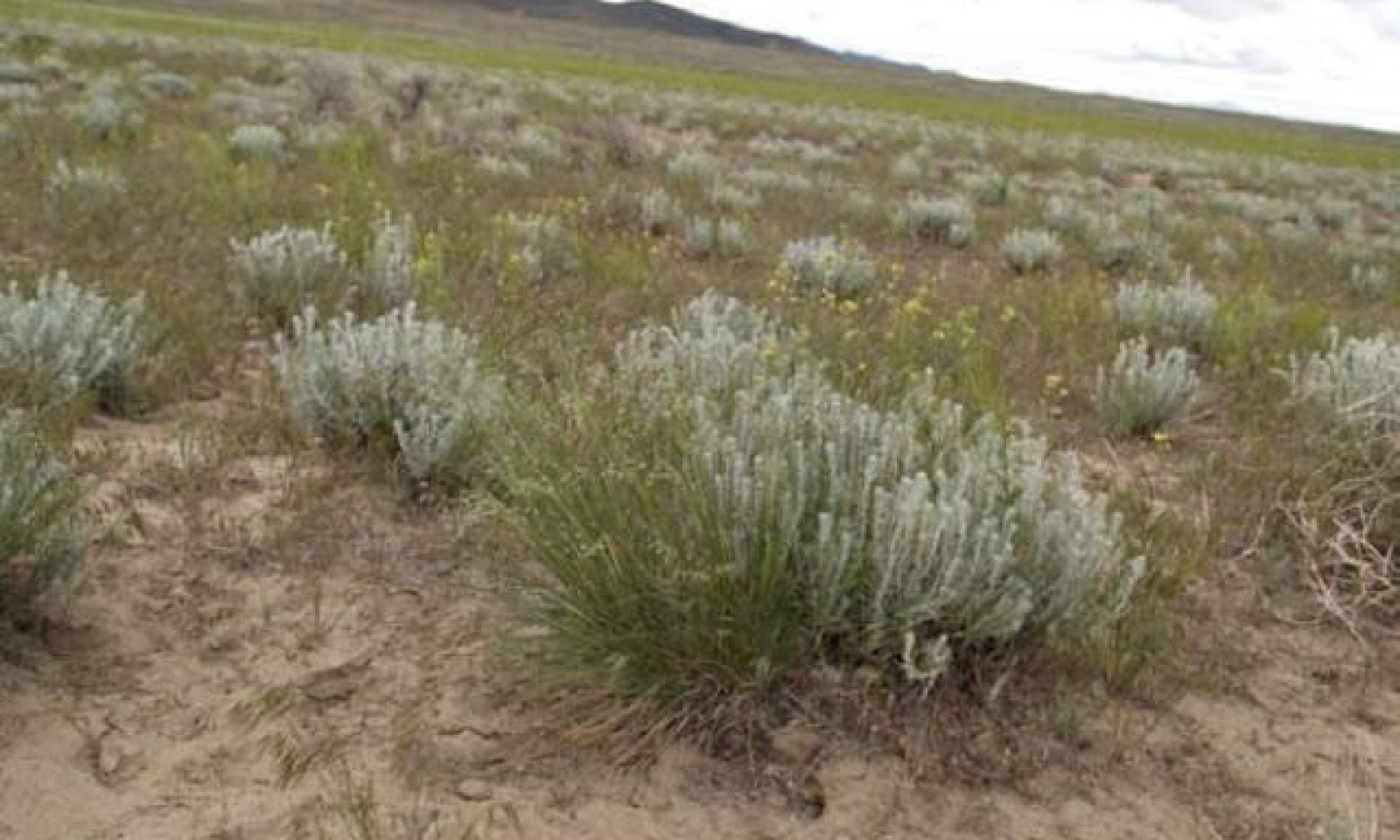
Winterfat/Indian ricegrassThe reference plant community is dominated by winterfat. Indian ricegrass, bud sagebrush and bottlebrush squirreltail are other important species associated with this site.
Potential vegetative composition is about 25 percent grasses, 5 percent forbs and 70 percent shrubs by weight. Approximate ground cover (basal and crown) is 10 to 20 percent.
Community phase changes are primarily a function of chronic drought and/or insect and disease attack. Fire is infrequent and patchy due to low fuel loads. Winterfat experiences good seed production during years with substantial summer precipitation and little browsing. Germination and subsequent recruitment of winterfat seedings into the stand relies on favorable precipitation throughout the spring and summer.Figure 9. Annual production by plant type (representative values) or group (midpoint values)
Table 5. Annual production by plant type
Plant type Low
(lb/acre)Representative value
(lb/acre)High
(lb/acre)Shrub/Vine 140 245 350 Grass/Grasslike 50 88 125 Forb 10 17 25 Total 200 350 500 Community 1.2
WinterfatThis plant community phase is characterized by a reduction in overall plant cover. Drought will favor shrubs over perennial bunchgrasses. However, long-term drought will result in an overall decline in the plant community, regardless of functional group. Release from drought influences herbaceous biomass production and pulses of shrub recruitment. Recovery of winterfat is dependent on a good seed production year followed by subsequent climatic conditions favorable to germination and survival.
This plant community is at risk of invasion by non-native invasive species, such as cheatgrass. Non-natives easily establish where structural and functional groups are reduced or missing.Pathway 1.1a
Community 1.1 to 1.2This pathway is a result of drought, insect or disease attack. The rare low intensity, patchy fire, or other disturbance that reduces overall plant cover.
Pathway 1.2a
Community 1.2 to 1.1This pathway is a result of recovery from drought and adequate rest and recovery from defoliation.
State 2
Current Potential StateThis state has the same two general community phases as the reference state, but differs by the presence of non-native invasive species in the understory. These non-natives are highly flammable and can promote wildfire where fires historically have been infrequent. Cheatgrass dieoff will reduce fine fuel loading, reducing threat of wildfire. Ecological function (soil hydrology, energy capture, nutrient cycling) has not changed, however the resiliency of the state has been reduced by the presence of annual non-natives. Prescribed grazing maintains state dynamics. Negative feedbacks enhance ecosystem resilience and contribute to the stability of the state. These include the presence of all structural and functional groups, low fine fuel loads, and an intact microbiotic crust that protects the soil surface from erosion. Positive feedbacks decrease ecosystem resilience and decrease the stability of the state. These include cheatgrass’s high seed output, persistent seed bank, rapid growth rate, ability to cross-pollinate and adaptations for seed dispersal.
Community 2.1
Winterfat/Indian ricegrass/non-native annualsThis community is compositionally similar to the Community Phase 1.1 with a trace of non-native annuals (cheatgrass, annual mustards) in the understory. Ecological resilience is reduced by the presence of non-native annuals. This plant community may respond differently following disturbance, when compared to non-invaded plant communities.
Community 2.2
Winterfat/non-native annuals
Figure 10. T. Stringham NV777 MU1023 Wholan Series, June 2010
This plant community phase is characterized by a decline in Indian ricegrass, bud sagebrush and winterfat. Bare ground and perennial basal gaps increase. Non-native annual species such as cheatgrass and annual mustards are common in the understory. Prolonged drought may lead to an overall decline in the plant community, including non-natives. This plant community is at risk of soil loss and redistribution.
Pathway 2.1a
Community 2.1 to 2.2This pathway is a result of prolonged drought, and inadequate rest and recovery from defoliation during the growing season which favors unpalatable shrub cover over perennial bunchgrass and winterfat cover.
Pathway 2.2a
Community 2.2 to 2.1This pathway is a result of a release from drought, adequate rest and recovery from defoliation and favorable climatic conditions which facilitates recovery of bunchgrasses, winterfat and associated shrub cover.
State 3
Shrub StateThis state consists of one community phase. This site has crossed a biotic threshold and site processes are being controlled by shrubs. Bare ground has increased.
Community 3.1
Shrub dominated
Figure 11. T. Stringham, 6/2010, NV777 MU 1023, Wholan series
Perennial bunchgrasses, like Indian ricegrass are reduced and the site is dominated by winterfat. Rabbitbrush and shadscale may be significant components or dominant shrubs. Annual non-native species increase. Bare ground has increased.
State 4
Annual StateThis state has two community phases a non-native annual dominated phase and a shrub with a non-native annual understory dominated phase. Annual non-native species dominate the site and control site resources and drive ecological dynamics. Bare ground may be abundant. Spatial and temporal energy capture and nutrient cycling has been truncated. Site function is primarily controlled by abiotic factors such as soil erosion, soil temperature and wind. Cheatgrass dieoff will reduce fine fuel loading and litter cover. Strong positive feedbacks contributing to this state include persistence of non-native seedbank and competition between natives and non-natives for limited soil moisture and nutrients. Decreased variability in the fuel structure and loss of structural and functional groups also contribute to the stability of the state.
Range plantings on this site are typically not successful because of limited precipitation. Management of this state should include prescribed grazing to manage fine fuel loads to reduce the threat of wildfire and allow for recruitment of winterfat.Community 4.1
Annual non-native plants
Figure 12. T. Stringham 6/2010, NV777, MU 1023, Wholan series
This plant community phase is dominated by annual non-native species. Annual species include cheatgrass, Russian thistle, halogeton, bur buttercup, and annual mustards. Trace amounts of winterfat and other shrubs may be present, but are not contributing to site function. Bare ground may be abundant, especially during low precipitation years. Soil erosion, soil temperature and wind are driving factors in site function. In above-average precipitation years annual production can exceed 500 lbs/ac.
Community 4.2
Annual non-native plants/WinterfatThis plant community phase is dominated by annual non-native species and shrubs, such as winterfat.
Pathway 4.1a
Community 4.1 to 4.2This pathway is a result of reestablishment of winterfat cover. This pathway is unlikely due to the impact of annual non-native species on the establishment and growth of winterfat seedlings.
Pathway 4.2a
Community 4.2 to 4.1This pathway is a result of Wildfire.
Transition T1A
State 1 to 2Trigger: introduction of non-native invasive species, such as cheatgrass, mustards, poverty weed, halogeton and Russian thistle.Slow variables: changes in kinds of animals and their grazing patterns, drought and/or changes in fire history that altered recruitment rates of native species. Threshold: reduction in the herbaceous understory, changes in soil hydrology including infiltration and runoff. Non-native invasive species cannot be easily removed from the system and have the potential to significantly alter disturbance regimes from their historic range of variation.
Transition T2A
State 2 to 3Trigger: Fire or inadequate rest and recovery from defoliation during spring and/or early summer. Slow variables: long-term decrease in grass density and reduced native species (shrubs and grass) recruitment rates. Increased reproduction, cover and density of non-native invasive species. Threshold: loss of deep-rooted perennial bunchgrasses and loss of native shrubs reduces infiltration and increases runoff; this leads to reduced soil organic matter and soil moisture. Modified fire regime driven by non-native invasive annuals (changes in frequency, intensity, size and spatial variability of fire).
Transition T3A
State 3 to 4Trigger: Severe fire/ multiple fires, long term inappropriate grazing management, and/or soil disturbing treatments such as plowing. Slow variables: Increased production and cover of non-native annual species. Threshold: Increased, continuous fine fuels modify the fire regime by changing intensity, size and spatial variability of fires. Changes in plant community composition and spatial variability of vegetation due to the loss of perennial bunchgrasses and sagebrush truncate energy capture spatially and temporally thus impacting nutrient cycling and distribution.
Additional community tables
Table 6. Community 1.1 plant community composition
Group Common name Symbol Scientific name Annual production () Foliar cover (%) Grass/Grasslike1 Primary Perennial Grasses 60–116 Indian ricegrass ACHY Achnatherum hymenoides 53–88 – squirreltail ELEL5 Elymus elymoides 7–28 – 2 Secondary Perennial Grasses 7–28 needle and thread HECO26 Hesperostipa comata 2–11 – western wheatgrass PASM Pascopyrum smithii 2–11 – Sandberg bluegrass POSE Poa secunda 2–11 – Forb3 Perennial Forbs 7–28 globemallow SPHAE Sphaeralcea 2–7 – 4 Annual Forbs 1–18 Shrub/Vine5 Primary Shrubs 75–163 winterfat KRLA2 Krascheninnikovia lanata 68–135 – 6 Secondary Shrubs 7–35 fourwing saltbush ATCA2 Atriplex canescens 4–7 – shadscale saltbush ATCO Atriplex confertifolia 4–7 – sickle saltbush ATFA Atriplex falcata 4–7 – yellow rabbitbrush CHVI8 Chrysothamnus viscidiflorus 4–7 – spiny hopsage GRSP Grayia spinosa 4–7 – Table 7. Community 1.2 plant community composition
Group Common name Symbol Scientific name Annual production () Foliar cover (%) Table 8. Community 2.1 plant community composition
Group Common name Symbol Scientific name Annual production () Foliar cover (%) Table 9. Community 2.2 plant community composition
Group Common name Symbol Scientific name Annual production () Foliar cover (%) Table 10. Community 3.1 plant community composition
Group Common name Symbol Scientific name Annual production () Foliar cover (%) Table 11. Community 4.1 plant community composition
Group Common name Symbol Scientific name Annual production () Foliar cover (%) Table 12. Community 4.2 plant community composition
Group Common name Symbol Scientific name Annual production () Foliar cover (%) Interpretations
Animal community
Livestock Interpretations:
This site has value for livestock grazing. Grazing management should be keyed to dominant grasses or palatable shrub production.
Winterfat is a valuable forage species with an average of 10 percent crude protein during winter when few nutritious options exist for livestock and wildlife (Welch 1989). However, excessive grazing throughout the West has negatively impacted survival of winterfat stands (Hilton 1941; Statler 1967; Stevens et al. 1977). Time of grazing is critical for winterfat with the active growing period being most critical (Romo 1995). Stevens et al. (1977) observed that both vigor and reproduction of winterfat were reduced in Steptoe Valley, Nevada by improper season of use, and recommended no more than 25 percent utilization during periods of active growth and up to 75 percent utilization during dormant season use. Rasmussen and Brotherson (1986) observed significantly greater foliar cover and density of winterfat in areas ungrazed for 26 years versus winter grazed areas in Utah. In exclosures protected from grazing, Rice and Westoby (1978) observed that winterfat increased in foliar cover but not in density where it was dominant, and in both foliar cover and density in shadscale-perennial grass communities where it was not dominant.
Bud sagebrush is also a palatable, nutritious forage for upland game birds, small game, big game and domestic sheep in winter, particularly late winter (Johnson 1978), however it can be poisonous or fatal to calves when eaten in quantity (Stubbendieck et al. 1992). Budsage is highly susceptible to effects of browsing. It decreases under browsing due to year-long palatability of its buds and is particularly susceptible to browsing in the spring when it is physiologically most active (Chambers and Norton 1993). Heavy browsing (>50 percent) may kill budsage rapidly (Wood and Brotherson 1986).
Grazing management following fire to promote Indian ricegrass seed production and establishment of seedlings is important. Heavy spring grazing reduced the vigor of Indian ricegrass and decrease the stand (Cook and Child 1971). In eastern Idaho, productivity of Indian ricegrass was at least 10 times greater in undisturbed plots than in heavily grazed ones (Pearson 1976). Cook and Child (1971) observed significant reduction in plant cover after 7 years of rest from heavy (90 percent) and moderate (60 percent) spring use. The seed crop may be reduced where grazing is heavy (Bich et al. 1995). Tolerance to grazing increases after May thus spring deferment may be necessary for
stand enhancement (Pearson 1964, Cook and Child 1971); however, utilization of less than 60 percent is recommended.
Bottlebrush squirreltail is very palatable winter forage for domestic sheep of Intermountain ranges. Overall, bottlebrush squirreltail is considered moderately palatable to livestock.
Stocking rates vary over time depending upon season of use, climate variations, site, and previous and current management goals. A safe starting stocking rate is an estimated stocking rate that is fine tuned by the client by adaptive management through the year and from year to year.
Wildlife Interpretations:
In addition to grazing by cattle, winterfat is browsed by rabbits, antelope, and other wildlife species (Stevens et al. 1977, Ogle et al. 2001). Winterfat and perennial grasses average 80 percent of jackrabbits’ diet in southeastern Idaho, with shrubs being grazed in fall and winter particularly (Johnson and Anderson 1984). Pronghorn and rabbits browse stems, leaves, and seed stalks of winterfat year round, especially during periods of active growth (Stevens et al. 1977). Management of wildlife browse is difficult and browse may be harmful to winterfat reestablishment as seed production and regrowth are curtailed if the plant is grazed at the onset of growth (Eckert 1954). Winterfat is used for cover by rodents. It is potential nesting cover for upland game birds, especially when grasses grow up through its crown. Budsage is palatable, nutritious forage for upland game birds, small game and big game in winter. Budsage is browsed by mule deer in Nevada in winter and is utilized by bighorn sheep in summer, but the importance of budsage in the diet of bighorns is not known. Bud sage comprises 18 to 35 percent of a pronghorn’s diet during the spring where it is available. Chukar will utilize the leaves and seeds of bud sage. Budsage is highly susceptible to effects of browsing. It decreases under browsing due to year-long palatability of its buds and is particularly susceptible to browsing in the spring when it is physiologically most active. Indian ricegrass is eaten by pronghorn in moderate amounts whenever available. In Nevada, it is consumed by desert bighorns. A number of heteromyid rodents inhabiting desert rangelands show preference for seed of Indian ricegrass. Indian ricegrass is an important component of jackrabbit diets in spring and summer. In Nevada, Indian ricegrass may even dominate jackrabbit diets during the spring through early summer months. Indian ricegrass seed provides food for many species of birds. Doves, for example, eat large amounts of shattered Indian ricegrass seed lying on the ground. Bottlebrush squirreltail is a dietary component of several wildlife species. Bottlebrush squirreltail may provide forage for mule deer and pronghorn.Hydrological functions
Runoff is low to medium. Permeability is moderately slow to moderately rapid. Hydrologic soil groups are A and B. Rills are none. Water flow patterns are rare to common depending on site location relative to major inflow areas. Pedestals are none. Gullies are none. Shrubs and deep-rooted perennial herbaceous bunchgrasses and/or rhizomatous grasses aid in infiltration. Shrub canopy and associated litter break raindrop impact and provide opportunity for snow catch and accumulation on site.
Recreational uses
Aesthetic value is derived from the diverse floral and faunal composition and the colorful flowering of wild flowers and shrubs during the spring and early summer. This site offers rewarding opportunities to photographers and for nature study. This site has potential for upland bird and big game hunting.
Other products
Indian ricegrass is traditionally eaten by some Native Americans. The Paiutes use seeds as a reserve food source.
Other information
Winterfat adapts well to most site conditions, and its extensive root system stabilizes soil. However, winterfat is intolerant of flooding, excess water, and acidic soils. Bottlebrush squirreltail is tolerant of disturbance and is a suitable species for revegetation.
Supporting information
Inventory data references
NASIS soil mapunit data was used for correlated soil components.
Type locality
Location 1: Pershing County, NV Township/Range/Section T33N R35E S26 UTM zone N UTM northing 4506603 UTM easting 414456 Latitude 40° 42′ 21″ Longitude 118° 0′ 45″ General legal description SE¼NW¼ About 2 miles southeast of Dun Glen-Mill City exit off I-80 west of Winnemucca, Dun Glen Flat area, Pershing County, Nevada. This site also occurs in Elko, Eureka, Humboldt, Lander, and Washoe Counties, Nevada. Other references
Banner, R.E. 1992. Vegetation types of Utah. Journal of Range Management 14(2):109-114.
Bich, B.S., J.L. Butler, and C.A. Schmidt. 1995. Effects of differential livestock use of key plant species and rodent populations within selected Oryzopsis hymenoides/Hilaria jamesii communities in Glen Canyon National Recreation Area. The Southwestern Naturalist 40(3):281-287.
Blaisdell, J.P. and R.C. Holmgren. 1984. Managing Intermountain Rangelands – Salt-desert shrub ranges. USDA-FS General Technical Report INT-163. 52 p.
Booth, D.T. 1989. A model of freeze tolerance in winterfat germinants. In: Proceedings--Symposium on shrub ecophysiology and biotechnology; 1987 June 30-July 2; Logan, UT. Gen. Tech. Rep. INT-256. Ogden, UT. U.S. Department of Agriculture, Forest Service, Intermountain Research Station: Pgs 83-89.
Britton, C.M., G.R. McPherson, and F.A. Sneva. 1990. Effects of burning and clipping on five bunchgrasses in eastern Oregon. The Great Basin Naturalist 50(2):115-120.
Chambers, J.C. and B.E. Norton. 1993. Effects of grazing and drought on population dynamics of salt desert species on the Desert Experimental Range, Utah. Journal of Arid Environments 24:261-275.
Clark, L.D. and N.E. West. 1971. Further studies of Eurotia lanata germination in relation to salinity. The Southwestern Naturalist 15(3):371-375.
Cook, C.W. and R.D. Child. 1971. Recovery of desert plants in various states of vigor. Journal of Range Management 24(5):339-343.
Dwyer, D.D. and R.D. Pieper. 1967. Fire effects on blue grama--pinyon-juniper rangeland in New Mexico. Journal of Range Management 20:359-362.
Eckert, R.E., Jr. 1954. A study of competition between whitesage and halogeton in Nevada. Journal of Range Management 7:223-225.
Eckert, R.E., Jr., F.F. Peterson, and F.L. Emmerich. 1987. A study of factors influencing secondary succession in the sagebrush [Artemisia spp. L.] type. In: Frasier, G.W. and R.A. Evans, (eds.). Proceedings of the symposium: "Seed and seedbed ecology of rangeland plants"; 1987 April 21-23; Tucson, AZ. Washington, DC: U.S. Department of Agriculture, Agricultural Research Service: Pgs 149-168.
Freemen, D.C. and J.M. Emlen. 1995. Assessment of interspecific interactions in plant communities: an illustration from the cold desert saltbush grasslands of North America. Journal of Arid Environments 31:179-198.
Hild, A.L, J.M. Muscha, and N.L.Shaw. 2007. Emergence and growth of four winterfat accessions in the presence of the exotic annual cheatgrass. In: Sosebee, R.E., D.B. Wester, C.M. Britton, E.D. McArthur, and S.G. Kitchen (compilers). Proceedings: Shrubland dynamics—fire and water; 2004 Aug 10-12; Lubbock, TX. RMRS-P-47. Fort Collins, CO: U.S. Department of Agriculture, Forest Service, Rocky Mountain Research Station: Pgs 147-152.
Hilton, J.W. 1941. Effects of certain micro-ecological factors on the germinability and early development of Eurotia lanata. Northwest Science 15:86-92.
Hironaka, M. and E.W. Tisdale. 1972. Growth and development of Sitanion hystrix and Poa sandbergii. Research Memorandum RM 72-24. U.S. International Biological Program, Desert Biome. 15 p.
Hutchings, S.S. and G. Stewart. 1953. Increasing forage yields and sheep production on Intermountain winter ranges. Circular No. 925. Washington, DC: U.S. Department of Agriculture. 63 p.
Johnson, K.L. 1978. Wyoming shrublands: Proceedings, 7th Wyoming shrub ecology workshop; 1978 May 31-June 1; Rock Springs, WY. Laramie, WY: University of Wyoming, Agricultural Extension Service. 58 p.
Johnson, R.D. and J.E. Anderson. 1984. Diets of black-tailed jackrabbits in relation to population density and vegetation. Journal of Range Management 37:79-83.
Majerus, M. 2003. Production and conditioning of winterfat seeds (Krascheninnikovia lanata). Native Plants Journal 4(1):10-17.
Mozingo, H.N. 1987. Shrubs of the Great Basin: A Aatural History. University of Nevada Press, Reno, NV. 342 p.
Ogle, D.G., L. St. John, and L. Holzworth. 2001. Plant guide management and use of winterfat. Boise (ID): USDA-NRCS. 4 p.
Pearson, L.C. 1964. Effect of harvest date on recovery of range grasses and shrubs. Agronomy Journal 56:80-82.
Pearson, L.C. 1976. Primary production in grazed and ungrazed desert communities of eastern Idaho. Ecology 46(3):278-285.
Pellant, M. and L. Reichert. 1984. Management and rehabilitation of a burned winterfat community in southwestern Idaho. In: Tiedemann, Arthur R.; McArthur, E. Durant; Stutz, Howard C.; [and others], compilers. Proceedings--symposium on the biology of Atriplex and related chenopods; 1983 May 2-6; Provo, UT. Gen. Tech. Rep. INT-172. Ogden, UT: U.S. Department of Agriculture, Forest Service, Intermountain Forest and Range Experiment Station: Pgs 281-285.
Rasmussen, L.L. and J.D. Brotherson. 1986. Response of winterfat communities to release from grazing pressure. Great Basin Naturalist 46:148-156.
Rice, B. and M. Westoby. 1978. Vegetative responses of some Great Basin shrub-communities protected against jackrabbits or domestic stock. Journal of Range Management 31:28-34.
Romo, J.T., R.E. Redmann, B.L. Kowalenko, and A.R. Nicholson. 1995. Growth of winterfat following defoliation in northern mixed prairie of Saskatchewan. Journal of Range Management 48:240-245.
Statler, G.D. 1967. Eurotia lanata establishment trials. Journal of Range Management 20:253-255.
Stevens, R., B.C. Giunta, K.R. Jorgensen, and A.P. Plummer. Winterfat (Ceratoides lanata). Publ. No. 77-2. Salt Lake City, UT: Utah State Division of Wildlife Resources. 41 p.
Stubbendieck, J., S.L. Hatch, and C.H. Butterfield. 1992. North American Range Plants. 4th ed. Lincoln, NE: University of Nebraska Press. 493 p.
Tirmenstein, D. 1999. Achnatherum hymenoides. In: Fire Effects Information System, [Online]. U.S. Department of Agriculture, Forest Service, Rocky Mountain Research Station, Fire Sciences Laboratory (Producer). Available: http://www.fs.fed.us/database/feis/
Welch, B.L. 1989. Nutritive value of shrubs. In: McKell, C.M. (ed.). The biology and utilization of shrubs. San Diego, CA: Academic Press, Inc. Pgs 405-424.
Welsh, S.L., N.D. Atwood, S. Goodrich, L.C. Higgins, (eds.). 1987. A Utah Flora. The Great Basin Naturalist Memoir No. 9. Provo, UT: Brigham Young University. 894 p.
West, N.E. 1994. Effects of fire on salt-desert shrub rangelands. In: Monsen, S.B. and S.G. Kitchen (compilers). Proceedings--ecology and management of annual rangelands; 1992 May 18-22; Boise, ID. Gen. Tech. Rep. INT-GTR-313. Ogden, UT: U.S. Department of Agriculture, Forest Service, Intermountain Research Station: Pgs 71-74.
West, N.E. and J. Gasto. 1978. Phenology of the aerial portions of shadscale and winterfat in Curlew Valley, Utah. Journal of Range Management 31(1):43-45.
Wood, B.W. and J.D. Brotherson. 1986. Ecological adaptation and grazing response of budsage (Artemisia spinescens). In: McArthur, E.D. and B.L. Welch (compilers). Proceedings--symposium on the biology of Artemisia and Chrysothamnus; 1984 July 9-13; Provo, UT. Gen. Tech. Rep. INT-200. Ogden, UT: U.S. Department of Agriculture, Forest Service, Intermountain Research Station: 75-92.
Woodmansee, R.G. and L.D. Potter. 1971. Natural reproduction of winterfat (Eurotia lanata) in New Mexico. Journal of Range management 24(1):24-30.
Workman, J.P. and N.E. West. 1967. Germination of Eurotia lanata in relation to temperature and salinity. Ecology 48(4):659-661.
Young, R.P. 1983. Fire as a vegetation management tool in rangelands of the Intermountain Region. In: Monsen, S.B. and N. Shaw (compilers). Managing Intermountain rangelands--improvement of range and wildlife habitats: Proceedings; 1981 September 15-17; Twin Falls, ID; 1982 June 22-24; Elko, NV. Gen. Tech. Rep. INT-157. Ogden, UT: U.S. Department of Agriculture, Forest Service, Intermountain Forest and Range Experiment Station: Pgs 18-31.
Young, J.A. and R.A. Evans 1977. Squirreltail seed germination. Journal of Range Management 30(1):33-36.Contributors
CP/GKB
TK Stringham
P NovakEcheniqueApproval
Kendra Moseley, 3/07/2025
Rangeland health reference sheet
Interpreting Indicators of Rangeland Health is a qualitative assessment protocol used to determine ecosystem condition based on benchmark characteristics described in the Reference Sheet. A suite of 17 (or more) indicators are typically considered in an assessment. The ecological site(s) representative of an assessment location must be known prior to applying the protocol and must be verified based on soils and climate. Current plant community cannot be used to identify the ecological site.
Author(s)/participant(s) Patti Novak-Echenique Contact for lead author State Rangeland Management Specialist Date 12/17/2009 Approved by Approval date Composition (Indicators 10 and 12) based on Annual Production Indicators
-
Number and extent of rills:
Rills are not typical. -
Presence of water flow patterns:
Water flow patterns are rare to common depending on site location relative to major inflow areas. -
Number and height of erosional pedestals or terracettes:
Pedestals are none. -
Bare ground from Ecological Site Description or other studies (rock, litter, lichen, moss, plant canopy are not bare ground):
Bare Ground ± 80 percent. -
Number of gullies and erosion associated with gullies:
None -
Extent of wind scoured, blowouts and/or depositional areas:
None -
Amount of litter movement (describe size and distance expected to travel):
Fine litter (foliage of grasses and annual & perennial forbs) expected to move distance of slope length during periods of intense summer convection storms or run in of early spring snow melt flows. Persistent litter (large woody material) will remain in place except during unusual flooding (ponding) events. -
Soil surface (top few mm) resistance to erosion (stability values are averages - most sites will show a range of values):
Soil stability values will range from 3 to 5. -
Soil surface structure and SOM content (include type of structure and A-horizon color and thickness):
Structure of soil surface is thin to medium platy. Soil surface colors are very light and soils are typified by an ochric epipedon. Organic matter is typically less than 0.9 percent (OM values taken from lab characterization data). -
Effect of community phase composition (relative proportion of different functional groups) and spatial distribution on infiltration and runoff:
Shrubs and deep-rooted perennial herbaceous bunchgrasses, rhizomatous grasses or both aid in infiltration. Shrub canopy and associated litter break raindrop impact and provide opportunity for snow catch and accumulation on site. -
Presence and thickness of compaction layer (usually none; describe soil profile features which may be mistaken for compaction on this site):
Compacted layers are not typical. Platy, subangular blocky, or massive subsurface layers are normal for this site and are not to be interpreted as compaction. -
Functional/Structural Groups (list in order of descending dominance by above-ground annual-production or live foliar cover using symbols: >>, >, = to indicate much greater than, greater than, and equal to):
Dominant:
Low statured or half shrubs (winterfat & budsage)Sub-dominant:
deep-rooted, cool season, perennial bunchgrasses > shallow-rooted cool season, perennial bunchgrasses > associated shrubs > cool season, rhizomatous grasses = deep-rooted, cool season, perennial forbs = fibrous, shallow-rooted, cool season, perennial and annual forbsOther:
Microbiotic crustsAdditional:
-
Amount of plant mortality and decadence (include which functional groups are expected to show mortality or decadence):
Dead branches within individual shrubs common and standing dead shrub canopy material may be as much as 35% of total woody canopy. -
Average percent litter cover (%) and depth ( in):
Between plant interspaces (< 5%) and depth (± ¼ in.) -
Expected annual annual-production (this is TOTAL above-ground annual-production, not just forage annual-production):
For normal or average growing season (March thru May) ± 350 lbs/ac. -
Potential invasive (including noxious) species (native and non-native). List species which BOTH characterize degraded states and have the potential to become a dominant or co-dominant species on the ecological site if their future establishment and growth is not actively controlled by management interventions. Species that become dominant for only one to several years (e.g., short-term response to drought or wildfire) are not invasive plants. Note that unlike other indicators, we are describing what is NOT expected in the reference state for the ecological site:
Invaders include cheatgrass, annual mustards, annual kochia, Russian thistle, halogeton, and knapweeds -
Perennial plant reproductive capability:
All functional groups should reproduce in average (or normal) and above average growing season years
Print Options
Sections
Font
AAAAOther
PrintThe Ecosystem Dynamics Interpretive Tool is an information system framework developed by the USDA-ARS Jornada Experimental Range, USDA Natural Resources Conservation Service, and New Mexico State University.
Accessibility statement


