
Natural Resources
Conservation Service
-
Search


Major Land Resource Area or ecological site by name and/or ID.
PreviousSectionsNextGeneral information
Draft. A draft ecological site description is either incomplete or has not undergone quality control and quality assurance review.
Associated sites
R022AY023NV LOAMY SLOPE 16-20 P.Z.
R022AY025NV MAHOGANY THICKET
R022AY028NV CLAYPAN 16+ P.Z.
Table 1. Dominant plant species
Tree Not specified
Shrub (1) Purshia tridentata
(2) Artemisia tridentata ssp. vaseyanaHerbaceous (1) Achnatherum occidentale
Physiographic features
The site occurs on the mountain sideslopes and summits on all exposures. Slopes range from 4 to 50 percent, but slope gradients of 4 to 30 percent are most typical. Elevations are 6500 to over 8300 feet.
Table 2. Representative physiographic features
Landforms (1) Mountain
Flooding frequency None Ponding frequency None Elevation 6500 – 8300 ft Slope 4 – 50 % Ponding depth 0 in Water table depth 60 in Aspect Aspect is not a significant factor Climatic features
The climate on this site is subhumid-continental, characterized by cold, moist winters, and cool dry summers. The average annual precipitation is 16 to 30 inches, mostly occurring as snow. The linear to convex slope shapes associated with this site cause some of the precipitation to be removed from the site because of wind action, thus reducing the moisture available for plant growth. The mean annual air temperature ranges from 37 to 45 degrees F. The average frost free growing season is 40 to 70 days.
Table 3 Representative climatic features
Frost-free period (average) 70 days Freeze-free period (average) 0 days Precipitation total (average) 30 in BarLineFigure 1. Monthly precipitation range
BarLineFigure 2. Monthly average minimum and maximum temperature
">Influencing water features
There are no influencing water features associated with this site.
Soil features
The soils in this ecological site are typically moderately deep and are well drained. They formed in residuum and colluvium from tuff, tuff breccia, and andesite. Surface layers are moderately coarse modified by a high percentage of rock fragments. These soils have a mollic epipedon that ranges from 5 to 23 inches thick. The soil series associated with this ecological site include:
Table 4. Representative soil features
Parent material (1) Residuum – tuff breccia
(2) Colluvium – andesite
Surface texture (1) Very gravelly sandy loam
Family particle size (1) Loamy
Drainage class Well drained Permeability class Moderate Soil depth 43 – 84 in Surface fragment cover <=3" 30 % Surface fragment cover >3" 14 % Available water capacity
(0-40in)2.9 – 0 in Calcium carbonate equivalent
(0-40in)Not specified Electrical conductivity
(0-40in)Not specified Sodium adsorption ratio
(0-40in)Not specified Soil reaction (1:1 water)
(0-40in)6.1 – 7.3 Subsurface fragment volume <=3"
(Depth not specified)18 – 32 % Subsurface fragment volume >3"
(Depth not specified)13 – 25 % Ecological dynamics
As ecological condition declines, big sagebrush, snowberry and other woody plants increase in prevalence as Letterman's needlegrass, mountain brome and other perennial grasses and forbs decline in the understory.
Fire Ecology:
Presettlement fire return intervals for antelope bitterbrush communities range from 15-25 years. Season of burning and environmental conditions have a large impact on antelope bitterbrush ability to survive fire and sprout. Antelope bitterbrush is considered a weak sprouter and is often killed by summer or fall fire. Antelope bitterbrush in some areas may sprout after light-severity spring fire. High fuel consumptions increase antelope bitterbrush mortality and therefore favors seedling establishment.
Mountain big sagebrush is highly susceptible to injury from fire. It is often top-killed by fire and will not resprout.
Perennial needlegrasses tend to be among the least fire resistant bunchgrass due to the densely tufted stems. Western needlegrass is only slightly to moderately damaged by fire, because it has relatively few culms per clump which may help to minimize the amount of subsurface heat transfer and subsequent damage.
Mountain brome is likely to be top-killed by fire, although the coarse stems and broad leaves may be more fire-resistant than fine-leaved bunchgrasses. Mountain brome is most susceptible to fire damage when it is actively growing in spring and early summer. Basin wildrye is top-killed by fire. Older basin wildrye plants with large proportions of dead material within the perennial crown can be expected to show higher mortality due to fire than younger plants having little debris. Basin wildrye is generally tolerant of fire but may be damaged by early season fire combined with dry soil conditions.State and transition model
More interactive model formats are also available. View Interactive Models
Click on state and transition labels to scroll to the respective textEcosystem states
State 1 submodel, plant communities
State 1
Reference StateCommunity 1.1
Reference Plant Community
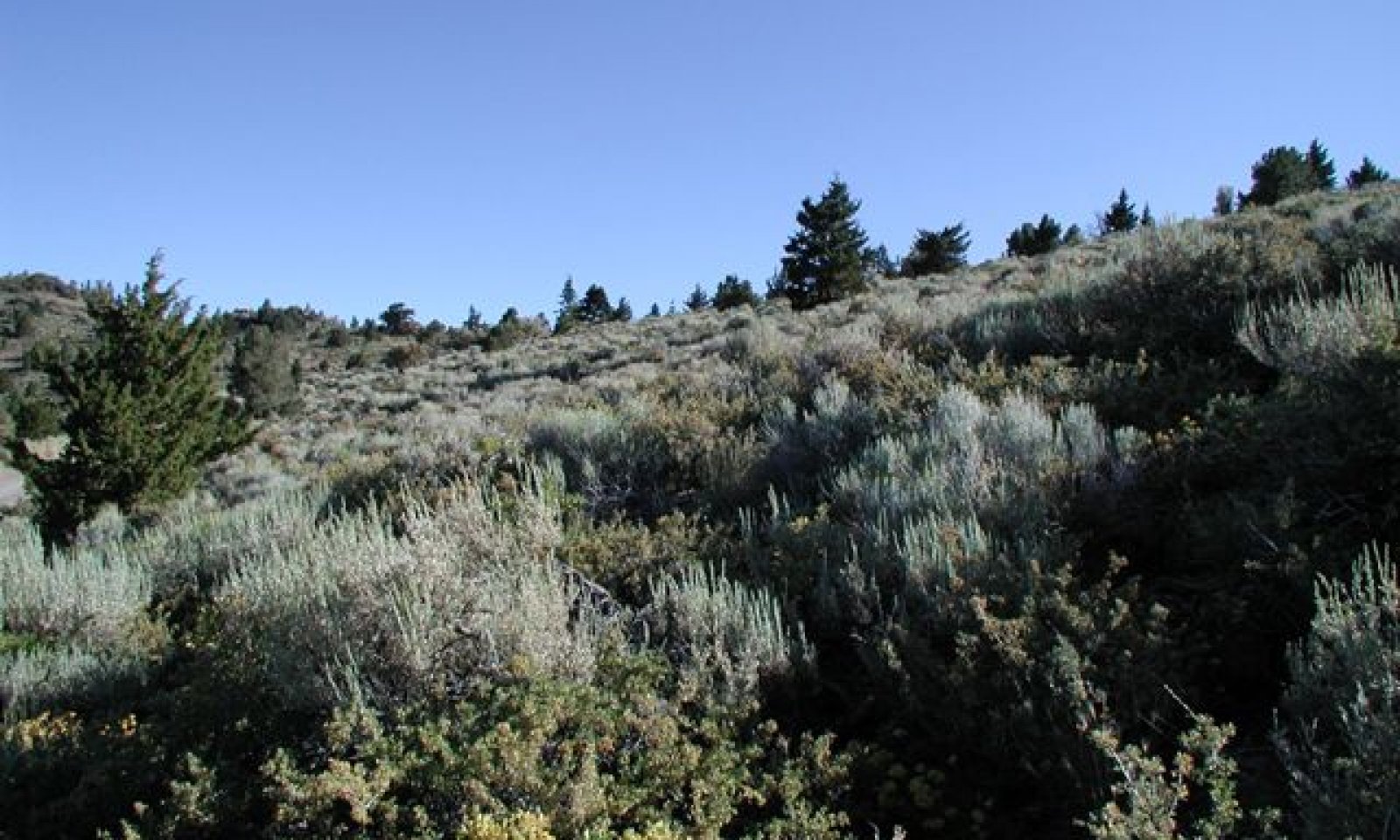
The reference plant community is characterized by an open canopy of soft-woody shrubs and a dense understory of perennial grasses. The representative plant community is dominated by western needlegrass, basin wildrye, mountain brome, antelope bitterbrush and mountain big sagebrush. Potential vegetative composition is about 55% grasses, 10% forbs and 35% shrubs.
Figure 3. Annual production by plant type (representative values) or group (midpoint values)
Table 5. Annual production by plant type
Plant type Low
(lb/acre)Representative value
(lb/acre)High
(lb/acre)Grass/Grasslike 605 825 990 Shrub/Vine 385 525 630 Forb 110 150 180 Total 1100 1500 1800 Additional community tables
Table 6. Community 1.1 plant community composition
Group Common name Symbol Scientific name Annual production () Foliar cover (%) Grass/Grasslike1 Primary Perennial Grasses 555–945 western needlegrass ACOCO Achnatherum occidentale ssp. occidentale 450–675 – basin wildrye LECI4 Leymus cinereus 75–150 – mountain brome BRMA4 Bromus marginatus 30–120 – 2 Secondary Perennial Grasses/Grasslikes 75–150 Letterman's needlegrass ACLE9 Achnatherum lettermanii 8–45 – big squirreltail ELMU3 Elymus multisetus 8–45 – Forb3 Perennial Forbs 30–150 rockcress ARABI2 Arabis 8–30 – tapertip hawksbeard CRAC2 Crepis acuminata 8–30 – buckwheat ERIOG Eriogonum 8–30 – lupine LUPIN Lupinus 8–30 – woolly mule-ears WYMO Wyethia mollis 8–30 – Shrub/Vine4 Primary Shrubs 150–525 antelope bitterbrush PUTR2 Purshia tridentata 75–375 – mountain big sagebrush ARTRV Artemisia tridentata ssp. vaseyana 75–150 – 5 Secondary Shrubs 30–120 curl-leaf mountain mahogany CELE3 Cercocarpus ledifolius 15–30 – yellow rabbitbrush CHVI8 Chrysothamnus viscidiflorus 15–30 – currant RIBES Ribes 15–30 – mountain snowberry SYOR2 Symphoricarpos oreophilus 15–30 – Tree6 Trees 1–50 white fir ABCO Abies concolor 2–18 – Jeffrey pine PIJE Pinus jeffreyi 2–18 – Interpretations
Animal community
Livestock Interpretations:
This site is suited to livestock grazing. Grazing management should be keyed to western needlegrass production. Antelope bitterbrush is important browse for livestock. Domestic livestock and mule deer may compete for antelope bitterbrush in late summer, fall, and/or winter. Cattle prefer antelope bitterbrush from mid-May through June and again in September and October. Mountain big sagebrush is eaten by domestic livestock but has long been considered to be of low palatability, and a competitor to more desirable species. Western needlegrass is an important forage species for domestic livestock. The early growth and abundant production of basin wildrye make it a valuable source of forage for livestock. It is important forage for cattle and is readily grazed by cattle and horses in early spring and fall. Though coarse-textured during the winter, basin wildrye may be utilized more frequently by livestock and wildlife when snow has covered low shrubs and other grasses. Mountain brome is one of the most important forage grasses in the quaking aspen zone. Mountain brome is ranked as excellent forage for both cattle and horses and good for domestic sheep. Domestic sheep will graze mountain brome only when it is fairly succulent.
Stocking rates vary over time depending upon season of use, climate variations, site, and previous and current management goals. A safe starting stocking rate is an estimated stocking rate that is fine tuned by the client by adaptive management through the year and from year to year.
Wildlife Interpretations:
Pronghorn antelope, mule deer, elk, and bighorn sheep utilize antelope bitterbrush extensively. Mule deer use of antelope bitterbrush peaks in September, when antelope bitterbrush may compose 91 percent of the diet. Winter use is greatest during periods of deep snow. Antelope bitterbrush is a critical winter food for mule deer. Antelope bitterbrush seed is a large part of the diets of rodents, especially deer mice and kangaroo rats. Western needlegrass is an important forage species for several wildlife species. Basin wildrye provides winter forage for mule deer, though use is often low compared to other native grasses. Basin wildrye provides summer forage for black-tailed jackrabbits. Because basin wildrye remains green throughout early summer, it remains available for small mammal forage for a longer time than other grasses. Mountain brome seedheads and seeds provide food for many birds and small mammals. Pronghorn antelope will consume mountain brome primarily in the spring. The palatability of mountain brome is excellent for deer, particularly during the late spring and early summer.Hydrological functions
Runoff is high and permeability is moderate.
Other products
Native people used big sagebrush leaves and branches for medicinal teas, and the leaves as a fumigant. Bark was woven into mats, bags and clothing. Basin wildrye was used as bedding for various Native American ceremonies, providing a cool place for dancers to stand.
Other information
Antelope bitterbrush has been used extensively in land reclamation. It is a pioneer species on some harsh sites. Antelope bitterbrush enhances succession by retaining soil and depositing organic material and, in some habitats and with some ecotypes, by fixing nitrogen. Antelope bitterbrush is important for watershed erosion control.
Mountain big sagebrush is easily propagated from seed under greenhouse, nursery, and common garden conditions and has been successfully seeded directly into field sites. Basin wildrye is useful in mine reclamation, fire rehabilitation and stabilizing disturbed areas. Its usefulness in range seeding, however, may be limited by initially weak stand establishment. Mountain brome is an excellent native bunchgrass for seeding alone or in mixtures in disturbed areas, including depleted rangelands, burned areas, roadways, mined lands, and degraded riparian zones.Supporting information
Type locality
Location 1: Mono County, CA Latitude 38° 41′ 43″ Longitude 119° 35′ 31″ General legal description Toiyabe National Forest, approximately three miles west of Topaz Lake along Indian Springs Road. Other references
Fire Effects Information System (Online; http://www.fs.fed.us/database/feis/plants/).
USDA NRCS Plant Database (Online; http://plants.usda.gov).Contributors
ALC/GKB
Rangeland health reference sheet
Interpreting Indicators of Rangeland Health is a qualitative assessment protocol used to determine ecosystem condition based on benchmark characteristics described in the Reference Sheet. A suite of 17 (or more) indicators are typically considered in an assessment. The ecological site(s) representative of an assessment location must be known prior to applying the protocol and must be verified based on soils and climate. Current plant community cannot be used to identify the ecological site.
Author(s)/participant(s) Patti Novak-Echenique Contact for lead author State Rangeland Management Specialist Date 07/18/2013 Approved by Approval date Composition (Indicators 10 and 12) based on Annual Production Indicators
-
Number and extent of rills:
Rills are typically none to rare. A few may be observed after summer convection storms. -
Presence of water flow patterns:
Water flow patterns are typically non-existent. Water flow patterns may rarely be observed on steeper slopes in areas recently subjected to summer convection storms or rapid spring snowmelt. -
Number and height of erosional pedestals or terracettes:
Pedestals are none to rare. Occurrence is usually limited to areas of water flow patterns. -
Bare ground from Ecological Site Description or other studies (rock, litter, lichen, moss, plant canopy are not bare ground):
Bare Ground 10-20% depending on amount of surface rock fragments. -
Number of gullies and erosion associated with gullies:
None -
Extent of wind scoured, blowouts and/or depositional areas:
None -
Amount of litter movement (describe size and distance expected to travel):
Fine litter (foliage from grasses and annual & perennial forbs) expected to move distance of slope length during intense summer convection storms or rapid snowmelt events. Persistent litter (large woody material) will remain in place except during large rainfall events. -
Soil surface (top few mm) resistance to erosion (stability values are averages - most sites will show a range of values):
Soil stability values should be 3 to 6 on most soil textures found on this site. (To be field tested.) -
Soil surface structure and SOM content (include type of structure and A-horizon color and thickness):
Surface structure is typically thin to thick platy, subangular blocky or massive. Soil surface colors are dark and soils are typified by a mollic epipedon. Organic matter of the surface 2 to 4 inches is typically 1.25 to 3 percent. Organic matter content can be more or less depending on micro-topography. -
Effect of community phase composition (relative proportion of different functional groups) and spatial distribution on infiltration and runoff:
Reference Plant Community: Perennial herbaceous plants (especially deep-rooted bunchgrasses [i.e., needlegrasses) slow runoff and increase infiltration. Shrub canopy and associated litter break raindrop impact and provide opportunity for snow catch and accumulation on site. -
Presence and thickness of compaction layer (usually none; describe soil profile features which may be mistaken for compaction on this site):
Compacted layers are none. Subangular blocky sub-surface horizons or subsoil argillic horizons are not to be interpreted as compaction. -
Functional/Structural Groups (list in order of descending dominance by above-ground annual-production or live foliar cover using symbols: >>, >, = to indicate much greater than, greater than, and equal to):
Dominant:
Deep-rooted, cool season, perennial bunchgrasses >> tall shrubs (antelope bitterbrush, mountain big sagebrush)Sub-dominant:
deep-rooted, cool season, perennial forbs > associate shrubs > shallow-rooted, cool season, perennial grasses > fibrous, shallow-rooted, cool season, perennial and annual forbsOther:
evergreen treesAdditional:
-
Amount of plant mortality and decadence (include which functional groups are expected to show mortality or decadence):
Dead branches within individual shrubs may be common with standing dead shrub canopy material as much as 25% of total woody canopy; some of the mature bunchgrasses (<10%) have dead centers. -
Average percent litter cover (%) and depth ( in):
Between plant interspaces 35-50% and litter depth is <½ inch. -
Expected annual annual-production (this is TOTAL above-ground annual-production, not just forage annual-production):
For normal or average growing season (through June) ± 1500 lbs/ac; Favorable years ±1800 lbs/ac and unfavorable years ±1100 lbs/ac -
Potential invasive (including noxious) species (native and non-native). List species which BOTH characterize degraded states and have the potential to become a dominant or co-dominant species on the ecological site if their future establishment and growth is not actively controlled by management interventions. Species that become dominant for only one to several years (e.g., short-term response to drought or wildfire) are not invasive plants. Note that unlike other indicators, we are describing what is NOT expected in the reference state for the ecological site:
Potential invaders on this site include cheatgrass, annual mustards, and knapweeds. -
Perennial plant reproductive capability:
All functional groups should reproduce in average (or normal) and above average growing season years. Reduced growth and reproduction occur during extended or extreme drought periods.
Print Options
Sections
Font
AAAAOther
PrintThe Ecosystem Dynamics Interpretive Tool is an information system framework developed by the USDA-ARS Jornada Experimental Range, USDA Natural Resources Conservation Service, and New Mexico State University.
Accessibility statement


