
Natural Resources
Conservation Service
-
Search


Major Land Resource Area or ecological site by name and/or ID.
PreviousSectionsNextGeneral information
Draft. A draft ecological site description is either incomplete or has not undergone quality control and quality assurance review.
Associated sites
R026XY028NV MOUNTAIN RIDGE
R026XY038NV LOAMY SLOPE 14+ P.Z.
R026XY039NV CLAYPAN 14+ P.Z.
R026XY080NV STONY MAHOGANY SAVANNA
R026XY081NV MAHOGANY THICKET
Table 1. Dominant plant species
Tree Not specified
Shrub (1) Cercocarpus ledifolius
(2) Artemisia tridentata ssp. vaseyanaHerbaceous (1) Achnatherum lettermanii
(2) Achnatherum occidentalePhysiographic features
This site occurs on mountain summits and upper side slopes on all exposures. Slopes range from 4 to 75 percent, but slope gradients of 4 to 30 percent are typical. Elevations are 6000 to over 11,000 feet.
Table 2. Representative physiographic features
Landforms (1) Mountain
(2) Mountain slope
(3) Moraine
Elevation 6000 – 11000 ft Slope 4 – 75 % Ponding depth 0 in Water table depth 0 in Aspect Aspect is not a significant factor Climatic features
Average annual precipitation is 14 to over 18 inches. Mean annual air temperature is 34 to 45 degrees F. The average growing season is about 30 to 70 days.
Table 3 Representative climatic features
Frost-free period (average) 70 days Freeze-free period (average) 0 days Precipitation total (average) 20 in BarLineFigure 1. Monthly precipitation range
BarLineFigure 2. Monthly average minimum and maximum temperature
">Influencing water features
There are no influencing water features associated with this site.
Soil features
The soils in this site are shallow to very deep. Available water capacity is low to very low due to shallow depth to bedrock or a high volume of rock fragments in the profile of deeper soils. The soils are slightly acidic or neutral. The soils families associated with this are Pachic Haplocryolls andTypic Cryorthents. The soil series associated with this site are Bakscratch, Buggin, Celeridge, Granhogany, and Thiefridge. The soil families associated with this site are Buggin inclusion, Celridge inclusion, Granhogany inclusion, Pachic Haplocryolls, Thiefridge inclusion and Vitrandic Haplocryolls inclusion.
Table 4. Representative soil features
Surface texture (1) Very gravelly sandy loam
(2) Extremely stony sandy loam
(3) Extremely bouldery loamy coarse sand
Family particle size (1) Loamy
Drainage class Well drained to somewhat excessively drained Permeability class Moderately rapid to rapid Soil depth 16 – 60 in Surface fragment cover <=3" 15 – 55 % Surface fragment cover >3" 4 – 40 % Available water capacity
(0-40in)0.6 – 3.8 in Calcium carbonate equivalent
(0-40in)Not specified Electrical conductivity
(0-40in)Not specified Sodium adsorption ratio
(0-40in)Not specified Soil reaction (1:1 water)
(0-40in)5.6 – 7.3 Subsurface fragment volume <=3"
(Depth not specified)16 – 41 % Subsurface fragment volume >3"
(Depth not specified)2 – 30 % Ecological dynamics
As ecological condition declines, curlleaf mountain mahogany plants become decadent with little regeneration of the overstory.
Fire Ecology:
The presettlement fire regime of curlleaf mountainmahogany communities probably varied with community type and structue. The fire return interval is highly variable, ranging from 13 to 1000 years. Curlleaf mountainmahogany may depend on fire to reduce conifer competition and produce favorable soil conditions for seedling establishment. Some curlleaf mountainmahogany stands occupy sites with very low fuel levels that rarely burn. Individual curlleaf mountainmahogany are severely damaged by fire. Because many dead branches persist in the crown and leaves are slightly resinous, curlleaf mountainmahogany is probably very flammable. Curlleaf mountainmahogany is a weak sprouter after a fire.
Mountain big sagebrush is highly susceptible to injury from fire. It is often top-killed by fire and will not resprout.
Little specific information is available on adaptations of Letterman's needlegrass to fire. It is morphologically similar to Columbia needlegrass, which is only slightly to moderately damaged by fire. Season of burn affects the plant's ability to survive a fire. Post fire regeneration is through seeding and tillering. Muttongrass is unharmed to slightly harmed by light-severity fall fires. Muttongrass appears to be harmed by and slow to recover from severe fire. Cusick’s bluegrass is unharmed to slightly harmed by light-severity fall fires. Cusick’s bluegrass regenerates after fire from seed and by tillering. Canby’s bluegrass is generally unharmed by fire. It produces little litter, and its small bunch size and sparse litter reduces the amount of heat transferred to perennating buds in the soil. Its rapid maturation in the spring also reduces fire damage, since it is dormant when most fires occur. Sandberg bluegrass is generally unharmed by fire. It produces little litter, and its small bunch size and sparse litter reduces the amount of heat transferred to perennating buds in the soil. Its rapid maturation in the spring also reduces fire damage, since it is dormant when most fires occur.
State and transition model
More interactive model formats are also available. View Interactive Models
Click on state and transition labels to scroll to the respective textEcosystem states
State 1 submodel, plant communities
State 1
Reference StateCommunity 1.1
Reference Plant Community
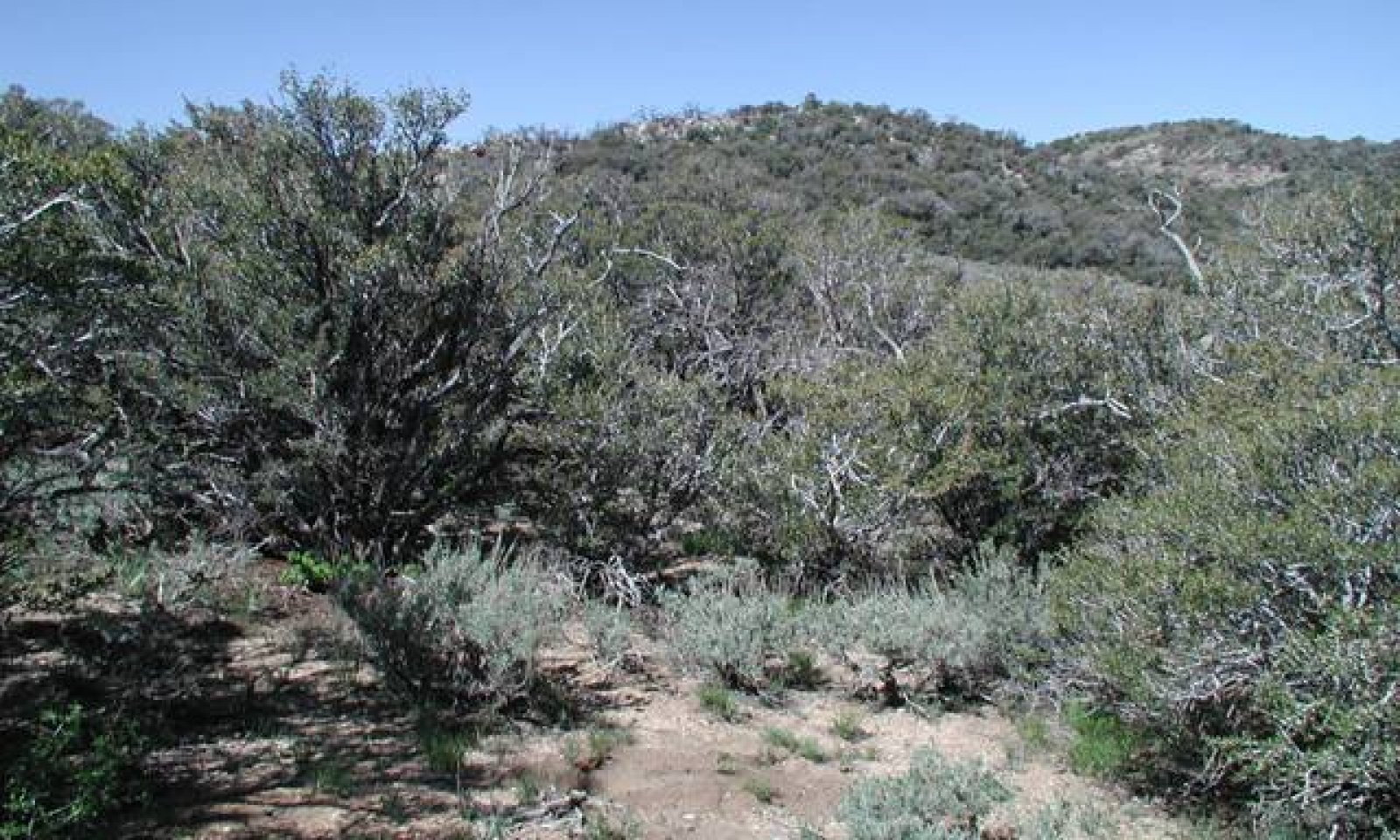
The reference plant community is characterized by an overstory of woody shrubs with an understory of perennial grasses and forbs. The representative plant community is dominated by curlleaf mountain mahogany. Mountain big sagebrush, and Letterman and western needlegrasses are other important species associated with this site. Potential vegetative composition is about 20% grasses, 5% forbs, and 75% shrubs and tree-like shrubs. Approximate crown cover of woody plants ranges from 25 percent to about 45 percent.
Figure 3. Annual production by plant type (representative values) or group (midpoint values)
Table 5. Annual production by plant type
Plant type Low
(lb/acre)Representative value
(lb/acre)High
(lb/acre)Shrub/Vine 1500 2625 3375 Grass/Grasslike 400 700 900 Forb 100 175 225 Total 2000 3500 4500 Additional community tables
Table 6. Community 1.1 plant community composition
Group Common name Symbol Scientific name Annual production () Foliar cover (%) Grass/Grasslike1 Primary Perennial Grasses 226–900 Letterman's needlegrass ACLE9 Achnatherum lettermanii 113–338 – western needlegrass ACOC3 Achnatherum occidentale 113–338 – Cusick's bluegrass POCU3 Poa cusickii 0–56 – muttongrass POFE Poa fendleriana 0–56 – Sandberg bluegrass POSE Poa secunda 0–56 – 2 Secondary Perennial Grasses/Grasslikes 90–360 pine needlegrass ACPI2 Achnatherum pinetorum 23–90 – Thurber's needlegrass ACTH7 Achnatherum thurberianum 23–90 – mountain brome BRMA4 Bromus marginatus 23–90 – basin wildrye LECI4 Leymus cinereus 23–90 – spike fescue LEKI2 Leucopoa kingii 23–90 – rock melicgrass MEST Melica stricta 23–90 – Forb3 Perennial Forbs 90–360 tapertip hawksbeard CRAC2 Crepis acuminata 23–90 – lupine LUPIN Lupinus 23–90 – skeletonplant LYGOD Lygodesmia 23–90 – Shrub/Vine4 Primary Shrubs 2790–3510 curl-leaf mountain mahogany CELE3 Cercocarpus ledifolius 2700–3150 – mountain big sagebrush ARTRV Artemisia tridentata ssp. vaseyana 90–360 – 5 Secondary Shrubs 1–225 yellow rabbitbrush CHVI8 Chrysothamnus viscidiflorus 45–90 – rockspirea HODU Holodiscus dumosus 45–90 – antelope bitterbrush PUTR2 Purshia tridentata 45–90 – currant RIBES Ribes 45–90 – mountain snowberry SYOR2 Symphoricarpos oreophilus 45–90 – Tree6 Trees 5–20 white fir ABCO Abies concolor 1–5 – lodgepole pine PICO Pinus contorta 1–5 – limber pine PIFL2 Pinus flexilis 1–5 – Jeffrey pine PIJE Pinus jeffreyi 1–5 – Interpretations
Animal community
Livestock Interpretations:
This site is suited to livestock grazing. Grazing management should be keyed to Letterman's and western needlegrass production. Mountain big sagebrush is eaten by domestic sheep and cattle, but has long been considered to be of low palatability to domestic livestock, a competitor with more desirable species. Letterman’s needlegrass begins growth early in the year and remains green throughout the relatively long growing season, thus, making it valuable forage for livestock. Muttongrass is excellent forage for domestic livestock especially in the early spring. Muttongrass begins growth in late winter and early spring, which makes it available before many other forage plants. Cusick's bluegrass makes up only a small proportion of the biomass of the sagebrush communities in which it lives, but it is often taken preferentially by cattle, especially early in the season. Canby’s bluegrass is a palatable species, but its production is closely tied to weather conditions. It produces little forage in drought years, making it a less dependable food source than other perennial bunchgrasses. Sandberg bluegrass is a palatable species, but its production is closely tied to weather conditions. It produces little forage in drought years, making it a less dependable food source than other perennial bunchgrasses.
Stocking rates vary over time depending upon season of use, climate variations, site, and previous and current management goals. A safe starting stocking rate is an estimated stocking rate that is fine tuned by the client by adaptive management through the year and from year to year.
Wildlife Interpretations:
Curlleaf mountainmahogany is good forage for all classes of browsing animals in both summer and winter; it is one of the few browse species that meets or exceeds the protein requirements for wintering big game animals. In mature stands, much of curlleaf mountainmahogany foliage is out of reach of browsing animals but provides excellent winter cover. Curlleaf mountainmahogany stands provide hiding and thermal cover for a variety of wildlife species. Mountain big sagebrush is highly preferred and nutritious winter forage for mule deer. Letterman's needlegrass provides valuable forage for many species of wildlife. It is consumed by mule deer. This species begins growth early in the year and like most needlegrasses it remains green throughout a relatively long growing season. This pattern of development enables animals to use Letterman's needlegrass when many other grasses are unavailable. It is grazed in early spring before fruits have developed as it becomes less palatable when mature. It is usually grazed in the fall only if the fruits are softened by rain. Letterman's needlegrass provides some cover for small birds and mammals. Deer and elk make heavy use of muttongrass, especially in early spring when other green forage is scarce. Depending upon availability of other nutritious forage, deer may use muttongrass in all seasons. Muttongrass cures well and is an important fall and winter deer food in some areas. Deer, elk, and mountain goat also use Cusick's bluegrass early in the season. The value of Cusick's bluegrass as cover for small animals has been rated as poor to fair. Canby’s bluegrass is desirable for pronghorn antelope and mule deer in the spring and preferable in the spring, summer, and fall for elk and desirable as part of their winter range. Sandberg bluegrass is desirable for pronghorn antelope and mule deer in the spring and preferable in the spring, summer, and fall for elk and desirable as part of their winter range.Hydrological functions
Permeability is moderately rapid to rapid.
Other products
Curlleaf mountain-mahogany wood burns slowly, it was the preferred charcoal wood used for smelting ores in the nineteenth century. It is also highly prized as a barbecue fuel. Because of its tolerance to heat and drought, curlleaf mountain-mahogany can be used for water-efficient landscaping in arid environments.
Native people used mountain big sagebrush leaves and branches for medicinal teas, and the leaves as a fumigant. Bark was woven into mats, bags and clothing.Other information
Curlleaf mountain-mahogany may be planted to help stabilize soil in disturbed areas such as road cuts and mine spoils. Curlleaf mountain-mahogany may be seeded to improve range, although shrub seedlings may exhibit low seedling vigor and slow initial growth rates.
Mountain big sagebrush is easily propagated from seed under greenhouse, nursery, and common garden conditions and has been successfully seeded directly into field sites.
Letterman's needlegrass has been used successfully in revegetating mine spoils. This species also has good potential for erosion control.Supporting information
Type locality
Location 1: Alpine County, CA Township/Range/Section T8N R23E S36 Latitude 38° 29′ 39″ Longitude 119° 24′ 28″ General legal description Toyiabe National Forest.Toiyabe National Forest, 1.5 miles north of the mouth to South Fork of Rock Creek. Other references
Fire Effects Information System (Online; http://www.fs.fed.us/database/feis/plants/).
USDA-NRCS Plant Database (Online; http://plants.usda.gov/).Contributors
ALC/GKB
Rangeland health reference sheet
Interpreting Indicators of Rangeland Health is a qualitative assessment protocol used to determine ecosystem condition based on benchmark characteristics described in the Reference Sheet. A suite of 17 (or more) indicators are typically considered in an assessment. The ecological site(s) representative of an assessment location must be known prior to applying the protocol and must be verified based on soils and climate. Current plant community cannot be used to identify the ecological site.
Author(s)/participant(s) Patti Novak-Echenique Contact for lead author State Rangeland Management Specialist Date 07/18/2013 Approved by Approval date Composition (Indicators 10 and 12) based on Annual Production Indicators
-
Number and extent of rills:
Rills are none to rare on this site. Rock fragments armor the surface. If rills are present, they occur on slopes >20%. -
Presence of water flow patterns:
Water flow patterns are none to rare on this site due to short slope lengths. They may occur on steeper slopes (20% gradient) in areas recently subjected to intense summer convection storms or rapid snowmelt. -
Number and height of erosional pedestals or terracettes:
Pedestals are none to rare. A few may occur in water flow patterns. -
Bare ground from Ecological Site Description or other studies (rock, litter, lichen, moss, plant canopy are not bare ground):
Bare ground 10-20% depending on amount of surface rock fragments. -
Number of gullies and erosion associated with gullies:
None -
Extent of wind scoured, blowouts and/or depositional areas:
None -
Amount of litter movement (describe size and distance expected to travel):
Fine litter (foliage from grasses and annual & perennial forbs) expected to move distance of slope length during intense summer convection storms or rapid snowmelt events. Persistent litter (large woody material) will remain in place except during large rainfall events. -
Soil surface (top few mm) resistance to erosion (stability values are averages - most sites will show a range of values):
Soil stability values should be 3 to 6 on most soil textures found on this site. (To be field tested.) -
Soil surface structure and SOM content (include type of structure and A-horizon color and thickness):
Surface structure is fine granular or medium subangular blocky. Soil surface colors are dark grayish browns and soils are typified by a mollic epipedon. Organic matter of the surface 2 to 4 inches is typically 1 to 3 percent. Organic matter content can be more or less depending on micro-topography. -
Effect of community phase composition (relative proportion of different functional groups) and spatial distribution on infiltration and runoff:
The tree-like canopy of curlleaf mountain mahogany and tall shrubs break raindrop impact and provide opportunity for snow catch and accumulation on site. Deep-rooted perennial bunchgrasses (i.e. needlegrasses) slow runoff and increase infiltration. -
Presence and thickness of compaction layer (usually none; describe soil profile features which may be mistaken for compaction on this site):
Compacted layers are none. Subsoil subangular blocky structure or argillic horizons are not to be interpreted as compacted layers. -
Functional/Structural Groups (list in order of descending dominance by above-ground annual-production or live foliar cover using symbols: >>, >, = to indicate much greater than, greater than, and equal to):
Dominant:
Tree-like shrubs (mountain mahogany)> deep-rooted, cool season, perennial bunchgrassesSub-dominant:
associated shrubs > deep-rooted, cool season perennial forbs > shallow-rooted, cool season, perennial grasses> fibrous, shallow-rooted, cool season, perennial and annual forbsOther:
evergreen treesAdditional:
-
Amount of plant mortality and decadence (include which functional groups are expected to show mortality or decadence):
Dead branches within individual shrubs are common and standing dead shrub canopy material may be as much as 25% of total woody canopy; some of the mature bunchgrasses (<10%) have dead centers. Mortality of mountain mahogany is usually the result of insect infestation or fire. -
Average percent litter cover (%) and depth ( in):
Between plant interspaces and under canopy up to 60% and litter depth is ± ½ inch. -
Expected annual annual-production (this is TOTAL above-ground annual-production, not just forage annual-production):
Production includes overstory and understory: normal or average growing season (through June) ± 3500 lbs/ac; ranges from 2000 lbs/ac for unfavorable years to 4500 lbs/ac for favorable years. -
Potential invasive (including noxious) species (native and non-native). List species which BOTH characterize degraded states and have the potential to become a dominant or co-dominant species on the ecological site if their future establishment and growth is not actively controlled by management interventions. Species that become dominant for only one to several years (e.g., short-term response to drought or wildfire) are not invasive plants. Note that unlike other indicators, we are describing what is NOT expected in the reference state for the ecological site:
Potential invaders include cheatgrass and bulbous bluegrass. -
Perennial plant reproductive capability:
All functional groups should reproduce in average (or normal) and above average growing season years. Reduced growth and reproduction occur during extreme or extended drought periods.
Print Options
Sections
Font
AAAAOther
PrintThe Ecosystem Dynamics Interpretive Tool is an information system framework developed by the USDA-ARS Jornada Experimental Range, USDA Natural Resources Conservation Service, and New Mexico State University.
Accessibility statement


