
Natural Resources
Conservation Service
-
Search


Major Land Resource Area or ecological site by name and/or ID.
PreviousSectionsNextGeneral information
Draft. A draft ecological site description is either incomplete or has not undergone quality control and quality assurance review.
Associated sites
R022AY015NV STREAMBANK
R022AY017NV SEMI-WET MEADOW
R022AY018NV DRY MEADOW
Table 1. Dominant plant species
Tree Not specified
Shrub Not specified
Herbaceous (1) Carex nebrascensis
(2) Deschampsia caespitosaPhysiographic features
This site occurs on poorly drained inset fans along perennial streams and adjacent to springs and seeps. Slopes range from 0 to 30 percent, but slope gradients of 4 to 15 are most typical. Elevations are 6000 to 11,500 feet.
Table 2. Representative physiographic features
Landforms (1) Flood plain
(2) Stream terrace
(3) Inset fan
Flooding duration Very brief (4 to 48 hours) to brief (2 to 7 days) Flooding frequency Occasional to rare Ponding duration Long (7 to 30 days) Ponding frequency None to frequent Elevation 6000 – 11500 ft Slope 0 – 30 % Ponding depth 0 in Water table depth 5 – 72 in Aspect Aspect is not a significant factor Climatic features
The climate on this site is subhumid-continental, characterized by cold, moist winters, and cool, dry summers. The average annual precipitation ranges from 16 to 55 inches, mostly occurring as snow. The mean annual air temperature ranges from 36 to 45 degrees F. The average frost free growing season ranges from 30 to 70 days.
Table 3 Representative climatic features
Frost-free period (average) 70 days Freeze-free period (average) 0 days Precipitation total (average) 60 in BarLineFigure 1. Monthly precipitation range
BarLineFigure 2. Monthly average minimum and maximum temperature
">Influencing water features
There are springs, seeps and perennial streams associated with this site.
Soil features
The soils associated with this site are very deep and are very poorly to poorly drained. Surface layers are typically very dark, medium textured with high to very high organic matter content, with redox features present. Subsoil material is typically stratified, but when averaged is typically moderately coarse to moderate textured. These soils are typically saturated near the surface throughout the growing season. The near surface saturated soil condition is conducive to the growth of species adapted for saturated conditions, and is the dominant soil factor in determining the vegetative community. The soil series associated with this site are Hopeval, Lavaspring and Wetbag.
Table 4. Representative soil features
Surface texture (1) Mucky loam
(2) Peaty clay
Family particle size (1) Loamy
Drainage class Poorly drained Permeability class Moderate to very slow Soil depth 60 in Surface fragment cover <=3" 0 – 6 % Surface fragment cover >3" Not specified Available water capacity
(0-40in)5.3 – 7 in Calcium carbonate equivalent
(0-40in)Not specified Electrical conductivity
(0-40in)Not specified Sodium adsorption ratio
(0-40in)Not specified Soil reaction (1:1 water)
(0-40in)5.6 – 7.3 Subsurface fragment volume <=3"
(Depth not specified)0 – 8 % Subsurface fragment volume >3"
(Depth not specified)0 – 2 % Ecological dynamics
Wet meadow development along riparian areas is driven by the magnitude and frequency of flooding, and valley and substrate type. Seasonally high water tables are critical for the maintenance of ecological integrity., The seasonal and episodic flooding erode and/or deposit sediment resulting in complex patterns of soil development which subsequently have a strong influence on the distribution of the vegetation.
Fire Ecology:
Fire in wet meadow communities often only top-kills plants. Prescribed fires are most effective in late summer, early fall, or during dry years when the water is below the soil surface. The sedges have deep buried rhizomes which usually survive all but the most severe fires. Nebraska sedge has deep buried rhizomes which usually survive all but the most severe fires. Fire consumes the aboveground tissue of beaked sedge, top-killing the plant. The rhizomes, however, survive most fires, even those that consume organic soils. Tufted hairgrass generally survives all but the most severe fires. It usually sprouts from the root crown after aerial portions are burned. Tufts formed by the leaves often protect basal buds from fire damage. Tufted hairgrass seeds occur in the seedbank; after fire tufted hairgrass may regenerate from soil-stored seed. Tufted hairgrass culms and leaves are often killed by fire, though dense tufts may protect some green biomass during low-severity fire. Baltic rush is fire tolerant when dormant and top-killed by fire during the growing season. It establishes after fire through seed and/or lateral spread by rhizomes.State and transition model
More interactive model formats are also available. View Interactive Models
Click on state and transition labels to scroll to the respective textEcosystem states
State 1 submodel, plant communities
State 1
Reference StateCommunity 1.1
Reference Plant Community
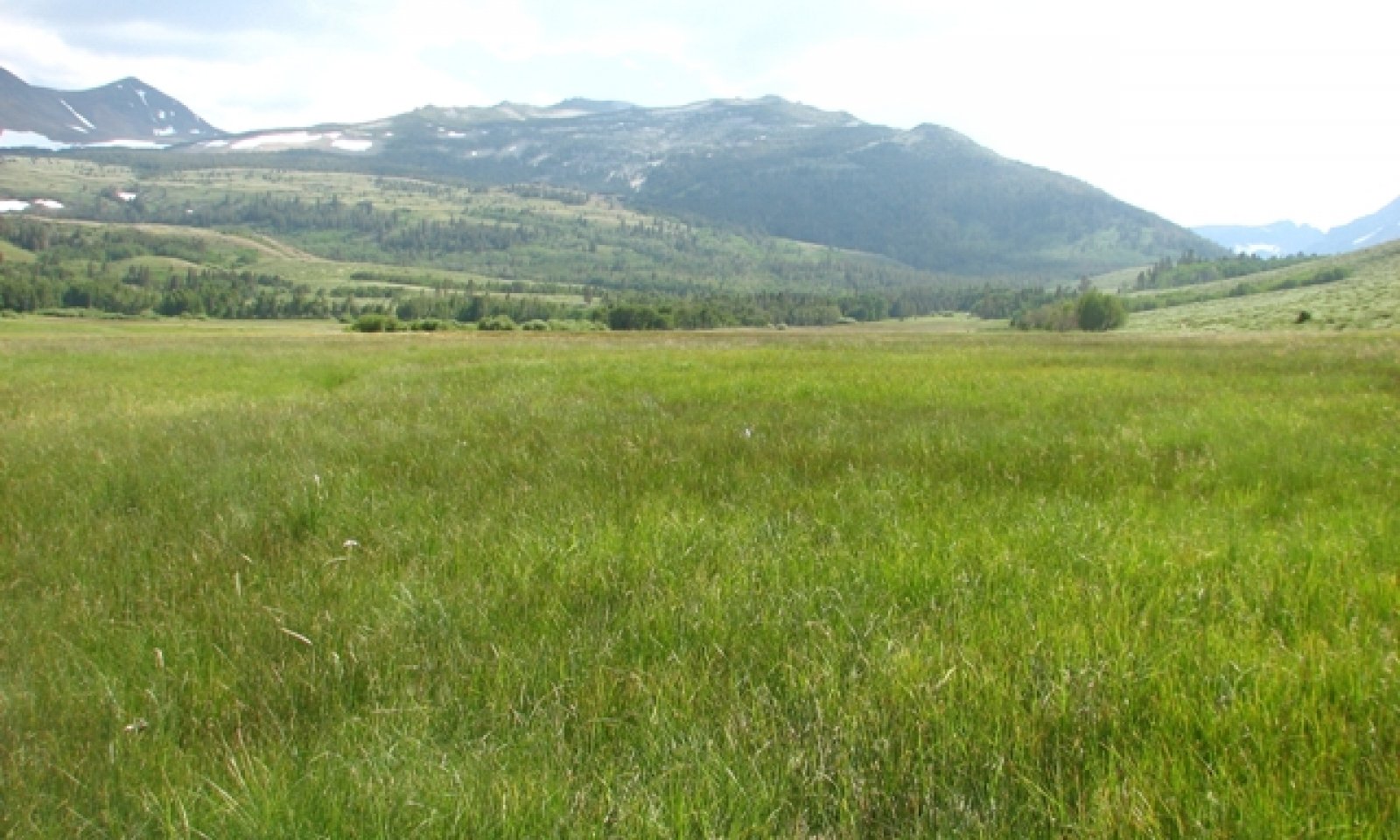
The reference plant community is dominated by a dense stand of perennial grasses, grass-like plants and forbs. The representative plant community is dominated by Nebraska sedge and tufted hairgrass. Potential vegetative composition is about 95% grasses and grasslike plants and 5% forbs. Approximate ground cover (basal and crown) is 75 to 90 percent.
Figure 3. Annual production by plant type (representative values) or group (midpoint values)
Table 5. Annual production by plant type
Plant type Low
(lb/acre)Representative value
(lb/acre)High
(lb/acre)Grass/Grasslike 2850 3325 4275 Forb 150 175 225 Total 3000 3500 4500 Additional community tables
Table 6. Community 1.1 plant community composition
Group Common name Symbol Scientific name Annual production () Foliar cover (%) Grass/Grasslike1 Primary Perennial Grasses/Grasslikes 2063–3080 Nebraska sedge CANE2 Carex nebrascensis 1500–2700 – slenderbeak sedge CAAT3 Carex athrostachya 437–525 – western inflated sedge CAEX5 Carex exsiccata 437–525 – Nebraska sedge CANE2 Carex nebrascensis 437–525 – analogue sedge CASI2 Carex simulata 437–525 – tufted hairgrass DECE Deschampsia cespitosa 175–525 – fewflower spikerush ELQU2 Eleocharis quinqueflora 70–175 – analogue sedge CASI2 Carex simulata 0–5 – western inflated sedge CAEX5 Carex exsiccata 0–5 – smallwing sedge CAMI7 Carex microptera 0–5 – 2 Secondary Perennial Grasses/Grasslikes 175–525 nodding brome BRAN Bromus anomalus 18–105 – slenderbeak sedge CAAT3 Carex athrostachya 18–105 – smallwing sedge CAMI7 Carex microptera 18–105 – meadow barley HOBR2 Hordeum brachyantherum 18–105 – straightleaf rush JUOR Juncus orthophyllus 18–105 – pullup muhly MUFI2 Muhlenbergia filiformis 18–105 – mat muhly MURI Muhlenbergia richardsonis 18–105 – Kentucky bluegrass POPRP2 Poa pratensis ssp. pratensis 18–105 – Forb3 Perennial Forbs 175–525 common yarrow ACMI2 Achillea millefolium 35–70 – Chamisso arnica ARCHF Arnica chamissonis ssp. foliosa 35–70 – Brewer's bittercress CABR6 Cardamine breweri 35–70 – largeleaf avens GEMA4 Geum macrophyllum 35–70 – Rocky Mountain iris IRMI Iris missouriensis 35–70 – primrose monkeyflower MIPR Mimulus primuloides 35–70 – water minerslettuce MOCH Montia chamissoi 35–70 – slender cinquefoil POGR9 Potentilla gracilis 35–70 – plantainleaf buttercup RAAL Ranunculus alismifolius 35–70 – Oregon saxifrage SAOR2 Saxifraga oregana 35–70 – water ragwort SEHY2 Senecio hydrophilus 35–70 – longstalk clover TRLO Trifolium longipes 35–70 – cows clover TRWO Trifolium wormskioldii 35–70 – American speedwell VEAM2 Veronica americana 35–70 – pullup muhly MUFI2 Muhlenbergia filiformis 0–20 – mat muhly MURI Muhlenbergia richardsonis 0–20 – Interpretations
Animal community
Livestock Interpretations:
This site is suited to livestock grazing. Grazing management should be keyed to Nebraska sedge and tufted hairgrass production. The palatability of sedges varies with the amount and distribution of palatable grasses and other plants associated with it, with the season of year, and with the amount of moisture in the soil. As a rule, it is fair forage for sheep and fairly good to good for cattle. Unless the soil is too boggy, cattle readily graze the moist areas where sedges grows. It is also produces a large volume of meadow hay for winter livestock feeding. Tufted hairgrass provides good to excellent forage for all classes of livestock. Tufted hairgrass is a preferred forage species, consistently grazed by sheep. It is often an abundant source of forage throughout its growing season. Baltic rush is described as a fair to good forage species for cattle. On average, Baltic rush’s palatability is considered medium to moderately low. Baltic rush is considered palatable early in the growing season when plants are young and tender, but as stems mature and toughen palatability declines.
Stocking rates vary over time depending upon season of use, climate variations, site, and previous and current management goals. A safe starting stocking rate is an estimated stocking rate that is fine tuned by the client by adaptive management through the year and from year to year.
Wildlife Interpretations:
During the growing season, mule deer and bighorn sheep forage on sedges. Tufted hairgrass is also a preferred forage species, consistently grazed by wildlife. Baltic rush provides food for several wildlife species and waterfowl. Baltic rush is an important cover species for a variety of small birds, upland game birds, birds of prey, and waterfowl.Hydrological functions
Runoff is high to very high. Permeability is moderate to very slow.
Other products
The stems of Baltic rush were historically used by Native Americans as a foundation for coiled basketry.
Other information
Sedges have a high potential for biomass production and long-term revegetation, and medium potential for erosion control and short-term revegetation. Its establishment requirements are medium to high. Sod from sedges rapidly recolonizes disturbed sites by rhizome expansion. Its rhizomes form dense networks that are effective in stabilizing streambanks and preventing soil erosion.
Tufted hairgrass has a broad ecological range and is useful for revegetation, particularly on disturbances at high elevation or high latitude. Tufted hairgrass occurs on acidic or pyritic mine spoils at high elevations throughout the western United States. It grows at a medium rate compared to other grasses used at these sites; it has a poor rate of spread. Tufted hairgrass has good competitive ability compared to other plants evaluated for high latitude revegetation. It has low to medium potential for short-term revegetation; it has medium to high potential for long-term revegetation. It is a valuable soil stabilizer, especially in wet, acid locations.
Tufted hairgrass has been successfully established by seeding on alpine disturbances. Seeds from locally adapted populations have been most successful. For disturbances on well-developed soils that contain minimum amounts of toxic substances, seeds can be selected from a broad range of relatively well-adapted populations. On sites with limiting spoil characteristics, selection from metal and/or acid tolerant populations is more successful. Some tufted hairgrass populations are highly tolerant of lead, zinc, copper, or manganese contaminated tailings. Late fall seeding is most successful; seedling establishment is improved if seeds are exposed to cold dormancy over winter. Baltic rushs production of deep and fibrous roots originating from a mass of coarse and creeping rhizomes makes it a valuable species for stabilizing streambanks and protecting against soil erosion.Supporting information
Type locality
Location 1: Alpine County, CA Township/Range/Section T11N R19E S19 Latitude 38° 46′ 41″ Longitude 119° 55′ 41″ General legal description Toiyabe National Forest, approximately 0.3 miles from Hope Valley. Other references
Fire Effects Information System (Online; http://www.fs.fed.us/database/feis/).
USDA-NRCS Plant Database (Online; http://plants.usda.gov/).Contributors
ALC/GKB
Rangeland health reference sheet
Interpreting Indicators of Rangeland Health is a qualitative assessment protocol used to determine ecosystem condition based on benchmark characteristics described in the Reference Sheet. A suite of 17 (or more) indicators are typically considered in an assessment. The ecological site(s) representative of an assessment location must be known prior to applying the protocol and must be verified based on soils and climate. Current plant community cannot be used to identify the ecological site.
Author(s)/participant(s) Contact for lead author Date Approved by Approval date Composition (Indicators 10 and 12) based on Annual Production Indicators
-
Number and extent of rills:
-
Presence of water flow patterns:
-
Number and height of erosional pedestals or terracettes:
-
Bare ground from Ecological Site Description or other studies (rock, litter, lichen, moss, plant canopy are not bare ground):
-
Number of gullies and erosion associated with gullies:
-
Extent of wind scoured, blowouts and/or depositional areas:
-
Amount of litter movement (describe size and distance expected to travel):
-
Soil surface (top few mm) resistance to erosion (stability values are averages - most sites will show a range of values):
-
Soil surface structure and SOM content (include type of structure and A-horizon color and thickness):
-
Effect of community phase composition (relative proportion of different functional groups) and spatial distribution on infiltration and runoff:
-
Presence and thickness of compaction layer (usually none; describe soil profile features which may be mistaken for compaction on this site):
-
Functional/Structural Groups (list in order of descending dominance by above-ground annual-production or live foliar cover using symbols: >>, >, = to indicate much greater than, greater than, and equal to):
Dominant:
Sub-dominant:
Other:
Additional:
-
Amount of plant mortality and decadence (include which functional groups are expected to show mortality or decadence):
-
Average percent litter cover (%) and depth ( in):
-
Expected annual annual-production (this is TOTAL above-ground annual-production, not just forage annual-production):
-
Potential invasive (including noxious) species (native and non-native). List species which BOTH characterize degraded states and have the potential to become a dominant or co-dominant species on the ecological site if their future establishment and growth is not actively controlled by management interventions. Species that become dominant for only one to several years (e.g., short-term response to drought or wildfire) are not invasive plants. Note that unlike other indicators, we are describing what is NOT expected in the reference state for the ecological site:
-
Perennial plant reproductive capability:
Print Options
Sections
Font
AAAAOther
PrintThe Ecosystem Dynamics Interpretive Tool is an information system framework developed by the USDA-ARS Jornada Experimental Range, USDA Natural Resources Conservation Service, and New Mexico State University.
Accessibility statement


