
Natural Resources
Conservation Service
-
Search


Major Land Resource Area or ecological site by name and/or ID.
PreviousSectionsNextGeneral information
Draft. A draft ecological site description is either incomplete or has not undergone quality control and quality assurance review.
Table 1. Dominant plant species
Tree (1) Populus tremuloides
Shrub (1) Symphoricarpos
Herbaceous (1) Bromus marginatus
(2) Elymus trachycaulus ssp. trachycaulusPhysiographic features
This forest site occurs on smooth to concave mountain sideslopes and moraines of mostly northern exposures. Slopes range from 4 to 50 percent, but slopes of 15 to 30 percent are most typical. Elevations range from 5500 feet to 10,000 feet.
Table 2. Representative physiographic features
Landforms (1) Moraine
(2) Mountain slope
Elevation 5500 – 10000 ft Slope 4 – 50 % Aspect N Climatic features
The climate is subhumid-continental with cold, moist winters and cool, dry summers. The mean annual precipitation is 20 to 45 inches, the mean annual temperature is 36 to 45 degrees F., and the frost-free period is 30 to 70 days. Climate data used to support this section were derived from PRISM and is not specifically tied to any dominant climate station.
Table 3 Representative climatic features
Frost-free period (average) 70 days Freeze-free period (average) 0 days Precipitation total (average) 50 in BarLineFigure 1. Monthly precipitation range
BarLineFigure 2. Monthly average minimum and maximum temperature
">Influencing water features
There are no influencing water features associated with this site.
Soil features
The soils associated with this site are deep to very deep, well drained soils that formed in till derived from igneous and metamorphic rocks or colluvium from granodiorite or tuff, tuff-breccia, and andesite. The soil profiles are modified with 35 to 80 percent rock fragments. The soils have mollic epipedons and an argillic horizon from 5 to 60 inches. The soils are usually moist in the moisture control section during late fall, winter and spring and dry from July through early October. The moisture regime is xeric and the temperature regime is cryic. Soil series associated with this site include Aspetill, Aspocket and Lostcannon.
CA693 Tahoe Basin Area, California and Nevada
7401;Burnlake-Roadcat association, 4 to 30 percent slopes;Aspetill
9131;Lithnip-Meiss-Hawkinspeak association, 30 to 75 percent slopes;Aspocket
CA724 Eldorado National Forest Area, California, Parts of Alpine, Amador, El Dorado, and Placer Counties
100ty;Lithnip-Hawkinspeak-Rock outcrop complex, 30 to 75 percent slopes;Aspocket
103ty;Lithnip-Meiss-Hawkinspeak association, 30 to 75 percent slopes;Aspocket
CA729 Toiyabe National Forest Area, California
100;Lithnip-Hawkinspeak-Rock outcrop complex, 30 to 75 percent slopes;Aspocket
102;Lithnip-Rock outcrop-Fishsnooze complex, 8 to 30 percent slopes;Aspocket
103;Lithnip-Meiss-Hawkinspeak association;Aspocket
120;Toiyabe-Corbett-Rock outcrop complex, 30 to 50 percent slopes;Lostcannon
121;Toiyabe-Corbett-Rock outcrop complex, 8 to 30 percent slopes;Lostcannon
122;Toiyabe-Corbett-Rock outcrop complex, 50 to 75 percent slopes;Lostcannon
131;Sofgran-Temo-Shalgran association;Lostcannon
132;Sofgran-Temo-Rock outcrop association;Aspetill
170;Burnlake-Roadcat association;Aspetill
172;Stumpatil very gravelly sandy loam, 30 to 50 percent slopes;Aspetill
173;Stumpatil very gravelly sandy loam, 8 to 30 percent slopes;Aspetill
174;Stumpatil-Sonorapass-Snowtell association;Aspetill
211;Waterpeak-Buggin-Rock outcrop association;Lostcannon
212;Waterpeak-Sofgran-Temo association;Lostcannon
222;Hardtil-Alpineco-Rock outcrop complex, warm, 8 to 30 percent slopes;Aspetill
230;Hawkinspeak-Thiefridge-Angelwhine association;Aspocket
231;Hawkinspeak association;Aspocket
232;Hawkinspeak-Hawkridge association;Aspocket
260;Hawkridge-Hawkinspeak association;Aspocket
261;Hawkridge-Lithnip-Hawkinspeak association;Aspocket
320;Franktown-Rock outcrop complex, 50 to 75 percent slopes;Aspocket
340;Aspocket association;Aspocket
350;Leroman-Chenhigh-Celeridge association;Aspocket
360;Monibasin-Vermdig association;Aspocket
370;Celeridge-Gerdog-Loope association;Aspocket
380;Joecut-Celeridge-Gerdog association;Aspocket
381;Joecut-Heenlake association;Aspocket
382;Joecut association;Aspocket
390;Heenlake-Loope-Chenhigh association;Aspocket
391;Heenlake-Loope-Dogbed association;Aspocket
420;Buggin-Rock outcrop complex, 30 to 75 percent slopes;Lostcannon
450;Carshal-Loope-Rock outcrop complex, 15 to 75 percent slopes;Aspocket
470;Sumeadow-Lostridge association;Aspocket
471;Sumeadow association;Aspocket
480;Aspetill association;Aspetill
481;Aspetill association, very stony;Aspetill
490;Cloudburst-Murain association;Aspetill
491;Cloudburst-Murain-Hardtil association;Aspetill
520;Canfire-Crispy-Rock outcrop association;Aspocket
530;Elaero-Lockgate-Granhogany association;Lostcannon
532;Elaero-Granidry-Rock outcrop association;Lostcannon
540;Lostcannon association;Lostcannon
560;Dunderberg-Conwayridge association;Aspetill
561;Dunderberg association;Aspetill
570;Angelwhine-Hawkinspeak-Hawkridge association;Aspocket
580;Murain-Shorthike association;Aspetill
581;Murain association;Aspetill
590;Loope-Heenlake-Carshal association;Aspocket
591;Loope-Heenlake-Celeridge association;Aspocket
600;Snowtell-Sonorapass-Rock outcrop complex, 8 to 30 percent slopes;Lostcannon
610;Forsell-Snowtell-Rock outcrop complex, 8 to 30 percent slopes;Aspetill
611;Forsell-Snowtell-Rock outcrop complex, 30 to 50 percent slopes;Aspetill;Lostcannon
760;Thiefridge-Rock outcrop complex, 30 to 75 percent slopes;Aspocket
770;Sweetmount-Hawkinspeak-Hawkridge association;Aspocket
790;Dab association;Aspocket
791;Dab-Longday-Thiefridge association;Aspocket
792;Dab-Aspocket-Hawkridge association;Aspocket
810;Corbett-Toiyabe-Rock outcrop complex, 15 to 50 percent slopes;Lostcannon
CA732 Inyo National Forest, Western Part, California
232ty;Hawkinspeak-Hawkridge association;Aspocket
470ty;Sumeadow-Lostridge association;Aspocket
CA790 Yosemite National Park, California
102t;Lithnip-Rock outcrop-Fishsnooze complex, 8 to 30 percent slopes, mountains, cryic;Aspocket
NV773 Douglas County Area, Nevada
120;Toiyabe-Corbett-Rock outcrop complex, 30 to 50 percent slopes;Lostcannon
998;Toiyabe-Corbett-Rock outcrop complex, 8 to 30 percent slopes;Lostcannon
1000;Dab-Longday-Thiefridge association;Aspocket
Table 4. Representative soil features
Surface texture (1) Very gravelly sandy loam
(2) Very gravelly coarse sandy loam
(3) Extremely gravelly coarse sandy loam
Family particle size (1) Loamy
Drainage class Well drained Permeability class Moderately slow to moderately rapid Soil depth 40 – 0 in Surface fragment cover <=3" 10 – 25 % Surface fragment cover >3" 2 – 15 % Available water capacity
(0-40in)3.5 – 4.4 in Calcium carbonate equivalent
(0-40in)Not specified Electrical conductivity
(0-40in)Not specified Sodium adsorption ratio
(0-40in)Not specified Soil reaction (1:1 water)
(0-40in)6.1 – 7.3 Subsurface fragment volume <=3"
(Depth not specified)23 – 50 % Subsurface fragment volume >3"
(Depth not specified)5 – 30 % Ecological dynamics
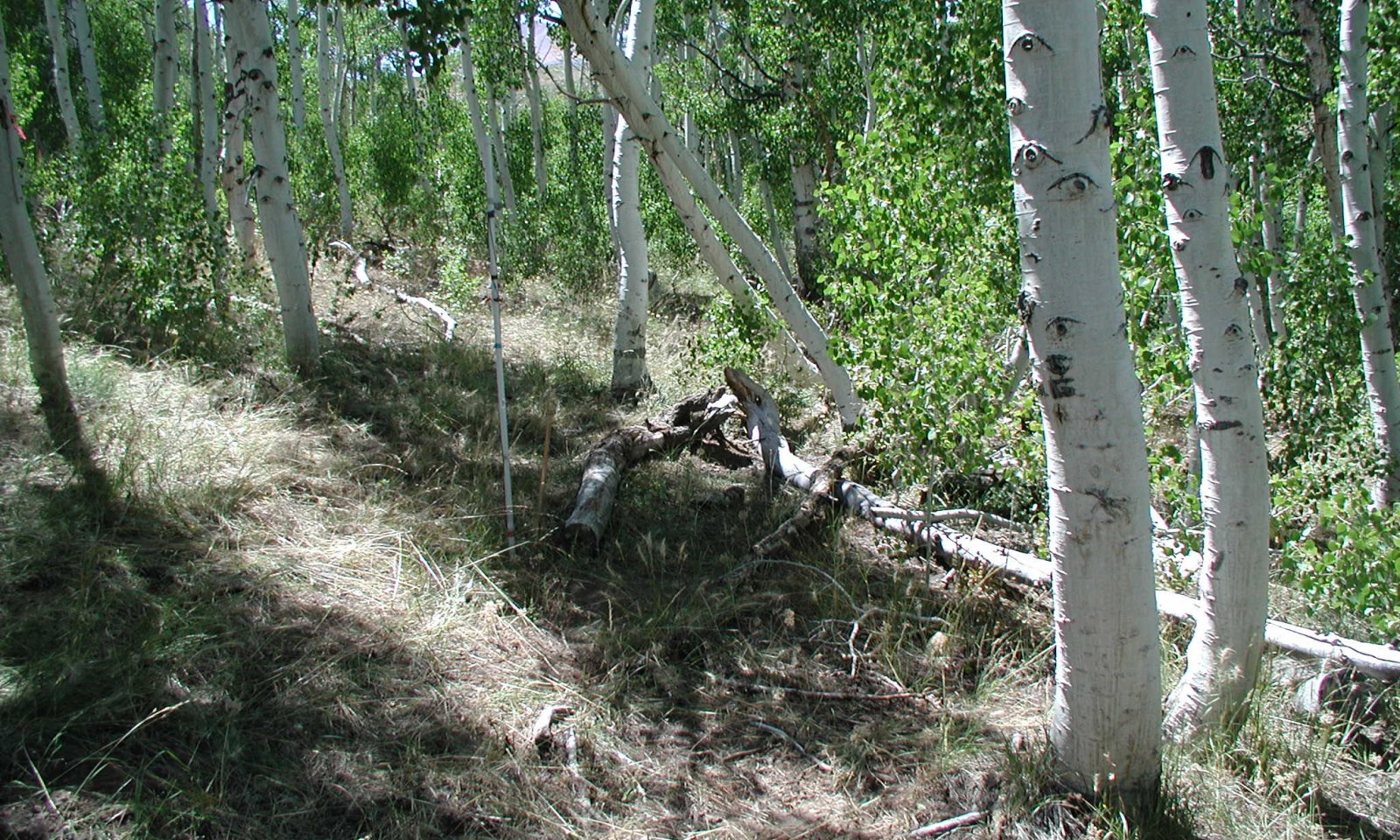
This site is composed of one to several quaking aspen clones, with a common genetic makeup and individual phenological and physiological characteristics. Wildfire is recognized as a natural disturbance that influenced the structure and composition of the climax vegetation of this woodland site. Periodic wildfires prevent over-mature aspen stands and maintain a naturally stratified mosaic of even-aged aspen stands in various stages of successional development. Many aspen stands are even-aged because of the rapid reproduction by suckering after a major disturbance such as fire. In the absence of fire, harvest, or similar events, aspen stands become uneven-aged. Uneven-aged stands form under stable conditions where the overstory gradually disintegrates with disease or age, and is replaced by suckers.
Major Successional Stages of Forest Development:
HERBACEOUS: Vegetation is dominated by grasses and forbs under full sunlight. This stage is experienced after a major disturbance such as fire, root-rot, insect damage, or tree harvest. Following a major disturbance, the root system gives rise to many root suckers, assuming the root system is intact and healthy. Residual trees left following harvest have little or no affect on the composition and production of the herbaceous vegetation.
SHRUB-HERBACEOUS: Herbaceous vegetation dominates the site. Early sucker growth ranges from less than 1 foot to more than 3 feet per year for shoots having good competitive position. If the aspen stand is healthy, these first two stages will only last from one to two years. However, if competing brush and herbaceous plants grow for a full season before aspen suckers emerge, a reduction in sprouting and the eventual growth and survival of the aspen suckers may occur.
SAPLING: In the absence of disturbance, tree seedlings develop into saplings (20 inches to 4.5 feet in height) with a range in canopy cover of about 5 to 15 percent. Vegetation consists of grasses, forbs and a few shrubs in association with tree saplings.
POLE STAGE: As the canopy closes, trees stratify into crown classes quickly, despite genetic uniformity within clones. Aspen stands are self-thinning, especially at young ages. This stage is characterized by rapid growth of the aspen trees, both in height and canopy cover. The visual aspect and vegetal structure are dominated by aspen ranging from about 10 to 20 feet in height, and having a diameter at breast height of about 2 to 4 inches. Understory vegetation is moderately influenced by a tree canopy of about 15 to over 25 percent.
IMMATURE FOREST: Growth of the aspen slows somewhat during this stage. There is a fairly continual adjustment of trees to growing space, and a loss in competitive position of many trees making up the codominant, intermediate and over-topped classes. When competition becomes intense enough to appreciably affect the diameter growth of dominants, mortality quickly reduces the number of trees in the lower crown classes. There are periodic surges in mortality, with a
disproportionate number of trees, mostly those over-topped, dying within a short time. The visual aspect and vegetal structure are dominated by quaking aspen greater than 35 feet in height. Understory vegetation is moderately influenced by a tree overstory canopy of about 20 to 30 percent.
MATURE FOREST: The visual aspect and vegetal structure are dominated by single-story, quaking aspen that have reached
or are near, maximal heights for the site. Growth of aspen continues during this stage. Diameter growth shows recovery with the release of competition previously endured during the immature forest stage. Diameter growth shows recovery with the release of competition previously endured during the immature forest stage. Tree heights range from 40 to over 60 feet, depending upon site and clonal genotype. Trees have developed tall, straight, clear stems with short, narrow, dome-like crowns. Tree canopy cover ranges from 25 to 40 percent. Understory vegetation is strongly influenced by tree competition, overstory shading, and duff accumulation. Relatively shade tolerant shrubs form an open, intermittent layer in the understory. Tall perennial grasses and forbs typically form a continuous layer beneath tree and tall shrub canopy. A lower stratum of small forbs and grasses is always part of the forest floor. Few vegetative shoots and/or saplings of quaking aspen occur in the understory.
OVER-MATURE FOREST: This stage is normally dominated by aspen that have reached maximal heights for the site. Trees have straight, clear stems. In the absence of natural disturbances, the tree canopy on this site can become very dense - often greater than 50 percent. As less light penetrates below the tree canopy, competitive relationships in the understory vegetation are altered. Although plants in the understory of the over-mature forest are shade tolerant, even these species progressively decrease in abundance and productivity as tree canopy cover increases.
Fire Ecology:
Fuels are usually more moist in quaking aspen
stands than in surrounding forest. Crown fires in coniferous forests often drop to the surface in quaking aspen, or may extinguish after burning into quaking aspen only a few meter. Quaking aspen stands often act as natural fuelbreaks during wildfires, and fires
sometimes bypass quaking aspen stands surrounded by conifers. Quaking aspen is highly competitive on burned sites. Even where quaking aspen was a barely detectable component of the prefire vegetation, it often dominates a site after fire. Quaking aspen
has adapted to fire in the following ways.
1. The thin bark has little heat resistance, and quaking aspen is easily top-killed by fire.
2. Root systems of top-killed stems send up a profusion of sprouts for several years after fire.
3. Sprouts grow rapidly by extracting water, nutrients, and photosynthate from an extant root system, and may outcompete other woody
vegetation.
4. Following a fire, a new, even-aged quaking aspen stand can develop within a decade.
5. In contrast to most trees, quaking aspen is self-thinning. Without intervention, a mature forest of healthy trees can develop from dense sprouts.
State and transition model
More interactive model formats are also available. View Interactive Models
Click on state and transition labels to scroll to the respective textEcosystem states
State 1 submodel, plant communities
State 1
Reference StateCommunity 1.1
Reference Plant Community
The reference plant community is the interpretative plant community for this site. The historic climax plant community is dominated by quaking aspen, snowberry, mountain brome and slender wheategrass. Overstory tree canopy composition is 100 percent quaking aspen. An overstory canopy of 20 to 35 percent is assumed to be representative of tree dominance on this site in a pristine environment. Sapling quaking aspen, snowberry and Utah serviceberry are the principal understory shrubs. Slender wheatgrass, mountain brome, Idaho fescue, sweetroot, groundsel, bedstaw and horsemint are common understory plants.
Forest overstory.The visual aspect and vegetal structure are dominated by single-story, quaking aspen that have reached <br /> or are near, maximal heights for the site. Growth of aspen continues during this stage. Diameter growth shows recovery with the release of competition previously endured during the immature forest stage. Diameter growth shows recovery with the release of competition previously endured during the immature forest stage. Tree heights range from 40 to over 60 feet, depending upon site and clonal genotype. Trees have developed tall, straight, clear stems with short, narrow, dome-like crowns. Tree canopy cover ranges from 25 to 40 percent. Understory vegetation is strongly influenced by tree competition, overstory shading, and duff accumulation. Relatively shade tolerant shrubs form an open, intermittent layer in the understory. Tall perennial grasses and forbs typically form a continuous layer beneath tree and tall shrub canopy. A lower stratum of small forbs and grasses is always part of the forest floor. Few vegetative shoots and/or saplings
Forest understory. Understory vegetative composition is about 60 percent grasses, 20 percent forbs and 20 percent shrubs and young trees. Average understory production ranges from 400 to 800 pounds per acre with a medium canopy cover. Understory production includes the total annual production of all species within 4.5 feet of the ground surface.
Figure 3. Annual production by plant type (representative values) or group (midpoint values)
Table 5. Annual production by plant type
Plant type Low
(lb/acre)Representative value
(lb/acre)High
(lb/acre)Grass/Grasslike 240 360 480 Forb 80 120 160 Shrub/Vine 60 90 120 Tree 20 30 40 Total 400 600 800 Additional community tables
Table 6. Community 1.1 plant community composition
Group Common name Symbol Scientific name Annual production () Foliar cover (%) Grass/Grasslike1 Primary Perennial Grasses 180–324 Columbia needlegrass ACNEN2 Achnatherum nelsonii ssp. nelsonii 30–54 – mountain brome BRMA4 Bromus marginatus 30–54 – slender wheatgrass ELTRT Elymus trachycaulus ssp. trachycaulus 30–54 – Idaho fescue FEID Festuca idahoensis 30–54 – muttongrass POFE Poa fendleriana 30–54 – 2 Secondary Perennnial Grasses/Grasslikes 6–30 sedge CAREX Carex 6–30 – Forb3 Perennial Forbs 24–180 nettleleaf giant hyssop AGUR Agastache urticifolia 6–30 – bedstraw GALIU Galium 6–30 – sweetroot OSMOR Osmorhiza 6–30 – ragwort SENEC Senecio 6–30 – Shrub/Vine4 Primary Shrubs 30–54 snowberry SYMPH Symphoricarpos 30–54 – 5 Secondary Shrubs 24–120 Utah serviceberry AMUT Amelanchier utahensis 6–30 – mountain big sagebrush ARTRV Artemisia tridentata ssp. vaseyana 6–30 – currant RIBES Ribes 6–30 – willow SALIX Salix 6–30 – Tree6 Trees 30–54 Interpretations
Animal community
Livestock Interpretations:
This site is suited to cattle and sheep grazing during the summer and early fall. Livestock use quaking aspen communities for forage and shade. Cattle select for understory grasses while sheep tend to select for forbs. Browsing has a direct impact on aspen. Through the early sapling stage, browsing reduces aspen growth, vigor and numbers. Heavy browsing by sheep or deer can eliminate aspen sucker regeneration. Suckers can be drastically reduced or eliminated by big game browsing on winter ranges. Aspen saplings need to attain a minimum height of 55 to 60 inches to avoid destructive browsing by livestock. Harvesting trees under a sound management program for fuelwood, posts or other products, can open up the tree canopy to allow increased production of understory species desirable for grazing and browsing.
Stocking rates vary over time depending upon season of use, climate variations, site, and previous and current management goals. A safe starting stocking rate is an estimated stocking rate that is fine tuned by the client by adaptive management through the year and from year to year.
Example: Sample Calculations using Favorable Year production amounts:
500 lbs of available forage/ac x. 25 (Harvest Efficiency) = 125 lbs forage consumed
125 lbs/790 lbs = .16 AUMs/ac or 6.32 ac/AUM
NOTE: 790 lbs/month for one Animal Unit is used as the baseline for maintenance requirements. This equates to 30 lbs/day of air-dry forage (1000 lb cow at 2.6% of body weight). See NRCS National Range and Pasture Handbook.
Forage Value Rating:
The forage value rating is not an ecological evaluation of the understory. It is a utilitarian rating of the existing understory plants for use by specific kinds of grazing animals. The amount and nature of the understory vegetation in a forestland is highly responsive to the amount and duration of shade provided by the overstory canopy. Significant changes in kinds and abundance of plants occur as the canopy changes, often regardless of grazing use. Some changes occur slowly and gradually as a result of normal changes in tree size and spacing. Other changes occur dramatically and quickly, following intensive woodland harvest, thinning, or fire.
Wildlife Interpretations:
Quaking aspen communities provide important habitat for many species of birds and mammals. This is especially true where these woodlands are the only upland hardwood tree species. Mule deer and elk use aspen woodlands for forage, thermal cover, and escape cover during severe weather and times of harassment. Commonly associated birds using aspen during breeding season include the Western tanager, common nighthawk, mourning dove, Swainson's hawk and various species of bluebird, thrush and flycatcher. Those using aspen during the wintering season include the Ruby-crowned kinglet, Townsend's solitaire, rough-legged hawk, Cooper's hawk, sharp-shinned hawk and various species of finch and waxwing. Those using aspen yearlong or as migrants include the American robin, American kestrel, mountain chickadee, scrub jay, yellow-bellied sapsucker, long-eared owl, screech owl, great-horned owl, California quail, red-tailed hawk, golden eagle, and various species of sparrow, nuthatch and woodpecker. Commonly associated mammals using the aspen community type include various species of shrew, myotis, bat, mouse and vole. Some very common species include deer mouse, Nuttall's cottontail, least chipmunk, Western gray squirrel, bushy-tailed woodrat, raccoon, long-tailed weasel and the North American porcupine. The mountain lion and bobcat use edges and sometimes the interior of the aspen community for hunting.
Wildlife and livestock utilization of quaking aspen communities varies with species composition of the understory and relative age of the quaking aspen stand. Young
stands generally provide the most browse. Quaking aspen crowns can grow out of reach of large ungulates in 6 to 8 years. Although many animals browse quaking aspen year-round, it is especially valuable during fall and winter, when protein levels are high relative to other browse species.
Hydrological functions
Well-stocked quaking aspen stand provides excellent watershed proctection. The trees, the shrub and herbaceous understories, and the
litter of quaking aspen stands provide nearly 100 percent soil cover. Soil cover and the intermixture of herbaceous and woody roots protect soil except during very intense rains.Recreational uses
Aesthetic value is derived from the rich hues and textures of the aspen trees, particularly in the fall. The diverse flora and fauna, and the colorful wildflowers in the summer enhance the beauty of this site. The site offers rewarding opportunities to photographers and for nature study. It has high value for hunting, camping, hiking, picnicking, cross country skiing and family wood gathering. Management of the aspen woodland should include small, irregularly shaped clearcuts that blend into the natural landscape. Harvesting plans should include a mix of even-aged aspen patches in all size classes. Aspen fits well into management for dispersed recreation activities, but does not tolerate concentrated use such as found in established campgrounds. Encouraging concentrated recreation or developing campgrounds within aspen stands can lead to serious damage, including carving on trees, vandalism, destruction or removal of young suckers and trampling and disturbance of the soil.
Wood products
Quaking aspen wood is used primarily for particleboard, especially waferboard and oriented strandboard, and for pulp. Specialty
products from quaking aspen wood include excelsior, matchsticks, and tongue depressors. Quaking aspen pellets are used for fuel.
PRODUCTIVE CAPACITY
This site has a low to medium site quality for tree production. Site index ranges from 35 to 45; Site Class V (Baker, 1925).
Productivity class: 1
CMAI*: 16 to 20 cu ft/ac/yr;
1.1 to 1.4 cu m/hr/yr.
*CMAI: is the culmination of mean annual increment or highest average growth rate of the stand in the units specified.
Basal Area: Aspen 144 sq.ft./acre with average of 9” D.B.H. and average age of 60 years.(H55)
Basal Area: Aspen 160 sq.ft./acre with an average D.B.H of 9” and an average age of 89 years.(H2B)
Basal Area: Aspen 188 sq.ft/acre with an average D.B.H. of 8.6” and an average age of 60 years.(AB264)
Basal Area: Aspen 92 sq.ft./acre with an average D.B.H. of 11”and an average age of 46 years.(AB220)
Fuelwood Production: 3 to 8 cords per acre at 80 years (includes all trees greater than six inches dbh to a top diameter of five inches). There are about 203,000 gross British Thermal Units (BTUs) heat content per cubic foot of quaking aspen wood. Firewood is commonly measured by cord, or a stacked unit equivalent to 128 cubic feet. Solid wood volume in a cord varies, but assuming an average of 75 cubic feet of solid wood per cord, there are about 15.2 million BTUs of heat value in a cord of quaking aspen.
Saw timber: Growth on this site is very slow. Stands must be managed for over 140 years to reach saw timber size. Wood decay increases significantly with these long rotations. Shorter rotations can reduce decay problems but will decrease saw wood yield.
MANAGEMENT GUIDES AND INTERPRETATIONS:
1.LIMITATIONS AND CONSIDERATIONS
a. Potential for sheet and rill erosion is moderate to severe depending on slope.
b. Severe equipment limitations on slopes over 30 percent.
c. Proper spacing is the key to a well managed, multiple use and multi-product aspen woodland.
d. To begin short-rotation management, older stands with larger trees will have to be utilized.
e. Cut residual, unmerchantable, trees to stimulate maximum sucker regeneration and rapid development of a replacement stand – thin resulting sucker stands.
2. ESSENTIAL REQUIREMENTS
a. Adequately protect from high intensity wildfire.
b. Protect soils from accelerated erosion.
c. Apply proper grazing management.
3. SILVICULTURAL PRACTICES
a. Harvest Cutting: Selectively harvest surplus trees to achieve desired spacing. Harvest stands in small blocks of 1/5 to 1/2 acre with slash left in place to shelter emerging aspen suckers from browsing.
1) Clear-Cutting - Clear-cutting is appropriate when the primary management objective is sustained production of forest products, either saw timber or fiber. Cutting sub-merchantable stems along with the merchantable ones will maximize sucker production, minimize the presence of diseased or defective growing stock in the new stand, and avoid suppression of the new crop by residual overstory stems.
2) Partial Cutting - Partial cutting may be feasible in some uneven-aged stands where management objectives require vertical canopy diversity or retention of some overstory; partial cutting may result in enough sprouting to adequately regenerate stands. Individual tree or group selection cutting methods can be applied. Extreme care is necessary to avoid injury to residual stems during logging. Partial cutting is not worthwhile in deteriorated aspen clones where root system die back has reduced suckering.
3) Selective Tree Removal - Remove selected trees on suitable sites to enhance forage production and manage site reproduction.
b. Thinning - Ordinarily, only stands on saw timber sites should be thinned. Pre-commercial thinning may be uneconomical as the low productivity of this site would not justify thinning costs.
c. Protection from Disease - There are no proven forest stand treatments that successfully prevent or control disease in aspen. Maintenance of well-stocked stands, minimizing wounding of stems and control of damaging agents, and harvesting at the proper rotation age are the best management recommendations that can be made today.
d. Protection from Insects - Direct control of insects in aspen forests has not been practical. The environmental side-effects from chemical pesticide spraying usually has not been acceptable in the aspen ecosystem. Maintenance of a well-stocked stand and protection from wounding is the most practical method of coping with insects in the aspen forest.
e. Protection from Mammals - Domestic livestock, wild ungulates, porcupines, rodents and hares utilize aspen as food and can have measurable impacts on some stands. Most animal damage can be prevented by careful husbandry of domestic livestock and by population control of wild game. Because most aspen stands are grazed by cattle and/or sheep and have a significant population of wild ungulates, grazing management and game management are important to aspen communities.
f. Fire Management - Fire is a natural feature of the aspen ecosystem. Fire is considered responsible for the abundance of aspen in the west as well as the even-aged structure of many stands. Without human intervention, fire appears to be necessary for the continued well-being of aspen on sites where natural degeneration of the clone occurs, or where insects or pests are especially harmful to the stand. Fires in aspen generally are infrequent, spread slowly, are of low intensity, and are easy to control. Although aspen forests do not burn readily, aspen trees are extremely sensitive to fire. Even very light fires will kill aspen because the bark is thin and green, and lacks protective corky layers.
Other products
Historically quaking aspen has been used for mine props, posts, bridge planking, flooring, furniture and fuelwood. This tree has a considerable potential for increased utilization. It makes excellent pulp, excelsior, door corestock, paper, particleboard, matchsticks, structural flakeboard, lumber products and boxwood. An undesirable characteristic of the quaking aspen stand is their heavy drain on available water in the soil.
Other information
Aspen propagates almost entirely by vegetative means throughout the Great Basin. Regeneration by seed is very rare, although aspen in this area produce large quantities of viable seed. Aspen seeds require a continually moist seedbed and the dry spring and summers of the Great Basin are not conducive to seedling survival.
An undesirable characteristic of quaking aspen is their heavy drain on available water in the soil.
Table 7. Representative site productivity
Common name Symbol Site index low Site index high CMAI low CMAI high Age of CMAI Site index curve code Site index curve basis Citation quaking aspen POTR5 35 45 16 20 – – – Supporting information
Type locality
Location 1: Mono County, CA Township/Range/Section T5N R23E S4 Latitude 38° 18′ 54″ Longitude 119° 27′ 16″ General legal description Toiyabe National Forest, approximately 0.1 miles from the mouth of Poison Creek T.5N., R.23E., Sec. 4 Latitude 38 degrees 18 minutes 54 seconds Longitude 119 degrees 27 minutes16 seconds NAD 83, Zone 11 Other references
Airola, D. A. 1980. Northeast Interior Zone: Vol. III - Birds & Vol. IV - Mammals. U.S. Gov. Printing Off.: 1980-690-082/26.
Alexander R.R. 1987. Ecology, Silviculture, and Management of the Engelmann Spruce-Subalpine Fir Type in the Central and Southern Rocky Mtns. Ag Hndbk No. 659. Rky Mtn For & Rng Exp Sta, USDA-FS.
Baker, F. S. 1925. Aspen in the Central Rocky Mountain Region. USDA Technical Bulletin 1291.
Cryer, D.H. and Murray, J.E. 1988. Aspen Regeneration and Soils. USDA, Bulletin 1291, 47 p. Washington D.C.
DeByle, N. V., and R.P. Winokur, editors. 1985. Aspen: Ecology and Management in the Western United States. General Technical Report RM-119, Rocky Mtn For & Rng Exp Sta, FS, USDA.
DeByle, N.V., P.J. Urness, and D.L. Blank. 1989. Forage Quality in Burned and Un-burned Aspen Communities. Research Paper INT-404. Inter. Res. Sta., FS, USDA.
Edminster, C., et al. 1982. Volume Tables and Point-Sampling Factors for Aspen in Colorado. Res Paper RM-232, Rocky Mtn For & Rng Exp Sta. USDA-FS.
Eyre, F.H. (editor). 1980. Forest Cover Types of the United States and Canada. Society of American Foresters, Washington.
Fire Effects Information System[Online], http://www.fs.fed.us/database/feis
Plants Database [Online], http://www.plants.usda.gov
Contributors
ALC/GKB
Rangeland health reference sheet
Interpreting Indicators of Rangeland Health is a qualitative assessment protocol used to determine ecosystem condition based on benchmark characteristics described in the Reference Sheet. A suite of 17 (or more) indicators are typically considered in an assessment. The ecological site(s) representative of an assessment location must be known prior to applying the protocol and must be verified based on soils and climate. Current plant community cannot be used to identify the ecological site.
Author(s)/participant(s) Contact for lead author Date Approved by Approval date Composition (Indicators 10 and 12) based on Annual Production Indicators
-
Number and extent of rills:
-
Presence of water flow patterns:
-
Number and height of erosional pedestals or terracettes:
-
Bare ground from Ecological Site Description or other studies (rock, litter, lichen, moss, plant canopy are not bare ground):
-
Number of gullies and erosion associated with gullies:
-
Extent of wind scoured, blowouts and/or depositional areas:
-
Amount of litter movement (describe size and distance expected to travel):
-
Soil surface (top few mm) resistance to erosion (stability values are averages - most sites will show a range of values):
-
Soil surface structure and SOM content (include type of structure and A-horizon color and thickness):
-
Effect of community phase composition (relative proportion of different functional groups) and spatial distribution on infiltration and runoff:
-
Presence and thickness of compaction layer (usually none; describe soil profile features which may be mistaken for compaction on this site):
-
Functional/Structural Groups (list in order of descending dominance by above-ground annual-production or live foliar cover using symbols: >>, >, = to indicate much greater than, greater than, and equal to):
Dominant:
Sub-dominant:
Other:
Additional:
-
Amount of plant mortality and decadence (include which functional groups are expected to show mortality or decadence):
-
Average percent litter cover (%) and depth ( in):
-
Expected annual annual-production (this is TOTAL above-ground annual-production, not just forage annual-production):
-
Potential invasive (including noxious) species (native and non-native). List species which BOTH characterize degraded states and have the potential to become a dominant or co-dominant species on the ecological site if their future establishment and growth is not actively controlled by management interventions. Species that become dominant for only one to several years (e.g., short-term response to drought or wildfire) are not invasive plants. Note that unlike other indicators, we are describing what is NOT expected in the reference state for the ecological site:
-
Perennial plant reproductive capability:
Print Options
Sections
Font
AAAAOther
PrintThe Ecosystem Dynamics Interpretive Tool is an information system framework developed by the USDA-ARS Jornada Experimental Range, USDA Natural Resources Conservation Service, and New Mexico State University.
Accessibility statement


