
Natural Resources
Conservation Service
-
Search


Major Land Resource Area or ecological site by name and/or ID.
PreviousSectionsNextGeneral information
Draft. A draft ecological site description is either incomplete or has not undergone quality control and quality assurance review.
Classification relationships
Holland, R.F. 1986. Preliminary descriptions of the terrestrial natural communities of California. Unpublished report. State of California, The Resources Agency, Department of Fish and Game, Natural Heritage Division, Sacramento, CA. (Updated September 2003). Element Code: Curlleaf Mountain Mahogany- Big Sagebrush 76.200.01.
Sawyer, J.O. and T. Keeler-Wolf. 1995. A Manual of California Vegetation. California Native Plant Society, Sacramento, CA. Curlleaf Mountain-Mahogany Series.
Associated sites
R021XE206CA Mountain Shoulders 30+ P.Z.
R021XE211CA Mahogany Thicket
R021XE221CA Claypan 30+ P.Z.
R021XE222CA Loamy Slope 30+ P.Z.
Similar sites
R021XE211CA Mahogany Thicket
More productive site; dense stands of CELE3 with sparse understory of shrubs and perennial grasses.
Table 1. Dominant plant species
Tree Not specified
Shrub (1) Cercocarpus ledifolius
(2) Artemisia tridentata ssp. vaseyanaHerbaceous (1) Achnatherum
Physiographic features
This site occurs on mountain sideslopes, often associated with rock outcrops. Slopes range from 15 to 50 percent. Elevations range from 6000 to 8300 feet.
Table 2. Representative physiographic features
Landforms (1) Mountain slope
Elevation 6000 – 8300 ft Slope 15 – 50 % Aspect Aspect is not a significant factor Climatic features
The climate of this site is temperate, characterized by warm, dry summers and cold, moist winters. The area's precipitation comes mostly from winter Pacific cyclonic storms, with a very slight summer monsoonal season that is erratic but can be locally significant. Average annual precipitation is 30 to 50 inches with most occurring during the winter months. Approximately half the precipitation falls as snow; half as rain. The mean annual air temperature is 38 to 44 degrees F. The average growing season is about 50 to 80 days.
Table 3 Representative climatic features
Frost-free period (average) 80 days Freeze-free period (average) 0 days Precipitation total (average) 50 in BarLineFigure 1. Monthly precipitation range
BarLineFigure 2. Monthly average minimum and maximum temperature
">Influencing water features
There are no influencing water features associated with this site.
Soil features
The soils associated with this site are very shallow and shallow to weathered, fractured andesite. The soils are well drained and formed in volcanic ash and colluvium over residuum derived from andesite or tuff. These soils have high amounts of vitric volcanic ash and glass throughout the profile which enhances the waterholding capacity. The profile is modified with 60 to 80 percent rock fragments. A mollic epipedon occurs from the mineral soil surface to 13 inches. An argillic horizon occurs from 4 to 13 inches. Soil series associated with this site includes Dawgbuffer.
Table 4. Representative soil features
Parent material (1) Colluvium – andesite
Surface texture (1) Very gravelly loam
Family particle size (1) Loamy
Drainage class Well drained Permeability class Moderately rapid Soil depth 7 – 14 in Surface fragment cover <=3" 35 – 40 % Surface fragment cover >3" 0 – 5 % Available water capacity
(0-40in)1 – 2 in Calcium carbonate equivalent
(0-40in)Not specified Electrical conductivity
(0-40in)Not specified Sodium adsorption ratio
(0-40in)Not specified Soil reaction (1:1 water)
(0-40in)6.3 – 6.5 Subsurface fragment volume <=3"
(Depth not specified)40 – 70 % Subsurface fragment volume >3"
(Depth not specified)0 – 5 % Ecological dynamics
The successional role of curlleaf mountain mahogany varies with community type. Mountain brush communities in which curlleaf mountain mahogany is either dominant or codominant are generally stable. Changes in relative abundance of codominant species may occur; however, succession rates are extremely slow because vegetation changes depend on soil development which is also slow. As ecological condition declines, understory grasses and forbs are reduced. Heavy browsing by livestock or big game animals can adversely affect the productivity and reproduction of curlleaf mountain mahogany.
Fire Ecology:
The presettlement fire regime of curlleaf mountain mahogany communities probably varied with community type and structure. Curlleaf mountain-mahogany may depend on fire to reduce conifer competition and produce favorable soil conditions for seedling establishment. Individual curlleaf mountain-mahogany are severely damaged by fire. Because many dead branches persist in the crown and leaves are slightly resinous, curlleaf mountain-mahogany is probably very flammable. Curlleaf mountain-mahogany is a weak sprouter after a fire. In many instances, patterns of burning are indicated by old, large trees in rocky, fire-resistant sites adjacent to young stands in less rocky sites more vulnerable to fire. Mountain big sagebrush is highly susceptible to injury from fire. Plants are readily killed in all seasons, even light severity fires. Mountain big sagebrush plants top-killed by fire will not resprout.
Little specific information is available on adaptations of Letterman's needlegrass to fire. It is morphologically similar to Columbia needlegrass, which is only slightly to moderately damaged by fire. Season of burn affects the plant's ability to survive a fire. Needlegrasses tends to be more susceptible to fire when burned during mid-summer. Post fire regeneration is through seeding and tillering.
State and transition model
More interactive model formats are also available. View Interactive Models
Click on state and transition labels to scroll to the respective textEcosystem states
State 1 submodel, plant communities
State 1
Reference StateCommunity 1.1
Reference Plant Community
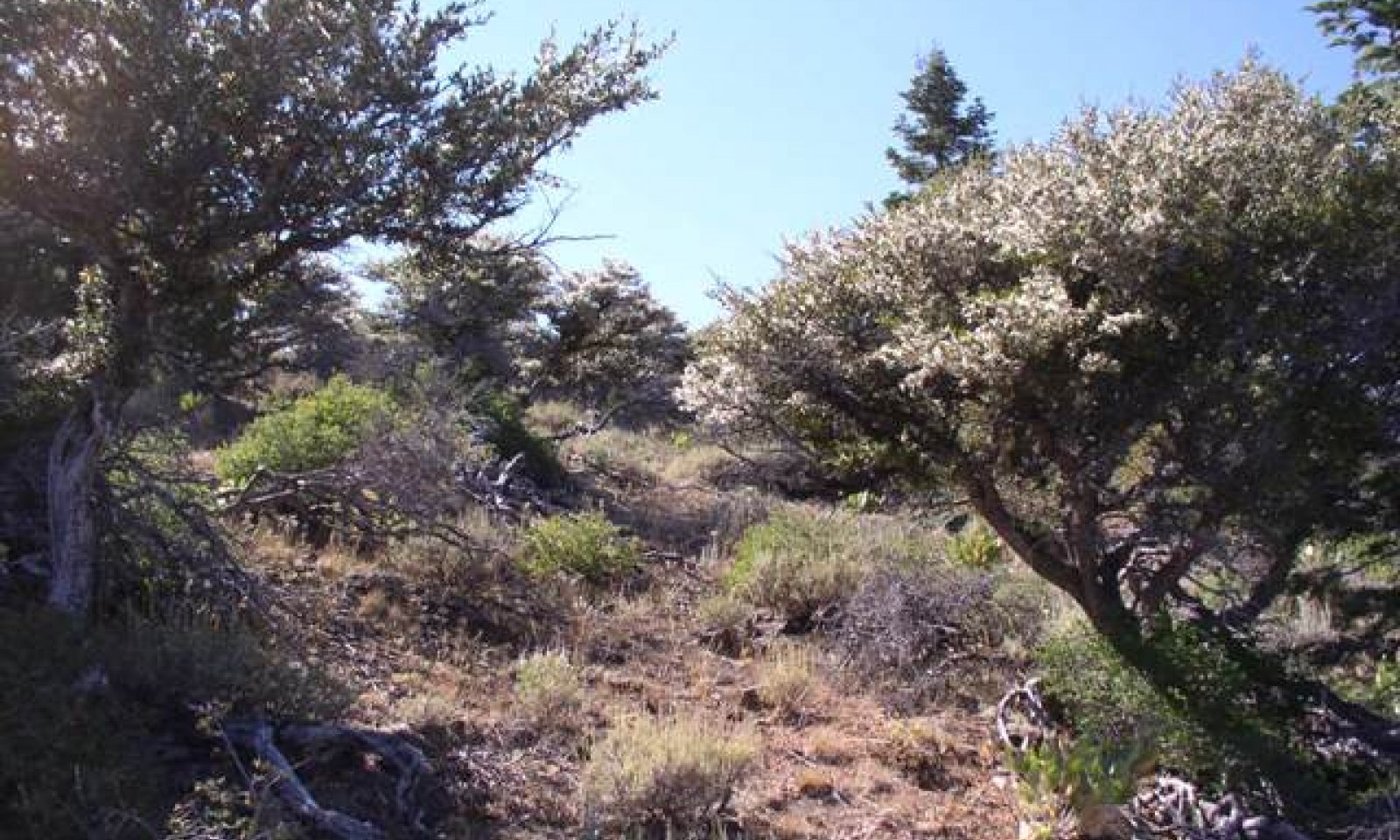
Figure 3. Mahogany Savanna
The reference plant community is dominated by an open stand of curlleaf mountain-mahogany with an understory of mountain big sagebrush, bluebunch wheatgrass, Idaho fescue and needlegrasses. Overstory canopy cover of mountain mahogany is 45 to 60 percent. Potential vegetative composition is about 30% grasses and grass-like plants, 15% forbs and 55% shrubs. Approximate ground cover (basal and canopy) ranges from 40 to 75 percent.
Figure 4. Annual production by plant type (representative values) or group (midpoint values)
Table 5. Annual production by plant type
Plant type Low
(lb/acre)Representative value
(lb/acre)High
(lb/acre)Shrub/Vine 990 1485 1925 Grass/Grasslike 540 810 1050 Forb 270 405 525 Total 1800 2700 3500 Additional community tables
Table 6. Community 1.1 plant community composition
Group Common name Symbol Scientific name Annual production () Foliar cover (%) Grass/Grasslike1 Primary Perennial Grasses 432–810 Letterman's needlegrass ACLE9 Achnatherum lettermanii 135–203 – western needlegrass ACOCO Achnatherum occidentale ssp. occidentale 135–202 – mountain brome BRMA4 Bromus marginatus 54–135 – bluebunch wheatgrass PSSPS Pseudoroegneria spicata ssp. spicata 54–135 – Cusick's bluegrass POCUE2 Poa cusickii ssp. epilis 18–45 – Sandberg bluegrass POSE Poa secunda 18–45 – Wheeler's bluegrass POWH2 Poa wheeleri 18–45 – 2 Secondary Perennial Grasses/Grasslike 70–135 sedge CAREX Carex 14–27 – big squirreltail ELMU3 Elymus multisetus 14–27 – Idaho fescue FEID Festuca idahoensis 14–27 – prairie Junegrass KOMA Koeleria macrantha 14–27 – basin wildrye LECI4 Leymus cinereus 14–27 – Forb3 Perennial Forbs 126–243 common yarrow ACMI2 Achillea millefolium 14–27 – sagebrush mariposa lily CAMAM9 Calochortus macrocarpus var. macrocarpus 14–27 – castilla CASTI Castilla 14–27 – tapertip hawksbeard CRAC2 Crepis acuminata 14–27 – naked buckwheat ERNU3 Eriogonum nudum 14–27 – lupine LUPIN Lupinus 14–27 – Brown's peony PABR Paeonia brownii 14–27 – cold-desert phlox PHST11 Phlox stansburyi 14–27 – woolly mule-ears WYMO Wyethia mollis 14–27 – 4 Annual Forbs 27–135 Shrub/Vine5 Primary Shrubs 945–1755 curl-leaf mountain mahogany CELE3 Cercocarpus ledifolius 810–1350 – mountain big sagebrush ARTRV Artemisia tridentata ssp. vaseyana 135–405 – 6 Secondary Shrubs 162–486 oceanspray HODI Holodiscus discolor 27–81 – wax currant RICE Ribes cereum 27–81 – American black elderberry SANIC4 Sambucus nigra ssp. canadensis 27–81 – roundleaf snowberry SYRO Symphoricarpos rotundifolius 27–81 – Interpretations
Animal community
Livestock Interpretations:
This site has limited value for livestock due to steep slopes. Grazing management should be keyed to palatable shrub and perennial grass production. Needlegrass provide important forage for domestic livestock. Big sagebrush is eaten by domestic sheep and cattle, but has long been considered to be of low palatability to domestic livestock, a competitor with more desirable species, and a physical impediment to grazing. Where management results in abusive grazing use by livestock, understory grasses and forbs are reduced as big sagebrush, Sandberg bluegrass, and squirreltail increase. Heavy utilization will result in a "highline" appearance of the mountain mahogany, limiting overstory production and reproduction.
Stocking rates vary over time depending upon season of use, climate variations, site, and previous and current management goals. A safe starting stocking rate is an estimated stocking rate that is fine tuned by the client by adaptive management through the year and from year to year.
Wildlife Interpretations:
The evergreen nature of mountain mahogany and mountain big sagebrush make stands of these species important year-round habitat for mule deer. Mountain mahogany provides valuable browse, and hiding and thermal cover in both summer and winter. Mountain mahogany is one of the few browse species that meets or exceeds the protein requirements for wintering big game animals. Big sagebrush is highly preferred and nutritious winter forage for mule deer. Sage grouse are also highly dependent on big sagebrush for both food and cover. Needlegrasses provide important forage for several wildlife species.
Hydrological functions
Soil Hydrologic Group D. Runoff is medium to high.
Recreational uses
Recreational uses for this site include camping, birdwatching, hiking and hunting.
Other products
Native peoples used big sagebrush leaves and branches for medicinal teas, and the leaves as a fumigant. Bark was woven into mats, bags and clothing.
Other information
Mountain big sagebrush has potential for range restoration and soil stabilization. Curlleaf mountain-mahogany may be planted to help stabilize soil in disturbed areas such as roadcuts and mine spoils.
Supporting information
Type locality
Location 1: Modoc County, CA Township/Range/Section T39N R16E S22 Latitude 41° 14′ 23″ Longitude 120° 8′ 18″ General legal description East of Emerson Peak, on the Modoc National Forest in the Warner Mountains, Modoc County, CA. Other references
Fire Effects Information System [Online]. http://www.fs.fed.us/feis
Miles, S.R. and C.B. Goudey. 1997. Ecological Subregions of California Section and Subsection Descriptions. United States Department of Agriculture Forest Service, Pacific Southwest Region R5-EM-TP-005. Subsection M261Gf-Warner Mountains.
Modoc Elk Working Group. 2000. The Greater Modoc Area A Strategic Plan for Elk Management. Modoc County, CA
Contributors
P.NOVAK-ECHENIQUE
Rangeland health reference sheet
Interpreting Indicators of Rangeland Health is a qualitative assessment protocol used to determine ecosystem condition based on benchmark characteristics described in the Reference Sheet. A suite of 17 (or more) indicators are typically considered in an assessment. The ecological site(s) representative of an assessment location must be known prior to applying the protocol and must be verified based on soils and climate. Current plant community cannot be used to identify the ecological site.
Author(s)/participant(s) Contact for lead author Date Approved by Approval date Composition (Indicators 10 and 12) based on Annual Production Indicators
-
Number and extent of rills:
-
Presence of water flow patterns:
-
Number and height of erosional pedestals or terracettes:
-
Bare ground from Ecological Site Description or other studies (rock, litter, lichen, moss, plant canopy are not bare ground):
-
Number of gullies and erosion associated with gullies:
-
Extent of wind scoured, blowouts and/or depositional areas:
-
Amount of litter movement (describe size and distance expected to travel):
-
Soil surface (top few mm) resistance to erosion (stability values are averages - most sites will show a range of values):
-
Soil surface structure and SOM content (include type of structure and A-horizon color and thickness):
-
Effect of community phase composition (relative proportion of different functional groups) and spatial distribution on infiltration and runoff:
-
Presence and thickness of compaction layer (usually none; describe soil profile features which may be mistaken for compaction on this site):
-
Functional/Structural Groups (list in order of descending dominance by above-ground annual-production or live foliar cover using symbols: >>, >, = to indicate much greater than, greater than, and equal to):
Dominant:
Sub-dominant:
Other:
Additional:
-
Amount of plant mortality and decadence (include which functional groups are expected to show mortality or decadence):
-
Average percent litter cover (%) and depth ( in):
-
Expected annual annual-production (this is TOTAL above-ground annual-production, not just forage annual-production):
-
Potential invasive (including noxious) species (native and non-native). List species which BOTH characterize degraded states and have the potential to become a dominant or co-dominant species on the ecological site if their future establishment and growth is not actively controlled by management interventions. Species that become dominant for only one to several years (e.g., short-term response to drought or wildfire) are not invasive plants. Note that unlike other indicators, we are describing what is NOT expected in the reference state for the ecological site:
-
Perennial plant reproductive capability:
Print Options
Sections
Font
AAAAOther
PrintThe Ecosystem Dynamics Interpretive Tool is an information system framework developed by the USDA-ARS Jornada Experimental Range, USDA Natural Resources Conservation Service, and New Mexico State University.
Accessibility statement


