
Natural Resources
Conservation Service
Ecological site F021XE233CA
Populus tremuloides/Symphoricarpos rotundifolius-Artemisia tridentata ssp. vaseyana/Bromus marginatus
Accessed: 08/30/2026
-
Search


Major Land Resource Area or ecological site by name and/or ID.
PreviousSectionsNextGeneral information
Draft. A draft ecological site description is either incomplete or has not undergone quality control and quality assurance review.
Associated sites
R021XE216CA Aspen Thicket
R021XE222CA Loamy Slope 30+ P.Z.
Similar sites
F021XE234CA Populus tremuloides/Symphoricarpos rotundifolius/Bromus marginatus
More productive site.
R021XE216CA Aspen Thicket
Shrubby snowbank aspen; more productive site.
Table 1. Dominant plant species
Tree (1) Populus tremuloides
Shrub (1) Symphoricarpos rotundifolius
(2) Artemisia tridentata ssp. vaseyanaHerbaceous (1) Bromus marginatus
Physiographic features
This site occurs on intermountain valleys and mountain sideslopes. Slopes range from 2 to 30 percent. Elevations range from 6200 to 8200 feet.
Table 2. Representative physiographic features
Landforms (1) Mountain valley
(2) Mountain slope
Elevation 6200 – 8200 ft Slope 2 – 30 % Water table depth 40 – 50 in Aspect Aspect is not a significant factor Climatic features
The climate of this site is subhumid, characterized by cool, dry summers and cold, moist winters. The area's precipitation comes mostly from winter Pacific cyclonic storms, with a very slight summer monsoonal season that is erratic but can be locally significant. Average annual precipitation ranges from 30 to 50 inches with most occurring during the winter months. Approximately half the precipitation falls as snow; half as rain.
Table 3 Representative climatic features
Frost-free period (average) 60 days Freeze-free period (average) 0 days Precipitation total (average) 50 in BarLineFigure 1. Monthly precipitation range
BarLineFigure 2. Monthly average minimum and maximum temperature
">Influencing water features
The soils are saturated for brief periods below 30 inches during spring snowmelt.
Soil features
The soils associated with this site are deep, well drained soils that formed in volcanic ash and colluvium over residuum from tuff and andesite. These soils have high amounts of vitric volcanic ash and glass throughout the profile which enhances the waterholding capacity of these soils. They are saturated for brief periods below 30 inches during spring snowmelt. These soils are usually moist in winter, spring and early summer and have a xeric soil moisture regime. Soil profiles are modified with 35 to 60 percent rock fragments. A mollic epipedon occurs to 48 inches and an argillic horizon occurs from 20 to 48 inches. Soil series associated with this site includes Pyropatti.
Table 4. Representative soil features
Parent material (1) Colluvium – andesite
(2) Residuum – tuff
Surface texture (1) Ashy loam
Family particle size (1) Loamy
Drainage class Well drained Permeability class Moderate Soil depth 40 – 60 in Surface fragment cover <=3" 20 – 25 % Surface fragment cover >3" Not specified Available water capacity
(0-40in)6 – 7 in Calcium carbonate equivalent
(0-40in)Not specified Electrical conductivity
(0-40in)Not specified Sodium adsorption ratio
(0-40in)Not specified Soil reaction (1:1 water)
(0-40in)6.1 – 7.3 Subsurface fragment volume <=3"
(Depth not specified)20 – 45 % Subsurface fragment volume >3"
(Depth not specified)0 – 10 % Ecological dynamics
Major Successional Stages of Forestland Development:
HERBACEOUS: Vegetation is dominated by grasses and forbs under full sunlight. This stage is experienced after a major disturbance such as fire, root-rot, insect damage, or tree harvest. Following a major disturbance, the root system gives rise to many root suckers, assuming the root system is intact and healthy. Residual trees left following harvest have little or no affect on the composition and production of the herbaceous vegetation.
SHRUB-HERBACEOUS: Herbaceous vegetation dominates the site. Quaking aspen suckers are evident. If the aspen stand is healthy, these first two stages will only last from one to two years. However, if competing brush and herbaceous plants grow for a full season before aspen suckers emerge, a reduction in growth and survival of aspen suckers may occur.
SAPLING: Early growth of quaking aspen suckers ranges from less than 1 foot to more than 3 feet per year for shoots having good competitive position. In the absence of disturbance, suckers develop into saplings (to 4.5 feet in height) with a range in canopy cover of about 5 to 15 percent. Vegetation consists of grasses, forbs and a few shrubs in association with tree saplings.
POLE STAGE: As the canopy closes, trees stratify into crown classes quickly despite genetic uniformity within clones. Aspen stands are self-thinning, especially at young ages. This stage is characterized by rapid growth of the aspen trees, both in height and canopy. The visual aspect and vegetal structure are dominated by aspen ranging from about 10 to 20 feet in height, and having a diameter at breast height (DBH) of about 2 to 4 inches. Understory vegetation is moderately influenced by a tree canopy of about 15 to over 25 percent.
IMMATURE FORESTLAND: Growth of the aspen slows somewhat during this stage. There is a fairly continual adjustment of trees to growing space, and a loss in competitive position of many trees making up the codominant, intermediate and over-topped classes. When competition becomes intense enough to appreciably affect the diameter growth of dominants, mortality quickly reduces the number of trees in the lower crown classes. There are periodic surges in mortality, with a disproportionate number of trees, mostly those over-topped, dying within a short time. The visual aspect and vegetal structure are dominated by quaking aspen greater than 35 feet in height and having a diameter at breast height (DBH) of about 5 to 8 inches. Understory vegetation is moderately influenced by a tree overstory canopy of about 20 to 30 percent.
MATURE FORESTLAND: The visual aspect and vegetal structure are dominated by single-story quaking aspen that have reached, or are near, maximal heights for the site. Growth of aspen continues during this stage. Diameter growth shows recovery with the release of competition previously endured during the immature woodland stage. Tree heights range from 30 to over 50 feet with stem diameter at breast height (DBH) of 8 to over 12 inches, depending upon site and clone genotype. Trees have developed tall, straight, clear stems with short, narrow, dome-like crowns. Tree canopy cover ranges from about 30 to 40 percent. Understory vegetation is strongly influenced by tree competition, overstory shading, and duff accumulation. Shade tolerant shrubs form an open, intermittent layer in the understory. Tall perennial grasses and forbs typically form a continuous layer beneath a tree and tall shrub canopy. A lower stratum of small forbs and grasses is always part of the forest floor. Few vegetative shoots and/or saplings of quaking aspen occur in the understory.
OVER-MATURE FORESTLAND: This stage is dominated by aspen that have reached maximal heights for the site. In the absence of natural disturbances, the tree canopy on this site can become very dense-often greater than 50 percent. As less light penetrates below the tree canopy, competitive relationships in the understory vegetation are altered. Although plants in the understory are shade tolerant, even these species progressively decrease in abundance and productivity as tree canopy cover increases. Over-mature aspen stands slowly die. As openings in the overstory are created through tree mortality, aspen suckers emerge on the forest floor. These suckers typically arise over a period of several years and the resulting stand is broadly even-aged. As even-aged stands reach old age without disturbance, stand deterioration is likely to extend over a long period due to the range of tree ages. In turn, a longer regeneration period and a new stand with an even greater range of ages results. If this process continues over several generations, an all-aged stand is established.
Aspen is highly competitive on burned sites and has several adaptations to fire including the following: a) the thin bark has little heat resistance, and aspen is easily top-killed by fire, b) root systems of top-killed stems send up a profusion of sprouts for several years after fire, c)sprouts grow rapidly by extracting water, nutrients, and photosynthate from an extant root system, and may outcompete other woody vegetation, d)following fire, a new, even-aged quaking aspen stand can develop within a decade, and e) aspen is self-thinning and a mature forest of healthy trees can develop from dense sprouts.
Fire Ecology:
Presettlement fire return intervals in mountain big sagebrush communities varied from 15 to 25 years. Mountain big sagebrush is highly susceptible to injury from fire. It is often top-killed by fire and will not resprout. Mountain brome is likely to be top-killed by fire, although the coarse stems and broad leaves may be more fire-resistant than fine-leaved bunchgrasses. Mountain brome is most susceptible to fire damage when it is actively growing in spring and early summer. Blue wildrye can survive fire. It typically forms small bunches that rarely exceed 4 inches (10 cm) in diameter, and mature aboveground growth generally consists of coarse leaves and stems. Such attributes suggest that this bunchgrass burns rather quickly, with little heat transferred down into the root crown. As a result, basal buds located at or just below the ground surface are not subjected to prolonged heating, and may survive and sprout. The most important agent of disturbance in aspen forests before 1900 was fire, although other natural disturbances were locally important including windthrow, snow damage, hail, lightning, fungal diseases and insect damage. Most aspen forests in the West are seral and have been dependent upon fire for their perpetuation. If fire occurs at infrequent intervals (e.g. 50-150 years) and is intense enough to kill most of the aspen and competing conifers, them most aspen sites in the West will retain viable stands of aspen. Periodic wildfires prevent over-mature aspen stands and maintain a naturally stratified mosaic of even-aged aspen communities in various stages of successional development. Uneven-aged stands form under stable conditions where the overstory gradually disintegrates with disease or age, and is replaced by aspen suckers. Although aspen forests do not burn readily, aspen trees are extremely sensitive to fire. A severe fire will top-kill the aspen overstory and will stimulate abundant suckering. A severe fire also removes the duff and may kill roots. Repeated fires have a detrimental effect on site quality and can eliminate aspen from a site.State and transition model
More interactive model formats are also available. View Interactive Models
Click on state and transition labels to scroll to the respective textEcosystem states
State 1 submodel, plant communities
State 1
Reference StateCommunity 1.1
Reference Plant Community
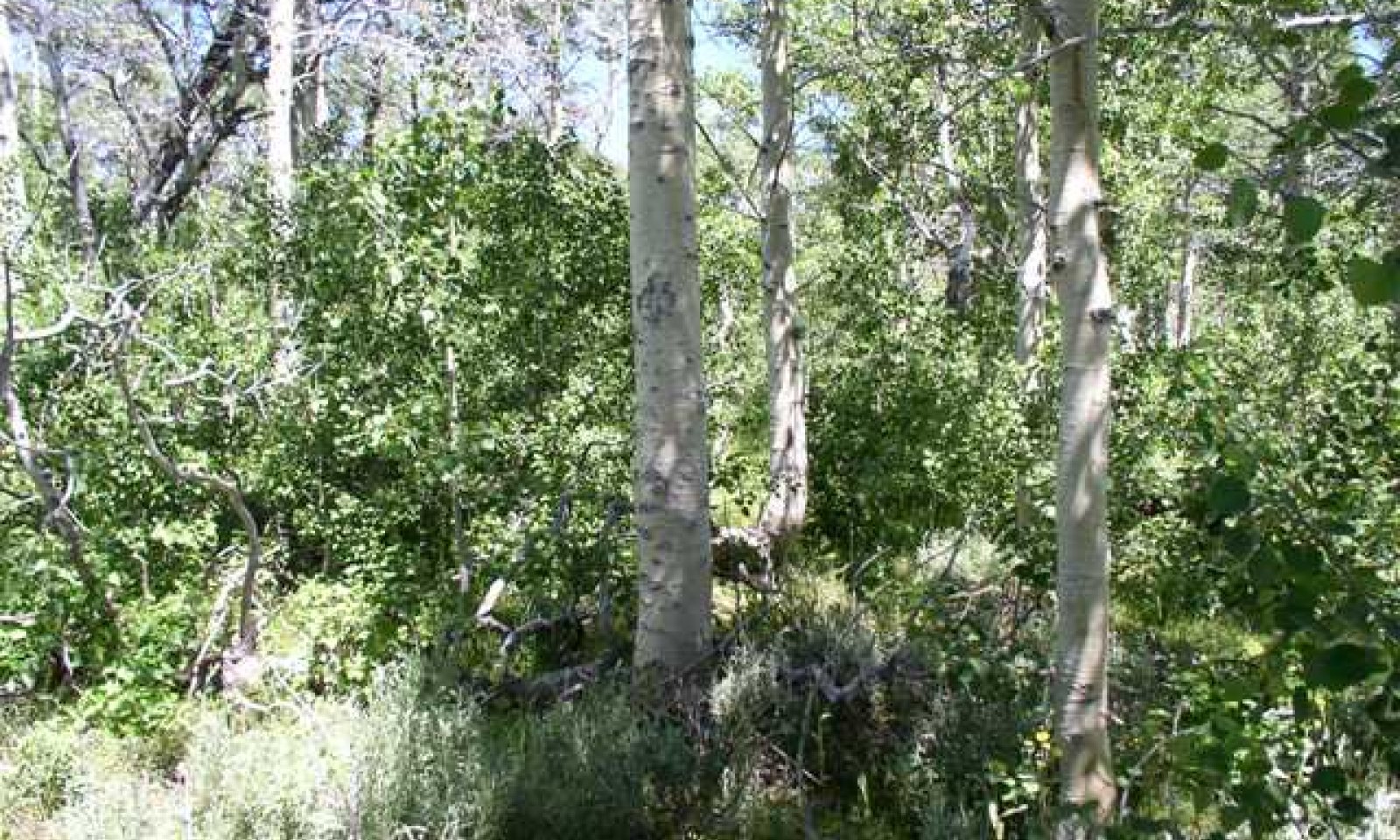
The reference plant community is dominated by a nearly continuous canopy of one to several aspen clones, each with a common genetic makeup and individual phenological and physiological characterisitics. This site is dominated by quaking aspen and overstory tree canopy composition is typically 100 percent quaking aspen. Aspen forests are multi-layered as sufficient light is able to penetrate the tree canopy to support abundant undergrowth. Young trees, medium height shrubs and tall forbs and grasses form an open, often intermittent layer beneath the tree canopy. Sapling quaking aspen, snowberry and mountain big sagebrush are the principal understory shrubs. Mountain brome and blue wildrye, and giant hyssop are other important understory plants associated with this site. An overstory canopy of about 35 percent is assumed to be representative of tree dominance on this site in a pristine environment.
Forest overstory.MATURE FORESTLAND: The visual aspect and vegetal structure are dominated by single-story quaking aspen that have reached, or are near, maximal heights for the site. Growth of aspen continues during this stage. Diameter growth shows recovery with the release of competition previously endured during the immature woodland stage. Tree heights range from 30 to over 50 feet with stem diameter at breast height (DBH) of 8 to over 12 inches, depending upon site and clone genotype. Trees have developed tall, straight, clear stems with short, narrow, dome-like crowns. Tree canopy cover ranges from about 30 to 40 percent. Understory vegetation is strongly influenced by tree competition, overstory shading, and duff accumulation. Shade tolerant shrubs form an open, intermittent layer in the understory. Tall perennial grasses and forbs typically form a continuous layer beneath a tree and tall shrub canopy. A lower stratum of small forbs and grasses is always part of the forest floor. Few vegetative shoots and/or saplings of quaking aspen occur in the understory.
Forest understory. Understory composition is about 35 percent grasses, 20 percent forbs, and 45 percent shrubs and young trees when the average overstory canopy is medium (30 to 40 percent). Litter cover is 60 to 70 percent, comprised mainly of dead leaves. Average understory production ranges from 700 to 1300 pounds per acres with a medium canopy cover. Understory production includes the total annual production of all species within 4.5 feet of the ground surface.
Figure 3. Annual production by plant type (representative values) or group (midpoint values)
Table 5. Annual production by plant type
Plant type Low
(lb/acre)Representative value
(lb/acre)High
(lb/acre)Shrub/Vine 287 410 533 Grass/Grasslike 245 350 455 Forb 140 200 260 Tree 28 40 52 Total 700 1000 1300 Additional community tables
Table 6. Community 1.1 plant community composition
Group Common name Symbol Scientific name Annual production () Foliar cover (%) Grass/Grasslike1 Primary Perennial Grasses 150–330 mountain brome BRMA4 Bromus marginatus 100–240 – blue wildrye ELGL Elymus glaucus 50–90 – 2 Secondary Perennial Grasses 30–90 slender wheatgrass ELTRT Elymus trachycaulus ssp. trachycaulus 10–50 – red fescue FERU2 Festuca rubra 5–10 – Wheeler's bluegrass POWH2 Poa wheeleri 5–10 – California needlegrass ACOCC Achnatherum occidentale ssp. californicum 5–10 – squirreltail ELELE Elymus elymoides ssp. elymoides 5–10 – Forb3 Annual 5–10 grand collomia COGR4 Collomia grandiflora 5–10 – 4 Perennial 80–220 California false hellebore VECA2 Veratrum californicum 10–50 – nettleleaf giant hyssop AGURU Agastache urticifolia var. urticifolia 10–50 – twolobe larkspur DENU2 Delphinium nuttallianum 5–10 – Jessica sticktight HAMI Hackelia micrantha 5–10 – ballhead waterleaf HYCA4 Hydrophyllum capitatum 5–10 – owl's-claws HYHO Hymenoxys hoopesii 5–10 – silvery lupine LUAR3 Lupinus argenteus 5–10 – western sweetroot OSOC Osmorhiza occidentalis 5–10 – alpine leafybract aster SYFOF Symphyotrichum foliaceum var. foliaceum 5–10 – Fendler's meadow-rue THFE Thalictrum fendleri 5–10 – American vetch VIAM Vicia americana 5–10 – goosefoot violet VIPU4 Viola purpurea 5–10 – western yarrow ACMIO Achillea millefolium var. occidentalis 5–10 – pale agoseris AGGL Agoseris glauca 5–10 – Shrub/Vine5 Primary Shrubs 150–330 roundleaf snowberry SYRO Symphoricarpos rotundifolius 100–240 – mountain big sagebrush ARTRV Artemisia tridentata ssp. vaseyana 50–90 – 6 Secondary Shrubs 20–100 yellow rabbitbrush CHVI8 Chrysothamnus viscidiflorus 10–50 – gooseberry currant RIMO2 Ribes montigenum 10–50 – Tree7 Deciduous 10–50 quaking aspen POTR5 Populus tremuloides 10–50 – Table 7. Community 1.1 forest overstory composition
Common name Symbol Scientific name Nativity Height ft Canopy cover (%) Diameter in Basal area (square ft/acre) Treequaking aspen POTR5 Populus tremuloides Native – 100 – 0 Interpretations
Animal community
Livestock Interpretations:
This site is suited to cattle and sheep grazing during the summer and early fall. Snowberry is readily eaten by all classes of livestock, particularly domestic sheep. Basin big sagebrush may serve as emergency food during severe winter weather, but it is not usually sought out by livestock. Blue wildrye is important forage for domestic animals throughout its range. Blue wildrye is rated as only fair in forage quality because of its coarse foliage. Although plants are grazed into the summer, most use occurs in the early spring. New growth is highly palatable to horses and cattle; plants are utilized less extensively by domestic sheep. The awned seedheads are generally not consumed. Mountain brome is one of the most important forage grasses in the quaking aspen zone. Mountain brome is ranked as excellent forage for both cattle and horses and good for domestic sheep. Domestic sheep will graze mountain brome only when it is fairly succulent. Livestock tend to concentrate on quaking aspen communities during the summer seeking shade and the green, succulent understory forage. Cattle select for understory grasses while sheep tend to select for forbs. Browsing has a direct impact on aspen. Through the early sapling stage, browsing reduces aspen growth, vigor and numbers. Heavy browsing by sheep or deer can eliminate aspen sucker regeneration. Suckers can be drastically reduced or eliminated by big game browsing on winter ranges. Aspen saplings need to attain a minimum height of 55 to 60 inches to avoid destructive browsing by livestock. Harvesting trees under a sound management program for fuelwood, posts or other products, can open up the tree canopy to allow increased production of understory species desirable for grazing and browsing.
Stocking rates vary over time depending upon season of use, climate variations, site, and previous and current management goals. A safe starting stocking rate is an estimated stocking rate that is fine tuned by the client by adaptive management through the year and from year to year.
Wildlife Interpretations:
Snowberry is an important forage species for deer and elk on high elevation summer ranges. Snowberry is frequently one of the first species to leaf out, making it a highly sought after food in the early spring. Basin big sagebrush is the least palatable of all the subspecies of big sagebrush. Basin big sagebrush is browsed by mule deer from fall to early spring, but is not preferred. Blue wildrye is important forage for wild animals throughout its range. Palatability of blue wildrye is poor for pronghorn, poor to good for mule deer, and good for elk. Mountain brome seedheads and seeds provide food for many birds and small mammals. Pronghorn antelope will consume mountain brome primarily in the spring. The palatability of mountain brome is excellent for deer, particularly during the late spring and early summer. Quaking aspen forests provide important breeding, foraging, and resting habitat for a variety of birds and mammals. Wildlife and livestock utilization of aspen communities varies with species composition of the understory and relative age of the aspen stand. Young stands generally provide the most browse. Aspen crowns can grow out of reach of large ungulates in 6 to 8 years. Although many animals browse aspen year-round, it is especially valuable during fall and winter, when protein levels are high relative to other browse species. Elk browse aspen year-round in much of the West, feeding on bark, branch apices, and sprouts. Aspen is important year-round forage for mule deer. Deer consume the leaves, buds, twigs, bark, and sprouts. New growth on burns or clearcuts is especially palatable to deer.Hydrological functions
A well stocked aspen stand provides excellent watershed protection. The trees produce abundant litter that contains more
nitrogen, phosphorus, potash, and calcium than leaf litter of most other hardwoods. The litter decays rapidly, forming a nutrient-rich humus that reduces runoff and aids in percolation and recharge of ground water. Litter and humus layers provide almost total soil cover, reducing evaporation from the soil surface. Compared to conifers, more snow accumulates under quaking aspen and snowmelt begins earlier in the spring. Soil under quaking aspen thaws faster and infiltrates snow more rapidly than soil under conifers. A mixture of herbaceous and woody root systems penetrate and anchor the soil. Erosion producing overland flow is rare. The hydrologic cover condition of this site is fair in a representative stand. The average runoff curve is about 55 for group B soils.Recreational uses
Aesthetic value is derived from the rich hues and textures of the aspen trees, particularly in the fall. The diverse flora and fauna, and the colorful wildflowers in the summer enhance the beauty of this site. The site offers rewarding opportunities to photographers and for nature study. It has high value for hunting, camping, picnicking, cross country skiing and family wood gathering. Management of the aspen woodland should include small, irregularly shaped clearcuts that blend into the natural landscape. Harvesting plans should include a mix of even-aged aspen patches in all size classes. Aspen fits well into management for dispersed recreation activities, but does not tolerate concentrated use such as found in established campgrounds. Encouraging concentrated recreation or developing campgrounds within aspen stands can lead to serious damage, including carving on trees, vandalism, destruction or removal of young suckers and trampling and disturbance of the soil.
Wood products
Historically quaking aspen has been used for mine props, posts, bridge planking, flooring, furniture and fuelwood. This tree has a considerable potential for increased utilization. It makes excellent pulp, excelsior, door corestock, paper, particleboard, matchsticks, structural flakeboard, lumber products and boxwood. An undesirable characteristic of the quaking aspen is their heavy drain on available water in the soil.
This site has low site quality for tree production. Site index ranges from 30 to 44; Site Class V (Baker, 1925).
SILVICULTURAL PRACTICES
a. Harvest Cutting: Selectively harvest surplus trees to achieve desired spacing. Harvest stands in small blocks of 1/5 to 1/2 acre with slash left in place to shelter emerging aspen suckers from browsing.
1) Clear-Cutting - Clear-cutting is appropriate when the primary management objective is sustained production of forest products, either saw timber or fiber. Cutting sub-merchantable stems along with the merchantable ones will maximize sucker production, minimize the presence of diseased or defective growing stock in the new stand, and avoid suppression of the new crop by residual overstory stems.
2) Partial Cutting - Partial cutting may be feasible in some uneven-aged stands where management objectives require vertical canopy diversity or retention of some overstory; partial cutting may result in enough sprouting to adequately regenerate stands. Individual tree or group selection cutting methods can be applied. Extreme care is necessary to avoid injury to residual stems during logging. Partial cutting is not worthwhile in deteriorated aspen clones where root system die back has reduced suckering.
3) Selective Tree Removal:
Remove selected trees on suitable sites to enhance forage production and manage site reproduction.
b. Thinning - Ordinarily, only stands on saw timber sites should be thinned. Pre-commercial thinning may be uneconomical as the low productivity of this site would not justify thinning costs.
c. Protection from Disease - There are no proven forest stand treatments that successfully prevent or control disease in aspen. Maintenance of well-stocked stands, minimizing wounding of stems and control of damaging agents, and harvesting at the proper rotation age are the best management recommendations that can be made today.
d. Protection from Insects - Direct control of insects in aspen forests has not been practical. The environmental side-effects from chemical pesticide spraying usually has not been acceptable in the aspen ecosystem. Maintenance of a well-stocked stand and protection from wounding is the most practical method of coping with insects in the aspen forest.
e. Protection from Mammals - Domestic livestock, wild ungulates, porcupines, rodents and hares utilize aspen as food and can have measurable impacts on some stands. Most animal damage can be prevented by careful husbandry of domestic livestock and by population control of wild game. Because most aspen stands are grazed by cattle and/or sheep and have a significant population of wild ungulates, grazing management and game management are important to aspen communities.
f. Fire Management - Fire is a natural feature of the aspen ecosystem. Fire is considered responsible for the abundance of aspen in the west as well as the even-aged structure of many stands. Without human intervention, fire appears to be necessary for the continued well-being of aspen on sites where natural degeneration of the clone occurs, or where insects or pests are especially harmful to the stand. Fires in aspen generally are infrequent, spread slowly, are of low intensity, and are easy to control.Other products
Aspen is frequently used in esthetic and functional landscaping. Esthetic uses include speciment, display, accent, spatial enclosure, and view enframement. Functional landscaping uses include visual screening, noise abatement, erosion control, and climate control.
Other information
Wide adaptability of quaking aspen makes it well-suited for restoration and rehabilitation projects on a wide range of sites. Seedlings
transplanted onto disturbed sites have shown good establishment. Seedlings have some advantages over vegetative cuttings. In large-scale greenhouse production, quaking aspen seedlings are more economical to establish and grow. Seedlings grow a taproot and secondary roots quickly, while quaking aspen cuttings can be slow to establish an adequate root system. Mountain brome is an excellent native bunchgrass for seeding alone or in mixtures in disturbed areas, including depleted rangelands, burned areas, roadways, mined lands, and degraded riparian zones.Table 8. Representative site productivity
Common name Symbol Site index low Site index high CMAI low CMAI high Age of CMAI Site index curve code Site index curve basis Citation quaking aspen POTR5 30 44 7 20 – – – Supporting information
Type locality
Location 1: Modoc County, CA Township/Range/Section T48N R16E S34 UTM zone N UTM northing 738025 UTM easting 4652231 Latitude 41° 59′ 10″ Longitude 120° 7′ 36″ General legal description Mount Bidwell, in the Warner Mountains, Modoc National Forest, Modoc County, California Other references
Baker, F.S. 1925. Aspen in the central Rocky Mountain region. USDA. Bulletin 1291, Washington. D.c.
Debyle, N.V. and R.P. Winokur (eds). 1985. Aspen: Ecology and Management in the western United States. USDA-Forest Service, Gen. Tech. Report RM-119.
Fire Effects Information System (Online; http://www.fs.fed.us/database/feis/plants/).
Howard, Janet L. 1996. Populus tremuloides. In: Fire Effects Information System, [Online].
U.S. Department of Agriculture, Forest Service, Rocky Mountain Research Station, Fire Sciences Laboratory (Producer).
Shepperd, W.D.; Binkley, D.; Bartos, D.L; Stohlgren, T.J.; and Eskew, L.G., compilers. 2001. Sustaining Aspen in Western Landscapes; Symposium Proceedings; 13-15 June 2000; Grand Junction, CO. Proceedings RMRS-P-18. Fort Collins, CO: U.S. Department of Agriculture, Forest Serice, Rocky Mountain Reserach Station.
USDA-NRCS. 2000 National Forestry Manual - Part 537. Washington, D.C.
USDA-NRCS. 2004 National Forestry Handbook, Title 190. Washington, D. C.
USDA-NRCS Plants Database (Online; http://www.plants.usda.gov).
Contributors
P. NOVAK-ECHENIQUE
Rangeland health reference sheet
Interpreting Indicators of Rangeland Health is a qualitative assessment protocol used to determine ecosystem condition based on benchmark characteristics described in the Reference Sheet. A suite of 17 (or more) indicators are typically considered in an assessment. The ecological site(s) representative of an assessment location must be known prior to applying the protocol and must be verified based on soils and climate. Current plant community cannot be used to identify the ecological site.
Author(s)/participant(s) Contact for lead author Date Approved by Approval date Composition (Indicators 10 and 12) based on Annual Production Indicators
-
Number and extent of rills:
-
Presence of water flow patterns:
-
Number and height of erosional pedestals or terracettes:
-
Bare ground from Ecological Site Description or other studies (rock, litter, lichen, moss, plant canopy are not bare ground):
-
Number of gullies and erosion associated with gullies:
-
Extent of wind scoured, blowouts and/or depositional areas:
-
Amount of litter movement (describe size and distance expected to travel):
-
Soil surface (top few mm) resistance to erosion (stability values are averages - most sites will show a range of values):
-
Soil surface structure and SOM content (include type of structure and A-horizon color and thickness):
-
Effect of community phase composition (relative proportion of different functional groups) and spatial distribution on infiltration and runoff:
-
Presence and thickness of compaction layer (usually none; describe soil profile features which may be mistaken for compaction on this site):
-
Functional/Structural Groups (list in order of descending dominance by above-ground annual-production or live foliar cover using symbols: >>, >, = to indicate much greater than, greater than, and equal to):
Dominant:
Sub-dominant:
Other:
Additional:
-
Amount of plant mortality and decadence (include which functional groups are expected to show mortality or decadence):
-
Average percent litter cover (%) and depth ( in):
-
Expected annual annual-production (this is TOTAL above-ground annual-production, not just forage annual-production):
-
Potential invasive (including noxious) species (native and non-native). List species which BOTH characterize degraded states and have the potential to become a dominant or co-dominant species on the ecological site if their future establishment and growth is not actively controlled by management interventions. Species that become dominant for only one to several years (e.g., short-term response to drought or wildfire) are not invasive plants. Note that unlike other indicators, we are describing what is NOT expected in the reference state for the ecological site:
-
Perennial plant reproductive capability:
Print Options
Sections
Font
AAAAOther
PrintThe Ecosystem Dynamics Interpretive Tool is an information system framework developed by the USDA-ARS Jornada Experimental Range, USDA Natural Resources Conservation Service, and New Mexico State University.
Accessibility statement


