
Natural Resources
Conservation Service
Ecological site F021XE231CA
Abies concolor var. lowiana/Symphoricarpos rotundifolius/Bromus marginatus
Accessed: 08/29/2026
-
Search


Major Land Resource Area or ecological site by name and/or ID.
PreviousSectionsNextGeneral information
Draft. A draft ecological site description is either incomplete or has not undergone quality control and quality assurance review.
Associated sites
R021XE215CA Prunus Pocket
R021XE222CA Loamy Slope 30+ P.Z.
Table 1. Dominant plant species
Tree (1) Abies concolor var. lowiana
Shrub (1) Symphoricarpos rotundifolius
Herbaceous (1) Bromus marginatus
Physiographic features
This site occurs on mountain sideslopes. Slopes range from 4 to 50 percent. Elevations range from 6400 to 8000 feet.
Table 2. Representative physiographic features
Landforms (1) Mountain slope
Elevation 6400 – 8000 ft Slope 4 – 50 % Aspect Aspect is not a significant factor Climatic features
The climate of this site is subhumid, characterized by warm, dry summers and cold, moist winters. The area's precipitation comes mostly from winter Pacific cyclonic storms, with a very slight summer monsoonal season that is erratic but can be locally significant. Average annual precipitation ranges from 20 to 40 inches with most occurring during the winter months. Approximately half the precipitation falls as snow; half as rain.
Table 3 Representative climatic features
Frost-free period (average) 80 days Freeze-free period (average) 0 days Precipitation total (average) 40 in BarLineFigure 1. Monthly precipitation range
BarLineFigure 2. Monthly average minimum and maximum temperature
">Influencing water features
There are no influencing water features associated with this site.
Soil features
The soils associated with this site are deep, well drained soils that formed in volcanic ash and colluvium over residuum derived from andesite or tuff. These soils have high amounts of vitric volcanic ash and glass throughout the profile which enhances the waterholding capacity. The soil profile is modified with 35 to 60 percent rock fragments, mainly gravels and cobbles. The soils have an umbric epipedon to 18 inches and an argillic horizon from 10 to 42 inches. Soil series associated with this site include Nowack.
Table 4. Representative soil features
Parent material (1) Colluvium – andesite
(2) Residuum – tuff
Surface texture (1) Ashy loam
Family particle size (1) Loamy
Drainage class Well drained Permeability class Moderate Soil depth 40 – 60 in Surface fragment cover <=3" 30 – 55 % Surface fragment cover >3" 0 – 5 % Available water capacity
(0-40in)6 – 7 in Calcium carbonate equivalent
(0-40in)Not specified Electrical conductivity
(0-40in)Not specified Sodium adsorption ratio
(0-40in)Not specified Soil reaction (1:1 water)
(0-40in)6 – 6.1 Subsurface fragment volume <=3"
(Depth not specified)35 – 45 % Subsurface fragment volume >3"
(Depth not specified)10 – 15 % Ecological dynamics
Major Successional Stages of Forestland Development:
HERBACEOUS: Vegetation is dominated by grasses and forbs under full sunlight. This stage is experienced after a major disturbance such as crown fire or tree harvest. Skeleton forest (dead trees) remaining after fire or residual trees left following harvest have little or no affect on the composition and production of the herbaceous vegetation.
SHRUB-HERBACEOUS: Herbaceous vegetation and woody shrubs dominate the site. Various amounts of tree seedlings (less than 20 inches in height) may be present. Snowbrush ceanothus readily root-sprouts following wildlife and may dominate the community at this stage. Successional development of the community may be arrested by the complete dominance of snowbrush.
SAPLING: In the absence of disturbance the tree seedlings develop into saplings (20 inches to 4.5 feet in height) with a range in canopy cover of about 5 to 10 percent. Vegetation consists of grasses, forbs and shrubs in association with tree saplings.
IMMATURE FORESTLAND: The visual aspect and vegetal structure are dominated by white fir greater than 4.5 feet in height. The upper crown of dominant and co-dominant are cone or pyramidal shaped. Dominants are the tallest trees on the site; co-dominants are 65 to 85 percent of the height of dominant trees. Understory vegetation is moderately influenced by a tree overstory canopy of about 10 to 20 percent.
MATURE FORESTLAND: The visual aspect and vegetal structure are dominated by white fir that have reached or are near maximal heights for the site. Dominant trees average greater than five inches in diameter at one-foot stump height. Tree canopy cover ranges from 30 to 40 percent. Understory vegetation is strongly influenced by tree competition, overstory shading, duff accumulation, etc. Few tree seedlings and/or saplings occur in the understory.
OVER-MATURE FORESTLAND: In the absence of wildfire or other naturally occurring disturbances, the tree canopy on this site can become very dense. This stage is dominated by juniper trees that have reached maximal heights for the site. Upper crowns are typically irregularly flat-topped or rounded. Understory vegetation is sparse to absent due to tree competition. Tree canopy cover is at the maximum for the site and is commonly greater than 40 percent.
Wildfire is recognized as a natural disturbance that strongly influenced the structure and composition of the climax vegetation of this forest site. At mid-elevations in the white fir zone, fires may have burned in a pattern of different severities, including patches where most of the moderately susceptible trees such as white fir, survived, and patches where white fir stands were completely destroyed. This type of fire regime creates a forest mosaic of stands with varied structures, species compositions, and seral stages. White fir is also a component of forest communities that evolved with less frequent, stand-replacing fires.
White fir seedlings, saplings and poles have resin-blistered thin-bark and long hanging lower branches which make them highly susceptible to fire damage and kill. Young white fir are usually killed by even low-intensity, surface fires. As trees mature and bark thickens, and some self-pruning of lower branches occurs, they become more resistant to fire. However, the tendency to retain some low branches, the moderately shallow roots, and heavy lichen growth on the branches of white fir make it only moderately fire resistant. In larger trees, mortality results from crown scorch, girdled stems from cambial heating, or damage to moderately shallow roots from soil heating.
Snowbrush ceanothus is promoted by fire, regenerating from seed stimulated by fire. Where its seeds are present in the soil, snowbrush ceanothus may dominate early seral growth following a medium or hot fire. Snowbrush ceanothus also sprouts vigorously from the root crown after fire. Resprouting may be an adaptation to recurring fires, allowing for rapid growth and recovery. When conifers overtop the shrubfields, snowbrush ceanothus may die out because of reduced light intensities in the forest understory.
Fire Ecology:
Wax currant regeneration is favored by short-duration, low-severity fire because soil-stored seed requires scarification to germinate. Most wax currant plants are severely damaged or killed by fire. The ability of wax currant to sprout after fire is described in the literature as weak. Mountain brome is likely to be top-killed by fire, although the coarse stems and broad leaves may be more fire-resistant than fine-leaved bunchgrasses. Mountain brome is most susceptible to fire damage when it is actively growing in spring and early summer. Ross’ sedge survives fire through buried seed with long-term viability. These seeds germinate after heat treatment. Ross’ sedge’s rhizomes survive low- to moderate-severity fires. Young white fir is highly susceptible to fire, and mature trees are only moderately fir tolerant. White fir is an aggressive, shade-tolerant species that will seed into the understory of low-elevation ponderosa or Jeffrey pine stands or into mixtures of ponderosa pine, Douglas-fir, quaking aspen, and southwestern white pine.State and transition model
More interactive model formats are also available. View Interactive Models
Click on state and transition labels to scroll to the respective textEcosystem states
State 1 submodel, plant communities
State 1
Reference StateCommunity 1.1
Reference Plant Community
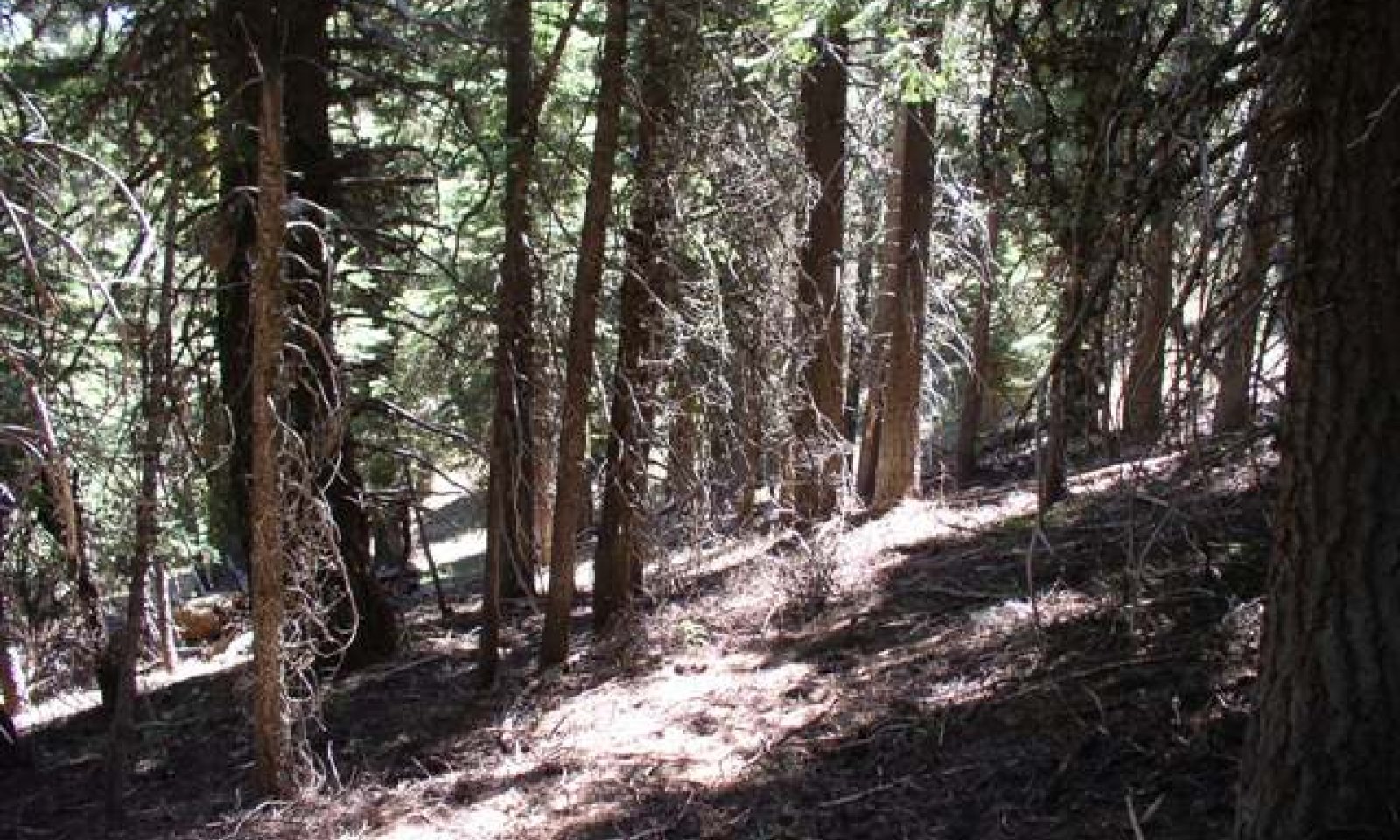
The reference plant community is dominated by an overstory of white fir trees. Scattered ponderosa or Jeffrey pines may also occur in the overstory. An overstory canopy of 30 to 35 percent is assumed to be representative of tree dominance on this site. The understory is dominated by perennial grasses and forbs with scattered shrubs. The understory is dominated by roundleaf snowberry, gooseberry and mountain brome.
Forest overstory.MATURE FORESTLAND: The visual aspect and vegetal structure are dominated by white fir that have reached or are near maximal heights for the site. Dominant trees average greater than five inches in diameter at one-foot stump height. Tree canopy cover ranges from 30 to 40 percent. Understory vegetation is strongly influenced by tree competition, overstory shading, duff accumulation, etc. Few tree seedlings and/or saplings occur in the understory.
Forest understory. Understory vegetative composition is approximately 35 percent grasses and grasslike plants, 15 percent forbs and 50 percent shrubs and young trees when the average overstory canopy is medium (30 to 40 percent). Average understory production ranges from 400 to 800 pounds pounds per care with a medium canopy cover. Understory production includes the total annual production of all species within 4.5 feet of the ground surface.
Figure 3. Annual production by plant type (representative values) or group (midpoint values)
Table 5. Annual production by plant type
Plant type Low
(lb/acre)Representative value
(lb/acre)High
(lb/acre)Shrub/Vine 176 264 352 Grass/Grasslike 140 210 280 Forb 60 90 120 Tree 24 36 48 Total 400 600 800 Additional community tables
Table 6. Community 1.1 plant community composition
Group Common name Symbol Scientific name Annual production () Foliar cover (%) Grass/Grasslike1 Primary Perennial Grasses/Grasslikes 60–108 mountain brome BRMA4 Bromus marginatus 30–54 – Ross' sedge CARO5 Carex rossii 30–54 – 2 Secondary Perennial Grasses 30–132 western needlegrass ACOCO Achnatherum occidentale ssp. occidentale 6–30 – squirreltail ELEL5 Elymus elymoides 6–30 – blue wildrye ELGL Elymus glaucus 6–30 – Wheeler's bluegrass POWH2 Poa wheeleri 6–30 – tall trisetum TRCA21 Trisetum canescens 3–6 – Alaska oniongrass MESU Melica subulata 3–6 – Forb3 Annual 9–18 tiny trumpet COLI2 Collomia linearis 3–6 – twinleaf bedstraw GABI Galium bifolium 3–6 – slender phlox MIGRG4 Microsteris gracilis var. gracilis 3–6 – 4 Perennial 39–96 woolly mule-ears WYMO Wyethia mollis 6–30 – western columbine AQFO Aquilegia formosa 3–6 – heartleaf arnica ARCO9 Arnica cordifolia 3–6 – prickly hawkweed HIHO Hieracium horridum 3–6 – ballhead waterleaf HYCA4 Hydrophyllum capitatum 3–6 – tailcup lupine LUCAC3 Lupinus caudatus ssp. caudatus 3–6 – feathery false lily of the valley MARAR Maianthemum racemosum ssp. racemosum 3–6 – sweetcicely OSBE Osmorhiza berteroi 3–6 – slender penstemon PEGR4 Penstemon gracilentus 3–6 – compact phacelia PHHAC3 Phacelia hastata var. compacta 3–6 – tuber starwort PSJA2 Pseudostellaria jamesiana 3–6 – whiteveined wintergreen PYPI2 Pyrola picta 3–6 – Shrub/Vine5 Primary Shrubs 90–162 wax currant RICE Ribes cereum 30–54 – sticky currant RIVI3 Ribes viscosissimum 30–54 – roundleaf snowberry SYRO Symphoricarpos rotundifolius 30–54 – 6 Secondary Shrubs 30–108 Utah serviceberry AMUT Amelanchier utahensis 6–30 – mountain big sagebrush ARTRV Artemisia tridentata ssp. vaseyana 6–30 – snowbrush ceanothus CEVE Ceanothus velutinus 6–30 – creeping barberry MARE11 Mahonia repens 3–6 – bitter cherry PREM Prunus emarginata 3–6 – Greene's mountain ash SOSCS Sorbus scopulina var. scopulina 3–6 – Tree7 Evergreen 15–48 incense cedar CADE27 Calocedrus decurrens 3–6 – ponderosa pine PIPOP Pinus ponderosa var. ponderosa 3–6 – Table 7. Community 1.1 forest overstory composition
Common name Symbol Scientific name Nativity Height ft Canopy cover (%) Diameter in Basal area (square ft/acre) Treeponderosa pine PIPOP Pinus ponderosa var. ponderosa Native – 0-2 – 0 incense cedar CADE27 Calocedrus decurrens Native – 0-1 – 0 Interpretations
Animal community
Livestock Interpretations:
This site is suited to cattle and sheep grazing during the spring, summer, and fall. Livestock will often concentrate on this site taking advantage of the shade and shelter offered by the tree overstory. Many areas are not used because of steep slopes and the lack of adequate water. Attentive grazing management is required due to steep slopes and erosion hazards. Harvesting trees under a sound management program can open up the tree canopy to allow increased production of understory species desirable for grazing. Mountain brome is one of the most important forage grasses in the quaking aspen zone. Mountain brome is ranked as excellent forage for both cattle and horses and good for domestic sheep. Domestic sheep will graze mountain brome only when it is fairly succulent. Ross' sedge may be a poor to good forage plant depending on the site. Palatability of Ross' sedge has been rated "fair" for domestic sheep, horses, cattle, and small mammals. Wax current is fair to poor browse for livestock.
Stocking rates vary over time depending upon season of use, climate variations, site, and previous and current management goals. A safe starting stocking rate is an estimated stocking rate that is fine tuned by the client by adaptive management through the year and from year to year.
Wildlife Interpretations:
Mountain brome seedheads and seeds provide food for many birds and small mammals. Pronghorn antelope will consume mountain brome primarily in the spring. The palatability of mountain brome is excellent for deer, particularly during the late spring and early summer. Ross' sedge is important summer elk forage, particularly in the first half of the growing season. It has been rated "good" for elk and "poor" for mule deer and pronghorn antelope. Wax currant provides food and cover for wildlife. It is only fair to poor browse for deer, but it is important on ranges where little else is available. These forests provide abundant browse and cover for large and small wildlife species. Mule deer, elk, and bear often use white fir habitats as either summer or winter range. Mule deer generally eat small amounts of white fir during the spring, fall, and winter, and sometimes larger amounts during the summer. Spring browsing of white fir by deer can be particularly heavy when small white firs are the only green food available; all of the current or previous year's growth may be consumed. Porcupines also feed on the bark of white fir, and may destroy saplings. Rodents feed on the cambial tissue of white fir. During the winter, mice feed on the leaders of small white firs near snow level. In the spring, they feed on seedlings, sometimes destroying a large proportion of the current year's seedlings. Pocket gophers also feed on white fir seedlings in the winter and spring. White fir needles are an important part of the diet of blue grouse. White fir seeds are eaten by several species of small mammals and birds including grouse, chipmunks and mice, flying squirrels, chickadees, crossbills, and Clark's nutcracker. Hollow logs and snags of white fir can be important to various birds and animals for foraging in the interior wood. Because they contain resins, terpenes, and other substances that make the foliage irritating to the digestive tract, most conifers are not particularly palatable to grazing animals. White fir may be slightly palatable to goats. Immature foliage is also consumed by mule deer. White fir seeds are palatable to numerous species of small rodents. White fir's evergreen foliage provides good hiding cover year-round and is usually continuous from the ground upward on trees less than 8 to 10 inches (20-25 cm) dbh. White fir stands of this nature provide excellent hiding cover for large wildlife species such as deer, elk, and black bear. If enough shrubs are present in the understory to provide adequate hiding cover, mature white fir forests are used by deer during fawning and by elk during calving.Hydrological functions
The hydrologic cover condition of this site is good for mature and climax stands. The average runoff curve is about 70 for group C soils. Potential for sheet and rill erosion is moderate to severe depending on slope.
Recreational uses
The trees on this site provide a welcome break in an otherwise open landscape. Steep slopes inhibit many forms of recreation. It has potential for hiking, camping, cross-country skiing, and deer and upland game hunting. Off-road vehicles can destroy the fragile soil-vegetation complex causing severe erosion problems.
Wood products
Historically white fir was considered undesirable for timber. Now that the availability of premium timber species has declined, white fir is being recognized as a highly productive and valuable tree species and is widely used in the wood products industry. White fir is a general, all-purpose, construction-grade wood used extensively for solid construction framing and plywood, and to a lesser extent, for pulpwood. It is also used for poles and pilings and firewood.
Other products
The fruit of wax currant is used for making jam, jelly, or pie. Some western Indian tribes used currants for making pemmican. Wax currant is cultivated as an ornamental. White fir is a valuable ornamental tree. It is often used for ornamental plantings in rural and urban landscapes. White fir is used extensively in the Christmas tree industry. Native Americans used the needles for tea.
Other information
Mountain brome is an excellent native bunchgrass for seeding alone or in mixtures in disturbed areas, including depleted rangelands, burned areas, roadways, mined lands, and degraded riparian zones. White fir can be planted on disturbed sites within forest vegetation types where it naturally occurs. It is a good soil stabilizer and may be particularly useful on roadcuts. Fir seedlings exhibit very slow initial growth, and are therefore usually outplanted as 2- to 3-year-old seedlings or 3- to 4-year-old transplants. Transplanting nursery stock is more successful than direct seeding. White fir can be propagated from stem cuttings, which root easily when treated with a rooting medium.
Table 8. Representative site productivity
Common name Symbol Site index low Site index high CMAI low CMAI high Age of CMAI Site index curve code Site index curve basis Citation ABCOL 30 45 51 77 – – – Supporting information
Type locality
Location 1: Modoc County, CA Township/Range/Section T47N R15E S21 UTM zone N UTM northing 727833 UTM easting 4645360 Latitude 41° 55′ 38″ Longitude 120° 15′ 8″ General legal description Near Highgrade Trail, Warner Mountains, Modoc National Forest; Modoc County, California. Other references
Zouhar, Kris 2001. Abies concolor. In: Fire Effects Information System, [Online]. U.S. Department of Agriculture, Forest Service, Rocky Mountain Research Station, Fire Sciences Laboratory (Producer). Available: http://www.fs.fed.us/database/feis/ [2006, January 12].
Miles, S.R. and C.B. Goudey. 1997. Ecological Subregions of California Section and Subsection Descriptions. United States Department of Agriculture Forest Service, Pacific Southwest Region R5-EM-TP-005. Subsection M261Gf-Warner Mountains.
USDA-NRCS 2000. National Forestry Manual, Washington D.C.
USDA-NRCS. 2004 National Forestry Handbook, Title 190. Washington, D. C.
USDA-NRCS Plants Database (Online; http://www.plants.usda.gov).Contributors
P. Novak-Echenique
Rangeland health reference sheet
Interpreting Indicators of Rangeland Health is a qualitative assessment protocol used to determine ecosystem condition based on benchmark characteristics described in the Reference Sheet. A suite of 17 (or more) indicators are typically considered in an assessment. The ecological site(s) representative of an assessment location must be known prior to applying the protocol and must be verified based on soils and climate. Current plant community cannot be used to identify the ecological site.
Author(s)/participant(s) Contact for lead author Date Approved by Approval date Composition (Indicators 10 and 12) based on Annual Production Indicators
-
Number and extent of rills:
-
Presence of water flow patterns:
-
Number and height of erosional pedestals or terracettes:
-
Bare ground from Ecological Site Description or other studies (rock, litter, lichen, moss, plant canopy are not bare ground):
-
Number of gullies and erosion associated with gullies:
-
Extent of wind scoured, blowouts and/or depositional areas:
-
Amount of litter movement (describe size and distance expected to travel):
-
Soil surface (top few mm) resistance to erosion (stability values are averages - most sites will show a range of values):
-
Soil surface structure and SOM content (include type of structure and A-horizon color and thickness):
-
Effect of community phase composition (relative proportion of different functional groups) and spatial distribution on infiltration and runoff:
-
Presence and thickness of compaction layer (usually none; describe soil profile features which may be mistaken for compaction on this site):
-
Functional/Structural Groups (list in order of descending dominance by above-ground annual-production or live foliar cover using symbols: >>, >, = to indicate much greater than, greater than, and equal to):
Dominant:
Sub-dominant:
Other:
Additional:
-
Amount of plant mortality and decadence (include which functional groups are expected to show mortality or decadence):
-
Average percent litter cover (%) and depth ( in):
-
Expected annual annual-production (this is TOTAL above-ground annual-production, not just forage annual-production):
-
Potential invasive (including noxious) species (native and non-native). List species which BOTH characterize degraded states and have the potential to become a dominant or co-dominant species on the ecological site if their future establishment and growth is not actively controlled by management interventions. Species that become dominant for only one to several years (e.g., short-term response to drought or wildfire) are not invasive plants. Note that unlike other indicators, we are describing what is NOT expected in the reference state for the ecological site:
-
Perennial plant reproductive capability:
Print Options
Sections
Font
AAAAOther
PrintThe Ecosystem Dynamics Interpretive Tool is an information system framework developed by the USDA-ARS Jornada Experimental Range, USDA Natural Resources Conservation Service, and New Mexico State University.
Accessibility statement


