
Natural Resources
Conservation Service
Ecological site F019XI200CA
Pinus muricata/Quercus pacifica
13-24" p.z.
Accessed: 09/01/2026
-
Search


Major Land Resource Area or ecological site by name and/or ID.
PreviousSectionsNextGeneral information
Draft. A draft ecological site description is either incomplete or has not undergone quality control and quality assurance review.
Table 1. Dominant plant species
Tree (1) Pinus muricata
Shrub (1) Quercus pacifica
Herbaceous Not specified
Physiographic features
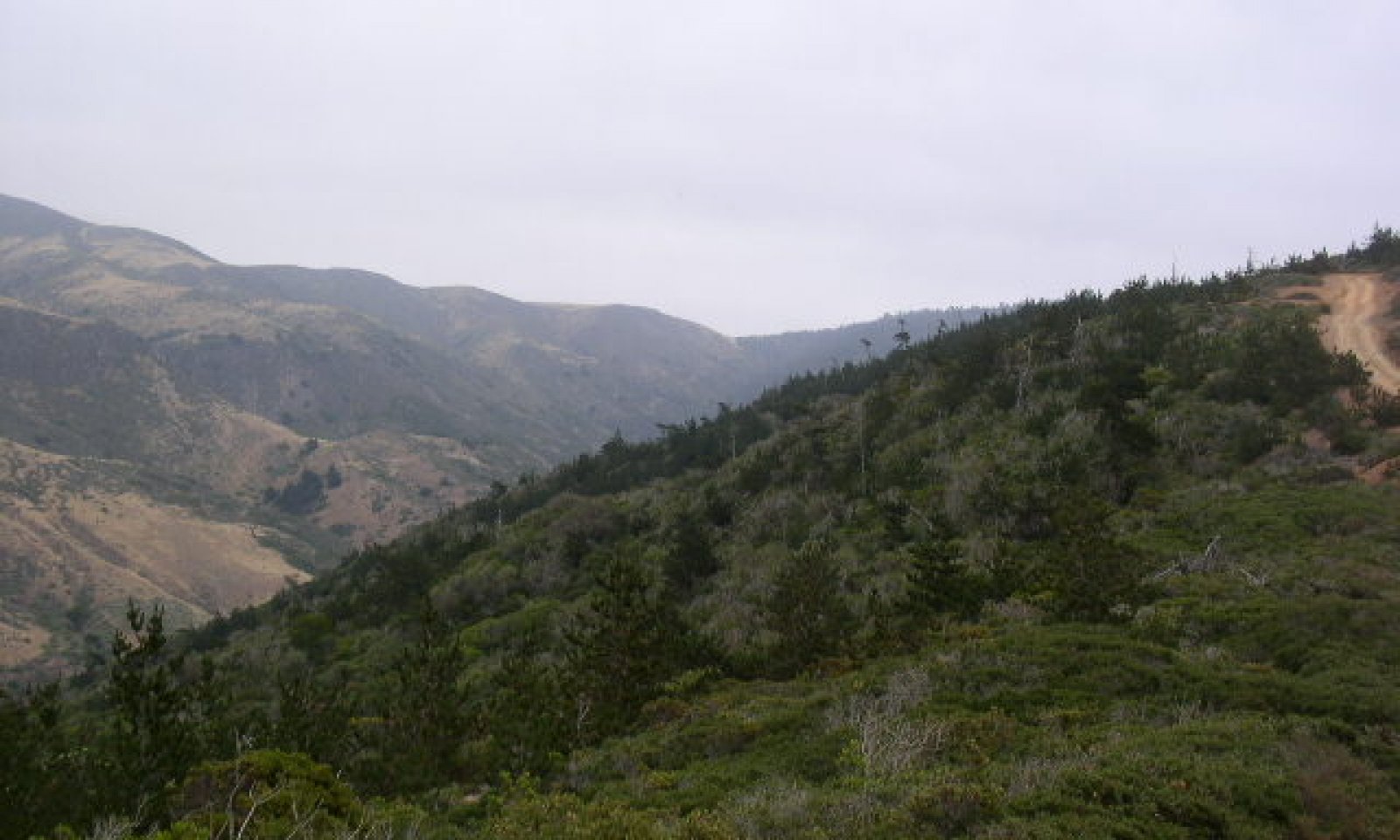
This ecological site is found on the north-facing slopes of hills and mountains on Santa Cruz Island. Slopes range from 30 to 75 percent, and elevations range from 499 to 1601 feet.
Table 2. Representative physiographic features
Landforms (1) Hill
(2) Mountain
Elevation 499 – 1601 ft Slope 30 – 75 % Aspect N, NE, NW Climatic features
This ecological site is found only on Santa Cruz Island, and due to its size, the temperature and precipitation ranges have been grouped together in order to capture the entire island's variance.
The average annual precipitation is 19 inches with a range between 13 and 24 inches, mostly in the form of rain in the winter months (November through April). The average annual air temperature is approximately 56 to 73 degrees Fahrenheit, and the frost-free (>32F) season is 320 to 365 days
Table 3 Representative climatic features
Frost-free period (average) 370 days Freeze-free period (average) 370 days Precipitation total (average) 20 in BarLineFigure 1. Monthly precipitation range
BarLineFigure 2. Monthly average minimum and maximum temperature
">Influencing water features
Soil features
The soils have derived from colluvium and residuum from several parent materials, including schist, gabbro, diorite, volcanic breccia, andesite and/or basalt. They are moderately deep to deep, well-drained, and have loamy textures throughout. The mean annual soil temperatures (MAST) range from 54 to 59 degrees F, which are classified as isomesic.
This ecological site is found in the following map units and soil components:
SSA Map unit Component
CA688 130 Frigate
CA688 311 Gunwale
CA688 321 RudderTable 4. Representative soil features
Surface texture (1) Very gravelly sandy loam
(2) Extremely gravelly loam
Family particle size (1) Loamy
Drainage class Well drained Permeability class Moderately slow to moderate Soil depth 20 – 79 in Surface fragment cover <=3" Not specified Surface fragment cover >3" Not specified Available water capacity
(0-40in)2.5 – 3.8 in Calcium carbonate equivalent
(0-40in)Not specified Electrical conductivity
(0-40in)Not specified Sodium adsorption ratio
(0-40in)Not specified Soil reaction (1:1 water)
(0-40in)4 – 6.5 Subsurface fragment volume <=3"
(Depth not specified)10 – 55 % Subsurface fragment volume >3"
(Depth not specified)1 % Ecological dynamics
This ecological site is characterized by over-aged Bishop pines, which experienced severe mortality during the 1986-1991 California drought. Aside from an uncontrolled prescribed fire in 1994, much of this site has not burned for years. The overstory is only Bishop pine (Pinus muricata), and the understory consists of chaparral shrubs, such as Channel Island scrub oak (Quercus pacifica), California live oak (Quercus agrifolia), and manzanitas. On the Channel Islands, the Bishop pine stands will generally be found on north facing slopes where the fog banks tend to form. The summer fog provides additional moisture and protects this area from extreme heat.
The ecological processes and natural regeneration cycle for the Bishop pines on Santa Cruz Island are not fully understood. This site description is based on a summary of limited field data and relevant references (full citations listed near the end of the description). Lightning and natural fires are rare on the Channel Islands, and therefore the importance of fire to Bishop pine regeneration is unknown. It is a member of the closed-cone pines, which are generally fire-dependent for their maintenance and regeneration (Cope 1993). Closed-cones do not open and release their seeds right after they mature. Instead, they are serotinous, or “late-opening;” meaning the seeds are often retained, sometimes for several years in the tree canopy or inside the cones. Fire may create temperatures hot enough to melt the resin seal on the closed cones, causing the seeds to be released over the ash-covered ground (Walter and Taha). However, results from studies on Santa Cruz Island have shown that the cones of the Bishop pine open without fire and the seeds germinate and grow well in normal soil conditions. The study implies that fire may be detrimental to the regeneration of the Bishop pines on Santa Cruz Island (Walter and Taha).
Drought may be the primary cause of death for Bishop pine on the Channel Islands. Drought conditions may weaken the trees and make them susceptible to insect and fungal infestations. The drought from 1986 to 1991 caused severe mortality of the mature Bishop pine forest, but subsequently in later years many Bishop pine seedlings were present. The impact of the drought on the associated chaparral species is not known, but chaparral species tend to be more drought-tolerant and probably survived or even became established during this drought period.
State and transition model
Custom diagramStandard diagram
More interactive model formats are also available. View Interactive Models
More interactive model formats are also available. View Interactive Models
Click on state and transition labels to scroll to the respective textEcosystem states
State 1 submodel, plant communities
Communities 1, 5 and 2 (additional pathways)
State 2 submodel, plant communities
State 1
ReferenceCommunity 1.1
Bishop pine/lemonade sumac-scrub oak
Figure 3. Bishop pine (Pinus muricata) forest
The most successionally-advanced community phase observed for the reference state is a Bishop pine (Pinus muricata) forest. Bishop pine has a canopy cover of 55 to 80% with the main overstory of trees ranging from 50 to more than 80 years in age. The understory varies depending on location on the island, changes in aspect, and overstory canopy cover. The most common understory species are lemonade sumac (Rhus integrifolia), summer holly (Comarostaphylis diversifolia), toyon (Heteromeles arbutifolia), and Channel Island scrub oak (Quercus pacifica).
Forest overstory.Canopy cover of Bishop pine (Pinus muricata) ranges from 30 to 80 percent, with canopy height usually between 25 to 30 feet. The trees are densely spaced, thin, and scraggly looking. Tree cores were not taken, so the age and site index is unknown. <br /> <br /> The table below represents percent canopy cover not percent production. The proper table is being developed.<br />
Forest understory. The understory cover is often high and ranges from 20 to 75 percent. In addition to the species mentioned above, common understory shrubs also include island manzanita (Arctostaphylos insularis), dwarf chaparral broom (Baccharis pilularis), feltleaf ceanothus (Ceanothus arboreus), Bishop pine (Pinus muricata), and hollyleaf cherry (Prunus ilicifolia ssp. lyonii). There is a diversity of plants on the forest floor. The most common species were roundfruit sedge (Carex globosa), redflower buckwheat (Eriogonum grande var. grande), coastal woodfern (Dryopteris arguta), and monkeyflowers (Mimulus spp.).<br />
Community 1.2
Bishop pine/lemondate sumac-scrub oak
Figure 4. Decling Bishop pine.
Bishop pines may begin to decline after approximately 60 years of age. The aging pine becomes more susceptible to drought and pest infestations resulting in a generally high cover of dead and dying trees in the area. Live Bishop pine canopy cover is usual less than 25 percent. Other common species found in this community includes lemonade sumac (Rhus integrifolia) and Channel Island scrub oak (Quercus pacifica).
Community 1.3
Lemonade sumac-scrub oak/Bishop pineThis community is temporarily dominated by shrubs, such as lemonade sumac and Channel Island scrub oak. These chaparral species remain an important component in the area, and may create competition with the Bishop pine seedlings and saplings. Bishop pine will regenerate as the dropped cones open and disperse seeds on the forest floor. The timing of seeding is spread out as the cone population opens over a multi-year period. In general, the trees in this community will be up to 20 years in age with up to 45% canopy cover. After the 1986 to 1991 drought, the Bishop pines regenerated prolifically from seed after the death of the overstory canopy. The mid-canopy of shrubs and the understory of forbs may have remained relatively undisturbed (Walter and Taha 2000).
Community 1.4
Bishop pine/lemonade sumac-scrub oakThis community is an intermediate phase with a mix of young Bishop pine and chaparral. The Bishop pine saplings seen in community phase 1.3 have begun to over-top the shrubs, and will eventual grow to the forest seen in CP 1.1. The tree age in this community phase ranges from 20 to 50 years, and the canopy is generally 35 to 60 percent Bishop pine cover. In some areas where shrubs are not well represented, a very dense forest of even-aged Bishop pine may develop with many young, somewhat spindly trees.
Community 1.5
Lemonade sumac-scrub oak/Bishop pineIn the unlikely event of a fire, a post-fire Bishop pine regeneration community may form. The composition of this community is dependent upon many variables, but most important are the stand age and burn intensity. Low intensity burns have higher seed survival, and thus greater regeneration of Bishop pine. High intensity burns, have higher seed mortality, making the young and over-mature stands of communities 1.2 and 1.3 most at risk. Regeneration can be dense and even-aged, with high seedling establishment, and canopy cover can reach up to 65 percent. In general, the trees in this community will be up to 20 years in age.
The impact and regeneration of chaparral species is related to fire intensity, but very little research can be found concerning the fire effects on the island’s chaparral species. Historical evidence from the nearby Santa Monica Mountains indicates that when chaparral burns, fires are very intense and difficult to control (Keeley, 2002). When fires are ignited early in the season they tend to remain small in size. However, the Santa Ana winds in the fall can spread fires rapidly and cover large areas. Fire in this community almost always burns the entire canopy, and so it is very unlikely it would remain a surface fire. Channel Island scrub oak (Quercus pacifica) will likely resprout from the root crown, while other species may produce seedlings. Post-fire conditions result in less potential competition of shrubs with Bishop pine assuming pine seedlings germinate within a year or so and follow their characteristic of growing rapidly.Pathway 1.1a
Community 1.1 to 1.2
Bishop pine/lemonade sumac-scrub oak
Bishop pine/lemondate sumac-scrub oakSevere drought and pathogens can shift community phase 1.1 to phase 1.2. Although Bishop pines can exceed 80 years in age, they typically succumb to pathogens at about 60 to 80 years old; drought conditions may weaken the trees and make them susceptible to insect and fungal infestations. The drought from 1986 to 1991 and a subsequent related beetle infestation caused severe mortality of the older Bishop pine stands. The impact of the drought on the associated chaparral species is not known, but chaparral species tend to be more drought-tolerant and would probably survive or even become established during this drought period.
Pathway 1.1b
Community 1.1 to 1.5Fire may also shift CP 1.1 to CP 1.5, but lightning and natural fires are rare on the Channel Islands, and therefore the effects of fire on the Bishop pine community is unclear. Bishop pine may be able to regenerate from seed after a fire, depending upon the fire severity, which would create a post-fire Bishop pine regeneration community.
Pathway 1.2a
Community 1.2 to 1.3On Santa Cruz Island Bishop pine is capable of regeneration in the absence of fire, shifting CP 1.2 to CP 1.3. As trees began to age, branches loaded with unopened or partially opened cones fall to the ground from the dead and dying trees. The cones that are removed from the tree are more likely to open, since the surface is warmer than on the exposed branches which are subject to wind and fog. The cones open and initiate Bishop pine regeneration (Community Phase 1.3) in the absence of fire.
Pathway 1.2b
Community 1.2 to 1.5Lightning and natural fires are rare on the Channel Islands, and therefore the likelihood of fire and movement to community phase 1.5 is low. In the unlikely event of a fire, seeds unconsumed during the fire may initiate a post-fire Bishop pine regeneration, shifting phase 1.2 to phase 1.5.
Pathway 1.3a
Community 1.3 to 1.4If given an extended period of time without disturbance from pests, grazing, and fire, community phase 1.3 will continue to grow, eventually shifting this site to the young Bishop pine forest seen in community phase 1.4.
Pathway 1.3b
Community 1.3 to 1.5Lightning and natural fires are rare on the Channel Islands, and therefore the effects of fire on the Bishop pine community phase is unclear. In the unlikely event of a fire, seeds unconsumed during the fire may initiate a post-fire Bishop pine regeneration, shifting community phase 1.3 to community phase 1.5.
Pathway 1.4a
Community 1.4 to 1.1After an extended period of time without disturbance, Bishop pine will continue to grow, eventually creating more canopy cover over the shrubs and shifting community phase 1.4 to the forest seen in community phase 1.1.
Pathway 1.4b
Community 1.4 to 1.5Lightning and natural fires are rare on the Channel Islands, and therefore the likelihood of fire on the Bishop pine community phase is low. In the unlikely event of a fire, seeds unconsumed during the fire may initiate a post-fire Bishop pine regeneration, shifting community phase 1.4 to community phase 1.5.
Pathway 1.5a
Community 1.5 to 1.4Pine seedlings and saplings continue to progress and begin occupying an overstory dominant position. Development moves towards community phase 1.4.
State 2
Altered State (Chaparral)Community 2.1
Lemonade sumac-summer holly-toyon-scrub oakThis community phase is dominated by a chaparral shrubland with a canopy cover of less than 25 percent. Due to the decimation of a Bishop pine seed source, pine regeneration is not expected. Common chaparral species may include lemonade sumac (Rhus integrifolia), summer holly (Comarostaphylis diversifolia), toyon (Heteromeles arbutifolia), and Channel Island scrub oak (Quercus pacifica).
Community 2.2
Lemonade sumac-summer holly-toyon-scrub oakFrom a reference state community phase, this altered state community phase can develop due to a severe fire and/or prolonged grazing whichs causes high Bishop pine tree and seed mortality. This disturbance will halt the Bishop pine regeneration seen in the Reference State and lead to a community dominated by chaparral species. Common chaparral species include lemonade sumac (Rhus integrifolia), summer holly (Comarostaphylis diversifolia), toyon (Heteromeles arbutifolia), and Channel Island scrub oak (Quercus pacifica). Initially, grasses and forbs dominate while the canopy is open during the first couple of years following a fire. Most of the dominant shrub species are able to rapidly recover and grow after a fire.
Pathway 2.1a
Community 2.1 to 2.2In the unlikely event of a fire, community phase 2.1 will shift to community phase 2.2. Lightning and natural fires are rare on the Channel Islands, and therefore the probability of fire is low. Historical evidence from the nearby Santa Monica Mountains indicates that when chaparral burns, fires are very intense and difficult to control (Keeley, 2002). When fires are ignited early in the season they tend to remain small in size. However, the Santa Ana winds in the fall can spread fires rapidly and cover large areas. Fire in this community phase would almost always burn the entire canopy, so it is very unlikely it would remain a low-intensity surface fire.
Pathway 2.2a
Community 2.2 to 2.1If given an extended period of time without disturbance from fires or grazing, community phase 2.2 will develop into the shrubland seen in community phase 2.1. Channel Island scrub oak (Quercus pacifica) will likely resprout from the root crown, while other species may produce seedlings. As the shrubs continue to increase in size and cover, they will eventually shade out the grasses and forbs in the understory creating a chaparral shrubland.
Transition T1
State 1 to 2Transition to State 2 (typically community phase 2.2) occurs after severe fire, and/or prolonged grazing. Severe fire during the later stages of community development can cause high tree and seed mortality, leaving little opportunity for Bishop pine regeneration and likely its exclusion as a species in the state’s community phases. In addition, heavy grazing on Bishop pine seedlings and saplings for long durations inhibits successful regeneration of Bishop pine. If regeneration does not occur before the stand dies of old age, Bishop pine will decline.
Restoration pathway R2
State 2 to 1Restoration to move the Altered State back to the Reference State is feasible but would require substantial time and financial input. It is unknown at this time how much area of the Channel Islands may have had Reference State Bishop pine forests. Regardless of historic or more recent transitions to the Altered State, Bishop pine seedlings of an acceptable seed source would need to be reintroduced and protected from herbivory, shrub competition and frequent fire.
Additional community tables
Table 5. Community 1.1 plant community composition
Group Common name Symbol Scientific name Annual production () Foliar cover (%) Table 6. Community 1.2 plant community composition
Group Common name Symbol Scientific name Annual production () Foliar cover (%) Table 7. Community 1.3 plant community composition
Group Common name Symbol Scientific name Annual production () Foliar cover (%) Table 8. Community 1.4 plant community composition
Group Common name Symbol Scientific name Annual production () Foliar cover (%) Table 9. Community 1.4 forest overstory composition
Common name Symbol Scientific name Nativity Height ft Canopy cover (%) Diameter in Basal area (square ft/acre) TreeBishop pine PIMU Pinus muricata – – 35-45 – 0 Table 10. Community 1.5 plant community composition
Group Common name Symbol Scientific name Annual production () Foliar cover (%) Table 11. Community 2.1 plant community composition
Group Common name Symbol Scientific name Annual production () Foliar cover (%) Table 12. Community 2.2 plant community composition
Group Common name Symbol Scientific name Annual production () Foliar cover (%) Interpretations
Animal community
Squirrels will occasionally eat Bishop pine (Pinus muricata) seeds, however the spiny cones act as a deterrent to most seed predators (Cope 1993).
Wood products
Bishop pine is a light, strong, hardwood, with a coarse-grain, and is good for papermaking. On fair to good sites, it shows good form and uniform size (Cope 1993).
Other information
Bishop pine can be used to stabilize some soils, such as sand dunes on low coastal terraces by binding the soil to their roots deeper into the soil profile (Cope 1993).
Supporting information
Inventory data references
The following NRCS plots were used to describe this ecological site. SC-328 lbs- Site location SC-350 lbs SC-370 % and lbs SCV-111 %
Type locality
Location 1: Santa Barbara County, CA UTM zone N UTM northing 3765735 UTM easting 239452 General legal description The site location is on Santa Cruz Island, in the Christi Pines area. Other references
Cope, Amy B. 1993. Pinus muricata. In: Fire Effects Information System, [Online]. U.S. Department of Agriculture, Forest Service, Rocky Mountain Research Station, Fire Sciences Laboratory (Producer). Available: http://www.fs.fed.us/database/feis/ [2006, Feb. 3].
Walter, H.S. and L.A. Taha. Regeneration of Bishop pine (PINUS MURICATA) in the Absence and Presence of Fire: A Case Study from Santa Cruz Island, California. Department of Geography, University of California, Los Angeles.Contributors
Marchel Munnecke
Rangeland health reference sheet
Interpreting Indicators of Rangeland Health is a qualitative assessment protocol used to determine ecosystem condition based on benchmark characteristics described in the Reference Sheet. A suite of 17 (or more) indicators are typically considered in an assessment. The ecological site(s) representative of an assessment location must be known prior to applying the protocol and must be verified based on soils and climate. Current plant community cannot be used to identify the ecological site.
Author(s)/participant(s) Contact for lead author Date Approved by Approval date Composition (Indicators 10 and 12) based on Annual Production Indicators
-
Number and extent of rills:
-
Presence of water flow patterns:
-
Number and height of erosional pedestals or terracettes:
-
Bare ground from Ecological Site Description or other studies (rock, litter, lichen, moss, plant canopy are not bare ground):
-
Number of gullies and erosion associated with gullies:
-
Extent of wind scoured, blowouts and/or depositional areas:
-
Amount of litter movement (describe size and distance expected to travel):
-
Soil surface (top few mm) resistance to erosion (stability values are averages - most sites will show a range of values):
-
Soil surface structure and SOM content (include type of structure and A-horizon color and thickness):
-
Effect of community phase composition (relative proportion of different functional groups) and spatial distribution on infiltration and runoff:
-
Presence and thickness of compaction layer (usually none; describe soil profile features which may be mistaken for compaction on this site):
-
Functional/Structural Groups (list in order of descending dominance by above-ground annual-production or live foliar cover using symbols: >>, >, = to indicate much greater than, greater than, and equal to):
Dominant:
Sub-dominant:
Other:
Additional:
-
Amount of plant mortality and decadence (include which functional groups are expected to show mortality or decadence):
-
Average percent litter cover (%) and depth ( in):
-
Expected annual annual-production (this is TOTAL above-ground annual-production, not just forage annual-production):
-
Potential invasive (including noxious) species (native and non-native). List species which BOTH characterize degraded states and have the potential to become a dominant or co-dominant species on the ecological site if their future establishment and growth is not actively controlled by management interventions. Species that become dominant for only one to several years (e.g., short-term response to drought or wildfire) are not invasive plants. Note that unlike other indicators, we are describing what is NOT expected in the reference state for the ecological site:
-
Perennial plant reproductive capability:
Print Options
Sections
Font
AAAAOther
PrintThe Ecosystem Dynamics Interpretive Tool is an information system framework developed by the USDA-ARS Jornada Experimental Range, USDA Natural Resources Conservation Service, and New Mexico State University.
Accessibility statement


