
Natural Resources
Conservation Service
Ecological site F003XN947WA
Southern Washington Cascades Low Cryic Coniferous Forest
Last updated: 1/30/2025
Accessed: 09/22/2026
-
Search


Major Land Resource Area or ecological site by name and/or ID.
PreviousSectionsNextGeneral information
Provisional. A provisional ecological site description has undergone quality control and quality assurance review. It contains a working state and transition model and enough information to identify the ecological site.
MLRA notes
Major Land Resource Area (MLRA): 003X–Olympic and Cascade Mountains
Steep mountains and narrow to broad, gently sloping valleys characterize this MLRA. A triple junction of two oceanic plates and one continental plate is directly offshore from Puget Sound. Subduction of the oceanic plates under the westerly and northwesterly moving continental plate contributes to volcanic activity in the Cascade Mountains. Movement among these plates has resulted in major earthquakes and the formation of large stratovolcanoes. The Cascade Mountains consist primarily of volcanic crystalline rock and some associated metasedimentary rock. The mean annual precipitation is dominantly 60 to 100 inches, but it is 30 to 60 inches on the east side of the Cascade Mountains.
The soil orders in this MLRA are dominantly Andisols, Spodosols, and Inceptisols and minor areas of Entisols and Histosols. The soils are dominantly in the frigid or cryic temperature regime and the udic moisture regime. The soils generally are shallow to very deep, well drained, ashy to medial, and loamy or sandy. They are on mountain slopes and ridges.Ecological site concept
This ecological site is in cold, moist areas. It is at middle elevations (about 2,600 to 4,900 feet) on the west side of the Cascade Crest in Mount Rainier National Park. The site commonly is on debris aprons, bedrock benches, ridges, and glacial-valley walls. The temperate climate supports a variety of flora and fauna.
The soils that support this ecological site are in the low cryic soil temperature regime and the udic soil moisture regime. They are moderately well drained or well drained and are shallow to bedrock to very deep. Laughingwater soils have a seasonal high water table at a depth of 19 to 40 inches some time during the growing season. Soil moisture is not a limiting factor to forest growth because of the abundance of precipitation and the inherent water-holding properties of soils influenced by volcanic ash. Slope and aspect are not defining features of this ecological site.
Pacific silver fir (Abies amabilis) and western hemlock (Tsuga heterophylla) are the most common overstory species. Some noble fir (Abies procera), western redcedar (Thuja plicata), Douglas-fir (Pseudotsuga menziesii), western white pine (Pinus monticola), and Engelmann spruce (Picea engelmannii) are present. Common understory shrubs include black mountain huckleberry (Vaccinium membranaceum), red huckleberry (Vaccinium parvifolium), prince’s pine (Chimaphila umbellata), bunchberry dogwood (Cornus canadensis), and vine maple (Acer circinatum).
The most common disturbance on this site is windthrow because of the seasonal high water table. The resulting openings in the canopy allow more sunlight to reach the forest floor. Other disturbances include forest pathogens, such as root rot, and high-intensity, low-frequency (300 years or more) fires that are stand replacing.Associated sites
F003XN943WA Southern Washington Cascades Frigid Coniferous Forest
Ecological site F003XN947WA, Low Cryic Coniferous Forest is located at higher elevations from F003XN943WA. Vegetation indicators for F003XN947WA include Pacific silver fir, noble fir, and black mountain huckleberry.
F003XN951WA Southern Washington Cascades High Cryic Coniferous Forest
Ecological site F003XN951WA, High Cryic Coniferous Forest is located at higher elevations from F003XN947WA. Vegetation indicators for F003XN951WA include mountain hemlock, subalpine fir, rusty menziesia, Sitka mountain-ash, and common beargrass.
Similar sites
F003XN945WA Southern Washington Cascades Wet Low Cryic Coniferous Forest
Ecological F003XN945WA, Southern Washington Cascades Wet Low Cryic Coniferous Forest, has features similar to those of site F003XN947WA, Washington Cascades Low Cryic Coniferous Forest. The soils of site F003XN945WA are subject to frequent ponding conditions. Species adapted to the wetter conditions, such as American skunkcabbage and devilsclub, are common.
F003XN946WA Southern Washington Cascades Moist Low Cryic Coniferous Forest
Ecological F003XN946WA, Southern Washington Cascades Moist Low Cryic Coniferous Forest, has features similar to those of site F003XN947WA, Washington Cascades Low Cryic Coniferous Forest. The soils of site F003XN947WA are well drained. Species adapted to the drier conditions, such as Pacific silver fir, western hemlock, and black mountain huckleberry, are common.
Table 1. Dominant plant species
Tree (1) Abies amabilis
(2) Tsuga heterophyllaShrub (1) Vaccinium membranaceum
Herbaceous (1) Linnaea borealis
Physiographic features
This ecological site is on debris aprons of mountain slopes, bedrock benches, glacial-valley walls, and ridges at the lower montane elevations (2,600 to 4,900 feet). The site is on all aspects. Slope is dominantly 5 to 45 percent. This site is the second largest in extent in Mount Rainier National Park.
Table 2. Representative physiographic features
Landforms (1) Mountain slope
(2) Bench
(3) Glacial-valley wall
(4) Ridge
Flooding frequency None Ponding frequency None Elevation 2600 – 4900 ft Slope 0 – 100 % Water table depth 20 – 79 in Aspect W, NW, N, NE, E, SE, S, SW Climatic features
Most of the annual precipitation is received in October through April. The mean annual precipitation is 72 to 87 inches, and the mean annual air temperature is 42.0 to 47.5 degrees F. Generally, the summers are cool and dry and the winters are cold and wet.
Table 3 Representative climatic features
Frost-free period (actual range) 90-130 days Freeze-free period (actual range) Precipitation total (actual range) 70-90 in BarLineFigure 1. Monthly precipitation range
BarLineFigure 2. Monthly minimum temperature range
">Influencing water features
Generally, this ecological site is not influenced by wetland or riparian water features. The site is not subject to flooding or ponding. The Laughingwater soils have a seasonal high water table at a depth of 19 to 40 inches some time during the growing season. The water table typically rises in spring and recedes in fall.
Soil features
Applicable soils: Longmire, Laughingwater, Arahustan, Ohanapecosh
Applicable soil map units: 8110, 8120, 8125, 8130, 8150, 9100, 9101, 9110, 9120, 9125
The Longmire and Laughingwater soils are deep or very deep, the Arahustan soils are moderately deep, and the Ohanapecosh soils are shallow. The Laughingwater soils have a seasonal high water table at a depth of 19 to 40 inches some time during the growing season. Generally, the soils have a mantle of volcanic ash over colluvium or residuum derived from andesite. The shallow Ohanapecosh series have volcanic ash directly over andesite. The mantle of volcanic ash is characterized by low bulk density, high available water-holding capacity, gravel-sized pumice parafragments, and sandy loam or loamy sand textures. The subsoil, where present, consists of colluvium derived from andesite. It is sandy loam and has andesite fragments. Podsolization is the dominant pedogenic process in the soils. All of the soils have an albic and a spodic diagnostic horizon. A thin organic horizon that consists of decomposing twigs, needles, and litter is on the soil surface. This horizon helps to protect the soil from wind and water erosion.Table 4. Representative soil features
Parent material (1) Acidic volcanic ash – andesite
(2) Colluvium – andesite
Surface texture (1) Ashy sandy loam
(2) Paragravelly, ashy sandy loam
(3) Paragravelly, ashy loamy sand
Drainage class Well drained Soil depth 10 – 60 in Surface fragment cover <=3" 0 – 10 % Surface fragment cover >3" 0 – 10 % Available water capacity
(Depth not specified)2.5 – 7 in Soil reaction (1:1 water)
(Depth not specified)3.5 – 6 Subsurface fragment volume <=3"
(Depth not specified)5 – 45 % Subsurface fragment volume >3"
(Depth not specified)0 – 20 % Ecological dynamics
This ecological site is in cold, moist areas at the middle elevations (2,600 to 4,900 feet) on the west side of the Cascade Crest. The site commonly is on debris aprons, bedrock benches, ridges, and glacial-valley walls. The mild, temperate climate supports a variety of flora and fauna.
The most common overstory species are Pacific silver fir (Abies amabilis) and western hemlock (Tsuga heterophylla). Other common species include noble fir (Abies procera), western redcedar (Thuja plicata), Douglas-fir (Pseudotsuga menziesii), western white pine (Pinus monticola), and Engelmann spruce (Picea engelmannii).
Common understory shrubs include black mountain huckleberry (Vaccinium membranaceum), red huckleberry (Vaccinium parvifolium), prince’s pine (Chimaphila umbellata), bunchberry dogwood (Cornus canadensis), and vine maple (Acer circinatum). Common forbs include twinflower (Linnaea borealis), western swordfern (Polystichum munitum), deerfoot vanillaleaf (Achlys triphylla), myrtle pachistima (Paxistima myrsinites), and common beargrass (Xerophyllum tenax). As the stand ages, competition for moisture and sunlight increases mortality of the vegetation. This results in a wide range of snag maturation and an abundance of coarse woody debris on the forest floor.
The most common disturbance on this site is windthrow. Pacific silver fir and western hemlock are susceptible to windthrow. The resulting openings in the canopy allow more sunlight to reach the forest floor. Other disturbances include forest pathogens, such as root rot, and high-intensity, low-frequency (300 years or more) fires that are stand replacing.State and transition model
Custom diagramStandard diagram
More interactive model formats are also available. View Interactive Models
More interactive model formats are also available. View Interactive Models
Click on state and transition labels to scroll to the respective textEcosystem states
State 1 submodel, plant communities
State 1
ReferenceCommunity 1.1
Pacific Silver Fir, Western Hemlock, Black Mountain Huckleberry, and Twinflower
Structure: Multistory with small gap dynamics
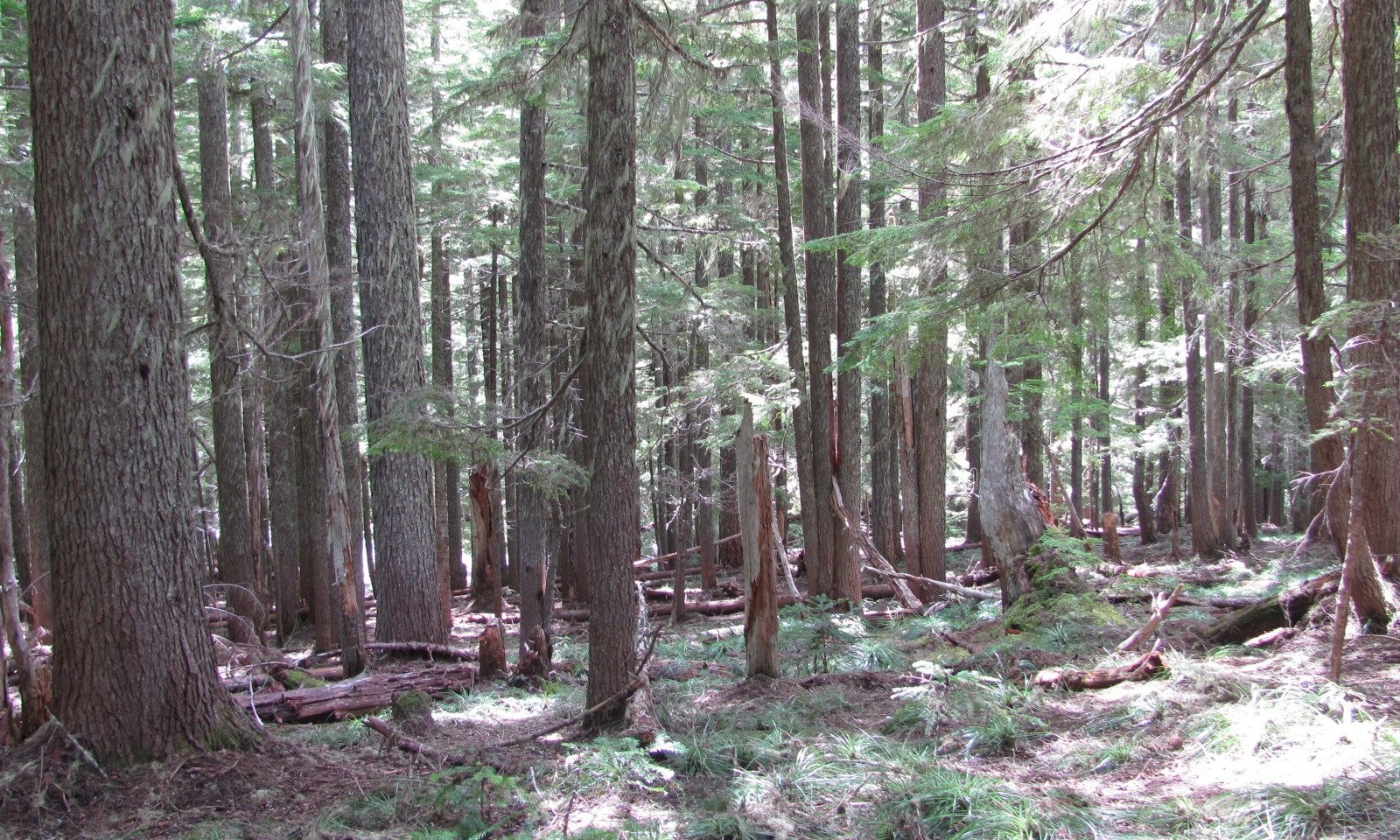
Pacific silver fir and western hemlock are the most common overstory species in the reference community. This forest group and reference community are considered most characteristic of Mount Rainier National Park (Crawford, 2009). Pacific silver fir and western hemlock are perhaps the most shade-tolerant tree species in North America (Crawford, 1990). Douglas-fir, noble fir, and western redcedar are present; however, minimal, if any, regeneration of Douglas-fir occurs in closed-canopy forests. The dense canopy created by multiple age groups of hemlocks may block most of the sunlight from the forest floor, leading to sparse understory in some areas. Gaps in the mid-canopy and overstory allow sunlight to reach the ground. Most of the understory plants are in these areas. The understory is more continuous in areas where there is no mid-canopy. The most common natural disturbance is the small gap dynamics resulting from the mortality of trees or from windthrow. Common understory species include twinflower, black mountain huckleberry, rattlesnake plantain, Cascade Oregon grape, red huckleberry, common beargrass, and deerfoot vanillaleaf.
Community phase pathway 1.1A
This pathway represents a minor disturbance, such as small pockets of root disease, individual tree mortality, and windthrow, that maintain the overall structure of the reference community. Mortality of individual trees or clusters of trees creates gaps in the understory that allow sunlight to reach the forest floor. This promotes growth of forbs and shrubs and regeneration of overstory species, and it perpetuates a multi-storied, uneven-aged forest.Forest overstory.The forest has multiple canopy layers. The upper canopy is 90 to 195 feet in height, and it averages 115 feet. The diameter of the trees varies depending on the species. The average diameter at breast height is 22 inches. The diameter of Douglas-fir and western hemlock trees is the largest; it is more than 30 inches in some areas.
Dominant plant species
-
Pacific silver fir (Abies amabilis), tree
-
western hemlock (Tsuga heterophylla), tree
-
noble fir (Abies procera), tree
-
Douglas-fir (Pseudotsuga menziesii), tree
-
western redcedar (Thuja plicata), tree
-
thinleaf huckleberry (Vaccinium membranaceum), shrub
-
Cascade barberry (Mahonia nervosa), shrub
-
red huckleberry (Vaccinium parvifolium), shrub
-
vine maple (Acer circinatum), shrub
-
pipsissewa (Chimaphila umbellata), shrub
-
twinflower (Linnaea borealis), other herbaceous
-
common beargrass (Xerophyllum tenax), other herbaceous
-
western swordfern (Polystichum munitum), other herbaceous
-
sweet after death (Achlys triphylla), other herbaceous
-
Oregon boxleaf (Paxistima myrsinites), other herbaceous
-
bunchberry dogwood (Cornus canadensis), other herbaceous
Community 1.2
Pacific Silver Fir, Western Hemlock, Black Mountain Huckleberry, and TwinflowerStructure: Mosaic of mature overstory and regenerating openings
Community phase 1.2 has some areas that resemble community phase 1.1, but it also has moderate-sized openings (2 to 4 acres). Pacific silver fir is susceptible to windthrow, which results in small openings in the forest that allow less shade-resistant trees to establish (Crawford, 1990). Many of the shrubs in the ecological site, including red huckleberry, black mountain huckleberry, Cascade Oregon grape, and vine maple, respond well to increased sunlight. This may delay or prevent reforestation of the openings.Dominant plant species
-
Pacific silver fir (Abies amabilis), tree
-
western hemlock (Tsuga heterophylla), tree
-
noble fir (Abies procera), tree
-
Douglas-fir (Pseudotsuga menziesii), tree
-
thinleaf huckleberry (Vaccinium membranaceum), shrub
-
Cascade barberry (Mahonia nervosa), shrub
-
red huckleberry (Vaccinium parvifolium), shrub
-
vine maple (Acer circinatum), shrub
-
twinflower (Linnaea borealis), other herbaceous
Community 1.3
Red Alder, Fireweed, and Common BeargrassStructure: Open meadow with snags
Community phase 1.3 is an early seral plant community that has been impacted by a stand-replacing disturbance such as a wildfire, large-scale windstorm, mass movement, or major insect infestation. Most of the trees are destroyed, but some trees may survive in the overstory. Standing, decaying snags are prevalent. The understory is dominantly shrubs and forbs such as red alder, fireweed, common beargrass, and arctic lupine. Some grasses will become established, but they will be replaced by shrubs over time. Tree seedlings and saplings will begin to establish within 3 to 10 years, depending on the severity of the disturbance.Dominant plant species
-
red alder (Alnus rubra), tree
-
fireweed (Chamerion angustifolium), grass
-
common beargrass (Xerophyllum tenax), grass
-
arctic lupine (Lupinus arcticus), grass
Community 1.4
Western White Pine, Douglas-fir, Red Alder, Vine Maple, and FireweedStructure: Single story
Community phase 1.4 is an early seral forest under regeneration. Scattered remnant mature trees may be present. The species composition depends on the natural seed sources present and the intensity of the disturbance. Following a moderate or severe fire, shrubs are likely to outcompete tree seedlings. Vine maple, red alder, red huckleberry, black mountain huckleberry, and Cascade Oregon grape, which may have been moderate in abundance previously, have the capacity to recover rapidly and spread when top-killed. This slows the successful regeneration of the overstory. Seed sources for tree species are from the surrounding areas of undisturbed forest and from surviving trees. The mixed stand can include Douglas-fir, western hemlock, and noble fir.Dominant plant species
-
western white pine (Pinus monticola), tree
-
Douglas-fir (Pseudotsuga menziesii), tree
-
red alder (Alnus rubra), tree
-
vine maple (Acer circinatum), shrub
-
red huckleberry (Vaccinium parvifolium), shrub
-
Cascade barberry (Mahonia nervosa), shrub
-
fireweed (Chamerion angustifolium), other herbaceous
Community 1.5
Douglas-fir, Noble Fir, Vine Maple, and Common BeargrassStructure: Dense single story with diminished understory
Community phase 1.5 is in the competitive exclusion stage. Scattered remnant mature trees may be present. Individual trees compete for the available water and nutrients. Douglas-fir and noble fir are dominant in the overstory; however, more shade-tolerant species such as saplings of Pacific silver fir and western hemlock increase in basal area as saplings. Vine maple commonly is prolific in the understory, but it decreases in abundance as the canopy becomes more dense. The canopy is nearly 100 percent closed; thus, the shrub and forb layers are diminished. Some understory species better adapted to at least partial shade, such as twinflower and black mountain huckleberry, will increase in abundance. Over time, the forest will begin to self-thin as a result of the competition. The species composition depends on the available seed sources. The forest may consist of a single species or mixed species, including Douglas-fir, western hemlock, noble fir, Alaska cedar, or Pacific silver fir.Dominant plant species
-
Douglas-fir (Pseudotsuga menziesii), tree
-
noble fir (Abies procera), tree
-
western hemlock (Tsuga heterophylla), tree
-
vine maple (Acer circinatum), shrub
-
Cascade barberry (Mahonia nervosa), shrub
-
red huckleberry (Vaccinium parvifolium), shrub
-
thinleaf huckleberry (Vaccinium membranaceum), shrub
-
common beargrass (Xerophyllum tenax), other herbaceous
Community 1.6
Douglas-fir, Western Hemlock, Black Mountain Huckleberry, and Western Rattlesnake Plantain
Structure: Single story with few small openings
Community phase 1.6 is a maturing forest that is becoming differentiated vertically. Individual trees are dying from competition, disease, insects, or windthrow, which allows some sunlight to reach the forest floor. The understory increases, and the overstory tree species regenerate in some areas. The abundance of less shade-tolerant species such as Douglas-fir and noble fir decreases, and the abundance of more shade-tolerant species such as western hemlock and Pacific silver fir increases.Dominant plant species
-
Douglas-fir (Pseudotsuga menziesii), tree
-
western hemlock (Tsuga heterophylla), tree
-
noble fir (Abies procera), tree
-
Pacific silver fir (Abies amabilis), tree
-
thinleaf huckleberry (Vaccinium membranaceum), shrub
-
western rattlesnake plantain (Goodyera oblongifolia), other herbaceous
-
common beargrass (Xerophyllum tenax), other herbaceous
Pathway 1.1B
Community 1.1 to 1.2This pathway represents a larger disturbance, such as a windstorm, insect infestation, or pocket of root rot. Areas of regeneration are 2 to 4 acres in size. Historically, this spatial pattern was caused by pockets of disease, such as annosum root rot (Heterobasidion annosum) or laminated root rot (Phellinus weirii), minor insect infestations, or fires of low to moderate intensity. Pacific silver fir is susceptible to windthrow. The resulting small openings in the forest allow less shade-resistant trees to establish (Crawford, 1990).
Pathway 1.1C
Community 1.1 to 1.3This pathway represents a major stand-replacing disturbance, such as a high-intensity fire, large-scale windstorm, major insect infestation, or large mass movement. The frequency of fire is 300 to 500 years. Volcanic activity may disrupt the ecology of the landscape beyond the boundaries of the ecological site and the purpose of this site description.
Pathway 1.2A
Community 1.2 to 1.1This pathway represents growth over time with no further significant disturbance. The areas of regeneration go through the typical phases of stands, including competitive exclusion, maturation, and understory re-initiation, until they resemble the old-growth structure of the reference community.
Pathway 1.2B
Community 1.2 to 1.3This pathway represents a major stand-replacing disturbance, such as a high-intensity fire (typical interval of 300 to 500 years), large-scale windstorm, major insect infestation, or large mass movement. This leads to the initiation phase of forest development.
Pathway 1.3A
Community 1.3 to 1.4This pathway represents growth over time with no further major disturbance.
Pathway 1.4B
Community 1.4 to 1.3This pathway represents a major stand-replacing disturbance, such as a high-intensity fire, large-scale windstorm, major insect infestation, or large mass movement. This leads to the initiation phase of forest development.
Pathway 1.4A
Community 1.4 to 1.5This pathway represents growth over time with no further major disturbance.
Pathway 1.5B
Community 1.5 to 1.3This pathway represents a major stand-replacing disturbance, such as a high-intensity fire, large-scale windstorm, major insect infestation, or large mass movement. This leads to the initiation phase of forest development.
Pathway 1.5A
Community 1.5 to 1.6This pathway represents growth over time with no further major disturbance.
Pathway 1.6A
Community 1.6 to 1.1
Douglas-fir, Western Hemlock, Black Mountain Huckleberry, and Western Rattlesnake Plantain
Pacific Silver Fir, Western Hemlock, Black Mountain Huckleberry, and TwinflowerThis pathway represents growth over time with no further major disturbance. Continued growth over time and ongoing mortality result in further vertical diversification. The community begins to resemble the structure of the reference community, including small pockets of regeneration and a more diversified understory.
Pathway 1.6B
Community 1.6 to 1.3This pathway represents a major stand-replacing disturbance, such as a high-intensity fire, large-scale windstorm, major insect infestation, or large mass movement. This leads to the initiation phase of forest development.
Additional community tables
Table 5. Community 1.1 plant community composition
Group Common name Symbol Scientific name Annual production () Foliar cover (%) Table 6. Community 1.1 forest overstory composition
Common name Symbol Scientific name Nativity Height ft Canopy cover (%) Diameter in Basal area (square ft/acre) TreePacific silver fir ABAM Abies amabilis Native – – – 0 western hemlock TSHE Tsuga heterophylla Native – – – 0 Douglas-fir PSME Pseudotsuga menziesii Native – – – 0 noble fir ABPR Abies procera Native – – – 0 western redcedar THPL Thuja plicata Native – – – 0 Table 7. Community 1.1 forest understory composition
Common name Symbol Scientific name Nativity Height (ft) Canopy cover (%) Forb/Herbsweet after death ACTR Achlys triphylla Native 1–36 1–60 common beargrass XETE Xerophyllum tenax Native 1–36 1–45 twinflower LIBO3 Linnaea borealis Native 2–12 1–40 roughfruit berry RULA2 Rubus lasiococcus Native 1–10 1–25 western rattlesnake plantain GOOB2 Goodyera oblongifolia Native 1–12 1–5 Shrub/Subshrubthinleaf huckleberry VAME Vaccinium membranaceum Native 1–96 1–50 Cascade barberry MANE2 Mahonia nervosa Native 1–36 1–40 pipsissewa CHUM Chimaphila umbellata Native 1–18 1–40 vine maple ACCI Acer circinatum Native 1–420 1–40 red huckleberry VAPA Vaccinium parvifolium Native 1–60 1–25 Table 8. Community 1.2 plant community composition
Group Common name Symbol Scientific name Annual production () Foliar cover (%) Table 9. Community 1.3 plant community composition
Group Common name Symbol Scientific name Annual production () Foliar cover (%) Table 10. Community 1.4 plant community composition
Group Common name Symbol Scientific name Annual production () Foliar cover (%) Table 11. Community 1.5 plant community composition
Group Common name Symbol Scientific name Annual production () Foliar cover (%) Table 12. Community 1.6 plant community composition
Group Common name Symbol Scientific name Annual production () Foliar cover (%) Interpretations
Animal community
Forests of old-growth Pacific silver fir provide important habitat for mountain goats and northern spotted owl. The old-growth forests provide nesting and forage habitat for northern spotted owl, and the less mature forests provide key dispersal habitat. The seeds of Pacific silver fir are sought after by birds, rodents, and squirrels; however, Pacific silver fir is not palatable to elk (Cope, 1992).
Recreational uses
This ecological site provides hiking and backpacking opportunities in May through October, when the site is free of snow.
Other information
Pathogen Information
Annosus, armillaria, and laminated root rots can infest Pacific silver fir and western hemlock forests. White pine blister rust impacts early seral forests of western white pine, and it may increase the rate of re-establishment of firs after a stand-replacing event. Foliar diseases, such as balsam woolly adelgid and western spruce budworm, are major pests in true fir forests. Outbreaks can cause severe dieback and mortality, depending on the level and duration of the infestation.
Annosus root disease (Heterobasidion annosum) affects nearly all conifer species in the Pacific Northwest. It is slow growing, but it can cause severe root and butt decay. It commonly affects stands in conjunction with armillaria and laminated root rots and precedes bark beetle infestations.
Signs and symptoms of annosus commonly are difficult to differentiate from armillaria. Obvious signs include circular pockets of windthrown trees and canopy dieback. A distinctive fruiting body, called a conk, is in hollow stumps of forests affected by annosus. Other identifying features include a reddish stain, decay, and a spongy texture in the heartwood and roots (Goheen, 2006). Regeneration of conifers may be unsuccessful for several decades, or until the soil is void of fungal inoculum. Applying borax on freshly cut tree stumps within 24 hours may reduce the rate of spread in managed stands. Stands impacted by annosus are highly susceptible to damage from the fir engraver beetle (Scolylus ventralis), which may cause devastating mortality of Pacific silver fir stands.
Armillaria root disease (Armillaria ostoyae) affects conifers and shrubs in the Pacific Northwest. It has the potential to affect several acres and cause widespread mortality of trees. Western larch, cedar, ponderosa pine, western white pine, and lodgepole pine are susceptible to armillaria, but mixed conifer stands commonly are more tolerant of the disease. Young regenerating stands (less than 30 years) are most affected, which may delay the maturation and succession of the forest.
Identifiers of armillaria are similar to those of other root diseases; however, armillaria produces a distinct white mycelial fan between the wood and bark. Rhizomorphs, or brown shoestrings of fungal mycelia, are common under the bark and roots (Goheen, 2006). High resin flow and excessive sapping is also common. Management may be limited to planting of less susceptible species.
Hemlock and Douglas-fir forests of the Washington and Oregon Cascade Mountains are highly susceptible to laminated root rot (Phellinus weirii), which results in moderate disturbances and openings in the forest. The fungus can cause severe root rot and butt decay and result in stunted growth and mortality. Western hemlock, Pacific silver fir, subalpine fir, and noble fir may be affected by laminated root rot; however, these species rarely are killed by the disease.
Signs and symptoms of laminated root rot include pockets of dead and fallen trees that are broken at or near ground level. Decay is identified by a brown to reddish brown speckled staining in the sapwood and wood that separates along the growth rings. Regeneration of highly susceptible species in the area affected by the fungus typically is unsuccessful (Goheen, 2006).
White pine blister rust (Cronartium ribicola) affects early seral white pine forests and causes mortality of the young trees. The disease commonly increases the rate of succession and transition by girdling affected trees. It affects five-needle pines. Mountain pine beetle commonly attacks large stands of western white pine that are stressed or dying from the fungus. The fungus requires an alternate currant (Ribes spp.) host to complete its lifecycle.
Identifiers of blister rust include swellings on branches, which may exude sap in spring. Cankers and pustules develop on tree branches and boles, and they have yellow-orange blisters (aeciospores) by midsummer. Management may include removing the currant (Ribes spp.), pruning affected branches, and planting genetically improved stock (Goheen, 2006).
Balsam woolly adelgid (Adelges piceae) is common in the Cascade Mountains of Washington. It affects Pacific silver fir. The insects suck sap from the branches and boles of trees, resulting in an infection. Outbreaks may stress, deform, or kill trees and impair cone production. Most mortality is caused by a secondary attack by bark beetles. An identifier is swelling on the branches and tips of needles.
Western spruce budworm (Choristoneura occidentalis) affects true firs, Douglas-fir, Engelmann spruce, and western larch. During outbreaks, it commonly feeds on pines and understory trees. The budworm larvae consume the current year’s foliage during the first year of infestation. Multiple years of infestation result in dieback of branches, complete defoliation, and mortality.
Identifiers include chewed and discolored needles of the current year’s foliage. Needles turn reddish brown from the tips, and the discoloration extends along the branches toward the bole of the tree. Larvae are light brown and have a dark-colored head. They develop into adult moths by midsummer. Females lay larvae on the underside of the needles. The larvae overwinter in sheltered spots, such as in crevasses of the bark. Outbreaks typically last 8 years. They can disrupt the successional pattern in fir-dominant forests by opening up the understory, which allows less shade-tolerant species to become more dominant (Goheen, 2006).Supporting information
Inventory data references
Other Established Classifications National vegetation classification: A3387—Abies amabilis-Tsuga heterophylla/Vaccinium membranaceum Cold Forest Alliance U.S. Department of Agriculture, Forest Service, plant association: • ABAM/VAME/CLUN • ABAM/VAME/XETE U.S. Department of the Interior, National Park Service, plant association: • ABIAMA-(PSEMEN)/VACMEM/ACHTRI • ABIAMA-(PSEMEN-ABIPRO)/VACMEM/XERTEN
Other references
Barnes, George H. 1962. Yield of even-aged stands of western hemlock. U.S. Department of Agriculture, Forest Service, Pacific Northwest Forest and Range Experiment Station Technical Bulletin 1273.
Cope, Amy B. 1992. Abies amabilis. In Fire Effects Information System. U.S. Department of Agriculture, Forest Service, Rocky Mountain Research Station, Fire Sciences Laboratory. https://www.fs.fed.us/database/feis/plants/tree/abiama/all.html Crawford, P.D. 1990. Abies amabilis. In Silvics of North America: Volume 1. Conifers. U.S. Department of Agriculture, Forest Service, Agriculture Handbook 654. Pages 17-25. https://www.srs.fs.usda.gov/pubs/misc/ag_654_vol1.pdf
Crawford, R.C., C B. Chappell, C.C. Thompson, and F.J. Rocchio. 2009. Vegetation classification of Mount Rainier, North Cascades, and Olympic National Parks. Natural Resource Technical Report NPS/NCCN/NRTR-2009/211. National Park Service, Fort Collins, Colorado.
Hanley, D.P., and D.M. Baumgartner. 2002. Forest ecology in Washington. Washington State University Cooperative Extension Technical Report EB 1943.
Hanson, E.J., D.L. Azuma, and B.A. Hiserote. 2002. Site index equations and mean annual increment equations for Pacific Northwest Research Station forest inventory and analysis inventories, 1985-2001. U.S. Department of Agriculture, Forest Service, Pacific Northwest Research Station Research Note PNW-RN-533.
Henderson, J.A., R.D. Lesher, D.H. Peter, and D.C. Shaw. 1992. Field guide to the forested plant associations of the Mt. Baker-Snoqualmie National Forest. U.S. Department of Agriculture, Forest Service, Pacific Northwest Region Technical Paper R6-ECOL-TP-028-91.
King, James E. 1966. Site index curves for Douglas-fir in the Pacific Northwest. Weyerhaeuser Company, Forestry Research Center Forestry Paper 8.
Kittel, G., D. Meidinger, and D. Faber-Langendoen. 2015. G240 Pseudotsuga menziesii-Tsuga heterophylla/Gaultheria shallon forest group. United States National Vegetation Classification. Federal Geographic Data Committee, Vegetation Subcommittee, Washington, D.C.
Pojar, J., and A. MacKinnon. 1994. Plants of the Pacific Northwest Coast. Lone Pine, Vancouver, British Columbia.
PRISM Climate Group. Oregon State University. Accessed February 2015. http://prism.oregonstate.edu
Smith, K., G. Kuhn, and L. Townsend. 2008. Culmination of mean annual increment for indicator tree species in the State of Washington. U.S. Department of Agriculture, Natural Resources Conservation Service, Technical Note Forestry-9.
Topik, C., N.M. Halverson, and D.G. Brockway. 1986. Plant associations and management guide for the western hemlock zone, Gifford Pinchot National Forest. U.S. Department of Agriculture, Forest Service, Pacific Northwest Region Technical Paper R6-ECOL-230A-1986.
United States Department of Agriculture, Natural Resources Conservation Service, and United States Department of the Interior, National Park Service. 2014. Ecological site descriptions for North Cascades National Park Complex, Washington.Contributors
Philip Roberts
Erin Kreutz
Erik DahlkeApproval
Kirt Walstad, 1/30/2025
Rangeland health reference sheet
Interpreting Indicators of Rangeland Health is a qualitative assessment protocol used to determine ecosystem condition based on benchmark characteristics described in the Reference Sheet. A suite of 17 (or more) indicators are typically considered in an assessment. The ecological site(s) representative of an assessment location must be known prior to applying the protocol and must be verified based on soils and climate. Current plant community cannot be used to identify the ecological site.
Author(s)/participant(s) Contact for lead author Date 05/10/2024 Approved by Approval date Composition (Indicators 10 and 12) based on Annual Production Indicators
-
Number and extent of rills:
-
Presence of water flow patterns:
-
Number and height of erosional pedestals or terracettes:
-
Bare ground from Ecological Site Description or other studies (rock, litter, lichen, moss, plant canopy are not bare ground):
-
Number of gullies and erosion associated with gullies:
-
Extent of wind scoured, blowouts and/or depositional areas:
-
Amount of litter movement (describe size and distance expected to travel):
-
Soil surface (top few mm) resistance to erosion (stability values are averages - most sites will show a range of values):
-
Soil surface structure and SOM content (include type of structure and A-horizon color and thickness):
-
Effect of community phase composition (relative proportion of different functional groups) and spatial distribution on infiltration and runoff:
-
Presence and thickness of compaction layer (usually none; describe soil profile features which may be mistaken for compaction on this site):
-
Functional/Structural Groups (list in order of descending dominance by above-ground annual-production or live foliar cover using symbols: >>, >, = to indicate much greater than, greater than, and equal to):
Dominant:
Sub-dominant:
Other:
Additional:
-
Amount of plant mortality and decadence (include which functional groups are expected to show mortality or decadence):
-
Average percent litter cover (%) and depth ( in):
-
Expected annual annual-production (this is TOTAL above-ground annual-production, not just forage annual-production):
-
Potential invasive (including noxious) species (native and non-native). List species which BOTH characterize degraded states and have the potential to become a dominant or co-dominant species on the ecological site if their future establishment and growth is not actively controlled by management interventions. Species that become dominant for only one to several years (e.g., short-term response to drought or wildfire) are not invasive plants. Note that unlike other indicators, we are describing what is NOT expected in the reference state for the ecological site:
-
Perennial plant reproductive capability:
Print Options
Sections
Font
AAAAOther
PrintThe Ecosystem Dynamics Interpretive Tool is an information system framework developed by the USDA-ARS Jornada Experimental Range, USDA Natural Resources Conservation Service, and New Mexico State University.
Accessibility statement


