
Natural Resources
Conservation Service
Ecological site AX001X04X410
Mesic Udic Forest
Last updated: 1/23/2025
Accessed: 09/22/2026
-
Search


Major Land Resource Area or ecological site by name and/or ID.
PreviousSectionsNextGeneral information
Provisional. A provisional ecological site description has undergone quality control and quality assurance review. It contains a working state and transition model and enough information to identify the ecological site.
MLRA notes
Major Land Resource Area (MLRA): 001X–Northern Pacific Coast Range, Foothills, and Valleys
This long and narrow resource area stretches along the Pacific Border Province of the Pacific Mountain System in Oregon and Washington. The area is bounded by the Olympic Mountains on the north and the Klamath Mountains on the south. Most of the area consists of hills and low mountains with gentle to steep slopes. The parent materials are composed primarily of young Tertiary sedimentary rocks with some minor volcanic rocks. Glacial till and outwash deposits are found in the northern half of the area within Washington. In the far southern portion of the area, near the Klamath Mountains, the sedimentary rocks are older and some have been metamorphosed. The average annual precipitation ranges from 60 to 200 inches, increasing with elevation.
The dominant soil orders in this MLRA are Andisols, Inceptisols, and Ultisols. Soil depth ranges from shallow to very deep. While most soils in the area are well drained and occur on foothills, mountain slopes and ridges, floodplain and depressional soils can range from well drained to very poorly drained. Soil textures are typically medial, loamy, or clayey. The dominant soils in the area have a mesic or frigid soil temperature regime and a udic soil moisture regime; however, soils with an aquic soil moisture regime or cryic soil temperature regime do occur.LRU notes
The Southern Pacific Coast Range land resource unit (LRU 4) of MLRA 1 is located in central to southern Oregon State. The LRU extends from the Siletz River to the Rogue River and is bounded on the west by MLRA 4a Sitka Spruce Belt and MLRA 2 Willamette and Puget Sound Valleys to the east. Several major rivers carved valleys through the landscape depositing more recent alluvium. These include the Alsea, Coos, Coquille, Green, Yachats, Siletz, Siuslaw, Umpqua, and Rogue Rivers.
Ecological site concept
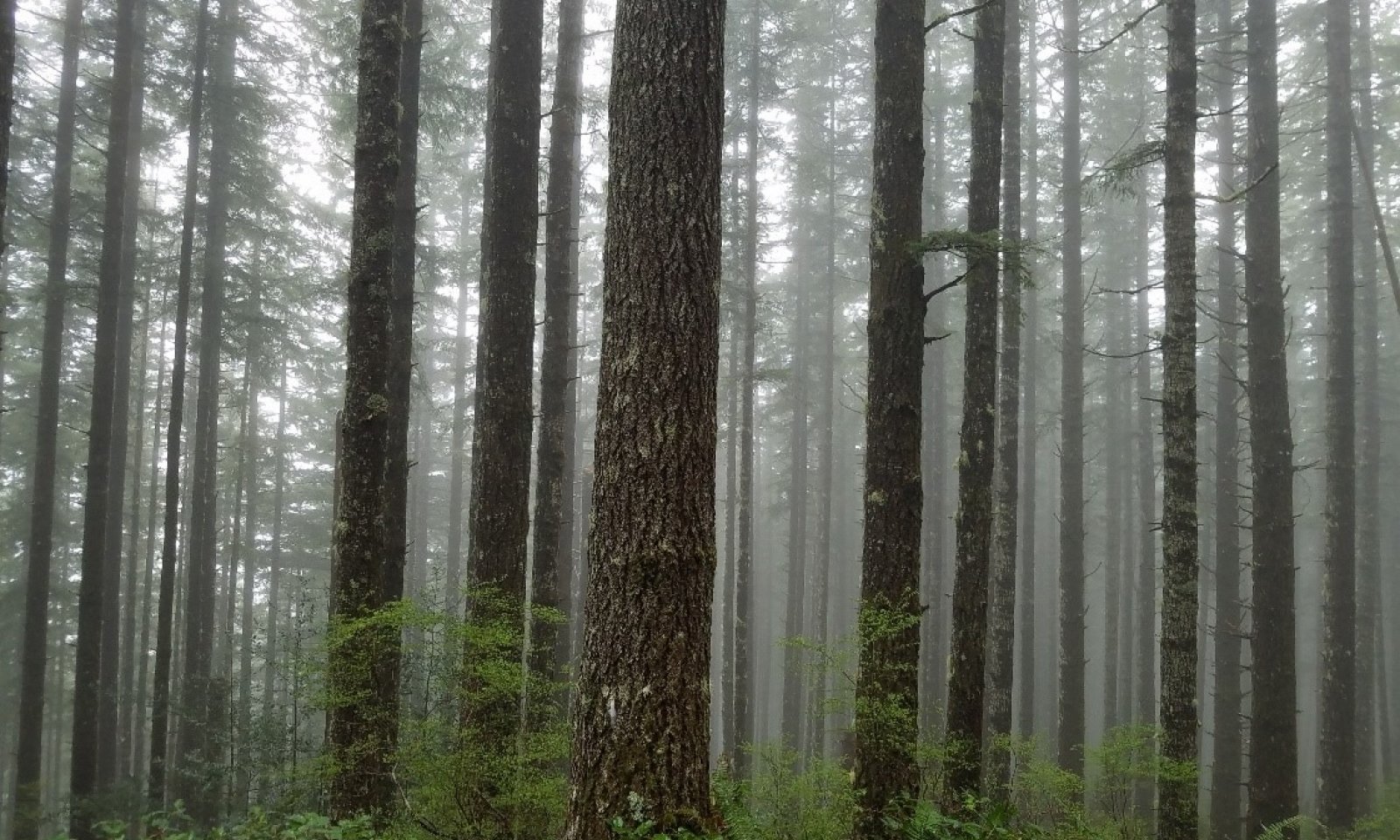
This ecological site is found on the western Coast Range in the Pacific Northwest from central to southern Oregon. This ecological site densely forested and is often lush. Elevations are typically between 50 and 4,000 feet with slopes ranging from 0 to 75 percent.
The most common overstory species are western hemlock (Tsuga heterophylla) and Douglas-fir (Pseudotsuga menziesii). Red alder (Alnus rubra) may be common where there are forest openings. Regeneration of red alder is limited by canopy cover and is commonly in gaps where sunlight is most available. Common understory species include salal (Gaultheria shallon), vine maple (Acer circinatum), oval-leaf huckleberry (Vaccinium ovatum), red huckleberry (Vaccinium parvifolium), Cascade Oregongrape (Mahonia nervosa), western swordfern (Polystichum munitum), and western cordilleran bunchberry (Cornus unalaschkensis).
The most common disturbance on this site is from winthrow of overstory trees, which results in patchy, small pockets of open areas. These areas commonly occur in conjunction with either root-, butt- or stem-rot. Western hemlock is highly susceptible to rot diseases from fungi such as; Armillaria ostoyae, Heterobasidion annosum, Phellinus weirii, and Echinodontium tinctorium which may exacerbate the extent and area of disturbance. The resulting openings in the canopy allow sunlight to reach the forest floor, benefiting the understory. Disturbance by fire is infrequent as a result of the high humidity and precipitation within the western hemlock zone; however, the site has a fire regime between 150-400 years and may experience stand replacing catastrophic wildfires (US Department of Agriculture, 2012).Associated sites
AX001X04X411 Mesic Udic Moist Forest
Mesic Udic Moist Forest is located within the same elevation zone as Mesic Udic Forest, but is restricted to depressions or concave landforms that retain soil moisture for longer periods of time.
AX001X04X413 Mesic Udic Warm Forest
Mesic Udic Warm Forest is typically found within the eastern most extent of the LRU. This site receives slightly less precipitation and the annual temperature is slightly warmer than Mesic Udic Forest. Oceanspray (Holodiscus discolor) is a good indicator species for Mesic Udic Warm Forest.
Table 1. Dominant plant species
Tree (1) Tsuga heterophylla
(2) Pseudotsuga menziesiiShrub (1) Gaultheria shallon
(2) Vaccinium ovalifoliumHerbaceous (1) Polystichum munitum
(2) Cornus unalaschkensisLegacy ID
F001XD410OR
Physiographic features
This ecological site is found at elevations are typically between 50 and 4,000 feet with slopes ranging from 0 to 75 percent.
Table 2. Representative physiographic features
Landforms (1) Mountains > Mountain slope
Flooding frequency None Ponding frequency None Elevation 50 – 4000 ft Slope 0 – 75 % Aspect W, NW, N, NE, E, SE, S, SW Climatic features
The climate has hot, moist summers and warm, wet winters. Mean annual precipitation ranges from 60 to 130 inches and occurs mostly as rain, when snow occurs it does not persist. Average annual temperatures range from 45 to 54 degrees F. The mild temperatures, abundant precipitation, and a long growing season result in highly productive forestlands.
Table 3 Representative climatic features
Frost-free period (characteristic range) 100-180 days Freeze-free period (characteristic range) 200-320 days Precipitation total (characteristic range) 60-130 in Characteristic rangeActual rangeBarLineFigure 1. Monthly precipitation range
Characteristic rangeActual rangeBarLineFigure 2. Monthly minimum temperature range
Characteristic rangeActual rangeBarLineFigure 3. Monthly maximum temperature range
BarLineFigure 4. Monthly average minimum and maximum temperature
Figure 5. Annual precipitation pattern
Figure 6 Annual average temperature pattern
Climate stations used
-
(1) POWERS [USC00356820], Powers, OR
-
(2) LAUREL MTN [USC00354776], Falls City, OR
-
(3) ALSEA FH (FALL CREEK) [USC00350145], Alsea, OR
-
(4) ELKTON 3 SW [USC00352633], Elkton, OR
">Influencing water features
In general, this ecological site is not influenced by wetland or riparian water features but may be found on stream terraces or adjacent to wetland and riparian areas. This site does not experience flooding or ponding.
Soil features
Soils that support this ecological site occur in the mesic soil temperature regime and the udic soil moisture regime. The soil is neither wet nor dry throughout the growing season.
Table 4. Representative soil features
Parent material (1) Colluvium – igneous and sedimentary rock
(2) Residuum – igneous and sedimentary rock
Surface texture (1) Silt loam
(2) Silty clay loam
(3) Loam
(4) Gravelly loam
(5) Very gravelly loam
(6) Gravelly, medial loam
Drainage class Moderately well drained to well drained Depth to restrictive layer 20 – 60 in Surface fragment cover <=3" 0 – 23 % Surface fragment cover >3" 0 – 15 % Clay content
(1-7in)14 – 35 % Subsurface fragment volume <=3"
(1-60in)0 – 56 % Subsurface fragment volume >3"
(1-60in)0 – 26 % Ecological dynamics
State and transition model
Custom diagramStandard diagram
More interactive model formats are also available. View Interactive Models
More interactive model formats are also available. View Interactive Models
Click on state and transition labels to scroll to the respective textEcosystem states
State 1 submodel, plant communities
State 1
ReferenceCommunity 1.1
Western Hemlock, Douglas-fir, Salal, Oval-leaf Huckleberry, Western Swordfern, and Western Cordilleran Bunchberry
Western hemlock – Douglas-fir / salal – oval-leaf huckleberry / western swordfern – western Cordilleran bunchberry
Structure: mosaic of mature overstory and regenerating openings
Western hemlock and Douglas-fir are the most common overstory species in the Reference Community which lacks major disturbance for at least 100 years. Western hemlock is the most shade tolerant species in this forest and regenerates successfully in the understory. Douglas-fir and western redcedar (Thuja plicata) may be codominant in the overstory, but regeneration is limited to gaps in the canopy. Gaps in the mid-canopy and overstory allow sunlight to reach the ground and are where the majority of the understory plants establish. In addition, these gaps provide opportunities for deciduous tree species such as red alder to regenerate throughout this reference community. Common understory shrub species include salal, red huckleberry (Vaccinium parvifolium), oval-leaf huckleberry, vine maple (Acer circinatum), twinflower (Linnaea borealis), Cascade oregongrape (Mahonia nervosa), deerfoot vanillaleaf (Achlys triphylla), deerfern (Blechnum spicant), western swordfern, and western cordilleran bunchberry.Dominant plant species
-
western hemlock (Tsuga heterophylla), tree
-
Douglas-fir (Pseudotsuga menziesii), tree
-
western redcedar (Thuja plicata), tree
-
salal (Gaultheria shallon), shrub
-
oval-leaf blueberry (Vaccinium ovalifolium), shrub
-
red huckleberry (Vaccinium parvifolium), shrub
-
vine maple (Acer circinatum), shrub
-
Cascade barberry (Mahonia nervosa), shrub
-
western swordfern (Polystichum munitum), other herbaceous
-
western cordilleran bunchberry (Cornus unalaschkensis), other herbaceous
-
twinflower (Linnaea borealis), other herbaceous
-
sweet after death (Achlys triphylla), other herbaceous
-
deer fern (Blechnum spicant), other herbaceous
Community 1.2
Red Alder, Douglas-fir, Trailing Blackberry, and Western SwordfernRed alder – Douglas-fir / trailing blackberry / western swordfern
Structure: open forest with abundant regeneration and snags
Community phase 1.2 is an early seral plant community that has been impacted by a stand-replacing disturbance such as a wildfire, large scale wind event, mass movement, or major insect pest or disease. Nearly all trees are absent, but some fire-resistant trees may survive in the overstory. Snags are prevalent and remain standing and decaying. Large woody debris may be present on the surface and serve as nurse sites. The understory is predominately early seral tree, shrub, and forb species such as red alder, red huckleberry, trailing blackberry (Rubus ursinus), and western swordfern. Red alder has several competitive advantages and can establish quickly, relative to conifers. Red alder can sprout and establish in full sunlight and fixes nitrogen providing an early competitive advantage (Villarin, 2009). In addition, the seeds of deciduous species are light and can be transported long distances by wind and water, allowing for rapid recolonization. Red alder seedlings and saplings will typically establish 3 to10 years following disturbance, depending on severity.
Douglas-fir is relatively fire resistant and can survive moderately intense fires, due to its thick corky bark. Depending on fire severity and cambium damage, a mature Douglas-fir component may remain as a dominant overstory species, while western red cedar and western hemlock may be at full stand replacement post fire.
When resulting from a moderate to severe fire event, there is a good probability for shrubs to out-compete tree seedlings. Vine maple, red huckleberry, salal, and Cascade Oregongrape (which may have been only moderately abundant previously) all have the capacity to rapidly recover and spread when top-killed, slowing successful overstory regeneration. Seed sources for tree species would be from the surrounding, undisturbed forest and any of the survivors of the disturbance and would result in a mixed stand which could include Douglas-fir, western hemlock, red alder (Alnus rubra), bigleaf maple (Acer macrophyllum), and western redcedar.Dominant plant species
-
red alder (Alnus rubra), tree
-
Douglas-fir (Pseudotsuga menziesii), tree
-
bigleaf maple (Acer macrophyllum), tree
-
western redcedar (Thuja plicata), tree
-
California blackberry (Rubus ursinus), shrub
-
red huckleberry (Vaccinium parvifolium), shrub
-
vine maple (Acer circinatum), shrub
-
salal (Gaultheria shallon), shrub
-
Cascade barberry (Mahonia nervosa), shrub
-
western swordfern (Polystichum munitum), other herbaceous
Community 1.3
Douglas-fir, Red Alder, Cascade Oregongrape, Salal, and Western SwordfernDouglas-fir – red alder / Cascade Oregongrape – salal / western swordfern
Structure: dense single story
Community phase 1.3 is an early seral forest in regeneration, possibly with scattered remnant mature trees. Species composition depends on the natural seed sources present and the intensity of disturbance. When resulting from a moderate to severe fire event, it is probable that shrubs will out-compete tree seedlings. Red alder, red huckleberry, western swordfern, and Cascade Oregongrape may be abundant in the understory depending on sunlight availability.
Red alder will begin to die between 40 to 70 years following disturbance and allow more light to penetrate the newly nitrogen rich soil (Naiman, 2009). As a result, conifer regeneration becomes more prevalent in this community phase. Douglas-fir will begin to regenerate rapidly and increase in dominance, creating thick patches of regenerating saplings. Species composition depends on the natural seed sources present and the intensity of disturbance.Dominant plant species
-
red alder (Alnus rubra), tree
-
bigleaf maple (Acer macrophyllum), tree
-
western redcedar (Thuja plicata), tree
-
Cascade barberry (Mahonia nervosa), shrub
-
salal (Gaultheria shallon), shrub
-
red huckleberry (Vaccinium parvifolium), shrub
-
western swordfern (Polystichum munitum), other herbaceous
Community 1.4
Douglas-fir, Western Hemlock, Salal, Oval-leaf Huckleberry, Western Swordfern, and Western Cordilleran BunchberryDouglas-fir - western hemlock / salal – oval-leaf huckleberry / western swordfern – western cordilleran bunchberry
Structure: dense single story with diminished understory
Community phase 1.4 is a forest in the competitive exclusion stage, possibly with scattered remnant mature trees. There is increasing competition among individual trees for available water and nutrients. Douglas-fir and western redcedar, will dominate the overstory canopy, however red alder may be present in pockets of canopy openings. In addition, western hemlock is very shade tolerant and will begin to establish in the shade of mature Douglas-fir and western redcedar. Canopy closure is almost 100 percent leading to diminished shrub and forb layers. Some understory species better adapted to at least partial shade will begin to increase. Over time, the forest will begin to self-thin due to the elevated competition.Dominant plant species
-
Douglas-fir (Pseudotsuga menziesii), tree
-
western hemlock (Tsuga heterophylla), tree
-
western redcedar (Thuja plicata), tree
-
salal (Gaultheria shallon), shrub
-
oval-leaf blueberry (Vaccinium ovalifolium), shrub
-
Cascade barberry (Mahonia nervosa), shrub
-
red huckleberry (Vaccinium parvifolium), shrub
-
western swordfern (Polystichum munitum), other herbaceous
-
western cordilleran bunchberry (Cornus unalaschkensis), other herbaceous
-
sweet after death (Achlys triphylla), other herbaceous
Pathway 1.1A
Community 1.1 to 1.2This pathway represents a major stand-replacing disturbance such as a high-intensity fire, large scale wind event, major insect pest infestation, timber management, or large mass movement event leading to the stand initiation phase of forest development.
Pathway 1.2A
Community 1.2 to 1.3This pathway represents growth over time with no further significant disturbance.
Pathway 1.3A
Community 1.3 to 1.2This pathway represents a major stand-replacing disturbance such as a high-intensity fire, large scale wind event, major insect pest or disease infestation, timber management, or large mass movement leading to the stand initiation phase of forest development.
Pathway 1.3B
Community 1.3 to 1.4This pathway represents growth over time with no further major disturbance.
Pathway 1.4B
Community 1.4 to 1.1This pathway represents growth over time with no further major disturbance.
Pathway 1.4A
Community 1.4 to 1.2This pathway represents a major stand-replacing disturbance such as a high-intensity fire, timber management, large scale wind event, major insect pest or disease infestation, or large mass movement leading to the stand initiation phase of forest development.
State 2
DisturbedCommunity 2.1
Red Alder, Himalayan Blackberry, and Common GorseRed alder/Himalayan blackberry-common gorse
Structure: Open forest with regeneration and large woody debris
Community Phase 2.1 represents a recently disturbed forest that is naturally regenerating. Large woody debris is often prolific following large-scale disturbances which inhibits vegetation to establish under natural conditions. Areas that are not replanted immediately (1 to 3 years) following a timber harvest or large-scale disturbance may become vulnerable to invasive species infestation.
Typically, commercially managed forests will be replanted following disturbance and species preference depends on site conditions and long-term economic market decisions. Overall, species biodiversity in forests managed for short rotation timber is diminished.
Natural reforestation depends on available seed sources following disturbance. Early seral species such as red alder tend to regenerate quickly with abundant sunlight. Plant community composition is typically homogenous and even-aged. Following disturbance, these sites are often dominated by common gorse (Ulex europaeus), Himalayan blackberry (Rubus armeniacus), and Scotch broom (Cytisus scoparius) which tend to outcompete native species establishment. Invasive species management is most critical during this phase.Dominant plant species
-
red alder (Alnus rubra), tree
-
Himalayan blackberry (Rubus armeniacus), shrub
-
common gorse (Ulex europaeus), shrub
-
Scotch broom (Cytisus scoparius), shrub
Community 2.2
Douglas-fir, Red Alder, Salal, and Himalayan BlackberryDouglas-fir-red alder/salal-Himalayan blackberry
Structure: Single story
Community phase 2.2 represents an even-aged, regenerating forest. Douglas-fir can regenerate quickly on nurse logs or in recently disturbed soils. Shade-intolerant red alder remains a large component in the overstory until it reaches maturity (Fonda, 1974).
The vegetation in areas that have been replanted commonly is dense and even aged, and the understory species are sparse in areas that have a high percentage of canopy cover. Salal is a common understory species, but invasive species increase in prominence. Scotch broom, common gorse, and Himalayan blackberry can greatly impact the shrubby understory and outcompete native species. Scotch broom and common gorse are shade-intolerant and will diminish as the canopy cover increases. Management techniques such as pre-commercial thinning and mitigation of invasive species will accelerate the maturation and improve the health of the forest.Dominant plant species
-
Douglas-fir (Pseudotsuga menziesii), tree
-
red alder (Alnus rubra), tree
-
salal (Gaultheria shallon), shrub
-
Himalayan blackberry (Rubus armeniacus), shrub
-
Scotch broom (Cytisus scoparius), shrub
-
common gorse (Ulex europaeus), shrub
Community 2.3
Douglas-fir, Western Hemlock, Salal, and Himalayan BlackberryDouglas-fir-western hemlock/salal-Himalayan blackberry
Structure: Dense single story with diminished understory
Community phase 2.3 represents a maturing forest that has increased plant diversity. Western hemlock can regenerate under dense, shrubby canopies. It will begin to establish in the overstory canopy along with Douglas-fir. Invasive species will inhibit the overall health and structure of the forest, creating an ecosystem which is susceptible to devastation from insects and disease. The dense, shrubby understory is susceptible to wildfires.
Commercial logging operations commonly take place during this phase as trees reach economical maturity in size and volume. It is presumed that without timber management during this phase, an old-growth western hemlock stand will develop.Dominant plant species
-
Douglas-fir (Pseudotsuga menziesii), tree
-
western hemlock (Tsuga heterophylla), tree
-
salal (Gaultheria shallon), shrub
-
Himalayan blackberry (Rubus armeniacus), shrub
Pathway 2.1A
Community 2.1 to 2.2This pathway represents growth over time with no further major disturbance or active forest management.
Pathway 2.2B
Community 2.2 to 2.1This pathway represents a major stand-replacing disturbance such as a high-intensity fire, a large-scale wind event, a major insect or disease infestation, large mass movement, or timber harvest activities that lead to the stand initiation phase of forest development.
Pathway 2.2A
Community 2.2 to 2.3This pathway represents growth over time with no further major disturbance or active forest management.
Pathway 2.3A
Community 2.3 to 2.1This pathway represents a major stand-replacing disturbance such as a high-intensity fire, a large-scale wind event, a major insect or disease infestation, large mass movement, or timber harvest activities that lead to the stand initiation phase of forest development.
Transition T1A
State 1 to 2This pathway represents an area of major disturbance that removes most of the overstory. Large-scale disturbances such as this, have the potential to increase the vulnerability of invasive species infestation when the seed source is either nearby or introduced to the site. This type of disturbance will impact the ecological site and the natural feedbacks that maintained the reference state.
Transition T2A
State 2 to 1This pathway represents intensive management to restore the historic plant community.
Additional community tables
Table 5. Community 1.1 plant community composition
Group Common name Symbol Scientific name Annual production () Foliar cover (%) Table 6. Community 1.2 plant community composition
Group Common name Symbol Scientific name Annual production () Foliar cover (%) Table 7. Community 1.3 plant community composition
Group Common name Symbol Scientific name Annual production () Foliar cover (%) Table 8. Community 1.4 plant community composition
Group Common name Symbol Scientific name Annual production () Foliar cover (%) Table 9. Community 2.1 plant community composition
Group Common name Symbol Scientific name Annual production () Foliar cover (%) Table 10. Community 2.2 plant community composition
Group Common name Symbol Scientific name Annual production () Foliar cover (%) Table 11. Community 2.3 plant community composition
Group Common name Symbol Scientific name Annual production () Foliar cover (%) Interpretations
Supporting information
Inventory data references
Other Established Classifications for Ecological Site National Vegetation Classification: A3378 Tsuga heterophylla – Pseudotsuga menziesii / Cornus unalaschkensis Mesic Forest Alliance USDA Forest Service Plant Associations of Southwestern Oregon: western hemlock / salal / western swordfern USDA Forest Service Plant Association and Management Guide of the Northern Oregon Coast Range: western hemlock/salal Northwest Oregon Coast
Other references
Atzet, T., White, D., McCrimmon, L., Martinez, P., Fong, P., Randall, V. Field Guide to the Forested Plant Associations of Southwestern Oregon. United States Department of Agriculture Forest Service, Pacific Northwest Region. Technical Paper R6-NR-ECOL-TP-17-96
Baily, A., Poulton, C. 1967. Plant Communities and Environmental Interrelationships in a Portion of the Tillamook Burn, Northwestern Oregon. Ecology, 55(1): 1-13. Franklin, J.F., and Dyrness C.T. 1973. Natural Vegetation of Oregon and Washington. Oregon State University press, Corvallis, USA.
Goheen, E.M. and Willhite, E.A. 2006. Field Guide to Common Diseases and Inspect Pests of Oregon and Washington Conifers. Portland, Oregon: USDA Forest Service, Pacific Northwest Region R6-NR-FID-PR-01-06.
Hemstrom, M., Logan, S. 1986. Plant Association and Management Guide: Siuslaw National Forest. United States Department of Agriculture Forest Service, Pacific Northwest Region. Technical Paper R6-Ecol 220-1986a
McCain, C., Diaz, N. 2002. Field Guide to the Forested Plant Associations of the Northern Oregon Coast Range. United States Department of Agriculture Forest Service, Pacific Northwest Region. Technical Paper R6-NR-Ecol-TP-03-02
Pojar J., and MacKinnon. 1994. Plants of the Pacific Northwest Coast. Lone Pine, Vancouver, British Columbia. 528 pages.
PRISM Climate Group, Oregon State University, http://prism.orgeonstate.edu, visited Feb., 2015.
Soil Survey Staff. 2014. Keys to Soil Taxonomy, 12th ed. USDA-Natural Resources Conservation Service, Washington, DC.
Soil Survey Staff. 1999. Soil Taxonomy: A Basic System of Soil classification for Making and Interpreting Soil Surveys. 2nd ed. USDA-Natural Resources Conservation Service. U.S. Department of Agriculture Handbook 436.
U.S. Department of Agriculture, Forest Service, Missoula Fire Sciences Laboratory. 2012. Information from LANDFIRE on fire regimes of wet-mesic western hemlock communities. In: Fire Effects Information System, [Online]. U.S. Department of Agriculture, Forest Service, Rocky Mountain Research Station, Missoula Fire Sciences Laboratory (Producer). Available: www.fs.fed.us/database/feis/fire_regimes/Western_hemlock_wet/all.html [ 2019, October 17].
United States National Vegetation Classification. 2016. United States National Vegetation Classification Database, V2.0. Federal Geographic Data Committee, Vegetation Subcommittee, Washington DC. (accessed 28, November, 2016.)
Utychil, R. 1990.Chamaecyparis lawsoniana. Silvics of North America. [Online]. U.S. Department of Agriculture, Forest Service, Northeastern Area.
Wshington Department of Natural Resources, Natural Heritage Program. 2015. Ecological Systems of Washington State. A Guide to Identification.Contributors
Erin Kreutz
Erik Dahlke
David Rand
Carri GainesApproval
Kirt Walstad, 1/23/2025
Rangeland health reference sheet
Interpreting Indicators of Rangeland Health is a qualitative assessment protocol used to determine ecosystem condition based on benchmark characteristics described in the Reference Sheet. A suite of 17 (or more) indicators are typically considered in an assessment. The ecological site(s) representative of an assessment location must be known prior to applying the protocol and must be verified based on soils and climate. Current plant community cannot be used to identify the ecological site.
Author(s)/participant(s) Contact for lead author Date 12/20/2021 Approved by Approval date Composition (Indicators 10 and 12) based on Annual Production Indicators
-
Number and extent of rills:
-
Presence of water flow patterns:
-
Number and height of erosional pedestals or terracettes:
-
Bare ground from Ecological Site Description or other studies (rock, litter, lichen, moss, plant canopy are not bare ground):
-
Number of gullies and erosion associated with gullies:
-
Extent of wind scoured, blowouts and/or depositional areas:
-
Amount of litter movement (describe size and distance expected to travel):
-
Soil surface (top few mm) resistance to erosion (stability values are averages - most sites will show a range of values):
-
Soil surface structure and SOM content (include type of structure and A-horizon color and thickness):
-
Effect of community phase composition (relative proportion of different functional groups) and spatial distribution on infiltration and runoff:
-
Presence and thickness of compaction layer (usually none; describe soil profile features which may be mistaken for compaction on this site):
-
Functional/Structural Groups (list in order of descending dominance by above-ground annual-production or live foliar cover using symbols: >>, >, = to indicate much greater than, greater than, and equal to):
Dominant:
Sub-dominant:
Other:
Additional:
-
Amount of plant mortality and decadence (include which functional groups are expected to show mortality or decadence):
-
Average percent litter cover (%) and depth ( in):
-
Expected annual annual-production (this is TOTAL above-ground annual-production, not just forage annual-production):
-
Potential invasive (including noxious) species (native and non-native). List species which BOTH characterize degraded states and have the potential to become a dominant or co-dominant species on the ecological site if their future establishment and growth is not actively controlled by management interventions. Species that become dominant for only one to several years (e.g., short-term response to drought or wildfire) are not invasive plants. Note that unlike other indicators, we are describing what is NOT expected in the reference state for the ecological site:
-
Perennial plant reproductive capability:
Print Options
Sections
Font
AAAAOther
PrintThe Ecosystem Dynamics Interpretive Tool is an information system framework developed by the USDA-ARS Jornada Experimental Range, USDA Natural Resources Conservation Service, and New Mexico State University.
Accessibility statement


